Gymnema (Gymnema sylvestre)
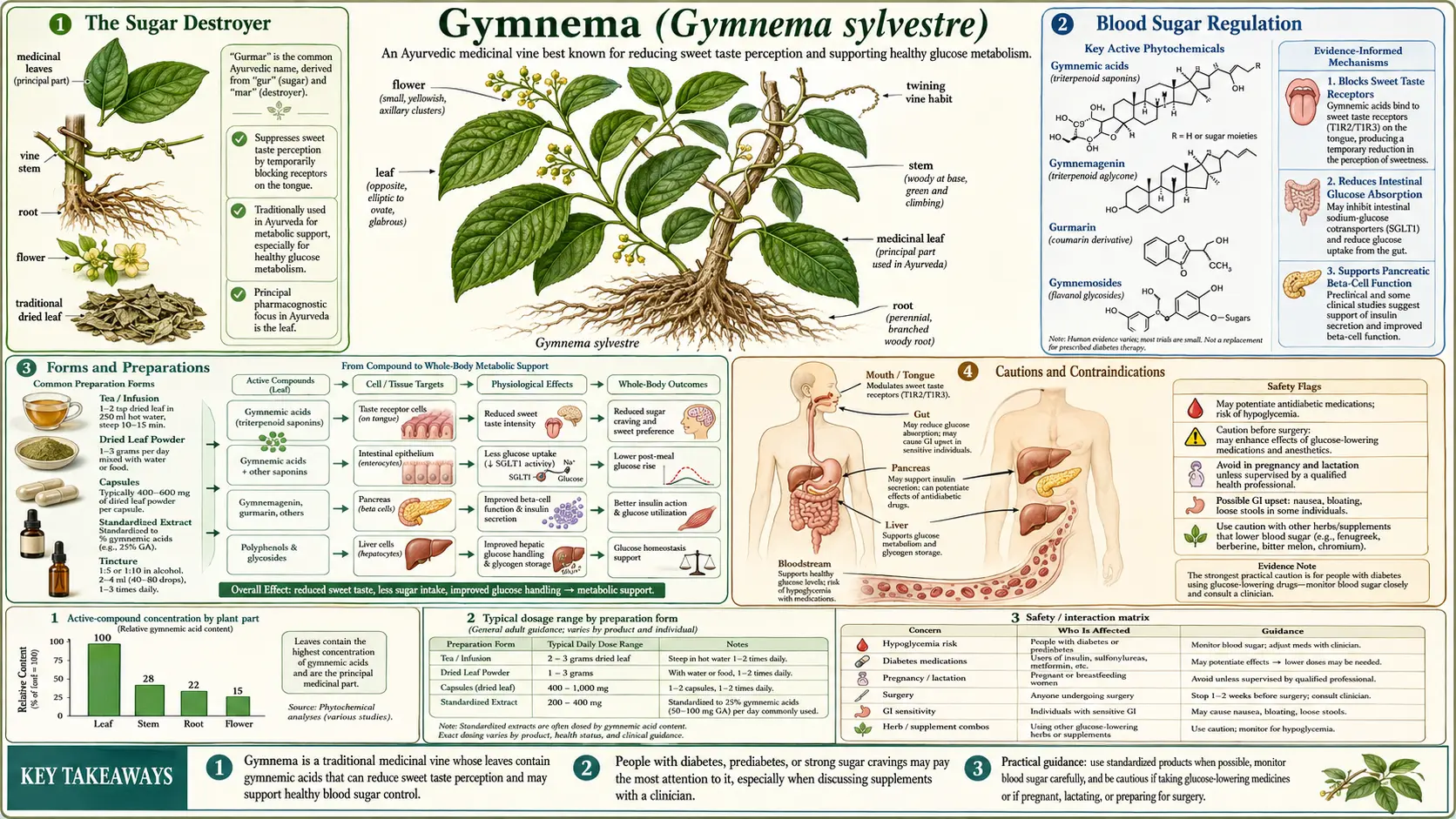
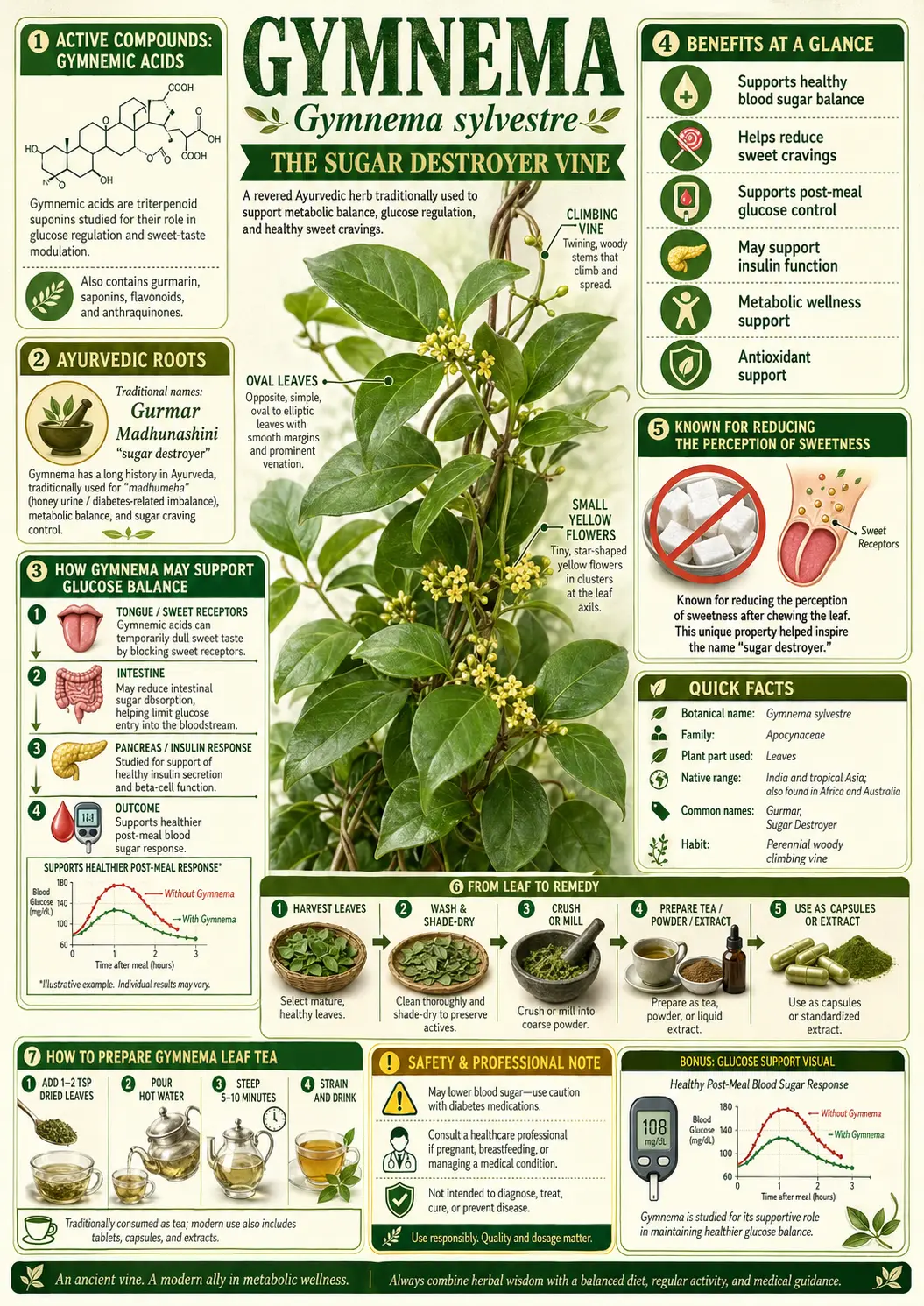
Table of Contents
- The Sugar Destroyer
- Gymnemic Acids
- Blood Sugar Regulation
- Sugar Cravings and Weight Management
- Lipid Metabolism
- Forms and Preparations
- Recommended Dosage
- Cautions and Contraindications
- Conditions It Is Used For
- Featured Videos
The Sugar Destroyer
Gymnema is a woody climbing vine native to the tropical forests of India, Sri Lanka, and parts of Africa. Its Hindi name gurmar — literally "sugar destroyer" — captures the two effects that made it famous: chewing the leaves temporarily switches off the taste of sweetness, and Ayurvedic physicians have long used it for madhumeha ("honey urine"), the sweet-urine disease we now call diabetes. A British officer first reported the vanishing-sweetness effect to Western science in 1847, and modern work has since identified the active gymnemic acids behind it. — the fuller story is told in the dedicated History & Traditional Use article.
Gymnemic Acids
The active compounds are a family of triterpene saponins called gymnemic acids, of which more than two dozen variants have been identified. They share a structural similarity to glucose, which underlies their two best-characterized actions:
- Sweet taste suppression — gymnemic acids bind to the sweet taste receptors (T1R2/T1R3) on the tongue, blocking the perception of sweetness for approximately 30-90 minutes after exposure
- Inhibition of intestinal sugar absorption — gymnemic acids competitively inhibit the absorption of glucose in the small intestine, reducing the postprandial glucose spike
- Beta-cell support — in animal and limited human studies, gymnema appears to support the function and possibly the regeneration of insulin-producing beta cells in the pancreas
- Reduced hepatic gluconeogenesis — preliminary evidence suggests inhibition of glucose-6-phosphatase, the rate-limiting enzyme in liver glucose production
The most-studied standardized extract, GS4, is calibrated to contain at least 25% gymnemic acids and is the form used in the majority of clinical trials.
Blood Sugar Regulation
Clinical evidence for gymnema in type 2 diabetes is substantial. In a landmark study, patients with type 2 diabetes taking 400 mg of GS4 daily in addition to oral hypoglycemic medication for 18-20 months experienced significant reductions in fasting glucose and HbA1c, and many were able to reduce or discontinue their conventional medications. Subsequent trials have confirmed glucose-lowering effects, with typical HbA1c reductions of 0.5-1.0 percentage points over three to twelve months of treatment.
In type 1 diabetes, a smaller body of evidence suggests that gymnema may support endogenous insulin production and reduce insulin requirements. This is one of the few herbs with case-series evidence in type 1 diabetes, though it should never replace insulin therapy and must be used only under endocrinology supervision.
Sugar Cravings and Weight Management
The temporary suppression of sweet taste perception has practical applications for behavioral change. Chewing a gymnema leaf or taking a gymnema lozenge before a sweet temptation makes the food taste flat and unappealing, which can disrupt habitual sugar consumption patterns. This is one of the few herbal interventions with a sensory mechanism that directly supports behavioral modification.
Beyond taste, the metabolic effects of gymnema — improved insulin sensitivity, reduced postprandial glucose spikes, and modulation of appetite-regulating hormones — can support weight management efforts. Gymnema fits well into broader weight loss protocols emphasizing whole foods, protein adequacy, and reduced refined carbohydrate intake.
Lipid Metabolism
Gymnema has demonstrated modest beneficial effects on lipid profile in clinical trials, with reductions in total cholesterol, LDL, and triglycerides, and small increases in HDL. These effects are smaller than those of berberine but contribute to overall cardiovascular benefit when gymnema is used long-term for diabetes management.
Forms and Preparations
- Standardized GS4 extract — 25% gymnemic acids; the most clinically validated form
- Whole leaf powder — 4-12 g daily of dried leaf, in capsules or as a tea
- Tinctures — 1:5 alcohol extracts; less commonly used
- Tea — dried leaves brewed for 10 minutes; pleasantly mild, slightly bitter flavor
- Chewable leaves or lozenges — for the sweet-taste-blocking effect; chew briefly to release gymnemic acids onto the tongue, then swallow or spit out
Recommended Dosage
- Standardized GS4 extract — 200-400 mg twice daily; total 400-800 mg/day for blood sugar management
- Whole leaf powder — 4-12 g daily, divided in two or three doses
- For sugar cravings — 400 mg of standardized extract before meals or before exposure to sweets, OR a chewable leaf 1-2 minutes before
- Onset — glucose-lowering effects develop over four to twelve weeks of consistent use
- Combination therapy — often combined with berberine, cinnamon, alpha-lipoic acid, and chromium for synergistic glycemic support
Cautions and Contraindications
- Hypoglycemia risk — when combined with insulin, sulfonylureas, or other glucose-lowering drugs, can cause low blood sugar; monitor glucose frequently and adjust medications with the prescribing physician
- Pregnancy and breastfeeding — limited safety data; avoid
- Children — limited safety data; do not use in young children
- Type 1 diabetes — never replace insulin therapy with gymnema; if used as an adjunct, only under endocrinology supervision
- Surgery — discontinue at least one week before scheduled surgery due to glucose-lowering effects
- Mild side effects — nausea, mild GI upset, headache; usually dose-related
Research Papers and References
The following PubMed search links provide curated entry points into the published clinical and mechanistic literature on Gymnema (Gymnema sylvestre). Each link opens directly in PubMed at the National Library of Medicine.
- Gymnema sylvestre for type 2 diabetes — PubMed: Gymnema sylvestre diabetes
- Gymnemic acids and sweet taste suppression — PubMed: gymnemic acid sweet taste
- Gymnema and beta-cell regeneration — PubMed: Gymnema beta cell
- Gymnema and lipid profile — PubMed: Gymnema cholesterol lipid
- Gymnema and weight loss / sugar craving — PubMed: Gymnema weight loss craving
- Gymnema standardized extract GS4 — PubMed: Gymnema GS4
- Gymnema safety review — PubMed: Gymnema safety
External Authoritative Resources
- NCCIH — Herbs at a Glance
- MedlinePlus — Herbs and Supplements
- PubMed — All research on Gymnema sylvestre
Conditions Gymnema Is Used For
Each condition below links to its page. The coloured half of every capsule shows how much human evidence supports this herb for that specific use — traditional use is history, not proof, and is marked as such.
Connections
- All Herbs
- Gymnema Benefits Deep Dive
- Berberine
- Cinnamon
- Fasting Insulin
- Bitter Melon
- Hemoglobin A1C
- Fenugreek
- Diabetes
- Blood Sugar Control
- Type 2 Diabetes
- Berberine Remedy
- Obesity
- Insulin Resistance
- Chromium
- Fasting
- Lipid Panel
- Chanca Piedra for Blood Sugar