Crape Jasmine (Tabernaemontana divaricata)
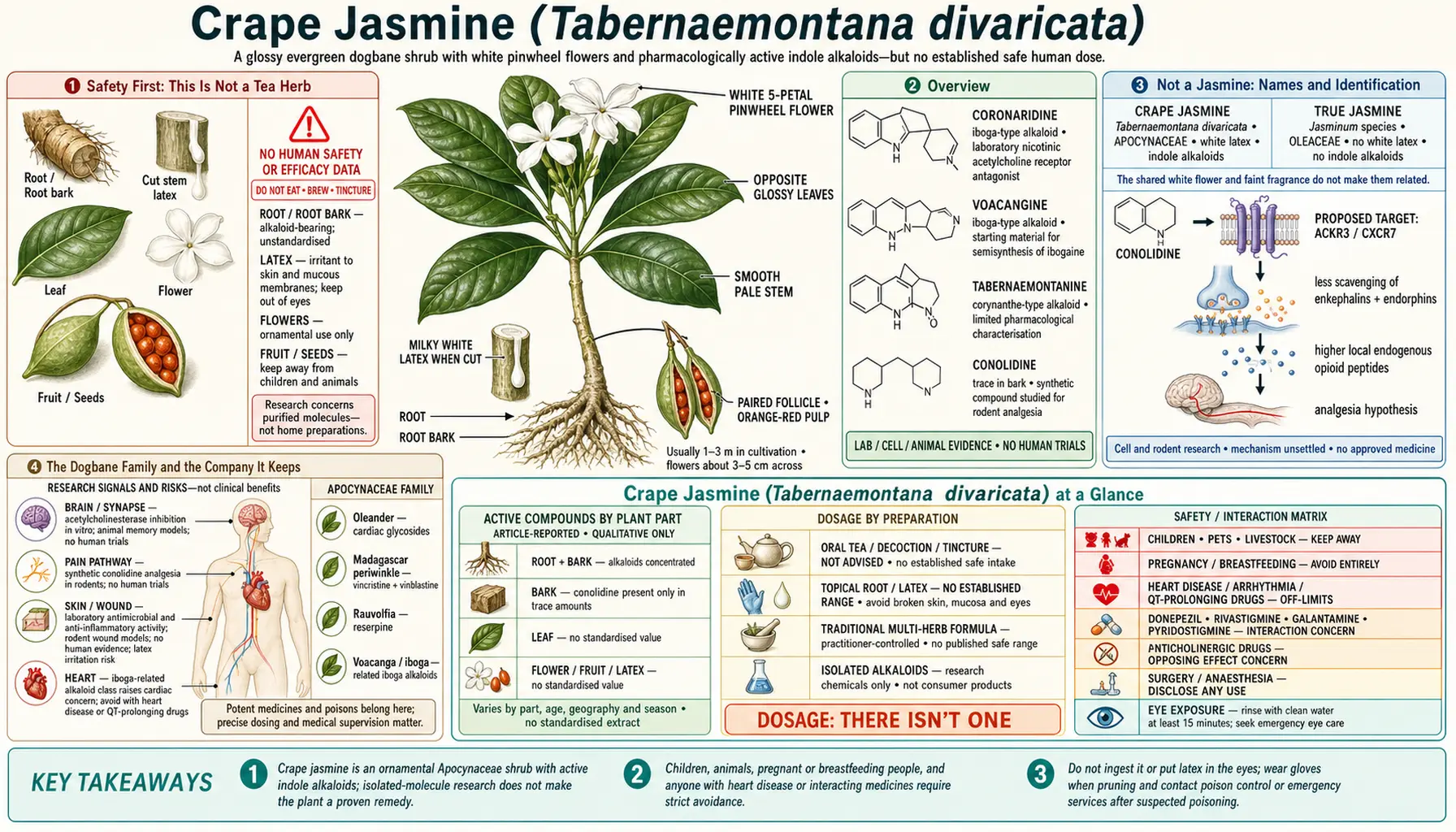
Crape jasmine is not a jasmine, and this page leads with safety rather than benefits. Tabernaemontana divaricata is a glossy evergreen shrub with pinwheel-shaped white flowers, planted in gardens and temple grounds from India through mainland Southeast Asia. Its name comes from the flowers' faint jasmine-like scent, but botanically it belongs to Apocynaceae — the dogbane family, alongside oleander, yellow oleander, Madagascar periwinkle and Rauvolfia. Break a stem and it bleeds milky white latex. That family membership and that latex are the two things a reader should take away first.
The plant is a genuine and serious source of indole alkaloids — coronaridine, voacangine, tabernaemontanine, conolidine — and it has drawn real pharmacological interest, particularly around conolidine as a scaffold for a non-opioid painkiller. That interest is a laboratory story about isolated molecules, not a reason to use the plant. There is essentially no human safety or efficacy data for Tabernaemontana divaricata in any form. Ingestion is not advised. This page deliberately does not give a dose, because giving one would imply a safe dose is known, and it is not.
Table of Contents
- Safety First: This Is Not a Tea Herb
- Overview
- Not a Jasmine: Names and Identification
- The Dogbane Family and the Company It Keeps
- Traditional Use
- Active Compounds: A Serious Alkaloid Source
- Conolidine and the Non-Opioid Painkiller Story
- Voacangine, Ibogaine, and Why That Matters
- Acetylcholinesterase Inhibition and Memory Research
- Traditional Topical Uses: Skin, Eyes and Wounds
- Forms and Preparations
- Dosage: There Isn't One
- Cautions and Contraindications
- Key Research Papers
- Connections
- Featured Videos
Safety First: This Is Not a Tea Herb
Most plants in a herb library are things people drink, eat or rub on themselves in reasonable quantities with a long record of tolerability. Crape jasmine is not one of them, and it is important to say so before describing anything else.
- It is an alkaloid plant in a dangerous family. Apocynaceae species concentrate potent, physiologically active compounds — that is why the family has given medicine reserpine, vincristine, vinblastine and ouabain, and why it has also given the world several of its most reliable plant poisons. Crape jasmine's own chemistry is indole alkaloids rather than the heart-stopping cardiac glycosides of oleander, but "different toxin class" is not "harmless".
- It bleeds white latex. Milky sap in a plant is an old and good warning sign. The latex is irritating to skin and mucous membranes and has no business anywhere near an eye.
- Nobody has established a safe human dose, because nobody has looked. There is no clinical trial, no human pharmacokinetic study, no toxicology dataset in people. The near-absence of published poisoning reports is not reassurance — it mostly reflects that the plant is grown as an ornamental and not routinely swallowed.
- The interesting research is about purified molecules, not the plant. Conolidine's analgesic story is about a synthesised compound given at controlled doses to mice. A root decoction is a variable mixture of many alkaloids at unknown concentrations, which is a completely different proposition.
The practical position of this page: enjoy the shrub in a garden. Do not eat it, brew it, tincture it, or give it to a child or an animal. If you are drawn here by the non-opioid painkiller headlines, the honest answer is that the research is at the molecule stage and the plant itself is not a route to it.
Overview
Tabernaemontana divaricata is an evergreen shrub or small tree, usually one to three metres tall in cultivation, with dark glossy leaves arranged in opposite pairs and smooth pale bark. The flowers are its selling point: waxy and white, about 3–5 cm across, with five petals that overlap in a distinctive pinwheel or propeller twist. A widely grown double-flowered cultivar produces ruffled, gardenia-like blooms — the "crape" of the English name refers to that crimped, crepe-paper texture. The scent is light and strongest at night.
The species is native to South and Southeast Asia and is now planted throughout the tropics as a hardy, long-flowering ornamental hedge and specimen shrub. It is common in Indian, Thai, Vietnamese, Cambodian, Malaysian, Indonesian and southern Chinese gardens, and especially common around temples, where the flowers are picked for offerings and garlands.
Every part of the plant exudes white latex when cut. The fruit is a paired follicle that splits open to reveal seeds in an orange-red pulp — conspicuous, and exactly the sort of thing a small child might put in their mouth, which is worth knowing if you have this shrub in a garden.
Not a Jasmine: Names and Identification
Botanical name: Tabernaemontana divaricata (L.) R.Br. ex Roem. & Schult.
Synonyms in the literature: Ervatamia divaricata, Ervatamia coronaria, Tabernaemontana coronaria. Older and regional papers commonly use the Ervatamia names, so a search on Tabernaemontana alone will miss part of the literature.
Family: Apocynaceae — the dogbane family.
True jasmines are species of Jasminum, in the olive family (Oleaceae). Jasminum sambac (Arabian jasmine, sampaguita, hoa nhài, melati) and Jasminum officinale are the plants used for jasmine tea, jasmine absolute and garlands. They are unrelated to crape jasmine, do not contain indole alkaloids, and do not bleed white latex. The only thing crape jasmine shares with them is a superficially similar white flower and a faint fragrance, which is how it collected the name.
The confusion is not merely academic. "Jasmine" reads to most people as a food-safe, tea-safe flower. Crape jasmine is not, and the borrowed name does real harm here.
Regional names:
- English: crape jasmine, crepe jasmine, pinwheel flower, East Indian rosebay, Nero's crown, coffee rose, moonbeam
- Hindi: chandni ("moonlight"); also called tagar in some regions — see the warning below
- Vietnamese: ngọc bút, hoa lài tây ("western jasmine")
- Malay / Indonesian: bunga susun kelapa; kembang mentega (Indonesian)
- Thai: phut, phut chip
- Chinese: gou ya hua (狗牙花, "dog-tooth flower")
- Sanskrit: nandivriksha, tagara (in some usages)
A second name trap: "tagar"
In Ayurvedic practice, tagar normally means Indian valerian — Valeriana jatamansi (also written Valeriana wallichii) — a sedative root with an entirely different profile. Tabernaemontana divaricata is also called tagar in parts of India, and its roots have been reported as a market substitute or adulterant for valerian tagar. If you buy "tagar" as a calming herb and receive dried Tabernaemontana root, you have bought an alkaloid-bearing Apocynaceae root instead of a valerian. Insist on the binomial.
The Dogbane Family and the Company It Keeps
Apocynaceae is one of the most pharmacologically loaded plant families on Earth. Knowing its members explains why caution is the right default for any plant in it:
- Nerium oleander (oleander) — cardiac glycosides; one of the most common serious plant poisonings worldwide. A few leaves can kill a child.
- Cascabela thevetia (yellow oleander) — the seeds are a leading cause of fatal plant poisoning in parts of South Asia.
- Cerbera odollam (pong-pong, the "suicide tree") — a Southeast Asian tree whose seed kernels are lethal.
- Catharanthus roseus (Madagascar periwinkle) — the source of vincristine and vinblastine, chemotherapy drugs that transformed childhood leukaemia survival, and which are also profoundly toxic. The same plant sold in garden centres.
- Rauvolfia serpentina (Indian snakeroot) — the source of reserpine, one of the first effective antihypertensive drugs, later largely abandoned because of depression as a side effect.
- Strophanthus and Acokanthera — African arrow-poison plants; ouabain came from them.
- Voacanga africana and Tabernanthe iboga — the iboga alkaloid plants, chemically the closest relatives of crape jasmine's own compounds.
The pattern is consistent: this family builds molecules that act hard on the nervous system and the heart. Some became essential medicines under precise dosing and medical supervision. Others kill. Almost none of them are safe to prepare at home. Crape jasmine belongs to this family, and although it is not known to carry oleander-type cardiac glycosides, it inherits the family's basic message — these are not gentle plants.
Traditional Use
Traditional use is history. It records what people did, not what worked.
Across South and Southeast Asia the recorded uses of crape jasmine are mostly external, mostly involving the root and the latex, and mostly aimed at skin, eyes, teeth and wounds:
- India (Ayurveda and folk practice). Root paste applied for skin diseases and to wounds; root chewed or applied for toothache; the latex applied to the eyes for various eye complaints; the root also used as an anthelmintic in some regional practice. The flowers are used in worship and garlands.
- Thailand. Root preparations appear in traditional formulations, including some categorised as rejuvenating or neurotonic remedies — the category that later attracted screening for acetylcholinesterase inhibition.
- Vietnam, Cambodia, Laos. Ornamental and temple use predominates; folk use of the root and latex for skin complaints and wounds is recorded.
- Malaysia and Indonesia. The plant is grown for its flowers; the root and latex have minor folk use for skin conditions and as a poultice.
Two features of this record deserve attention. First, unlike most herbs in this library, crape jasmine has no meaningful food or beverage tradition anywhere — no tea, no soup, no seasonal vegetable use. Populations that grew it for centuries did not drink it. Second, the eye application described in the older ethnobotanical record is one of the few traditional uses this site will flag as actively unsafe rather than merely unproven. Putting a caustic plant latex on a cornea can cause chemical keratitis and permanent scarring.
Active Compounds: A Serious Alkaloid Source
The genus Tabernaemontana is one of the richest known sources of monoterpene indole alkaloids — the same structural family that produces strychnine, quinine, vincristine, reserpine and ibogaine. Several hundred distinct alkaloids have been described across the genus, and T. divaricata alone contains dozens, concentrated in the root and bark. The ones named most often:
- Coronaridine — an iboga-type alkaloid. Studied in the laboratory as an antagonist at nicotinic acetylcholine receptors, and screened for antitumour activity in cell lines. It is pharmacologically active, which is the point: this is a compound that does things to receptors.
- Voacangine — another iboga-type alkaloid, and the one with the most consequential chemistry attached to it (see below). It is a standard starting material for the semisynthesis of ibogaine.
- Tabernaemontanine — a corynanthe-type alkaloid named after the genus; one of the principal alkaloids of the plant, with limited pharmacological characterisation.
- Conolidine — present only in trace amounts in the bark, and the compound that pulled this obscure ornamental into mainstream pharmacology journals.
Also reported: voacristine, dregamine, apparicine, ervatamine and related alkaloids, plus the usual plant background of flavonoids, phenolics and triterpenes that produce unremarkable antioxidant assay results.
The concentration problem. Alkaloid content in the genus varies enormously by part, plant age, geography and season. A root harvested from one shrub may contain several times the alkaloid load of another. There is no standardised extract, no marker compound assay in commercial use, and no way for a consumer to know what is in a preparation. That variability is exactly what makes home preparation of an alkaloid plant a bad idea, and it is why traditional systems that used potent plants safely did so through trained practitioners who controlled sourcing.
Conolidine and the Non-Opioid Painkiller Story
This is the reason most people arrive at this plant, so it deserves an accurate account.
What happened. Conolidine is a structurally unusual alkaloid found in only trace quantities in Tabernaemontana divaricata bark — so little that it could not be studied by extraction. In 2011, chemists led by Glenn Micalizio, working with the pharmacology group of Laura Bohn, published a concise total synthesis of conolidine in Nature Chemistry and were then able to test it. In rodent models of tonic and persistent pain, synthetic conolidine produced meaningful analgesia. Critically, it did not appear to act through the classical opioid receptors — mu, delta or kappa — which is what made it interesting. Opioid analgesia comes bundled with tolerance, dependence, constipation and respiratory depression; a potent analgesic that works by another route is one of the most sought-after goals in pain pharmacology.
What happened next. For a decade the mechanism was unknown, which is an uncomfortable position for a drug candidate. More recent work has proposed that conolidine and related compounds act at ACKR3/CXCR7, an atypical chemokine receptor that appears to function as a scavenger for the body's own opioid peptides — the idea being that blocking the scavenger raises local levels of natural enkephalins and endorphins rather than flooding opioid receptors with a drug. That is an elegant hypothesis and an active research area. It is also not settled science, and it has not produced an approved medicine.
Level of evidence: cell culture and rodent. There are no human trials of conolidine.
What this does not mean. It does not mean crape jasmine relieves pain. Three separate gaps sit between the headline and the shrub:
- Quantity. Conolidine is present in trace amounts. The research exists because there was too little in the plant to work with — the compound had to be synthesised. You cannot get a pharmacological dose of conolidine from a plant preparation.
- Everything else in the plant. A root or bark preparation delivers dozens of other alkaloids, most uncharacterised, at unknown doses. Whatever a decoction does, it is not "taking conolidine".
- Rodent to human. The overwhelming majority of analgesics that work in rodent pain models fail in people. This is one of the best-documented translation failures in pharmacology.
Conolidine is a genuinely interesting molecule and a legitimate scientific story. It is not a reason to consume the plant it was named after.
Voacangine, Ibogaine, and Why That Matters
Voacangine is an iboga-type alkaloid found in Tabernaemontana species and, in commercially useful quantity, in the West African tree Voacanga africana. Chemically it sits one short step from ibogaine, and it is the usual starting material for making ibogaine semisynthetically.
Why this belongs in a safety section. Ibogaine is a psychoactive alkaloid used in unregulated clinics as an opioid-withdrawal interruption treatment. It also has a documented pattern of serious cardiac toxicity: it prolongs the QT interval and has been associated with life-threatening ventricular arrhythmias and with deaths in and around treatment settings. It is a controlled substance in the United States and several other countries.
Crape jasmine is not ibogaine, does not contain ibogaine in any meaningful sense, and is not a psychoactive drug. The relevant point is narrower and still important: this plant makes alkaloids from a class known to carry cardiac and neurological risk. When people discover that an ornamental garden shrub contains iboga-family alkaloids, a predictable next thought is to see what happens if they take it. The answer is that nobody knows, that the alkaloid profile of any given plant is uncharacterised, and that the closest well-studied relatives of these compounds are cardiotoxic. That is a bad basis for an experiment on yourself.
Acetylcholinesterase Inhibition and Memory Research
Mechanism. Acetylcholinesterase is the enzyme that clears acetylcholine from the synapse. Inhibiting it raises acetylcholine levels, which is the mechanism of donepezil, rivastigmine and galantamine — the modest-benefit drugs used in Alzheimer's disease. Screening plants for this activity is a standard approach to finding new candidates.
The finding. Thai research screening plants used in traditional rejuvenating and neurotonic formulations identified Tabernaemontana divaricata as an active acetylcholinesterase inhibitor in vitro, and later work followed up on root extracts and on individual alkaloids from the genus. Some rodent memory-model work has also been published.
Level of evidence: in vitro and animal. There are no human trials.
How to read it. Enzyme inhibition in a cuvette is a screening hit, not a treatment. Many plant alkaloids inhibit acetylcholinesterase — that is a general property of the chemical class, not a special virtue of this species. And the mechanism cuts both ways: strong acetylcholinesterase inhibition is also how organophosphate insecticides and nerve agents poison people. An uncontrolled dose of a cholinesterase-inhibiting plant is not a nootropic; excess cholinergic activity causes salivation, vomiting, diarrhoea, slowed heart rate, constricted pupils, bronchial secretions and, at the extreme, respiratory failure. This is a further reason not to swallow the plant.
If you are looking for something to do about memory concerns, the honest answer is that blood pressure control, hearing correction, sleep, exercise and treating depression have far better evidence than any herb, and that a diagnostic assessment matters more than a supplement.
Traditional Topical Uses: Skin, Eyes and Wounds
The traditional record for crape jasmine is dominated by external applications. Here is what can be said about each honestly.
- Skin complaints. Root paste applied to rashes, eruptions and itching. Extracts show antimicrobial and anti-inflammatory activity in laboratory assays — as do most alkaloid- and phenolic-rich plant extracts. No human evidence. Applying a latex-bearing Apocynaceae root paste to inflamed skin carries a real risk of contact dermatitis on top of whatever you started with.
- Wounds. Traditional use as a wound application; rodent wound-healing model data exist for various Tabernaemontana preparations. An open wound is the worst place for a non-sterile, irritant plant preparation, and infected wounds need proper cleaning and, sometimes, antibiotics.
- Toothache. Root chewed or applied. Toothache is a symptom of decay, infection or a cracked tooth, all of which progress while being masked. Dental abscesses can spread to deep neck spaces and become emergencies.
- Eye complaints — do not do this. The traditional application of the latex to the eye is recorded in the ethnobotanical literature and should be treated as a historical note, not an instruction. Plant latex in the eye causes chemical injury to the cornea; the potential outcomes include ulceration and permanent visual loss. There is no circumstance in which this is a reasonable thing to try.
For skin problems where a plant-based topical is genuinely wanted, better-characterised options with actual safety records exist — see Neem for the most studied South Asian example, and the Dermatology section for what the underlying conditions actually are.
Forms and Preparations
Crape jasmine is essentially absent from the regulated supplement market, and that is appropriate. What exists:
- The living plant. Overwhelmingly the most common form: a garden and temple ornamental, grown for flowers used in garlands and offerings. This is a safe use — handling and displaying the flowers is not the concern of this page.
- Dried root and root bark. Traded in some regional markets, including as a substitute for valerian "tagar". Unstandardised and of uncertain identity.
- Latex. Collected fresh from cut stems in folk practice. Irritant.
- Traditional multi-herb formulations. The plant appears as a minor component in some regional formulas, where a trained practitioner controls the quantity.
- Research-grade isolated alkaloids. Coronaridine, voacangine and synthetic conolidine exist as laboratory chemicals for pharmacological research. These are not consumer products and are not the same thing as the plant.
If you see a "conolidine supplement" for sale, treat it as a red flag. Conolidine is a trace alkaloid that has to be synthesised to be studied at all; a cheap capsule claiming to contain a pharmacologically active dose is not credible, and nothing in that supply chain has been evaluated for safety.
Dosage: There Isn't One
This page gives no dose, and the omission is deliberate.
A dosage figure implies that someone has determined how much is effective and how much is too much. For Tabernaemontana divaricata nobody has determined either. There is no human pharmacokinetic data, no established therapeutic dose, no established toxic dose, no standardised extract, and no marker compound by which two products could even be compared. Printing a number from a traditional text or a supplement label would give a false impression of knowledge.
What can be said instead:
- Oral use is not advised at any quantity. There is no established safe intake.
- Topical folk use exists but is unstudied, involves an irritant latex, and should not be applied to broken skin, mucous membranes, or the eyes.
- If you are already using a traditional formulation containing this plant under a qualified practitioner who sourced and compounded it, that is between you and that practitioner — but tell your doctor, particularly before surgery or if you take heart or neurological medication.
Cautions and Contraindications
The central caution, stated once more: this is an alkaloid-bearing member of the dogbane family with no human safety data. It should be treated as an ornamental plant with pharmacological potential, not as a herbal remedy.
Absolute cautions
- Do not ingest the plant — leaf, root, bark, latex, flower or fruit — in any preparation.
- Do not put the latex or any preparation in the eyes. Chemical keratitis and permanent corneal damage are the realistic risks.
- Keep it away from children. The split fruit exposes seeds in bright orange-red pulp, which is precisely the kind of thing toddlers sample. If a child has eaten any part of a plant in this family, contact a poison control centre — do not wait for symptoms.
- Keep it away from pets and livestock. Apocynaceae plants are a well-known cause of animal poisoning, and dogs, cats, goats and horses do chew garden shrubs.
- Pregnancy and breastfeeding: avoid entirely. No data of any kind exists, and alkaloids cross the placenta.
Specific risks and interactions
- Cardiac. The family and the iboga-related alkaloid class carry cardiac risk, and ibogaine — made from a compound this plant contains — is documented to prolong the QT interval and cause fatal arrhythmias. Anyone with heart disease, an arrhythmia, or on QT-prolonging medication (some antibiotics, antipsychotics, antidepressants, antiarrhythmics) should regard this plant as off-limits.
- Cholinergic effects. Acetylcholinesterase inhibition means potential interaction with donepezil, rivastigmine, galantamine, pyridostigmine, and with anticholinergic drugs in the opposite direction. Cholinergic excess is not benign.
- Contact dermatitis. The latex irritates skin. Wear gloves when pruning, and wash exposed skin.
- Identity and adulteration. Sold in some markets as "tagar", where the expected plant is Indian valerian. Buy by binomial or not at all.
- Surgery. Disclose any use to the anaesthetist. Unknown alkaloids plus anaesthesia is an avoidable unknown.
When to seek help
If someone has swallowed part of this plant and develops vomiting, excessive salivation, diarrhoea, a slow or irregular heartbeat, dizziness, confusion, blurred vision, or difficulty breathing, treat it as a poisoning: contact a poison control centre or emergency services immediately, and bring a sample or photograph of the plant. Do not induce vomiting unless told to. For latex in an eye, irrigate copiously with clean water for at least fifteen minutes and go to an emergency department or eye service.
Our Toxins section covers plant and chemical exposures more broadly.
Key Research Papers
Each link below opens a PubMed search rather than a fixed record number. A search cannot silently resolve to the wrong paper, and it will also surface work published since this page was written — which matters here, because conolidine pharmacology is an active field.
- Tarselli MA, Raehal KM, Brasher AK, Streicher JM, Groer CE, Cameron MD, Bohn LM, Micalizio GC. Synthesis of conolidine, a potent non-opioid analgesic for tonic and persistent pain. Nature Chemistry. 2011;3(6). The paper that started the conolidine story: total synthesis plus rodent analgesia without classical opioid receptor activity.
- Pratchayasakul W, Pongchaidecha A, Chattipakorn N, Chattipakorn S. Ethnobotany and ethnopharmacology of Tabernaemontana divaricata. Indian Journal of Medical Research. 2008;127(4). The standard review of traditional uses and reported pharmacology for this species.
- Ingkaninan K, et al. Screening for acetylcholinesterase inhibitory activity in plants used in Thai traditional rejuvenating and neurotonic remedies. Journal of Ethnopharmacology. 2003;89(2-3). The screening work that put this plant into the cholinesterase literature.
- Work proposing ACKR3/CXCR7 as the molecular target of conolidine and related compounds, and characterising that receptor as a scavenger of endogenous opioid peptides. Search this literature — it is moving quickly.
- Pharmacology of coronaridine and related iboga-type alkaloids, including nicotinic acetylcholine receptor activity. Search the coronaridine literature.
- Documented cardiac toxicity of ibogaine, the semisynthetic derivative of voacangine — QT prolongation, ventricular arrhythmia and fatalities. Search the ibogaine safety literature.
- Alkaloid chemistry of the genus Tabernaemontana — isolation and characterisation of monoterpene indole alkaloids. Search the alkaloid chemistry.
Live PubMed Searches
- Tabernaemontana divaricata — everything indexed
- Ervatamia coronaria — the older synonym
- Conolidine — all research
- Voacangine
- Tabernaemontana divaricata and acetylcholinesterase
- Apocynaceae plant poisoning
- Plant latex and eye injury
- Valerian "tagar" adulteration
Connections
- All Herbs
- Toxins — plant and chemical exposures, and how to think about dose and risk.
- Neem — the South Asian topical plant with a far better characterised safety and use record; a useful contrast in what "traditionally used on the skin" can mean when the evidence exists.
- Dermatology — the skin conditions crape jasmine was traditionally applied to, and what actually treats them.
- Conditions on this site that reference this page: Alzheimer's Disease · Neurology