Nhan Tran (Adenosma caeruleum)
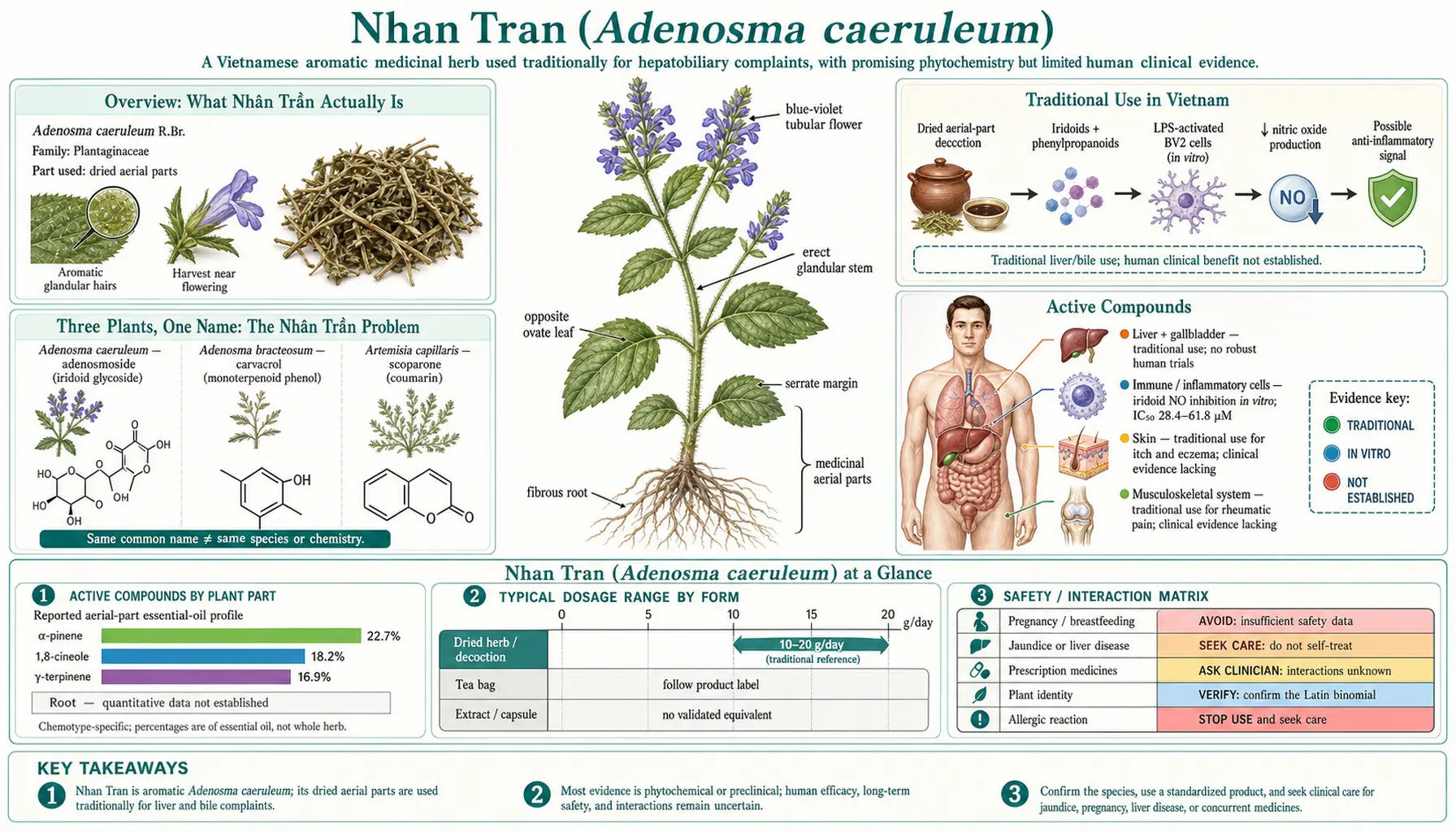
Nhân trần (Adenosma caeruleum) is an aromatic Vietnamese herb brewed as an everyday cooling tea for jaundice, sluggish digestion, and what traditional practitioners call a "hot liver." It is genuinely popular — you can buy bagged nhân trần tea in any Vietnamese market — but you should know two things before you read another word. First, there are essentially no randomized controlled trials of Adenosma caeruleum in humans. The evidence behind it is animal bile-flow work, laboratory antimicrobial screens, and several centuries of traditional use, much of it published in Vietnamese and never indexed in PubMed. Second, the name "nhân trần" is attached to at least three unrelated plants, and most of the impressive liver research you will find quoted under that name was done on a completely different species.
This page exists mainly to untangle that confusion and to give you an honest account of what the plant in your teabag actually is, what it plausibly does, and one specific safety problem — the near-universal nhân trần plus licorice blend — that is worth more of your attention than any of its claimed benefits.
Table of Contents
- Overview: What Nhân Trần Actually Is
- Three Plants, One Name: The Nhân Trần Problem
- Traditional Use in Vietnam
- Active Compounds
- Bile Flow and the Liver
- Jaundice: What the Evidence Really Shows
- Digestion, Appetite, and Bloating
- Antimicrobial and Skin Uses
- The Diuretic and "Cooling" Effect
- Forms and Preparations
- Recommended Dosage
- The Nhân Trần + Licorice Problem
- Cautions and Contraindications
- Key Research Papers
- Conditions It Is Used For
- Connections
- Featured Videos
Overview: What Nhân Trần Actually Is
Adenosma caeruleum R.Br. is a soft, strongly aromatic annual herb in the family Plantaginaceae — the plantain family, which also holds foxglove, snapdragon, and speedwell. Older books place it in Scrophulariaceae, and many Vietnamese pharmacognosy texts still do; that older placement is not a mistake so much as a snapshot of botany before DNA sequencing broke the old Scrophulariaceae into pieces in the early 2000s.
The plant grows to roughly knee height, with paired toothed leaves covered in fine hairs and small blue to violet flowers arranged in loose spikes — caeruleum is simply Latin for "sky blue." Crush a leaf and it smells sharp and faintly medicinal, somewhere between mint, eucalyptus, and lemon peel. That smell is the essential oil, and it is the most chemically distinctive thing about the herb.
It is native to Vietnam, southern China, Laos, Cambodia, and parts of India, and it behaves like a pioneer weed: it colonizes sandy open ground, roadside banks, fallow rice terraces, and dry hillsides. In Vietnam it is common enough in the north-central provinces that it has historically been gathered wild rather than farmed, though commercial demand has pushed some cultivation.
The part used is the whole aerial portion — stems, leaves, and flowering tops, cut when the plant is in bloom and dried in shade. On a Vietnamese product label or in the Vietnamese Pharmacopoeia this drug is listed as Herba Adenosmatis caerulei. If a package says that, you know what species you have. If it only says "nhân trần," you do not.
Vietnamese names you will see on packaging
- Nhân trần — the standard name.
- Nhân trần cái — literally "female nhân trần," used in some regions for this species specifically to distinguish it from its cousin.
- Chè cát — "sand tea," a name that describes exactly where it grows.
- Hoắc hương núi — "mountain patchouli," from the aroma.
Three Plants, One Name: The Nhân Trần Problem
This is the single most important section on the page, and it is the reason most English-language writing about nhân trần is wrong.
Three botanically unrelated plants circulate under the name "nhân trần" in Vietnamese herbal commerce and literature. They belong to two different plant families. They have different chemistry. Only one of them is the subject of nearly all the published liver research — and it is not the one in most Vietnamese teabags.
| Plant | Family | Names used | Why it matters |
|---|---|---|---|
| Adenosma caeruleum | Plantaginaceae | Nhân trần, nhân trần cái, chè cát | This page's subject. The species in most Vietnamese herbal teas and tablets. Essential-oil rich. Very little indexed research. |
| Adenosma bracteosum | Plantaginaceae | Nhân trần Tây Ninh, bồ bồ | A genuine Vietnamese relative, native to the south. Frequently sold under the same name. Similar traditional use, different flavonoid profile. |
| Artemisia capillaris | Asteraceae (daisy family) | Yin Chen Hao (茵陳蒿); translated as "nhân trần" in Chinese-medicine contexts | Chemically unrelated. This is the plant behind essentially all the published "nhân trần liver" science. Conflating it with Adenosma is the most common error in writing about this herb. |
How did this happen? The Chinese materia medica tradition has a jaundice herb called yin chen hao, used for close to two thousand years. When Chinese medical texts were read and translated in Vietnam, the Sino-Vietnamese reading of those same characters is nhân trần. Meanwhile, Vietnamese folk practice had its own local jaundice herb — Adenosma caeruleum — growing on the sandy hillsides. The classical name landed on the local plant. Two separate traditions merged into one word.
The practical consequence: when you read that "nhân trần lowers bilirubin," or see a citation to a Chinese clinical trial in neonatal jaundice, or find a mechanism paper about a nuclear receptor called CAR, that is Artemisia capillaris. It tells you close to nothing about Adenosma caeruleum. Two plants from different families do not share pharmacology just because they share a name. Everywhere on this page where we mention Artemisia research, we label it explicitly as a different species — and you should demand the same labeling from any other source you read.
A fourth name, and the one that matters most for searching
There is one more name to know, and it is not a different plant — it is this plant. Vietnamese sources frequently label nhân trần Adenosma glutinosum (L.) Druce rather than Adenosma caeruleum R.Br., and the two are widely treated as the same species under different binomials, with A. glutinosum the older and more often accepted name. The practical consequence is easy to check and easy to miss: the United States National Center for Biotechnology Information's taxonomy database carries Adenosma glutinosa as a recognised taxon but returns no record at all for Adenosma caeruleum. A literature search run only on A. caeruleum — which is the name printed on Vietnamese product labels, including the tablet formula that prompted this page — will therefore miss part of what has been published on the plant.
So the rule for this herb is the same one that applies to every ambiguous botanical name: search both binomials, and identify the plant from the description and the compounds measured rather than from the name on the label. That is a different problem from the three-plants confusion above. There, one name covers several plants. Here, one plant answers to several names.
Traditional Use in Vietnam
Nhân trần's traditional role is best understood as a daily beverage rather than a prescription drug. It is drunk the way iced tea is drunk in the American South — habitually, in quantity, in hot weather, by people who are not sick.
Within Vietnamese traditional medicine it is classed as a cooling, bitter, slightly pungent herb directed at the liver, gallbladder, spleen, and stomach. The classic indications are:
- Jaundice (vàng da) — the signature use, and the one that connects it to the Chinese yin chen hao tradition.
- "Hot liver" (nóng gan) — a broad folk category covering acne, mouth ulcers, bad breath, irritability, dark urine, and a general sense of being overheated. There is no Western diagnostic equivalent; it is a syndrome description, not a lab finding.
- Poor appetite and post-meal heaviness — the bitter-aromatic profile fits the global category of digestive bitters.
- Postpartum recovery — traditionally given to new mothers to "clear remaining heat and blood." This use is directly contradicted by the same tradition's warning about breastfeeding; see Cautions.
- Mild fevers, damp-heat conditions, and skin eruptions.
Longer treatment of the herb's textual history, its Chinese name-ancestor, and how it was prepared in different regions is on the history page.
A note on how to read all of this: traditional use tells you that generations of people found a plant palatable, tolerable in ordinary amounts, and worth the effort of gathering. That is real information — it is a crude, uncontrolled, very long safety observation. It is not evidence that the herb changes liver enzymes, clears bilirubin, or treats hepatitis.
Active Compounds
The best-characterized fraction of Adenosma caeruleum is its essential oil, which makes up roughly one percent of the dried herb. That is a substantial yield for a leafy plant, and it is why a cup of nhân trần tea smells so strongly.
The essential oil
- Limonene — the citrus-peel terpene. In other plants it is associated with mild gastric-emptying and reflux effects; it is also a solvent-like compound that carries other constituents into the aqueous infusion.
- Fenchone — a camphor-like ketone, the same one that gives fennel seed its sharp back-note. Fenchone is one of the more distinctive markers of this species.
- 1,8-Cineole (eucalyptol) — the eucalyptus compound, well studied on its own as an anti-inflammatory and mucolytic agent in respiratory medicine.
- α-Humulene — a sesquiterpene shared with hops and cannabis, studied in isolation for anti-inflammatory activity.
Proportions shift substantially with growing region, harvest timing, and drying method. Two bags of nhân trần from different provinces are not chemically interchangeable, and no Vietnamese retail product is standardized to a marker compound the way a European milk thistle extract is standardized to silymarin.
Non-volatile constituents
- Flavonoids — the plant's polyphenol fraction. These are the constituents most likely to survive into a water infusion in meaningful quantity, and they are the usual explanation offered for antioxidant activity in test-tube assays.
- Saponins — soap-like glycosides. They account for the slight foam on a vigorously stirred infusion and contribute bitterness.
An honest caveat about all of this: knowing which molecules are present is not the same as knowing what the tea does. Most of the interesting pharmacology attributed to 1,8-cineole and α-humulene comes from studies of the isolated compound at doses far above what a cup of infusion delivers. A dried-herb infusion extracts volatile oil poorly to begin with — much of the aroma you smell is oil escaping into the air, not dissolving into the water.
Bile Flow and the Liver
The central claim for nhân trần is that it is a choleretic — a substance that increases the volume of bile the liver produces — and to a lesser extent a cholagogue, meaning it promotes emptying of the gallbladder.
Why this would matter
Bile is the liver's disposal route. Cholesterol, bilirubin, many drug metabolites, and a range of fat-soluble waste products leave the body through bile, into the intestine, and out. Bile is also the detergent that lets you digest fat. If bile is thick, sluggish, or slow to move, the plausible downstream consequences are exactly the symptoms nhân trần is traditionally used for: fatty-meal intolerance, upper-abdominal heaviness, nausea after rich food, and pale stools.
Increasing bile flow is a legitimate, established pharmacological category. Artichoke leaf, dandelion root, turmeric, and ox bile are all used this way, and the effect is measurable.
What the evidence for Adenosma caeruleum actually is
Rodent bile-duct cannulation studies from Vietnamese pharmacology groups have reported increased bile output after Adenosma extract administration. This is the classic method: cannulate the common bile duct in an anesthetized animal, collect bile over a fixed period, compare volume against control. It is a real experiment and it produces a real number.
Three limitations you should hold onto:
- Much of this work is published in Vietnamese journals not indexed in PubMed, which means most readers cannot check the methods, the doses, or the statistics.
- Animal choleresis at an extract dose given by gavage does not predict what a cup of tea does in a person. The dose gap is usually one to two orders of magnitude.
- Increasing bile volume is not the same as improving liver function. A liver with hepatitis, fibrosis, or fat accumulation is not a liver with a bile-flow problem, and pushing more bile through it does not repair it.
Bottom line: a mild choleretic effect is the most biologically plausible thing nhân trần does, it fits the traditional use closely, and it is supported by animal data — but there is no human trial measuring bile flow, liver enzymes, or any clinical outcome with this species. If you want a liver herb with actual human trial data, milk thistle is the better-studied option, and chanca piedra has more published human work on the biliary tract.
Jaundice: What the Evidence Really Shows
Jaundice — the yellowing of skin and eyes caused by bilirubin accumulating in the blood — is the headline traditional indication, and it is where the species confusion does the most damage.
There is a well-characterized mechanism connecting a "nhân trần" herb to bilirubin clearance. Work on the Chinese formula Yin Zhi Huang, whose principal ingredient is Artemisia capillaris, showed that it accelerates bilirubin clearance by activating the nuclear receptor CAR (constitutive androstane receptor), which in turn upregulates the enzyme UGT1A1 — the liver enzyme that conjugates bilirubin so it can be excreted. That is elegant, mechanistically satisfying, and clinically relevant to neonatal jaundice.
It is also about a plant in the daisy family, not the plant on this page. Artemisia capillaris contains scoparone, capillarisin, and chlorogenic acid derivatives. Adenosma caeruleum contains none of those as principal constituents. There is no published evidence that Adenosma extract activates CAR, upregulates UGT1A1, or lowers serum bilirubin in any species.
If you are looking at a Vietnamese nhân trần product marketed for jaundice and the packaging cites liver research, the most likely explanation is that it is citing Artemisia work. That is not necessarily deliberate deception — the two plants genuinely share a name in the Vietnamese language — but the result is the same: you are reading evidence about a plant you are not taking.
What to do if you actually have jaundice
Yellowing skin or eyes in an adult is a medical finding, not a wellness complaint. It can mean viral hepatitis, alcohol-related liver disease, gallstones obstructing the bile duct, a drug reaction, hemolysis, or pancreatic disease. Several of those are time-critical. Herbal tea is not a substitute for a bilirubin panel, liver enzymes, and an ultrasound. If your jaundice is caused by an obstructed bile duct, a choleretic herb is theoretically the wrong direction entirely — you are pushing against a closed door.
Digestion, Appetite, and Bloating
This is the use with the most modest claim and, ironically, the most believable mechanism.
Nhân trần is bitter and aromatic. Bitter compounds hitting taste receptors on the tongue trigger a reflex increase in saliva and gastric secretion — the same principle behind European digestive bitters, Italian amari, and the Chinese and Ayurvedic use of bitter herbs before meals. Aromatic terpenes like limonene, fenchone, and cineole have carminative properties: they relax gut smooth muscle, which helps trapped gas move rather than distend the intestine.
Nothing about this requires a systemic drug effect. It works at the level of the mouth and the gut wall, at doses a tea can realistically deliver. That makes it the one claimed benefit that survives the "does a cup of tea contain enough?" test.
What it does not do:
- It does not treat gastritis, ulcers, or reflux — and limonene-rich preparations can loosen the lower esophageal sphincter, which may make reflux worse in some people.
- It does not address bacterial overgrowth, celiac disease, or inflammatory bowel disease.
- Bitter herbs are counterproductive during an active ulcer or acute gastritis flare, because stimulating acid secretion is the opposite of what an inflamed stomach lining needs.
The Digestive Comfort article goes into how to time a bitter tea around meals and who should skip it.
Antimicrobial and Skin Uses
Essential-oil-bearing plants are almost universally antimicrobial in a petri dish, and Adenosma caeruleum is no exception. Screens of the oil and of alcoholic extracts have reported inhibition of common test organisms including staphylococci and various fungi.
Here is the honest framing that laboratory antimicrobial screens rarely get:
- Almost every aromatic plant passes this test. Oregano, thyme, clove, tea tree, eucalyptus, lemongrass, and hundreds of others all inhibit bacteria on agar. A positive screen distinguishes a plant from water, not from other plants.
- The concentrations are unreachable internally. Inhibitory concentrations in these assays are typically in the range of hundreds of micrograms to milligrams per milliliter. Drinking tea does not produce those concentrations in blood, urine, or bile. It may briefly produce them in the mouth and upper gut, which is a real but limited effect.
- Topical application is a different question. On skin, where you can apply a concentrated preparation directly, aromatic-plant antimicrobial activity is more plausible — which is precisely how the traditional use runs: washes and compresses for itching, heat rash, and minor eruptions, not internal treatment of infection.
Traditional Vietnamese practice uses a strong decoction as a body wash for prickly heat and itchy rashes, particularly for children in hot weather. That is a low-risk application with a plausible mechanism (cooling, mild astringency, mild antimicrobial), and it does not require anyone to believe the tea cures infection. It is covered further in Antimicrobial and Skin.
Nhân trần is not a treatment for any diagnosed infection. It has no role in cellulitis, abscess, urinary tract infection, or any condition that needs an antibiotic.
The Diuretic and "Cooling" Effect
Nhân trần is traditionally described as promoting urination — "lợi tiểu" — and this is part of why it is drunk in hot weather and after childbirth. It is also drunk in large volumes, which guarantees increased urine output regardless of whether the plant contributes anything.
Whether Adenosma has a true diuretic action independent of fluid load has not been established in humans. Many bitter, saponin-containing plants show mild diuretic effects in animal models; the effect size is usually small and is not comparable to a pharmaceutical diuretic.
Two practical implications:
- If you already take a prescription diuretic (furosemide, hydrochlorothiazide, spironolactone), adding a folk diuretic on top of it is a good way to end up dehydrated or with a disturbed potassium level. Mention it to whoever manages your prescriptions.
- The diuretic framing is what makes the standard licorice blend pharmacologically odd — see the next section.
Forms and Preparations
Loose dried herb
The traditional and most transparent form. You can see the stems, leaves, and small flower spikes, and you can smell whether the oil is still there. Old stock smells of hay rather than mint-eucalyptus and has lost the fraction that makes the herb distinctive. Buy in small quantities and store in an airtight container away from light.
Tea bags and blends
The dominant commercial format in Vietnam. Read the ingredient list. Ready-made "trà nhân trần" is very often nhân trần plus cam thảo (licorice root), and sometimes also atisô (artichoke), cỏ ngọt (stevia), or hà thủ ô. The licorice is added for sweetness and to soften the bitterness. See the licorice section before you drink this daily.
Instant granules and tablets
Convenient, opaque, and usually blended. Dose per serving is rarely stated in terms of grams of raw herb equivalent, which makes it impossible to compare against traditional practice.
Fresh herb
Used where the plant grows. Roughly three to four times the weight of dried herb for an equivalent amount, though the volatile-oil profile of fresh material differs.
How to brew it
- Infusion (standard): pour boiling water over the dried herb, cover, and steep 10–15 minutes. Covering matters — the aromatic oil is volatile, and an uncovered pot sends the most characteristic constituents into the room instead of the cup.
- Decoction (traditional for therapeutic use): simmer in water for 15–20 minutes. Extracts more of the flavonoid and saponin fraction, less of the volatile oil.
- Cold-brewed daily drink: a strong decoction is often made in the morning, cooled, and drunk through the day. This is how large habitual volumes accumulate, and it is the pattern most relevant to the cautions below.
What to look for on a label
- The Latin binomial, or the pharmacopeial name Herba Adenosmatis caerulei. If neither appears, you do not know which of the three "nhân trần" plants you have.
- A full ingredient list, specifically checking for cam thảo / licorice / Glycyrrhiza.
- Harvest or packaging date. Volatile oil degrades; a three-year-old bag is mostly fiber.
Recommended Dosage
There is no evidence-based dose for Adenosma caeruleum, because there are no dose-finding studies in humans. What follows is traditional Vietnamese practice, presented as what people do rather than what has been shown to work.
| Preparation | Traditional amount | Notes |
|---|---|---|
| Dried herb, daily infusion | Roughly 8–20 g dried herb per day, in 1–1.5 L of water | The wide range reflects regional practice, not titration to an effect. |
| Decoction for a defined complaint | Toward the upper end of that range, for a limited course | Traditional practice treats a course, not a permanent habit. |
| Topical wash | A strong decoction, cooled, applied to affected skin | External use; do not apply to broken skin. |
Duration matters more than dose
The pattern that concerns Vietnamese practitioners is not a strong cup — it is a moderate cup every day for years, treated as a beverage rather than a medicine. Traditional guidance is to use nhân trần in courses of a few weeks for a specific reason and then stop, rather than replacing water with it indefinitely. That guidance is not backed by toxicology data; it is backed by the general principle that a cooling, drying, diuretic herb taken continuously is a different proposition from one taken occasionally.
Practical starting point if you want to try it: brew a light infusion, drink one to two cups a day, use plain nhân trần without licorice, and give it two to three weeks. If the digestive heaviness or post-meal discomfort you were targeting has not changed, it is not going to.
The Nhân Trần + Licorice Problem
This is the most practically useful thing on this page. If you remember nothing else, remember this.
Ready-made nhân trần tea in Vietnam is very commonly blended with cam thảo, which is licorice root (Glycyrrhiza species). It is added because nhân trần is bitter and licorice is intensely sweet — roughly fifty times sweeter than sugar — so it makes the tea palatable at no calorie cost. From a flavor standpoint it is a sensible pairing. From a pharmacological standpoint it is close to self-cancelling, and the licorice half carries real risk.
They pull in opposite directions
Nhân trần is used as a diuretic and choleretic — the traditional intent is to move fluid and bile out. Licorice does the opposite. Its principal constituent, glycyrrhizin, is metabolized to glycyrrhetinic acid, which inhibits the enzyme 11β-hydroxysteroid dehydrogenase type 2 in the kidney. That enzyme normally deactivates cortisol before it can reach the mineralocorticoid receptor. Block it, and cortisol starts acting like aldosterone: the kidney retains sodium and water, and dumps potassium.
So one ingredient is prescribed to promote urination and the other causes fluid retention. You are, in a fairly literal sense, drinking the accelerator and the brake in the same cup.
The licorice half is the one that can hurt you
The condition licorice causes is called pseudoaldosteronism — the clinical picture of excess aldosterone without excess aldosterone. Its features are:
- Raised blood pressure. The dose-response relationship is roughly linear, and it appears at intakes lower than most people assume — meaningful blood pressure rises have been documented at daily glycyrrhizic acid intakes in the range of 100 mg, achievable from a modest habitual licorice intake.
- Low potassium (hypokalemia). This is the dangerous one. Severe hypokalemia causes muscle weakness, cramping, and cardiac arrhythmias, and there are well-documented case reports of hospitalization — including rhabdomyolysis and paralysis — from habitual licorice consumption.
- Fluid retention and edema, and suppressed plasma renin and aldosterone on lab testing.
Who is at real risk
- Anyone with high blood pressure, heart failure, or kidney disease.
- Anyone taking a diuretic — thiazides and loop diuretics also lower potassium, and the effects stack.
- Anyone taking digoxin. Low potassium sharply increases digoxin toxicity, and this combination has caused serious harm.
- Anyone on corticosteroids, or with an existing potassium-losing condition.
- Pregnant women — high licorice intake in pregnancy has been associated with adverse outcomes in observational research, and it is one of the clearer reasons to avoid the blend.
The practical rule
If you want to drink nhân trần regularly, buy plain nhân trần and add nothing. If you want it sweeter, add a little honey or a leaf of stevia. Do not drink a licorice-containing blend daily for months. If you have been doing so and you have unexplained high blood pressure, swelling, or muscle weakness, the potassium level on a basic metabolic panel is worth checking — and the fix is usually simply stopping, after which the effect reverses over weeks.
None of this makes licorice a bad herb. It has genuine uses. It is a bad daily beverage additive, and pairing it with a diuretic herb is an odd combination that persists because it tastes good, not because it makes pharmacological sense.
Cautions and Contraindications
Pregnancy and breastfeeding
Vietnamese practitioners traditionally advise against habitual daily nhân trần in pregnancy and while breastfeeding. The specific folk concern is that it reduces milk supply. There is no clinical research testing this — no lactation study, no milk-volume measurement, nothing. It should be treated as an unverified traditional caution rather than a demonstrated effect. But note that the tradition holds this caution simultaneously with the postpartum-recovery use, which is an internal contradiction worth respecting on the conservative side. Add the licorice problem in most commercial blends, and the reasonable position is to avoid nhân trần in pregnancy and during breastfeeding.
Liver disease
There are no safety data for Adenosma caeruleum in people with hepatitis, cirrhosis, or liver failure. A damaged liver clears compounds unpredictably, and "it's for the liver" is not a safety argument — several herbs marketed for liver health are themselves hepatotoxic. If you have diagnosed liver disease, do not add an unstudied herb without telling your hepatologist.
Gallstones and bile duct obstruction
Do not use a choleretic herb if you have known gallstones or any suspicion of biliary obstruction. Stimulating bile production against a blocked duct is the wrong direction and can provoke pain. This is standard advice for all bile-stimulating herbs, including artichoke, dandelion, and turmeric.
Children
No established pediatric safety data. The traditional external wash for heat rash is a different and lower-risk proposition than internal dosing. Neonatal jaundice in particular must be managed medically — it can cause permanent neurological injury, and it is not a home-remedy condition.
Drug interactions
- Diuretics — additive fluid and electrolyte effects.
- Antihypertensives — the licorice in blended products works against them.
- Digoxin — via licorice-induced hypokalemia; a genuinely dangerous combination.
- Corticosteroids — licorice prolongs cortisol activity.
- Drugs with narrow therapeutic windows — any agent that alters bile flow may in theory alter the elimination of biliary-excreted drugs. This has not been studied for this species, which is itself the point: absence of interaction data is not the same as absence of interactions.
Allergy and quality
Allergic reaction to any plant is possible. Separately, wild-gathered herbs from roadsides and industrial margins can carry heavy metals and pesticide residue — a genuine concern for contaminant exposure with informally traded Vietnamese herbal material. Prefer a supplier that tests, or at minimum one that names a source region.
Stop and seek care if
- Jaundice appears, deepens, or is accompanied by dark urine and pale stools.
- You develop right-upper-abdominal pain, fever, or vomiting.
- You experience muscle weakness, cramping, or palpitations while drinking a licorice blend.
- Blood pressure rises without explanation.
Key Research Papers
Every paper below has been checked against its PubMed record — author list, title, journal, year, volume and pages all confirmed — and the year/volume/pages link goes straight to that record. Papers marked "different species" are about Artemisia capillaris or Glycyrrhiza, not Adenosma caeruleum — they are included because they explain the pharmacology this herb is repeatedly credited with, or the safety issue in its most common commercial blend.
- Olmstead RG, dePamphilis CW, Wolfe AD, Young ND, Elisons WJ, Reeves PA. Disintegration of the Scrophulariaceae. American Journal of Botany. 2001;88(2):348–361. The molecular work that broke up Scrophulariaceae. It placed tribe Gratioleae — the tribe that contains Adenosma — outside Scrophulariaceae in the strict sense, in the clade the authors called Veronicaceae and that is now known as Plantaginaceae. This is the reason older and newer sources disagree about this plant's family.
- Huang W, Zhang J, Moore DD. A traditional herbal medicine enhances bilirubin clearance by activating the nuclear receptor CAR. Journal of Clinical Investigation. 2004;113(1):137–143. Different species — the paper's own first sentence identifies the medicine as Yin Zhi Huang, "a decoction of Yin Chin (Artemisia capillaris) and three other herbs." This is the mechanism most often misattributed to Adenosma.
- Farese RV Jr, Biglieri EG, Shackleton CH, Irony I, Gomez-Fontes R. Licorice-induced hypermineralocorticoidism. New England Journal of Medicine. 1991;325(17):1223–1227. Different species — the classic description of how licorice mimics aldosterone. Directly relevant to blended nhân trần teas.
- Sigurjonsdottir HA, Franzson L, Manhem K, Ragnarsson J, Sigurdsson G, Wallerstedt S. Liquorice-induced rise in blood pressure: a linear dose-response relationship. Journal of Human Hypertension. 2001;15(8):549–552. Different species — shows the blood pressure effect starts at modest intakes; volunteers took 50–200 g of liquorice a day, equal to 75–540 mg of glycyrrhetinic acid.
- Størmer FC, Reistad R, Alexander J. Glycyrrhizic acid in liquorice — evaluation of health hazard. Food and Chemical Toxicology. 1993;31(4):303–312. Different species — the risk assessment behind most national intake limits.
- Omar HR, Komarova I, El-Ghonemi M, Fathy A, Rashad R, Abdelmalak HD, et al. Licorice abuse: time to send a warning message. Therapeutic Advances in Endocrinology and Metabolism. 2012;3(4):125–138. Different species — case-based review of hypokalemia, arrhythmia, and rhabdomyolysis from habitual licorice.
- Nazari S, Rameshrad M, Hosseinzadeh H. Toxicological effects of Glycyrrhiza glabra (licorice): a review. Phytotherapy Research. 2017;31(11):1635–1650. Different species — systematic account of licorice adverse effects.
- Juergens UR, Dethlefsen U, Steinkamp G, Gillissen A, Repges R, Vetter H. Anti-inflammatory activity of 1.8-cineol (eucalyptol) in bronchial asthma: a double-blind placebo-controlled trial. Respiratory Medicine. 2003;97(3):250–256. Isolated constituent — human data for 1,8-cineole at pharmaceutical doses, far above what a tea provides. Included so you can see the size of that gap.
- Sun J. D-Limonene: safety and clinical applications. Alternative Medicine Review. 2007;12(3):259–264. Isolated constituent — review of the other major terpene in this herb's oil.
What is missing from this list, and why: there is no randomized controlled trial, no pharmacokinetic study, and no human safety study of Adenosma caeruleum to cite. We have not padded the list with animal papers whose identifiers we cannot verify, and we have not dressed up Artemisia research as though it were about this plant. The searches below will show you the real, small state of the indexed literature.
Live PubMed Searches
- Adenosma caeruleum
- Adenosma bracteosum (bồ bồ)
- Adenosma essential oil composition
- Artemisia capillaris and jaundice (different species)
- Artemisia capillaris choleretic activity (different species)
- Vietnamese medicinal plants, hepatoprotective
- Glycyrrhizin and pseudoaldosteronism
- Licorice-induced hypokalemia case reports
- Choleretic herbs and bile flow
- Herbal tea heavy metal contamination
External Resources
- International Plant Names Index — Adenosma caeruleum: the authoritative record of the name and its publishing author.
- PubChem — limonene: properties and toxicology of the herb's main terpene.
- PubChem — 1,8-cineole (eucalyptol).
- LiverTox (NIH): the reference database for herb- and drug-induced liver injury.
Conditions Nhan Tran Is Used For
Each condition below links to its page. The coloured half of every capsule shows how much human evidence supports this herb for that specific use — traditional use is history, not proof, and is marked as such.
Connections
- All Herbs
- Deep dives: Nhân Trần Benefits · Liver and Bile Flow · Digestive Comfort · Antimicrobial and Skin · Traditional Tea and Safety · History and Traditional Use
- Licorice (cam thảo) — the blend partner, and the reason to read an ingredient list.
- Milk Thistle — the liver herb with actual human trial data, for comparison.
- Chanca Piedra — another traditional biliary and urinary herb, with more published human work.
- Phyllanthus Species Comparison — the same one-name-many-species problem, worked through in another genus.
- Dandelion — the Western bitter choleretic and diuretic, closest in intent to nhân trần.
- Artemisia annua — a relative of the Artemisia species that shares nhân trần's name in Chinese-medicine contexts.
- Fatty Liver Disease — the condition people most often reach for a "liver tea" to treat, and what actually changes it.