Vietnamese Balm (Elsholtzia ciliata)
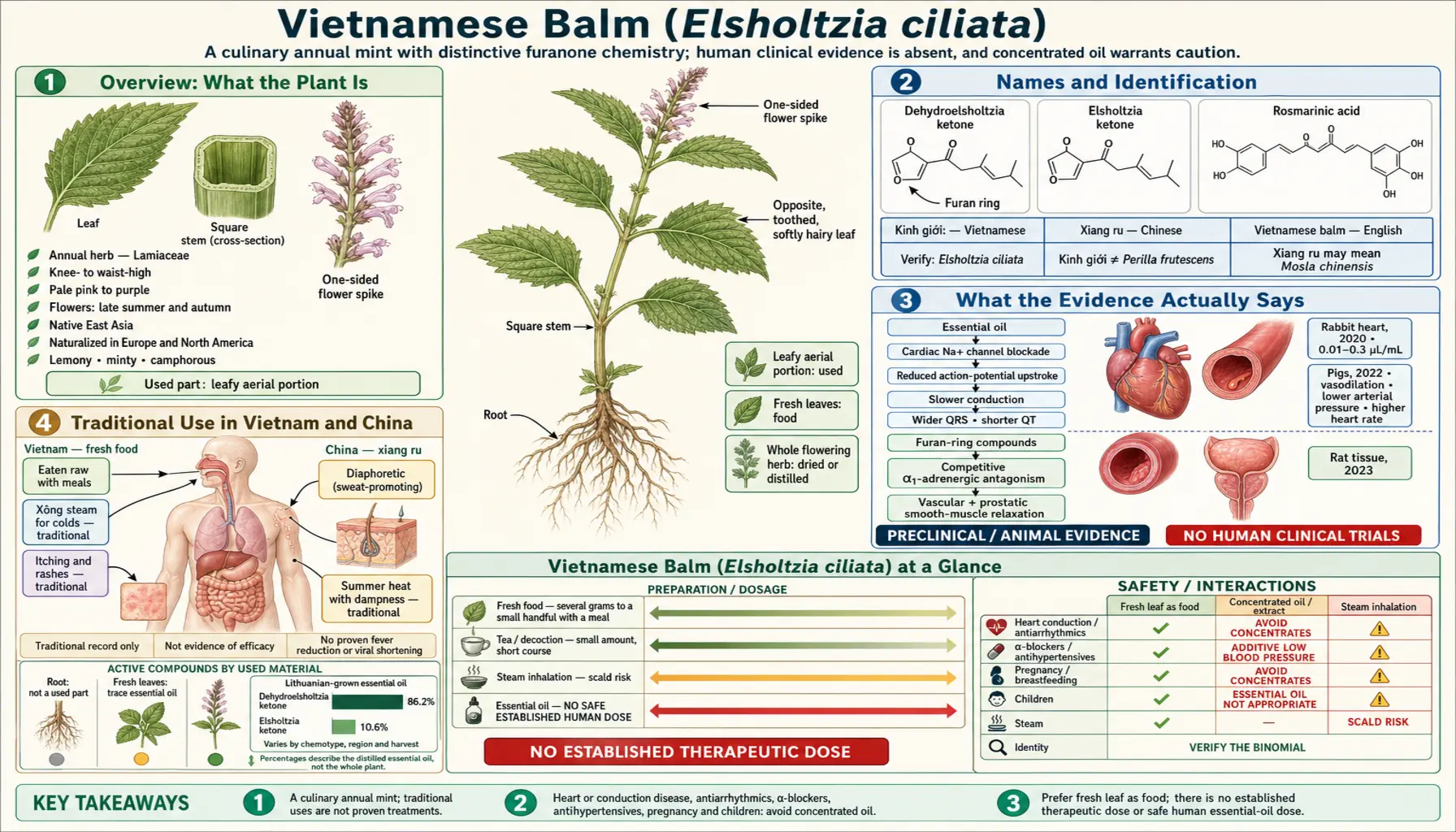
Vietnamese balm (Elsholtzia ciliata) is a soft annual mint eaten fresh by the handful in Vietnam, where it is called kinh giới and arrives at the table on the same plate as perilla, fish mint and Vietnamese coriander. The flavour is lemony and minty with a distinct camphorous edge that separates it from anything in a European kitchen. In Chinese medicine the same plant — or a close relative traded under the same name — is xiang ru, a “summer-heat” and sweating herb reached for during the humid late-summer months.
Here is the honest evidence position, and it should be stated at the top rather than buried: there is essentially no human clinical literature on this plant. No randomised trials. No controlled studies. What exists is essential-oil chemistry, antimicrobial screening in dishes, insecticidal work, and a genuinely interesting body of cardiovascular animal pharmacology from Lithuanian and Chinese laboratories — including evidence that the essential oil blocks cardiac sodium channels. That last finding is a reason for caution about concentrated oil preparations, not a reason for enthusiasm. And the traditional “summer heat” indication should not be read as an established fever-reducing effect. Nobody has tested it in a person.
Table of Contents
- Overview: What the Plant Is
- Names and Identification
- What the Evidence Actually Says
- Traditional Use in Vietnam and China
- Active Compounds
- Cardiac Sodium Channels: The Antiarrhythmic Work
- Blood Pressure and Smooth Muscle
- Antimicrobial and Insecticidal Screening
- Culinary Use: The Vietnamese Herb Plate
- Forms and Preparations
- Dosage
- Cautions and Contraindications
- Key Research Papers
- Connections
- Featured Videos
Overview: What the Plant Is
Elsholtzia ciliata is an annual herb in the mint family (Lamiaceae), growing knee- to waist-high, with the family’s square stems and opposite, toothed, softly hairy leaves. The flowers are the identifying feature and give it its odd English book name, crested late summer mint: they crowd onto one side of a flattened, one-sided spike that looks like a small comb or crest, pale pink to purple, opening in late summer and autumn.
The plant’s native range is enormous — across temperate and subtropical East Asia from Siberia and the Russian Far East through Korea, Japan, China and into Vietnam — and it has naturalised widely in Europe and North America, where it turns up as a roadside weed that almost nobody recognises. It grows fast, self-seeds aggressively, and does well in ordinary garden soil, which is why it is one of the easier Southeast Asian herbs to grow in a temperate climate.
The part used is the leafy aerial portion — fresh leaves for the table, and the whole flowering herb, dried, for medicinal preparations and for essential-oil distillation. The scent is the thing: crush a leaf and you get lemon first, then mint, then a cool camphorous note underneath that is unlike lemon balm and unlike perilla.
Names and Identification
Accepted botanical name: Elsholtzia ciliata (Thunb.) Hyl. Family Lamiaceae.
Local and trade names:
- Kinh giới (Vietnamese) — the kitchen name, and the one on the bunch at a Vietnamese grocer.
- Xiang ru (香薄, Chinese) — literally “fragrant rush.”
- Naginata-kōju (Japanese), hyangyu (향유, Korean).
- Vietnamese balm, crested late summer mint, Vietnamese lemon mint (English).
Two name confusions that matter
1. Kinh giới is not tía tô. Vietnamese cooks distinguish these two rigorously, and Western writing on Vietnamese herbs muddles them constantly. Tía tô is perilla (Perilla frutescens) — the large, ruffled leaf that is green on top and deep purple underneath, with an anise-and-basil flavour. Kinh giới is Elsholtzia ciliata — smaller, uniformly green, softly hairy, lemony-camphorous. They are both Lamiaceae, they are frequently served on the same plate, and they are not interchangeable. If a recipe or a supplement label calls kinh giới “Vietnamese perilla,” that label is wrong.
2. The name “kinh giới” itself is shared. Kinh giới is the Sino-Vietnamese reading of the Chinese drug name 荀芝 jing jie — which in Chinese materia medica refers to Schizonepeta tenuifolia, a quite different Lamiaceae used as a wind-dispersing, surface-releasing herb. So in a Vietnamese kitchen “kinh giới” means Elsholtzia ciliata, while in a Vietnamese pharmacy dispensing a Chinese-derived formula, “kinh giới” may well mean imported Schizonepeta. Both usages are legitimate in their own context, and confusing them is easy. When buying dried herb, look for the binomial.
3. Xiang ru is not a single species either. Historical Chinese materia medica generally identify 香薄 with Elsholtzia ciliata, and Chinese sources still refer to it as “northern xiangru.” The modern Chinese Pharmacopoeia standard for 香薄, however, is a different plant — Mosla chinensis, the cultivar known as jiangxiangru. This substitution is openly discussed in the Chinese literature; a 2022 review of E. ciliata in Molecules opens by addressing exactly this confusion of medicinal source. The practical consequence is that a paper or a package saying “xiang ru” may be describing either plant, and you cannot assume which.
What the Evidence Actually Says
This section exists so that nothing further down the page can be misread.
There are no human clinical trials of Elsholtzia ciliata. Not for fever, not for colds, not for arrhythmia, not for blood pressure, not for anything. A PubMed search returns a few hundred records, and essentially all of them fall into four buckets:
- Essential-oil composition analysis — gas chromatography of oil from plants collected in different countries and seasons. Useful chemistry, no clinical content.
- Antimicrobial screening — oil or extract against bacteria and fungi in culture plates.
- Insecticidal and pesticidal work — a genuinely active research area for this genus, aimed at stored-product pests and agriculture, not at people.
- Cardiovascular animal pharmacology — mostly from a single Lithuanian group at the Lithuanian University of Health Sciences, plus Chinese groups. Isolated rabbit hearts, anaesthetised pigs, rat tissue baths, mice.
The Lithuanian cardiovascular programme is real science, carefully done and published in peer-reviewed journals. It is also, at this stage, entirely preclinical, largely from one laboratory, and connected to a patented preparation — which is a normal way for drug development to start and a reason to read the enthusiasm in the papers with the usual discount.
On the traditional indication specifically: the TCM use of xiang ru for “summer heat with dampness” — the cluster of malaise, low-grade fever, heaviness and gastrointestinal upset that hot humid weather brings — is an old and coherent traditional category. It has never been tested as an antipyretic. There is no trial showing that Elsholtzia ciliata lowers body temperature or shortens a viral illness in a human being. Eating it in soup during a summer cold is a pleasant tradition. It is not a treatment.
Traditional Use in Vietnam and China
Vietnam. Kinh giới sits in an unusual position: it is simultaneously a daily food and a household remedy, and Vietnamese cooks do not draw a sharp line between the two. It is eaten raw in quantity with noodle dishes and grilled meats. It is also brewed as a tea, or steamed as part of a xông — the herbal steam inhalation, a bowl of boiling water with aromatic leaves and a towel over the head, used at the first sign of a cold across the whole country. In thuốc nam, the indigenous Vietnamese branch of traditional medicine, kinh giới is used for colds and chills, for itching and rashes, and for “wind” conditions generally.
China. Xiang ru is classified in Chinese medicine as an acrid, warm, diaphoretic (sweat-promoting) herb of the exterior-releasing category, with the specific seasonal indication of summer-heat illness complicated by dampness — typically framed as what happens when someone overheats outdoors, then cools down abruptly with cold food or air, and develops chills, headache, no sweating, abdominal fullness and diarrhoea. It appears in classical formulas alongside white lentil and magnolia bark. The traditional dose is small and the duration short; classical sources warn against prolonged use in someone already sweating.
Korea and Japan use the same plant in comparable seasonal roles, and it appears in regional food traditions as a seasoning and pickling herb.
What to take from this. The traditional record is internally consistent across four countries and centuries old, which is worth something as a description of what people did. It is not evidence of efficacy, and the specific mechanism implied — that promoting sweating resolves a summer illness — has no modern support.
Active Compounds
The chemistry here is unusually distinctive, and it is the reason the plant is interesting to pharmacologists at all.
- Dehydroelsholtzia ketone and elsholtzia ketone — the two dominant essential-oil constituents and the chemical signature of the genus. Both are furanone-type compounds: they carry a furan ring, a five-membered oxygen-containing aromatic ring, attached to a short ketone side chain. That structure is uncommon in aromatic plants; most culinary mints are dominated by monoterpenes such as menthol, carvone or linalool. Elsholtzia is not.
- In the Lithuanian-grown material used in the cardiovascular studies, gas chromatography found the oil to be 86.2% dehydroelsholtzia ketone and 10.6% elsholtzia ketone — nearly the whole oil in two compounds. Composition varies substantially by chemotype, growing region and harvest time, and material from China, Korea and Vietnam does not necessarily match those proportions.
- Rosmarinic acid — the mint family’s standard polyphenol, present here as in perilla, lemon balm, rosemary and sage. It is the most-studied antioxidant constituent of the Lamiaceae and is what most “antioxidant activity” results for this plant reflect.
- Flavonoids, terpenoids, phenylpropanoids and alkaloids — a 2022 review catalogues the structures of 352 compounds identified in the species. That number tells you the plant has been chemically characterised in considerable depth, and equally that almost none of it has been followed into a clinical setting.
The essential oil content of the fresh herb is small, which matters practically: eating a handful of leaves delivers a trace of the ketones, while a dropper of distilled essential oil delivers a dose in a different order of magnitude. Almost every caution on this page hinges on that distinction.
Cardiac Sodium Channels: The Antiarrhythmic Work
This is the most substantive research on the plant, and it needs reading carefully, because the same finding that makes it interesting is the finding that makes concentrated preparations risky.
Isolated rabbit heart (animal). A 2020 study perfused isolated rabbit hearts with Elsholtzia ciliata essential oil at 0.01–0.3 µL/mL and mapped the electrical consequences with microelectrodes and optical imaging. The oil widened the QRS complex, shortened the QT interval, reduced the upstroke velocity of the action potential (dV/dtmax) and slowed conduction, in a concentration- and use-dependent way. That combination is the classic fingerprint of sodium channel blockade. The changes were at least partly reversible on washout.
Anaesthetised pigs (animal). A 2022 follow-up gave intravenous boluses of the oil to anaesthetised pigs and confirmed the same electrocardiographic profile in a whole animal — prolonged QRS, shortened QT, altered PQ interval — alongside vasodilation, a fall in arterial blood pressure and a rise in heart rate. The authors describe the profile as resembling a class 1B antiarrhythmic, the lidocaine and mexiletine family.
Why this is a caution rather than a selling point. Sodium-channel-blocking antiarrhythmic drugs have a difficult history in human medicine. The Cardiac Arrhythmia Suppression Trial found that class 1C agents, given to suppress ventricular ectopy after myocardial infarction, increased mortality — the drugs did exactly what they were designed to do to the ECG and killed more patients than placebo. That is why antiarrhythmic therapy is now managed by cardiologists with ECG monitoring rather than prescribed casually. An over-the-counter plant oil that widens the QRS complex is not an obviously safe thing to swallow, and the fact that its effect resembles a real antiarrhythmic drug class is a reason for more caution, not less.
What has not been done: any human study. No healthy-volunteer ECG study, no dose-finding, no arrhythmia trial. Whether these effects occur at doses a person could realistically take, and whether they would help or harm, is entirely unknown.
Toxicology, for balance. A 2023 study gave Balb/c mice acute (single-dose, 24-hour) and sub-chronic (daily for 60 days) intraperitoneal injections of the extract and found no significant adverse effects on blood counts, biochemistry, mitochondrial function or organ histology, with no cytotoxicity in kidney and liver cell lines. That is genuinely reassuring as far as it goes. It is mouse data, by injection into the abdominal cavity rather than by mouth, from the same research group that is developing the preparation, and it does not address the cardiac electrophysiology that the same group documented elsewhere.
Blood Pressure and Smooth Muscle
Rat tissue baths (animal). A 2023 study measured tension in rat aortic rings and prostate strips. The essential oil produced concentration-dependent relaxation of both, with the prostate more sensitive than the aorta: half-maximal inhibition at 0.24 ± 0.03 µL/mL for prostate versus 0.72 ± 0.11 µL/mL for aorta. Analysis of the concentration–response shift suggested the mechanism is competitive antagonism at α1-adrenergic receptors — the same target as tamsulosin, doxazosin and prazosin.
The investigators went further and tested two simple furan-ring compounds, 2-acetylfuran and 5-methylfurfural, finding that they too shifted smooth-muscle responsiveness — suggesting the furan ring itself, rather than some elaborate three-dimensional fit, is doing much of the work.
Why that matters practically. An α1-blocking effect explains the blood-pressure drop seen in the pig study. It also predicts the classic α-blocker adverse effects: orthostatic hypotension, dizziness on standing, and first-dose fainting. And it predicts additive effects with prescribed α-blockers and other antihypertensives. All of this is inferred from animal tissue; none of it has been observed in a person. But if you are on tamsulosin for prostate symptoms or on antihypertensive medication, this is the plausible interaction to be aware of.
Antimicrobial and Insecticidal Screening
Bacteria (in vitro). A 2025 Chinese study tested essential oils from clove and Elsholtzia species against common bovine mastitis pathogens, reporting antibacterial and antioxidant activity along with toxicity assessment in bovine mammary epithelial cells. Note the framing: this is veterinary and agricultural research aimed at replacing antibiotics in dairy herds, not human medicine.
Insects (in vitro and applied). The genus is genuinely promising as a botanical pesticide. A 2024 study showed E. ciliata oil and its main components acting synergistically against the cigarette beetle (Lasioderma serricorne), a major stored-product pest, and a 2025 review surveys the pesticidal potential of Elsholtzia species for sustainable agriculture.
Formulation work. A 2019 Lithuanian study spray-dried an ethanolic extract into microcapsules using maltodextrin, sodium caseinate, skim milk and beta-cyclodextrin — the kind of pharmaceutical-technology work that precedes a product, and a further indication that the Lithuanian programme is developmental rather than observational.
None of the antimicrobial work implies clinical benefit. Essential oils kill bacteria in a dish at concentrations that are membrane-disruptive to human cells too. The gap between “inhibits Staphylococcus on a plate” and “treats an infection in a person” is where the overwhelming majority of antimicrobial plant research stops permanently.
Culinary Use: The Vietnamese Herb Plate
This is the plant’s real and unambiguous home.
Vietnamese meals frequently arrive with a plate of raw herbs — rau sống — that diners tear into the dish themselves. Kinh giới is a fixture on that plate, and it is normal to eat a genuinely large quantity, a handful or more, at a sitting. Its usual companions are:
- Tía tô — perilla, purple-backed and anise-scented.
- Diếp cá — fish mint (Houttuynia cordata), the polarising one, with a strong fishy-metallic note.
- Rau răm — Vietnamese coriander (Persicaria odorata), peppery and hot.
- Thai basil, culantro, mint, and whatever lettuce and bean sprouts are on hand.
Kinh giới is particularly associated with bún noodle dishes, with grilled and fried foods, and with the assembled rice-paper rolls where its lemon-camphor note cuts richness. It is always used raw or added at the very end — the volatile oils that carry the flavour are gone within a minute of boiling. It also goes into cháo, Vietnamese rice porridge, stirred in off the heat, which is the version most often given to someone with a cold and is the point where food and medicine become the same thing.
Growing it is easy. It is an annual, germinates readily, tolerates ordinary soil and a temperate summer, and self-seeds. Seed is sold as “Vietnamese balm” or “kinh gioi.” Harvest before flowering for the best leaf.
The food-versus-oil distinction is the whole safety story. Eating the fresh leaf as a vegetable is a food-level exposure with a very long history of ordinary daily use in hundreds of millions of meals. Taking distilled essential oil, or a concentrated standardised extract, is a pharmacological act with animal data showing cardiac sodium-channel blockade and α1-adrenergic antagonism behind it. Do not reason from the safety of the first to the safety of the second.
Forms and Preparations
- Fresh leaf. The primary and best-established form. Sold in bunches at Vietnamese and pan-Asian grocers, usually alongside perilla and Vietnamese coriander. Keep the stems in water in the fridge; it wilts fast.
- Dried herb for tea or decoction. The traditional medicinal form in both Vietnamese and Chinese practice. Brewed briefly — classical Chinese instructions for xiang ru emphasise short decoction, because the aromatic constituents are volatile and prolonged boiling drives them off.
- Steam inhalation (xông). Fresh or dried herb in hot water, inhaled under a towel. The most common Vietnamese household use during a cold. Effectively an aromatic steam treatment, with the well-known scald risk of any boiling-water inhalation — and not something to do with a child leaning over the bowl.
- Essential oil. Distilled from the flowering herb, dominated by the two furanone ketones. This is the form used in the Lithuanian cardiovascular research and the form that carries the pharmacological cautions below. It is not a culinary or casual product.
- Standardised extracts and spray-dried powders. Exist as research and development materials rather than as widely available consumer supplements.
Dosage
There is no established therapeutic dose for Elsholtzia ciliata, because there has never been a human trial from which to derive one. Saying otherwise would be inventing a number.
What can be said accurately:
- As a food, the herb is eaten fresh in the quantities a plate of raw herbs implies — several grams to a small handful with a meal — with a very long record of ordinary safe use at that level.
- As a traditional decoction, Chinese practice uses xiang ru in small amounts and for short courses, and classical sources explicitly caution against prolonged use. Because the pharmacopoeial identity of xiang ru is now Mosla chinensis rather than Elsholtzia, traditional dose figures cannot be transferred to E. ciliata with confidence in any case.
- As an essential oil, there is no safe established human dose whatsoever. The animal cardiac work used concentrations in the range of 0.01–0.3 µL/mL in a perfused heart preparation, and intravenous boluses in pigs — numbers with no meaningful translation to an oral dose in a person. Ingesting concentrated Elsholtzia essential oil is not something this page can give a number for, and the honest advice is not to.
Cautions and Contraindications
Vietnamese balm as a fresh culinary herb has an excellent real-world safety record: it is eaten daily, in quantity, by very large numbers of people, and no pattern of harm has emerged. The cautions below are almost entirely about concentrated preparations, and they follow directly from the animal pharmacology.
Heart rhythm and conduction — the main concern
Because the essential oil blocks cardiac sodium channels and widens the QRS complex in isolated hearts and in living pigs, concentrated preparations should be avoided by anyone with:
- Any known conduction abnormality — bundle branch block, AV block, an existing wide QRS.
- Brugada syndrome or a family history of it, or any condition in which sodium channel blockers are contraindicated. Sodium channel blockade is the diagnostic provocation for Brugada syndrome, which is to say it is precisely the thing that unmasks it.
- Structural heart disease or a previous myocardial infarction — the population in which class 1 antiarrhythmic drugs proved harmful.
- Existing antiarrhythmic therapy (flecainide, propafenone, lidocaine, mexiletine, amiodarone, sotalol) — additive and unpredictable effects.
- A pacemaker or implantable defibrillator, where altering conduction can change device behaviour.
None of this has been observed in a human. It is inference from good animal data, which is exactly the situation in which caution is appropriate rather than optional.
Blood pressure and α-blockade
The oil relaxes vascular and prostatic smooth muscle by antagonising α1-adrenergic receptors, and lowered arterial pressure in pigs. Anyone taking tamsulosin, alfuzosin, doxazosin, prazosin or terazosin, or antihypertensive medication of any class, should be alert to additive blood-pressure lowering and orthostatic dizziness. Older adults are the group most likely to be harmed by an unexpected drop in standing blood pressure, because the consequence is a fall.
The furan-ring question
The two dominant constituents both contain a furan ring. Furan-containing natural products are a chemical class in which metabolic activation by liver enzymes to reactive intermediates is a recognised phenomenon, and no metabolism, genotoxicity or long-term oral toxicity studies of elsholtzia ketone or dehydroelsholtzia ketone in humans have been published. This is an open question rather than a demonstrated hazard, and it applies to concentrated oil rather than to a leaf on a plate — but it is a genuine reason not to treat a novel essential oil as though it were olive oil.
Pregnancy and breastfeeding
No data. Culinary use of the fresh herb as part of normal Vietnamese food carries no signal of harm and has been going on forever. Concentrated extracts and essential oil should be avoided entirely — there is no reproductive toxicology, and a compound class with cardiac and vascular activity is not one to test during pregnancy. Traditional use as a diaphoretic adds a further conventional reason for caution.
Children
The fresh herb as food is food. Essential oil is not appropriate for children under any circumstances — concentrated aromatic oils carry aspiration and central nervous system risks in small children entirely apart from anything specific to this plant. Steam inhalation with a child requires supervision because of the scald risk.
Identity, again
Because “kinh giới” may mean Schizonepeta in a pharmacy context and “xiang ru” is now officially Mosla chinensis in China, a dried herb bought on a common name is not reliably this plant. Buy fresh from a Vietnamese grocer, grow it yourself, or buy dried material that states Elsholtzia ciliata on the label.
Do not substitute for real treatment
Nothing here supports using Vietnamese balm to treat fever, infection, arrhythmia or high blood pressure. A fever that is high, persistent, or accompanied by confusion, breathlessness, stiff neck or a rash needs medical assessment, not a herbal steam.
Key Research Papers
Every citation below has been checked against the PubMed record. Note how few of them involve a human being — that absence is the honest state of the field, not an omission on this page.
- Wang F, Liu X, Chen Y, An Y, Zhao W, Wang L, et al. Elsholtzia ciliata (Thunb.) Hyland: a review of phytochemistry and pharmacology. Molecules. 2022;27(19):6411. Catalogues 352 identified compounds and opens by addressing the confusion of medicinal sources described above.
- Mačianskienė R, Pudžiuvelytė L, Bernatonienė J, Almanaitytė M, Navalinskas A, Treinys R, et al. Antiarrhythmic properties of Elsholtzia ciliata essential oil on electrical activity of the isolated rabbit heart and preferential inhibition of sodium conductance. Biomolecules. 2020;10(6):948.
- Zigmantaitė V, Jonušaitė E, Grigalevičiūtė R, Kučinskas A, Treinys R, Navalinskas A, et al. Evaluation of the cardiac electrophysiological and haemodynamic effects of Elsholtzia ciliata essential oil on swine. Pharmaceuticals (Basel). 2022;15(8):982.
- Martišienė I, Zigmantaitė V, Pudžiuvelytė L, Bernatonienė J, Jurevičius J. Elsholtzia ciliata essential oil exhibits a smooth muscle relaxant effect. Pharmaceuticals (Basel). 2023;16(10):1464. Source of the 86.2% / 10.6% oil composition and the α1-adrenergic mechanism.
- Mačianskienė R, Zigmantaitė V, Andriulė I, Pangonytė D, Sadauskienė I, Arandarčikaitė O, et al. Acute and sub-chronic intraperitoneal toxicity studies of the Elsholtzia ciliata herbal extract in Balb/c mice. Pharmaceutics. 2023;15(10):2417.
- Wang XD, Bai JL, Ma ZJ, et al. Antibacterial activity of essential oils from clove and Elsholtzia plants against common pathogens of bovine mastitis, antioxidant activity, and toxicity to bovine mammary epithelial cells. Current Microbiology. 2025;82(8):359.
- Song S, Tang Y, Feng R, et al. Bioactivities and synergistic effect of Elsholtzia ciliata essential oil and its main components against Lasioderma serricorne. Molecules. 2024;29(9).
- Kabdal T, Prakash O, Kumar R, et al. Harnessing the phytochemistry through pesticidal potential of diverse Elsholtzia species: a path to sustainable agriculture. Chemistry & Biodiversity. 2025;22(1):e202401906.
- Pudziuvelyte L, Marksa M, Jakstas V, et al. Microencapsulation of Elsholtzia ciliata herb ethanolic extract by spray-drying: impact of resistant-maltodextrin complemented with sodium caseinate, skim milk, and beta-cyclodextrin on the quality of spray-dried powders. Molecules. 2019;24(8).
- Boo YC. Therapeutic potential and mechanisms of rosmarinic acid and the extracts of Lamiaceae plants for the treatment of fibrosis of various organs. Antioxidants (Basel). 2024;13(2). Context for the rosmarinic acid shared across this plant, perilla and lemon balm.
Live PubMed Searches
These run a fresh search each time and stay current as new work appears.
- Elsholtzia ciliata — all published work
- Elsholtzia ciliata essential oil composition
- Elsholtzia ciliata and antiarrhythmic activity
- Elsholtzia and antibacterial screening
- Mosla chinensis (the modern pharmacopoeial “xiang ru”)
- Schizonepeta tenuifolia (the other “kinh giới”)
- Rosmarinic acid — the shared Lamiaceae polyphenol
- The Cardiac Arrhythmia Suppression Trial (why sodium channel blockade needs respect)
- Brugada syndrome and sodium channel blockers
- Perilla frutescens (tía tô, the herb kinh giới is confused with)
Connections
- All Herbs
- Perilla — tía tô, the herb Vietnamese balm is most often confused with, and its constant companion on the herb plate.
- Houttuynia — diếp cá, fish mint, the third fixture of the Vietnamese raw-herb plate.
- Lemon Balm — the European Lamiaceae with the same lemon note and the same rosmarinic acid, but a far larger clinical literature.
- Conditions on this site that reference this page: Arrhythmia · Common Cold · Constipation · Benign Prostatic Hyperplasia