Houttuynia cordata (Fish Mint)
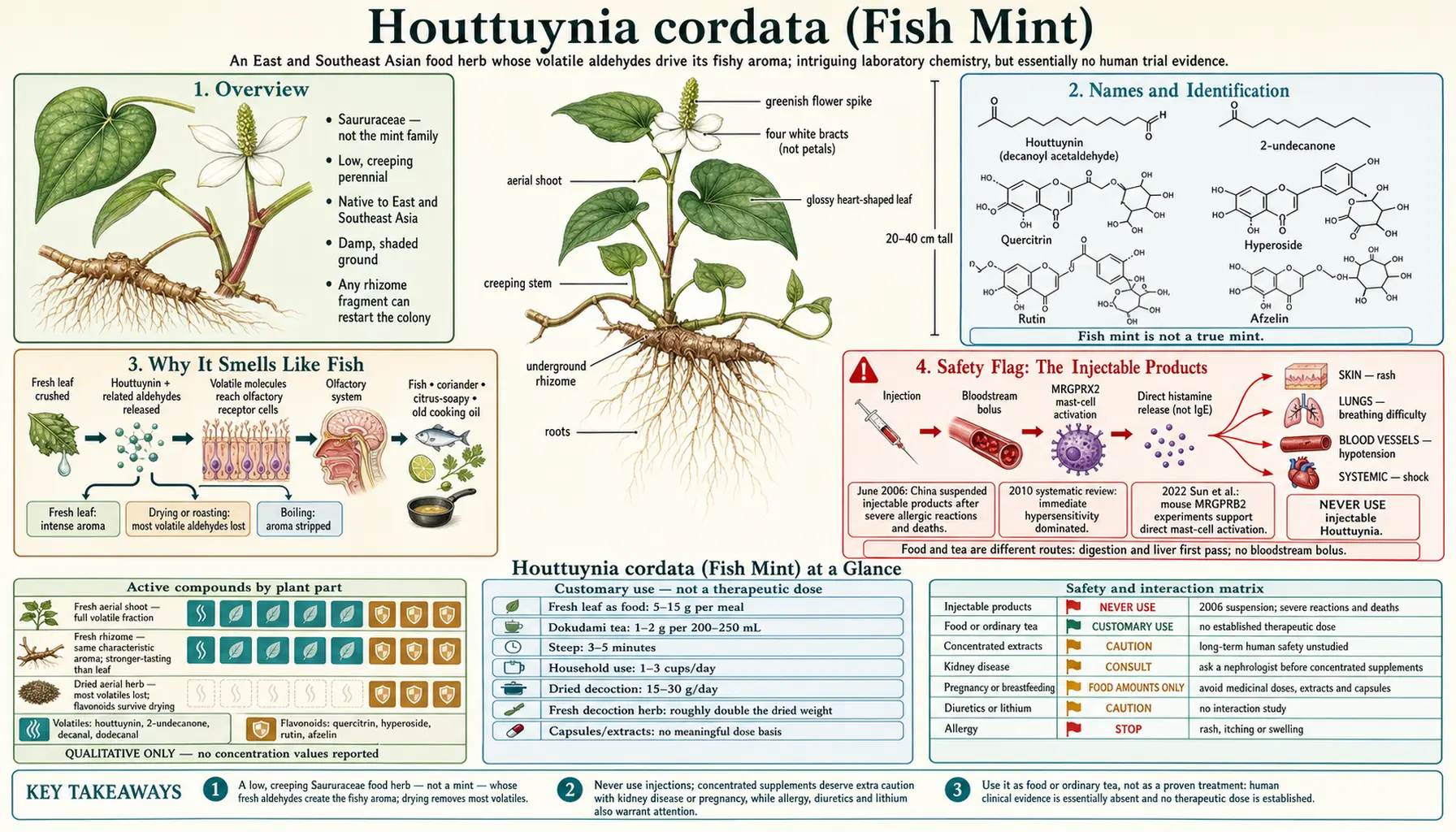
Fish mint is the herb people argue about. Its heart-shaped leaves smell unmistakably of raw fish, and diners tend to fall hard on one side or the other — in Vietnam it is eaten raw by the handful as diếp cá, in Japan it is dried into an everyday household tea called dokudami-cha, and in Chinese medicine it is yu xing cao, a standard herb for what is described as heat in the lungs.
Two things need saying at the top. First, a real safety event: injectable Houttuynia products were pulled from the Chinese market in 2006 after severe allergic reactions and deaths. That is a fact about an injection — a concentrated extract pushed straight into the bloodstream — and it does not transfer to eating the leaf or drinking the tea. Second, the evidence: almost everything published about this plant is cell-culture and animal work. There is essentially no human trial data supporting fish mint for any illness. It is a good vegetable with an interesting chemistry and a thin clinical file, and this page will not pretend otherwise.
Table of Contents
- Overview
- Names and Identification
- Why It Smells Like Fish
- Safety Flag: The Injectable Products
- Traditional Use
- Active Compounds
- Antiviral Activity in the Laboratory
- Inflammation, Allergy, and the Nose
- Antibacterial and Oral-Care Research
- Aristolactams and the Aristolochic Acid Question
- Culinary Use
- Forms and Preparations
- Dosage
- Cautions and Contraindications
- Key Research Papers
- Connections
- Featured Videos
Overview
Houttuynia cordata Thunb. is a low, creeping perennial in the Saururaceae — the lizard's-tail family, a small and rather obscure group of only a handful of genera, and emphatically not the mint family despite the English name "fish mint." It spreads by underground rhizomes into dense mats about 20–40 cm tall, carries glossy heart-shaped (cordate) leaves, and in early summer throws up a short greenish flower spike sitting on four white bracts that most people mistake for petals.
It is native to a wide belt of East and Southeast Asia — southern China, Japan, Korea, Taiwan, Vietnam, Laos, Thailand, Nepal and northeastern India — and it grows where the ground stays damp and shaded: ditch banks, paddy margins, the north side of a wall. It is fiercely persistent. Any fragment of rhizome left in the soil restarts the colony, which is why gardeners who plant the variegated ornamental form (usually sold as the "chameleon plant," with cream, pink and green leaves) often regret it within two seasons.
The part used depends on the country. In Vietnam and Japan it is the leafy aerial shoot. In southwestern China — Guizhou, Sichuan, Yunnan — the prize is the white underground rhizome, sold in bundles as zhé'ěrgēn and eaten as a crunchy cold-dressed vegetable. In Chinese materia medica the drug yu xing cao is the dried aerial part. All three come from the same plant, and all three carry the same smell to a greater or lesser degree.
How it reaches a kitchen is worth knowing, because it explains the price. Fish mint is not really farmed at industrial scale outside China; much of what reaches Vietnamese groceries in the West is grown on small plots or in greenhouse beds, cut with roots attached, and shipped in damp bunches. It bruises easily and the aroma fades within days of cutting, so a bunch that smells only faintly fishy is old, not mild.
Names and Identification
The binomial is Houttuynia cordata Thunberg, 1783 — the genus commemorates the Dutch naturalist Martinus Houttuyn, and cordata simply means heart-shaped, for the leaf. It is the only widely used species in its genus.
| Language / region | Name | Literal sense |
|---|---|---|
| Vietnamese | diếp cá, giấp cá, rau diếp cá | "fish lettuce" |
| Chinese (standard) | 魚腥草 yú xīng cǎo | "fishy-smell herb" |
| Chinese (Guizhou/Sichuan, the root) | 折耳根 zhé'ěrgēn | "folded-ear root" |
| Japanese | ドクダミ dokudami | usually glossed as "poison-blocking" |
| Korean | 어성초 eoseongcho, 약모밀 yakmomil | "fish-smell herb" |
| Thai | ผักคาวตอง phak khao tong | "rank-smelling vegetable" |
| English | fish mint, fish leaf, heartleaf, chameleon plant | — |
Two name traps are worth flagging.
First, "fish mint" is not a mint. True mints are Lamiaceae — square stems, opposite leaves, menthol-family terpenes. Houttuynia is Saururaceae, its chemistry is dominated by fatty aldehydes rather than terpenes, and nothing about how you use a mint carries over. If a recipe or a label treats fish mint as interchangeable with mint, it is wrong.
Second, the ornamental "chameleon plant" sold in Western garden centres as a groundcover is the same species — the variegated cultivar Houttuynia cordata 'Chameleon'. It is edible in the same sense the plain green form is, but garden-centre stock is grown as an ornamental and may have been treated with pesticides not cleared for food crops. Do not eat nursery plants; buy the herb from a grocery that sells it as food, or grow your own from a food-grade cutting.
Why It Smells Like Fish
The smell is the whole story of this plant, and it has a specific chemical cause. Crushing a fresh leaf releases decanoyl acetaldehyde, usually called houttuynin — a twelve-carbon aldehyde — along with a group of related aliphatic aldehydes and ketones including 2-undecanone (methyl nonyl ketone), decanal, dodecanal and lauryl aldehyde.
Aldehydes of exactly this chain length are also what our noses read as "fish," "coriander," and "old cooking oil," which is why fish mint smells simultaneously marine, citrus-soapy and slightly rancid to people who dislike it. It is the same chemical family that gives Vietnamese coriander its aroma, and the same family that makes fresh cilantro taste like soap to a minority of people. That last case has a documented genetic basis in an olfactory receptor gene; no comparable gene has been identified for fish mint, so the polarised reaction to it is best described as real and widely reported but not yet explained.
Houttuynin is chemically unstable — it degrades quickly once the cell is broken and it evaporates readily with heat. Three practical consequences follow, and they explain almost everything about how the plant is used:
- Fresh leaf is intensely fishy; dried leaf is not. Japanese dokudami-cha is made from aerial parts that have been dried and often lightly roasted, which drives off nearly all of the volatile aldehydes. The tea tastes grassy and faintly toasted, and people who cannot bear the fresh herb usually have no trouble with it.
- Boiling strips the aroma. In Chinese decoctions yu xing cao is traditionally added at the very end of the simmer (the technique called hòu xià, "added later") specifically to keep the volatiles from boiling off.
- The pharmaceutical industry had to stabilise it. Because houttuynin itself will not survive in a bottle, Chinese manufacturers use sodium houttuyfonate and its synthetic analogue sodium new houttuyfonate — bisulfite adducts that are shelf-stable. Most of the "Houttuynia" pharmacology you will read about from China is really the pharmacology of these derivatives, not of the leaf you eat.
Safety Flag: The Injectable Products
This section exists because the single most alarming thing you can find about Houttuynia online is true, and it is also routinely misapplied to the vegetable.
For decades, Chinese hospitals used Houttuynia cordata injection — a sterile aqueous extract given intramuscularly or by intravenous drip, mostly for respiratory infections. In June 2006, China's drug regulator suspended the sale and clinical use of Houttuynia-containing injectable products following a cluster of severe allergic and anaphylactoid reactions, including deaths. Some intramuscular formulations were later permitted again under tighter restrictions; the intravenous drip products did not come back in their old form. A 2010 systematic review pooled the published adverse-event reports and found the reactions were dominated by immediate hypersensitivity: rash, breathing difficulty, hypotension and, in the worst cases, shock.
Later work identified a plausible mechanism, and the mechanism is the key to reading this correctly. Animal experiments implicate MRGPRB2 — the mouse counterpart of the human mast-cell receptor MRGPRX2 — in Houttuynia-injection reactions. That receptor is the known route for "pseudo-allergic" drug reactions: it triggers mast cells to dump histamine directly, without any IgE antibody and without prior sensitisation, when certain molecules reach them in the bloodstream at high concentration. Solubilising excipients used in traditional-medicine injectables, notably polysorbate 80, are themselves implicated in this kind of reaction.
Why this does not transfer to food. An injection does three things eating cannot. It skips digestion, so compounds that would be broken down in the gut arrive intact. It skips the liver's first pass. And it delivers the entire dose as a bolus into the circulation, where mast cells line every blood vessel. Direct mast-cell triggering of the MRGPRX2 type is concentration-dependent and requires that bloodstream delivery. Eating a handful of leaves with grilled pork produces nothing remotely like it.
So the honest summary is: never take an injectable Houttuynia product — they are not legally sold outside China anyway — and do not let that history frighten you off a vegetable that hundreds of millions of people eat weekly. The two exposures are not the same event at different doses; they are different routes with different biology.
Traditional Use
In Chinese medicine, yu xing cao is classified as cold and acrid and grouped with the herbs that "clear heat and resolve toxin." Its classical territory is the lung: cough with thick yellow phlegm, and the pattern traditionally called lung abscess. It also appears in formulas for urinary heat and for boils. It is a genuinely mainstream herb — listed in the Chinese Pharmacopoeia, not a folk curiosity.
In Japan, dokudami is one of the "three great folk medicines" of the household tradition, drunk as a daily tea and credited with everything from clearing the skin to acting as a mild laxative and diuretic. The name's usual gloss — something like "stopping poison" — reflects an old reputation as a general detoxicant.
In Vietnam, diếp cá sits at the boundary between food and thuốc nam (southern folk medicine). Blended with water and a little sugar into a green juice, it is a standard home remedy for heat rash, boils, constipation and haemorrhoids, and mothers give it to children in hot weather as a cooling drink.
All of this is history, and history is not evidence. Long use tells you a plant is broadly tolerated as a food at customary amounts. It tells you nothing about whether it treats a disease.
Active Compounds
Two chemically unrelated groups do the work, and they behave completely differently in the kitchen.
The volatile fraction — houttuynin (decanoyl acetaldehyde), 2-undecanone, decanal, dodecanal, lauryl aldehyde, β-myrcene, α-pinene, limonene. This is the smell, it is the fraction with most of the reported antimicrobial activity in a dish, and it is largely destroyed by drying and boiling.
The flavonoid fraction — mostly quercetin and kaempferol sugars: quercitrin (quercetin-3-rhamnoside), hyperoside (quercetin-3-galactoside), rutin, afzelin (kaempferol-3-rhamnoside), isoquercitrin, plus chlorogenic acid. These are stable, water-soluble, survive drying, and are what you actually get from a cup of dokudami tea. Quercitrin is the compound traditionally credited with the herb's diuretic reputation. Flavonol glycosides of this kind are common across the plant kingdom and are poorly absorbed; they are not unique to this herb and their presence is not by itself a reason to expect a clinical effect.
A third group — aristolactams, plus a set of alkaloids sometimes called houttuynoids and splendidosides — is chemically the most interesting and is dealt with in its own section below.
Antiviral Activity in the Laboratory
Mechanism. The steam-distilled volatile fraction of Houttuynia is directly virucidal in a test tube against enveloped viruses. Enveloped viruses — herpes simplex, influenza, HIV, coronaviruses — are wrapped in a lipid membrane stolen from the host cell. Long-chain aldehydes and ketones partition into lipid membranes and disorder them. A 1995 study in Planta Med showed exactly this: the steam distillate inactivated HSV-1, influenza virus and HIV-1 on contact, and the activity tracked with the individual aldehyde and ketone constituents. Non-enveloped viruses such as poliovirus were unaffected — which is the pattern you would predict if the mechanism is membrane disruption, and it is a good sign the finding is real rather than an artefact.
What that is worth. Very little, clinically. "Kills virus in a dish" is a description of a chemical, not a treatment. Detergent does it. So does alcohol. The concentrations used in these assays are far above anything a cup of tea or a plate of leaves puts into your blood, and the aldehydes responsible are the ones that evaporate first during drying. There have been repeated attempts to develop Houttuynia extracts against influenza, SARS-CoV-1 during 2003, and later SARS-CoV-2, and cell-culture and molecular-docking papers exist for all of them. None of that has produced a controlled human trial showing that fish mint shortens or prevents a viral illness. Treat it as an interesting chemistry lead, not a therapy.
Inflammation, Allergy, and the Nose
Mechanism. The flavonoid fraction — quercitrin, hyperoside, afzelin — inhibits NF-κB signalling and reduces the output of inflammatory messengers such as IL-6, TNF-α and prostaglandin E2 in cultured cells. Quercetin derivatives also stabilise mast cells in vitro, which is the theoretical basis for the herb's use in allergic nasal symptoms.
Human evidence. Sparse and indirect. The one randomised study frequently cited tested Zheng-Yi-Fang, a Houttuynia-based multi-herb Chinese formula, in adults with moderate-to-severe perennial allergic rhinitis over four weeks. Participants taking the formula reported better nasal obstruction, secretion, sense of smell and postnasal drip than a control group taking conventional Western medication. Read the design before reading the result: this was a multi-herb formula, so nothing can be attributed to Houttuynia specifically; the comparison was an active control rather than a placebo; and it was not blinded, which matters enormously for self-reported symptom scores. It is a reasonable justification for further study. It is not evidence that fish mint treats allergic rhinitis.
Antibacterial and Oral-Care Research
Mechanism. Sodium houttuyfonate and the volatile fraction disrupt bacterial membranes and, more interestingly, interfere with biofilms — the sticky polysaccharide communities that make dental plaque, catheter infections and Pseudomonas colonisation so hard to clear. Anti-biofilm activity is a different and often more achievable target than outright killing, because it works at lower concentrations.
Evidence. Japanese groups have tested Houttuynia decoction against oral pathogens and reported inhibition of biofilm formation by Porphyromonas gingivalis and related periodontal organisms, alongside anti-inflammatory effects on gum cells — all in vitro. Chinese work on sodium houttuyfonate reports activity against Candida albicans and Pseudomonas aeruginosa biofilms, again in culture. This is the most plausible use case the plant has, because a mouth rinse puts the compound in direct contact with the target at high concentration and does not depend on absorption. It has still not been tested as a mouth rinse in a properly controlled human trial of gum disease. If you want to gargle dokudami tea, it is unlikely to hurt you and there is no evidence it will help.
Aristolactams and the Aristolochic Acid Question
This is a legitimate scientific concern that has been partly, though not entirely, resolved — and it deserves a careful reading rather than either dismissal or alarm.
The background. Aristolochic acids (AA-I and AA-II), found in Aristolochia species, are among the most dangerous compounds in the herbal world. They caused an epidemic of kidney failure in Belgium in the 1990s in women taking a slimming preparation containing a misidentified herb, they are implicated in Balkan endemic nephropathy, and they cause urothelial cancer. The International Agency for Research on Cancer classifies aristolochic acid mixtures as carcinogenic to humans. This is not a theoretical hazard.
The link to fish mint. Houttuynia cordata contains aristolactams — chiefly aristolactam I and aristolactam BII. These are structural relatives of aristolochic acids: same phenanthrene skeleton, different functional group. Aristolactam I is also a metabolite of aristolochic acid I in the body and has been implicated in the kidney damage. In Chinese the two chemical families have similar names, which amplified public anxiety when this was noticed.
What testing found. A Hong Kong group used sensitive tandem mass spectrometry to look for aristolochic acids themselves in 20 samples of fresh and sun-dried Houttuynia from different Chinese cities, with detection limits down to about 2 nanograms per gram. AA-I and AA-II were either absent or below that limit in every sample. Their conclusion was that eating Houttuynia is unlikely to cause aristolochic acid nephropathy, because the actual carcinogens are not being made by the plant.
What about the aristolactams themselves? A 2025 Chinese toxicology study fed aristolactam I, aristolactam BII, and a whole aristolactam fraction from Houttuynia to mice, with aristolochic acid I as the positive control. Aristolochic acid I did what it always does — significant kidney injury with oxidative stress and complement activation. The aristolactams produced only modest changes in body weight, serum kidney markers and urinary injury biomarkers. The reason is instructive: although aristolactam I was actually more toxic than aristolochic acid I to isolated human kidney cells in a dish, its oral bioavailability was roughly half (about 53%, versus essentially complete absorption for AA-I), it was metabolised into less toxic derivatives, and no unchanged aristolactam appeared in the urine. Poor absorption and fast metabolism kept it away from the kidney.
How to hold all that. The reassuring reading is well supported: normal culinary use of fish mint has not been shown to carry aristolochic-acid risk, and the plant does not appear to make the carcinogens. The residual caution is narrower and honest — nobody has run a long-term human study of concentrated, high-dose Houttuynia extract taken daily for years, which is a different exposure from a plate of leaves. If you have existing kidney disease, or if you are considering a standardised extract capsule rather than the vegetable, that gap is worth knowing about. It is a reason to prefer the food over the supplement, not a reason to avoid the food.
Culinary Use
Fish mint is a real vegetable eaten in serious quantity across at least four cuisines, and how it is used is not decorative.
Vietnam — the raw herb plate. Rau diếp cá is a fixture of rau sống, the platter of raw herbs and greens that arrives alongside grilled and fried food. Its natural partners are rich, fatty and hot: bánh xèo (the crackling turmeric-yellow rice crepe stuffed with pork and shrimp), bún chả, grilled pork skewers, fried spring rolls. The technique is to lay a piece of crepe or meat on a lettuce or mustard leaf, add fish mint, perilla and other herbs, roll it, and dip in nước chấm. The aldehydes cut fat in the same way a squeeze of lime does — they give the palate somewhere to go after each mouthful of grease. Used this way the herb is far less confronting than eating a leaf on its own, which is worth knowing if you are trying it for the first time.
Vietnamese cooks also blend it. Nước ép diếp cá — the leaves blended with water, strained and sweetened, sometimes with a little pineapple — is sold at juice stalls as a hot-weather cooling drink and pressed on children with heat rash. It is bright green, tastes strongly of the plant, and is a genuinely acquired flavour.
Southwest China — the root. In Guizhou, Sichuan and Yunnan the star is zhé'ěrgēn, the pale crunchy rhizome. Cut into short lengths and dressed cold with chilli oil, black vinegar, soy, garlic and sugar (liángbàn zhé'ěrgēn), it has a texture like a cross between a bean sprout and a water chestnut and a taste that is much more fishy-metallic than the leaf. It is also stir-fried with cured pork belly (làròu), where the smoke and fat tame it considerably. Regional loyalty to it is intense, and the running joke that it divides Guizhou from the rest of China is not much of an exaggeration.
Japan — the tea. Dokudami-cha is made from aerial parts harvested around flowering, hung to dry, then usually roasted. As explained above, the roasting drives off the fishy aldehydes almost completely, and the resulting tea is mild, grassy and slightly sweet. It is sold in every Japanese supermarket in tea bags, drunk hot in winter and iced in summer, often blended with barley or hatomugi (Job's tears).
Thailand and Laos. Phak khao tong appears on the raw-vegetable plate served with larb and nam phrik chilli dips, the same role it plays in Vietnam. It is also eaten raw in Manipur and neighbouring northeastern Indian states, where it goes into chutneys and salads.
Buying and keeping it. Look for bunches at Vietnamese or Chinese groceries, usually sold with roots on and often with damp soil still attached. Good fish mint is firm, deeply green, and smells strong from a foot away — a weak smell means old stock. Rinse well, shake dry, wrap loosely in damp kitchen paper and refrigerate in a bag; it keeps four or five days. If it comes with roots, push a rooted stem into a pot of damp compost and you will have a permanent supply, though it must stay in a pot: planted in open ground it becomes a genuine nuisance.
If you cannot stand it. Try it three ways before deciding: raw with something fatty and grilled; the dried roasted tea; and blanched briefly, which knocks the aldehydes back sharply. Many people who reject the raw leaf are perfectly happy with the tea.
Forms and Preparations
- Fresh aerial herb — the culinary form and the one with the full volatile fraction. Sold in bunches, cheap, seasonal in temperate climates.
- Fresh rhizome (zhé'ěrgēn) — sold in Chinese groceries, sometimes frozen or vacuum-packed. Stronger tasting than the leaf.
- Dried aerial herb — the tea and decoction form. Roasted (Japanese dokudami-cha) or plain (Chinese yu xing cao). Cheap, stable, and stripped of most of its volatile chemistry.
- Decoction ingredient — in Chinese formulas, added late in the simmer to preserve the volatiles.
- Capsules and leaf-powder supplements — widely sold, rarely standardised to anything, and this is the form for which the long-term aristolactam exposure question is genuinely open. There is no clinical reason to prefer a capsule over the food.
- Sodium houttuyfonate / sodium new houttuyfonate pharmaceuticals — Chinese prescription products. Not the same thing as the herb.
- Injectable extracts — do not use. See the safety section above.
Dosage
There is no established therapeutic dose of fish mint for any health condition, because there is no controlled human trial establishing that it treats one. What follows is customary use, not a recommendation with evidence behind it.
- As food: whatever tastes good. A typical Vietnamese herb plate carries perhaps 5–15 g of fresh leaf per person per meal, eaten alongside other herbs.
- Dokudami tea: roughly 1–2 g of dried herb (about a teaspoon, or one tea bag) per 200–250 mL cup, steeped 3–5 minutes; commonly 1–3 cups a day in Japanese household use.
- Chinese decoction: the dried herb yu xing cao is commonly given at around 15–30 g per day within a multi-herb formula, with fresh herb used at roughly double that weight. This is a traditional prescribing range, prescribed as part of a pattern-based formula, not a validated dose for a diagnosis.
- Extracts and capsules: no meaningful basis for a number exists. Manufacturers' doses are arbitrary.
Cautions and Contraindications
- Never use an injectable Houttuynia preparation. This is the one hard rule on the page. Serious anaphylactoid reactions and deaths led to the 2006 Chinese suspension. These products are not legally marketed in the United States, Europe or most of Asia; if you encounter one offered privately, decline.
- Concentrated extracts, long term, are the open question. The plant contains aristolactams. Current evidence — no detectable aristolochic acids, low aristolactam bioavailability, mild findings in mouse toxicology — is reassuring for food use. Nobody has studied years of daily high-dose extract in people. Prefer the vegetable and the tea over capsules, and if you have chronic kidney disease, discuss any concentrated Houttuynia supplement with your nephrologist rather than starting it on your own.
- Allergy. As with any food, allergy is possible. Handling large quantities of the fresh plant can irritate skin in sensitive people. Stop if you develop a rash, itching or swelling.
- Pregnancy and breastfeeding. Culinary amounts have a long history of use in Vietnam and Japan, including by pregnant women, and there is no signal of harm at food quantities. There is no safety data for medicinal doses, extracts or capsules in pregnancy, so those should be avoided.
- Children. Vietnamese and Japanese practice includes giving the juice and tea to children. No formal paediatric safety work exists. Food amounts and ordinary tea are reasonable; supplements are not.
- Traditional caution. Chinese medicine classes the herb as cold and advises against long-term use in people with what it calls spleen-and-stomach deficiency cold — in plain terms, people who reliably get loose stools, bloating and stomach chill from cold raw foods. That is a traditional framing rather than a tested contraindication, but it maps onto a real observation: some people get diarrhoea from a large serving of raw fish mint.
- Diuretic reputation. The herb is traditionally used to increase urine output. If you take prescription diuretics, or lithium (whose blood level rises when fluid balance shifts), be aware that no interaction study has been done in either direction.
- Drug interactions generally. Essentially unstudied. There is no meaningful human pharmacokinetic literature on fish mint and prescription medicines.
- Do not eat ornamental nursery plants. Garden-centre 'Chameleon' stock is grown as a decorative plant and may carry pesticide residues not permitted on food crops.
Key Research Papers
- Wei P, Luo Q, Hou Y, et al. Houttuynia cordata Thunb.: A comprehensive review of traditional applications, phytochemistry, pharmacology and safety. Phytomedicine. 2024;123:155195.
- Chan CK, Pan G, Chan W. Analysis of aristolochic acids in Houttuynia cordata by liquid chromatography–tandem mass spectrometry. Journal of Mass Spectrometry. 2021;56(4):e4652. Aristolochic acids I and II were absent or below a 2 ng/g detection limit in 20 fresh and sun-dried samples.
- Xue S, Wang T, Zhou J, et al. Safety evaluation of aristolactams from the edible herb Houttuynia cordata: implications for dietary exposure and food safety. Food Research International. 2025;222(Pt 1):117663. Mouse study; aristolactams caused only modest renal changes versus marked injury from aristolochic acid I, explained by lower oral bioavailability and metabolism to less toxic derivatives.
- Wang L, Cui X, Cheng L, et al. Adverse events to Houttuynia injection: a systematic review. Journal of Evidence-Based Medicine. 2010;3(3):168–176.
- Sun X, Lv W, Wang Y, et al. Mrgprb2 gene plays a role in the anaphylactoid reactions induced by Houttuynia cordata injection. Journal of Ethnopharmacology. 2022;289:115053. Identifies direct mast-cell activation, not IgE allergy, as the likely mechanism of the injection reactions.
- Hayashi K, Kamiya M, Hayashi T. Virucidal effects of the steam distillate from Houttuynia cordata and its components on HSV-1, influenza virus, and HIV. Planta Medica. 1995;61(3):237–241. In vitro only.
- Chen H, Sha X, Luo Y, et al. Acute and subacute toxicity evaluation of Houttuynia cordata ethanol extract and plasma metabolic profiling analysis in both male and female rats. Journal of Applied Toxicology. 2021;41(12):2068–2082.
- Sekita Y, Murakami K, Yumoto H, et al. Antibiofilm and anti-inflammatory activities of Houttuynia cordata decoction for oral care. Evidence-Based Complementary and Alternative Medicine. 2017;2017:2850947. In vitro only.
- Chang KW, Lin TY, Fu SL, et al. A Houttuynia cordata-based Chinese herbal formula improved symptoms of allergic rhinitis during the COVID-19 pandemic. Journal of the Chinese Medical Association. 2022;85(6):717–722. Multi-herb formula, unblinded, active control — hypothesis-generating at best.
Live PubMed Searches
- Houttuynia cordata — all literature
- Houttuynia cordata antiviral
- Houttuynia injection adverse events
- Aristolactams in Houttuynia
- Sodium houttuyfonate
- Houttuynin (decanoyl acetaldehyde)
- Houttuynia cordata anti-inflammatory
- Houttuynia cordata and biofilms
- Aristolochic acid nephropathy — background
- MRGPRX2 and pseudo-allergic drug reactions
Connections
- All Herbs
- Vietnamese Coriander (Persicaria odorata) — the other aldehyde-driven Vietnamese raw herb; shares decanal and dodecanal with fish mint.
- Perilla (Perilla frutescens) — tía tô, fish mint's constant companion on the Vietnamese herb plate.
- Vietnamese Balm — kinh giới, the third member of the raw-herb trio.
- Lemongrass — the aromatic backbone of the same cuisine.
- Peppermint — a true mint, for contrast: fish mint is not one.
- Coriander Seeds — the plant fish mint is confused with by smell alone.
- Turmeric — the yellow in bánh xèo, the dish fish mint is most often eaten with.
- Ginger — the other warming counterweight in Vietnamese and Chinese cooking.
- Conditions on this site that reference this page: Acute Kidney Injury · Kidney Disease · Influenza