Meadowsweet
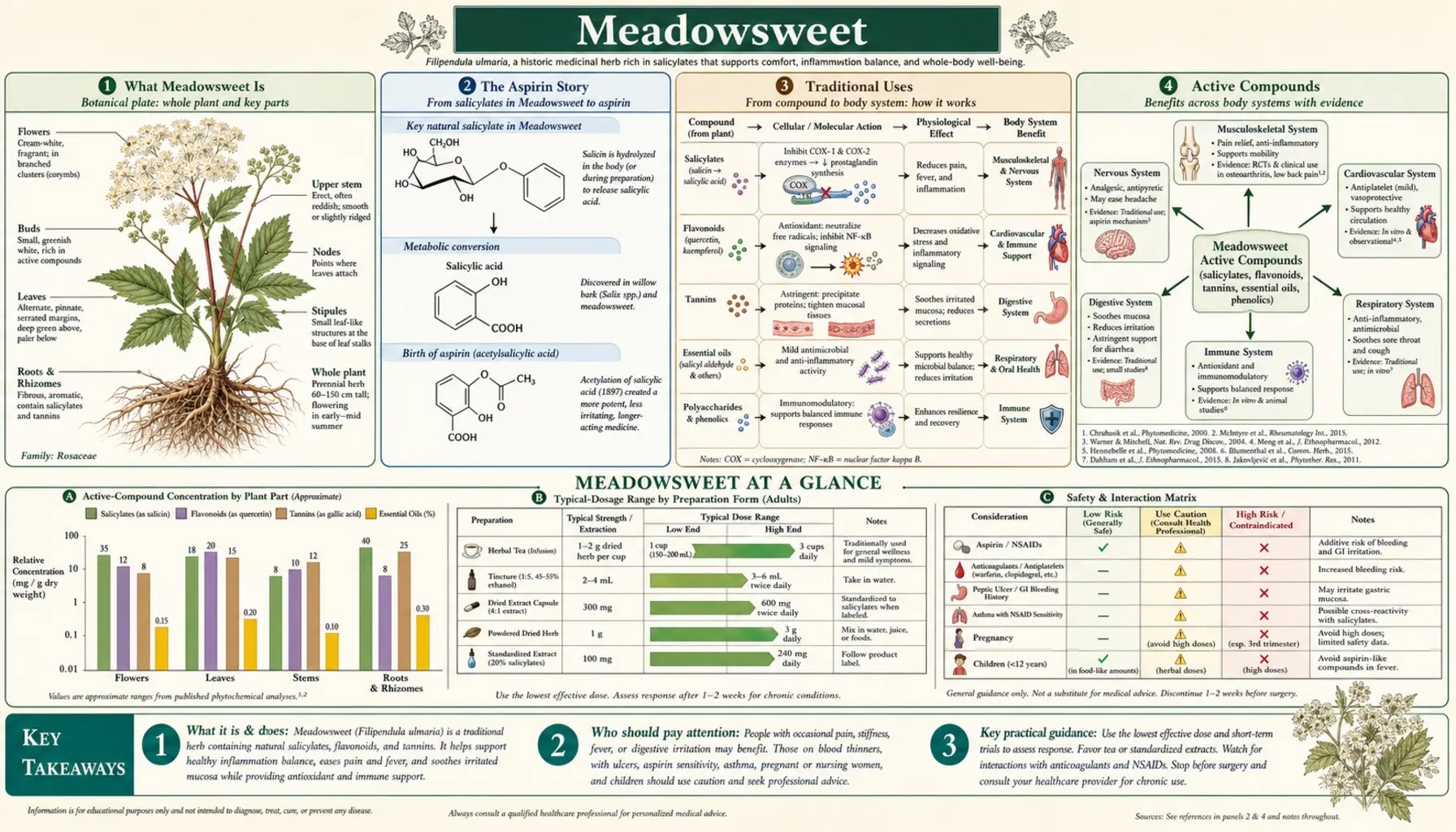
Meadowsweet (Filipendula ulmaria, once classified as Spiraea ulmaria) is a tall, frothy, sweet-smelling herb of damp European meadows and riverbanks. For centuries people brewed its creamy flowers and leaves into teas for fever, aches, rheumatic pain, and—perhaps most interestingly—an upset stomach. It carries a genuinely famous secret: meadowsweet is rich in salicylates, the same family of compounds that willow bark gave the world, and its old botanical name Spiraea is literally where the "spir" in a-SPIR-in comes from. This page tells that story honestly, walks through what the plant actually contains, weighs the real (and still limited) modern evidence, and—because it behaves a lot like a gentle natural aspirin—spells out the safety cautions that genuinely matter.
Table of Contents
- What Meadowsweet Is
- The Aspirin Story
- Traditional Uses
- Active Compounds
- What the Evidence Shows
- Forms & Dosing
- Safety & Cautions
- The Honest Bottom Line
- Research Papers
- Connections
- Featured Videos
What Meadowsweet Is
Meadowsweet is a hardy perennial in the rose family (Rosaceae), native to Europe and western Asia and now naturalized across parts of North America. It likes wet feet—you find it in damp meadows, ditches, marshy ground, and along streams, often standing waist-high with clouds of tiny creamy-white flowers held in flat-topped sprays. Crush a flower or leaf and you catch an unmistakable scent, somewhere between wintergreen and sweet almond. That aroma is your first clue to its chemistry: it comes largely from salicylaldehyde and methyl salicylate, aromatic relatives of the salicylates in aspirin.
The plant has a rich basket of old English names—queen of the meadow, bridewort, meadwort, and lady of the meadow. "Bridewort" recalls its strewing on floors and at weddings for its honeyed fragrance, and one common theory holds that "meadowsweet" comes from "mead-sweet," because the flowers were used to flavor mead and beer. The parts used medicinally are the flowering tops (the flowers and upper leaves), gathered in summer and dried.
The Aspirin Story
Here is the part that delights herbalists and chemists alike, and it is true. In the early 1830s, chemists distilling meadowsweet flowers isolated a fragrant oil and, from it, an aromatic aldehyde (salicylaldehyde). Working from meadowsweet's chemistry, they obtained an acid they named spiraeic acid (in German, Spirsaure) after the plant's old genus name, Spiraea. That acid turned out to be identical to salicylic acid—the very same compound chemists were also getting from willow bark, whose glycoside salicin takes its name from the willow genus Salix. Two damp-meadow plants, willow and meadowsweet, were quietly pointing at the same molecule.
Salicylic acid worked: by the mid-1800s it was used for fever, pain, and rheumatism. But it was harsh—bitter, and famously rough on the stomach. In 1897 chemists at the German firm Bayer prepared a modified, more tolerable version, acetylsalicylic acid, and in 1899 the company launched it under a now-legendary trade name: Aspirin. The name is a little piece of botany folded into a word—"a" for the acetyl group added to the molecule, "spir" from Spiraea (the meadowsweet genus that gave spiraeic acid its name), and "in," a common tidy suffix for medicines of the era. In other words, the world's most familiar painkiller is named, in part, after this unassuming meadow flower.
An honest footnote to the honest story: history long credited the young chemist Felix Hoffmann with the 1897 synthesis, but a careful 2000 reappraisal by the pharmaceutical historian Walter Sneader argued that Arthur Eichengrun—a senior Bayer chemist whose contributions were erased during the Nazi era because he was Jewish—deserves far more of the credit for directing the work. The chemistry is settled; the human story behind it is more tangled and more poignant than the tidy textbook version. Either way, meadowsweet stands at the botanical root of it all.
Traditional Uses
Long before anyone had heard the word "salicylate," European folk medicine used meadowsweet for exactly the complaints modern aspirin treats. Traditional herbalists reached for it to:
- Bring down fever and ease aches during colds, flu, and feverish illness—the classic "aspirin-like" role.
- Soothe rheumatic and joint pain, aching muscles, and general inflammatory aches.
- Calm the digestive tract—and this is the fascinating twist. Where pure aspirin famously irritates the stomach lining, whole meadowsweet was traditionally used for the stomach: for heartburn, hyperacidity, nausea, and mild diarrhea, and it was considered gentle enough to be a folk remedy for children's tummy upsets.
Herbalists explained this apparent paradox by pointing out that meadowsweet is not pure salicylate. Alongside its aspirin-like compounds it is loaded with tannins—astringent, protein-binding molecules—plus flavonoids and buffering plant matter that were thought to soothe and protect the stomach lining rather than strip it. The whole herb, the tradition holds, is kinder to the gut than the isolated drug. It is a lovely idea with real chemical plausibility; the modern evidence for it, as we will see, is promising but still mostly from the lab.
Active Compounds
Meadowsweet's reputation rests on a genuinely interesting mix of constituents that work together:
- Salicylates. The flowers and buds contain salicylaldehyde, methyl salicylate, and small amounts of free salicylic acid, plus phenolic glycosides (such as monotropitin/gaultherin and spiraein) that release these salicylate compounds when the plant is broken down or digested. This is the herb's aspirin-like heart.
- Tannins. Meadowsweet is notably rich in ellagitannins (including rugosin and related compounds). Tannins are astringent and were the traditional basis for the herb's stomach-soothing, anti-diarrheal reputation.
- Flavonoids. The plant is a well-known source of spiraeoside (quercetin 4'-O-glucoside, first isolated from Spiraea and named for it), along with quercetin, kaempferol glycosides, hyperoside, and rutin—antioxidant polyphenols that add anti-inflammatory activity.
- Essential oil. The volatile oil, dominated by salicylaldehyde and methyl salicylate, gives the flowers their wintergreen-almond scent and carries antimicrobial activity.
- Other constituents. Phenolic acids, a modest amount of vitamin C, and mucilage round out the profile.
What the Evidence Shows
Let us be honest and clear. Meadowsweet has a strong traditional record and a strong mechanistic rationale—it demonstrably contains salicylates and antioxidant, anti-inflammatory polyphenols. What it lacks is a body of large, modern, controlled human trials. Most of the good recent science is preclinical (test-tube and animal studies). That does not make the plant worthless—it makes it plausible and under-studied. Here is where the research actually stands.
Anti-inflammatory and pain activity
The salicylate mechanism is not just folklore. In a 2016 study, meadowsweet extract reduced inflammation both in cell tests and in live-animal models, supporting the traditional anti-inflammatory use. A 2025 study similarly reported anti-inflammatory and analgesic (pain-relieving) effects of a Filipendula ulmaria extract in animal models. And a 2023 study went further, showing that when the plant's constituents are metabolized in the gut, the resulting compounds retain anti-inflammatory activity—an important detail, because it means the whole herb's benefit does not depend on a single molecule surviving digestion intact.
Digestive and anti-ulcer activity
This is where the tradition gets its most striking modern echo. A 2018 study in the Journal of Ethnopharmacology tested meadowsweet (and its close relative Filipendula vulgaris) and found meaningful gastroprotective activity—the extracts helped protect the stomach lining in an experimental ulcer model—alongside antioxidant and anti-inflammatory effects. That is a laboratory finding, not a human trial, but it is exactly the direction the old herbalists predicted: a salicylate-containing plant that, as a whole, appears to shield rather than irritate the stomach, most likely thanks to its tannins and antioxidants offsetting the salicylate.
Antioxidant and antimicrobial activity
Meadowsweet consistently scores high in antioxidant assays, driven by its heavy phenolic and flavonoid load; a 2023 analysis mapped how these compounds and their antioxidant and antibacterial activities vary across the plant's flowers, leaves, and roots. Its essential oil and extracts also show antimicrobial activity, and one study zeroed in on salicylaldehyde as a key antimicrobial player in Filipendula oil. A 2024 evaluation confirmed antibacterial and antioxidant potential and profiled the plant's phenolics in both wild and lab-grown material.
The takeaway: meadowsweet's traditional uses line up remarkably well with what the plant's chemistry and preclinical data suggest. But "plausible and promising in the lab" is not the same as "proven in people," and anyone reading marketing claims should hold that distinction firmly.
Forms & Dosing
Meadowsweet is used almost entirely as the dried flowering tops, in two everyday forms. These are traditional herbal preparations, not standardized medicines—the salicylate content of any given batch varies with the plant, the harvest, and the drying.
- Tea (infusion). The most common form. A typical traditional infusion uses roughly 1 to 2 teaspoons (about 2 to 6 grams) of dried flowering tops per cup of hot water, steeped covered for 10 to 15 minutes, taken up to two or three times a day. Keep it covered and avoid a hard boil—the aromatic salicylates are volatile and boil off with the steam.
- Tincture. An alcohol extract, taken by the dropperful (commonly around 1 to 4 mL, up to three times daily in traditional herbal references), diluted in water.
Because meadowsweet is a genuine salicylate herb, "more is better" does not apply—the sensible ceiling is roughly the same conservative attitude you would take toward aspirin. If you take any medication or have any of the conditions below, treat it with the caution you would treat a mild NSAID, and talk to a clinician or pharmacist first.
Safety & Cautions
This section matters more for meadowsweet than for most gentle herbs, precisely because it contains salicylates. The simplest and safest rule of thumb: respect the same cautions you would respect for aspirin.
- Aspirin or salicylate allergy/sensitivity—avoid. If you react to aspirin or other salicylates, do not use meadowsweet. The same compounds are present.
- Children and teenagers with a viral illness—avoid. Because aspirin-type salicylates are linked to Reye's syndrome (a rare but serious condition) in children and teens recovering from flu, chickenpox, or other viral infections, the same theoretical caution applies to a salicylate-containing herb. Do not give meadowsweet to feverish children or adolescents.
- Blood thinners and surgery—caution. Salicylates can affect platelets and add to the effect of anticoagulant or antiplatelet drugs (such as warfarin), theoretically increasing bleeding risk. Avoid combining them without medical advice, and stop meadowsweet well before any planned surgery or dental procedure.
- Asthma with salicylate/NSAID sensitivity—caution. A minority of people with asthma react to aspirin and salicylates with wheezing or bronchospasm. If that describes you, avoid meadowsweet.
- Pregnancy and breastfeeding—avoid. Salicylates are best avoided in pregnancy, and there is not enough safety data for meadowsweet during pregnancy or nursing. Skip it.
- A soothing reputation is not a guarantee. Yes, tradition and preclinical data suggest the whole herb is gentler on the stomach than pure aspirin. But if you have an active ulcer, a bleeding disorder, or serious stomach disease, do not rely on that—the human evidence is not there yet. Get individual advice.
The Honest Bottom Line
Meadowsweet is one of the most historically important herbs in the whole herbal cabinet: a fragrant meadow flower that helped give the world salicylic acid and lent its old name, Spiraea, to the word "aspirin." It contains real salicylates, real antioxidant flavonoids, and real astringent tannins, and its traditional uses for fever, aches, rheumatic pain, and—unusually—stomach complaints are well documented and chemically plausible. Modern preclinical work backs up its anti-inflammatory, antioxidant, and even gastroprotective reputation. What is missing is the modern human-trial evidence that would let anyone make firm clinical claims. So the fair verdict is this: a genuinely interesting, historically significant salicylate herb that tradition considers gentler on the stomach than aspirin, promising in the lab, thin on clinical proof—and deserving of exactly the same respect and cautions you would give aspirin itself.
Research Papers
- Sneader W. The discovery of aspirin: a reappraisal. BMJ. 2000;321(7276):1591-1594. doi:10.1136/bmj.321.7276.1591 — The influential reassessment of who really developed acetylsalicylic acid, and how the drug got its name.
- Desborough MJR, Keeling DM. The aspirin story – from willow to wonder drug. British Journal of Haematology. 2017;177(5):674-683. doi:10.1111/bjh.14520 — A readable history tracing salicylates from willow and meadowsweet to the modern medicine.
- Mahdi JG. Medicinal potential of willow: a chemical perspective of aspirin discovery. Journal of Saudi Chemical Society. 2010;14(3):317-322. doi:10.1016/j.jscs.2010.04.010 — Reviews the salicylate chemistry behind the willow-to-aspirin story that meadowsweet shares.
- Samardzic S, Arsenijevic J, Bozic D, Milenkovic M, Tesevic V, Maksimovic Z. Antioxidant, anti-inflammatory and gastroprotective activity of Filipendula ulmaria (L.) Maxim. and Filipendula vulgaris Moench. Journal of Ethnopharmacology. 2018;213:132-137. doi:10.1016/j.jep.2017.11.013 — The key study echoing tradition: meadowsweet protected the stomach lining while showing antioxidant and anti-inflammatory effects.
- Katanic J, Boroja T, Mihailovic V, et al. In vitro and in vivo assessment of meadowsweet (Filipendula ulmaria) as anti-inflammatory agent. Journal of Ethnopharmacology. 2016;193:627-636. doi:10.1016/j.jep.2016.10.015 — Meadowsweet extract reduced inflammation in both cell and animal models.
- Marinov L, Momekov G, Voynikov Y, et al. Anti-inflammatory and analgesic effects of Filipendula ulmaria extract. Pharmacia. 2025;72:1-11. doi:10.3897/pharmacia.72.e141286 — Recent animal-model evidence for pain-relieving and anti-inflammatory activity.
- Van der Auwera A, Peeters L, Foubert K, et al. In vitro biotransformation and anti-inflammatory activity of constituents and metabolites of Filipendula ulmaria. Pharmaceutics. 2023;15(4):1291. doi:10.3390/pharmaceutics15041291 — Shows the herb's constituents keep anti-inflammatory activity after gut metabolism.
- Savina T, Lisun V, Feduraev P, Skrypnik L. Variation in phenolic compounds, antioxidant and antibacterial activities of extracts from different plant organs of meadowsweet (Filipendula ulmaria (L.) Maxim.) Molecules. 2023;28(8):3512. doi:10.3390/molecules28083512 — Maps how phenolics and antioxidant/antibacterial activity differ across flowers, leaves, and roots.
- Popowski D, Pawlowska KA, Piwowarski JP, Granica S. Gut microbiota-assisted isolation of flavonoids with a galloyl moiety from flowers of meadowsweet, Filipendula ulmaria (L.) Maxim. Phytochemistry Letters. 2019;30:220-223. doi:10.1016/j.phytol.2018.12.003 — Characterizes distinctive tannin-linked flavonoids in the flowers.
- Radulovic N, Misic M, Aleksic J, Djokovic D, Palic R, Stojanovic G. Antimicrobial synergism and antagonism of salicylaldehyde in Filipendula vulgaris essential oil. Fitoterapia. 2007;78(7-8):565-570. doi:10.1016/j.fitote.2007.03.022 — Identifies salicylaldehyde, the salicylate that scents the plant, as a key antimicrobial constituent in a close relative.
- Birinci Yildirim A, Cimen A, Baba Y, Turker A. Natural- and in vitro-grown Filipendula ulmaria (L.) Maxim: evaluation of pharmaceutical potential (antibacterial, antioxidant and toxicity) and phenolic profiles. Prospects in Pharmaceutical Sciences. 2024;22(1):1-10. doi:10.56782/pps.171 — Confirms antibacterial and antioxidant potential and details the phenolic makeup.
Connections
- All Herbs
- Willow Bark
- Aspirin
- Feverfew
- Turmeric
- Ginger
- Gastroenterology
- Peptic Ulcer Disease
- Gastritis
- Rheumatology
- Arthritis
- Osteoarthritis