Haritaki (Terminalia chebula)
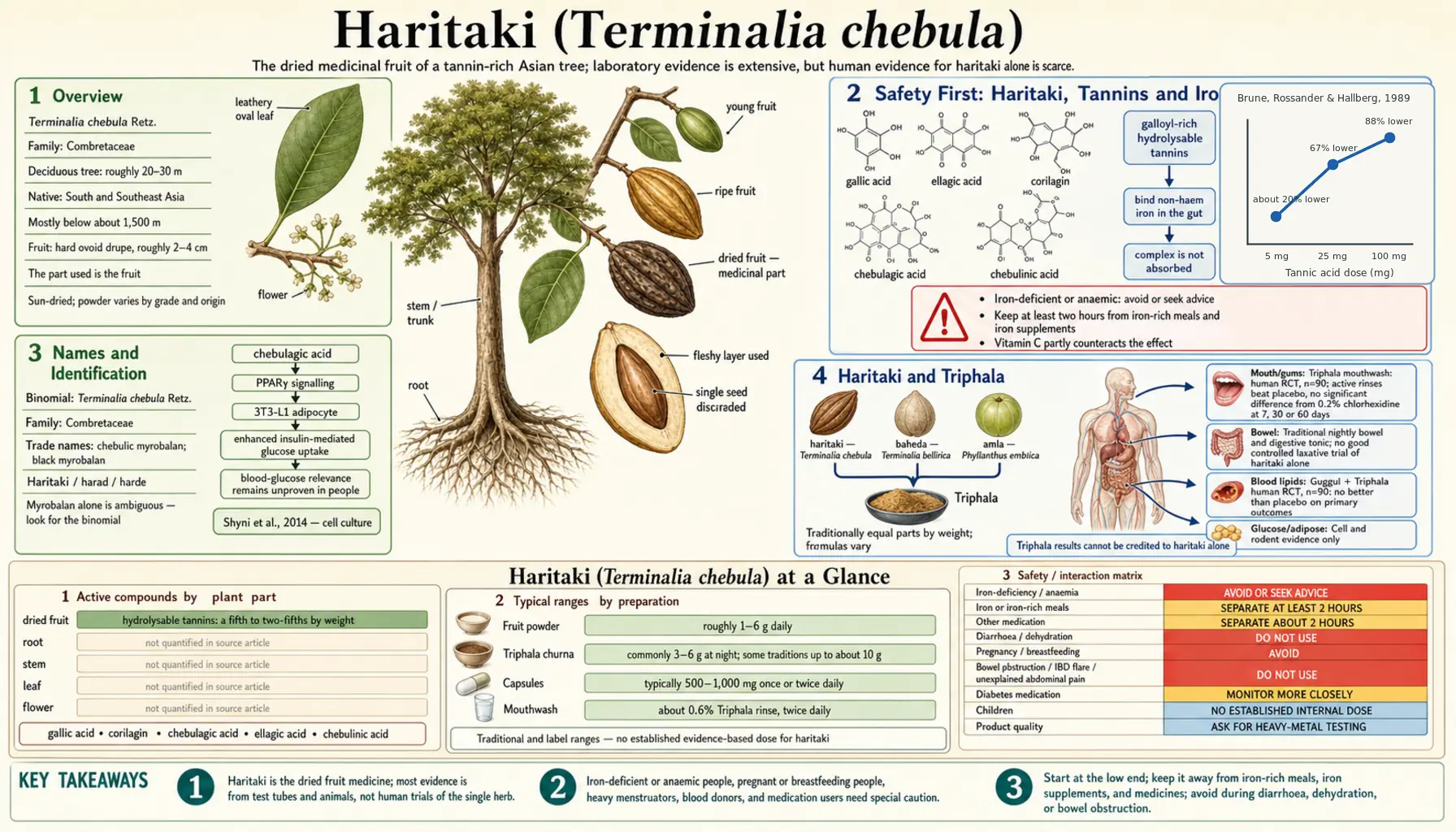
Haritaki is the dried fruit of Terminalia chebula, a large tree of South and Southeast Asia, and one of the three fruits that make up Triphala, the best-known compound medicine in Ayurveda. Tibetan medicine calls it the king of medicines and puts it in the hand of the Medicine Buddha; the fruit has been traded across Asia for well over a thousand years, chiefly as a bowel regulator. The honest summary of the modern evidence is short: haritaki is very heavily studied in test tubes and rodents and almost unstudied in people on its own, and the human trials that exist are nearly all of Triphala — a three-herb mixture whose results cannot be credited to haritaki alone.
One caution belongs at the top rather than buried at the bottom. Haritaki is one of the most tannin-rich medicinal fruits in common use, and those tannins are the specific chemical type — galloyl-bearing hydrolysable tannins — that blocks the absorption of iron from food. If you are anaemic, iron-deficient, pregnant, menstruating heavily, or a blood donor, that is not a footnote. It is the main thing to know.
Table of Contents
- Overview
- Safety First: Haritaki, Tannins and Iron
- Names and Identification
- Haritaki and Triphala
- Traditional Use
- Active Compounds
- Bowel Regulation and the Laxative Question
- Antioxidant and Anti-Inflammatory Activity
- Antimicrobial and Antiviral Activity
- Blood Sugar and Metabolic Effects
- Oral Health: Where the Human Evidence Actually Is
- Culinary Use
- Forms and Preparations
- Dosage
- Cautions and Contraindications
- Key Research Papers
- Connections
- Featured Videos
Overview
Terminalia chebula Retz. is a deciduous tree in the family Combretaceae, the same family as the tropical almond and as its Triphala partner baheda. It grows to roughly 20–30 metres, with a straight trunk, a spreading crown and leathery oval leaves. It is native across a wide band of Asia: India, Nepal, Bhutan, Bangladesh, Sri Lanka, Myanmar, Thailand, Laos, Vietnam and southern China, mostly in deciduous forest below about 1,500 metres.
The part used is the fruit — a hard, ovoid drupe roughly 2–4 cm long with five faint longitudinal ridges, green when young and yellowish-brown when ripe. It is gathered by hand, sun-dried, and reaches the market as a wrinkled, ribbed, stone-hard nut-like object with a single seed inside. The seed is discarded; the fleshy layer around it is the medicine.
How it gets from the forest to a shop is worth picturing, because it explains a lot of the variability in the product you can buy. Most haritaki is still collected from wild or semi-wild trees by rural gatherers, dried on the ground or on mats, sold to village traders, aggregated at regional mandis, and only then graded. Grading matters: Ayurvedic tradition distinguishes several types of haritaki by size, maturity and origin — names such as vijaya, abhaya, rohini and chetaki appear in the classical texts — and the immature, smaller fruit is regarded as the more strongly purgative, the fully ripe as the gentler tonic. A commercial powder is very often a blend of grades from several sources, which is one reason two bottles of “haritaki” can behave quite differently in the same person.
Safety First: Haritaki, Tannins and Iron
Haritaki's chemistry is dominated by hydrolysable tannins — large molecules built from a sugar core studded with gallic acid units. Depending on grade and origin, tannins are commonly reported to make up something in the range of a fifth to two-fifths of the dried fruit by weight. That is what makes the fruit so mouth-puckeringly astringent, and it is also the source of its most predictable interaction.
The mechanism is well characterised in human absorption studies. Tannins bearing galloyl groups bind non-haem iron (the plant-food form) in the gut and hold it in a complex your intestine cannot take up. Brune, Rossander and Hallberg showed in 1989 that this effect tracks the number of galloyl groups almost linearly and is strongly dose-related: in their human test meals, 5 mg of tannic acid cut iron absorption by about 20%, 25 mg by 67%, and 100 mg by 88%. Crucially, they also found that condensed tannins (the type in cocoa or apples) do not interfere much — it is the galloyl-rich hydrolysable tannins that do. Haritaki is exactly that type.
Hurrell, Reddy and Cook confirmed how large the everyday version of this effect is: beverages carrying 100–400 mg of total polyphenols per serving reduced iron absorption from a bread meal by 60–90%, with black tea coming in at 79–94%. Haritaki is more tannin-dense than tea by weight.
What that means practically:
- If you are iron-deficient or anaemic, or being treated for either, haritaki is a poor choice. Ask about it before starting, and mention it if your ferritin is being tracked.
- If you take haritaki anyway, take it well away from iron-containing meals and iron supplements — two hours is the usual practical spacing, and further is better.
- The same spacing rule applies to medications generally. Tannins bind many drug molecules non-specifically, and haritaki's laxative action speeds transit, which shortens the window in which anything else can be absorbed. Two hours either side of medication is the sensible default.
- Vitamin C partly counteracts the effect on iron. That is not an endorsement of taking them together, but it is why iron-rich meals are better paired with citrus than with tannin-rich preparations. See Vitamin C.
Names and Identification
Binomial: Terminalia chebula Retz. Family: Combretaceae.
- English trade name: chebulic myrobalan, black myrobalan.
- Sanskrit / Hindi: haritaki; also harad, har, harde in north Indian markets.
- Tamil: kadukkai. Telugu: karakkaya. Malayalam: kadukka. Bengali: haritaki.
- Tibetan: a-ru-ra (arura).
- Chinese (TCM): 訶子 / 诃子, hē zĭ — also written “hezi”.
- Thai: samo thai (สมอไทย).
- Unani / Persian: halela, with grades distinguished as halela zard (yellow), halela siyah (black) and halela kabuli (large).
The name “myrobalan” is a trap, and it is worth a paragraph. All three Triphala fruits are called myrobalans in English: Terminalia chebula is the chebulic myrobalan, Terminalia bellirica is the belleric myrobalan, and Phyllanthus emblica is the emblic myrobalan. They are three different species, and the last is not even in the same family. Worse, in European horticulture “myrobalan” usually means Prunus cerasifera, the cherry plum used as a rootstock — a plant with no relationship to any of these and no shared use. If a label, a supplier or an old text says only “myrobalan”, that word alone does not identify the plant. Look for the binomial.
Haritaki and Triphala
Triphala means “three fruits”: haritaki (Terminalia chebula), baheda (Terminalia bellirica) and amla (Phyllanthus emblica), traditionally combined in equal parts by weight, though many classical and commercial formulas vary the ratio. It is the single most widely used compound preparation in Ayurveda, taken chiefly as a nightly bowel and digestive tonic.
This matters for reading the research. The overwhelming majority of human data on haritaki is actually data on Triphala, and a positive Triphala result cannot be assigned to haritaki, to baheda or to amla individually — the three have overlapping but genuinely different chemistry, and amla in particular brings ascorbic acid that the two Terminalia fruits do not. When a supplement label cites “clinical research” for a single-herb haritaki capsule, check whether the trial it points to actually used haritaki alone. Usually it did not.
A 2024 metabolome study by Hegde and colleagues profiled all three fruits side by side specifically to work out what each contributes to the mixture — the sort of groundwork that has to happen before anyone can honestly separate their effects.
Traditional Use
Ayurveda. Haritaki is classified as predominantly astringent (kashaya rasa) and is described in the classical texts as carrying five of the six tastes — everything except salty. Its principal traditional roles are as an anulomana (something that restores downward flow, i.e. regulates the bowel), a digestive, and a rasayana or rejuvenative. It is the leading fruit of Triphala and appears in a great many compound formulas.
Tibetan medicine (Sowa Rigpa). Here haritaki carries more prestige than anywhere else. It is called the king of medicines, and it appears in the iconography of the Medicine Buddha, Sangye Menla, who is conventionally depicted holding a sprig or fruit of the myrobalan plant. It is a component of a very large share of Tibetan compound formulas.
Traditional Chinese Medicine. As hē zĭ, haritaki is placed in the astringent category and used almost in the opposite direction from Ayurveda — to stop chronic diarrhoea and dysentery, and for chronic cough and loss of voice. That contradiction is real and unresolved, and the usual explanation offered is that dose and preparation shift the balance: raw and immature fruit leans laxative, while heavily processed, roasted or long-decocted fruit leans astringent. There is a suggestive animal finding along these lines for the sibling species — Pandey and colleagues reported in 2017 that grilling the fruits of Terminalia bellerica enhanced their antidiarrhoeal activity in a rodent model — but that is one animal study on a different species, and it does not settle the question.
Unani and Persian medicine. Traded as halela since at least the medieval period, used as a purgative and as a general corrective added to other formulas.
Traditional use is history, not evidence of effect. It tells you what people did and believed, and it is a good guide to where to look. It is not a substitute for a trial.
Active Compounds
The chemistry of haritaki is unusually well mapped, largely because the tannins are abundant and easy to isolate.
- Chebulagic acid — a benzopyran hydrolysable tannin, one of the two signature molecules of the fruit. Isolated preparatively from T. chebula by Han and colleagues in 2006 using counter-current chromatography.
- Chebulinic acid — the other signature tannin, closely related and often quantified alongside chebulagic acid.
- Corilagin — a smaller galloyl-glucose tannin found across many tannin-rich plants, including Phyllanthus species.
- Gallic acid — the simplest galloyl unit, present free as well as bound. It is the specific structure implicated in tannin–iron binding.
- Ellagic acid — formed from ellagitannins; widely studied as an antioxidant.
- Others: punicalagin, terchebulin, chebulic acid, neochebulinic acid, terflavins; flavonoids including quercetin and rutin; small quantities of triterpenoids; and a minor anthraquinone fraction.
Dhanani, Shah and Kumar published a validated HPLC method in 2015 for measuring five of these markers — gallic acid, corilagin, chebulagic acid, ellagic acid and chebulinic acid — across four Indian Terminalia species. That paper is a good reference point for anyone trying to make sense of a certificate of analysis, because a product that reports none of these markers is not telling you much about what is in the bottle.
Bowel Regulation and the Laxative Question
This is the use haritaki is genuinely famous for, and it is also the one where the mechanism is least well established.
The intuitive assumption is that haritaki works like senna. It does not, or at least not mainly. Senna's action is well characterised: it contains sennosides, anthraquinone glycosides that gut bacteria convert into an active form which directly stimulates colonic secretion and motility. Haritaki contains only a minor anthraquinone fraction — nothing like senna's — so anthraquinone stimulation is unlikely to be the whole story or even most of it.
What is more plausible, and what the traditional descriptions actually match, is a milder, mixed effect: some osmotic and bulking contribution from the fruit's sugars and fibre, some prokinetic effect on gut motility, and a change in the gut environment from the tannins and their bacterial breakdown products. A comparative animal study by Tiwari and colleagues in 2023 found antispasmodic activity for Terminalia chebula alongside T. bellerica, long pepper, black pepper and ginger — consistent with an effect on smooth muscle, but that was rodent tissue, not people.
Human evidence: essentially none for haritaki alone. There is no good controlled trial of single-herb haritaki as a laxative. What exists are trials of Triphala, and even those are mostly aimed at other outcomes. If someone tells you haritaki is a clinically proven laxative, ask which trial. This is a case where centuries of consistent use is the best available evidence, and it is worth saying plainly that centuries of consistent use is not the same as a trial.
The practical corollary matters more than the mechanism: because the effect is real but not dose-predictable across products, haritaki should be started low and titrated, and it should not be used in the presence of diarrhoea, dehydration or suspected bowel obstruction.
Antioxidant and Anti-Inflammatory Activity
Haritaki extracts perform extremely well in laboratory antioxidant assays — frequently at the top of screens that include dozens of medicinal plants. This is not surprising and should not be over-read: hydrolysable tannins are chemically excellent at donating electrons in a test tube, which is precisely what those assays measure. A high ORAC or DPPH figure tells you about the chemistry of the extract, not about what happens in a person who swallows it.
The gap between the two is real. Large tannins are poorly absorbed intact; much of what reaches the bloodstream is bacterial metabolites, and their behaviour is different from the parent molecules. Pfundstein and colleagues quantified and characterised the polyphenols and antioxidant capacities of T. chebula, T. bellerica and T. horrida fruits in a careful 2010 analysis, which is a useful corrective to marketing figures.
Evidence level: in vitro, plus animal models. There is no human trial showing that haritaki supplementation improves a clinical outcome through antioxidant action.
Antimicrobial and Antiviral Activity
Haritaki extracts inhibit a broad range of bacteria and viruses in cell culture, and the two signature tannins carry much of that activity. Kesharwani and colleagues showed in 2017 that T. chebula extract and its isolated constituents chebulagic and chebulinic acids had activity against herpes simplex virus type 2 in cell-based assays. Tannins in general interfere with viral attachment and entry, which is a plausible mechanism and also a reason to be cautious about extrapolating: a molecule that gums up viral attachment in a dish may never reach an infected tissue at a meaningful concentration after oral dosing.
Evidence level: cell culture. No human trial supports using haritaki to treat any infection. This is the area where the gap between laboratory enthusiasm and clinical reality is widest, and where the risk of someone delaying real antiviral or antibiotic treatment is highest.
Blood Sugar and Metabolic Effects
There is a coherent laboratory story here. Shyni and colleagues reported in 2014 that chebulagic acid enhanced insulin-mediated glucose uptake in 3T3-L1 adipocytes, apparently through PPARγ signalling — the same receptor family targeted by the glitazone class of diabetes drugs. Separately, Das and colleagues found in 2022 that foods formulated with all three Triphala herbs inhibited α-amylase, α-glucosidase and DPP-IV activity and lowered glucose in a rat model of diabetes; enzyme inhibition of that kind slows the breakdown of starch and would be expected to blunt post-meal glucose spikes.
Evidence level: cell culture and rodent. No adequate human trial of haritaki alone for glycaemic control exists. A meta-analysis of amla trials found metabolic benefits, but that is amla, not haritaki — see the amla page.
The practical implication is a caution, not a recommendation: if you take haritaki or Triphala while on metformin, sulfonylureas or insulin, monitor your glucose more closely than usual for the first couple of weeks, because an additive effect is biologically plausible even though it has not been quantified.
Oral Health: Where the Human Evidence Actually Is
If you want to know where randomised human trials of Triphala genuinely exist, the answer is dentistry — and this is worth knowing precisely because it is not the use most people buy haritaki for.
Pradeep and colleagues randomised 90 people with chronic generalised gingivitis to placebo, Triphala mouthwash, or 0.2% chlorhexidine mouthwash, rinsing twice daily, and measured plaque index, gingival index and bacterial counts at 7, 30 and 60 days. Both active rinses beat placebo, and there was no significant difference between Triphala and chlorhexidine on any measure at any time point. Naiktari and colleagues reported a comparable result in hospitalised patients with periodontal disease in 2014, and several further small trials since have pointed the same way.
Two honest caveats. First, these are mouthwash trials — a rinse, spat out. They say nothing about swallowing haritaki. Second, they are small, short, largely single-centre and largely from Indian dental schools; that does not make them wrong, but it does mean the effect size should be held loosely until independent replication accumulates. A 2024 systematic review and meta-analysis of Triphala versus chlorhexidine in children reached broadly favourable conclusions on the same limited base.
And the counterweight. The best-designed European trial of a Triphala-containing preparation was negative. Donato and colleagues randomised 90 people with high cholesterol to a guggul-plus-Triphala preparation or placebo, three times daily for three months. Total cholesterol fell 3.3% on the herb and 1.9% on placebo; LDL cholesterol fell 4.8% and 4.9% respectively — that is, no better than placebo on the primary outcomes, or on BMI or waist circumference. Two participants (4.3%) in the herb group developed a hypersensitivity rash and none did on placebo. That is exactly the kind of result that gets quietly left out of supplement marketing, and it belongs on this page.
Culinary Use
Haritaki is a medicine first, but it does have a genuine, if narrow, food life. In Tamil Nadu, kadukkai appears in home preparations — powdered into ghee or honey, or made into a pickle. In parts of Thailand the fruit (samo thai) is candied or preserved in syrup and eaten as a sweet-sour snack, and it turns up in traditional herbal drinks. The candying is not incidental: raw haritaki is punishingly astringent, and sugar plus long soaking is the traditional way of making it palatable.
It is not a spice in the way that cardamom or pepper is, and it is not used for flavour in everyday cooking. If a recipe calls for it, it is being used medicinally.
Forms and Preparations
- Whole dried fruit. The traditional article of trade. Soaked, decocted, or ground fresh. Longest shelf life; you can see what you are buying, which is an advantage.
- Churna (powder). The commonest form. Taken with warm water, honey or ghee. Powder oxidises and loses potency faster than whole fruit; buy small quantities.
- Triphala churna. Equal parts haritaki, baheda and amla. The default traditional preparation, usually taken at night.
- Capsules and tablets. Convenient, dose-consistent, but frequently under-dosed relative to traditional practice, and rarely standardised to any marker compound.
- Standardised extracts. Occasionally standardised to chebulagic acid, chebulinic acid or total tannins. If a product names and quantifies a marker, that is a meaningfully better signal than one that says only “fruit extract”.
- Decoction (kwath). Simmered water extract, traditional and cheap; strongly astringent.
- Mouthwash. A dilute Triphala infusion — the form with the best human trial support, as above.
What to look for on a label: the binomial Terminalia chebula, the plant part (it should say fruit), the country of origin, and ideally a marker compound with a number attached. Heavy-metal testing is worth asking about for any Ayurvedic product, since contamination of imported traditional medicines has been documented repeatedly.
Dosage
There is no established evidence-based dose for haritaki. No dose-finding trial has been done in humans for the single herb. What follows is the range in traditional practice and on commercial labels, given so you can interpret what you are handed — not as a recommendation.
- Powder, traditional range: roughly 1–6 g of dried fruit powder daily, most often taken once at night with warm water.
- Triphala churna: commonly 3–6 g at night; some traditions use up to about 10 g.
- Capsules: typically 500–1,000 mg once or twice daily, which is often well below the traditional powder dose.
- Mouthwash: the trials above generally used a dilute aqueous Triphala rinse (in the region of 0.6%) twice daily.
Start at the low end. Haritaki's most reliable effect is on the bowel, and the practical difference between a dose that regulates and a dose that causes cramping and loose stools is individual. Take it in the evening, on an empty stomach or well away from other medications, and increase only if nothing happens after several days.
Cautions and Contraindications
- Iron deficiency and anaemia — the headline caution. Haritaki's galloyl-rich tannins substantially block non-haem iron absorption (see the section above). Anyone with low ferritin, iron-deficiency anaemia, heavy menstrual bleeding, or on iron replacement should avoid it or at minimum separate it from iron and from iron-rich meals by at least two hours. Vegetarians and vegans, who rely on non-haem iron, are at greater risk than meat-eaters.
- Do not use during diarrhoea or dehydration. A laxative-leaning herb during fluid loss is the wrong direction. The TCM antidiarrhoeal use is a different preparation and a different tradition; do not assume the powder on your shelf behaves that way.
- Separate from all medication by about two hours. Two independent reasons: tannins bind drug molecules in the gut, and faster transit reduces absorption time. This matters most for narrow-margin drugs — thyroid hormone, anticonvulsants, digoxin, lithium, immunosuppressants and oral contraceptives.
- Pregnancy: avoid. Safety in pregnancy has not been established. Stimulant and strongly purgative herbs are conventionally avoided in pregnancy, and there is no human safety data for haritaki specifically. The same reasoning applies to breastfeeding.
- Diabetes medication. Plausible additive glucose-lowering effect (cell and animal data only). Monitor more closely for the first few weeks.
- Bowel obstruction, inflammatory bowel disease in flare, undiagnosed abdominal pain. Do not use.
- Children. No established paediatric dosing for internal use. The mouthwash trials in adolescents are a different exposure entirely.
- Allergic reactions are possible. In the Donato trial of a Triphala-containing preparation, 4.3% of participants developed a hypersensitivity rash versus none on placebo. Stop if a rash appears.
- Long-term use. Chronic daily use of any laxative-leaning herb deserves a periodic reassessment. If you have needed haritaki nightly for a year to move your bowels, the underlying cause is worth investigating rather than managing indefinitely.
- Product quality. Contamination of imported Ayurvedic products with heavy metals has been repeatedly documented. Buy from suppliers who test and will show you the results.
Formal toxicity work is limited but not absent: Kim and colleagues published mutagenicity and oral toxicity studies of Terminalia chebula in 2012, and a 2024 Thai study assessed acute and chronic oral toxicity of a Triphala preparation in rats. Rodent toxicology establishes a margin; it does not establish human safety in the populations excluded above.
Key Research Papers
- Nigam M, Mishra AP, Adhikari-Devkota A, Dirar AI, Hassan MM, Adhikari A, Belwal T, Devkota HP. Fruits of Terminalia chebula Retz.: a review on traditional uses, bioactive chemical constituents and pharmacological activities. Phytotherapy Research. 2020;34(10):2518–2533.
- Wang C, Zhang H, Wang X, Wang X, Li X, Li C, Wang Y, Zhang M. Comprehensive review on fruit of Terminalia chebula: traditional uses, phytochemistry, pharmacology, toxicity, and pharmacokinetics. Molecules. 2024;29(23):5547.
- Dhanani T, Shah S, Kumar S. A validated high-performance liquid chromatography method for determination of tannin-related marker constituents gallic acid, corilagin, chebulagic acid, ellagic acid and chebulinic acid in four Terminalia species from India. Journal of Chromatographic Science. 2015;53(4):625–632.
- Han Q, Song J, Qiao C, Wong L, Xu H. Preparative isolation of hydrolysable tannins chebulagic acid and chebulinic acid from Terminalia chebula by high-speed counter-current chromatography. Journal of Separation Science. 2006;29(11):1653–1657.
- Kesharwani A, Polachira SK, Nair R, Agarwal A, Mishra NN, Gupta SK. Anti-HSV-2 activity of Terminalia chebula Retz extract and its constituents, chebulagic and chebulinic acids. BMC Complementary and Alternative Medicine. 2017;17(1):110. Cell culture.
- Shyni GL, Kavitha S, Indu S, Arya AD, Anusree SS, Vineetha VP, Vandana S, Sundaresan A, Raghu KG. Chebulagic acid from Terminalia chebula enhances insulin mediated glucose uptake in 3T3-L1 adipocytes via PPARγ signaling pathway. BioFactors. 2014;40(6):646–657. Cell culture.
- Pradeep AR, Suke DK, Martande SS, Singh SP, Nagpal K, Naik SB. Triphala, a new herbal mouthwash for the treatment of gingivitis: a randomized controlled clinical trial. Journal of Periodontology. 2016;87(11):1352–1359. Human RCT, n=90.
- Naiktari RS, Gaonkar P, Gurav AN, Khiste SV. A randomized clinical trial to evaluate and compare the efficacy of triphala mouthwash with 0.2% chlorhexidine in hospitalized patients with periodontal diseases. Journal of Periodontal & Implant Science. 2014;44(3):134–140. Human RCT.
- Donato F, Raffetti E, Toninelli G, Festa A, Scarcella C, Castellano M. Guggulu and Triphala for the treatment of hypercholesterolaemia: a placebo-controlled, double-blind, randomised trial. Complementary Medicine Research. 2021;28(3):216–225. Human RCT, n=90 — negative on primary outcomes.
- Brune M, Rossander L, Hallberg L. Iron absorption and phenolic compounds: importance of different phenolic structures. European Journal of Clinical Nutrition. 1989;43(8):547–557. Human absorption study — the galloyl-group mechanism.
- Hurrell RF, Reddy M, Cook JD. Inhibition of non-haem iron absorption in man by polyphenolic-containing beverages. British Journal of Nutrition. 1999;81(4):289–295. Human absorption study.
- Thankachan P, Walczyk T, Muthayya S, Kurpad AV, Hurrell RF. Iron absorption in young Indian women: the interaction of iron status with the influence of tea and ascorbic acid. American Journal of Clinical Nutrition. 2008;87(4):881–886. Human RCT.
- Kim JH, Koo YC, Hong CO, Yang SY, Jun W, Lee KW. Mutagenicity and oral toxicity studies of Terminalia chebula. Phytotherapy Research. 2012;26(1):39–47. Rodent toxicology.
- Hegde SN, K LD, Choudhary M, Menon N, Singh G. A comprehensive metabolome profiling of Terminalia chebula, Terminalia bellerica, and Phyllanthus emblica to explore the medicinal potential of Triphala. Scientific Reports. 2024;14(1):31635.
Live PubMed Searches
- Terminalia chebula — all literature
- Terminalia chebula — clinical trials
- Triphala — all literature
- Triphala — randomised controlled trials
- Chebulagic acid
- Chebulinic acid
- Corilagin — pharmacology
- Hydrolysable tannins and iron absorption
- Terminalia chebula — toxicity and safety
- Triphala mouthwash and gingivitis
Connections
- All Herbs
- Baheda (Terminalia bellirica) — the second fruit of Triphala, and haritaki's closest botanical relative on this site.
- Amla / Indian Gooseberry (Phyllanthus emblica) — the third fruit of Triphala, and the only one of the three that is a serious vitamin C source.
- Senna — the herb haritaki is most often compared with, and the one whose laxative mechanism is genuinely well characterised.
- Vitamin C — the nutrient that partly counteracts tannin inhibition of iron absorption.
- Conditions on this site that reference this page: Cholesterol Management · Gingivitis · Halitosis (Chronic Bad Breath) · Periodontitis (Gum Disease) · Dentistry & Oral Health · Gum Disease · Prediabetes · Constipation