Hawthorn (Crataegus monogyna)
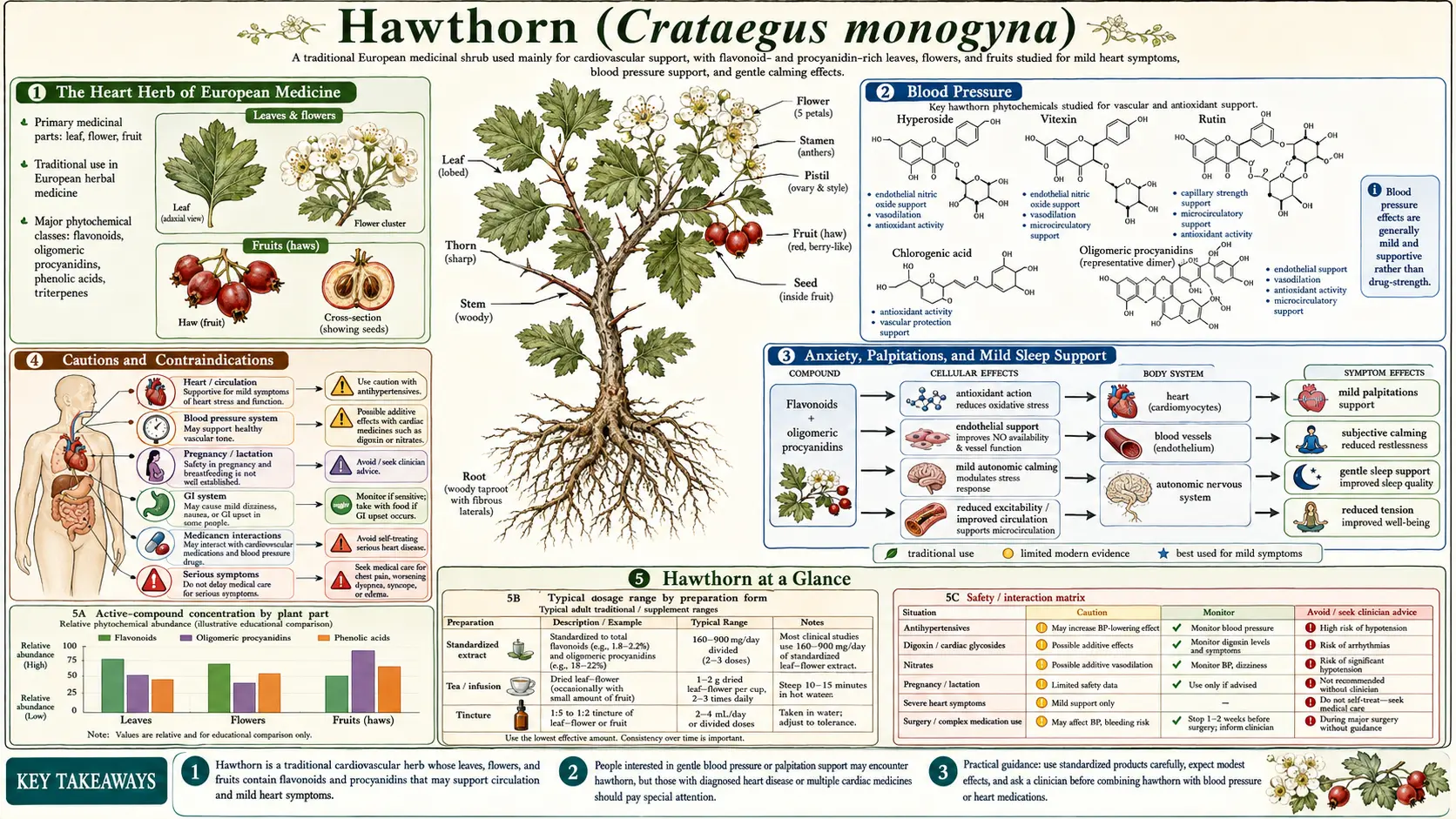
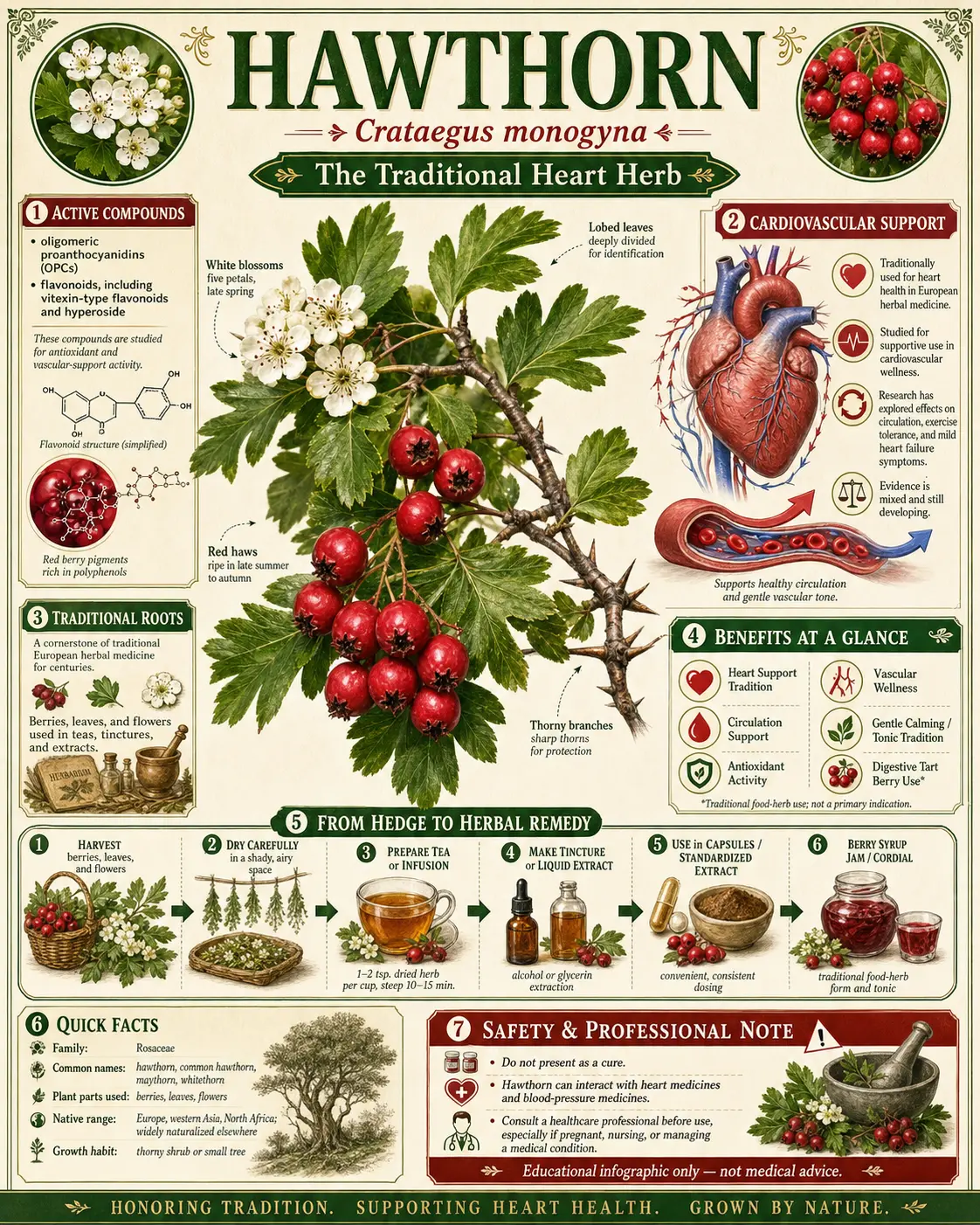
Table of Contents
The Heart Herb of European Medicine
Hawthorn is a thorny tree of the rose family, with white spring flowers and bright red autumn berries (haws), found across Europe, North Africa, and Western Asia. Its name and lore reach back to the ancient Greek botanists and to the "May tree" and fairy-thorn folklore of the British Isles, while in China the fruit (shan zha) is an age-old digestive food-medicine; the herb's famous reputation for the heart, however, is largely a story of the last century and a half, carried into modern medicine by figures such as the French physician Henri Leclerc and, more recently, by the German standardized extract WS 1442. — the fuller story is told in the dedicated History & Traditional Use article.
Active Compounds
Hawthorn's cardiovascular activity comes from a synergistic blend of polyphenolic compounds:
- Oligomeric proanthocyanidins (OPCs) — complex polyphenols with strong antioxidant, anti-inflammatory, and vascular-protective activity; concentrated in the leaves and flowers
- Flavonoids — including vitexin, hyperoside, rutin, and quercetin; active on cardiac contractility and vascular tone
- Triterpene acids — ursolic acid, oleanolic acid; mild positive inotropic and antioxidant effects
- Catechins and epicatechins — additional antioxidant and endothelial-protective compounds
Standardized extracts are typically calibrated to OPC content (often 18.75% as in WS 1442) or to total flavonoid content, drawn from leaves and flowers (the most pharmacologically active parts). Berry preparations are also used but contain different proportions of constituents.
Chronic Heart Failure
The strongest evidence base for hawthorn is in NYHA Class I-II chronic heart failure. Multiple randomized controlled trials and meta-analyses have shown that the standardized extract WS 1442, taken at 900 mg/day, produces:
- Improved exercise tolerance (longer 6-minute walk distance, higher maximum workload on bicycle ergometry)
- Reduced symptoms of fatigue, dyspnea (shortness of breath) on exertion, and palpitations
- Modest improvements in left ventricular ejection fraction in some studies
- Quality of life improvements similar to those seen with low-dose ACE inhibitor therapy
- Mortality benefit in the SPICE trial (modest but in the direction of benefit)
Hawthorn is best regarded as a complement to, rather than replacement for, evidence-based heart failure pharmacotherapy (ACE inhibitors, beta-blockers, mineralocorticoid receptor antagonists, SGLT2 inhibitors). Its role is to add symptomatic relief and quality-of-life improvement on top of established therapy in mild to moderate heart failure.
Blood Pressure
Hawthorn produces modest but consistent reductions in blood pressure in clinical trials, on the order of 5-10 mmHg systolic and 2-5 mmHg diastolic. The mechanism appears to involve nitric oxide-mediated vasodilation, mild ACE-inhibition-like activity, and reduction of catecholamine-driven vascular tone.
Effects are too small to serve as monotherapy for established hypertension but are useful in:
- Stage 1 hypertension as part of lifestyle-first management
- Adjunctive therapy in patients on suboptimal pharmacotherapy
- Stress-related blood pressure elevation
- Patients seeking a heart-supportive daily tonic
Antioxidant and Vascular Protection
The OPC content of hawthorn is among the highest of commonly used herbs. OPCs are powerful antioxidants that protect vascular endothelium, reduce LDL oxidation, improve nitric oxide bioavailability, and stabilize the basement membrane of small blood vessels. These effects translate to long-term cardiovascular protection beyond the immediate symptomatic benefits.
Animal studies suggest hawthorn may slow atherosclerotic plaque progression, reduce ischemia-reperfusion injury after a cardiac event, and protect cardiac muscle from oxidative damage during exercise. Human evidence for these long-term outcomes is more limited but biologically plausible.
Anxiety, Palpitations, and Mild Sleep Support
Hawthorn has a long traditional use for "palpitations of nervous origin" the kind of fluttery, racing heart sensation that occurs with anxiety, stress, or hormonal transitions, even in the absence of structural heart disease. It is gentle and non-sedating, making it suitable for daytime use, and pairs well with lemon balm, motherwort, and passionflower in formulas for anxiety with cardiac symptoms.
Its mild effect on autonomic balance also makes it useful as a daily cardiovascular tonic for individuals with stress-related cardiovascular complaints, including premature ventricular contractions and benign tachycardia related to caffeine sensitivity or anxiety.
Forms and Preparations
- Standardized leaf-and-flower extract — the form used in clinical trials; standardized to OPCs (18.75%) or flavonoids (typically 2-3%)
- WS 1442 (Crataegutt) — the most-studied commercial preparation; specifically validated in heart failure trials
- Whole-berry preparations — traditional jelly, syrup, or tincture from the red autumn berries; gentler tonic action
- Combination preparations — often combined with motherwort, lemon balm, and lily of the valley for cardiac herbal formulas (under clinical guidance)
- Tea — dried leaves and flowers in hot water, 10-15 minutes; pleasant, mildly astringent flavor
Recommended Dosage
- Standardized leaf-flower extract — 160-1,800 mg daily, divided in two or three doses; the heart failure trials used 900 mg/day of WS 1442
- Tincture (1:5) — 4-5 mL three times daily
- Dried leaf and flower tea — 1-2 g three times daily
- Berry preparations — 1-2 teaspoons of berry syrup or 5-10 g of dried berries daily
- Onset — effects build gradually; meaningful symptomatic improvement is typical at 6-12 weeks
- Long-term use — well tolerated for indefinite daily use
Cautions and Contraindications
- Existing heart disease and medication — patients on cardiac medications (digoxin, beta-blockers, calcium channel blockers, ACE inhibitors, antiarrhythmics) should add hawthorn only under cardiology supervision; theoretical interactions exist with all major cardiac drug classes
- Digoxin — hawthorn may potentiate digoxin's positive inotropic effect; monitor digoxin levels and clinical status
- Hypotension — in combination with antihypertensives, additive blood pressure lowering may produce symptomatic hypotension
- Pregnancy and breastfeeding — limited safety data; avoid
- Severe heart failure — not a substitute for established therapy in NYHA Class III-IV heart failure; never delay or replace standard care
- Surgery — discontinue at least two weeks before scheduled surgery due to potential effects on blood pressure and cardiac contractility during anesthesia
- Mild side effects — mild GI upset, headache, dizziness; generally well tolerated
Key Research Papers
The following PubMed search links provide curated entry points into the published clinical and mechanistic literature on Hawthorn (Crataegus monogyna). Each link opens directly in PubMed at the National Library of Medicine.
- Crataegus extract for chronic heart failure — PubMed: Crataegus heart failure
- Hawthorn for hypertension — PubMed: hawthorn hypertension
- Hawthorn oligomeric proanthocyanidins — PubMed: hawthorn OPC proanthocyanidin
- Hawthorn and angina pectoris — PubMed: Crataegus angina
- Hawthorn antioxidant mechanism — PubMed: hawthorn antioxidant mechanism
- Hawthorn standardized extract WS 1442 — PubMed: hawthorn WS 1442
- Hawthorn safety and drug interactions — PubMed PMID: 30000891