Ringworm Bush (Senna alata)
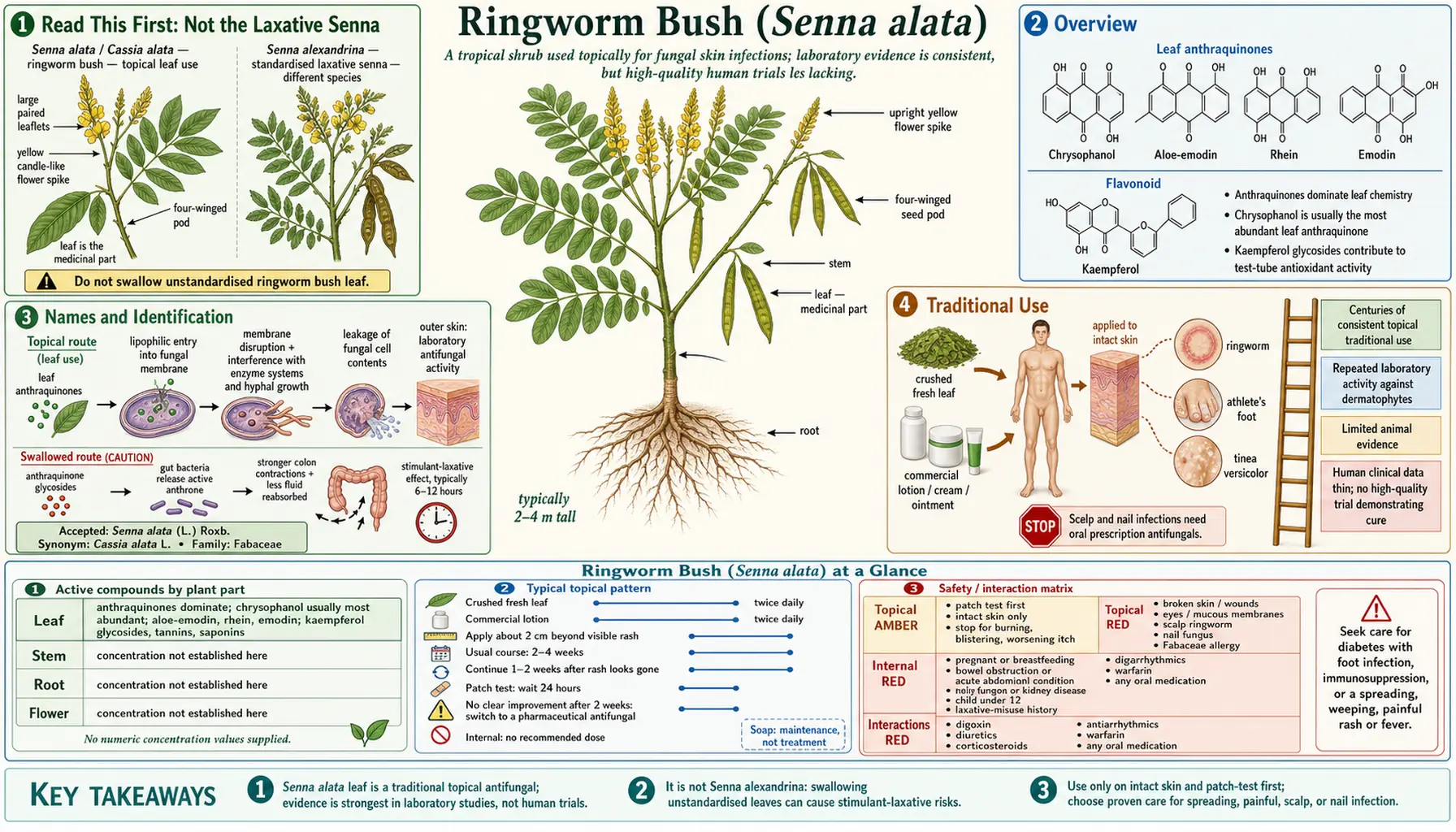
Ringworm bush (Senna alata, still widely sold and published under its older name Cassia alata) is a fast-growing tropical shrub whose crushed fresh leaves have been rubbed on ringworm, athlete's foot and other superficial fungal skin infections across Southeast Asia, South Asia, Africa and the Caribbean for centuries. It is one of the very few folk skin remedies to have reached formal government endorsement: in the Philippines, where it is called akapulko, it sits on the Department of Health's short list of medicinal plants and is manufactured as a commercial antifungal lotion and soap. That endorsement covers topical use on the skin only.
Two things must be said before anything else. First, this plant is not the senna sold as a laxative — that is a different species, Senna alexandrina, and confusing the two is the most common error people make with this herb. Second, ringworm bush leaves do contain the same family of laxative compounds, so swallowing them has a purgative effect and carries the same risks as chronic laxative use. The evidence base is honest but narrow: laboratory testing against fungi is consistent and repeated, human clinical trial data are thin, and nothing here should displace a proven antifungal cream for an infection that is spreading, painful, or on the scalp or nails.
Table of Contents
- Read This First: Not the Laxative Senna
- Overview
- Names and Identification
- Traditional Use
- The Philippine Department of Health Endorsement
- Active Compounds
- Antifungal Activity: Mechanism and Evidence
- Antibacterial and Wound Uses
- The Laxative Effect and Why It Matters
- Other Research Directions
- Forms and Preparations
- Dosage
- Cautions and Contraindications
- Key Research Papers
- Connections
- Featured Videos
Read This First: Not the Laxative Senna
Walk into a pharmacy anywhere in the world and ask for senna and you will be handed Senna alexandrina — the standardised stimulant laxative built from sennoside A and B, sold as tablets and as "smooth move" style teas. That plant is covered on our Senna page. It is a different species with a different chemical profile, a different dose, and a completely different purpose.
Senna alata — ringworm bush — is its cousin. Both sit in the genus Senna in the pea and bean family (Fabaceae), and both make anthraquinone compounds, which is why both will loosen the bowels if you swallow enough. But the traditional and regulatory use of ringworm bush is on the skin, for fungal infection. Nobody, including the Philippine health authorities who endorse it, recommends it as a laxative product.
Why this matters in practice:
- Dose confusion runs the wrong way. Pharmaceutical senna is standardised so that you know how much sennoside you are taking. Ringworm bush leaf is not standardised at all. Its anthraquinone content varies with the plant, the season and how the leaves were dried. Treating it as interchangeable with a laxative tablet means taking an unknown dose of a stimulant purgative.
- The names collide in shops and online listings. Sellers frequently label Senna alata products simply "senna leaf". If you are buying a laxative, check the binomial — you want Senna alexandrina. If you are buying an antifungal wash, you want Senna alata or Cassia alata.
- The older literature indexes it under Cassia. Most of the laboratory work published before roughly 2010 says Cassia alata. Searching only for Senna alata will hide half of the research from you.
Overview
Ringworm bush is a shrub or small tree, typically two to four metres tall, that grows quickly in warm, wet, disturbed ground — roadsides, field margins, riverbanks, backyards. It is native to tropical America and has been carried around the world's tropics for so long that it is now naturalised, and often weedy, throughout Southeast Asia, India, West Africa, the Caribbean and northern Australia. Where it grows, it grows abundantly and for free, which is a large part of why it became a household remedy rather than a market herb.
The leaves are the medicinal part: large, paired, oblong leaflets arranged along a stout central stalk, ten to twenty pairs per leaf, each leaflet with a rounded or slightly notched tip. The flowers are the plant's signature — bright yellow, packed into an upright spike that looks like a wax candle before it opens, which is where the alternative common name "candle bush" comes from. The seed pods are long, straight and conspicuously four-winged, running down the branches like little zippers.
Its journey to a person's skin is usually short. In a Filipino, Indonesian, Malaysian, Thai or Vietnamese household, someone picks a handful of fresh leaves from the yard or the roadside, crushes or pounds them until the juice runs, and rubs the pulp directly on the patch of ringworm. In the Philippines that same plant also arrives by a second route: as a manufactured lotion, soap or ointment on a pharmacy shelf, standardised to at least some extent and labelled as an antifungal. Very few folk remedies exist in both forms at once.
Names and Identification
Accepted botanical name: Senna alata (L.) Roxb.
Common synonym: Cassia alata L. — the name under which most of the research literature is filed.
Family: Fabaceae (the pea, bean and legume family), subfamily Caesalpinioideae.
The species was originally described by Linnaeus as Cassia alata. The huge, unwieldy genus Cassia was later split, and the bulk of its species — including both this plant and the laxative senna — moved into Senna. Both names remain in daily use. The epithet alata means "winged", after the pods.
Regional names:
- English: ringworm bush, ringworm senna, candle bush, candelabra bush, emperor's candlesticks, seven golden candlesticks
- Filipino / Tagalog: akapulko (also spelled acapulco); katanda, andadasi, palochina in other Philippine languages
- Vietnamese: muồng trâu ("buffalo senna")
- Malay / Indonesian: gelenggang; daun kupang; ketepeng cina, ketepeng badak (Indonesian)
- Thai: chum het thet
- Hindi / Bengali: dadmurdan, dadmari — both names literally mean "ringworm killer"
- Sinhala: eth thora
The name pattern is worth pausing on. Across languages that had no contact with each other, this plant is repeatedly named after the disease it is used for: ringworm bush, dadmurdan, eth thora. Independent cultures reached for the same plant for the same skin complaint. That is not proof it works, but it is a stronger ethnobotanical signal than most folk remedies carry.
How to tell it apart
Ringworm bush is easy to identify once you have seen it: the upright yellow candle-like flower spike and the four-winged pods are distinctive, and the leaves are much larger and coarser than those of the laxative senna. Two nearby confusions are worth knowing about. Senna occidentalis (coffee senna, muồng hôi) is a smaller relative whose seeds are toxic to livestock. Senna tora and Senna obtusifolia are the small-leaved sennas used as a coffee substitute and in Chinese medicine as jue ming zi. None of these is the ringworm plant, and none should be substituted for it.
Traditional Use
Traditional use is history, not proof — but the history here is unusually consistent. Wherever ringworm bush grows, the dominant recorded use is the same: crush fresh leaves, apply to fungal skin disease.
- Philippines. Akapulko leaves are pounded and rubbed on ringworm (buni), tinea versicolor (an-an), athlete's foot, and scabies. This is among the most widely known household remedies in the country, taught in school health classes and printed on government health posters.
- Indonesia and Malaysia (Jamu and Malay traditional medicine). Ketepeng cina or gelenggang leaves are used for kurap (ringworm), panu (tinea versicolor), and itchy skin generally, often rubbed with lime juice.
- Vietnam (thuốc nam). Muồng trâu leaves are used topically for ringworm and eczema; the leaf and seed also appear in internal preparations for constipation, which reflects the anthraquinone content.
- India and Sri Lanka. The vernacular names translate as "ringworm destroyer". The leaf paste is applied for tinea and other itchy rashes; some Ayurvedic and Siddha texts also list it as a mild purgative.
- West Africa and the Caribbean. Similar topical use for ringworm and skin eruptions, plus decoctions used as a laxative and, in places, for intestinal parasites — a use that has never been supported by controlled evidence.
Internal traditional uses do exist — for constipation, for "cleansing", occasionally for asthma or as a diuretic. These are much less consistent between regions than the topical antifungal use, and only the laxative effect has a clear chemical explanation.
The Philippine Department of Health Endorsement
This is the part of the ringworm bush story that makes it unusual, and it is worth stating precisely, because it is frequently exaggerated online.
The Philippine Department of Health maintains a short list of medicinal plants — usually cited as ten — that it endorses for specific, limited household uses. The list emerged from a long-running government herbal medicine research programme and was given institutional footing by the Traditional and Alternative Medicine Act (Republic Act 8423, 1997), which created the Philippine Institute of Traditional and Alternative Health Care. Akapulko (Senna alata) is on that list. Its listed indication is topical treatment of fungal skin infections — ringworm, tinea versicolor, athlete's foot — and related itchy skin conditions. Akapulko lotion, soap and ointment are manufactured and sold in Philippine pharmacies.
What that endorsement means:
- It applies to external use on intact skin. It is not an endorsement of drinking akapulko tea, taking akapulko capsules, or using the plant for internal disease.
- It is a national health-system decision made partly on evidence and partly on the reality that this plant is already in universal household use, is cheap, is locally available, and is safer applied to skin than many alternatives people would otherwise try. Endorsing and standardising a remedy people already use is good public health policy. It is not the same thing as a new drug passing phase III trials.
- It is not an approval by the United States Food and Drug Administration, the European Medicines Agency, or any other regulator outside the Philippines. Outside the Philippines, ringworm bush products are sold as cosmetics or supplements with no efficacy claim reviewed by anyone.
- A commercial akapulko lotion is a more predictable product than a handful of leaves from a roadside, because at least the extract concentration is controlled. If you are going to use this plant and a manufactured product is available to you, that is the better version.
Read plainly: a government looked at a folk antifungal, decided the traditional use was reasonable and low-risk, and put it into the formal system for skin use. That is a genuine and rare distinction. It is not evidence that akapulko outperforms terbinafine cream, and no one has shown that it does.
Active Compounds
The chemistry of ringworm bush leaves is dominated by anthraquinones — a class of ringed aromatic pigments that legumes, buckwheats and some fungi make in quantity. The named ones in this plant are:
- Chrysophanol — usually the most abundant anthraquinone in the leaf. It carries much of the reported antifungal and antibacterial activity in laboratory assays.
- Aloe-emodin — the same compound found in aloe latex (not aloe gel) and rhubarb root; studied for antimicrobial and cytotoxic effects in cell culture.
- Rhein — the anthraquinone behind diacerein, a pharmaceutical used for osteoarthritis in some countries; also a laxative anthraquinone.
- Emodin — widely distributed across laxative plants; heavily studied in cell culture for anti-inflammatory and anticancer signalling, with almost no human evidence for any of it.
Alongside these, the leaves contain anthraquinone glycosides (anthraquinones with sugars attached — the form that survives the stomach and is released by gut bacteria in the colon), flavonoids including kaempferol and its glycosides, tannins, and saponins. Kaempferol glycosides account for part of the antioxidant activity measured in test-tube assays.
The single most useful thing to understand about this plant is that one chemical family explains both of its effects. The anthraquinones that show antifungal activity against dermatophytes in a petri dish are, chemically, the same family that stimulates the colon when swallowed. You cannot have the plant without both properties. That is why the sensible route of use is topical, and why the internal caution section below is not boilerplate.
Antifungal Activity: Mechanism and Evidence
What "ringworm" actually is. Ringworm is not a worm. It is a fungal infection of the outer skin layer, usually caused by dermatophytes — Trichophyton rubrum, Trichophyton mentagrophytes, Microsporum canis, Epidermophyton floccosum. The same organisms cause athlete's foot (tinea pedis), jock itch (tinea cruris) and scalp ringworm (tinea capitis). Tinea versicolor, the pale or tan patchy rash common in humid climates, is caused by a different organism, a yeast of the Malassezia group.
Proposed mechanism. Anthraquinones are lipophilic — they dissolve into fatty membranes. In laboratory studies they appear to disrupt the fungal cell membrane and interfere with fungal enzyme systems and hyphal growth, causing leakage of cell contents. Some anthraquinones also generate reactive oxygen species inside the fungal cell under light. This is a plausible, general antimicrobial mechanism rather than a precise drug target like the one that pharmaceutical azoles hit (fungal 14α-demethylase) or that terbinafine hits (squalene epoxidase).
Cell-culture and laboratory evidence. This is where the data are strongest. Leaf extracts of Cassia alata have inhibited dermatophyte growth in agar-diffusion and broth-dilution assays in multiple independent studies from the 1980s onward, from France, India, Malaysia, Nigeria and the Philippines. Activity is reported against Trichophyton, Microsporum, Epidermophyton and Candida albicans, with the strongest and most repeatable results against the dermatophytes rather than against Candida. The effective concentrations in these assays are far higher than those of pharmaceutical antifungals — this is a weak antifungal by drug standards, applied in bulk.
Animal evidence. Limited. Studies in guinea pigs experimentally infected with dermatophytes have reported that Cassia alata preparations reduce lesions, which is consistent with the in-vitro work.
Human evidence. This is the honest weak point. There are small clinical evaluations of akapulko lotions and creams, mostly conducted in the Philippines, several of them not indexed in international databases and several of them uncontrolled or unblinded. What is missing is what would settle the question: an adequately powered, randomised, blinded trial comparing a standardised Senna alata preparation against a standard topical antifungal such as clotrimazole or terbinafine, with mycological cure — not just "the rash looks better" — as the endpoint. Until that exists, the fair summary is: plausible mechanism, consistent laboratory activity, centuries of use, and no high-quality human trial demonstrating it cures tinea.
What to do with that. For a small, new patch of ringworm or athlete's foot in a healthy adult, ringworm bush is a low-risk thing to try, and in a village where a tube of terbinafine costs a day's wage and the plant grows by the door, it is a reasonable choice. But terbinafine 1% cream and clotrimazole 1% cream are inexpensive, sold over the counter almost everywhere, and supported by large randomised trials with mycological cure rates commonly in the 70–90% range for tinea pedis and tinea corporis. If your infection is spreading, painful, recurrent, on the scalp, or under a nail, use the proven drug — and understand that scalp and nail infections need oral antifungals, because no cream, herbal or pharmaceutical, reliably penetrates hair follicles or nail plate.
Antibacterial and Wound Uses
Beyond fungi, ringworm bush leaf extracts have been screened repeatedly against bacteria. In agar-diffusion testing, extracts inhibit a range of Gram-positive organisms, including Staphylococcus aureus, more readily than Gram-negative organisms such as Escherichia coli and Pseudomonas aeruginosa — a pattern typical of plant phenolics, which struggle to cross the extra outer membrane that Gram-negative bacteria carry. Chrysophanol and the tannin fraction are the usual candidates for the activity.
Traditional practice extends this to minor wounds, insect bites, eczema and scabies. For scabies the traditional use is worth flagging as a special case: scabies is a mite infestation, not a fungal or bacterial infection, and it requires permethrin or ivermectin to eradicate. A leaf paste may calm the itch; it will not clear the mites, and untreated scabies spreads to everyone in the household.
All of this antibacterial work is cell-culture level. There is no human trial evidence that ringworm bush accelerates wound healing or prevents wound infection, and an open wound is exactly the wrong place to put a non-sterile plant paste. Use it on intact skin.
The Laxative Effect and Why It Matters
Swallowed ringworm bush leaf is a stimulant laxative, and it works the same way pharmaceutical senna does.
Mechanism. Anthraquinone glycosides pass through the stomach and small intestine largely intact, because the attached sugar keeps them from being absorbed. In the colon, resident bacteria cleave off the sugar and release the active anthrone. The anthrone does two things: it irritates the colonic wall into stronger propulsive contractions, and it shifts the balance of water and electrolyte movement across the colon lining so that less fluid is reabsorbed. More water in, faster transit out. The delay while bacteria do their work is why anthraquinone laxatives typically act six to twelve hours after they are taken, usually the following morning.
Why this is a caution rather than a feature. The dose is unknown. Standardised senna tablets tell you how many milligrams of sennoside you are getting; a handful of ringworm bush leaves does not. Anthraquinone content in the leaf varies substantially between plants, seasons and drying methods, so the same preparation can be inert one week and violently purgative the next.
Beyond dose unpredictability, all stimulant laxatives share a set of problems when used regularly:
- Potassium loss. Repeated stimulant-laxative use drains potassium. Low potassium causes muscle weakness, cramping and heart-rhythm disturbance, and it makes digoxin dangerously more potent. This is the single most serious risk of chronic use.
- Dependence and worsening constipation. With prolonged daily use, the bowel becomes less responsive without the stimulus, and people escalate the dose. Guidance for pharmaceutical senna is generally to use it for no more than about a week without medical advice; the same limit is a sensible ceiling here, and there is even less reason to use an unstandardised version.
- Cramping and urgency. Anthraquinone laxatives are not gentle. Griping abdominal pain is the most common complaint.
- Melanosis coli. Long-term anthraquinone use darkens the colon lining, a harmless but visible pigmentation found at colonoscopy. It is a marker of chronic use rather than a disease.
Bottom line: if you want a stimulant laxative, use a standardised product with a known dose — and read the Senna page for the full picture on that class. Ringworm bush's laxative property is best understood as a reason not to swallow it, not as a second indication.
Other Research Directions
Ringworm bush appears in a scattering of preclinical screening literature. All of it is early, and none of it supports using the plant for these purposes in people.
- Antioxidant activity. Leaf extracts scavenge free radicals in standard test-tube assays (DPPH, FRAP), which is unsurprising for a plant rich in flavonoids and tannins. Test-tube antioxidant scores are among the least predictive measurements in natural-products research and rarely translate to a clinical benefit.
- Anti-inflammatory and analgesic screening. Rodent studies from the 1990s reported reduced paw swelling and pain responses with leaf extracts. Interesting, animal-level, never followed into humans.
- Blood sugar. Some rodent work reports reduced blood glucose. No human trial. Do not use this plant for diabetes.
- Antiviral and anti-parasitic screening. Extracts have been tested against various organisms in cell culture with mixed results. Traditional use against intestinal worms has no controlled human support, and treating a confirmed parasitic infection with a leaf decoction instead of a proven antiparasitic drug is a bad trade.
- Anticancer cell-line work. Aloe-emodin and emodin are heavily studied in cancer cell lines. That is true of dozens of common plant compounds and means nothing for a person with cancer. There is no clinical evidence of any kind here.
Forms and Preparations
- Fresh crushed leaf (the traditional form). A handful of fresh leaves pounded or crushed until the juice runs, applied directly to the affected patch. Some traditions mix the pulp with a little coconut oil, calamansi or lime juice, or vinegar. This is the preparation behind essentially all the ethnobotanical reports.
- Leaf juice. Leaves blended and strained; the juice dabbed on with cotton.
- Commercial akapulko lotion, cream, soap and ointment. Made in the Philippines, sold in pharmacies, and the most consistent form. If you are buying, look for a stated Senna alata or Cassia alata leaf extract content and a manufacturer's registration number. Soaps are a maintenance form rather than a treatment — contact time in a shower is seconds, which is not enough to treat an infection.
- Dried leaf and leaf powder. Sold loose for making pastes and washes. Anthraquinone content degrades with poor drying and long storage.
- Decoction (internal). Traditional as a purgative. Covered here for completeness, not recommended.
- Capsules and "senna alata" supplements. Occasionally sold online as detox or cleanse products. These are unstandardised stimulant laxatives with a botanical name that most buyers will not recognise. Avoid.
Dosage
There is no established, evidence-based dose for this plant in any form. What follows is traditional practice, described so that you know what people actually do — not a validated regimen.
Topical, traditional pattern: apply crushed fresh leaf or the commercial lotion to the affected area twice daily, morning and evening, after washing and thoroughly drying the skin. Extend application about 2 cm beyond the visible edge of the rash, because dermatophytes spread outward past the border you can see.
Duration: two to four weeks is the usual traditional course. Borrowing the rule that applies to every topical antifungal, keep applying for one to two weeks after the rash looks gone. Stopping the moment the redness fades is the most common reason tinea comes straight back.
Patch test first. Apply a small amount to the inner forearm and wait 24 hours before treating a larger area. Plant pastes cause contact dermatitis in a meaningful minority of people, and a contact rash on top of ringworm is a miserable and confusing combination.
When to stop and switch: if there is no clear improvement after two weeks of consistent twice-daily use, stop and use a pharmaceutical antifungal. Two weeks is enough time for a topical treatment that is going to work to show progress.
Internal: no recommended dose. This site does not provide one for ringworm bush. If you need a laxative, use a standardised product.
Cautions and Contraindications
The headline caution, repeated: ringworm bush is a topical remedy that happens to contain laxative compounds. Its endorsed and evidenced route is on the skin. Taken internally it is an unstandardised stimulant laxative and carries every risk that class carries.
Do not take internally if you
- are pregnant or breastfeeding — stimulant laxatives are avoided in pregnancy without medical advice, and an unstandardised one has no place there at all;
- have bowel obstruction, ileus, undiagnosed abdominal pain, appendicitis, inflammatory bowel disease (Crohn's or ulcerative colitis), or any acute abdominal condition — stimulating a blocked or inflamed bowel is dangerous;
- are dehydrated or have significant kidney disease;
- are a child under 12;
- have a history of eating-disorder-related laxative misuse.
Drug interactions (internal use)
- Digoxin — the most serious. Potassium loss from laxative use markedly increases digoxin toxicity risk.
- Diuretics (furosemide, hydrochlorothiazide) and corticosteroids — additive potassium depletion.
- Antiarrhythmic drugs — low potassium destabilises heart rhythm and undermines these medicines.
- Warfarin — diarrhoea alters vitamin K absorption and can swing INR.
- Any oral medication — accelerated transit reduces absorption of whatever else you swallowed.
Topical cautions
- Contact dermatitis. Redness, burning, blistering or worsening itch after application means stop. Patch test first.
- Not on broken skin, open wounds, mucous membranes or near the eyes. Plant paste is not sterile and anthraquinones are irritating to mucosa.
- Not for scalp ringworm (tinea capitis) or nail fungus (onychomycosis). These require oral prescription antifungals. Topical treatment of tinea capitis in a child delays proper care and can lead to permanent scarring hair loss.
- Legume-family allergy. People with known allergy to Fabaceae plants should avoid it.
- Staining. Anthraquinone pigments stain skin and fabric yellow-brown.
See a clinician instead of self-treating if
- you have diabetes and the infection is on the feet — foot infections in diabetes escalate fast;
- you are immunosuppressed (chemotherapy, transplant medication, advanced HIV, long-term steroids);
- the rash is spreading, weeping, painful, or accompanied by fever — that suggests bacterial infection, not tinea;
- the diagnosis is uncertain. Many things look like ringworm and are not: eczema (nummular dermatitis), psoriasis, pityriasis rosea, granuloma annulare, and early Lyme disease rash. Treating eczema with an antifungal wastes weeks. Our Dermatology section covers the differential.
Key Research Papers
The links below open a PubMed search on each paper's title rather than a fixed record number. This is deliberate: a search cannot silently resolve to the wrong paper, and it also surfaces later work on the same question.
- Hennebelle T, Weniger B, Joseph H, Sahpaz S, Bailleul F. Senna alata. Fitoterapia. 2009;80(7). A comprehensive review of the botany, traditional use, chemistry and pharmacology of the species — the best single starting point.
- Palanichamy S, Nagarajan S. Antifungal activity of Cassia alata leaf extract. Journal of Ethnopharmacology. 1990;29(3). One of the earliest systematic laboratory confirmations of activity against dermatophytes.
- Fuzellier MC, Mortier F, Lectard P. Antifungal activity of Cassia alata L. Annales Pharmaceutiques Françaises. 1982;40(4). Early French work linking the antifungal effect to the anthraquinone fraction.
- Ibrahim D, Osman H. Antimicrobial activity of Cassia alata from Malaysia. Journal of Ethnopharmacology. 1995;45(3). Screening against both fungi and bacteria.
- Villaseñor IM, et al. Bioactivity studies on Cassia alata Linn. leaf extracts. Phytotherapy Research. 2002. Philippine work characterising the leaf's biological activity.
- Crockett CO, et al. Cassia alata and the preclinical search for therapeutic agents for the treatment of opportunistic infections in AIDS patients. Cellular and Molecular Biology. 1992. Context for the interest in the plant against fungal infection in immunocompromised patients.
Live PubMed Searches
- Senna alata antifungal
- Cassia alata and dermatophytes
- Cassia alata anthraquinones
- Senna alata clinical trials
- Akapulko and Philippine medicinal plants
- Chrysophanol antifungal activity
- Anthraquinone laxatives and potassium loss
- Topical terbinafine versus clotrimazole for tinea
Connections
- All Herbs
- Senna (Senna alexandrina) — the laxative senna this plant is constantly confused with; read it to see exactly how the two differ.
- Neem — the other great South and Southeast Asian topical antimicrobial plant, with a broader traditional skin repertoire and a similar evidence gap.
- Tea Tree — the topical antifungal essential oil with the most human trial data behind it, including trials in athlete's foot.
- Aloe Vera — a useful comparison in anthraquinone chemistry: the soothing gel and the laxative latex are two different parts of the same plant.
- Calendula — a gentler traditional topical for irritated skin, without laxative compounds.
- Dermatology — skin conditions, including what ringworm is and what else looks like it.
- Conditions on this site that reference this page: Pseudomonas aeruginosa · Athlete's Foot (Tinea Pedis) · Fungal Infections · Ringworm (Tinea) · Seborrheic Dermatitis · Type 1 Diabetes · Osteoarthritis · Rheumatoid Arthritis