Cissus quadrangularis (Veldt Grape)
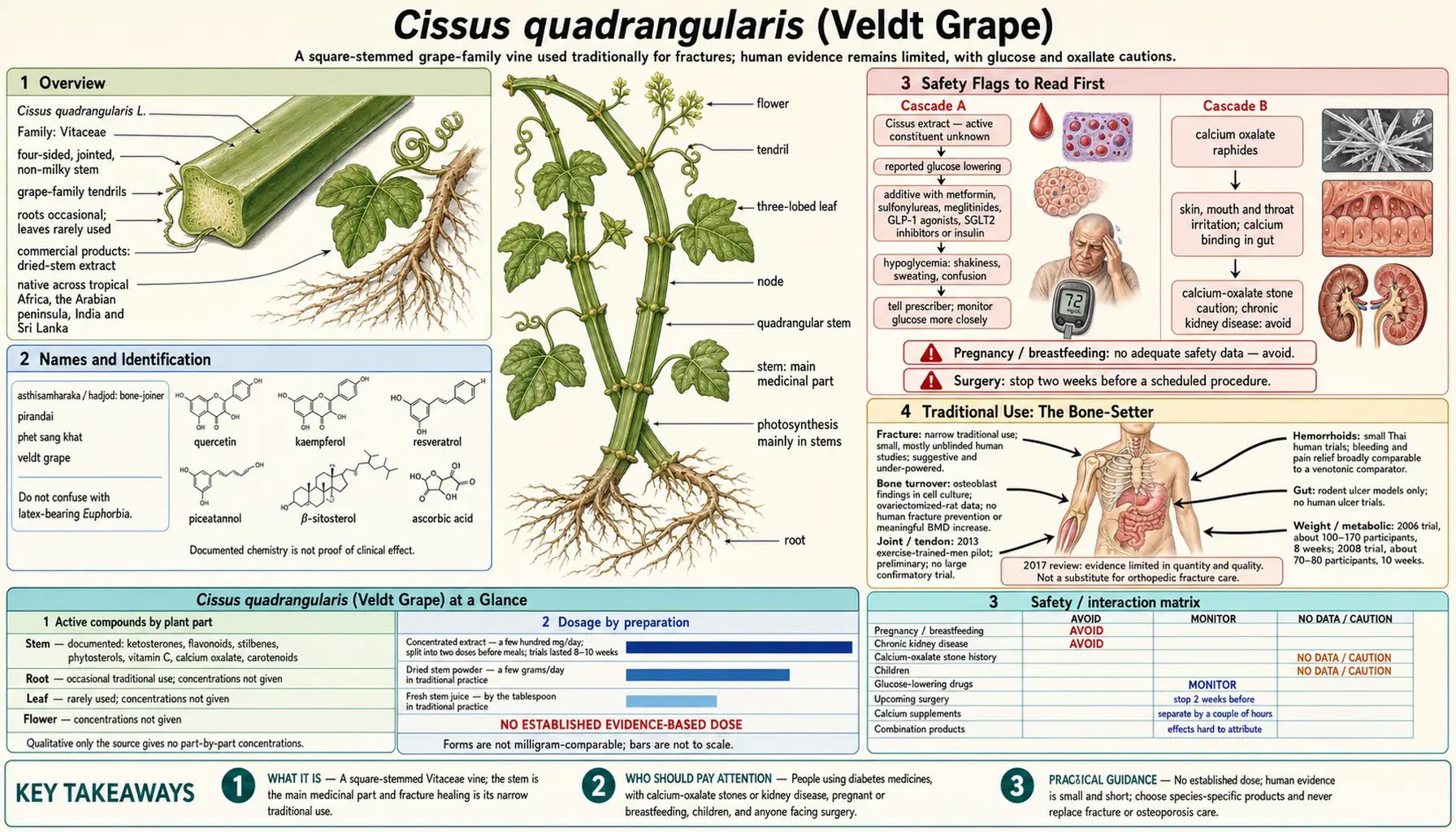
Cissus quadrangularis is a succulent, square-stemmed climbing vine in the grape family, grown from India and Sri Lanka across tropical Africa and into Thailand and Southeast Asia. Its Sanskrit and Hindi names both mean roughly "that which joins bones" — asthisamharaka and hadjod — and traditional use is startlingly specific: it was given to people with broken bones, to speed the knitting of the fracture. That specificity is unusual for a folk remedy, and it is exactly what drew modern researchers to the plant in the first place.
Read the safety notes before you buy anything. Two things matter more than any benefit claim on this page. First, the weight-loss and "joint support" marketing far outruns the evidence — the human trials behind those claims are small, short, mostly run at a handful of sites, and several were funded by or authored by people connected to the company that supplies the extract. Second, Cissus has been reported to lower blood glucose, so anyone taking metformin, a sulfonylurea, or insulin can stack effects and go low. The plant also carries meaningful oxalate, has no pregnancy or breastfeeding safety data, and is very often sold inside combination formulas where nobody — including the manufacturer — can tell you which ingredient did anything.
Table of Contents
- Overview
- Names and Identification
- Safety Flags to Read First
- Traditional Use: The Bone-Setter
- Active Compounds
- Fracture Healing: What the Human Evidence Shows
- Bone Turnover and Bone Density
- Joint Pain and Exercise Recovery
- Weight Loss and Metabolic Syndrome
- Other Research: Hemorrhoids, Gut, Antioxidant Activity
- Culinary Use
- Forms and Preparations
- Dosage
- Cautions and Contraindications
- Key Research Papers
- Connections
- Featured Videos
Overview
Picture a cactus-like vine with fleshy, four-sided green stems that look extruded through a square die and jointed every few inches like bamboo. It is not a cactus — it is a member of the Vitaceae, the same family as the wine grape, and it climbs by curling tendrils opposite its leaves exactly as a grapevine does. The leaves are small, often three-lobed, and drop away in dry weather; the plant photosynthesizes mainly in the stems, which is why it looks so strange and why it survives dry, rocky ground where little else grows.
It is native to a broad belt across tropical Africa, the Arabian peninsula, India and Sri Lanka, and has been carried into Thailand, Cambodia, Malaysia, Indonesia and the Philippines. In India it grows as a hedge plant and a backyard vine; in Tamil Nadu it is common enough that most older cooks know how to handle it. In Thailand it is cultivated deliberately and sits in the formal traditional pharmacopoeia rather than in folk practice alone.
The part used is the stem — thick, jointed and quadrangular. Roots appear occasionally in traditional preparations, leaves rarely, and almost everything sold commercially is an extract of dried stem.
How it reaches you depends on where you are. In a South Indian market it is bundles of fresh green stem sold as a vegetable. In a Thai pharmacy it is a capsule of dried stem powder dispensed for hemorrhoids. In a Western supplement shop it is a concentrated extract standardized to a percentage of "ketosterones," sold for fat loss, joint support and tendon recovery — claims with a much weaker evidence base than the bone-healing tradition that made the plant famous.
Names and Identification
Binomial: Cissus quadrangularis L. Family: Vitaceae (the grape family). The species epithet quadrangularis simply describes the four-angled stem. Some floras place it in the segregate genus Vitis historically, and older Indian literature sometimes writes Vitis quadrangularis; they are the same plant.
| Language / region | Name | What the name means |
|---|---|---|
| Sanskrit | asthisamharaka, asthisamhari, vajravalli | "that which prevents the destruction of bone"; vajravalli = "thunderbolt creeper" |
| Hindi | hadjod, hadjora | literally "bone-joiner" |
| Tamil | pirandai | the culinary name in Tamil Nadu |
| Telugu / Kannada | nalleru / mangaroli | — |
| Thai | phet sang khat (เพชรสังฆาต) | used in Thai traditional medicine, notably for hemorrhoids |
| English | veldt grape, adamant creeper, devil's backbone, edible-stemmed vine | "veldt grape" reflects its African range and grape-family membership |
| Supplement label | Cissus, CQ, "ketosterone extract", CQR-300 | marketing names for standardized stem extracts |
Where the common names get dangerous
Two of the English names are shared with entirely different plants, and one of the confusions matters medically.
"Devil's backbone" is at least three different plants. It is used for Cissus quadrangularis; for Euphorbia tithymaloides (formerly Pedilanthus tithymaloides), a spurge with caustic white latex that can burn skin and eyes; and for Kalanchoe daigremontiana, "mother of thousands," which contains cardiac-glycoside-like bufadienolides and has poisoned livestock. If a source, a seed packet or a market vendor says "devil's backbone," do not assume it is Cissus. Cissus has square, jointed, non-milky green stems and grape-family tendrils. The Euphorbia bleeds white latex when cut — Cissus does not.
"Veldt grape" is not a grape. It is in the grape family, and it does genuinely contain some of the same stilbene compounds found in grapes, but the fruit is a small inedible-to-unpleasant berry, not a table grape, and nothing on this page transfers from research on Vitis vinifera, wine, or grape-seed extract.
Genus confusion. The genus Cissus has several hundred species. Cissus rotundifolia, Cissus verticillata and others also appear in traditional medicine and occasionally in supplements. Only Cissus quadrangularis has the bone-healing tradition and the (limited) clinical literature. A label that says only "Cissus extract" without the species is a label that has not told you what is in the bottle.
Safety Flags to Read First
Most herb pages put safety at the bottom. For this plant that would be the wrong order, because the two biggest problems with Cissus are not rare side effects — they are the ordinary experience of buying it.
1. The weight-loss marketing far outruns the evidence
Cissus is sold across the fitness and weight-loss industry as a fat-loss compound, a "cortisol blocker," and a joint, tendon and ligament repair agent. The human data underneath those claims consists of a handful of small trials, most lasting eight to ten weeks, several conducted by the same research group in Cameroon using a proprietary extract supplied by the company that sells it, and at least one influential review authored by a scientist with long-standing consulting relationships in the supplement industry. None of that automatically makes the findings false. It does mean the findings have not been independently reproduced by disinterested groups at the scale that would justify the confidence of the marketing. Treat "clinically proven for fat loss" on a Cissus label as an advertisement, not a summary of the literature.
2. It may add to diabetes medication
Several trials and animal studies report lower fasting blood glucose in people and animals given Cissus extract. If that effect is real, it is additive with the drugs people already take for it. Someone on metformin, a sulfonylurea (glipizide, glyburide, glimepiride), a meglitinide, or insulin could push their glucose lower than intended, and the symptoms of a low — shakiness, sweating, confusion — can be mistaken for a side effect of the herb rather than the interaction. Anyone in that situation should be monitoring glucose more closely than usual and should tell the prescriber they have started it.
3. Oxalate, pregnancy, and combination products
The fresh stem contains calcium oxalate raphides — needle-shaped crystals that are the reason raw pirandai makes hands and mouths itch. Oxalate load is a genuine concern for anyone with a history of calcium-oxalate kidney stones. There is no adequate safety data in pregnancy or breastfeeding, and the traditional literature does not fill that gap. And Cissus is very frequently sold blended with Irvingia gabonensis, green tea extract, caffeine, chromium and other actives, which makes both the benefit claims and any adverse effect impossible to attribute to Cissus itself. These points are expanded in Cautions and Contraindications.
Traditional Use: The Bone-Setter
Folk remedies are usually vague. A plant is "for strength," or "for the stomach," or "for cooling." Cissus quadrangularis is an exception, and the exception is the whole story of this herb.
Across Ayurvedic practice and North Indian folk medicine, the plant has one dominant, narrow indication: broken bones. The Sanskrit asthisamharaka is built from asthi (bone) and a root meaning to hold together or to prevent destruction. The Hindi hadjod is even blunter — haddi (bone) plus jodna (to join). Traditional bone-setters applied a paste of the crushed fresh stem over a splinted limb and gave the patient stem juice or powder internally, on the theory that it accelerated the union of the fracture. The same tradition extended the plant to ligament and tendon injuries, back pain, and gout.
Elsewhere the emphasis shifts. In Thai traditional medicine, phet sang khat is used mainly for hemorrhoids, and the preparation has been formalized into a dispensed dried-stem capsule rather than remaining a household remedy. In parts of Africa the stem is used for wounds, gut complaints and menstrual problems. In Tamil Nadu, pirandai is as much a digestive food as a medicine — the chutney is eaten for gas, indigestion and appetite.
None of this is evidence of efficacy. Traditional use tells you what people believed and what they did with a plant, and it is a legitimate reason to run a study. It is not a study. The value of the Cissus tradition to researchers was its specificity: "this heals fractures faster" is a claim you can actually design a trial around, unlike "this builds vitality." That is why the plant got tested at all, and it is why the fracture literature is the oldest part of the modern record.
Active Compounds
Cissus stem is chemically busy, and the classes below are all genuinely documented in the plant. What is far less settled is which of them, if any, accounts for the traditional effect — and the compound the industry markets hardest is the one with the least clear pharmacology.
| Constituent class | Examples | What is actually known |
|---|---|---|
| Ketosterones (3-ketosteroids) | the marketed "ketosterone" fraction | The extract standard the supplement industry sells against. Assays vary between labs and there is no universally agreed method, so a "5% ketosterones" claim is difficult to verify. The anabolic and cortisol-blocking mechanisms attributed to this fraction are marketing extrapolations, not established human pharmacology. |
| Flavonoids | quercetin, kaempferol and glycosides | Well-characterized plant antioxidants with real cell-culture anti-inflammatory activity. Present in many foods; their contribution here is plausible but not demonstrated. |
| Stilbenes (resveratrol family) | resveratrol, piceatannol, pallidol, parthenocissin, quadrangularin A/B/C | Resveratrol oligomers and dimers isolated from the stem. Interesting chemistry — grape-family plants make these — and the reason some vendors invoke resveratrol research. Amounts in a capsule are small; do not read grape or wine literature onto this plant. |
| Triterpenoids and phytosterols | onocer-ene-diols, β-sitosterol | Common plant sterols; documented in the stem, mechanism in humans unstudied. |
| Vitamin C | ascorbic acid | The fresh stem is a genuinely good source. Vitamin C is required for collagen cross-linking, which is a real and non-mystical part of both bone and soft-tissue healing. |
| Calcium | largely as calcium oxalate | Total calcium content is high on paper. Much of it is locked in oxalate crystals, which the gut absorbs poorly — so "high in calcium" does not translate cleanly into "a calcium supplement." See Calcium. |
| Oxalates | calcium oxalate raphides | Needle crystals responsible for the itch and mouth irritation of raw stem, and the basis of the kidney-stone caution. Cooking and the traditional oil-and-salt handling reduce the irritation. |
| Carotenoids | β-carotene and relatives | Contributes to the antioxidant content of the fresh vegetable. |
A practical consequence: a fresh stem eaten as food and a concentrated capsule standardized to ketosterones are not the same intervention. The vegetable delivers vitamin C, carotenoids, fiber and calcium in a food matrix. The capsule delivers a concentrated, partly-characterized fraction of the plant's sterols and stilbenes with essentially none of the vitamin C. Evidence from one does not carry over to the other.
Fracture Healing: What the Human Evidence Shows
Evidence level: animal and small human. Old, mostly unblinded, rarely replicated outside India.
The scientific interest in Cissus began in the 1960s at Banaras Hindu University, where K. N. Udupa and colleagues ran a series of studies on fracture repair — first in laboratory animals, then in small groups of patients. The animal work reported that fractures in treated animals regained mechanical strength sooner and showed earlier mineral deposition at the fracture site than untreated controls. A later veterinary study in dogs with experimentally fractured forelimbs reported a similar acceleration.
The human studies that followed were, by modern standards, weak instruments. They were small — dozens of patients, not hundreds. Most were not blinded, so patient and assessing surgeon both knew who was taking the herb, exactly the setup in which subjective healing assessments drift. Several had no placebo arm, comparing treated patients against untreated or historical controls. Endpoints were usually radiographic callus and time to clinical union rather than a hard functional outcome. And nearly all came from the same few Indian centers, so they are not independent replication in the sense that matters.
More recent Indian work has looked at mandibular (jaw) fractures and at healing after certain orthopedic procedures, reporting faster union and lower pain scores — again small, single-center, and often in regional journals with limited peer-review visibility. A 2017 systematic review and meta-analysis pooled the available randomized trials of Cissus and found the evidence base limited in both quantity and quality. The honest summary is suggestive, under-powered, and not yet confirmed.
What would change that is a properly powered, blinded, multi-center trial of a defined extract in a defined fracture type, with union read by assessors blind to allocation. That trial has not been published. Anyone offered Cissus as a substitute for orthopedic care of a fracture is being offered something the evidence does not support.
Bone Turnover and Bone Density
Evidence level: cell culture and animal, with a thin layer of small human biomarker data.
The laboratory mechanism is more coherent than the clinical picture. In cell culture, Cissus stem extracts have been reported to push bone-marrow mesenchymal stem cells toward the osteoblast lineage — toward becoming bone-building cells — with rises in alkaline phosphatase and osteocalcin and more mineralized nodule formation in the dish. In animal models, the most relevant work uses ovariectomized rats, the standard model for post-menopausal bone loss; several groups report that Cissus limits the bone loss that follows ovariectomy, with better trabecular architecture and higher bone mineral density in treated animals.
In humans, the picture thins out fast. There are small studies reporting shifts in bone turnover markers — the blood and urine chemicals that reflect how fast bone is being broken down and rebuilt. Moving a turnover marker is a long way from preventing a fracture; drugs that clearly moved turnover markers have sometimes failed to reduce fractures, which is why regulators demand fracture endpoints. No trial has shown that Cissus prevents fractures or meaningfully raises bone mineral density in humans over the years-long timescale osteoporosis treatment requires.
If your concern is bone density, build on the interventions with real fracture-endpoint evidence: adequate calcium and vitamin D intake, resistance and impact exercise, not smoking, and prescription therapy where indicated. Cissus replaces none of them.
Joint Pain and Exercise Recovery
Evidence level: one small human pilot study; animal anti-inflammatory data.
Cissus is heavily marketed to lifters and athletes for joint, tendon and ligament pain. The core human citation for that market is a pilot study in exercise-trained men published in 2013, reporting reduced joint pain versus placebo over eight weeks. Read what a pilot study is: a small exploratory trial designed to find out whether a larger trial is worth running. It enrolled a modest number of men, used self-reported joint pain as the outcome, and was not powered to establish efficacy — its own authors framed it as preliminary. In the decade since, the large confirmatory trial it was meant to justify has not appeared.
The supporting biology is animal and cell-culture work: anti-inflammatory and analgesic activity in standard rodent paw-edema and writhing tests, and inhibition of inflammatory mediators in cultured cells. That is the same level of evidence that exists for hundreds of plants and is not specific to joints.
For inflammatory joint pain, Boswellia and Turmeric carry substantially more human trial data. That does not make Cissus worthless — it means that if you are going to try one plant for knee pain, those two have been asked the question more times and more carefully.
Weight Loss and Metabolic Syndrome
Evidence level: several small human randomized trials, 8–10 weeks, industry-adjacent, not independently replicated.
This is where Cissus makes its money, and where the gap between the shelf and the literature is widest. Here is what the trials actually did.
| Study type | Roughly what was tested | Size and length | What was reported |
|---|---|---|---|
| Randomized, placebo-controlled (Cameroon, 2006) | A proprietary standardized Cissus extract in overweight and obese adults, some with features of metabolic syndrome | On the order of 100–170 participants; 8 weeks | Reductions in body weight and body fat versus placebo, plus falls in total cholesterol, LDL, triglycerides and fasting glucose |
| Randomized, double-blind, placebo-controlled (Cameroon, 2008) | Cissus alone versus a Cissus + Irvingia gabonensis combination versus placebo | Roughly 70–80 participants across three arms; 10 weeks | Weight and waist reductions in both active arms, larger in the combination arm |
| Pilot / open studies | Various extracts, sometimes with diet advice | Tens of participants; weeks | Modest weight and lipid changes; no blinding in several |
| Systematic review and meta-analysis (2017) | Pooled the available randomized trials of Cissus in clinical use | A small number of eligible trials | Concluded the evidence base is limited in quantity and quality; effects possible but not established |
Four things about that table deserve to be said out loud.
- The trials are short. Eight to ten weeks tells you nothing about whether weight stays off, and nothing about safety over the months or years people actually take supplements.
- They are small. A hundred people split across arms cannot reliably detect either a modest real benefit or an uncommon harm.
- They cluster. A large share of the positive weight-loss literature comes from one research group, using one proprietary extract, in one country. Independent replication by unaffiliated groups elsewhere is what is missing.
- The financial relationships are real. The proprietary extract used in the influential trials was supplied by its commercial owner, and at least one prominent review of Cissus safety and efficacy was written by an author with industry consulting ties. This is disclosed in the literature and is a normal feature of supplement research — but it means the results carry less weight than the same numbers from a disinterested group would.
The proposed mechanisms — pancreatic lipase inhibition, effects on amylase and glucosidase, appetite effects, and the widely repeated "cortisol blocking" story — come mostly from enzyme assays and animal work. They are hypotheses about why an effect might exist, not evidence that it does.
A fair bottom line: it is possible that a standardized Cissus extract produces a small weight and lipid benefit in overweight adults. It is not established, and nothing in the published record supports the way the product is sold.
Other Research: Hemorrhoids, Gut, Antioxidant Activity
Hemorrhoids (human, Thailand). This is the one indication where Cissus has an institutional foothold in a national health system: dried stem powder is an established Thai traditional preparation for hemorrhoids and has been compared there against a standard venotonic flavonoid drug, with reported bleeding and pain relief broadly comparable to the comparator. The trials are small and largely Thai, and relevance outside Thailand is limited by product availability and standardization — but it is a legitimate line of human evidence rather than a marketing claim.
Gastroprotection (animal). Rodent ulcer models — aspirin-induced and stress-induced — report reduced ulcer index and increased gastric mucus. Consistent with the South Indian use of pirandai as a digestive, but rat ulcer models predict human benefit poorly, and no human ulcer trials exist.
Antioxidant and antimicrobial (cell culture). Extracts scavenge free radicals in the standard chemical assays and inhibit various bacteria in culture. Nearly every plant extract does this; nothing here supports using Cissus as an antimicrobial in a person.
Culinary Use
Cissus is not only a supplement — in Tamil Nadu it is a real vegetable with a real technique behind it, and that technique explains the oxalate story better than any chemistry paragraph.
Pirandai thogayal (a thick chutney) is the classic preparation. Young, tender stems are chosen; older stems are woody and far more irritating. The cook rubs sesame (gingelly) oil onto their hands and onto the stem, then scrapes off the fibrous ridge along each of the four angles and the nodes. That oil step is not superstition: the calcium oxalate raphides in the fresh sap cause intense itching and burning on skin and mucous membranes, and the oil barrier plus removal of the ridges sharply reduces contact. The cut stem is then sautéed until it loses its raw green character and ground with roasted urad dal, dried red chilies, tamarind, salt and sometimes coconut — and the cooking tames the irritant further.
Pirandai pachadi is a yogurt-based version; the stems also go into thuvaiyal, dosai batter and occasionally pickles. In every case it is eaten in small quantities as a condiment rather than as a bulk vegetable — a sensible traditional limit on oxalate intake, even if nobody framed it that way. In Thailand and parts of Southeast Asia the young shoots are likewise eaten cooked, and in parts of Africa the stems serve as a supplementary or famine food.
Practical points if you cook it: use young tender stems only; oil your hands first; strip the ridges and nodes; always cook it, never eat it raw; and treat it as a small side dish. If your mouth or throat tingles or burns after eating it, that is the oxalate crystals, and it means the preparation was insufficient or the stem too mature.
Forms and Preparations
- Fresh stem (vegetable). The traditional South Indian and Southeast Asian food form, requiring the oil-and-scrape handling above. Delivers vitamin C, carotenoids, fiber and calcium — and oxalate.
- Dried stem powder. The traditional Ayurvedic and Thai medicinal form, taken by the gram in water, in ghee, or as a capsule. Closest to what the historical literature actually studied.
- Standardized extract capsules. The dominant Western form, concentrated and standardized to a stated percentage of "ketosterones" (commonly 2.5% or 5%). The assay is not standardized across the industry, so the same number on two labels does not guarantee the same content.
- Named proprietary extracts. Trade-named materials (CQR-300 and similar) are the specific extracts used in the weight-loss trials. If you are trying to match a study, the trade name matters more than the milligram number — a generic extract has not been studied.
- Combination formulas. Extremely common: Cissus with Irvingia gabonensis, green tea, caffeine or chromium, or with glucosamine and collagen in "joint" products. These make cause and effect unknowable and are the biggest single reason people report unclear results.
- Topical pastes. Traditional application of crushed fresh stem over injuries. No controlled human evidence, and the raphides can irritate broken or sensitive skin.
Dosage
There is no established, evidence-based dose of Cissus quadrangularis for any condition. That is the honest headline, and the ranges below are descriptions of what has been used, not recommendations.
- Concentrated standardized extract: the weight-loss and metabolic trials used a few hundred milligrams per day of a proprietary standardized extract, typically split into two doses taken before meals over 8–10 weeks. Products on the shelf frequently exceed this considerably, because a higher number sells better, not because a higher dose was tested.
- Dried stem powder (traditional): Ayurvedic practice commonly cites a few grams per day of dried stem powder, and fresh stem juice by the tablespoon. These figures come from traditional texts and practitioner convention, not from dose-finding studies.
- Duration: the human trials ran 8–10 weeks. Nobody has studied continuous use over months or years, so nobody can tell you it is safe over that horizon.
Because extract concentrations differ by a factor of many between products, milligram numbers are not comparable across labels. A gram of dried stem powder and a gram of a concentrated extract are entirely different doses of whatever the active material is. If you use it, follow the specific product's label rather than a number you read elsewhere, start at the low end, and do not assume more is better — particularly given the oxalate content.
Cautions and Contraindications
The two flags again, because they matter most
Blood-sugar-lowering drugs. Reported glucose-lowering effects mean Cissus can be additive with metformin, sulfonylureas, meglitinides, GLP-1 agonists, SGLT2 inhibitors and insulin. The realistic risk is not a dramatic event on day one; it is a gradual drift into more frequent lows in someone whose medication was titrated before they started the herb. If you take any of these, tell your prescriber, check glucose more often for the first few weeks, and know your hypoglycemia symptoms.
Marketing versus evidence. Cissus is sold for fat loss, "cortisol blocking," tendon repair and joint regeneration on the strength of small, short, industry-adjacent trials. Buying it with realistic expectations is a safety issue too — people who believe a supplement is treating their fracture, their osteoporosis or their obesity sometimes delay care that would actually work.
Who should avoid it
- Pregnancy and breastfeeding. No adequate human safety data exists. Avoid.
- History of calcium-oxalate kidney stones. The plant carries meaningful oxalate, particularly in the fresh stem. Stone formers should avoid the vegetable and be cautious with powders made from whole dried stem.
- Children. No pediatric dosing or safety data.
- Anyone with an upcoming surgery. Given the reported glucose effects and unknown platelet effects, stopping two weeks before a scheduled procedure is the standard conservative approach for any supplement of this kind.
- People with chronic kidney disease. Oxalate handling is impaired; avoid.
Reported side effects
In the published trials, adverse effects were generally mild and gastrointestinal — gas, loose stools, stomach discomfort — with occasional reports of headache, dry mouth and insomnia. Because the trials were small and short, they could not detect uncommon harms. Raw or under-prepared fresh stem causes mouth, throat and skin irritation from the oxalate raphides; this is expected, not an allergy.
Other interaction considerations
- Combination products often contain caffeine or other stimulants, which carry their own blood-pressure and anxiety effects that people wrongly attribute to Cissus.
- Lipid-lowering and antihypertensive drugs: trials reported changes in lipids and, in some cases, blood pressure. The clinical significance is unclear, but monitoring is reasonable.
- Calcium supplements: the oxalate in Cissus binds calcium in the gut. Taken together, each reduces the absorption of the other; separate them by a couple of hours if you use both.
- Not a substitute for fracture care. A broken bone needs imaging, reduction where required, immobilization and follow-up. No herb replaces that.
If you take prescription medication, have kidney disease or diabetes, are pregnant, or are recovering from a fracture, talk to the clinician managing that condition before adding Cissus — specifically so they can watch for the glucose interaction.
Key Research Papers
Journal, author and title below are given as plain text; each link is a PubMed search built from the authors and distinctive title words, so it cannot resolve to the wrong paper. Open the link and confirm the record before citing anything from this page.
- Stohs SJ, Ray SD. A review and evaluation of the efficacy and safety of Cissus quadrangularis extracts. Phytotherapy Research. 2013;27(8):1107–1114. (Note: an industry-adjacent review — read the competing-interests statement.)
- Sawangjit R, Puttarak P, Saokaew S, Chaiyakunapruk N. Efficacy and safety of Cissus quadrangularis L. in clinical use: a systematic review and meta-analysis of randomized controlled trials. Phytotherapy Research. 2017 — find the record. (The most useful single entry point: it pools the randomized evidence and judges its quality.)
- Oben JE, Kuate D, Agbor G, Momo C, Talla X. The use of a Cissus quadrangularis formulation in the management of weight loss and metabolic syndrome. Lipids in Health and Disease. 2006 — find the record.
- Oben JE, Ngondi JL, Momo CN, Agbor GA, Sonqueng SM. The use of a Cissus quadrangularis / Irvingia gabonensis combination in the management of weight loss: a double-blind placebo-controlled study. Lipids in Health and Disease. 2008 — find the record.
- Bloomer RJ, Farney TM, McCarthy CG, Lee SR. Cissus quadrangularis reduces joint pain in exercise-trained men: a pilot study. The Physician and Sportsmedicine. 2013 — find the record.
- Udupa KN, Prasad GC. Studies on the effect of Cissus quadrangularis in accelerating fracture healing. Indian Journal of Medical Research. 1960s — find the records. (The origin of the modern literature; several papers from this group.)
- Deka DK, Lahon LC, Saikia J, Mukit A. Effect of Cissus quadrangularis in accelerating healing process of experimentally fractured radius-ulna of dog. Indian Journal of Pharmacology. 1994 — find the record.
- Potu BK, Bhat KMR, Rao MS, et al. Petroleum ether extract of Cissus quadrangularis enhances bone marrow mesenchymal stem cell proliferation and facilitates osteoblastogenesis. Clinics. 2009 — find the record.
- Adesanya SA, Nia R, Martin MT, et al. Stilbene derivatives from Cissus quadrangularis. Journal of Natural Products. 1999 — find the record. (Where the resveratrol-family compounds were characterized.)
- Panpimanmas S, Sithipongsri S, Sukdanon C, Manmee C. Comparative study of the efficacy and side effects of Cissus quadrangularis L. versus a flavonoid venotonic and placebo in acute hemorrhoids. Journal of the Medical Association of Thailand. 2010 — find the record.
Live PubMed Searches
- Cissus quadrangularis and fracture healing
- Cissus quadrangularis and bone mineral density
- Cissus quadrangularis and osteoblast differentiation
- Cissus quadrangularis, obesity, randomized trials
- Cissus quadrangularis and metabolic syndrome
- Cissus quadrangularis ketosterones
- Cissus quadrangularis and hemorrhoids
- Cissus quadrangularis antioxidant activity
- Cissus quadrangularis safety and adverse effects
- Cissus quadrangularis and oxalate content
Connections
- All Herbs
- Boswellia — the resin with substantially more human trial data for inflammatory joint pain than Cissus has.
- Turmeric — the other joint-pain herb worth comparing against, and the one with the largest trial literature.
- Calcium — why Cissus's high paper calcium content does not make it a calcium supplement, and what actually supports bone.
- Conditions on this site that reference this page: Osteoarthritis · Osteoporosis · Kidney Stones