Marsh Barbel (Hygrophila auriculata)
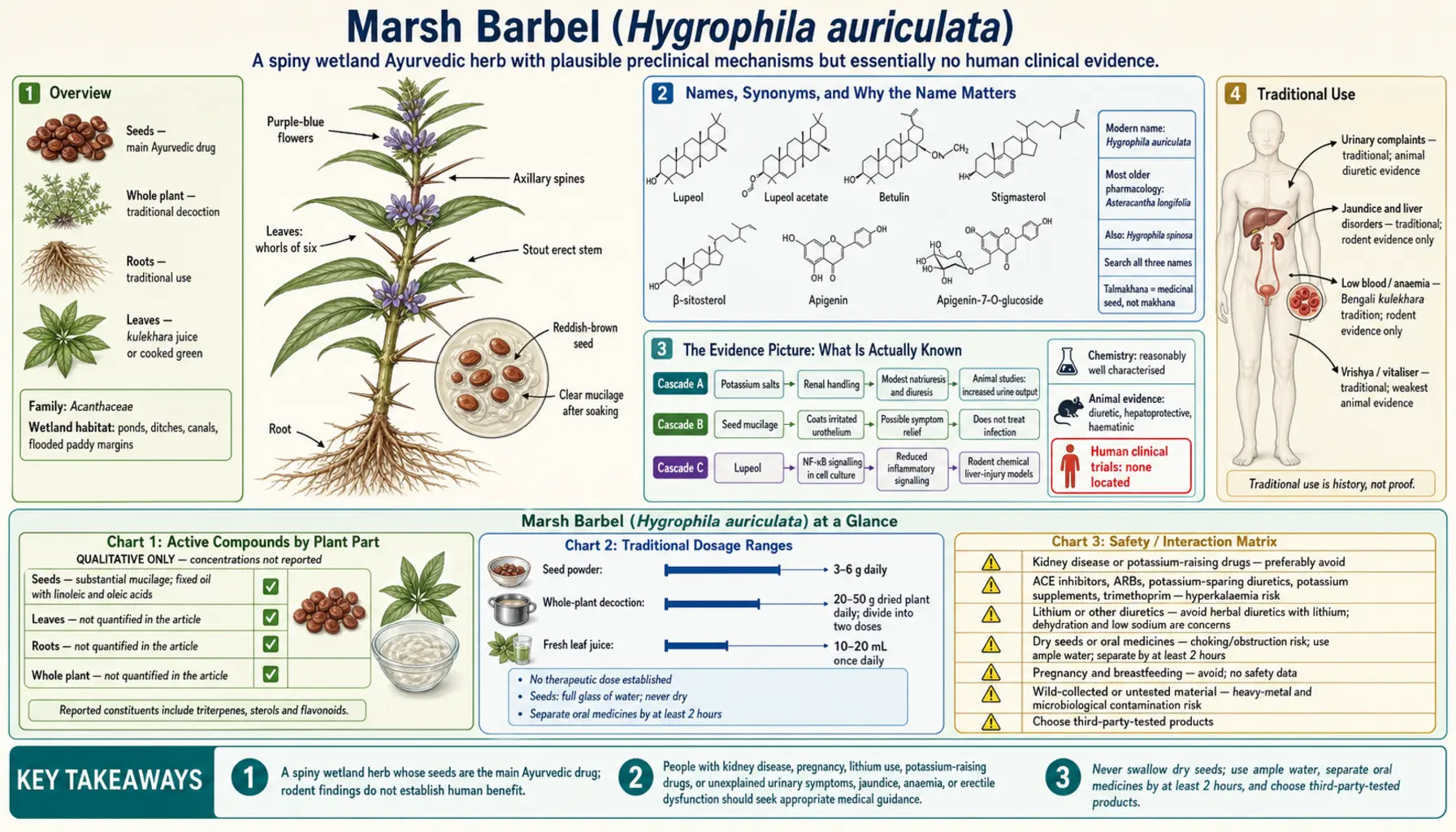
Marsh barbel is a spiny marsh plant of India and Southeast Asia whose seeds — sold in Indian markets as talmakhana — are a long-established Ayurvedic drug for urinary complaints, jaundice, and as a general "vitaliser." The honest headline is that there is essentially no human clinical evidence for any of it. What exists is a body of animal screening work from Indian pharmacology departments: diuretic tests in rats, liver-protection models in mice, and blood-count studies in chemically anaemic rodents.
Animal screening is a starting point, not a result. This page describes the plant properly, gives the mechanistic reasoning where there is any, and marks clearly where the data stops — because most of what is written about talmakhana online consists of rodent findings restated as human benefits. There is also a naming problem worth knowing about before you search for anything: most of the older literature calls this plant Asteracantha longifolia, and if you search only the modern name you will miss the majority of the published work.
Table of Contents
- Overview
- Names, Synonyms, and Why the Name Matters
- The Evidence Picture: What Is Actually Known
- Traditional Use
- Active Compounds
- Urinary Complaints and the Diuretic Claim
- Liver, Jaundice and Hepatoprotection
- Anaemia and the Kulekhara Tradition
- Aphrodisiac and "Vitaliser" Claims
- Forms and Preparations
- Dosage
- Cautions and Contraindications
- Key Research Papers
- Connections
- Featured Videos
Overview
Hygrophila auriculata is a stout, erect herb of the Acanthaceae family, growing to about one metre. Its defining feature is armament: pairs of long, sharp axillary spines sit at each node, arranged in whorls around the stem, which makes the plant genuinely unpleasant to harvest by hand and gives it its Tamil name, neermulli — "water thorn." The leaves are long and narrow in whorls of six, and the flowers are purple-blue, borne in clusters tucked between the spines.
It is an obligate wetland plant. It grows on the margins of ponds and tanks, in ditches, along canal banks, in flooded paddy margins and in seasonally waterlogged ground — typically in the shallow, slow, nutrient-rich water that also carries agricultural runoff. Its range covers India, Sri Lanka, Bangladesh, Nepal, Myanmar, Thailand, Malaysia and parts of tropical Africa. It is common enough in India to be considered a weed of rice cultivation.
The seeds are the main Ayurvedic drug. They are small, flattened, reddish-brown, and strongly mucilaginous — drop them in water and within minutes each seed is wrapped in a clear gel, the same way basil or chia seeds behave. This property is not incidental; it is the entire physical basis of the plant's traditional use as a soothing drug for irritated urinary passages, and it is also the reason for the practical dosing advice further down this page.
Beyond the seeds, the whole plant, the roots and the leaves all have separate traditional uses, and different regional traditions favour different parts — the Ayurvedic tradition of the north uses the seeds, while the Bengali household tradition uses the leaves.
Names, Synonyms, and Why the Name Matters
Binomial: Hygrophila auriculata (Schumach.) Heine
Family: Acanthaceae
The synonym problem — read this before searching for anything
This plant has been shuffled between genera repeatedly and carries an unusually heavy load of synonyms:
- Asteracantha longifolia (L.) Nees — this is the name used in most of the pharmacology literature. Essentially all Indian experimental work published before roughly 2005, and much of it since, appears under this name.
- Hygrophila spinosa T. Anderson — the second most common name in the older literature.
- Hygrophila schulli (Buch.-Ham.) M.R. Almeida & S.M. Almeida
- Barleria longifolia L. and Barleria auriculata Schumach. — the original eighteenth- and nineteenth-century placements.
The practical consequence is concrete. A PubMed search for "Hygrophila auriculata" returns a fraction of the literature; a search that also includes "Asteracantha longifolia" and "Hygrophila spinosa" returns considerably more. The searches at the bottom of this page are constructed to catch all three. If you are trying to evaluate a claim on a product label, this is the single most useful thing to know.
Regional names
- Sanskrit: kokilaksha (कोकिलाक्ष, "cuckoo's eye" — a reference to the flower); also ikshura and ikshuraka, and gokulakanta
- Hindi: talmakhana (तालमखाना), gokhulakanta
- Bengali: kulekhara / kulekhāṛā — under this name it is a genuinely famous household remedy in West Bengal and Bangladesh
- Tamil: neermulli (நீர்முள்ளி, "water thorn")
- Telugu: nirugobbi; Malayalam: vayalchulli; Kannada: kolavalike; Marathi: talimkhana
- Sinhala: neeramulliya; Thai and Malay: no widely used common name — the plant is present but is not a major traditional drug outside South Asia
Two name confusions that matter
Talmakhana is not makhana. This trips people up constantly. Makhana (fox nut, popped lotus seed) is the puffed seed of Euryale ferox — a completely different water plant, sold as a snack food, eaten by the handful, and entirely benign. Talmakhana is the medicinal seed of Hygrophila auriculata, sold by the gram in herb shops, and is a drug rather than a food. The names look alike, the plants are unrelated, and the confusion runs in both directions in online recipes and product listings.
The genus Hygrophila is mostly an aquarium genus. If you search the internet for "Hygrophila," the overwhelming majority of results concern Hygrophila difformis (water wisteria) and Hygrophila polysperma — ornamental aquarium plants with no medicinal use and, in the case of H. polysperma, federal noxious-weed status in the United States. None of that has anything to do with marsh barbel. Search the species name, not the genus.
The Evidence Picture: What Is Actually Known
Set out plainly, because it is short:
- Human clinical trials: we could not locate any that meet a reasonable standard. No randomised controlled trial for diuresis, for urinary stones, for jaundice or liver disease, for anaemia, or for sexual function. Not a negative trial — an absent one.
- Animal diuretic studies: yes, several. Rats given plant extracts pass more urine over the following hours than vehicle-treated controls, with some studies comparing against furosemide. These are real experiments with real results, in rats.
- Animal hepatoprotection: yes, several. Reduced ALT/AST elevation and reduced histological damage in rodents given carbon tetrachloride, paracetamol or thioacetamide alongside plant extract.
- Animal haematinic work: yes, some. Rodents made anaemic with phenylhydrazine, then given extract, show higher haemoglobin and red-cell counts than untreated anaemic controls.
- Animal sexual-behaviour studies: yes, and they are the weakest of the set. Rat mount-frequency assays are a notoriously poor predictor of anything in humans.
- Chemistry: reasonably well characterised. The constituent list is solid. What those constituents do at achievable human doses is not established.
The pattern here is worth naming, because it recurs across dozens of South Asian medicinal plants: an extensive preclinical screening literature produced mostly for pharmacy dissertations, no follow-through into human studies, and a marketing layer that presents the rodent results as though they were clinical outcomes. The rodent work is not fraudulent. It is simply the first rung of a ladder nobody climbed.
Traditional Use
Marsh barbel appears in the classical Ayurvedic materia medica under the name ikshuraka or kokilaksha, and is grouped with the mutrala (diuretic) drugs. Its traditional indications cluster tightly around three areas.
Urinary complaints
This is the primary and most consistent traditional use. The seeds and whole plant were prescribed for mutrakricchra (painful or difficult urination), mutraghata (obstructed urination), and ashmari (urinary stones), and for the general category of "heat" in the urinary passages. Two mechanisms were implicitly at work in traditional practice: increasing urine volume, and coating irritated tissue with the seed mucilage.
Jaundice and liver disorders
Marsh barbel appears in traditional treatment of kamala (jaundice) and general liver complaints, usually as part of a compound formulation rather than alone. This is the same indication cluster occupied by a large number of Indian plants, and the historical reasoning was symptomatic — jaundice was treated with plants that were believed to move fluid and clear "heat."
Vrishya — the aphrodisiac and vitaliser category
The seeds are classed as vrishya, which in Ayurvedic pharmacology means a drug that supports sexual vitality and semen production. This category also carries an overlapping meaning of general strengthening after illness or debility. Talmakhana seeds appear in a great many commercial Ayurvedic "vitality" formulations for this reason, and this is currently their largest commercial use.
The Bengali kulekhara tradition
Separate from formal Ayurveda, marsh barbel leaves have a strong presence in Bengali household medicine as kulekhara, taken specifically for weakness and "low blood." The leaves are juiced, or cooked and eaten as a green. This is genuine, current, widespread folk practice rather than a textbook indication, and it is discussed in its own section below.
As always: traditional use is history. It records what people believed and did. It is a reason to investigate a plant, not evidence that the plant works.
Active Compounds
Triterpenes and sterols
- Lupeol and lupeol acetate — pentacyclic triterpenes, and the most-studied constituents of the plant. Lupeol has a substantial independent pharmacology literature of its own: it inhibits NF-κB signalling in cell culture, shows anti-inflammatory activity in rodent models, and has been examined in preclinical cancer work. It is present in many plants and in some foods, so it is not distinctive to marsh barbel — but it is a real molecule with real activity, and it is the most credible candidate for whatever anti-inflammatory effect the plant has.
- Betulin — another lupane-type triterpene, best known from birch bark. (You will often see this misspelled "butelin" in secondary sources; the correct name is betulin.)
- Stigmasterol and β-sitosterol — plant sterols, present in most edible plants, with modest cholesterol-absorption-blocking effects at gram-level doses far above anything achievable here.
Flavonoids
Apigenin and apigenin-7-O-glucoside are the principal flavonoids reported, with luteolin glycosides also described. Both are common dietary flavones with antioxidant and mild anti-inflammatory activity in vitro.
Seed mucilage and fixed oil
The seeds contain a substantial polysaccharide mucilage that hydrates into a gel, plus a fixed oil rich in linoleic and oleic acids. The mucilage is pharmacologically inert in the usual sense but physically real: it is a bulking demulcent, in the same category as psyllium husk. Its clinical relevance is chiefly as a drug-interaction risk, since gels of this kind can slow the absorption of medication taken at the same time.
Potassium salts — the most plausible mechanism on the page
Older Indian pharmacognosy repeatedly notes that the ash of this plant is unusually rich in potassium salts. This is worth taking seriously, because it is the most parsimonious explanation for the observed diuretic effect in rodents. A potassium load does produce a modest natriuresis and diuresis, by well-understood renal physiology, without requiring any exotic constituent at all.
That explanation is deflationary but it is honest, and it has a direct safety consequence: if the diuretic effect is a potassium effect, then the people most likely to notice it are also the people most at risk from it — those with chronic kidney disease or on potassium-sparing drugs. See Cautions.
Alkaloids
Compounds named asteracanthine and asteracanthicine appear in older literature. They have never been well characterised, their structures are not securely established, and they should be treated as unverified.
Urinary Complaints and the Diuretic Claim
This is the plant's flagship claim and the one with the most preclinical support — which is to say, some.
The mechanism, as far as it goes
Two things could be happening, and they are independent:
- A potassium-driven diuresis. A meaningful potassium load increases urine output through ordinary renal handling. This requires no special pharmacology and is the most likely explanation for the rodent results.
- A demulcent effect on irritated urothelium. Mucilage does coat mucous membranes, and this is a genuinely plausible mechanism for symptomatic relief of urinary burning — the same rationale behind marshmallow root and slippery elm. It would relieve a symptom, not treat an infection.
The evidence
Rodent: Several studies from Indian pharmacology groups report increased urine volume and increased sodium and potassium excretion in rats given aqueous or alcoholic extracts, sometimes benchmarked against furosemide. The effects are consistently smaller than furosemide's, which is unsurprising.
Human: None located. No trial of urine output, no trial in urinary tract infection, no trial in kidney stones, no trial in benign prostatic hyperplasia.
What this means practically
The claim that marsh barbel "dissolves kidney stones" is not supported by anything. No study has examined stone composition, stone passage, or recurrence in humans, and no proposed mechanism would dissolve calcium oxalate — the commonest stone type — in the urinary tract. Increasing fluid intake genuinely does reduce stone recurrence, which is well established. If a marsh barbel preparation helps, the most likely reason is that people take it with a lot of water.
More importantly: a urinary tract infection needs antibiotics. Untreated, it can ascend to the kidneys and become pyelonephritis, and from there sepsis. A demulcent that eases burning while an infection climbs is worse than useless, because it removes the symptom that would have sent you to a doctor.
Liver, Jaundice and Hepatoprotection
Rodent evidence: Extracts of the whole plant and of the roots reduce the rise in serum transaminases and reduce histological necrosis in rats and mice challenged with carbon tetrachloride, paracetamol, or thioacetamide. Several independent groups have reported this. Lupeol's NF-κB inhibition is the usual proposed mechanism, and it is at least a coherent one, since NF-κB-driven inflammation in liver macrophages is a real amplifier of chemical liver injury.
Human evidence: None located.
Two cautions specific to this claim. First, the "prevention" design used in almost all of these studies — extract given before the toxin — is much easier to succeed at than the "treatment" design that would matter clinically. Second, jaundice in a real person is a symptom with a long differential: viral hepatitis, gallstones, drug injury, haemolysis, and pancreatic or biliary cancer among them. Some of those are urgent. New jaundice needs a diagnosis, not a herb.
Anaemia and the Kulekhara Tradition
In West Bengal and Bangladesh, kulekhara leaves are one of the best-known household remedies for weakness and "low blood," taken as a juice or cooked as a leafy green. The practice is real and widespread, and mothers and grandmothers still press it on tired teenagers.
What the evidence shows: rodent studies in which animals are made anaemic with phenylhydrazine and then treated with extract report higher haemoglobin and red-cell counts than in untreated anaemic controls. We could not locate a randomised controlled trial in humans.
A plausible and unglamorous explanation. Dark leafy greens genuinely contain iron and folate. If a person with dietary-deficiency anaemia starts eating a bowl of green leaves daily, their haemoglobin may well improve — because of the nutrients, not because of any special property of this particular species. Note also that non-haem plant iron is poorly absorbed, so the effect would be modest and slow.
Why this one matters clinically
Anaemia is a sign, not a disease. In adults, and especially in men and in postmenopausal women, unexplained iron-deficiency anaemia is a recognised presentation of gastrointestinal blood loss, including colorectal cancer, and standard practice is to investigate the gut rather than simply replace iron. Coeliac disease, heavy menstrual bleeding, chronic kidney disease and B12 deficiency are other common causes, and each has a different treatment.
Treating anaemia with leaf juice, without a blood count and a cause, can delay a diagnosis that is time-sensitive. If the leaves are eaten as food alongside proper investigation, no harm done — they are a green vegetable. If they replace the investigation, that is the harm.
Aphrodisiac and "Vitaliser" Claims
Talmakhana seeds are marketed heavily in India as a male vitality ingredient. The supporting evidence is rat mating-behaviour studies: mount frequency, intromission frequency, ejaculation latency, and sometimes testosterone levels and sperm counts in treated rats.
It is worth being direct about how weak this evidence class is. Rodent copulatory assays are highly sensitive to handling, novelty, arousal and stress, they are scored by observers who usually know the treatment groups, and the translation record from rat mating behaviour to human sexual function is poor. Meanwhile, erectile dysfunction in men is most often vascular, and is frequently the first visible sign of endothelial disease — which means it can be an early warning of cardiovascular risk that deserves proper assessment.
Human evidence for marsh barbel in sexual dysfunction: none located.
One further warning specific to this product category: Ayurvedic and traditional "male vitality" supplements are among the most frequently adulterated products in the world. Regulators including the US Food and Drug Administration have repeatedly found undeclared sildenafil, tadalafil and their chemical analogues in products sold as purely herbal. That is a real, documented hazard, and it is dangerous specifically for men taking nitrates for angina, in whom the combination can cause a catastrophic drop in blood pressure.
Forms and Preparations
- Seeds (talmakhana). The principal Ayurvedic form, sold whole or powdered. Traditionally soaked in water — they gel — or taken as powder with water or milk.
- Whole-plant or root decoction (kwatha). Dried plant simmered in water; the traditional form for the diuretic indication.
- Leaf juice. The Bengali kulekhara form: fresh leaves pounded and strained, usually taken in the morning.
- Leaves as a cooked green. In Bengal the leaves are also cooked and eaten as a vegetable.
- Compound formulations. The most common commercial exposure. Marsh barbel appears as one ingredient among many in Ayurvedic urinary and vitality formulas, at doses you generally cannot determine from the label.
- Capsules and powders. Standardised extracts are rare; most capsule products are milled dried plant with no marker assay.
What to look for on a label
- A binomial — any of Hygrophila auriculata, Hygrophila spinosa, or Asteracantha longifolia. All three are this plant.
- The plant part. Seed, leaf, root and whole plant are used differently in tradition and are not interchangeable.
- Third-party heavy-metal testing — see Cautions; this matters more for this plant than for most.
- For any "vitality" formula: prefer manufacturers who test for undeclared pharmaceutical adulterants.
Dosage
No therapeutic dose has been established, because no human dose-finding study has been done. The figures below are traditional practice, given for description only.
- Seed powder: traditionally around 3–6 g daily, taken with a full glass of water.
- Whole-plant decoction: traditionally prepared from roughly 20–50 g of dried plant per day, reduced by simmering and divided into two doses.
- Fresh leaf juice (kulekhara): commonly 10–20 mL once daily.
Practical rule if you use the seeds: always take them with plenty of water and never dry. Mucilaginous seeds that swell before they clear the oesophagus are a genuine, documented choking and obstruction hazard — the same reason psyllium carries that warning on every package.
Keep at least two hours between marsh barbel seeds and any oral medication, for the same reason: the gel can delay or reduce absorption of whatever else is in your stomach.
Cautions and Contraindications
Overall: this plant has been eaten and used for a very long time without a signal of acute toxicity, which is mild reassurance. There is no formal human toxicology programme, no long-term safety data, and no pregnancy data.
Kidney disease and potassium-raising drugs
This is the caution most worth acting on, and it follows directly from the chemistry. The plant is potassium-rich, and if that is what drives its diuretic effect, then anyone whose kidneys cannot excrete a potassium load is at risk of hyperkalaemia — a high blood potassium level, which can cause dangerous heart-rhythm disturbances with very little warning.
Be cautious, and preferably avoid, if you have chronic kidney disease or take any of: ACE inhibitors (lisinopril, ramipril), ARBs (losartan, valsartan), potassium-sparing diuretics (spironolactone, eplerenone, amiloride), potassium supplements, or trimethoprim. Each of these already raises potassium.
Diuretic drugs and lithium
If the plant has any diuretic effect, it is additive with furosemide, hydrochlorothiazide and similar drugs, with the usual consequences: dehydration, low sodium, dizziness on standing. Anyone taking lithium should avoid herbal diuretics altogether — changes in sodium and fluid balance alter lithium clearance, and lithium has an extremely narrow safety margin.
Contamination — a specific risk for this plant
Marsh barbel is a wetland plant, usually wild-collected, growing in exactly the water that receives agricultural and industrial runoff. Aquatic and semi-aquatic plants concentrate heavy metals — lead, cadmium, arsenic, chromium — from sediment and water, and this is well documented across wetland species. There is also a microbiological risk from ditch water for anything used fresh.
On top of that, imported Ayurvedic products carry the broader documented heavy-metal problem identified in the JAMA surveys by Saper and colleagues. Between the two, third-party testing is not optional for this plant. Wild-collected material of unknown provenance is a poor bet.
Pregnancy and breastfeeding
Avoid. No safety data exists. The plant carries traditional vrishya and reproductive associations, which is a reason for caution rather than reassurance, and diuresis in pregnancy is undesirable in itself.
Do not substitute it for treatment
- Urinary tract infection needs antibiotics. Ascending infection causes pyelonephritis and sepsis.
- Jaundice needs a diagnosis. Some causes are urgent.
- Anaemia needs a cause. In adults, unexplained iron deficiency warrants investigation of the gut.
- Erectile dysfunction can be an early sign of cardiovascular disease and deserves proper assessment.
Choking hazard
Never swallow the dry mucilaginous seeds without ample water. This is a real, non-theoretical risk with any swelling seed.
The plant itself is armed
If you are harvesting: the spines are long, hard and sharp, they sit at every node, and puncture wounds from a plant growing in stagnant water are an infection risk. Gloves.
Key Research Papers
A note on the links. Every link below goes to a PubMed search rather than a numeric identifier. A mistyped PMID silently delivers a different paper; a search always resolves and lets you confirm the record yourself. Note also that the searches include the synonym Asteracantha longifolia, without which much of this literature is invisible.
- Hussain T, Fareed S, Siddiqui HH, et al. Pharmacognostic and phytochemical studies on Hygrophila auriculata. Find on PubMed. Constituent characterisation of the seeds and whole plant.
- Diuretic activity of Asteracantha longifolia in rats — multiple Indian pharmacology reports. Find on PubMed. The rodent basis of the diuretic claim; note the absence of any human follow-up.
- Hepatoprotective activity of Hygrophila spinosa / Asteracantha longifolia against chemically induced liver injury in rodents. Find on PubMed.
- Haematinic activity of Asteracantha longifolia in experimentally anaemic animals. Find on PubMed. The rodent basis of the kulekhara anaemia tradition.
- Saleem M, Alam A, Arifin S, et al. Lupeol, a triterpene, inhibits inflammation and tumour promotion. Find lupeol pharmacology on PubMed. Background on the plant's most-studied constituent — useful, but note that lupeol is not specific to this species.
- Saper RB, Phillips RS, Sehgal A, et al. Lead, mercury, and arsenic in US- and Indian-manufactured Ayurvedic medicines sold via the Internet. JAMA. 2008 — find on PubMed. The basis of the heavy-metal caution.
- Undeclared pharmaceutical adulterants in "herbal" sexual-enhancement supplements. Find on PubMed. Relevant to any vitality formula containing talmakhana.
- Heavy-metal accumulation in aquatic and wetland macrophytes. Find on PubMed. Why provenance matters for a plant harvested from ditches.
Live PubMed Searches
- All three names at once — start here
- Asteracantha longifolia — the older literature
- Hygrophila auriculata diuretic
- Hygrophila auriculata hepatoprotective
- Kulekhara and haemoglobin
- Hygrophila auriculata aphrodisiac studies
- Lupeol pharmacology
- Herbal diuretics and hyperkalaemia
- Why adult iron-deficiency anaemia is investigated
- Ayurvedic products and heavy-metal contamination
Connections
- All Herbs
- Horsetail — the other classic herbal diuretic, with a comparable evidence problem and its own thiaminase caution
- Uva Ursi — the urinary herb that does have some human data, and a clear hydroquinone-related time limit on use
- Dandelion — another potassium-rich traditional diuretic, where the same potassium caution applies
- Saw Palmetto — the urinary herb most studied in men, and a useful contrast in evidence quality
- Milk Thistle — the liver herb with actual human trials, for comparison
- Kidney Stones — what actually reduces recurrence
- Urinary Tract Infections — why these need antibiotics, not demulcents
- Iron Deficiency Anemia — and why the cause matters more than the treatment
- Iron — absorption, plant versus animal sources, and why leaf iron is poorly absorbed
- Potassium — the mineral behind both the diuretic mechanism and the main caution
- Kidney and Liver Conditions — the disease area this plant is traditionally aimed at
- Conditions on this site that reference this page: Coronary Artery Disease (CAD) · Gallstones · Erectile Dysfunction