Shampoo Ginger (Zingiber zerumbet)
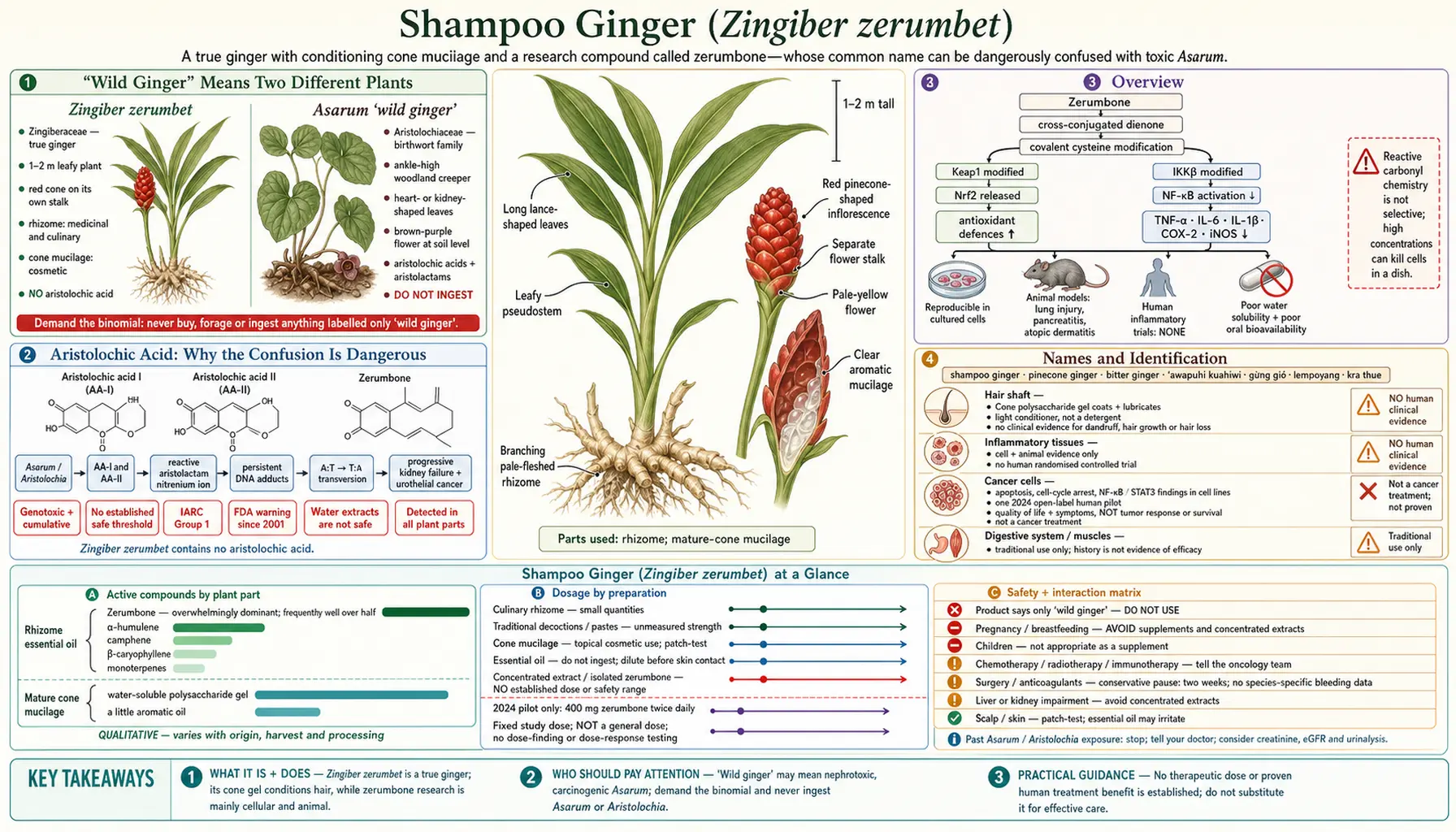
Read this before you buy anything labelled "wild ginger." That name is attached to two completely unrelated groups of plants, and one of them will destroy your kidneys. In Southeast Asia and the Pacific, "wild ginger" usually means Zingiber zerumbet — a true ginger, the shampoo ginger or pinecone ginger, harmless and widely eaten. In North America and Europe, "wild ginger" almost always means a species of Asarum, which is not a ginger at all but a member of the birthwort family, and which contains aristolochic acid — a potent nephrotoxin and a confirmed human carcinogen responsible for Balkan endemic nephropathy and for aristolochic acid nephropathy. The two plants share a common name and nothing else.
This page is about Zingiber zerumbet: the plant whose red pinecone-shaped flower head squeezes out a fragrant, slippery gel that Hawaiians and Southeast Asians have used for centuries as a hair rinse. It contains no aristolochic acid. Its main research compound is zerumbone, which has an enormous cell-culture and rodent literature and, as of a 2024 pilot study, exactly one human study — an open-label trial in patients with advanced cancer that measured quality of life, not tumor response (see Benefits: Zerumbone and Cancer for the full picture). The single most valuable thing this page can do is make sure you know which plant is in your hand.
Table of Contents
- "Wild Ginger" Means Two Different Plants
- Aristolochic Acid: Why the Confusion Is Dangerous
- Overview
- Names and Identification
- Traditional Use
- Active Compounds
- Zerumbone and Inflammation
- Zerumbone and Cancer Cell Lines
- The Shampoo: Mucilage and Hair Use
- Culinary Use
- Forms and Preparations
- Dosage
- Cautions and Contraindications
- Key Research Papers
- Connections
- Featured Videos
"Wild Ginger" Means Two Different Plants
There is no botanical authority behind the phrase "wild ginger". It is a folk name, and it was applied independently on opposite sides of the world to plants that happen to smell gingery. The two groups are not related, not similar in chemistry, and not equally safe.
| Shampoo ginger (this page) | Asarum "wild ginger" | |
|---|---|---|
| Binomial | Zingiber zerumbet (L.) Roscoe ex Sm. | Asarum canadense, A. europaeum, A. sieboldii, A. heterotropoides and ~100 others |
| Family | Zingiberaceae — the true ginger family | Aristolochiaceae — the birthwort family |
| Where the name is used | Southeast Asia, Pacific, Hawaii, Australia | North America, Europe, East Asia |
| Looks like | A 1–2 m leafy ginger with a separate red pinecone-shaped flower head | A low woodland groundcover, heart- or kidney-shaped leaves, hidden brown-purple flower at soil level |
| Aristolochic acid | None. Not present in the family. | Yes — aristolochic acids and aristolactam analogs. |
| Safe to eat? | Eaten as a food and folk medicine across its range; no aristolochic acid concern. | No. Do not ingest. Genotoxic, nephrotoxic, IARC Group 1 carcinogen. |
The reason Asarum ever picked up the name is prosaic: crush the rhizome of Asarum canadense and it smells and tastes convincingly of ginger, so European settlers in North America used it as a ginger substitute and as a candied sweetmeat. That resemblance is entirely in the aroma compounds. It says nothing about the rest of the plant's chemistry, and the rest of the plant's chemistry is the problem.
Practical rule: never buy, forage or ingest anything sold under the bare name "wild ginger". Demand the binomial. Zingiber zerumbet is fine. Anything beginning with Asarum or Aristolochia should not be swallowed, in any preparation, at any dose.
Aristolochic Acid: Why the Confusion Is Dangerous
This section is about the plant that is not the subject of this page, and it is here because the name collision is the most consequential fact a reader can take away.
What aristolochic acid does. Aristolochic acids (principally AA-I and AA-II) are nitrophenanthrene carboxylic acids found throughout the family Aristolochiaceae, which includes both Aristolochia and Asarum. Once absorbed, they are reduced in the body to a reactive aristolactam nitrenium ion that binds covalently to DNA, forming adducts that persist for years. Those adducts cause a distinctive and unusual mutation — an A:T to T:A transversion — which shows up as a recognisable fingerprint in the TP53 tumour-suppressor gene of the cancers that follow. Two things follow from this mechanism, and both are unforgiving. First, the injury is genotoxic and cumulative: there is no established safe threshold, and doses add up over a lifetime. Second, there is a long latency — kidney failure and urothelial cancer can appear years or decades after exposure stops.
Balkan endemic nephropathy. For most of the twentieth century, a slow, progressive kidney disease of unknown cause afflicted farming villages along the tributaries of the Danube in Serbia, Bosnia, Croatia, Bulgaria and Romania, along with a strikingly high rate of cancers of the upper urinary tract. Grollman and colleagues resolved it in 2007: they found aristolochic acid–DNA adducts in the kidney tissue of affected patients and the characteristic aristolochic acid mutational signature in the TP53 gene of their urothelial tumours. The exposure route was the local wheat, contaminated in the field with the seeds of Aristolochia clematitis, a common weed in those valleys. Jelaković and colleagues have since documented the causative role in detail, and Jelaković's group also showed continuing dietary exposure among farmers in the endemic Croatian region and among Bosnian immigrants.
Aristolochic acid nephropathy. The second, and more relevant, disaster was iatrogenic. At a Belgian weight-loss clinic in the early 1990s an Aristolochia species was substituted — through a mix-up of Chinese herb names — for the intended ingredient in a slimming preparation. Women taking it developed a rapidly progressive interstitial renal fibrosis that in many cases went to end-stage kidney failure, and a substantial proportion of those who had their kidneys and ureters removed were found to have urothelial carcinoma. Nortier and Vanherweghem documented the episode; Debelle, Vanherweghem and Nortier's 2008 review established that it was not a Belgian curiosity but a worldwide problem, wherever aristolochic-acid-containing botanicals are used. Heinrich and colleagues' global survey of 566 sources found Aristolochia species in traditional use across Asia, the Americas, Europe and Africa — often for gastrointestinal complaints, which implies repeated exposure.
The public-health case is closed enough that you can see the effect of stopping. Taiwan, which had extraordinarily high historical consumption of aristolochic-acid-containing Chinese herbal products, banned them; Jhuang and colleagues' interrupted time-series analysis found a measurable reduction in the incidence of urological cancers afterwards. Aristolochic acid and plants containing it are classified by the International Agency for Research on Cancer as Group 1 — carcinogenic to humans, the same category as tobacco smoke and asbestos. Regulators including the US FDA have warned since 2001 about botanical products containing or suspected of containing aristolochic acid, and Asarum appears among the genera of concern.
Where Asarum specifically fits. This is the part people get wrong, so it is worth being precise. Michl and colleagues at the UCL School of Pharmacy ran high-resolution LC-MS on medicinally used Asarum species and found that the majority of samples contained aristolochic acid analogs — 9-methoxy aristolactam IV, aristolactam I and aristolactam IV among them. Three details from that paper matter:
- The compounds were present in water extracts as well as methanol extracts. The common reassurance that "it's only a tea, not a strong solvent extract" does not hold.
- They were detected in all parts of the plant, not only the root. Restricting use to leaf or to aerial parts is not a safeguard.
- Most of the extracts were not acutely cytotoxic to cultured human kidney (HK-2) cells at the doses tested — and the authors are explicit that this is not reassuring, because the mechanism of harm is DNA adduct formation and mutation over time, not acute cell killing. A substance can be entirely non-toxic in a 48-hour cell assay and still be a carcinogen.
Asarum species remain in use: Asarum sieboldii and A. heterotropoides are the traditional Chinese drug xì xīn (细辛, Asari Radix et Rhizoma), and A. canadense is still promoted in some North American foraging and herbal circles as a ginger substitute or a digestive. Chinese pharmacopoeial standards have tightened, restricting the part used and limiting aristolochic acid I content, and analytical chemists continue to publish methods for measuring it. None of that changes the advice for an individual reader, which is simply: do not ingest it.
If you have taken an Asarum or Aristolochia product. Stop, and tell your doctor — including if it was years ago. Aristolochic acid nephropathy is usually silent until a large fraction of kidney function is gone, so the reasonable steps are a check of kidney function (creatinine and eGFR) and urinalysis, and a conversation about whether surveillance for urothelial cancer is warranted given how much you took and for how long. This is not a reason to panic over a single cup of tea; it is a reason not to keep taking it and to have it on your medical record.
Overview
With that settled: Zingiber zerumbet (L.) Roscoe ex Sm. is a true ginger, in the same genus as culinary ginger. It grows one to two metres tall from a branching, pale-fleshed rhizome, with the usual ginger arrangement of long lance-shaped leaves on leafy pseudostems.
What makes it instantly recognisable is the inflorescence. Like torch ginger, it flowers on a separate short stalk arising directly from the rhizome, but the flower head is a tight oval cone of overlapping bracts — the pinecone. It emerges green, and as it matures it flushes through gold to a vivid scarlet. Small pale yellow flowers push out one or two at a time between the bracts. As the cone ages it fills with a clear, viscous, sweetly aromatic mucilage, and squeezing a ripe cone in your fist sends it running out over your hand like liquid soap. That is the shampoo.
The species is native to South and Southeast Asia and was carried east across the Pacific by Polynesian voyagers, making it one of the classic canoe plants of Hawaii, where it naturalised into wet forest. It is now pantropical and is grown ornamentally in warm climates worldwide.
Parts used: the rhizome (medicinally and, sparingly, in cooking) and the mucilage from the mature cone (cosmetically).
Names and Identification
Binomial: Zingiber zerumbet (L.) Roscoe ex Sm. Family: Zingiberaceae. Synonyms in older literature include Amomum zerumbet L. and Zingiber amaricans Blume.
- English: shampoo ginger, pinecone ginger, bitter ginger, and — the problematic one — wild ginger.
- Hawaiian: 'awapuhi kuahiwi ("mountain 'awapuhi"), often shortened to 'awapuhi. Distinguish from 'awapuhi melemele (yellow ginger, Hedychium flavescens) and 'awapuhi ke'oke'o (white ginger, H. coronarium), which are different plants introduced far more recently.
- Vietnamese: gừng gió — "wind ginger".
- Malay / Indonesian: lempoyang.
- Thai: กระทือ (kra thue).
How to tell it apart in the field or the shop. Shampoo ginger is a metre or more tall with a red cone held clear of the ground on its own stalk; Asarum is an ankle-high woodland creeper with paired heart- or kidney-shaped leaves and a small brown-purple flower hidden in the leaf litter, which you have to move the leaves aside to find. They could not look less alike. The danger is not in the field, it is on a label — in a jar of dried root or a bag of capsules where the only identifying information is two English words.
Traditional Use
Zingiber zerumbet is used across its range, and the uses are consistent enough to be worth listing, with the standing caveat that traditional use is history, not evidence of efficacy.
- Hawaii. The cone mucilage was used to wash and soften hair and to scent kapa cloth. The rhizome was pounded and used for sprains, bruises and aching muscles as a massage preparation, and preparations were used for stomach complaints, toothache and earache. It also served as a food flavouring in small amounts.
- Malaysia and Indonesia. Lempoyang rhizome features in jamu preparations for indigestion, flatulence and loss of appetite, and as a post-partum tonic.
- Vietnam. Gừng gió is a thuốc nam remedy for digestive complaints and for what is described as stagnation of qi and blood, and appears in liver-tonic formulas.
- Thailand and India. Used for inflammatory and gastrointestinal complaints, and applied topically for pain and swelling.
Yob and colleagues' 2011 review remains the standard survey of these ethnomedicinal uses alongside the chemistry and pharmacology, and is the sensible starting point for anyone reading further.
Active Compounds
Zerumbone is the story. It is a monocyclic sesquiterpene ketone and, in most chemotypes, the overwhelmingly dominant compound of the rhizome essential oil — frequently well over half of it, with reported figures varying widely with origin, harvest and processing. Tian and colleagues compared fresh with dried rhizome oils and found the composition and measured bioactivities differ between them; Rawat and colleagues showed that even the length of the post-harvest drying period shifts the essential oil profile. In practical terms: two batches of "shampoo ginger rhizome" can be chemically quite different products.
What makes zerumbone interesting to chemists is a structural feature called a cross-conjugated dienone — an electron-poor carbon–carbon double bond sitting next to a carbonyl group. Chemically this is an electrophile, and it reacts readily with the sulfur atom of cysteine residues in proteins. That single property explains most of zerumbone's reported biology at once. Two cysteine-sensor proteins are especially relevant: Keap1, which normally holds the antioxidant transcription factor Nrf2 down and releases it when its cysteines are modified; and IKKβ, the kinase that switches on the inflammatory transcription factor NF-κB. Modify the first and antioxidant defences go up; modify the second and inflammatory gene expression goes down. Analogous reactive-carbonyl chemistry underlies sulforaphane from broccoli and curcumin from turmeric.
The same reactivity is also the reason for caution. A compound that covalently modifies cysteines is not selective in the way a designed drug is — it will touch many proteins, and at high concentration that is precisely how such compounds kill cells in a dish.
Other constituents of the rhizome oil include α-humulene (also a major component of hops), camphene, β-caryophyllene and various monoterpenes. The mucilage of the cone is a water-soluble polysaccharide gel carrying a little of the aromatic oil.
Zerumbone and Inflammation
Mechanism. By modifying IKKβ and related targets, zerumbone reduces activation of NF-κB, the master switch for inflammatory genes — TNF-α, IL-6, IL-1β, COX-2, iNOS. It also activates the Nrf2 antioxidant response. Both effects are reproducible across laboratories in cultured cells.
Animal evidence. There is a great deal of it, and it is broadly consistent. To take representative examples: Chen and colleagues reported that zerumbone protected against sepsis-induced acute lung injury in an animal model through anti-inflammatory and antioxidative effects with NF-κB inhibition; Zhang and Xu reported reduced inflammation and organ damage in severe acute pancreatitis via the ROS/NF-κB pathway; Chang and colleagues reported improvement in an atopic dermatitis model through MAP kinase/NF-κB, Akt and STAT pathways. Yuandani and colleagues' review surveys the immunomodulatory work across Zingiber and Alpinia species more broadly.
Human evidence: none. There is no published randomised controlled trial of zerumbone or of Zingiber zerumbet extract for any inflammatory condition. Not a small one, not a negative one — none. Everything above is an animal or cell result, which in drug development means the hypothesis has been generated but not yet tested where it counts.
There is also a concrete reason this literature has not translated, and it is worth knowing before buying a supplement: zerumbone is poorly water-soluble and has poor oral bioavailability. Kesharwani and Bhat's review of formulation and nanotechnology approaches exists precisely because getting meaningful concentrations of zerumbone into an animal, let alone a person, is difficult. The concentrations that produce these effects in a dish are not concentrations a capsule of rhizome powder will produce in your blood.
Zerumbone and Cancer Cell Lines
Zerumbone has one of the larger anticancer cell-culture literatures of any plant sesquiterpene. Reported effects across many cell lines — colorectal, breast, pancreatic, liver, leukaemia, glioma — include induction of apoptosis, cell-cycle arrest, inhibition of NF-κB and STAT3 signalling, and reduced expression of proteins associated with invasion and angiogenesis. Soroush and colleagues' 2024 review covers the current state of that work, with particular attention to glioma.
This needs to be read correctly, because it is the most misused genre of evidence in the supplement world. Killing cancer cells in a dish is not a high bar. Detergents do it. Most plant extracts do it at some concentration. The hard part — the part that separates a compound from a drug — is killing cancer cells in a living body, at a dose the body tolerates, at concentrations the body can actually reach. Zerumbone has not been shown to do that in a human being. One 2024 pilot study tested oral zerumbone in patients with advanced solid tumors — but it measured quality of life and symptoms, not tumor size or survival, so it still does not show that eating shampoo ginger rhizome or taking a zerumbone supplement affects any cancer in any way. See Benefits: Zerumbone and Cancer for the full trial and a detailed breakdown of what it does and does not establish.
It is genuinely worth studying, and the mechanistic work is legitimate science. It is not a treatment, and no one with cancer should substitute it for, or add it to, oncological care without telling their oncologist — both because it may do nothing and because compounds that modify NF-κB and Nrf2 signalling can in principle interact with chemotherapy and radiotherapy in directions nobody has measured.
The Shampoo: Mucilage and Hair Use
The plant's best-known and least controversial use needs no clinical trial to justify, because the claim is cosmetic rather than medical.
As the flower cone matures past its peak it accumulates a clear, slippery, aromatic gel between the bracts. Squeeze a ripe cone and it runs out freely — a mature cone will yield a generous handful. In Hawaii this liquid was used to wash and condition hair and to perfume kapa cloth, and it remains a well-known trailside novelty: hikers squeeze a cone and use it on hands and hair. It has a soft, sweet, gingery-floral scent and a genuinely slippery feel, which comes from a water-soluble polysaccharide, not from any saponin or true detergent.
Because it is not a detergent, it does not lather much and it does not strip oil. What it does is coat and lubricate the hair shaft, which reduces friction and makes hair easier to comb — functionally a light conditioner rather than a shampoo, despite the name. Modern cosmetic products containing Zingiber zerumbet extract sell that conditioning and fragrance effect, which is a fair description of what it does. Claims that it treats dandruff, stimulates hair growth or reverses hair loss are not supported by clinical evidence.
Culinary Use
Shampoo ginger is a minor food plant, and the reason is in one of its common names: bitter ginger. The rhizome is aromatic but distinctly bitter, and it is used in far smaller quantities than culinary ginger.
- Malaysia and Indonesia. Young lempoyang rhizome and shoots are used sparingly in curries, in pecel and vegetable dishes, and in jamu drinks where the bitterness is part of the point.
- Thailand. Kra thue shoots and young rhizome appear as a vegetable alongside chilli dips and in some southern curries.
- Hawaii. Used historically as a flavouring in small amounts rather than as a staple.
- The cone mucilage is not a food.
If you are cooking with it, treat it as an aromatic bitter, not as a substitute for ginger. Swapping it one-for-one into a recipe that calls for ginger will produce something unpleasantly bitter and short on heat, since it contains none of ginger's gingerols.
Forms and Preparations
- Fresh rhizome. Sold in Southeast Asian markets as lempoyang or kra thue. Look for firm rhizomes; the cut flesh is pale yellow and strongly aromatic.
- Dried rhizome and powder. Widely sold. Note that drying changes the essential oil composition measurably, so dried material is not chemically equivalent to fresh.
- Essential oil. Rich in zerumbone; used in research and in fragrance. Not for ingestion, and like all concentrated essential oils it should be diluted before skin contact.
- Purified zerumbone. A research chemical. Supplement products claiming standardised zerumbone content should be treated with scepticism absent third-party analysis, given how much natural variation the analytical literature documents.
- Cone mucilage and cosmetic extracts. Shampoos, conditioners and body products. This is the use with the longest uncontroversial track record.
- Nanoformulations. Liposomal and nanoparticle zerumbone preparations exist in the research literature to work around its poor solubility. These are laboratory tools, not consumer products, and a consumer product borrowing the word "nano" is not the same thing.
Dosage
No therapeutic dose is established for Zingiber zerumbet or for zerumbone in humans. A single 2024 pilot study used a fixed oral dose of 400 mg zerumbone twice daily in patients with advanced cancer, with no dose-finding or dose-response testing of any kind (see Benefits: Zerumbone and Cancer), so this remains true for any general use. Any dosage on a supplement label is derived from manufacturing convention or, at best, back-calculated from rodent studies — and scaling a rodent dose to a human is not a simple multiplication.
What can be said:
- Culinary use — small quantities of fresh or dried rhizome as a bitter aromatic — has a long history of ordinary consumption across Southeast Asia and no signal of harm.
- Traditional preparations are decoctions and pastes of unmeasured strength; they are not comparable to a concentrated extract.
- Topical use of the cone mucilage is as safe as most plant gels, allergy aside.
- Concentrated extracts and isolated zerumbone taken orally have no established dose, no established safety range in humans, and no demonstrated benefit. That combination is a reason to decline, not a reason to guess.
Cautions and Contraindications
1. The identity caution comes first, because it is the one that can cause irreversible harm. Never purchase or consume a product labelled only "wild ginger". If the label does not say Zingiber zerumbet, assume it may be Asarum — a plant containing aristolochic acid, which causes progressive kidney failure and urothelial cancer, is classified by IARC as carcinogenic to humans, and is present in water extracts and in every part of the plant. This applies to dried root, teas, tinctures, capsules and foraged material alike, and it applies to traditional formulas that may contain xì xīn (Asarum sieboldii / A. heterotropoides) as one ingredient among many. If you have taken such a product, stop and tell your doctor, however long ago it was — kidney function testing and a note on your record are reasonable.
The remaining cautions concern Zingiber zerumbet itself.
- Absence of human safety data. The reason there are few reported adverse effects is largely that there is little human study, not that safety has been demonstrated. Absence of evidence of harm is not evidence of absence of harm, and this distinction matters most for concentrated extracts that no traditional user ever consumed.
- Pregnancy and breastfeeding — avoid. There is no safety data, and some traditional uses are as post-partum and emmenagogue preparations, which is a traditional signal for avoidance in pregnancy. Do not use supplements or concentrated extracts.
- Children. Not studied. Not appropriate as a supplement.
- Cancer treatment. Do not take zerumbone products during chemotherapy, radiotherapy or immunotherapy without telling your oncology team. Compounds that modify NF-κB and Nrf2 signalling could plausibly alter treatment response in either direction, and nobody has measured which.
- Surgery and anticoagulants. Ginger-family plants are conventionally paused two weeks before surgery. There is no specific bleeding data for this species, but in the absence of data the conservative course is reasonable.
- Liver and kidney impairment. An electrophilic compound with unknown human pharmacokinetics is not something to add to compromised clearance. Avoid concentrated extracts.
- Skin contact and allergy. The mucilage is generally well tolerated, but ginger family allergy exists, and the concentrated essential oil can irritate. Patch-test before using a new preparation on the scalp.
- Do not use it to treat anything. The strength of the preclinical literature can give a misleading impression of clinical readiness. For inflammation, infection or cancer, it has not been tested in a person. Use effective treatment for those conditions.
Key Research Papers
On Zingiber zerumbet and zerumbone
- Yob NJ, Jofrry SM, Affandi MM, Teh LK, et al. Zingiber zerumbet (L.) Smith: a review of its ethnomedicinal, chemical, and pharmacological uses. Evidence-Based Complementary and Alternative Medicine. 2011;2011:543216.
- Tian M, Wu X, Hong Y, Wang H, et al. Comparison of chemical composition and bioactivities of essential oils from fresh and dry rhizomes of Zingiber zerumbet (L.) Smith. BioMed Research International. 2020;2020:9641284.
- Rawat A, Kholiya S, Chauhan A, Srivastava D, et al. Effect of post-harvest drying period on the chemical composition of Zingiber zerumbet Sm. rhizomes essential oil and its biological activities. Physiology and Molecular Biology of Plants. 2024;30(6):957–967.
- Soroush A, Pourhossein S, Hosseingholizadeh D, Hjazi A, et al. Anti-cancer potential of zerumbone in cancer and glioma: current trends and future perspectives. Medical Oncology. 2024;41(5):125.
- Chen J, Zhou L, Li X, Wu X, et al. Protective effect of zerumbone on sepsis-induced acute lung injury through anti-inflammatory and antioxidative activity via NF-κB pathway inhibition. Naunyn-Schmiedeberg's Archives of Pharmacology. 2024;397(4):2241–2255.
- Kesharwani SS, Bhat GJ. Formulation and nanotechnology-based approaches for solubility and bioavailability enhancement of zerumbone. Medicina (Kaunas). 2020;56(11):557.
- Yuandani, Jantan I, Haque MA, Rohani AS, et al. Immunomodulatory effects and mechanisms of the extracts and secondary compounds of Zingiber and Alpinia species: a review. Frontiers in Pharmacology. 2023;14:1222195.
On aristolochic acid and the Asarum / Aristolochia hazard
- Grollman AP, Shibutani S, Moriya M, Miller F, et al. Aristolochic acid and the etiology of endemic (Balkan) nephropathy. Proceedings of the National Academy of Sciences USA. 2007;104(29):12129–12134.
- Debelle FD, Vanherweghem JL, Nortier JL. Aristolochic acid nephropathy: a worldwide problem. Kidney International. 2008;74(2):158–169.
- Michl J, Bello O, Kite GC, Simmonds MSJ, et al. Medicinally used Asarum species: high-resolution LC-MS analysis of aristolochic acid analogs and in vitro toxicity screening in HK-2 cells. Frontiers in Pharmacology. 2017;8:215.
- Heinrich M, Chan J, Wanke S, Neinhuis C, et al. Local uses of Aristolochia species and content of nephrotoxic aristolochic acid 1 and 2 — a global assessment based on bibliographic sources. Journal of Ethnopharmacology. 2009;125(1):108–144.
- Jelaković B, Dika Ž, Arlt VM, Stiborova M, et al. Balkan endemic nephropathy and the causative role of aristolochic acid. Seminars in Nephrology. 2019;39(3):284–296.
- Nortier JL, Vanherweghem JL. Renal interstitial fibrosis and urothelial carcinoma associated with the use of a Chinese herb (Aristolochia fangchi). Toxicology. 2002;181–182:577–580.
- Jhuang JR, Chiang CJ, Su SY, Yang YW, et al. Reduction in the incidence of urological cancers after the ban on Chinese herbal products containing aristolochic acid: an interrupted time-series analysis. Scientific Reports. 2019;9(1):19860.
Live PubMed Searches
- Zingiber zerumbet — all results
- Zerumbone — all results
- Zerumbone clinical trials
- Zerumbone bioavailability
- Aristolochic acid nephropathy
- Asarum and aristolochic acid
- Balkan endemic nephropathy
- Aristolochic acid and urothelial carcinoma
- Herbal product misidentification and adulteration
- Zingiberaceae sesquiterpenes and NF-κB
Connections
- All Herbs
- Ginger (Zingiber officinale) — the same genus, and the plant with the human evidence base that shampoo ginger lacks.
- Galangal — another Southeast Asian Zingiberaceae rhizome, and another plant whose common names travel badly.
- Toxins — the site's index of harmful exposures, including nephrotoxins and carcinogens.
- Conditions on this site that reference this page: Gastroenterology · Oncology