Black Ginger (Kaempferia parviflora)
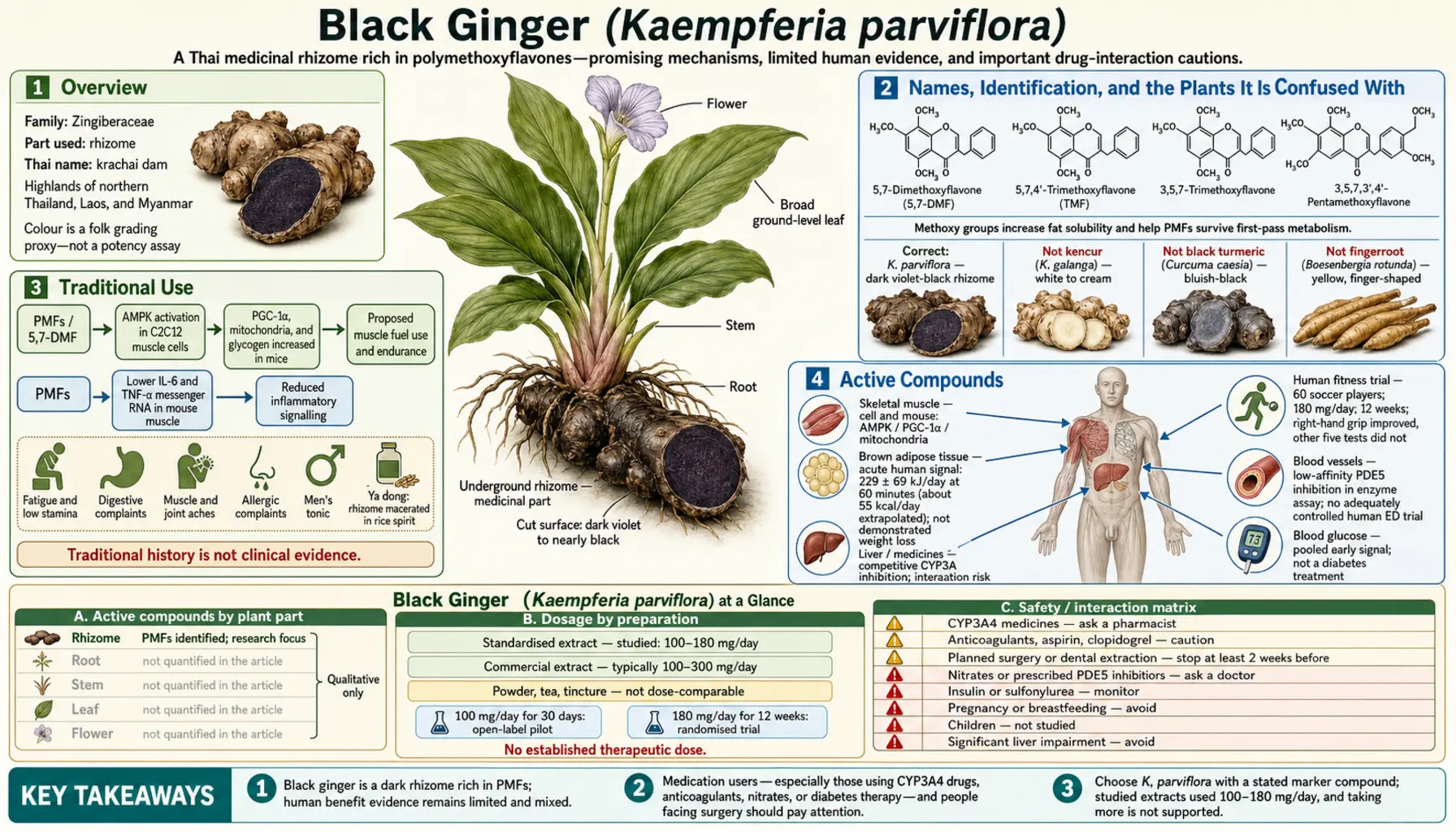
Black ginger is the deep purple-black rhizome of Kaempferia parviflora, a small ginger-family plant of the highlands of northern Thailand, Laos and Myanmar, where it is called krachai dam (Thai กระชายดำ, literally "black krachai"). Cut one open and the flesh is genuinely dark — violet to nearly black — which is how it earned every one of its names. It is sold across Thailand and, increasingly, online as an energy and vitality tonic, and its chemistry is unusual and real: it is loaded with polymethoxyflavones, the same class of compounds that gives dried citrus peel its pharmacology.
The honest position on the evidence is this. Black ginger has a genuinely interesting compound profile and a handful of small human trials — but those trials are small, several are open-label or industry-run, and the largest randomised trial found an effect on only one of six fitness measures. It is not a proven performance drug or an erection drug. The frequently repeated claim that it "works like Viagra" traces back to a laboratory finding about low-affinity PDE5 inhibition, and that word "low-affinity" is doing enormous work that the marketing copy quietly drops.
Table of Contents
- Overview
- Names, Identification, and the Plants It Is Confused With
- Traditional Use
- Active Compounds
- Energy, Exercise Performance, and Muscle
- Blood Sugar, Body Fat, and Metabolic Syndrome
- Blood Flow, Blood Vessels, and the PDE5 Claim
- Inflammation and Antioxidant Activity
- Culinary and Beverage Use
- Forms and Preparations
- Dosage
- Cautions and Contraindications
- Key Research Papers
- Connections
- Featured Videos
Overview
Kaempferia parviflora Wall. ex Baker is a low-growing perennial herb in the Zingiberaceae — the ginger family, which also contains ginger, turmeric, galangal, cardamom and kencur. The plant is small and unassuming: broad ground-level leaves, a modest pale-violet flower, and an underground rhizome that rarely exceeds the size of a walnut. Almost nothing about the plant above ground signals what is below it.
The rhizome is the part used, and it is the colour that matters commercially. Grades are sold on how dark the cut surface is; a rhizome with pale, patchy or brownish flesh fetches less, because growers and buyers treat colour as a rough proxy for the flavonoid content that gives the plant its value. The colour itself comes from anthocyanin-type pigments, not from the methoxyflavones that the research is actually about, so darkness is a folk grading standard rather than a validated potency assay — useful, but not a substitute for a certificate of analysis.
The plant grows wild and semi-wild in cool, well-drained hill country, particularly in Loei, Phitsanulok and Phetchabun provinces of Thailand and across the Lao and Shan uplands. Harvest is in the dry season, after the leaves die back. From there it reaches consumers by three quite different routes. The oldest is ya dong — sliced rhizome macerated in rice spirit and sold by the shot glass from roadside jars. The second is the domestic Thai health-drink and capsule market, where "krachai dam" is a mainstream category alongside ginseng. The third, and the one most readers will meet, is the export supplement channel, where standardised ethanol extracts are sold under brand names and marketed for energy, blood flow and male sexual health.
Names, Identification, and the Plants It Is Confused With
Binomial: Kaempferia parviflora Wall. ex Baker. Family: Zingiberaceae. Part used: rhizome.
Local names: Thai กระชายดำ (krachai dam); also krachai dum, kra chai dam in transliteration. Lao kachai dam. In English-language trade it appears as black ginger, Thai black ginger, and — unhelpfully — as "black turmeric" and "Thai ginseng", neither of which it is. Japanese supplement labels use ブラックジンジャー (burakku jinjā) or the Thai-derived kurachai damu.
This is a plant defined as much by what it is not as by what it is. Three different species are routinely sold, described or written about as though they were black ginger. They are chemically distinct and they are not interchangeable.
- Kencur — Kaempferia galanga. Same genus, different species. Kencur's rhizome flesh is white to cream, not black, and its dominant compound is ethyl p-methoxycinnamate, a camphorous aromatic that makes it a kitchen spice across Java and a staple of Indonesian jamu. If a rhizome smells sharply of camphor and cuts pale, it is kencur. See Kencur.
- Black turmeric — Curcuma caesia. A different genus entirely. Its flesh is bluish-black, which is exactly why the names collide, but it is a Curcuma: it contains curcuminoids and a camphor-rich essential oil, and its traditional home is north-eastern India and Bangladesh rather than Thailand. Buying "black turmeric" and expecting polymethoxyflavones is a category error. See Black Turmeric.
- Fingerroot — Boesenbergia rotunda. In Thailand this is plain krachai, without the dam. Drop one syllable and you have a completely different plant: yellow, finger-shaped rhizomes used by the handful in Thai fish curries and pad cha, with pinostrobin and panduratin rather than methoxyflavones as its signature compounds. Recipes translated from Thai frequently render both as "krachai", which is how the confusion enters English cookbooks. See Fingerroot.
The practical rule for a buyer: black ginger should be sold under the binomial Kaempferia parviflora, the cut rhizome should be dark violet to black throughout rather than only at the skin, and a good extract will state a percentage of 5,7-dimethoxyflavone or of total methoxyflavones. A product that names only "black ginger" with no binomial is not identifiable, and given how many dark rhizomes circulate in this trade, that matters.
Traditional Use
In Thai traditional medicine krachai dam belongs to the category of warming, invigorating remedies. It has been used for fatigue and low stamina, for digestive complaints including flatulence and colic, for muscular and joint aches, for allergic complaints, and — most prominently in how it is sold today — as a men's tonic. Hill communities in Loei and neighbouring provinces have long macerated the sliced rhizome in rice spirit and taken it as a daily dram, a preparation that doubles as a village medicine and a social drink.
It also has a place in Thai folk practice as a plant given to working animals and to labourers before heavy work — the "keeps you going" framing that survives intact in the modern sports-supplement marketing. Some sources describe it as an offering plant with protective associations, which is worth noting as ethnography rather than pharmacology.
All of this is history, not evidence. Long use tells us that a plant is broadly tolerated by the people who used it and that it was valued; it does not tell us that it works, and traditional dosing (a shot of infused spirit) bears little resemblance to a standardised capsule of concentrated extract. Where black ginger differs from many traditional herbs is that some of the traditional claims — stamina, blood flow — have actually been taken into a clinic and tested. The results of those tests are covered below, and they are mixed.
Active Compounds
The defining chemistry of black ginger is its polymethoxyflavones (PMFs), and this is what makes the plant genuinely distinctive rather than just another aromatic rhizome.
A flavonoid is a plant pigment built on a two-ring-plus-linker skeleton; quercetin in onions and catechins in tea are the familiar examples. Most dietary flavonoids carry free hydroxyl (–OH) groups, which the body treats as a handle: gut and liver enzymes attach sulfate or glucuronide to those handles within minutes and excrete the result. That is why swallowing large amounts of quercetin produces disappointingly small blood levels.
A polymethoxyflavone is a flavonoid in which those hydroxyls have been capped with methyl groups (–OCH3). Capping does two things: it removes the handles that conjugating enzymes grab, and it makes the molecule considerably more fat-soluble. The practical consequence is that PMFs survive first-pass metabolism better than ordinary flavonoids and cross membranes more readily. This is the same structural trick behind nobiletin and tangeretin in dried citrus peel — the traditional Chinese medicine chen pi — and it is why the two plants keep appearing in the same research conversations despite being botanically unrelated.
The methoxyflavones identified in K. parviflora rhizome include:
- 5,7-Dimethoxyflavone (5,7-DMF) — usually the most abundant and the one most extracts are standardised on. Most of the mechanistic work on this plant is really work on this molecule.
- 5,7,4'-Trimethoxyflavone (TMF) — the second signature compound, and the one most often paired with 5,7-DMF in analyses of the PDE-inhibitory fraction.
- 3,5,7-Trimethoxyflavone and 3,5,7,3',4'-pentamethoxyflavone — consistently present, less studied.
- Smaller amounts of related tri- and tetramethoxyflavones, plus anthocyanin-type pigments responsible for the black colour, and a modest essential-oil fraction.
Chen and colleagues' 2018 review remains the most useful single map of this chemistry and of what has and has not been tested for each compound. The important caveat for a shopper is that total methoxyflavone content varies substantially with growing location, altitude, age of the rhizome and extraction solvent — methoxyflavones are lipophilic, so an ethanol or ethanol-water extract pulls far more of them out than a water decoction does. A traditional water infusion and a standardised ethanolic extract are, chemically speaking, two different products.
Energy, Exercise Performance, and Muscle
The proposed mechanism. In cultured C2C12 muscle cells, black ginger extract and its purified PMFs activate AMP-activated protein kinase (AMPK). AMPK is the cell's fuel gauge: it switches on when energy is scarce and pushes the cell toward burning fuel and building mitochondria rather than storing fat. In mice given the extract orally for four weeks, Toda and colleagues reported longer forced-swimming times, better movement after swimming and greater grip strength, alongside lower IL-6 and TNF-α messenger RNA in the soleus muscle and higher PGC-1α expression, more mitochondria and more stored glycogen. That is a coherent story: less inflammatory signalling in the muscle, more mitochondrial machinery, more fuel on hand. It is a cell-culture and mouse story.
The human trial. The one substantial randomised controlled trial is Promthep and colleagues, 2015, from Khon Kaen University. Sixty soccer players at a sports school were randomised double-blind to 180 mg of K. parviflora extract daily or placebo for 12 weeks, with six fitness tests repeated every four weeks: sit-and-reach flexibility, hand-grip strength, back-and-leg strength, a 40-yard technical test, a 50-metre sprint, and cardiorespiratory fitness.
The result deserves to be reported precisely, because it is usually not. Right-hand grip strength was significantly higher than placebo at weeks 4, 8 and 12, and left-hand grip strength at week 8 only. The other five tests — back-and-leg strength, the 40-yard technical test, sit-and-reach, the 50-metre sprint and cardiorespiratory fitness — showed no significant difference from placebo.
So: one measure out of six moved, asymmetrically between hands, and it happens to be the measure least connected to actually playing soccer. When you run six tests at three time points, some comparison crossing the significance threshold is close to expected by chance alone. This is a legitimately conducted trial and it is worth having, but read plainly it is a largely negative trial with one isolated positive signal, not a demonstration that black ginger improves athletic performance. Anyone quoting it as proof of a performance effect is quoting the abstract's conclusion and not its results.
Blood Sugar, Body Fat, and Metabolic Syndrome
Energy expenditure. Matsushita and colleagues gave healthy men a single oral dose of an ethanol extract and measured whole-body energy expenditure by indirect calorimetry. Energy expenditure rose, peaking at a mean increase of 229 ± 69 kJ per day at 60 minutes, while placebo produced no change. The subjects then had FDG-PET scanning to grade brown adipose tissue activity, and the effect was concentrated in the high-brown-fat group (351 ± 50 kJ/day), with no significant response in the low-brown-fat group. Brown fat is the tissue that burns calories to make heat rather than to make ATP, so the finding fits a real physiological mechanism.
Put that number in context, because it is a human finding and it is small. 229 kJ/day is about 55 kilocalories per day — roughly a small apple — and it is an extrapolated daily rate measured over one hour after a single dose. Nobody showed it persists across a day, across weeks, or that it produces weight loss. It also only appeared in people who already had active brown fat, which skews young and lean. This is a mechanistically interesting acute measurement, not a weight-loss result.
Blood glucose. The 2024 systematic review and meta-analysis by Na Takuathung, Klinjan and Koonrungsesomboon screened 664 articles and pooled 57. Black ginger extract significantly lowered fasting blood glucose in animal studies (standardised mean difference −0.88, 95% CI −1.63 to −0.14) and in human studies (SMD −0.51, 95% CI −0.98 to −0.05). The human confidence interval runs from a moderate effect to an effect that is very nearly nothing — its upper bound sits at −0.05, a hair from zero. Pooling small, heterogeneous trials with wide intervals gives a signal worth following up, not a treatment.
A separate Thai study by Sripanidkulchai and colleagues ran a formal oral glucose tolerance test plus pharmacokinetics in healthy subjects — a useful piece of groundwork, and again a small early-phase study rather than a clinical outcome trial.
The bottom line: black ginger is not a diabetes treatment and should not displace any prescribed glucose-lowering therapy. If you take it alongside diabetes medication, treat it as a reason to monitor more closely, not less.
Blood Flow, Blood Vessels, and the PDE5 Claim
This is the section where black ginger is most oversold, so it is worth walking through carefully.
What was actually found. Temkitthawon and colleagues published a paper in 2011 whose title is the whole story: "Kaempferia parviflora, a plant used in traditional medicine to enhance sexual performance contains large amounts of low affinity PDE5 inhibitors." PDE5 — phosphodiesterase type 5 — is the enzyme that breaks down cyclic GMP in the smooth muscle of blood vessels, including those of the penis. Sildenafil (Viagra) works by blocking it, so cyclic GMP accumulates, smooth muscle relaxes and blood flows in. The methoxyflavones in black ginger do block PDE5 in an enzyme assay. But they do so with low affinity: they need to be present at concentrations orders of magnitude higher than sildenafil to produce the same enzyme inhibition. "Large amounts of weak inhibitors" is a fundamentally different statement from "a natural Viagra."
Why the distinction is decisive: a drug's clinical effect depends on whether it reaches the inhibitory concentration in the tissue. Sildenafil is potent enough that a 50 mg tablet gets there. There is no evidence that a capsule of black ginger extract produces methoxyflavone concentrations in penile tissue anywhere near what these enzyme assays required. Citing an in vitro IC50 as if it were a clinical effect is the single most common way supplement marketing misuses real research.
Vascular tissue work. Tep-Areenan and colleagues showed that isolated 5,7-DMF relaxes pre-contracted rat aortic rings and probed the mechanism. That is isolated animal tissue in an organ bath — genuine pharmacology, no human relevance established.
Blood fluidity. Murata and colleagues reported that the rhizome shortened blood passage time through a micro-slit device in a disseminated-intravascular-coagulation model, and attributed it to activation of fibrinolysis (clot breakdown), with methoxyflavones as the active principles. This is a laboratory and animal-model finding. It is also, importantly, the mechanistic basis for a real caution: a plant that activates fibrinolysis is a plant to think about before surgery and alongside anticoagulants.
The human sexual-health data. There is one frequently cited study: Stein and colleagues, 2018. It was an open-label, one-arm study in 14 generally healthy men aged 50–68 with self-reported mild erectile dysfunction, who took 100 mg of a branded ethanol extract daily for 30 days and completed the International Index of Erectile Function and a Global Assessment Question. Every structural weakness that can be present is present: no placebo group, no randomisation, no blinding, fourteen participants, self-reported outcomes, thirty days, and authorship from a supplement company. Erectile-function questionnaires are notoriously placebo-responsive — placebo arms in ED trials routinely produce meaningful IIEF gains. A single-arm study cannot separate drug from expectation, and the authors describe it as a pilot for exactly that reason.
The 2024 meta-analysis did report improvement in sexual function across its pooled studies, but that pool is dominated by animal experiments; its human component carries the same limitations as the individual trials feeding it.
Honest summary: there is a plausible vascular mechanism, real enzyme-level activity, and no adequately controlled human trial showing that black ginger improves erectile function. If erectile dysfunction is the problem you are trying to solve, it is also worth knowing that new-onset ED is frequently the first visible sign of cardiovascular disease or diabetes. That is a reason to be evaluated, not to self-treat with a supplement.
Inflammation and Antioxidant Activity
Black ginger extracts and isolated methoxyflavones suppress inflammatory signalling in cultured cells — reduced nitric oxide production in stimulated macrophages, reduced expression of inflammatory cytokines, and interference with the NF-κB pathway that switches those genes on. In the mouse exercise work, IL-6 and TNF-α messenger RNA fell in skeletal muscle. This is consistent, replicated across laboratories, and entirely pre-clinical: cell culture and rodents.
The traditional Thai use for allergy and for aches and stiffness maps onto this anti-inflammatory profile neatly enough to be worth investigating, and the compound class is a reasonable place to look. But no human trial has shown that black ginger reduces pain, stiffness or allergic symptoms. Reduced NF-κB activity in a dish is a hypothesis about a person, not a result in one.
On antioxidant capacity: methoxyflavones perform respectably in DPPH and FRAP assays, but these are chemistry tests in a test tube. The site's general position applies — a high antioxidant assay number is not a health claim, and dozens of ordinary foods score higher than most supplements.
Culinary and Beverage Use
Black ginger is a marginal culinary plant. Unlike fingerroot or kencur, which are genuine kitchen staples, K. parviflora is bitter and astringent and is not something Thai cooks put in a curry. Its everyday form is a drink.
- Ya dong. Sliced or crushed rhizome steeped in rice spirit for weeks to months, often with honey and other roots, and drunk in small glasses. This is the traditional preparation and it is worth noting that the vehicle is high-proof alcohol — a factor in both the extraction of the lipophilic methoxyflavones and in some of the perceived effect.
- Herbal tea and instant drinks. Dried sliced rhizome brewed as a dark, earthy, slightly bitter tea, and commercial instant sachets blended with sugar, ginger or cocoa to cover the bitterness. A water infusion extracts far fewer methoxyflavones than an alcoholic one.
- Energy and functional beverages. In Thailand and Japan, black ginger appears in ready-to-drink tonics, often alongside caffeine, taurine or ginseng — which makes attributing any felt effect to the black ginger itself impossible.
Forms and Preparations
- Standardised ethanol extract (capsules). The form used in essentially all the human research and the one to prefer if you are going to use it. Look for the binomial Kaempferia parviflora and a stated methoxyflavone percentage, ideally naming 5,7-dimethoxyflavone. Trial doses have been in the 100–180 mg/day range of extract.
- Dried rhizome powder. Cheaper, unstandardised, and highly variable in methoxyflavone content. There is no reliable conversion between a gram of powder and a milligram of standardised extract.
- Sliced dried rhizome for tea. Traditional, pleasant, and the weakest form for the lipophilic actives.
- Tincture / macerated spirit. Traditionally effective at extraction; the alcohol itself is a meaningful consideration for anyone limiting intake.
- Topical and transdermal preparations. Thai researchers have developed methoxyflavone patches, but these are laboratory formulations, not consumer products.
Because black ginger is sold in a market crowded with dark rhizomes of other species, third-party identity testing matters more here than for a common herb. A product that will not tell you the species and the marker compound is a product you cannot evaluate.
Dosage
There is no established therapeutic dose for black ginger, because there is no established therapeutic effect. What exists are the doses used in the published human studies, which is a different and more modest thing:
- 180 mg/day of extract for 12 weeks — the soccer-player randomised trial. This is the best-characterised chronic dose in humans and it produced one positive result out of six.
- 100 mg/day of a branded ethanol extract for 30 days — the open-label sexual-health pilot.
- Single oral doses of ethanol extract — the acute energy-expenditure study.
Commercial capsules typically fall in the 100–300 mg/day range of extract, which brackets the studied doses. Taking more than the studied range is not supported by anything, and the CYP3A interaction described below is dose-related, so escalating the dose escalates that risk rather than the benefit.
Traditional preparations are not dose-comparable: a shot of ya dong delivers an unknown and highly variable quantity of methoxyflavones plus a measurable quantity of ethanol.
Cautions and Contraindications
The drug-interaction issue is the most important thing in this section, and it is not theoretical.
- CYP3A inhibition — the headline caution. Kashiwabuchi and colleagues showed
that black ginger extract and its main compounds (5,7-dimethoxyflavone and
3,5,7,3',4'-pentamethoxyflavone) competitively inhibit CYP3A-mediated metabolism in human
liver microsomes, and that a single oral dose of the extract altered midazolam
pharmacokinetics in rats. Ochiai and colleagues found something arguably more concerning: ten days of
5,7-DMF in mice reduced hepatic CYP3A expression and raised blood levels of
midazolam, meaning the effect can build with repeated use rather than washing out. Earlier work by
Mekjaruskul and colleagues had already reported modulation of mouse hepatic cytochrome P450 enzymes,
and a separate study found altered acetaminophen pharmacokinetics in vivo.
CYP3A4 metabolises an enormous fraction of prescription drugs: many statins (simvastatin, atorvastatin), calcium-channel blockers, several benzodiazepines, immunosuppressants such as tacrolimus and cyclosporine, certain anticoagulants, many antivirals, and — a genuinely relevant irony — sildenafil and tadalafil themselves. Inhibiting CYP3A4 raises blood levels of these drugs, which for a statin means a higher risk of muscle injury and for an immunosuppressant can mean toxicity. This is the same mechanism that makes grapefruit juice a labelled interaction. If you take any regular prescription medication, discuss black ginger with a pharmacist before starting it, and do not assume a "natural" product is interaction-free. - Bleeding and surgery. The blood-fluidity work attributes the effect to activation of fibrinolysis. Combined with the vasodilatory findings, that is enough reason to stop black ginger at least two weeks before any planned surgery or dental extraction, and to be cautious if you take warfarin, a direct oral anticoagulant, aspirin or clopidogrel.
- Blood pressure and nitrates. Anything acting on the cGMP/PDE5 pathway shares a theoretical concern with PDE5 inhibitor drugs: combining them with nitrate medications (nitroglycerin, isosorbide) can cause a dangerous fall in blood pressure. The potency here is low, so the practical risk is likely small — but if you take nitrates for angina, or if you are already using a prescribed PDE5 inhibitor, that is a conversation to have with your doctor rather than an experiment to run.
- Diabetes medication. Given the fasting-glucose signal in the meta-analysis, additive glucose lowering is plausible. Monitor if you take insulin or a sulfonylurea.
- Pregnancy and breastfeeding — avoid. There is no safety data in pregnancy or lactation. It is traditionally regarded as a warming, circulation-stimulating herb, which is itself a traditional reason for avoidance. Do not use it.
- Children. Not studied. Not appropriate.
- General toxicity. The reassuring data: Yoshino and colleagues found a standardised extract was not mutagenic in the standard bacterial reverse-mutation panel, and a 90-day oral study in Sprague-Dawley rats produced no toxicologically relevant biochemical, macroscopic or histopathological changes, with increased salivation at the high dose (249 mg/kg/day) as the main observation. That is a decent safety margin for short-to-medium-term use at ordinary doses. It is not human long-term safety data, which does not exist.
- Liver and kidney disease. Because the plant measurably interacts with hepatic drug metabolism, anyone with significant liver impairment should avoid it.
- Identity risk. Given the number of dark rhizomes sold under overlapping names, an unlabelled "black ginger" powder may not be K. parviflora at all. Insist on the binomial.
Key Research Papers
- Chen D, Li H, Li W, Feng S, et al. Kaempferia parviflora and its methoxyflavones: chemistry and biological activities. Evidence-Based Complementary and Alternative Medicine. 2018;2018:4057456.
- Promthep K, Eungpinichpong W, Sripanidkulchai B, Chatchawan U. Effect of Kaempferia parviflora extract on physical fitness of soccer players: a randomized double-blind placebo-controlled trial. Medical Science Monitor Basic Research. 2015;21:100–108.
- Matsushita M, Yoneshiro T, Aita S, Kamiya T, et al. Kaempferia parviflora extract increases whole-body energy expenditure in humans: roles of brown adipose tissue. Journal of Nutritional Science and Vitaminology. 2015;61(1):79–83.
- Na Takuathung M, Klinjan P, Koonrungsesomboon N. A systematic review and meta-analysis of animal and human studies demonstrates the beneficial effects of Kaempferia parviflora on metabolic syndrome and erectile dysfunction. Nutrition Research. 2024;122:80–91.
- Temkitthawon P, Hinds TR, Beavo JA, Viyoch J, et al. Kaempferia parviflora, a plant used in traditional medicine to enhance sexual performance contains large amounts of low affinity PDE5 inhibitors. Journal of Ethnopharmacology. 2011;137(3):1437–1441.
- Stein RA, Schmid K, Bolivar J, Swick AG, et al. Kaempferia parviflora ethanol extract improves self-assessed sexual health in men: a pilot study. Journal of Integrative Medicine. 2018;16(4):249–254.
- Toda K, Hitoe S, Takeda S, Shimoda H. Black ginger extract increases physical fitness performance and muscular endurance by improving inflammation and energy metabolism. Heliyon. 2016;2(5):e00115.
- Sripanidkulchai B, Mekjaruskul C, Areemit R, Cheawchanwattana A, et al. Glucose tolerance test and pharmacokinetic study of Kaempferia parviflora extract in healthy subjects. Nutrients. 2019;11(5):1176.
- Kashiwabuchi Y, Nishimura Y, Kurata N, Iwase M, et al. Inhibition of CYP3A-mediated midazolam metabolism by Kaempferia parviflora. Food Safety (Tokyo). 2022;10(1):32–41.
- Ochiai W, Kobayashi H, Kitaoka S, Kashiwada M, et al. Effect of the active ingredient of Kaempferia parviflora, 5,7-dimethoxyflavone, on the pharmacokinetics of midazolam. Journal of Natural Medicines. 2018;72(3):607–614.
- Mekjaruskul C, Jay M, Sripanidkulchai B. Modulatory effects of Kaempferia parviflora extract on mouse hepatic cytochrome P450 enzymes. Journal of Ethnopharmacology. 2012;141(3):831–839.
- Yoshino S, Awa R, Ohto N, Miyake Y, et al. Toxicological evaluation of standardized Kaempferia parviflora extract: sub-chronic and mutagenicity studies. Toxicology Reports. 2019;6:544–549.
- Tep-Areenan P, Sawasdee P, Randall M. Possible mechanisms of vasorelaxation for 5,7-dimethoxyflavone from Kaempferia parviflora in the rat aorta. Phytotherapy Research. 2010;24(10):1520–1525.
- Murata K, Deguchi T, Fujita T, Matsuda H. Improvement in blood fluidity by Kaempferia parviflora rhizome. Journal of Natural Medicines. 2013;67(4):719–724.
Live PubMed Searches
- Kaempferia parviflora — all results
- Kaempferia parviflora clinical trials
- 5,7-Dimethoxyflavone
- Polymethoxyflavone metabolism
- Kaempferia parviflora and CYP3A
- Kaempferia parviflora and exercise performance
- Kaempferia parviflora and erectile function
- Kaempferia parviflora and brown adipose tissue
- Plant-derived PDE5 inhibitors
- Kaempferia parviflora toxicity and safety
Connections
- All Herbs
- Kencur (Kaempferia galanga) — the same genus, a pale rhizome and a completely different chemistry; the most common mix-up.
- Black Turmeric (Curcuma caesia) — the other black rhizome, a Curcuma rather than a Kaempferia.
- Fingerroot (Boesenbergia rotunda) — plain "krachai" in Thai, without the dam.
- Chen Pi (Aged Citrus Peel) — botanically unrelated, but the other great dietary source of polymethoxyflavones.
- Ginger (Zingiber officinale) — the reference plant of the family, and a useful comparison for how much stronger the human evidence can be.
- Conditions on this site that reference this page: Atherosclerosis · Coronary Artery Disease (CAD) · Liver Disease · Erectile Dysfunction · Low Testosterone and Testosterone Replacement Therapy (TRT)