Nutmeg and Mace (Myristica fragrans)
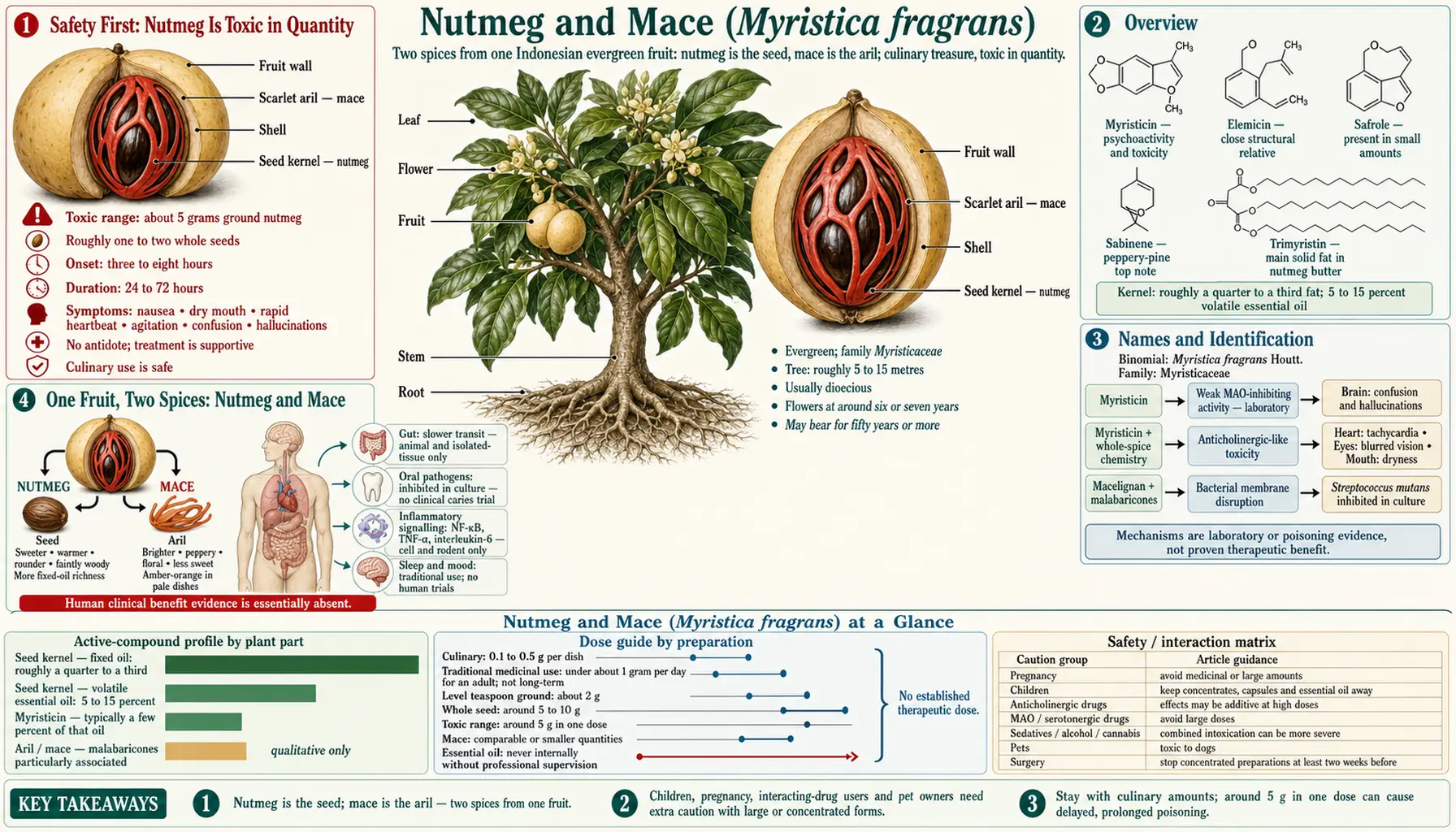
Nutmeg is the seed kernel of Myristica fragrans, an evergreen tree native to a handful of tiny volcanic islands in eastern Indonesia. It is the only spice that gives you two different products from one fruit — the hard brown seed sold as nutmeg, and the lacy crimson coat around that seed, sold separately as mace.
Read the safety section before anything else on this page. Nutmeg is one of the very few kitchen spices that is genuinely poisonous in quantity. Roughly five grams or more — about one to two whole nutmegs — can trigger a frightening, day-long syndrome of nausea, racing heart, agitation, confusion and hallucinations, and poison centres see these cases every year. The amounts used in cooking, a pinch to a teaspoon spread across a whole dish, are not the concern. The gap between "delicious" and "dangerous" is large, but it is not infinite, and this page treats that honestly rather than either alarming you or pretending the problem does not exist.
On the evidence: nutmeg has thousands of years of documented culinary and medicinal use and almost no modern human trial data. Nearly everything you will read about nutmeg as a remedy comes from test tubes, rodents, or tradition. Where that is the case below, it is labelled plainly.
Table of Contents
- Safety First: Nutmeg Is Toxic in Quantity
- Overview
- Names and Identification
- One Fruit, Two Spices: Nutmeg and Mace
- The Banda Islands and the Spice Wars
- Traditional Use
- Active Compounds
- Digestive Effects
- Antibacterial and Oral-Health Activity
- Antioxidant and Anti-Inflammatory Research
- Nutmeg, the Brain, and the "Legal High"
- Culinary Use
- Forms and Preparations
- Dosage
- Cautions and Contraindications
- Key Research Papers
- Connections
- Featured Videos
Safety First: Nutmeg Is Toxic in Quantity
Most spices are safe at any dose you could plausibly swallow. Nutmeg is not one of them. It is the classic example of a substance whose culinary dose and toxic dose sit close enough together that the distance is worth knowing exactly.
How much is too much
The threshold usually quoted in the toxicology literature is about 5 grams of ground nutmeg — roughly one to two whole nutmeg seeds. A whole seed weighs somewhere around 5 to 10 grams depending on size. A level teaspoon of pre-ground nutmeg is about 2 grams. So a person would need to eat the equivalent of two or three heaped teaspoons at one sitting, deliberately, to reach the range where poisoning is reported. Nobody does that by accident while making a béchamel.
What the poisoning looks like
Symptoms typically begin three to eight hours after ingestion — a long, deceptive delay that leads people to take a second dose because "nothing is happening." What follows is a mixed picture that emergency doctors describe as resembling anticholinergic overstimulation combined with a dysphoric psychedelic state:
- Nausea, vomiting, abdominal pain
- Dry mouth, flushed skin, blurred vision
- Rapid heartbeat, palpitations, sometimes raised blood pressure
- Dizziness, unsteadiness, a strong sense of dissociation or unreality
- Agitation, anxiety, a characteristic "sense of impending doom"
- Visual hallucinations, disorientation, confusion
The episode commonly lasts 24 to 72 hours, far longer than most recreational intoxications, and people describe it as thoroughly unpleasant rather than euphoric. There is no antidote; hospital treatment is supportive — fluids, monitoring, sedation with a benzodiazepine if the person is dangerously agitated.
Who this actually happens to
A ten-year review of nutmeg exposures reported to the Illinois Poison Center between 2001 and 2011 found 32 cases. About 47 percent were intentional, and a third of those intentional exposures involved combining nutmeg with other drugs — every one of those in people aged 15 to 20. One patient who had taken nutmeg along with several pharmaceuticals needed ventilatory support in hospital. The other half of the cases were unintentional, and strikingly, most of those were in children under 13, including several eye exposures from handling the spice.
Two lessons come out of that data. First, adolescents do use nutmeg as a supposedly legal, free, kitchen-cupboard high, and mixing it with anything else is what turns an ugly night into a hospital admission. Second, keep the jar and the grater out of reach of small children, and wash your hands after grating.
Deaths
Fatalities are genuinely rare, but they are on record. A German poison-information-centre case series published in Forensic Science International in 2001 documented a fatal nutmeg poisoning alongside a run of non-fatal cases. Rare is not the same as never, and it is one more reason not to treat a "nutmeg trip" as a harmless experiment.
The proportionate conclusion
Grating nutmeg over a custard, a lasagne, a pumpkin pie or a bowl of creamed spinach is safe. Sharing a pot of eggnog is safe. Baking with a teaspoon of it across twelve muffins is safe. Swallowing a whole nutmeg on purpose is not. That is the entire message; nothing about ordinary cooking needs to change.
Overview
Myristica fragrans is a slow, handsome evergreen tree in the family Myristicaceae. It reaches roughly 5 to 15 metres, carries dense dark-green leaves, and is usually dioecious — individual trees are male or female, so growers plant a small share of males for pollination and can only tell the sexes apart once the trees flower, at around six or seven years old. A productive tree may then bear for fifty years or more.
The fruit looks like a small, pale yellow apricot. When ripe it splits along a seam and hangs open, revealing what is easily the most theatrical sight in the spice world: a glossy brown seed wrapped in a bright scarlet, branching, net-like structure. The netting is the aril. Dried, it becomes mace. The seed inside, dried and cracked out of its shell, is nutmeg.
Harvest is by hand, often with a long pole and basket. The aril is peeled off and dried separately, fading from scarlet to orange-amber. The seeds are dried in their shells for weeks — traditionally over low smoke or in the sun — until the kernel rattles inside, then cracked open. Grenada, Indonesia and India dominate world production today; Grenada thought so highly of the crop that it put a nutmeg on its national flag.
This page is about the whole spice — the seed and the aril as food and as traditional medicine. The steam-distilled essential oil is a different product with a different concentration profile and a different set of risks, and it has its own page: Nutmeg Oil. If you are reading about diffusing, diluting, or applying nutmeg preparations to skin, that is the page you want.
Names and Identification
Binomial: Myristica fragrans Houtt. Family: Myristicaceae. The genus name comes from the Greek for "fragrance for anointing"; fragrans repeats the point.
Regional names:
- Indonesian / Malay: pala (nutmeg); the mace is bunga pala, "nutmeg flower" — a lovely and accurate description of what the aril looks like
- Hindi / Urdu: jaiphal (nutmeg), javitri (mace)
- Thai: chan thet
- Vietnamese: nhục đậu khấu
- Tagalog: anis moskada / nues moscada, from Spanish
- Chinese: 肉豆蔻 ròu dòu kòu
- Sanskrit: jatiphala
Look-alikes and false nutmegs
Several unrelated plants carry "nutmeg" in their names and are not the true spice:
- Papuan or long nutmeg (Myristica argentea) is a real relative, sometimes traded as nutmeg, with a coarser, less refined aroma.
- Bombay nutmeg or false nutmeg (Myristica malabarica) has been used as a cheap adulterant. It lacks the true spice's aroma and is not the same thing.
- Calabash nutmeg (Monodora myristica, a West African tree in the custard-apple family) and California nutmeg (Torreya californica, a conifer) share the name and nothing else.
Buying whole seeds from a reputable seller and grating them yourself solves nearly all of this. Whole nutmeg also keeps its aroma for years, while pre-ground nutmeg fades within months — a practical reason to buy whole quite apart from authenticity.
One Fruit, Two Spices: Nutmeg and Mace
This is the single most useful fact on the page for a cook, and most people do not know it. Nutmeg and mace come from the same fruit of the same tree. They are not two species and not two grades. Nutmeg is the seed; mace is the aril, the red webbing wrapped around the seed.
Because they grow in contact with one another, they share much of the same aromatic chemistry — but not in the same proportions, and the difference is real on the tongue:
- Nutmeg is sweeter, warmer, rounder, faintly woody, with more of the buttery fixed-oil richness. It dominates a dish easily.
- Mace is brighter, more peppery and more floral, with less sweetness. Cooks reach for it when they want the aroma without the heaviness.
Two practical points follow. First, mace is used in pale dishes — white sauces, potted meats, light cakes, delicate custards — because ground mace is amber-orange rather than brown and does not leave dark specks. Second, mace is more expensive, because each fruit produces only a thin lace of aril against a whole solid seed. A rough rule of thumb is that one part of mace substitutes for a slightly larger part of nutmeg, but they are not interchangeable if you care about the result.
Whole mace is sold as flattened, brittle "blades." Buying blades and grinding or infusing them yourself gives dramatically more aroma than the pre-ground powder.
The Banda Islands and the Spice Wars
For most of recorded history, every nutmeg on earth came from one place: the Banda Islands, a cluster of ten small volcanic islands in the Maluku (Molucca) group of eastern Indonesia, with a total land area smaller than many cities. That was the entire world supply. Bandanese traders moved nutmeg and mace up the archipelago into networks that carried it to Java, then to India, then through Arab and Venetian intermediaries to Europe, where by the medieval period it commanded prices that make no sense today — a spice worth many times its weight in silver, valued as a preservative, a medicine, a status marker, and a supposed protection against plague.
Nobody in Europe knew where it came from. That single geographic fact — a global monopoly resting on a few square miles of island — is what made the Bandas one of the most violently contested places on the planet in the early modern period.
The Portuguese reached Maluku in the early 1500s. The Dutch East India Company (VOC) arrived at the turn of the seventeenth century and set out not to trade but to own. English traders held small footholds, notably on the tiny island of Run. In 1621, the VOC governor-general Jan Pieterszoon Coen led a campaign against the Bandanese that destroyed the islands' population: of a people numbering on the order of fifteen thousand, the overwhelming majority were killed, starved, deported or enslaved. The VOC then repopulated the islands with enslaved labour working nutmeg plantations under Dutch overseers. It is one of the clearest cases in history of a genocide carried out for control of a commodity, and it is the reason the Banda nutmeg trade exists in the form it does.
The English claim to Run was formally traded away in the Treaty of Breda in 1667, when England ceded it to the Dutch and kept, in exchange, a North American settlement called New Amsterdam — today Manhattan. At the time, contemporaries were not at all sure the English had got the better end of the deal.
The Dutch monopoly was maintained by limiting cultivation to controlled islands and destroying trees elsewhere. It broke in stages. The French administrator and agronomist Pierre Poivre smuggled seedlings out in the 1770s and established them on Mauritius and Réunion. British forces occupied the Bandas during the Napoleonic Wars and moved plants to Penang, Ceylon and Singapore. From there the crop reached the Caribbean; nutmeg arrived in Grenada in the mid-nineteenth century and eventually made that island one of the world's leading producers.
It is worth carrying that history to the spice rack. The mild, sweet, unremarkable jar in the cupboard is the reason a whole society was destroyed and the reason Manhattan changed hands.
Traditional Use
Traditional use tells us what people believed and practised. It is history, not evidence of efficacy, and almost none of what follows has been tested in a controlled human trial.
- Ayurveda treats jatiphala as warming, drying and grounding — used in small quantities for diarrhoea, weak digestion, and as a sleep aid, often stirred into warm milk at night. Mace (javitri) appears in the same formulas and in spice blends.
- Traditional Chinese medicine uses rou dou kou in the "warming the interior" category, chiefly for chronic loose stools and cold-type abdominal pain; classically it is prepared by roasting in a bran or flour coating to reduce its oiliness.
- Unani medicine classifies jauzbuwa as hot and dry, using it as a stomach and nerve tonic.
- Indonesian jamu and Maluku household practice used nutmeg fruit flesh (the outer pericarp, which is candied or made into syrup and jam locally) as well as the seed, and applied nutmeg butter as a warming rub for aching joints.
- Early modern Europe credited nutmeg with preventing plague, sweetening breath, and warming a cold constitution — and Europeans wore whole nutmegs in silver graters on a chain to season food at the table.
Notice how consistent the digestive and sedative themes are across systems that had little contact with one another. That consistency is interesting. It is not proof.
Active Compounds
Nutmeg kernel is roughly a quarter to a third fat by weight, plus 5 to 15 percent volatile essential oil. Both fractions matter.
The aromatic ethers — the interesting and dangerous ones
- Myristicin is the compound most associated with nutmeg's psychoactivity and toxicity. It is an allylbenzene ether present in the essential oil, typically at a few percent of that oil, and it also occurs in smaller amounts in parsley, dill and carrot. A long-standing hypothesis is that the body converts myristicin into an amphetamine-like metabolite (often written as MMDA); this remains a plausible but unproven mechanism, and myristicin alone does not fully reproduce nutmeg intoxication in animals, which suggests the whole-spice effect comes from several compounds acting together.
- Elemicin is a close structural relative, present in similar or sometimes greater amounts, and is thought to contribute to the same effects.
- Safrole is present in small amounts. Safrole is a recognised rodent liver carcinogen and is banned as an isolated food additive in the United States and restricted in the EU, although the natural spice itself is not banned. This is a good reason to keep nutmeg at seasoning levels rather than treating it as a daily supplement.
A 2023 analytical study developed a gas-chromatography method to measure safrole, myristicin and elemicin in human serum after nutmeg ingestion — useful confirmation that these compounds really do reach the bloodstream in people, and a tool for future poisoning investigations.
The terpenes — the smell
Most of the volume of nutmeg oil is monoterpenes: sabinene (usually the largest single component, giving the fresh peppery-pine top note), α-pinene and β-pinene, limonene, terpinen-4-ol and myrcene. These are the compounds you actually smell when you grate a nutmeg, and they are shared with dozens of other aromatic plants.
The fat and the phenolics
- Trimyristin, the triglyceride of myristic acid, makes up most of the solid fat known as nutmeg butter — historically used in soaps, ointments and liniments.
- Lignans and neolignans, including macelignan and the malabaricones (a group of acylphenols particularly associated with mace), account for most of the antibacterial and antioxidant activity found in laboratory work. A 2023 review in Plants catalogued the acylphenols and dimeric acylphenols of the genus Myristica and their reported pharmacology, essentially all of it preclinical.
Digestive Effects
Mechanism. Nutmeg's traditional reputation as an anti-diarrhoeal has a plausible basis: several of its constituents relax intestinal smooth muscle and slow gut transit in isolated-tissue and animal experiments. Volatile oils in general also stimulate saliva and digestive secretions, which is the standard carminative story shared with clove, cinnamon and cardamom.
Evidence. Animal and isolated-tissue only. Rodent studies show reduced intestinal motility and reduced castor-oil-induced diarrhoea with nutmeg extracts. There are, to our knowledge, no randomised controlled human trials of nutmeg for diarrhoea, IBS, bloating or dyspepsia. Traditional Chinese and Ayurvedic use for chronic loose stools is centuries old and widespread, and it may well reflect a real effect — but it has never been formally tested, and it should not be presented as though it has.
What that means for you. If a warm drink with a scrape of nutmeg settles your stomach, nothing about that is unreasonable. Do not scale it up in the belief that more will work better, because the dose that starts to matter pharmacologically is uncomfortably close to the dose that makes people ill.
Antibacterial and Oral-Health Activity
Mechanism. The lignan macelignan and the malabaricone acylphenols disrupt bacterial membranes and have been shown to inhibit growth of several oral pathogens in culture, including Streptococcus mutans, the principal organism in dental caries.
Evidence. Cell-culture only. A 2012 study in Evidence-Based Complementary and Alternative Medicine reported antibacterial activity of Myristica fragrans extracts against oral pathogens in vitro. That is a laboratory finding: bacteria on a plate exposed directly to a concentrated extract. It does not establish that chewing nutmeg, rinsing with a nutmeg preparation, or using a nutmeg-containing toothpaste reduces cavities in people. No clinical caries trial exists.
What that means for you. This is a genuinely interesting line of research for dental product development. It is not a reason to change your oral-hygiene routine. Fluoride toothpaste, flossing and reduced free-sugar intake have human evidence behind them; nutmeg does not.
Antioxidant and Anti-Inflammatory Research
Mechanism. Nutmeg and especially mace are rich in phenolic compounds that scavenge free radicals in chemical assays and, in cell models, dampen inflammatory signalling through pathways such as NF-κB, reducing production of mediators like TNF-α and interleukin-6. Malabaricones and macelignan are the constituents most often implicated.
Evidence. Cell culture and rodent models. Extracts reduce markers of inflammation and oxidative damage in animals; some rodent work also reports liver-protective and lipid-lowering effects at doses far above culinary exposure. A comprehensive 2026 review of Myristica fragrans in the Journal of Ethnopharmacology surveys this literature in detail, and the honest summary of it is that the preclinical pharmacology is broad and the clinical pharmacology is essentially empty.
What that means for you. "High in antioxidants" is true of nutmeg in a test tube and true of most aromatic spices. It has not been shown to translate into any measured health outcome in humans, and the quantities used in the laboratory could not be safely eaten. Enjoy nutmeg for what it does to food.
Nutmeg, the Brain, and the "Legal High"
Mechanism. Myristicin and elemicin are structurally related to compounds with amphetamine-like and serotonergic activity, and myristicin has weak monoamine-oxidase-inhibiting activity in laboratory systems. The clinical picture of nutmeg poisoning — dry mouth, flushing, tachycardia, blurred vision, hallucinations — strongly resembles anticholinergic toxicity, and a UK emergency-medicine report in 2005 made exactly that point: nutmeg intoxication should be considered in a recreational drug user presenting with acute psychotic symptoms and signs that partly mimic anticholinergic overstimulation.
Evidence for benefit. Essentially none in humans. Traditional use as a sedative and sleep aid is real and widespread. Rodent studies report sedative, anticonvulsant and antidepressant-like effects of nutmeg extracts, which is a hypothesis, not a treatment. There is no human trial of nutmeg for insomnia, anxiety or depression.
The important part. Because nutmeg is legal, cheap and already in the house, it periodically circulates online as a free high — and because the onset is delayed by hours, users take more, and end up in emergency departments. People who go through it consistently describe a long, nauseating, disorienting, anxiety-soaked experience rather than a pleasant one, and the effects can persist into a second and third day. Combining it with alcohol, cannabis or pharmaceuticals is what escalates cases into serious harm. There is nothing to recommend here, and this page will not pretend otherwise.
Culinary Use
Nutmeg's real value is in the kitchen, and its range is wider than most Western cooks realise.
- Dairy and eggs. Béchamel and its descendants, gratins, quiches, custards, rice pudding, eggnog. There is something about nutmeg and warm dairy that works so reliably it feels like a rule.
- Vegetables. Spinach, chard, cauliflower cheese, potato purée, pumpkin and squash.
- Meat and charcuterie. Italian sausage and mortadella, English potted meats, French quatre épices (nutmeg with pepper, clove and ginger), pâtés and terrines, meatballs.
- Baking. Pumpkin pie spice, doughnuts, spice cakes, Dutch speculaas, gingerbread, apple desserts.
- Southeast Asia. In Indonesia and Malaysia nutmeg goes into braises and spice pastes; in Maluku the fleshy fruit wall — discarded elsewhere — is candied, made into syrup, jam, and a well-known sweet-sour preserve. Nutmeg syrup is a Banda specialty and a good reminder that the spice is the by-product of a fruit.
- Grenada and the Caribbean. Nutmeg jam, nutmeg ice cream, rum punch, and a dusting on almost anything.
- Mace specifically. White sauces, light-coloured cakes, Indian biryani and korma, potted shrimp, pickling spice, and the classic role in a doughnut recipe.
Technique matters more with nutmeg than with most spices. Grate it fresh, add it late, and use less than you think — the volatile oils are fragile and the flavour turns bitter and dusty with prolonged cooking or with stale pre-ground powder.
Forms and Preparations
- Whole seeds. The best form by a wide margin. Aroma holds for years. Use a dedicated fine rasp or a nutmeg grater.
- Ground nutmeg. Convenient, and noticeably weaker after a few months. Buy small jars.
- Whole mace blades. Steep in warm milk or stock, or grind fresh. Far superior to ground mace.
- Ground mace. Amber-coloured, for pale dishes.
- Nutmeg butter. The pressed fixed oil, semi-solid at room temperature; a traditional external liniment base, not a food.
- Essential oil. Steam-distilled from the seed and very much more concentrated than the spice — concentrated enough that the toxicological cautions on this page apply with much greater force. Never taken internally without professional supervision. See Nutmeg Oil for that discussion in full.
- Capsules and powders sold as supplements. These exist, and this is the form where accidental over-dosing is easiest, because a capsule bypasses the strong flavour that normally stops people. Read the per-capsule weight before considering any such product.
Dosage
There is no established therapeutic dose of nutmeg, because there are no controlled human trials to derive one from. Anyone quoting you a precise medicinal dosage is quoting tradition, not data.
What can be said with confidence:
- Culinary use is typically 0.1 to 0.5 g per dish — a few passes of a grater. A level teaspoon of ground nutmeg is about 2 g, and that would usually flavour a recipe serving six or more people.
- Traditional medicinal use across systems generally stays under about 1 gram per day for an adult, often much less, and is not intended for continuous long-term use.
- The toxic range begins around 5 g in a single dose, with severity rising from there. Children reach that range at proportionally smaller amounts.
- Mace is used in comparable or smaller quantities and carries the same class of constituents; treat it with the same respect.
A useful mental model: nutmeg is a seasoning with a pharmacological tail. Stay in seasoning territory and it is one of the great spices. Step out of it deliberately and you have taken a drug with no benefit, no antidote and a two-day duration.
Cautions and Contraindications
Acute toxicity
Repeating the headline because it belongs here too: doses around 5 g or more of ground nutmeg can cause a serious, prolonged toxic syndrome with hallucinations, agitation, tachycardia and confusion lasting one to three days. If someone has taken a large amount, contact a poison-control centre. Do not wait for symptoms — onset is delayed by hours.
Pregnancy and breastfeeding
Culinary amounts are considered acceptable. Medicinal or large amounts should be avoided in pregnancy. Nutmeg has a long ethnographic record as a folk abortifacient, myristicin crosses the placenta, and large doses have caused toxicity in pregnant women. There is no safety data on concentrated nutmeg preparations while breastfeeding.
Children
Nutmeg in food is fine. Concentrated nutmeg preparations, capsules and essential oil should be kept away from children entirely — body weight means the toxic dose is much smaller, and poison-centre data show young children make up a large share of unintentional exposures, including eye exposures from handling the spice.
Drug interactions
- Anticholinergic drugs (some antihistamines, tricyclic antidepressants, oxybutynin, scopolamine): effects may be additive with nutmeg's anticholinergic-like toxicity at high doses.
- MAO inhibitors and serotonergic drugs: myristicin has weak MAO-inhibiting activity in the laboratory; a theoretical interaction warrants avoiding large doses.
- Sedatives, alcohol, cannabis and other recreational drugs: the Illinois poison-centre data specifically identified combined intoxication as the factor driving more severe outcomes.
- Nutmeg constituents affect several cytochrome P450 enzymes in laboratory systems, so large doses could in principle alter the clearance of other medicines. Culinary amounts are not a realistic concern.
Liver and safrole
Safrole is a known rodent hepatocarcinogen, present in nutmeg in small amounts. This is not a reason to avoid nutmeg in food; it is a strong reason not to take nutmeg daily as a supplement or to consume nutmeg essential oil internally.
Allergy
Genuine nutmeg allergy is uncommon but reported, including contact dermatitis in spice handlers.
Pets
Nutmeg is toxic to dogs, which matters if you leave eggnog, spiced baked goods or a spilled jar within reach. Signs include disorientation, tremors and rapid heart rate. Call a veterinarian.
Surgery
Stop concentrated nutmeg preparations at least two weeks before planned surgery, on general principle given its central-nervous-system activity and interaction potential.
Key Research Papers
Every citation below has been checked against its PubMed record. Where we could not verify an identifier, we have given a PubMed topic search instead — a search link can never point at the wrong paper.
- Ehrenpreis JE, DesLauriers C, Lank P, Armstrong PK, Leikin JB. Nutmeg poisonings: a retrospective review of 10 years experience from the Illinois Poison Center, 2001-2011. Journal of Medical Toxicology. 2014;10(2):148–151.
- Stein U, Greyer H, Hentschel H. Nutmeg (myristicin) poisoning — report on a fatal case and a series of cases recorded by a poison information centre. Forensic Science International. 2001;118(1):87–90.
- Demetriades AK, Wallman PD, McGuiness A, Gavalas MC. Low cost, high risk: accidental nutmeg intoxication. Emergency Medicine Journal. 2005;22(3):223–225.
- Usui K, Kubota E, Kobayashi H, et al. Detection of major psychoactive compounds (safrole, myristicin, and elemicin) of nutmeg in human serum via GC-MS/MS. Journal of Pharmaceutical and Biomedical Analysis. 2023;234:115565.
- Luo J, Yang X, Bai M, et al. Myristica fragrans: a comprehensive review of its botanical characterization, traditional uses, phytochemistry, and pharmacology. Journal of Ethnopharmacology. 2026;358:120916.
- Othman MA, Sivasothy Y. Acylphenols and dimeric acylphenols from the genus Myristica: a review of their phytochemistry and pharmacology. Plants (Basel). 2023;12(8).
- Shafiei Z, Shuhairi NN, Md Fazly Shah Yap N, et al. Antibacterial activity of Myristica fragrans against oral pathogens. Evidence-Based Complementary and Alternative Medicine. 2012;2012:825362.
Live PubMed Searches
These links run a live search on PubMed and will always return current results.
- Myristica fragrans pharmacology
- Nutmeg intoxication case reports
- Myristicin toxicity and metabolism
- Elemicin pharmacokinetics
- Safrole hepatocarcinogenicity
- Macelignan antibacterial activity
- Malabaricones and antioxidant activity
- Mace (aril) essential oil composition
- Nutmeg, intestinal motility and diarrhoea
- Trimyristin and nutmeg butter
Connections
- All Herbs
- Nutmeg Oil — the steam-distilled essential oil, its uses and its much narrower safety margin.
- Clove — the other Maluku spice that drove the same wars; both were once found nowhere else on earth.
- Cinnamon — nutmeg's constant partner in baking spice blends and mulled drinks.