Fingerroot (Boesenbergia rotunda)
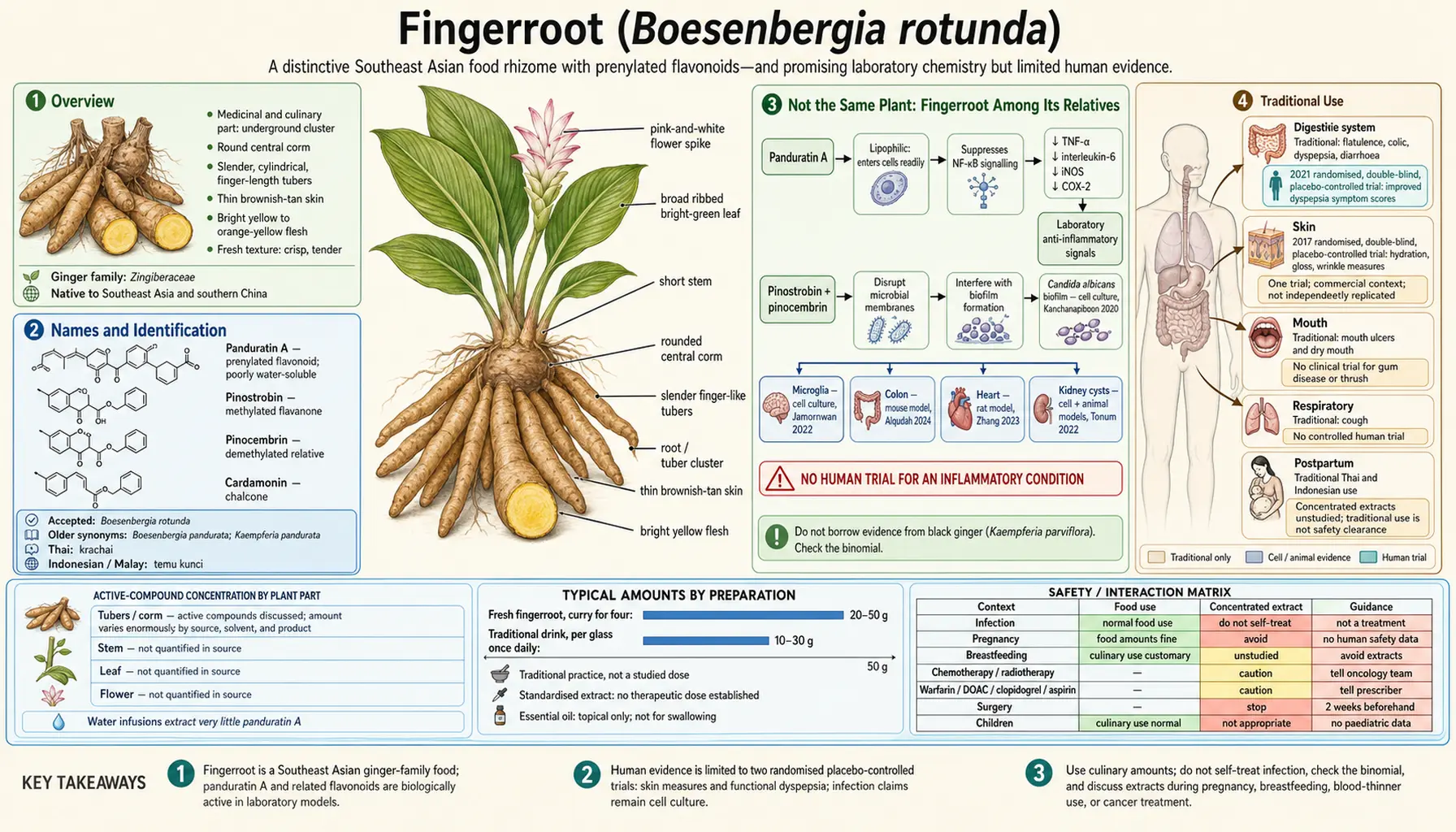
Fingerroot is the one Zingiberaceae rhizome you can identify at a glance. Where galangal and ginger form knobbly lumps, Boesenbergia rotunda sends out a tight bundle of long, slim, tapering tubers that hang from a central corm like a hand of yellow fingers — which is where every one of its names, in every language, comes from. In the kitchen it is a Thai and Indonesian workhorse, shredded raw into fish curries and jungle curry, or pounded into jamu tonics.
Between roughly 2020 and 2022 this modest kitchen root became the subject of a burst of international research attention, because a Thai screening study found that fingerroot extract and its distinctive compound panduratin A blocked SARS-CoV-2 replication in cell culture. That finding is real and it was published in a good journal. It is also, five years later, still entirely cell-culture work. No human trial has shown that fingerroot treats any viral infection, and this page is deliberately careful about that gap, because it was widely misreported at the time.
Table of Contents
- Overview
- Names and Identification
- Not the Same Plant: Fingerroot Among Its Relatives
- Traditional Use
- Active Compounds
- Panduratin A and the Antiviral Research Wave
- Anti-Inflammatory Activity
- Antibacterial, Antifungal, and Oral Health Research
- Skin and Digestion: The Randomised Human Trials
- The Aphrodisiac Reputation
- Culinary Use
- Forms and Preparations
- Dosage
- Cautions and Contraindications
- Key Research Papers
- Connections
- Featured Videos
Overview
Boesenbergia rotunda (L.) Mansf. is a small, clumping perennial herb in the ginger family, Zingiberaceae. It grows to only about half a metre — far shorter than galangal — with broad, ribbed, bright-green leaves that splay out close to the ground and, in season, short spikes of pink-and-white flowers. It is native to Southeast Asia and southern China and is cultivated across Thailand, Indonesia, Malaysia, Cambodia, Vietnam, and Yunnan.
The useful part is the underground cluster. A central rounded corm — hence the species name rotunda — sits at the base of the plant, and from it a fistful of slender, cylindrical, finger-length tubers grow downward and outward. Skin is thin, brownish-tan; flesh is bright yellow to orange-yellow, softer and more tender than galangal, with a crisp snap when fresh.
The flavour is its own thing: peppery and earthy up front, with a resinous, slightly bitter, camphor-adjacent finish and a citrus edge. It is milder than galangal, less sweet than ginger, and more bitter than either. In Thai cooking it is prized for its ability to cut fishiness, which is why it turns up so consistently with freshwater fish and with fermented fish sauces.
Most fingerroot reaches a market fresh, in bundled clusters with the fingers still attached to the corm, sold beside galangal and turmeric. Outside Southeast Asia it is usually frozen or brined in jars, occasionally dried. It is far less commonly available in Western supermarkets than either ginger or galangal, and if you find it, it will most likely be in the freezer case of a Thai or Indonesian grocer.
Names and Identification
The accepted binomial is Boesenbergia rotunda (L.) Mansf. You will also see the older synonyms Boesenbergia pandurata and Kaempferia pandurata in the research literature — and those synonyms matter, because a PubMed search on the current name misses a large fraction of the published work, including the one randomised human trial discussed below.
- Thai: krachai (กระชาย). Written in English as krachai, kachai, or grachai.
- Indonesian / Malay: temu kunci — literally "key tuber", after the bunch-of-keys shape.
- Vietnamese: ngải bún.
- Chinese: 凹唇姜 ao chun jiang; also traded as Chinese keys.
- Khmer: k'chiey. Burmese: seik-phoo.
- English: fingerroot, Chinese keys, Chinese ginger, lesser galangal (an actively wrong name — see below), finger ginger.
Two naming traps are worth flagging. First, some Western spice references call fingerroot "lesser galangal". That name properly belongs to Alpinia officinarum, a different genus and a different plant, and the collision causes real confusion in ingredient lists. Second, and more consequentially in Thailand itself, krachai (fingerroot) and krachai dam (black ginger, Kaempferia parviflora) share the first word of their names but are not the same plant, not the same genus, and not interchangeable. If a Thai product says krachai dam, it is black ginger.
Not the Same Plant: Fingerroot Among Its Relatives
Fingerroot belongs to a cluster of Southeast Asian rhizomes that share a family, a market stall, and a great deal of naming confusion. Once dried and sliced, several of them are difficult to tell apart by eye — which is exactly how substitution happens in the supplement supply chain.
| Rhizome | Species | Shape | Flesh colour | Marker compound |
|---|---|---|---|---|
| Fingerroot | Boesenbergia rotunda | Cluster of slender fingers from a round corm | Bright yellow | Panduratin A, pinostrobin |
| Greater galangal | Alpinia galanga | Thick, hard, ringed, branching | Cream to pale yellow | 1'-acetoxychavicol acetate |
| Ginger | Zingiber officinale | Knobbly hand, fibrous | Pale yellow, juicy | Gingerols, shogaols |
| Turmeric | Curcuma longa | Small fingers off a central knob | Deep orange, staining | Curcuminoids |
| Kencur | Kaempferia galanga | Small rounded knobs, no fingers | White | Ethyl p-methoxycinnamate |
| Black ginger | Kaempferia parviflora | Rounded rhizome | Deep purple-black | Polymethoxyflavones |
Fingerroot vs turmeric is the confusion most likely to bite in a kitchen, because both produce slim yellow fingers off a central knob. Turmeric's flesh is a much deeper orange and stains everything it touches permanently; fingerroot's yellow is paler and washes off. Turmeric smells musky and slightly bitter-medicinal; fingerroot smells peppery and green.
Fingerroot vs black ginger is the confusion most likely to bite in a supplement. Kaempferia parviflora has a substantial body of human trial data — on physical performance, blood flow, and safety — and fingerroot does not. A product that borrows black ginger's clinical evidence while containing fingerroot, or vice versa, is citing the wrong plant's research. Cut open, they are unmistakable: black ginger's flesh is deep purple to nearly black. Dried and powdered, you cannot tell.
Traditional Use
Fingerroot has a long record in Southeast Asian folk medicine, and as always that record is history rather than proof of effect.
In Thai traditional medicine, krachai is a digestive and carminative: used for flatulence, colic, dyspepsia, and diarrhoea, and often included in postpartum recovery preparations. It also appears in traditional formulations for oral complaints and as a general tonic.
In Indonesian jamu, temu kunci is a component of postpartum tonics given to new mothers — part of the broad jamu tradition of warming, drying herbal preparations taken in the weeks after childbirth — and of preparations aimed at digestive complaints and at what would loosely be described as women's health. It is closely associated with the same jamu culture that produced beras kencur, though it is a different plant from the kencur in that drink.
In Malaysia, the rhizome has been used for coughs, mouth ulcers, and dry mouth, and applied to the skin for fungal complaints. In Chinese and Vietnamese folk practice it turns up as a warming digestive.
Two things are worth saying plainly. First, none of these traditional indications has been tested in a controlled human trial of fingerroot. Second, the postpartum use is precisely the context in which a modern reader should be most cautious: pregnancy and the postpartum period are exactly where we have the least safety data for concentrated herbal extracts, and traditional use in that setting is not a safety clearance.
Active Compounds
Fingerroot's chemistry is genuinely distinctive. Where ginger has gingerols and turmeric has curcuminoids, fingerroot's calling card is a group of prenylated flavonoids — flavonoid skeletons carrying an extra lipid-like side chain that makes them far more fat-soluble and better able to cross cell membranes than ordinary flavonoids.
- Panduratin A is the headline compound and the one largely characteristic of this plant. It is a cyclohexenyl chalcone derivative. Its lipophilic prenyl group is the structural reason it shows up as a hit in so many cell-based screens: it gets into cells easily. In laboratory studies it inhibits NF-κB signalling, reduces inflammatory mediator production, and shows activity against a range of microbes and viruses in culture. Note that the same lipophilicity that makes it a good screening hit also makes it poorly water-soluble, which is a real obstacle to turning it into a usable oral drug.
- Pinostrobin is a methylated flavanone found in quantity in fingerroot (and in some other plants, including honey and Mexican oregano). It has antioxidant, anti-inflammatory, and in-vitro anticancer literature of its own.
- Pinocembrin, the demethylated relative of pinostrobin, is also present. It is better known as a propolis constituent and has been studied for antibacterial and neuroprotective activity in laboratory models.
- Cardamonin, a chalcone shared with cardamom and several other Zingiberaceae, has a broad preclinical literature covering inflammation, metabolic signalling, and cancer cell biology.
- Alpinetin and other flavanones round out the phenolic fraction.
- Essential oil constituents include camphor, geraniol, methyl cinnamate, and various monoterpenes, which supply the aroma; composition varies with origin and processing.
An important practical point: panduratin A content varies enormously between plant sources, extraction solvents, and products. Water infusions extract very little of it, because it is not water-soluble. A traditional fingerroot drink and a laboratory ethanol extract are chemically very different things, and results from one do not transfer to the other.
Panduratin A and the Antiviral Research Wave
This section exists because the story was widely and badly reported, and because being clear about it is the most useful thing this page can do.
What was actually found. In November 2020, Kanjanasirirat and colleagues published a study in Scientific Reports describing a high-content screen of Thai medicinal plant extracts against SARS-CoV-2 in cultured cells. Fingerroot extract came out as a hit, and the activity was traced to panduratin A, which inhibited viral infection in the cell model both before and after the cells were exposed to the virus. It is careful, competent work from a serious group.
What that means. It means panduratin A stops the virus replicating in a dish of cells. That is a legitimate starting point for drug discovery and nothing more. Cell-culture antiviral activity is the first step of a pipeline that most compounds never finish, because the concentration that works in a dish is frequently unreachable in a human body, and because a compound that inhibits a virus outside the body may be toxic, poorly absorbed, or rapidly metabolised inside it. Panduratin A's poor water solubility makes that hurdle higher than average.
What has not happened. As of this writing there is no completed randomised controlled trial demonstrating that fingerroot or panduratin A treats or prevents COVID-19, influenza, dengue, or any other viral infection in humans. Related work exists — computational studies from the early 2010s proposed fingerroot constituents as dengue NS2B/NS3 protease inhibitors, for instance — but computational docking is a prediction, not a result, and it sits even further from clinical evidence than cell culture does.
Why this matters practically. During 2021 and 2022 fingerroot products were marketed and shared in Southeast Asia with strong implied antiviral claims, and prices rose sharply. If you catch a respiratory infection, fingerroot is not a treatment. If you have symptoms that are worsening — breathlessness, chest pain, confusion, a fever that will not settle — that is a reason to seek medical care, not a reason to increase your dose of anything herbal. Enjoying krachai in a curry is a fine thing to do. Relying on it to treat an infection is not.
Anti-Inflammatory Activity
Mechanism. Panduratin A's most consistently reported laboratory action is suppression of NF-κB, the transcription factor that switches on inflammatory genes when an immune cell detects danger. Downstream, that means less TNF-α, less interleukin-6, less inducible nitric oxide synthase, less COX-2. Because panduratin A is lipophilic, it enters cells readily, which is why it produces clean effects in these assays at low micromolar concentrations.
What the evidence shows. Jamornwan and colleagues (2022) reported that panduratin A suppressed inflammatory activation of microglia — the brain's resident immune cells — challenged with bacterial lipopolysaccharide, in cell culture. Alqudah and colleagues (2024) reported reduced inflammation and oxidative stress in a chemically induced mouse colitis model, an animal study. Zhang and colleagues (2023) reported that fingerroot extract reduced markers of inflammation and cell death in rats given doxorubicin, a chemotherapy drug with well-known cardiac toxicity — again, animal work. Tonum and colleagues (2022) examined panduratin A in cell and animal models of polycystic kidney disease.
What it does not show. No human trial of fingerroot or panduratin A exists for any inflammatory condition. The animal colitis and cardiotoxicity findings are interesting hypotheses; they are not a reason to take fingerroot for inflammatory bowel disease or to protect the heart during chemotherapy. On that last point specifically: do not add any supplement during chemotherapy without telling your oncology team, because antioxidant and anti-inflammatory compounds can in principle interfere with treatments that work by generating oxidative damage.
Antibacterial, Antifungal, and Oral Health Research
Mechanism. Fingerroot's flavanones appear to work partly by disrupting microbial membranes and partly by interfering with biofilm formation — the protective slime layer that lets bacteria and fungi resist both immune attack and antimicrobial drugs.
What the evidence shows. Kanchanapiboon and colleagues (2020) found that fingerroot extract inhibited biofilm formation by Candida albicans and traced the activity to pinostrobin and pinocembrin rather than to panduratin A — a useful reminder that the famous compound is not always the active one. Bailly (2022) reviewed the case for fingerroot extracts and panduratin A in periodontitis, drawing on laboratory activity against oral pathogens and on the anti-inflammatory profile; that review is an argument for investigation, and the author frames it that way.
What it does not show. There is no clinical trial of fingerroot for gum disease, thrush, or any other infection. The oral-health idea is plausible enough that someone should test it in a mouthwash trial. Until someone does, it is a hypothesis.
Skin and Digestion: The Randomised Human Trials
Fingerroot's clinical record is very short, and none of it is about infection. There are two randomised, placebo-controlled human trials on record — one on skin, one on functional dyspepsia — and both are worth reading for what they actually measured, not just their conclusion sentences.
Kim and colleagues published a randomised, double-blind, placebo-controlled study in the Journal of Cosmetic Dermatology in 2017, testing oral intake of a standardised Boesenbergia pandurata extract in human volunteers. The reported outcomes were improvements in skin hydration, skin gloss, and wrinkle measures compared with placebo. It is a genuine randomised trial with a placebo arm, which is more than almost any other fingerroot claim can offer.
How much weight it carries. Modest. It is a single trial, it was conducted with commercial involvement in a supplement-ingredient context, the outcomes are instrument-measured cosmetic parameters rather than health endpoints, and it has not been independently replicated. It also tested a specific standardised extract at a specific dose, not fingerroot in general. If you are drawn to fingerroot for skin reasons, the honest position is that there is one supportive trial and that is not the same as an established effect.
Note again the synonym problem: this trial is indexed under Boesenbergia pandurata. Searching only for Boesenbergia rotunda will not find it.
The second trial: functional dyspepsia. Chitapanarux and colleagues published a randomised, double-blind, placebo-controlled trial in 2021 testing standardised fingerroot extract capsules in patients with functional dyspepsia (persistent upper-abdominal discomfort with no structural cause found on investigation). It reported improved dyspepsia symptom scores over the placebo arm. Full detail, including how much weight the trial carries and what it does and does not establish, is on the Digestive Health Benefits page. Between the two trials, fingerroot now has more randomised human evidence than most herbs on this site — still modest by the standards of a proven treatment, but a genuinely different evidence position than “no human trials.”
The Aphrodisiac Reputation
Fingerroot carries a folk reputation as an aphrodisiac across Thailand and Indonesia, and it is sometimes marketed on that basis, occasionally with the tag "Thai ginseng".
A 2017 review in Pharmacognosy Reviews by Ongwisespaiboon and Jiraungkoorskul gathered what exists on the question. The supporting material is preclinical — animal and laboratory studies, plus traditional-use reports. There is no controlled human trial showing that fingerroot improves sexual function, testosterone, or fertility.
Some of the marketing confusion here is downstream of the naming problem discussed earlier. Kaempferia parviflora (black ginger, krachai dam) does have human trial data touching on physical performance and blood flow, and it is frequently sold as "Thai ginseng" too. Claims that properly belong to that plant migrate onto fingerroot products because the Thai names share a word. Check the binomial.
Culinary Use
Fingerroot is genuinely a food, and this is where it is most worth your attention.
In Thai cooking, krachai is shredded into fine matchsticks and used raw or briefly cooked. It is essential to gaeng pa (jungle curry), the coconut-free, fiery curry of central and northern Thailand, and to pad cha, a stir-fry of seafood or wild meats with krachai, green peppercorns, and holy basil. It is nearly obligatory with freshwater fish, where its job is to counteract muddiness. It also appears in nam ya, the fish-based curry sauce served over rice noodles at breakfast.
In Indonesian and Malay cooking, temu kunci is added to vegetable soups — particularly sayur bening and sweetcorn-and-spinach soups — and to fish preparations, again for its deodorising effect.
Practical notes:
- Slice the fingers into thin julienne. Unlike galangal, fingerroot is tender enough to eat, and in jungle curry you are meant to.
- Use it fresh or frozen. Frozen fingerroot, sold in bags in Thai groceries, is close to fresh in flavour. Brined jarred krachai is softer and saltier; rinse it.
- Do not substitute ginger. The bitterness and pepperiness are the point. If you cannot find fingerroot, a jungle curry made without it is simply a different dish.
- In Thailand it is also drunk — blended with honey and lime as a refreshing cold drink, a preparation that became very popular during the pandemic years.
Forms and Preparations
- Fresh rhizome clusters — the best form. Keeps one to two weeks refrigerated; freezes well for months.
- Frozen, whole or shredded — the practical option outside Southeast Asia.
- Brined in jars — convenient, softer texture, salty; rinse before use.
- Dried slices and powder — weaker in aroma and impossible to identify by eye, which is where species substitution enters the supply chain.
- Traditional drink — fresh rhizome blended or pounded with water, honey, and lime. Pleasant; extracts almost none of the fat-soluble panduratin A.
- Ethanol or supercritical extracts in capsules — the form used in research. Potency depends entirely on the extraction, and few consumer products state a panduratin A content.
- Essential oil — aromatic and topical use only. Not for swallowing.
Dosage
No therapeutic dose of fingerroot has been established for any condition. There is no dose-finding study, no accepted daily intake, and no monograph from a regulatory body. Anything printed on a supplement label is a manufacturer's choice, not a research finding.
- Culinary: a jungle curry for four might use 20–50 g of fresh fingerroot. Food-level amounts have a long history of safe use.
- Traditional drink: commonly a few fresh fingers — on the order of 10–30 g — blended with water and honey per glass, once daily. Traditional practice, not a studied dose.
- Standardised extract: each randomised human trial used its own specific standardised extract at the dose reported in that publication — the skin trial's extract and dose are not the digestive trial's. If you are taking a fingerroot supplement, the only meaningful approach is to use a product that names the extract and its standardisation and to stay at the labelled dose for the outcome you actually want. Do not extrapolate upward from cell-culture concentrations — the micromolar concentrations that inhibit viruses in a dish do not correspond to any oral dose.
Because panduratin A is poorly water-soluble, a fingerroot tea and a fingerroot ethanol extract deliver very different chemistry at the same nominal weight of rhizome. Comparing doses across preparations is not meaningful.
Cautions and Contraindications
Fingerroot has a long record of safe culinary use across Southeast Asia. Concentrated extracts have essentially no long-term human safety data, and the honest position is that we do not know much.
- Do not use it to treat an infection. The antiviral and antibacterial literature is cell culture. Substituting fingerroot for antibiotics, antivirals, or medical assessment of a worsening infection is dangerous. This is the single most important caution on this page.
- Pregnancy: food amounts are fine. Avoid concentrated extracts. There is no human pregnancy safety data. The traditional postpartum use is not evidence of safety in pregnancy, and it is not evidence of safety after birth either.
- Breastfeeding: the same. Culinary use is customary; extracts are unstudied and pass an unknown amount into milk.
- Chemotherapy and radiotherapy: tell your oncology team before taking any fingerroot supplement. Anti-inflammatory and antioxidant compounds have theoretical potential to interact with treatments that rely on oxidative damage, and none of this has been studied for fingerroot.
- Anticoagulants and antiplatelet drugs: several Zingiberaceae constituents affect platelet function in laboratory studies. If you take warfarin, a direct oral anticoagulant, clopidogrel, or regular aspirin, do not add an extract-strength product without telling your prescriber.
- Surgery: stop fingerroot supplements two weeks beforehand, as a precaution consistent with other rhizomes in this family.
- Drug metabolism: prenylated flavonoids as a class can inhibit cytochrome P450 enzymes in vitro. Nobody has measured this for fingerroot in people. If you take a medication with a narrow safety margin, treat a concentrated extract as an unknown quantity.
- Reflux and gallbladder disease: fingerroot is pungent and stimulates bile flow in the traditional model; concentrated preparations may aggravate reflux or biliary colic.
- Allergy: uncommon, but cross-reaction within Zingiberaceae is possible if you already react to ginger, turmeric, or cardamom.
- Children: culinary use is normal in Southeast Asia. Supplements are not appropriate — there is no paediatric data at all.
- Product identity: insist on a binomial. A product labelled only "krachai", "Thai ginseng", or "fingerroot extract" without Boesenbergia rotunda or Boesenbergia pandurata printed on it could contain a different species with a different chemistry and a different evidence base.
Key Research Papers
- Kanjanasirirat P, Suksatu A, Manopwisedjaroen S, et al. High-content screening of Thai medicinal plants reveals Boesenbergia rotunda extract and its component panduratin A as anti-SARS-CoV-2 agents. Scientific Reports. 2020;10(1):19963. (Cell culture.)
- Kim DU, Chung HC, Kim C, et al. Oral intake of Boesenbergia pandurata extract improves skin hydration, gloss, and wrinkling: a randomized, double-blind, and placebo-controlled study. Journal of Cosmetic Dermatology. 2017;16(4):512–519. (Randomised human trial.)
- Kanchanapiboon J, Kongsa U, Pattamadilok D, et al. Boesenbergia rotunda extract inhibits Candida albicans biofilm formation by pinostrobin and pinocembrin. Journal of Ethnopharmacology. 2020;261:113193. (Cell culture.)
- Bailly C. Toward the use of Boesenbergia rotunda extracts and the chalcone panduratin A to treat periodontitis. Journal of Oral Biosciences. 2022;64(2):183–192. (Review.)
- Jamornwan S, Chokpanuwat T, Uppakara K, et al. Anti-inflammatory activity of panduratin A against LPS-induced microglial activation. Biomedicines. 2022;10(10):2587. (Cell culture.)
- Alqudah A, Qnais E, Gammoh O, et al. Panduratin A mitigates inflammation and oxidative stress in DSS-induced colitis mice model. Future Science OA. 2024;10(1):2428129. (Animal.)
- Zhang L, Jiang Q, Wang X, et al. Boesenbergia rotunda displayed anti-inflammatory, antioxidant and anti-apoptotic efficacy in doxorubicin-induced cardiotoxicity in rats. Scientific Reports. 2023;13(1):11398. (Animal.)
- Tonum K, Srimai N, Chabang N, et al. Pharmacological effects of panduratin A on renal cyst development in in vitro and in vivo models of polycystic kidney disease. International Journal of Molecular Sciences. 2022;23(8):4328. (Cell culture and animal.)
- Ongwisespaiboon O, Jiraungkoorskul W. Fingerroot, Boesenbergia rotunda and its aphrodisiac activity. Pharmacognosy Reviews. 2017;11(21):27–30. (Review; preclinical evidence only.)
- Frimayanti N, Zain SM, Lee VS, et al. Fragment-based molecular design of new competitive dengue Den2 NS2B/NS3 inhibitors from the components of fingerroot (Boesenbergia rotunda). In Silico Biology. 2011–2012;11(1-2):29–37. (Computational.)
- Nawaz J, Rasul A, Shah MA, et al. Cardamonin: a new player to fight cancer via multiple cancer signaling pathways. Life Sciences. 2020;250:117591. (Review; preclinical.)
- Alshahrani MY, Emon Y, Al Hasan MS, et al. Unveiling the anticancer potential of pinostrobin: mechanisms of action, pharmacokinetic insights, and therapeutic prospects. Medical Oncology. 2025;42(7):269. (Review; preclinical.)
Live PubMed Searches
- Boesenbergia rotunda — all research
- Boesenbergia pandurata (the older synonym)
- Panduratin A
- Pinostrobin
- Pinocembrin
- Cardamonin
- Boesenbergia and antiviral activity
- Kaempferia parviflora (black ginger — the other krachai)
- Prenylated flavonoid bioavailability
- Zingiberaceae ethnopharmacology in Thailand
Connections
- All Herbs
- Galangal (Alpinia galanga) — the other great Thai curry-paste rhizome, and another plant whose common name covers several species.
- Ginger (Zingiber officinale) — the family's best-studied member, and the one with real clinical trials behind it.
- Turmeric (Curcuma longa) — the rhizome fingerroot is most easily mistaken for in a kitchen, and a cautionary tale about laboratory promise.
- Kencur (Kaempferia galanga) — the aromatic ginger of Indonesian jamu, sharing the same market stalls and much of the same confusion.
- Conditions on this site that reference this page: Dentistry & Oral Health · Infectious Disease