Black Walnut
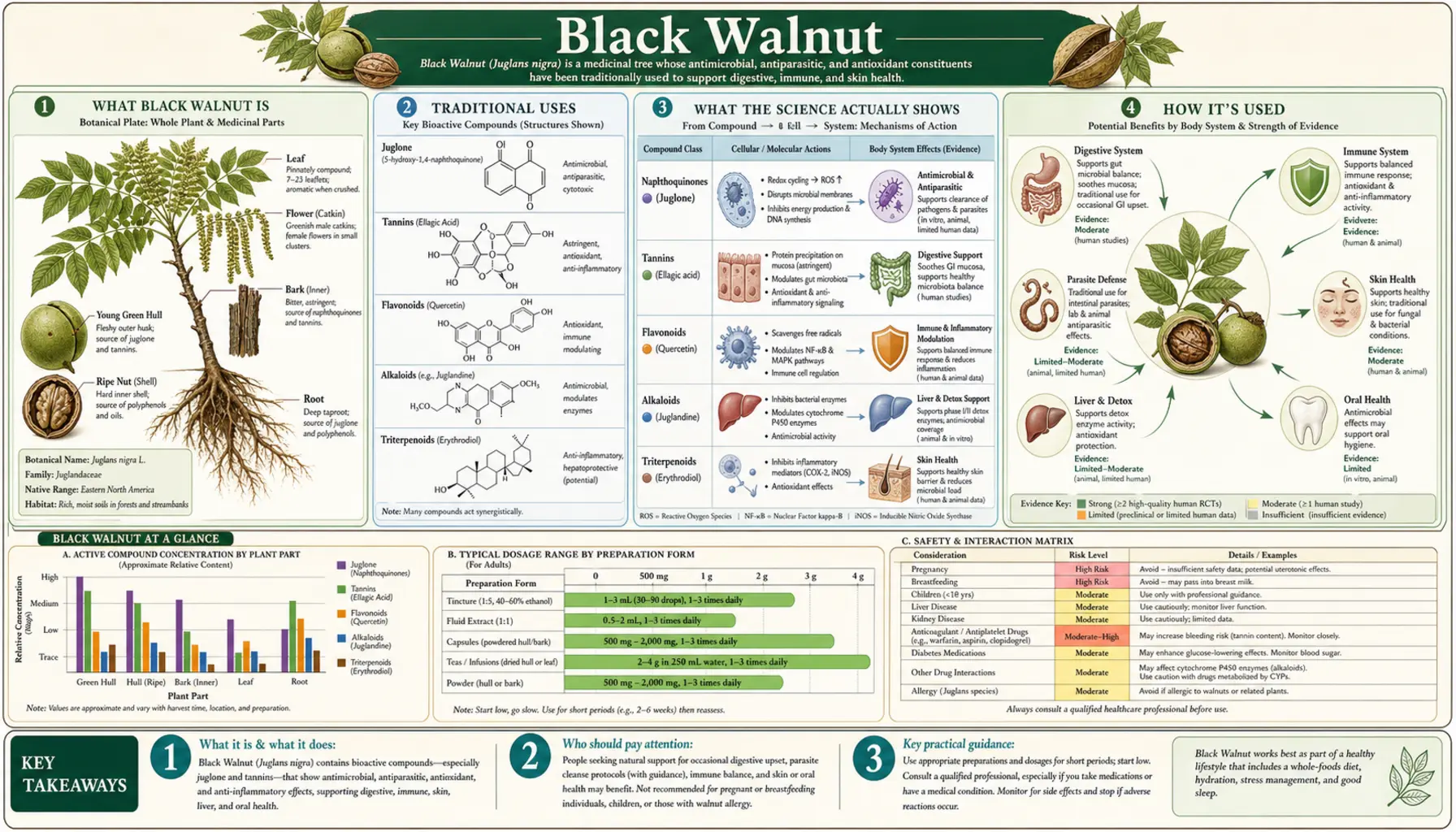
Black walnut (Juglans nigra) is one of those old-fashioned folk remedies you still find on health-store shelves today, usually sold as a tincture or capsule made from the green outer hull of the nut. It has a long reputation as a remedy for intestinal worms and skin fungus, and it is a fixture of traditional "parasite cleanse" formulas. But here is the honest headline up front: almost all of the evidence behind those claims comes from laboratory and test-tube experiments, not from rigorous studies in people. The lab findings are genuinely interesting, but they do not prove black walnut treats parasites, cancer, or any serious infection in humans. This page walks through what black walnut is, how it has traditionally been used, and — most importantly — what the science actually does and does not show.
Table of Contents
- What Black Walnut Is
- Traditional Uses
- What the Science Actually Shows
- How It's Used
- Safety & Cautions
- The Bottom Line
- Research Papers
- Connections
- Featured Videos
What Black Walnut Is
Black walnut is a large hardwood tree native to eastern North America. Most people know it for its strong-flavored edible nut and its prized dark timber, but in herbal medicine the part that matters is the green outer hull — the thick, fleshy husk that surrounds the nut before it dries and splits. This hull is harvested while still green and made into tinctures (alcohol extracts), liquid drops, or capsules.
The hull's most studied compound is juglone, a naturally occurring naphthoquinone (a type of plant pigment with a distinctive ring structure). Juglone is what stains your fingers brown when you handle fresh hulls, and it is the same chemical the walnut tree releases into the soil to discourage competing plants from growing nearby. The hull also contains a high concentration of tannins — astringent, bitter plant compounds — along with various other polyphenols. Black walnut has been used in folk and traditional medicine for a very long time, which is part of why it remains popular even though modern clinical research on it is thin.
Traditional Uses
It is worth being clear that the uses below are traditional and folk uses — things black walnut has historically been used for, not things it has been proven to do. Traditionally, black walnut hull has been used for:
- Intestinal parasites and worms. This is the best-known folk use. The hull was taken internally in the belief that it expelled worms, and it remains the signature ingredient in traditional "parasite cleanse" products.
- Fungal skin problems. The fresh juice of unripe hulls has been applied to the skin for conditions like ringworm and athlete's foot.
- A digestive bitter. Like many bitter, tannin-rich plants, it was used in small amounts as a digestive tonic.
In modern alternative-medicine circles, black walnut hull is most famous as one leg of a three-herb "parasite cleanse" — typically paired with wormwood and clove. This particular trio was popularized in the 1990s and is still widely sold. The marketing claim is that the three herbs target different stages of a parasite's life cycle. It is important to understand that this is a traditional/marketing framework, not a clinically validated treatment: the combination has not been shown in good human trials to clear parasitic infections.
What the Science Actually Shows
Here is where we need to be direct. The great majority of scientific work on black walnut and juglone is laboratory and test-tube ("in vitro") research, sometimes extended to animal or cell-culture experiments. That body of work is real and reasonably consistent on a few points:
- Juglone has antibacterial activity in the lab. In cultured bacteria, juglone can inhibit growth of organisms such as E. coli and Staphylococcus aureus at low concentrations, apparently by causing oxidative stress, damaging DNA, and disrupting the bacterial cell's energy and membrane systems.
- Juglone has antifungal activity in the lab. Test-tube studies support the old observation that walnut-hull juice can suppress fungi like those that cause ringworm.
- Juglone has antiparasitic activity in the lab. In dishes of cultured parasites, juglone can be toxic to certain protozoa.
- Black walnut is rich in antioxidant compounds. The hull and kernel contain phenolics that show antioxidant activity in laboratory assays.
So why the strong cautions? Because showing that a compound kills microbes in a dish is a world away from proving it safely treats an infection in a living person. Plenty of substances destroy bacteria, fungi, or parasites in a test tube and yet are useless or even harmful when swallowed — because the body breaks them down, can't deliver them to the right place at a high enough dose, or is itself damaged at the doses needed. There is a real shortage of rigorous human clinical trials on black walnut for any of these uses.
The bottom line on evidence: the popular claims — especially that black walnut cures parasites or cancer — are not supported by good clinical evidence in humans. If you have a diagnosed parasitic infection, that is a medical condition that needs proper testing and prescription antiparasitic medication. Black walnut is not a substitute, and relying on it instead of real treatment can let a treatable infection get worse.
How It's Used
Black walnut is sold mainly as a hull tincture or liquid extract and as capsules of dried hull powder. It is sometimes applied topically (as the traditional skin remedy) rather than taken internally. In commercial "parasite cleanse" kits it is usually combined with wormwood and clove and sold with a suggested daily schedule.
An honest point about dosing: there is no well-established, standardized dose for black walnut, precisely because the human research needed to define a safe and effective amount has not been done. Product labels give serving sizes, but those reflect manufacturer convention, not clinical evidence. Concentrations of juglone and tannins also vary from product to product. If you choose to try it, less is more, and it should never replace medical care for a real infection.
Safety & Cautions
"Natural" does not mean "harmless," and black walnut hull carries some real cautions:
- High tannin content. The hull is very astringent, and tannins can cause nausea, stomach upset, and digestive irritation. Heavy or long-term use is generally discouraged for this reason.
- Juglone can be toxic in high amounts. Juglone is biologically active and, at high concentrations in laboratory studies, has shown the ability to damage cells and DNA. This is one reason not to take large or prolonged doses.
- Not for pregnancy or breastfeeding. There is not enough safety data, and bitter, tannin-rich herbs like this are traditionally avoided during pregnancy. Skip it if you are pregnant or nursing.
- Tree-nut allergy. Because it comes from a walnut tree, anyone with a tree-nut allergy should avoid it or be especially cautious.
- Possible interactions and GI effects. The high tannin load may interfere with the absorption of some medications and nutrients and can compound digestive side effects. If you take regular medication, check with a pharmacist or doctor first.
- Don't use it for prolonged periods. Continuous, long-term use is not advised.
Most important: if you suspect you have a parasite, see a doctor for proper testing rather than self-treating. Parasitic infections are diagnosable with stool tests and other lab work, and they are treatable with specific, proven medications. Guessing — and dosing yourself with an herb — is the wrong approach to a real infection.
The Bottom Line
Black walnut is a traditional remedy with a genuinely intriguing laboratory profile: its key compound, juglone, can kill bacteria, fungi, and parasites in test-tube studies, and the plant is rich in antioxidant phenolics. That is enough to make it scientifically interesting and worth knowing about. But it is not enough to support the strong health claims you'll see attached to it. There is little good human evidence, no standardized dose, and real safety reasons to avoid heavy or prolonged use. Be skeptical of products promising it will "cure" parasites or cancer, and — this is the part that matters most — never use black walnut in place of proven medical treatment for an actual infection. Know it as folklore with some interesting lab science behind it, and treat any bigger promises with healthy doubt.
Research Papers
- Wang L, Qiu M, Li X, et al. Antimicrobial activity and possible mechanisms of juglone against Escherichia coli, Staphylococcus aureus, and Salmonella pullorum. BMC Microbiology. 2025;25:668. doi:10.1186/s12866-025-04354-0 — Preclinical/in vitro: juglone inhibited all three bacteria in the dish at the same low concentration — a laboratory result, not evidence it treats infection in people.
- Wang J, Cheng Y, Wu R, et al. Antibacterial activity of juglone against Staphylococcus aureus: from apparent to proteomic. International Journal of Molecular Sciences. 2016;17(6):965. doi:10.3390/ijms17060965 — Preclinical/in vitro: in cultured bacteria, juglone appears to kill S. aureus mainly by causing oxidative damage and disrupting DNA, cell wall, and membrane — mechanism only, no human data.
- Kong YH, Zhang L, Yang ZY, et al. Natural product juglone targets three key enzymes from Helicobacter pylori: inhibition assay with crystal structure characterization. Acta Pharmacologica Sinica. 2008;29(7):870–876. doi:10.1111/j.1745-7254.2008.00808.x — Preclinical/in vitro: juglone blocked three bacterial enzymes in test-tube assays — a biochemical finding, far short of a treatment.
- Clark AM, Jurgens TM, Hufford CD. Antimicrobial activity of juglone. Phytotherapy Research. 1990;4(1):11–14. doi:10.1002/ptr.2650040104 — Preclinical/in vitro: an early lab study comparing juglone with standard antifungal drugs, prompted by the folk use of walnut-hull juice for ringworm — supports the lab activity, not clinical use.
- Ho KV, Roy A, Foote S, et al. Profiling anticancer and antioxidant activities of phenolic compounds present in black walnuts (Juglans nigra) using a high-throughput screening approach. Molecules. 2020;25(19):4516. doi:10.3390/molecules25194516 — Preclinical/in vitro: black-walnut phenolics showed antioxidant activity and slowed growth of cultured cells in the lab — a cell-culture screen, not evidence of an anticancer effect in people.
- Erisen S, Arasoğlu T, Mansuroglu B, Kocacaliskan İ, Derman S. Cytotoxic and mutagenic potential of juglone: a comparison of free and nano-encapsulated form. Archives of Industrial Hygiene and Toxicology. 2020;71(1):69–77. doi:10.2478/aiht-2020-71-3344 — Preclinical/in vitro (safety): a reminder of the other side of the coin — free juglone was both cytotoxic and mutagenic in lab tests, underscoring why high or prolonged doses are a concern.