Tamarind (Tamarindus indica)
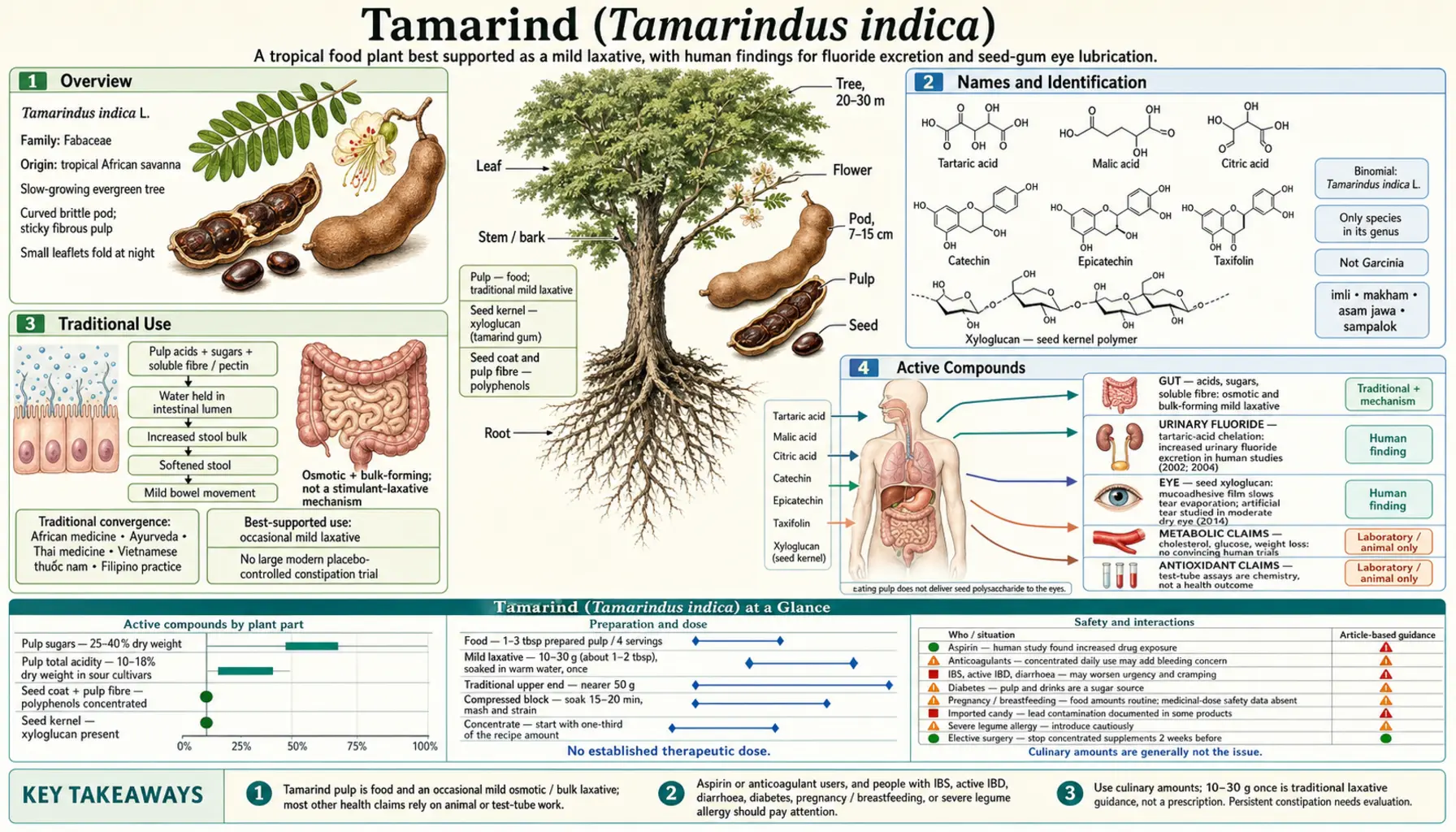
Tamarind is the sour brown pulp inside a brittle pod that hangs from a large tropical tree, and it may be the most widely eaten medicinal plant on earth — it is in pad thai, in sambal, in rendang, in Worcestershire sauce, in Mexican candy and in Indian chutney. Almost everything written about tamarind's health benefits rests on animal and test-tube work; the one traditional use with genuine, long-standing human support is the simplest one, as a mild laxative. Its distinctive sourness comes from tartaric acid rather than the citric or malic acid that makes most fruit taste sour, which is a small piece of chemistry with real consequences for how tamarind tastes, how it behaves in cooking, and how it interacts with at least one common drug.
Table of Contents
- Overview
- Names and Identification
- Traditional Use
- Active Compounds
- Why Tamarind Tastes Different: Tartaric Acid
- Laxative Effect: The Best-Supported Use
- Tamarind and Fluoride Excretion
- Tamarind Seed Polysaccharide and the Eye
- Metabolic and Antioxidant Claims: What the Evidence Shows
- Culinary Use
- Forms and Preparations
- Dosage
- Cautions and Contraindications
- Key Research Papers
- Connections
- Featured Videos
Overview
Tamarindus indica is a slow-growing evergreen tree in the pea and bean family, Fabaceae, reaching 20–30 metres with a dense canopy and small feathery leaflets that fold up at night. It produces a curved, cinnamon-brown pod 7–15 cm long with a shell so thin and dry that it cracks between your fingers. Inside is the part everyone wants: a sticky, fibrous, dark brown pulp wrapped around several hard, flattened, shiny seeds.
The pulp is the medicine and the food. It is roughly 30–40% sugars and 8–18% organic acids by dry weight — an unusual combination that makes it simultaneously one of the sweetest and one of the most acidic fruits in common use. That is why a spoonful of tamarind paste can carry a whole pot of curry: it is doing the work of both sugar and vinegar at once.
Despite being inseparable from Southeast Asian cooking, tamarind is African in origin. Its natural range is the dry savanna belt of tropical Africa, most likely Sudan and the surrounding region, and it was carried east to India in antiquity and onward through the Indian Ocean trade network. It reached the Americas with Spanish and Portuguese ships. Today, India is the largest producer, Thailand grows the sweetest cultivars, and the tree grows semi-wild across most of the tropics.
How tamarind reaches a kitchen depends on where you are. In village markets it is sold as whole pods or as a rough compressed block of pulp, seeds and fibre that you soak in hot water and squeeze by hand. In supermarkets it appears as a smooth seedless concentrate in a jar, as a paste in a tub, or as a bottled sauce. In a pharmacy in India or Thailand it may appear as a component of a laxative confection or a digestive syrup.
Names and Identification
Binomial: Tamarindus indica L. — the genus is monotypic, meaning tamarind is the only species in it. Family: Fabaceae (Leguminosae), subfamily Detarioideae.
The regional names tell the story of the plant's travels:
- Vietnamese: me (the fruit); me chua for the sour type
- Malay and Indonesian: asam jawa — literally “Javanese sour”
- Thai: makham (มะขาม); the sweet dessert cultivar is makham wan
- Hindi and Urdu: imli; Sanskrit amlika
- Tagalog: sampalok
- Khmer: ampil; Burmese: magyi
Two naming ironies are worth knowing. First, the Latin name means “Indian date” — from the Arabic tamr hindi, the date of India — even though the tree is neither a date palm nor Indian in origin. Arab traders met it in India and named it for where they found it. Second, the Malay name asam jawa means “Javanese sour,” which likewise records a stop on the trade route rather than the plant's homeland. A plant that started in African savanna carries two names crediting two different countries that did not have it first.
Name ambiguity to watch for. In Malay and Indonesian, asam on its own simply means “sour” and is used for several unrelated souring agents. Asam gelugur (also asam keping) is dried slices of Garcinia atroviridis; asam kandis is Garcinia xanthochymus or a related Garcinia. These are Clusiaceae fruits, not tamarind, and their acid profile and any pharmacology are different. If a recipe or a supplement label says only “asam,” it is not automatically tamarind. Separately, Manila tamarind (Pithecellobium dulce) and velvet tamarind (Dialium species) are different trees entirely; they share the word because their pods look vaguely similar.
Traditional Use
Traditional use is history, not proof — but tamarind's history is unusually consistent across systems that had little contact with each other, and consistency is at least a reason to look.
In traditional African medicine, where the plant is native, an ethnobotanical review covering the continent found tamarind recorded for fever, malaria, wounds, gastrointestinal complaints and as a laxative across a wide range of cultures and languages. In Ayurveda, amlika is classed as sour and heating, used as a digestive and mild purgative, with the ripe pulp preferred for constipation. In Thai traditional medicine, makham pulp is a standard mild laxative and the young leaves are used in a sour soup partly for digestive reasons. In Vietnamese thuốc nam and in Filipino folk practice the pulp is used similarly, as a gentle bowel-mover and a cooling drink in fever.
The common thread across every one of those traditions is the gut. Tamarind was not primarily a fever herb or a wound herb anywhere it was used seriously; it was a bowel herb that also happened to be delicious. That convergence is the reason the laxative claim is the one that eventually got tested and held up, while most of the others remain untested folklore.
Active Compounds
Organic acids (the defining feature). Tartaric acid dominates, typically making up the great majority of the total acid in the pulp, with smaller amounts of malic, citric, succinic and acetic acid. Total titratable acidity in sour cultivars commonly runs 10–18% of dry pulp weight. Sweet dessert cultivars have the same acid chemistry with far more sugar layered on top.
Sugars. Mainly glucose and fructose, 25–40% of dry weight. This matters practically: tamarind concentrate is a high-sugar product, and “tamarind for blood sugar” supplements are a strange proposition when the raw material is roughly a third sugar.
Dietary fibre and pectin. The pulp carries a substantial amount of soluble fibre and pectic material. Along with the sugars and the osmotic load of the acids, this is the most likely explanation for the laxative effect — a bulk-and-osmotic mechanism, not a stimulant one.
Tamarind seed polysaccharide (tamarind gum, TSP). The seed kernel yields a xyloglucan — a branched polysaccharide with a cellulose-like backbone. This is the industrially valuable part of the plant: it is used as a food thickener and, more interestingly, as a mucoadhesive polymer in eye drops. Reviews of xyloglucan describe it forming a film over mucous membranes that slows water loss and physically shields the surface.
Polyphenols. Procyanidins, catechin, epicatechin, taxifolin and related flavonoids are present, mostly concentrated in the seed coat and the pulp fibre rather than the smooth part people eat. As with most fruit polyphenols, they perform well in antioxidant assays in a test tube; that is a chemical measurement, not a health outcome.
Volatiles. The characteristic aroma comes from a mixture including furan derivatives, 2-phenylacetaldehyde and various pyrazines developed during ripening and drying.
Why Tamarind Tastes Different: Tartaric Acid
Most sour fruit is sour because of citric acid (citrus, berries, pineapple) or malic acid (apples, stone fruit, rhubarb). Tamarind is one of the few widely eaten fruits whose acidity is predominantly tartaric acid — a distinction it shares mainly with grapes, which is why wine chemistry and tamarind chemistry rhyme in odd ways.
This is not trivia. It explains three things people notice:
- The taste is different from lime. Tartaric acid is a stronger acid than citric acid and delivers sourness that reads as sharper at the front of the tongue and shorter in the finish. Substituting lime juice for tamarind in a curry gives you acidity but not the same shape of acidity — cooks are not imagining that.
- Tamarind chelates minerals. Tartaric acid binds metal ions readily. In the kitchen this is why tamarind strips tarnish from copper and brass pots — a genuinely traditional use in South India, and a hint that the same binding happens with dietary minerals in the gut.
- It changes how some substances are absorbed. The acid load and the chelation both alter conditions in the stomach and upper intestine. This is the mechanistic basis of the aspirin interaction described in Cautions, and it is a real, human-measured effect rather than a theoretical one.
One practical note for anyone on a low-oxalate diet for kidney stones: tartaric acid is not oxalic acid and they are not interchangeable, though tamarind does contain some oxalate. If you have calcium oxalate stones, treat tamarind as a moderate-oxalate food and ask your clinician rather than assuming the tartaric acid is the issue.
Laxative Effect: The Best-Supported Use
Mechanism. Tamarind's laxative action is generally understood to be osmotic and bulk-forming: the pulp delivers a load of poorly absorbed acids, sugars and soluble fibre into the gut, which holds water in the lumen, softens stool and increases volume. That is fundamentally different from a stimulant laxative such as senna, which works by irritating the colonic wall to force contraction. The practical difference matters: a gentle osmotic effect is generally better tolerated for occasional use and does not carry the same concerns about dependence and cramping that stimulant laxatives do.
What the evidence actually is. This is the point to be honest about. Tamarind's laxative use is documented consistently across African, Indian and Southeast Asian traditional medicine, it is recorded in colonial-era pharmacopoeias, and it appears in reviews of the plant's pharmacology as its most established application. What does not exist is a large, modern, placebo-controlled randomised trial of tamarind pulp for constipation with stool-frequency endpoints. The claim rests on centuries of consistent practical use plus a plausible and well-understood mechanism — a respectable footing, and a weaker one than a proper trial.
What that means for you. If you are constipated, tamarind is a reasonable thing to try, in the same category as prunes or figs: a food with an osmotic effect that most people tolerate. It is dose-dependent — a tablespoon of pulp in water is a nudge, half a cup is not. It is not a treatment for chronic constipation, and constipation that is new, persistent, or accompanied by bleeding, weight loss or a change in stool calibre needs a proper evaluation rather than a fruit.
Tamarind and Fluoride Excretion
This is tamarind's most unusual and genuinely human-tested effect, and it is almost unknown outside India.
Endemic fluorosis — skeletal and dental damage from naturally high fluoride in groundwater — affects large populations in parts of Andhra Pradesh, Rajasthan and Gujarat. Indian researchers noticed that tamarind-eating communities in fluorotic areas seemed less affected, and tested it directly. In a human study, tamarind ingestion increased urinary fluoride excretion, consistent with the tartaric acid chelating fluoride and mobilising it for elimination rather than deposition in bone. A follow-up study in adolescent boys in a fluorotic area found that tamarind ingestion gave a benefit in addition to switching to defluoridated water.
How to read this: these are small studies in a specific population with a specific exposure. They do not make tamarind a detox agent, and there is no reason to eat tamarind to “remove fluoride” if you drink normal municipal water — the fluoride levels involved in fluorosis are many times higher than those in fluoridated supplies. But the finding is real, it is human data, and it is a nice demonstration that the chelation chemistry described above has consequences in a living body.
Tamarind Seed Polysaccharide and the Eye
The seeds are usually discarded in cooking, which is a shame commercially, because the seed kernel yields tamarind gum, a xyloglucan polysaccharide that is one of the plant's real success stories.
Mechanism. Xyloglucan is mucoadhesive — it sticks to and spreads over mucous surfaces, forming a thin film. On the ocular surface, that film slows tear evaporation and provides a physical barrier over irritated epithelium. It also has favourable rheology: it is more viscous at rest and thins under the shear of a blink, so it stays put between blinks without blurring vision as much as a plain viscous drop would.
Human evidence. Tamarind seed polysaccharide is a genuine, commercially used ophthalmic excipient, not a folk remedy. A published clinical study evaluated an artificial tear combining hyaluronic acid with tamarind seed polysaccharide in patients with moderate dry eye. Broader reviews of xyloglucan describe barrier-protective effects across mucous membranes including the gut. This is a modest, mechanically sensible application — a good lubricant polymer — not a claim that tamarind cures dry eye.
Other uses of the gum. Tamarind seed polysaccharide is widely investigated as a drug-delivery and wound-dressing biopolymer, and it is used as a food thickener and sizing agent. Note the distinction clearly: eating tamarind pulp does not deliver tamarind seed polysaccharide to your eyes. These are different parts of the plant used in different ways.
Metabolic and Antioxidant Claims: What the Evidence Shows
Search for tamarind supplements and you will find claims for weight loss, blood sugar, cholesterol, liver protection and blood pressure. Here is the honest state of that literature.
Antioxidant activity: cell-culture and chemical assays. Tamarind extracts perform well in DPPH, FRAP and similar test-tube assays, as almost every polyphenol-containing plant does. Reviews consistently report this. It tells you the chemistry is capable of donating electrons in a cuvette. It does not tell you that eating tamarind reduces oxidative damage in a person.
Lipids and blood sugar: mostly animal. Rodent studies of tamarind pulp, seed and leaf extracts have reported reductions in cholesterol, triglycerides and blood glucose, and these are widely cited. They are animal studies, often at doses far above dietary intake, and they have not been followed by convincing human trials. Reviews of the plant's pharmacology describe its potential as substantially unexplored in humans — which is a fair summary rather than a criticism.
Weight loss. There is no good human evidence that tamarind causes weight loss. Be alert to a specific confusion here: Garcinia cambogia (Malabar tamarind) is a completely different plant, and its hydroxycitric acid weight-loss claims — which have their own disappointing trial record and their own liver-safety questions — are frequently and wrongly attached to Tamarindus indica in marketing copy.
Antimicrobial work. Laboratory studies report activity of tamarind bark and leaf extracts against various organisms, including one study of stem bark extract inhibiting Newcastle disease virus replication in vitro. This is early laboratory work with no human application.
Bottom line: for anything other than the bowel, the fluoride finding, and the seed gum's use as an ophthalmic polymer, tamarind's health claims are currently hypothesis. Eat it because it is good food.
Culinary Use
Tamarind is first and foremost a food, and it is one of the great souring agents of world cooking — the tropical equivalent of lemon in the Mediterranean or vinegar in Europe.
- Thailand: the sour backbone of pad thai, of tom kha-adjacent sour soups, and of sweet-sour dipping sauces. Makham wan, the sweet cultivar, is eaten out of hand as fruit.
- Indonesia and Malaysia: asam jawa in sambal, in rendang, in asam pedas fish stew, and in the herbal drink jamu kunyit asam with turmeric.
- Vietnam: canh chua, the sweet-and-sour fish soup, gets its sourness from me; tamarind also glazes crab and shrimp.
- India: essential to sambar, rasam, puliyodarai (tamarind rice) and to the sweet-sour chutney served with chaat.
- Britain and everywhere: tamarind is a named ingredient in Worcestershire sauce, which means a great many people who have never seen a tamarind pod eat it regularly.
- Mexico and the Caribbean: agua de tamarindo, tamarind candies (often with chilli and salt), and pulparindo-style confections.
A cook's note that doubles as a safety note: tamarind is acidic enough to react with unlined copper, brass and aluminium cookware. Traditional South Indian kitchens exploit this to clean brass; a modern kitchen should simply use stainless steel or enamelled cookware when simmering tamarind for any length of time.
Forms and Preparations
- Whole pods. Crack, peel, and use the pulp. Longest keeping, most work, best flavour.
- Compressed block (wet tamarind). A slab of pulp, fibre and seeds. Break off a piece, soak in hot water 15–20 minutes, mash and strain out fibre and seeds. The standard form in Asian groceries and the best value.
- Concentrate or paste. Smooth, seedless, jarred, often much stronger and sometimes much darker than fresh pulp. Strength varies enormously between brands — start with a third of what a recipe says and adjust.
- Tamarind candy and sauces. Usually loaded with added sugar and salt. Some Mexican tamarind candies have historically been a source of lead exposure, from the glazed ceramic pots used in traditional preparation and from tamarind grown near contaminated soil — buy from reputable manufacturers and do not give large amounts to small children.
- Tamarind seed polysaccharide eye drops. A pharmaceutical product, not a home preparation. Available as lubricant drops in several markets.
- Capsules and extracts. Sold for metabolic claims that the human evidence does not support. Check the Latin binomial on the label: many “tamarind” supplements are Garcinia, not Tamarindus.
Dosage
There is no established therapeutic dose of tamarind for any condition. No regulatory body has set one, and no trial has established one. What follows is culinary and traditional practice, offered as a starting point rather than a prescription.
- As a food: a typical curry or soup uses 1–3 tablespoons of prepared pulp for 4 servings — a few grams per person. No concerns at this level for a healthy adult.
- Traditional mild laxative use: roughly 10–30 g of pulp (about 1–2 tablespoons) soaked in a glass of warm water, taken once. Traditional practice puts the upper end nearer 50 g. Effect is dose-related and takes hours, not minutes.
- Do not escalate. Large doses give you cramping and diarrhoea, not a better result, along with a substantial acid and sugar load.
- Duration: occasional use only. Constipation lasting more than a week or two needs a diagnosis, not a bigger dose.
Cautions and Contraindications
The laxative effect is dose-related — that cuts both ways. The same property that makes tamarind useful for occasional constipation makes a large dose an unpleasant experience. People with irritable bowel syndrome, active inflammatory bowel disease, or diarrhoea-predominant symptoms should be cautious: the osmotic load can worsen urgency and cramping. Anyone already taking a laxative should not stack tamarind on top without expecting an additive effect.
Aspirin and drug absorption — the interaction that matters. A published human study in healthy volunteers found that Tamarindus indica altered the bioavailability of aspirin, increasing exposure to the drug. The likely mechanism is the acid load changing gastric conditions and dissolution. The practical implications:
- If you take aspirin regularly — including low-dose aspirin for cardiovascular protection — be aware that a large tamarind intake at the same time may raise your aspirin exposure. The main concern with more aspirin is gastrointestinal bleeding, and tamarind's own acidity does not help an already irritated stomach.
- The same mechanism could plausibly affect other drugs whose absorption is pH-dependent, though this has been much less studied. If you take a medication with narrow margins for error, separate it from large tamarind doses by a couple of hours.
- If you take anticoagulants (warfarin, apixaban, rivaroxaban, clopidogrel and similar), the concern is layered: tamarind may raise aspirin levels, and aspirin plus an anticoagulant already raises bleeding risk. Reviews of herb–drug interactions in cardiovascular medicine flag exactly this kind of stacking. Culinary amounts are not the issue; concentrated daily supplement use alongside anticoagulation is worth raising with your prescriber.
Blood sugar and dental health. Tamarind pulp is high in sugar and high in acid. For people with diabetes, tamarind concentrate and tamarind drinks are a sugar source, not a blood-sugar treatment. For teeth, the combination of acid and sugar is corrosive — rinse with water after tamarind candy or drinks, and do not brush immediately afterwards, which grinds softened enamel.
Pregnancy and breastfeeding. Tamarind as food is eaten routinely throughout pregnancy across South and Southeast Asia and there is no signal of harm at culinary amounts. Medicinal or laxative doses are a different matter — there is no safety data, and strong laxatives are generally avoided in pregnancy. Concentrated tamarind supplements are not recommended in pregnancy or while breastfeeding.
Lead contamination in some tamarind candies. This is a documented public-health issue rather than a property of the plant: certain imported tamarind candies, particularly those sold in traditional glazed ceramic containers, have tested high for lead. Children are most vulnerable. Buy from established manufacturers and avoid unbranded candies in ceramic pots.
Allergy. Tamarind is a legume. True tamarind allergy is uncommon but reported, and people with severe legume allergies should introduce it cautiously.
Surgery. Given the possible aspirin interaction and the theoretical bleeding concern, stop concentrated tamarind supplements two weeks before elective surgery. Food amounts are fine.
Key Research Papers
- Mustapha A, Yakasai IA, Aguye IA. Effect of Tamarindus indica L. on the bioavailability of aspirin in healthy human volunteers. European Journal of Drug Metabolism and Pharmacokinetics. 1996;21(3):223–226.
- Khandare AL, Rao GS, Lakshmaiah N. Effect of tamarind ingestion on fluoride excretion in humans. European Journal of Clinical Nutrition. 2002;56(1):82–85.
- Khandare AL, Kumar PU, Shanker RG, et al. Additional beneficial effect of tamarind ingestion over defluoridated water supply to adolescent boys in a fluorotic area. Nutrition. 2004;20(5):433–436.
- Barabino S, Rolando M, Nardi M, et al. The effect of an artificial tear combining hyaluronic acid and tamarind seeds polysaccharide in patients with moderate dry eye syndrome. European Journal of Ophthalmology. 2014;24(2):173–178.
- Havinga RM, Hartl A, Putscher J, et al. Tamarindus indica L. (Fabaceae): patterns of use in traditional African medicine. Journal of Ethnopharmacology. 2010;127(3):573–588.
- Bhadoriya SS, Ganeshpurkar A, Narwaria J, et al. Tamarindus indica: extent of explored potential. Pharmacognosy Reviews. 2011;5(9):73–81.
- Piqué N, Gómez-Guillén MDC, Montero MP. Xyloglucan, a plant polymer with barrier protective properties over the mucous membranes: an overview. International Journal of Molecular Sciences. 2018;19(3).
- Chinta ML, Gandam PK, Sivasankar MV, et al. Tamarind (Tamarindus indica L.) seed polysaccharide: a promising biopolymer for drug delivery, wound healing, tissue engineering and beyond. Carbohydrate Research. 2025;552:109454.
- El-Gazzar NS. Tamarind genus chemical composition and biological activities. Natural Product Research. 2025;39(4):935–947.
- Izzo AA, Di Carlo G, Borrelli F, Ernst E. Cardiovascular pharmacotherapy and herbal medicines: the risk of drug interaction. International Journal of Cardiology. 2005;98(1):1–14.
Live PubMed Searches
- Tamarindus indica — all literature
- Tamarind and constipation
- Tamarind seed polysaccharide (xyloglucan)
- Tamarind and fluoride excretion
- Tamarind drug interactions and bioavailability
- Tamarind polyphenols and antioxidant activity
- Tamarind, lipids and glucose
- Lead contamination in tamarind confectionery
- Tartaric acid and mineral chelation
- Tamarind antimicrobial studies
Connections
- Fluoride Chelation — the classic Indian fluorosis remedy, with published human studies
- All Herbs
- Senna — the stimulant laxative tamarind is usually contrasted with; useful for understanding why an osmotic laxative is a gentler first choice.
- Food — tamarind is more food than medicine, and the food section covers how souring agents work in cooking.
- Gastroenterology — constipation, IBS and the digestive conditions where a laxative choice actually matters.
- Conditions on this site that reference this page: Cholesterol Management · Dentistry & Oral Health · Hypothyroidism · Type 1 Diabetes · Type 2 Diabetes · H. pylori (Helicobacter pylori) · Inflammatory Bowel Disease (IBD)