Maca (Lepidium meyenii)
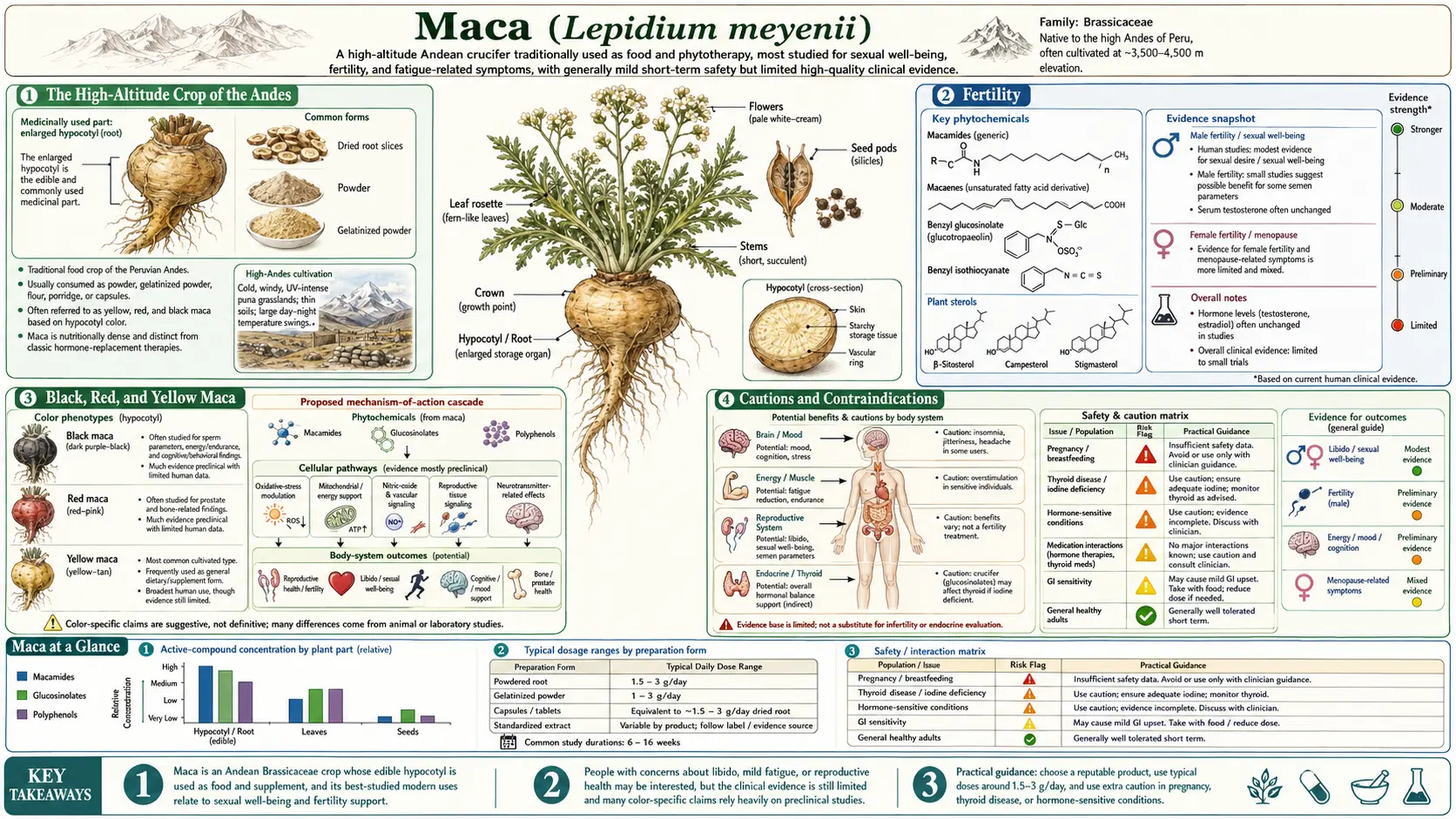
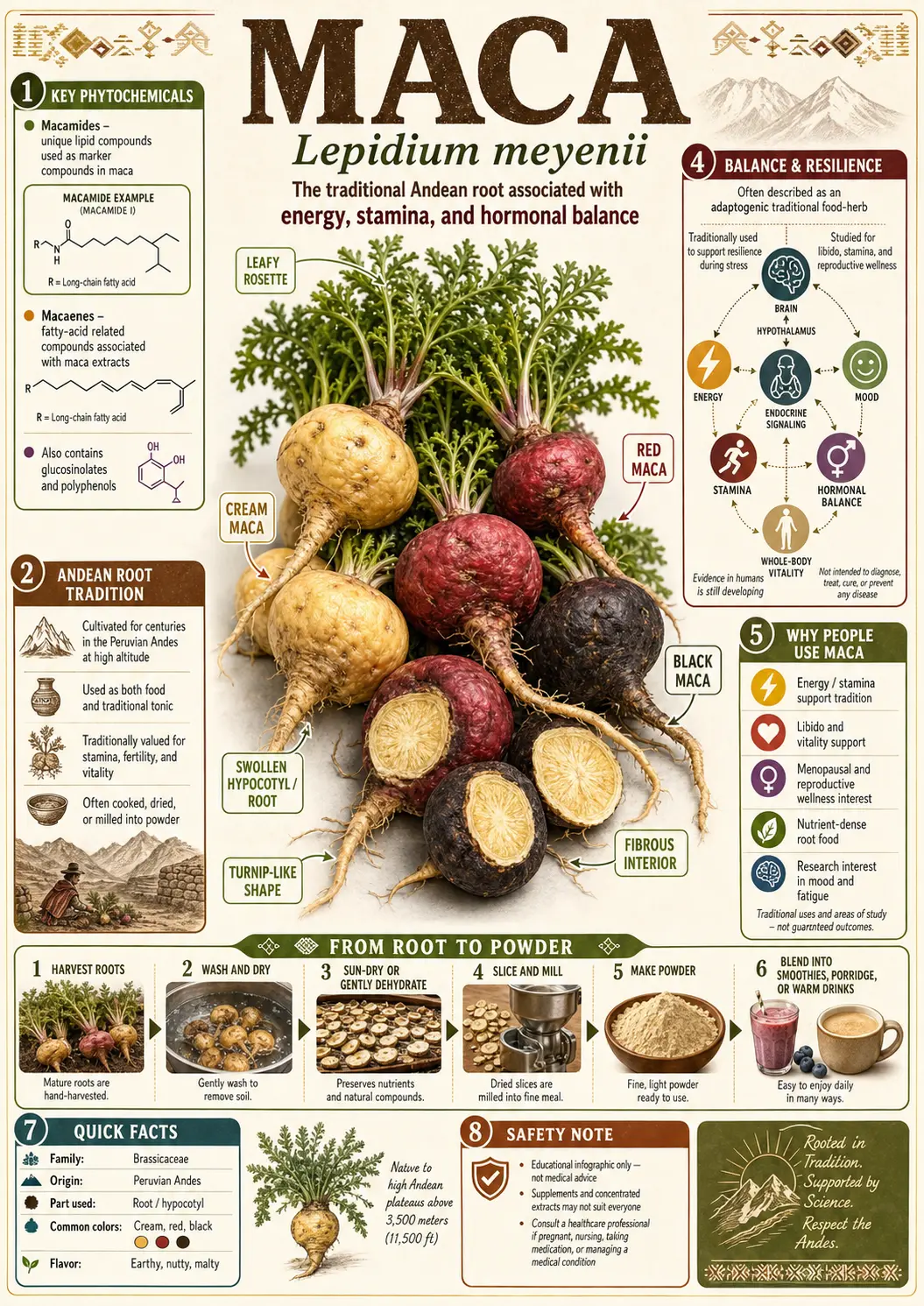
Table of Contents
- The High-Altitude Crop of the Andes
- Active Compounds
- Sexual Function and Libido
- Fertility
- Menopausal Symptoms
- Energy, Mood, and Adaptogenic Action
- Black, Red, and Yellow Maca
- Forms and Preparations
- Recommended Dosage
- Cautions and Contraindications
- Featured Videos
The High-Altitude Crop of the Andes
Maca is a cruciferous root vegetable cultivated for roughly 2,000 years on the high Andean plateau around Lake Junin in central Peru, between about 4,000 and 4,500 meters — a harsh environment of intense ultraviolet light, freezing nights, and thin air where few crops survive. It was a vital highland food and trade good, carried a long reputation for supporting fertility and vigor, faded to a local crop after the Spanish conquest, and was rediscovered commercially in the late twentieth century before becoming a globally traded supplement — the fuller story is told in the dedicated History & Traditional Use article.
Active Compounds
Maca's active compounds are unusual and somewhat poorly characterized compared with herbs from longer scientific traditions. Notable constituents include:
- Macamides and macaenes — unique fatty acid amides found only in maca; thought to be primary contributors to libidinal and energy effects
- Glucosinolates — including aromatic glucosinolates that may underlie some of the hormonal-modulating effects
- Sterols — including sitosterol and campesterol, with mild membrane-modulating activity
- Polyphenols and flavonoids — antioxidant activity
- Amino acids and proteins — maca is unusually high in protein for a root vegetable (roughly 10% by dry weight)
- Minerals — iron, calcium, potassium, copper, zinc, manganese; nutritional contribution
Notably, maca does not contain identifiable plant estrogens or androgens; its hormonal effects appear to occur through modulation of the hypothalamic-pituitary axis rather than direct hormone-receptor binding. This is an important distinction for use in hormone-sensitive conditions.
Sexual Function and Libido
The strongest evidence base for maca is in the modulation of sexual desire (libido) in both men and women. Several randomized controlled trials have shown improvements in self-reported sexual desire, frequency of sexual thoughts, and sexual satisfaction over 6-12 weeks of supplementation.
Importantly, maca's libido effect appears to be independent of testosterone or estrogen levels — studies measuring sex hormone levels generally find no significant change with maca supplementation. The mechanism is thought to involve central nervous system pathways related to motivation, reward, and arousal rather than peripheral hormone changes.
SSRI-induced sexual dysfunction — one of the more clinically interesting indications for maca. Selective serotonin reuptake inhibitors (sertraline, fluoxetine, paroxetine, escitalopram) commonly cause sexual side effects that persist as long as the medication is taken. Two randomized controlled trials have shown that 1.5-3 g of maca daily significantly improved sexual function in patients with SSRI-induced dysfunction without affecting the antidepressant benefit.
Fertility
Multiple small studies have shown that maca improves sperm parameters in men, including sperm count, motility, and morphology. Effects are typically observed after 2-3 months of consistent use at 1.5-3 g daily. The mechanism may involve antioxidant protection of sperm cells, improved testicular function, or central modulation of reproductive hormones.
In women, maca has been studied as part of fertility protocols, particularly for women with stress-related cycle irregularity. Evidence is more preliminary but the favorable safety profile makes it reasonable to include in integrative fertility programs.
Menopausal Symptoms
Several controlled trials in postmenopausal women have shown that maca reduces hot flashes, improves mood and sleep quality, and reduces self-reported menopausal symptom burden. Effects are smaller than hormone replacement therapy but appropriate for women seeking non-hormonal botanical support.
Because maca does not appear to bind estrogen receptors directly, it may be a safer option than phytoestrogen-rich herbs (red clover, soy isoflavones) for women with hormone-sensitive conditions, although clinical guidance is still recommended in breast cancer survivors and women with active estrogen-sensitive disease.
Energy, Mood, and Adaptogenic Action
Beyond sexual function, maca shows mild but consistent benefits for energy, mood, and stress tolerance. It is one of the more food-like adaptogens, suitable for daily use in smoothies, oatmeal, or baked goods. Many users report improved morning energy and reduced afternoon fatigue with regular consumption.
Athletes have used maca for endurance and recovery; small studies in cyclists have shown modest improvements in time-trial performance after 14 days of supplementation, though evidence is limited and effect sizes are small.
Black, Red, and Yellow Maca
Maca roots come in three primary color phenotypes: black, red, and yellow. Yellow is the most common, accounting for 60-70% of harvest. Modern research has begun to identify subtle differences in clinical effects:
- Yellow maca — the standard, mildest preparation; suitable for general daily use
- Black maca — preferred for male sexual function, sperm quality, and physical endurance; richer in macamides
- Red maca — preferred for female reproductive issues, prostate health (where it has shown reduction of prostate volume in animal studies), and bone density
These distinctions are best regarded as preliminary; differences between color phenotypes are smaller than differences between high-quality and low-quality preparations regardless of color.
Forms and Preparations
- Raw maca powder — traditional form; contains active glucosinolates but may cause GI upset in some individuals
- Gelatinized maca powder — pressure-cooked to break down starches, improving digestibility and tolerance; the recommended form for most users
- Capsules / tablets — convenient dosing; check that gelatinized form is used
- Standardized extracts — some products standardize to macamide content; quality varies
- Whole dried root — traditional preparation, simmered into a porridge or thick broth
Authenticity: high-altitude Peruvian maca is the standard of comparison. Lower-altitude or non-Peruvian maca may have less active phytochemistry. Look for products that specify origin.
Recommended Dosage
- Gelatinized maca powder — 1.5-3 g daily for most therapeutic uses; some studies use up to 5 g daily
- Capsules — 500-1500 mg, two to three times daily
- For male sexual function and fertility — 1.5-3 g daily of black maca for 8-12 weeks
- For menopausal symptoms — 1.5-3 g daily of red or yellow maca for 8-12 weeks
- Cycling — some clinicians recommend taking maca 5 days on, 2 days off; others use it continuously
- Timing — best taken in the morning or early afternoon; energizing effect can interfere with sleep if taken in the evening
Cautions and Contraindications
- Thyroid conditions — maca contains glucosinolates which, in raw form and high amounts, can theoretically interfere with thyroid function; use gelatinized maca and avoid excessive doses if you have thyroid disease
- Hormone-sensitive cancers — although maca is not directly estrogenic, women with breast or other estrogen-sensitive cancers should use only under oncology guidance
- Pregnancy and breastfeeding — limited safety data; avoid high-dose supplementation during pregnancy
- High blood pressure — some users report mild blood pressure elevation; monitor if you have hypertension
- Mild side effects — gastrointestinal upset, gas, and bloating in some users (especially with raw maca); usually resolves with the gelatinized form
- Quality and adulteration — maca is sometimes adulterated with cheaper root powders; choose products from established brands with origin verification
Research Papers and References
The following PubMed search links provide curated entry points into the published clinical and mechanistic literature on Maca (Lepidium meyenii). Each link opens directly in PubMed at the National Library of Medicine.
- Maca for sexual function in men — PubMed: maca sexual function men
- Maca for menopausal symptoms women — PubMed: maca menopause women
- Maca and fertility / sperm quality — PubMed: maca fertility sperm
- Lepidium meyenii ergogenic / endurance — PubMed: Lepidium meyenii endurance
- Maca and SSRI-induced sexual dysfunction — PubMed: maca SSRI sexual dysfunction
- Maca color phenotypes black red yellow — PubMed: maca black red yellow
- Maca safety and high-altitude cultivation — PubMed: maca safety altitude
External Authoritative Resources
- NCCIH — Herbs at a Glance
- MedlinePlus — Herbs and Supplements
- PubMed — All research on Lepidium meyenii
Connections
- All Herbs
- Maca Benefits Deep Dive
- Ginseng
- Ashwagandha
- Stress Management
- Holy Basil
- Hormone Panel
- Black Cohosh
- Rhodiola Rosea
- Testosterone Test
- Fatigue
- Hypertension
- Iron
- Zinc
- Calcium
- Fasting