Sabah Snake Grass (Clinacanthus nutans)
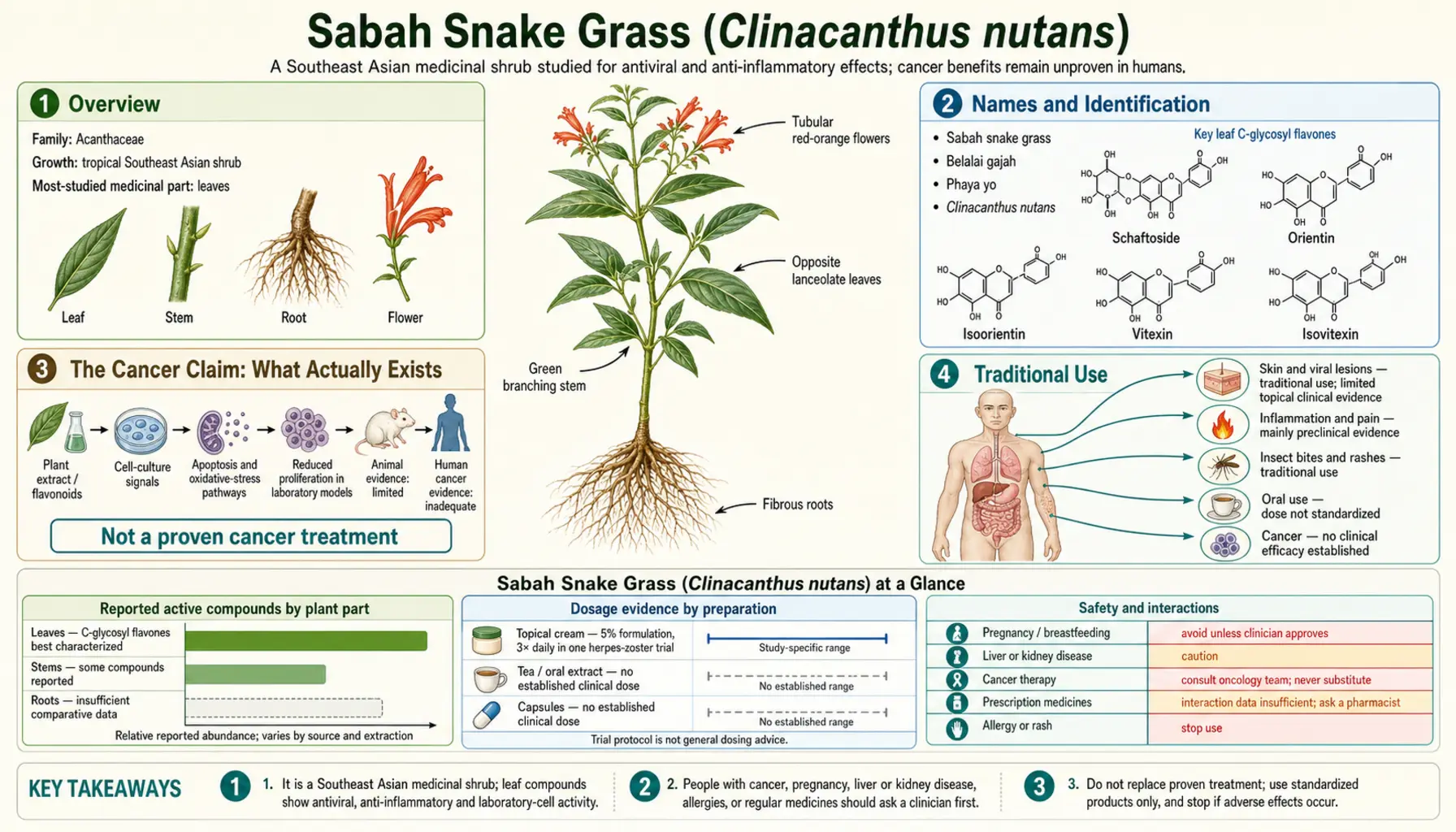
Clinacanthus nutans is a scrambling shrub of Southeast Asia, known in Malaysia as Sabah snake grass or belalai gajah and in Thailand as phaya yo. It is unusual among regional folk herbs in having formal regulatory standing: Thailand lists it in its National List of Essential Medicines as a topical preparation for the skin and mouth lesions of herpes simplex and herpes zoster. That listing is narrow and specific, and it is worth understanding exactly what it does and does not say — it approves a cream and a mouth solution applied to a rash, not a systemic antiviral and not a cure.
It is also the plant at the centre of one of the more damaging herbal episodes in recent Malaysian memory. Between roughly 2010 and 2015 snake grass was promoted intensively as a cancer cure, and people drank large volumes of fresh blended leaf in place of, or alongside, oncology treatment. There is no clinical trial evidence that Clinacanthus nutans treats any cancer. The entire anticancer literature is cell-culture work, it is inconsistent even at that level, and nothing in it justifies delaying or replacing treatment. That is stated at the top of this page because delay is where the real harm happened.
Table of Contents
- Overview
- Names and Identification
- The Cancer Claim: What Actually Exists
- Traditional Use
- Official Standing: Thailand's Essential Medicines List
- Active Compounds
- Herpes Simplex and Herpes Zoster
- Snake Bites, Insect Stings and Irritated Skin
- Anti-Inflammatory and Antioxidant Activity
- Eaten as a Leaf, Drunk as a Juice
- Forms and Preparations
- Dosage
- Cautions and Contraindications
- Key Research Papers
- Conditions It Is Used For
- Connections
- Featured Videos
Overview
Clinacanthus nutans (Burm.f.) Lindau is a member of the Acanthaceae, the acanthus family, which also contains andrographis and several other Asian medicinal plants. It is a soft-stemmed scrambling shrub, typically one to three metres tall, that sprawls through other vegetation rather than standing upright. The leaves are narrow, opposite, lance-shaped and dark green; the flowers are dull red to orange, tubular and curved, and it is that curve that gives the plant its Malay name — belalai gajah, elephant's trunk.
It grows readily throughout Malaysia, Indonesia, Thailand, Vietnam, southern China and the Philippines, in gardens as often as in the wild. This matters practically: unlike tongkat ali, which takes the better part of a decade to produce a harvestable root, snake grass is a fast, easy garden plant that roots from cuttings and can be picked continuously. Anyone in a suitable climate can grow a supply in a pot. That accessibility is part of why it spread so quickly in the 2010s, and part of why it stayed cheap while claims about it grew expensive.
The part used is the leaf, occasionally with the young stem. Traditional preparations are fresh — leaves pounded into a poultice for the skin, or blended and drunk — and modern preparations include dried-leaf tea, capsules, and in Thailand a standardised cream and a glycerin-based oral solution manufactured under national pharmaceutical regulation.
Names and Identification
Binomial: Clinacanthus nutans (Burm.f.) Lindau. Family: Acanthaceae. The synonym Clinacanthus burmanni appears in older literature.
- English / Malaysian English: Sabah snake grass, snake grass.
- Malay: belalai gajah ("elephant's trunk"), also rumput Sabah, daun belalai gajah.
- Thai: phaya yo — พญายอ — and phaya plong thong — พญาปล้องทอง. The phaya element means "lord" or "chief", a common honorific in Thai plant names for herbs held in high regard.
- Chinese: 鱷嘴花 (è zuǐ huā, "crocodile-mouth flower"), for the shape of the corolla; also written 沙巴蛇草 ("Sabah snake grass") in Malaysian Chinese usage.
- Vietnamese: bìm bịp and xương khỉ ("monkey bone").
- Indonesian: dandang gendis, ki tajam.
Why "snake grass". The name records the plant's oldest documented use: pounded leaf applied to snake bites and to the stings and bites of insects and scorpions. It is not a grass and it has no relationship to grasses.
Name confusion worth flagging. "Snake grass" and "snake plant" are attached to several unrelated species in English — Sansevieria (mother-in-law's tongue) is commonly called snake plant, and Equisetum is sometimes called snake grass. Neither is this plant. Within Southeast Asia the plant is also frequently mentioned in the same breath as Clinacanthus siamensis, a close relative, and as Gendarussa vulgaris, another Acanthaceae used for aches and bites. If you are sourcing leaf material, the binomial is the only reliable identifier.
The Cancer Claim: What Actually Exists
Around 2010 Clinacanthus nutans became the subject of an intense, largely word-of-mouth and social-media campaign across Malaysia and Singapore promoting it as a cure for cancer. People were advised to blend dozens of fresh leaves daily into juice and drink it. Plants were given away, growers could not keep up with demand, and patients with diagnosed cancers took it as a primary treatment.
What the research actually contains. A real and growing laboratory literature. Extracts and fractions of C. nutans have been tested against a range of cancer cell lines — lymphoma, breast, cervical, oral squamous carcinoma and others — and several studies report cytotoxicity, apoptosis induction and effects on signalling pathways. Reviews summarising this work exist. Every one of these studies is done on cells in a dish, or on nanoparticle composites, or in a molecular docking simulation.
What the research does not contain. One randomised controlled trial has tested a C. nutans preparation in cancer patients — a 2022 Thai trial of a mouthwash for preventing radiation-induced mouth sores during head-and-neck radiotherapy, which found it performed no better than plain saline and bicarbonate. It measured a treatment side effect, not the cancer itself. No trial of any kind — randomised, non-randomised, or a published case series with objective tumour response measurement — has ever tested whether this plant shrinks a tumour, slows its progression, or extends survival. Nothing exists at the level of evidence at which cancer treatments are judged. The full trial-by-trial picture, including two real mouse tumour studies and the chemotherapy-interaction risk, is in the cancer deep dive.
Why the cell-culture results should not move you. Killing cancer cells in a dish is easy. Bleach does it. Distilled water does it. Hundreds of plant extracts do it, at concentrations that could never be achieved in a human bloodstream after swallowing a drink, applied directly to cells with no liver in between, no absorption barrier, no immune system, no blood supply and no tumour architecture. The conversion rate from "cytotoxic in vitro" to "useful in patients" is famously close to zero. On top of that, the C. nutans in-vitro results are themselves inconsistent between laboratories — some studies find substantial activity, others find little — which is what you would expect from extracts that vary with the plant's growing conditions, harvest time and processing, as a 2024 review of exactly that variability describes.
The harm. It is not that drinking leaf juice is dangerous in itself. It is that a treatable cancer becomes an untreatable one while someone waits to see whether the juice works. Stage-dependence is brutal in oncology: many cancers that are curable when caught early are not curable a year later. The cost of the snake-grass episode is measured in the months patients spent not receiving treatment that would have worked.
If you have a cancer diagnosis and want to take snake grass, the sequence that protects you is: accept the oncology treatment, tell your oncologist what you are taking, and understand the interaction risk described in the Cautions section — laboratory work shows C. nutans inhibits cytochrome P450 enzymes, which is the machinery that clears many chemotherapy drugs from the body.
Traditional Use
Across Malay, Thai, Chinese-Malaysian, Indonesian and Vietnamese folk practice the plant's traditional applications are remarkably consistent, and they are overwhelmingly external and local:
- Bites and stings. Fresh leaves pounded to a paste and applied to snake bites, scorpion stings, centipede bites and insect bites — the use that names the plant.
- Skin eruptions. Poultices applied to rashes, boils, burns, herpetic blisters and shingles lesions. This is the traditional use that eventually became a registered medicine in Thailand.
- Aches and inflammation. Applied to bruises, sprains and sore joints.
- Internally, as a cooling tea. In Thai practice the leaves are taken for fever and to "cool" the body; in Chinese-Malaysian practice a leaf infusion is drunk for what is described as heatiness. In Vietnam and Indonesia the leaf is used for fever, urinary complaints and diabetes.
- Anaemia and general weakness appear in some Malay accounts.
Note what is not in the traditional record: cancer. The cancer application is a twenty-first-century addition, not a traditional indication. That is worth saying because the marketing around it borrowed the authority of tradition without having any.
Official Standing: Thailand's Essential Medicines List
Thailand maintains a National List of Essential Medicines that includes a section for herbal medicines, and preparations of Clinacanthus nutans — phaya yo — are on it. This is rare. Very few Southeast Asian folk herbs have been evaluated by a national regulator and admitted to an essential medicines list as a defined pharmaceutical product with a defined indication.
What the listing covers. Topical preparations for the skin and mucosal lesions of herpes simplex and herpes zoster (shingles) — a cream or lotion applied to the affected skin, and a glycerin-based solution used in the mouth for herpetic lesions and aphthous ulcers. These are hospital-manufactured products made to a pharmaceutical standard, not garden leaves.
What the listing does not cover, and this is the important part:
- It is not a systemic antiviral. It is applied to the lesion, not swallowed to treat the infection.
- It does not eradicate the virus. Herpes simplex and varicella zoster remain latent in nerve ganglia for life, and no topical treatment changes that.
- It is not a substitute for oral aciclovir, valaciclovir or famciclovir in shingles. Systemic antiviral therapy started within 72 hours of rash onset is the standard of care, it reduces the duration of the acute illness, and — critically — it is the treatment that addresses complications such as postherpetic neuralgia and eye involvement. A topical herbal cream does not do that job.
- It says nothing whatsoever about cancer, diabetes, or any internal use.
The listing represents a national health system deciding that a cheap, locally produced topical herbal product is a reasonable option for symptomatic relief of a rash, in a context where it can be made locally and affordably. That is a real and sensible endorsement. It is also a much smaller claim than "approved by the Thai government as a medicine", which is how it is usually reported. National essential medicines lists are revised periodically, so the current edition is the authority on what is listed today.
Active Compounds
- C-glycosyl flavones — the best-characterised group, including vitexin, isovitexin, shaftoside (schaftoside), orientin and isoorientin. Chelyn and colleagues developed the HPTLC and HPLC methods used to quantify these and they serve as the practical marker compounds for identifying and standardising leaf material. C-glycosyl flavones are more resistant to breakdown in the gut than ordinary O-glycosides, though that does not make them well absorbed.
- Sulphur-containing glycosides — an unusual and distinctive class for this plant, including entadamide derivatives and the clinacosides. Sulphur-containing plant metabolites are relatively uncommon outside the brassica and allium families, and these compounds are among the more chemically interesting things C. nutans produces.
- Chlorophyll derivatives — pheophorbides and pheophytins, the breakdown products of chlorophyll. These have attracted attention because chlorophyll-related compounds isolated from C. nutans have shown antiviral activity in laboratory assays, and they are a plausible candidate for whatever the topical preparations are doing. Pheophorbide a is also a known photosensitiser — a compound that becomes more reactive when exposed to light — which is the basis for the theoretical photosensitivity caution below.
- Cerebrosides and glycoglycerolipids — membrane-derived lipids isolated from the leaf and reported to have antiviral activity in cell assays.
- Triterpenoids, phytosterols and simple phenolic acids — the usual supporting cast, contributing to antioxidant readings.
No single constituent has been established as the active principle, and it is entirely possible that the topical antiviral effect, if real, comes from a combination.
Herpes Simplex and Herpes Zoster
Proposed mechanism. Laboratory studies report that C. nutans extracts and isolated constituents can interfere with herpesvirus replication in cell culture, with the chlorophyll derivatives and glycoglycerolipids among the candidate actives, and reviews have also described immunomodulatory activity. Applied to a lesion, the extract may also act simply as a soothing, anti-inflammatory topical — which for a painful rash is not nothing.
Human evidence. This is the herb's strongest indication and it still rests on a small base. Two Thai clinical studies from the mid-1990s form the core: Sangkitporn and colleagues reported on treatment of herpes zoster with C. nutans extract, and Charuwichitratana and colleagues reported on treatment of herpes zoster with a C. nutans cream. Kongkaew and Chaiyakunapruk later conducted a systematic review and meta-analysis of the randomised trials of C. nutans extracts in patients with herpes infection — the right way to summarise a small literature, and a useful paper precisely because it shows how few trials there are and how small they are.
How to read that. A handful of small randomised trials, conducted decades ago, mostly in one country, is a genuinely different level of evidence from an untested folk remedy — and a genuinely lower level than the evidence behind aciclovir, which rests on large multicentre trials with hard clinical endpoints. Both statements are true at once. Snake grass is one of the better-supported topical herbal treatments in Southeast Asian medicine, and it is not competitive with an antiviral drug.
The practical advice for shingles. Shingles is time-critical. Oral antiviral therapy started within 72 hours of the rash appearing shortens the acute episode and reduces the risk of postherpetic neuralgia — nerve pain that can persist for months or years and is genuinely difficult to treat. Shingles affecting the eye, the ear, or a large area, or occurring in someone immunocompromised, is a same-day medical problem. Use a herbal cream for comfort alongside proper treatment if you like. Do not use it instead, and do not let it cost you the 72-hour window.
Snake Bites, Insect Stings and Irritated Skin
The traditional claim. Pounded fresh leaf applied to the bite draws out venom, reduces swelling and relieves pain.
The evidence. For insect bites and stings, plausible and untested — a cool moist leaf poultice with anti-inflammatory constituents would be expected to soothe a local reaction, and there is nothing to lose by trying it. For snake bite, this needs to be said as directly as possible: no plant poultice treats venomous snake envenomation. The definitive treatment is antivenom, given in hospital. Southeast Asia carries a heavy burden of bites from cobras, kraits, Russell's vipers and pit vipers, some of which cause paralysis, uncontrolled bleeding or tissue destruction within hours. The traditional name of this plant is a piece of ethnobotanical history, not first aid. Anyone bitten by a snake should be immobilised and taken to hospital immediately, and no time at all should be spent looking for leaves.
For everyday skin irritation — rashes, minor burns, itchy bites — a leaf poultice is a low-risk traditional remedy with a long record of use and no controlled evidence.
Anti-Inflammatory and Antioxidant Activity
Proposed mechanism. The flavones and other phenolics in the leaf inhibit inflammatory signalling in cell models, and reviews have catalogued effects on the usual mediators. Ong and colleagues reviewed the anti-inflammatory effects of the plant's phytochemical components in detail.
Animal evidence. Tantowi and colleagues compared an apigenin-glycoside-rich C. nutans extract with diclofenac for effects on inflammation and catabolic proteases in an animal model of joint degeneration. Comparing a plant extract head-to-head against a real anti-inflammatory drug is a good design choice, and results of this kind are why the plant continues to be studied. It is an animal study, and animal joint models translate to human osteoarthritis poorly.
Human evidence. None for any inflammatory condition. Antioxidant capacity has been measured repeatedly in test-tube assays, and those assays are among the least predictive measurements in nutrition research — a high score in a cuvette says nothing about whether a compound is absorbed, survives first-pass metabolism, or reaches an inflamed joint at any relevant concentration.
Eaten as a Leaf, Drunk as a Juice
Clinacanthus nutans sits on the boundary between food and medicine, which is a common position for leafy herbs in Southeast Asia. Young leaves are eaten fresh as part of a mixed raw-vegetable plate in some Malay and Thai households, cooked briefly in soups, and — most commonly in the modern era — blended raw with water and fruit into a green juice. Dried leaves are brewed as a mild, grassy herbal tea, sold in Thailand and Malaysia in ordinary supermarkets.
The taste is unremarkable: green, faintly grassy, mildly bitter, with no strong aromatic character. It is not a spice and it contributes nothing distinctive to a dish. Its presence in the kitchen is medicinal rather than culinary, and this is the one section of this page where the honest answer is that the plant is eaten as food mainly by people who are eating it as medicine.
The blended-juice format is worth a specific note, because it is how the very large quantities were consumed during the cancer episode — twenty, thirty, fifty fresh leaves at a time. There is no safety data at that level of intake, and "it's just a vegetable" is a poor argument when the amounts involved are far beyond what anyone eats as a vegetable.
Forms and Preparations
- Fresh leaf poultice — leaves washed, pounded or crushed, applied directly to the affected skin, sometimes held with a cloth. The traditional external preparation.
- Fresh leaf juice — leaves blended with water, often with honey, lime or fruit to make them palatable. The modern Malaysian format.
- Dried leaf tea — commercially available in teabags in Thailand and Malaysia; also made at home from air-dried leaves.
- Capsules of dried leaf powder — widely sold, rarely standardised, with no clinical evidence for oral use at any dose.
- Thai pharmaceutical topical preparations — a cream or lotion for skin lesions and a glycerin-based solution for the mouth, manufactured under Thai regulation. These are the only C. nutans products with regulatory approval anywhere, and they are the only ones tied to the clinical trials.
- Live plants and cuttings — easily grown from stem cuttings in any warm, humid climate; commonly passed between gardeners across Malaysia and Singapore.
Dosage
There is no established oral dose. No dose–response study exists, no regulator has approved an oral preparation, and the human trials that exist tested topical products applied to lesions rather than anything swallowed. Any oral dose you see quoted — "seven leaves a day", "thirty leaves a day", a capsule strength on a bottle — is convention or marketing, not evidence.
- Topical: the Thai pharmaceutical preparations carry their own labelled directions, typically applied to the lesion several times daily. Follow the product's own instructions. A home poultice of crushed fresh leaf is applied to the affected area as needed.
- Tea: a few grams of dried leaf infused in hot water, once or twice daily, is the customary domestic amount. This is a traditional practice, not a researched dose.
- Fresh leaf juice: traditional cooling use involves a modest handful of leaves. The very large intakes popularised during the cancer promotion — dozens of leaves daily, sustained for months — have never been studied for safety and should not be assumed harmless because the plant is a vegetable.
If you use it topically for a herpes lesion, use it as an adjunct and start proper antiviral treatment within the 72-hour window. If you use it as a tea, treat it as a pleasant herbal drink rather than a therapy.
Cautions and Contraindications
Never as a cancer treatment, and never as a reason to delay one. This is the first and largest caution. No clinical evidence exists. The documented harm from this plant is not toxicity; it is substitution and delay.
Cytochrome P450 interaction — the concrete drug-interaction risk. Quah and colleagues examined the cytotoxicity and cytochrome P450 inhibitory activity of C. nutans and reported inhibition of P450 enzymes in laboratory assay. The cytochrome P450 system is how the liver clears most medications, and inhibiting it can raise blood levels of a drug well above the intended range. That matters most for medicines with a narrow safety margin: many chemotherapy agents, warfarin, ciclosporin and tacrolimus, some antiepileptics, statins, and certain antiretrovirals. A cancer patient drinking large amounts of leaf juice while on oral chemotherapy is exactly the combination this finding warns against. Anyone on a narrow-margin medication should not take snake grass internally without telling the prescribing clinician.
Shingles is time-critical — do not use this instead of an antiviral. Repeating this because it is where a well-meaning choice does the most damage. Oral antivirals within 72 hours reduce the risk of postherpetic neuralgia. Shingles near the eye is an ophthalmic emergency.
Snake bite is a medical emergency. Antivenom, hospital, immediately. The plant's name is not a treatment protocol.
Pregnancy and breastfeeding. No safety data of any kind. Avoid internal use.
Photosensitivity — theoretical. The leaf contains chlorophyll breakdown products including pheophorbide a, which is a documented photosensitiser in other contexts. There are no case reports of photosensitivity from C. nutans that this page can point to, so this is a theoretical consideration rather than an observed problem — but anyone consuming very large quantities of fresh green leaf who develops an unusual sunburn-like reaction should stop and consider it.
Allergy and skin reactions. Contact dermatitis to any applied plant material is possible. Test a small patch of skin before applying a poultice to a large area, and do not apply plant material to broken skin or an open wound.
Children. No data. Not appropriate as an internal remedy.
Sourcing. Southeast Asian herbal products have a documented record of heavy-metal contamination and, in some categories, undeclared pharmaceutical adulteration. Snake grass is less exposed to this than the sexual-performance category because it is cheap and often home-grown, but a capsule bought from an anonymous seller carries the same unknowns as any other. Home-grown leaf from a pot you can see is, unusually, the better-characterised option here.
Key Research Papers
- Kongkaew C, Chaiyakunapruk N. Efficacy of Clinacanthus nutans extracts in patients with herpes infection: systematic review and meta-analysis of randomised clinical trials. Complementary Therapies in Medicine. 2011;19(1):47–53.
- Charuwichitratana S, Wongrattanapasson N, Timpatanapong P, et al. Herpes zoster: treatment with Clinacanthus nutans cream. International Journal of Dermatology. 1996;35(9):665–666.
- Sangkitporn S, Chaiwat S, Balachandra K, et al. Treatment of herpes zoster with Clinacanthus nutans (bi phaya yaw) extract. Journal of the Medical Association of Thailand. 1995;78(11):624–627.
- Zulkipli IN, Rajabalaya R, Idris A, et al. Clinacanthus nutans: a review on ethnomedicinal uses, chemical constituents and pharmacological properties. Pharmaceutical Biology. 2017;55(1):1093–1113.
- Alam A, Ferdosh S, Ghafoor K, et al. Clinacanthus nutans: a review of the medicinal uses, pharmacology and phytochemistry. Asian Pacific Journal of Tropical Medicine. 2016;9(4):402–409.
- Chelyn JL, Omar MH, Mohd Yousof NS, et al. Analysis of flavone C-glycosides in the leaves of Clinacanthus nutans (Burm. f.) Lindau by HPTLC and HPLC-UV/DAD. The Scientific World Journal. 2014;2014:724267.
- Lin CM, Chen HH, Lung CW, et al. Antiviral and immunomodulatory activities of Clinacanthus nutans (Burm. f.) Lindau. International Journal of Molecular Sciences. 2023;24(13).
- Ong WY, Herr DR, Sun GY, et al. Anti-inflammatory effects of phytochemical components of Clinacanthus nutans. Molecules. 2022;27(11).
- Quah SY, Chin JH, Akowuah GA, et al. Cytotoxicity and cytochrome P450 inhibitory activities of Clinacanthus nutans. Drug Metabolism and Personalized Therapy. 2017;32(1):59–65.
- Lin CM, Chen HH, Lung CW, et al. Recent advancement in anticancer activity of Clinacanthus nutans (Burm. f.) Lindau. Evidence-Based Complementary and Alternative Medicine. 2021;2021:5560502.
- Mutazah R, Hamid HA, Mazila Ramli AN, et al. In vitro cytotoxicity of Clinacanthus nutans fractions on breast cancer cells and molecular docking study of sulphur containing compounds against caspase-3. Food and Chemical Toxicology. 2020;135:110869.
- Lu MC, Li TY, Hsieh YC, et al. Chemical evaluation and cytotoxic mechanism investigation of Clinacanthus nutans extract in lymphoma SUP-T1 cells. Environmental Toxicology. 2018;33(12):1229–1236.
- Tantowi NACA, Mohamed S, Lau SF, et al. Comparison of diclofenac with apigenin-glycosides rich Clinacanthus nutans extract for amending inflammation and catabolic proteases. DARU Journal of Pharmaceutical Sciences. 2020;28(2):443–453.
- Sabindo NH, Yatim RM, Kannan Thirumulu P, et al. Phytochemical composition of Clinacanthus nutans based on factors of environment, genetics and postharvest processes: a review. Biomedicine (Taipei). 2024;14(2):1–11.
Live PubMed Searches
- Clinacanthus nutans — all literature
- Clinacanthus nutans — clinical trials
- Clinacanthus nutans — herpes and antiviral activity
- Clinacanthus nutans and cancer — see for yourself how much is in vitro
- Clinacanthus nutans — cytochrome P450 and drug interactions
- Clinacanthus nutans — flavone C-glycosides
- Thailand's National List of Essential Medicines — herbal medicines
- Herpes zoster — antivirals and postherpetic neuralgia
- Complementary medicine, treatment delay and cancer survival
- Snakebite envenoming and antivenom in Southeast Asia
Conditions Sabah Snake Grass Is Used For
Each condition below links to its page. The coloured half of every capsule shows how much human evidence supports this herb for that specific use — traditional use is history, not proof, and is marked as such.
Connections
- All Herbs
- Andrographis — the other major Acanthaceae medicinal of Southeast Asia, and an instructive contrast: its human trial evidence for acute respiratory infection is far more developed.
- Oncology — for what cancer treatment actually involves, and why delay is the central risk of any unproven alternative.
- Dermatology — for shingles, herpes simplex and the skin conditions this plant is genuinely used on.
- Tongkat Ali (Eurycoma longifolia) — Malaysia's other flagship herb, and a case study in supply-chain contamination rather than efficacy.
- Kacip Fatimah (Labisia pumila) — the third of Malaysia's national herbs, with the same pattern of strong tradition and thin trial evidence.
- Conditions on this site that reference this page: Type 1 Diabetes · Herpes Simplex