Chiretta (Swertia chirayita)
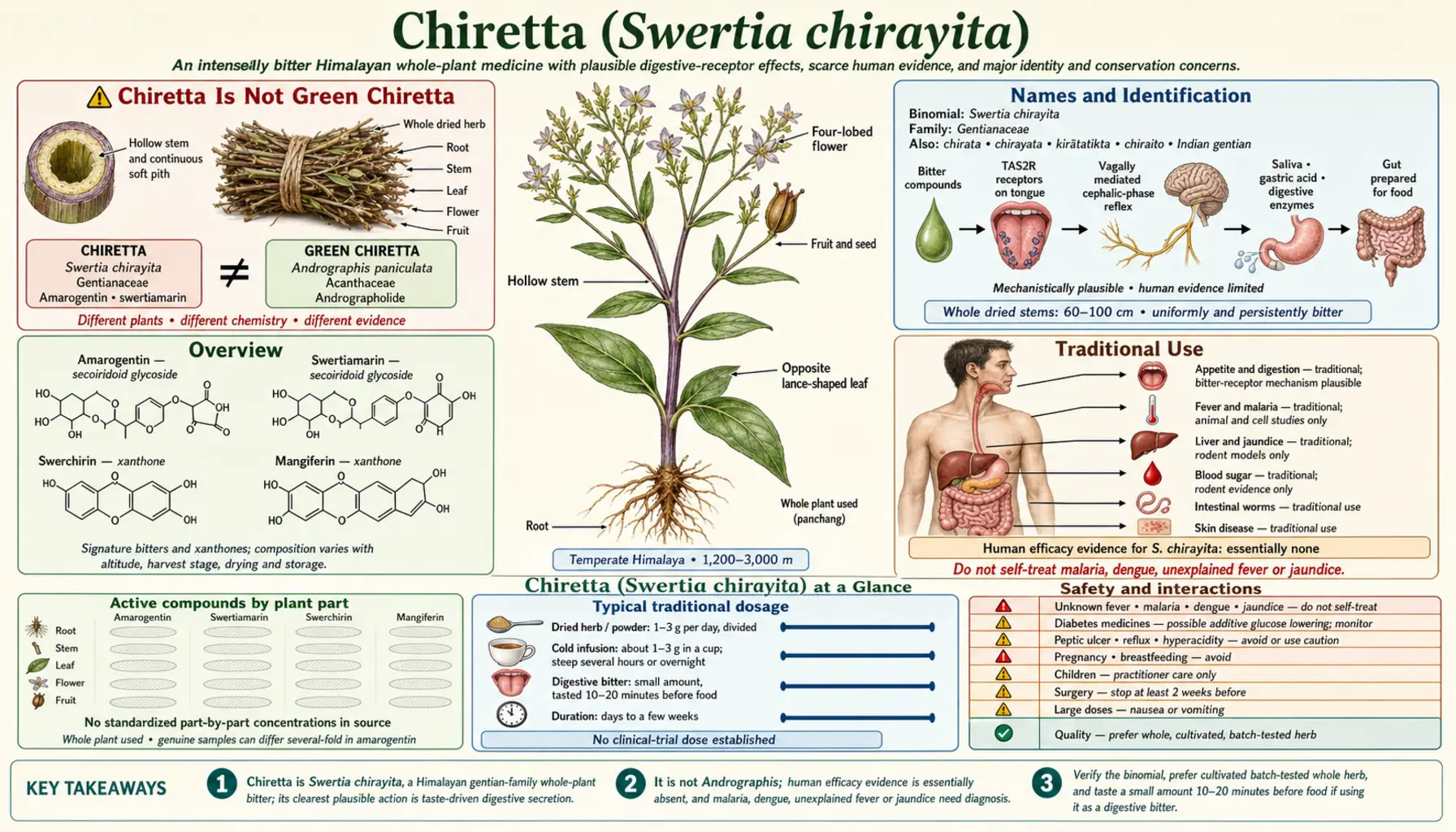
⚠️ Before anything else: make sure you have the right plant. Chiretta is Swertia chirayita, a Himalayan herb in the gentian family. It is constantly confused with "green chiretta", also called "king of bitters", which is Andrographis paniculata — a completely different plant in a different family. They share a bitter-tonic reputation and overlapping traditional uses, and sellers use the names interchangeably, but their chemistry has nothing in common and their evidence bases are nothing alike.
Swertia chirayita is the whole dried plant of a temperate Himalayan herb, ferociously bitter from root to seed, used in Ayurveda and Unani medicine for fever, sluggish digestion, worms and liver complaints. Its signature compounds are the secoiridoid glycosides amarogentin — one of the most intensely bitter substances ever measured — and swertiamarin.
Two honest warnings up front. First, the human evidence for S. chirayita is thin to the point of absence: nearly everything published is cell-culture or rodent work on fever, malaria parasites, liver injury and blood sugar. Second, the plant is badly overharvested and treated as threatened across its Himalayan range, and the resulting price pressure has made adulteration with cheaper Swertia species routine — which is a practical problem for anyone buying it, not just a conservation footnote.
Table of Contents
- ⚠️ Chiretta Is Not Green Chiretta
- Overview
- Names and Identification
- Traditional Use
- Active Compounds
- Bitterness and Digestion
- Fever and Antimalarial Research
- Liver Research
- Blood Sugar Research
- Endangered, Overharvested and Widely Adulterated
- Forms and Preparations
- Dosage
- Cautions and Contraindications
- Key Research Papers
- Connections
- Featured Videos
⚠️ Chiretta Is Not Green Chiretta
This is the most useful thing this page can tell you, so it comes first.
| Chiretta | "Green Chiretta" / "King of Bitters" | |
|---|---|---|
| Species | Swertia chirayita | Andrographis paniculata |
| Family | Gentianaceae (gentian family) | Acanthaceae (acanthus family) |
| Marker compounds | Amarogentin, swertiamarin, sweroside; xanthones such as swerchirin and mangiferin | Andrographolide (a labdane diterpenoid lactone) |
| Compound class | Secoiridoid glycosides | Diterpene lactones |
| Where it grows | Temperate Himalaya, roughly 1,200–3,000 m | Lowland tropical South and Southeast Asia; widely cultivated |
| Other names | Chirata, chirayata, kirātatikta, tite, Indian gentian | Kalmegh, creat, kariyat, chuan xin lian, fah talai jone, nilavembu |
| Human trial evidence | Essentially none. Animal and cell studies only | Multiple randomised trials and meta-analyses in acute respiratory infection — modest benefit, quality caveats |
| Conservation | Wild-harvested, depleted, widely adulterated | Cultivated at scale; supply is not a problem |
Why they got tangled. Both are extremely bitter. Both are classed as bitter febrifuges and liver herbs in South Asian medicine. Both attract "earth neem" style names — Sanskrit bhūnimba, Tamil nilavēmbu — because being as bitter as neem was the descriptive category that mattered. The English trade then layered "chiretta" and "green chiretta" on top of each other, and by the time material reaches an online listing the species is frequently unstated.
Why it matters to you. If you went looking for chiretta because you read that it helps with colds and respiratory infections, you almost certainly wanted Andrographis, which is the one with the randomised trials. Coon and Ernst reviewed the controlled trials of A. paniculata in upper respiratory tract infection in 2004; Hu and colleagues published a systematic review and meta-analysis in 2017 (later issued with a published correction) finding it improved cough and sore throat compared with placebo, while flagging the generally low quality of the underlying trials. Nothing remotely comparable exists for Swertia chirayita. Buying "chiretta" and expecting the Andrographis evidence to apply is a straightforward category error.
Conversely, if you want the classical Ayurvedic kirātatikta — the Himalayan bitter of the fever formulas — then Andrographis is not a substitute, whatever the label says.
Overview
Swertia chirayita (Roxb.) H.Karst. is an erect annual or biennial herb in the gentian family, Gentianaceae — making it a relative of the European yellow gentian used in aperitifs and digestive bitters, which is exactly the right mental model for it. It grows to roughly half a metre to a metre and a half, with a hollow, often purplish stem, opposite lance-shaped leaves, and loose sprays of small greenish-yellow to pale-purple four-lobed flowers.
Its range is the temperate Himalaya, broadly between about 1,200 and 3,000 metres: Nepal, Bhutan, Sikkim, Darjeeling, Meghalaya, Uttarakhand and Himachal Pradesh. It is a plant of forest clearings, grassy slopes and open scrub — and it is genuinely difficult to cultivate at scale, which is central to the supply and adulteration problem discussed below.
The part used is the whole plant — panchang, root, stem, leaf, flower and fruit together — collected at or after flowering, dried, and traded in bundles of stems. The whole plant is bitter; there is no mild part.
How it reaches a consumer: from Himalayan collectors, chiefly in Nepal, through cross-border trade into the Indian herbal-medicine industry, where it is sold as bundled dried herb, as powder, and as an ingredient in classical polyherbal formulas. Cunningham and colleagues traced this trade in detail in 2018, describing a supply chain that draws on both wild harvest and cultivation.
Names and Identification
Binomial: Swertia chirayita (Roxb.) H.Karst. Family: Gentianaceae.
Botanical synonyms you will meet in older literature: Swertia chirata Buch.-Ham. ex Wall., Ophelia chirata (Wall.) Griseb., Gentiana chirayita Roxb. All refer to this plant; "chirata" in a nineteenth-century pharmacopoeia is this species.
- Sanskrit: kirātatikta (किरातातिक्त) — "the bitter herb of the Kirātas", a Himalayan hill people. Also kirāta, bhūnimba ("earth neem").
- Hindi / Urdu: chirayata, chirata.
- Nepali: chiraito; also tite, which simply means "bitter".
- Bengali: chirata. Gujarati / Marathi: kariyatu, kirayat.
- English trade names: chiretta, chirata, Indian gentian, bitter stick, Nepali bitter.
Watch the vernacular names carefully. Gujarati kariyatu and English "creat" and "kariyat" are commonly applied to Andrographis, not to Swertia. Sanskrit bhūnimba has been used for both plants in different texts and regions. These overlaps are older than the modern supplement trade — the confusion is inherited, not invented.
What genuine chiretta looks like
- Traded as whole dried stems in bundles, typically 60–100 cm long, yellowish-brown to purplish, with a distinctive hollow stem and a large, continuous soft pith you can see in cross-section.
- The taste is uniformly, persistently bitter with no sweet or aromatic finish, and the bitterness lingers for minutes.
- Root is short, tapering, with a bitter yellowish core.
Powder cannot be identified by eye at all, which is why powder is the form most often adulterated. If you can buy the whole dried herb, do.
Traditional Use
Chiretta is a genuinely old and well-attested drug, not a modern marketing creation. In Ayurveda, kirātatikta is a canonical tikta (bitter) substance, indicated for:
- Jvara — fever, especially recurrent and intermittent fevers. This is its central classical use.
- Kamala — jaundice, and liver disorders generally.
- Krimi — intestinal worms.
- Poor appetite, sluggish digestion, and agnimandya (weak digestive fire) — the classic bitter-tonic indication.
- Skin disease and prameha, a category overlapping with what we now call diabetes.
It appears in named classical formulas — most familiarly the Sudarshan / Mahasudarshan churna family used for fevers — and it is one of the four botanicals in AYUSH-64, a polyherbal originally developed in India as an antimalarial.
In Unani medicine it is chirayta, used as a tonic and febrifuge on the same broad logic. In Nepali and Himalayan folk practice, an infusion is taken for fever, worms, indigestion and as a general "blood purifier", and the plant is a significant cash crop for collectors.
Chiretta also had a formal Western career: it was an official bitter in British and Indian pharmacopoeias of the nineteenth and early twentieth centuries, sitting alongside gentian and quassia as a simple bitter tonic, dispensed as an infusion or tincture and used to stimulate appetite in convalescents.
All of this is history, not evidence of efficacy. A plant can hold a place in three pharmacopoeias for two hundred years on the strength of an unmistakable taste and a plausible theory. What traditional use does tell you reliably is that people have consumed chiretta in ordinary amounts for a very long time without an obvious pattern of acute harm — a weak but real safety signal, and nothing more.
Active Compounds
Secoiridoid glycosides — the bitter principles:
- Amarogentin. The signature compound and one of the most bitter substances ever characterised; its bitterness threshold is often quoted at around one part in fifty million in water. It is the marker chemists use to authenticate S. chirayita. PubChem entry.
- Swertiamarin. The most abundant secoiridoid in the plant and the subject of most of the pharmacology literature. PubChem entry.
- Sweroside and gentiopicroside (gentiopicrin) — shared with true gentians.
Xanthones — the yellow pigment class: swerchirin, mangiferin, bellidifolin, decussatin, methylswertianin and relatives. Swerchirin is the compound behind the blood-sugar work below; mangiferin also occurs in mango leaf and is studied in its own right.
Also present: triterpenoids including oleanolic acid, assorted flavonoids, and traces of the alkaloid gentianine — which is worth a caveat, because gentianine is well known to form as an artefact when secoiridoids are extracted in the presence of ammonia. Older papers describing chiretta as an alkaloid-containing plant may be describing their own extraction chemistry.
Composition varies enormously with altitude, harvest stage, drying and storage. Two authenticated samples of genuine S. chirayita can differ several-fold in amarogentin content. This is one reason the pharmacology literature is hard to compare across studies.
Bitterness and Digestion
Mechanism. Bitter compounds bind TAS2R bitter taste receptors on the tongue. That triggers a cephalic-phase reflex — a vagally mediated anticipatory response — that increases saliva, gastric acid and digestive enzyme secretion and gets the gut ready for food. TAS2R receptors are also expressed outside the mouth, in the stomach, intestine and airway, where their roles are still being worked out. This is the pharmacology behind every bitter aperitif in Europe and every tikta drug in Ayurveda, and chiretta is an unusually pure example of it.
Evidence level: mechanistically plausible, human evidence limited. The bitter-receptor biology is solid. Human trials showing that a specific bitter herb improves specific digestive symptoms are small, few and mostly not about chiretta. What can honestly be said: bitters demonstrably provoke a measurable secretory and appetite response; whether that translates into feeling better after meals is largely reported, not proven.
The practical consequence is worth acting on, though. If the mechanism runs through taste receptors, then the herb has to be tasted to work that way. A capsule that bypasses the tongue bypasses the entire proposed mechanism. If you are taking chiretta as a digestive bitter, take it as a bitter — in water, before the meal, and let yourself taste it.
Fever and Antimalarial Research
The traditional claim. Chiretta's principal classical indication is fever, particularly the recurring fevers that in the Himalayan foothills historically meant malaria. It is the reason the plant is in AYUSH-64.
Evidence level: animal and cell culture. Rodent antipyretic screening (typically yeast- or brewer's-yeast-induced pyrexia) has reported temperature-lowering activity from Swertia extracts, and antiplasmodial screening has reported activity of extracts and isolated compounds against Plasmodium species in culture and in infected mice. Patel and colleagues reported that swertiamarin altered immune responses in mice infected with Plasmodium berghei, conferring some protection. The reviews by Kumar and Van Staden and by Swati and colleagues collect this literature.
Human evidence: none of adequate quality for S. chirayita alone. There is no randomised controlled trial establishing that chiretta reduces fever or treats malaria in people.
🔴 This is a safety issue, not just an evidence gap. Malaria kills. Plasmodium falciparum can go from fever to cerebral malaria in a day or two. If you have a fever after travel in a malaria-endemic area, you need a blood film or rapid diagnostic test and, if positive, an artemisinin-based combination therapy — not a bitter herb. The same applies to any high or persistent fever of unknown cause. Chiretta is not an antimalarial in the sense that matters clinically.
Liver Research
Mechanism (proposed). Swertiamarin and the xanthone fraction are credited with antioxidant activity and with reducing markers of hepatocellular injury — the classic hepatoprotective profile claimed for many bitter herbs.
Evidence level: rodent models only. The standard experiment gives rats or mice a liver toxin — carbon tetrachloride or a paracetamol overdose — with or without plant extract, and measures serum ALT and AST and liver histology. Swertia extracts and swertiamarin have repeatedly reduced enzyme rises and tissue damage in these models. Muhamad Fadzil and colleagues reviewed the swertiamarin pharmacology literature comprehensively in 2021.
What that does and does not mean. Carbon-tetrachloride hepatotoxicity in a rat is a chemical injury model. It is a legitimate screening tool and a poor stand-in for human fatty liver disease, viral hepatitis, or alcohol-related liver disease, which have different mechanisms and different time courses. There are no human trials of chiretta for any liver condition.
If you are interested in a herb for liver health with at least some human trial data — still mixed, still contested, but real — that is milk thistle, not chiretta. And if you have jaundice, dark urine, pale stools or persistently abnormal liver enzymes, that needs a diagnosis: see liver function tests and liver disease.
Blood Sugar Research
Mechanism (proposed). The xanthone swerchirin is the compound of interest. Bajpai and colleagues, publishing in Planta Medica in 1991, reported that swerchirin isolated from the hexane fraction of Swertia chirayita lowered blood glucose in fasted rats, and attributed the effect to stimulation of insulin release from pancreatic islets. Later chemistry papers — Suryawanshi and colleagues in 2006, for instance — describe the plant in their titles as "a potent antidiabetic", which is a claim carried forward from that rodent work rather than an independent clinical finding. Separate work on swertiamarin has explored effects on lipid and glucose handling in animal models.
Evidence level: rodent, and old. There is no human trial of S. chirayita for diabetes, prediabetes or glycaemic control.
But treat the animal finding as a real interaction warning, not a benefit claim. If a plant lowers blood glucose in rats, and you are taking metformin, a sulfonylurea, a GLP-1 agonist or insulin, the sensible assumption is that the effects could add. Monitor your glucose more closely if you start chiretta, and tell whoever manages your diabetes.
Endangered, Overharvested and Widely Adulterated
This section is here because it changes what is in the bag you buy.
The conservation picture, stated precisely
Swertia chirayita is one of the most heavily traded wild-collected medicinal plants of the Himalaya. It is slow to establish, difficult to cultivate at commercial scale, and collected before or during seed set — a combination that depletes wild populations quickly. Cunningham and colleagues documented the cross-border trade and the mix of wild harvest and cultivation feeding it.
Be careful with the "critically endangered" label, which appears on a great many product pages. Where it comes from matters:
- The species is assessed as threatened, and in places critically endangered, in national and state-level Red Data listings in India and Nepal. Those assessments are real and reflect genuine local depletion.
- India restricts the export of wild-collected Swertia chirayita under its export-policy list of endangered plant species.
- It is not listed in the CITES appendices, unlike several other Himalayan medicinal plants — Nardostachys, Picrorhiza, Saussurea costus, Rauvolfia serpentina and others are. You can check any species yourself at the CITES checklist or Species+. If a seller cites CITES protection for chiretta as a mark of quality, they have not checked.
None of that makes the pressure on wild populations less real. It just means the accurate statement is "regionally depleted and nationally protected in its range states", not "CITES-listed".
Why that becomes your problem: adulteration
Scarcity plus high price plus an unidentifiable powdered product is the standard recipe for substitution, and chiretta has it in full. What turns up in its place:
- Cheaper Swertia species — S. angustifolia, S. cordata, S. paniculata, S. alata, S. bimaculata and others. These are related plants with genuinely different secoiridoid and xanthone profiles; several contain little or no amarogentin. Li and colleagues surveyed the phytochemistry across the whole genus, and the differences are substantial.
- Andrographis paniculata — sold as chiretta because "green chiretta" is one of its names and because it is cheap and cultivated. Chemically unrelated.
- Bulked or exhausted material — stems from which the soluble bitters have already been extracted, or mixed plant debris.
What to actually do about it
- Buy the whole dried herb, not powder, whenever you can. Whole hollow stems in bundles are far harder to fake than a brown powder.
- Taste it. Genuine chiretta is uncompromisingly, persistently bitter with no aromatic top note. Weak bitterness is a red flag.
- Insist on the binomial on the label — Swertia chirayita, not "chirata" or "chiretta" alone.
- Prefer cultivated, source-identified material where it exists. It reduces pressure on wild stands and comes with a traceable chain.
- Ask for identity testing. Reputable suppliers can produce HPTLC or HPLC identity data with amarogentin and swertiamarin as markers.
Forms and Preparations
- Cold infusion — the classical form. The traditional instruction for chirata is to steep the herb in cold or lukewarm water, often overnight, and drink the liquid. Cold water extracts the bitters efficiently and avoids heat-driven changes; it is also the form the old pharmacopoeial Infusum Chiratae took.
- Decoction (kwath). Simmered in water, the more common preparation in Ayurvedic clinical practice, usually inside a compound formula.
- Powder (churna). Convenient, cheap, and the form most exposed to adulteration.
- Tincture. Alcohol extracts the bitters well; the historical Tinctura Chiratae, and the form most similar to a European digestive bitter.
- Capsules and tablets. Widely sold — and, as noted above, the form least likely to deliver the bitter-reflex mechanism, because they bypass the tongue.
- Classical polyherbal formulas — Mahasudarshan churna, AYUSH-64 and others, where chiretta is one ingredient among several and the dose per herb is small.
- Bitters and aperitifs. Chirata appears historically in bitter tonic and aperitif formulations, in the same role as gentian.
Dosage
No dose of chiretta has been established in a clinical trial, because no adequate clinical trial exists. What follows is traditional and pharmacopoeial convention, and should be read that way.
- Dried herb / powder: practitioner and pharmacopoeial sources commonly give roughly 1–3 g per day of the dried plant, in divided doses.
- Cold infusion: made from about that quantity of herb in a cup of water, steeped for several hours or overnight, taken in divided doses before meals.
- As a digestive bitter: a small amount, tasted, 10–20 minutes before eating — the timing matters more than the quantity if the cephalic reflex is what you are after.
- Inside a classical formula: follow the formula, not this page. The per-herb dose is deliberately much smaller.
- Duration: traditional use is short-course — days to a few weeks around an episode of fever or poor digestion — not indefinite daily supplementation. There is no long-term human safety data at all, so open-ended use is not supported by anything.
Start low. The bitterness alone limits most people, which is arguably a useful built-in brake.
Cautions and Contraindications
- Do not use it to self-treat a fever of unknown cause, suspected malaria, dengue, or jaundice. These need diagnosis and, often, urgent specific treatment. This is the most important caution on the page — the traditional indications are exactly the situations where delay is dangerous.
- Diabetes medication. Animal data show blood-glucose lowering. Assume additive effects with metformin, sulfonylureas, insulin and other glucose-lowering drugs; monitor more closely and tell your clinician.
- Active peptic ulcer, significant reflux or hyperacidity. Bitters increase gastric acid secretion by design. That is unhelpful here.
- Pregnancy and breastfeeding. Avoid. There is no human safety data, and bitter febrifuges carry a traditional reputation as emmenagogues.
- Children. No data on dose or safety. Not recommended outside qualified practitioner care.
- Nausea and vomiting. The commonest adverse effect is simply the bitterness — large doses provoke nausea and can cause vomiting.
- Surgery. Given the glycaemic signal in animals, stop at least two weeks before planned surgery and tell the team.
- Adulteration and contamination. Because the material is wild-collected, high-value and frequently substituted, quality risk here is above average. A minority of imported traditional-medicine products have historically carried heavy-metal contamination; buy from suppliers who publish batch testing. See heavy metals.
- Conservation. Buying wild-harvested chiretta casually contributes to the depletion of a genuinely pressured Himalayan species. If you do not need it, do not buy it.
Key Research Papers
- Kumar V, Van Staden J. A review of Swertia chirayita (Gentianaceae) as a traditional medicinal plant. Frontiers in Pharmacology. 2015;6:308.
- Swati K, Bhatt V, Sendri N, et al. Swertia chirayita: a comprehensive review on traditional uses, phytochemistry, quality assessment and pharmacology. Journal of Ethnopharmacology. 2023;300:115714.
- Li J, Zhao YL, Huang HY, et al. Phytochemistry and pharmacological activities of the genus Swertia (Gentianaceae): a review. American Journal of Chinese Medicine. 2017;45(4):667–736.
- Cunningham AB, Brinckmann JA, Schippmann U, et al. Production from both wild harvest and cultivation: the cross-border Swertia chirayita (Gentianaceae) trade. Journal of Ethnopharmacology. 2018;225:42–52.
- Bajpai MB, Asthana RK, Sharma NK, et al. Hypoglycemic effect of swerchirin from the hexane fraction of Swertia chirayita. Planta Medica. 1991;57(2):102–104.
- Suryawanshi S, Mehrotra N, Asthana RK, et al. Liquid chromatography/tandem mass spectrometric study and analysis of xanthone and secoiridoid glycoside composition of Swertia chirata, a potent antidiabetic. Rapid Communications in Mass Spectrometry. 2006;20(24):3761–3768.
- Shukla S, Bafna K, Sundar D, et al. The bitter barricading of prostaglandin biosynthesis pathway: understanding the molecular mechanism of selective cyclooxygenase-2 inhibition by amarogentin, a secoiridoid glycoside from Swertia chirayita. PLoS ONE. 2014;9(6):e90637.
- Saha P, Mandal S, Das A, et al. Amarogentin can reduce hyperproliferation by downregulation of Cox-II and upregulation of apoptosis in mouse skin carcinogenesis model. Cancer Letters. 2006;244(2):252–259.
- Muhamad Fadzil NS, Sekar M, Gan SH, et al. Chemistry, pharmacology and therapeutic potential of swertiamarin — a promising natural lead for new drug discovery and development. Drug Design, Development and Therapy. 2021;15:2721–2746.
- Patel N, Zinzuvadia A, Prajapati M, et al. Swertiamarin-mediated immune modulation/adaptation confers protection against Plasmodium berghei. Future Microbiology. 2022;17:931–941.
- Coon JT, Ernst E. Andrographis paniculata in the treatment of upper respiratory tract infections: a systematic review of safety and efficacy. Planta Medica. 2004;70(4):293–298. — note: this is the other plant, A. paniculata.
- Hu XY, Wu RH, Logue M, et al. Andrographis paniculata for symptomatic relief of acute respiratory tract infections in adults and children: a systematic review and meta-analysis. PLoS ONE. 2017;12(8):e0181780. A correction was published in 2018. — again, A. paniculata, not S. chirayita.
Live PubMed Searches
- Swertia chirayita
- Amarogentin
- Swertiamarin pharmacology
- Swertia chirayita hepatoprotective
- Swertia antimalarial / antiplasmodial
- Swertia chirayita adulteration and authentication
- Swerchirin, xanthones and blood glucose
- Bitter taste receptors (TAS2R) and gastric secretion
- Andrographis paniculata / andrographolide clinical trials
- Himalayan medicinal plants — overharvesting and conservation
Connections
- All Herbs
- Andrographis — "green chiretta", the plant chiretta is most often confused with, and the one with actual clinical trials.
- Barberry — another intensely bitter traditional herb used for liver and digestive complaints.
- Milk Thistle — the liver herb that does have human trial data, mixed as it is.
- Berberine — the bitter alkaloid behind barberry, with genuine human glycaemic trials, for contrast with chiretta's rodent-only blood-sugar story.
- Neem — the bitter tree whose name gave chiretta its Sanskrit epithet bhūnimba, "earth neem".
- Turmeric — the other South Asian botanical routinely claimed for liver support, and a case study in trial-quality caveats.
- Gastroenterology — digestion, appetite and the conditions bitters are traditionally aimed at.
- Liver Function Tests — how liver injury is actually measured, rather than assumed.
- Liver Disease — what jaundice and abnormal enzymes may mean.
- Malaria — the disease behind chiretta's classical fever indication, and why it needs real treatment.
- Heavy Metals — the contamination risk in wild-collected and imported traditional medicines.