Curry Leaf (Murraya koenigii)
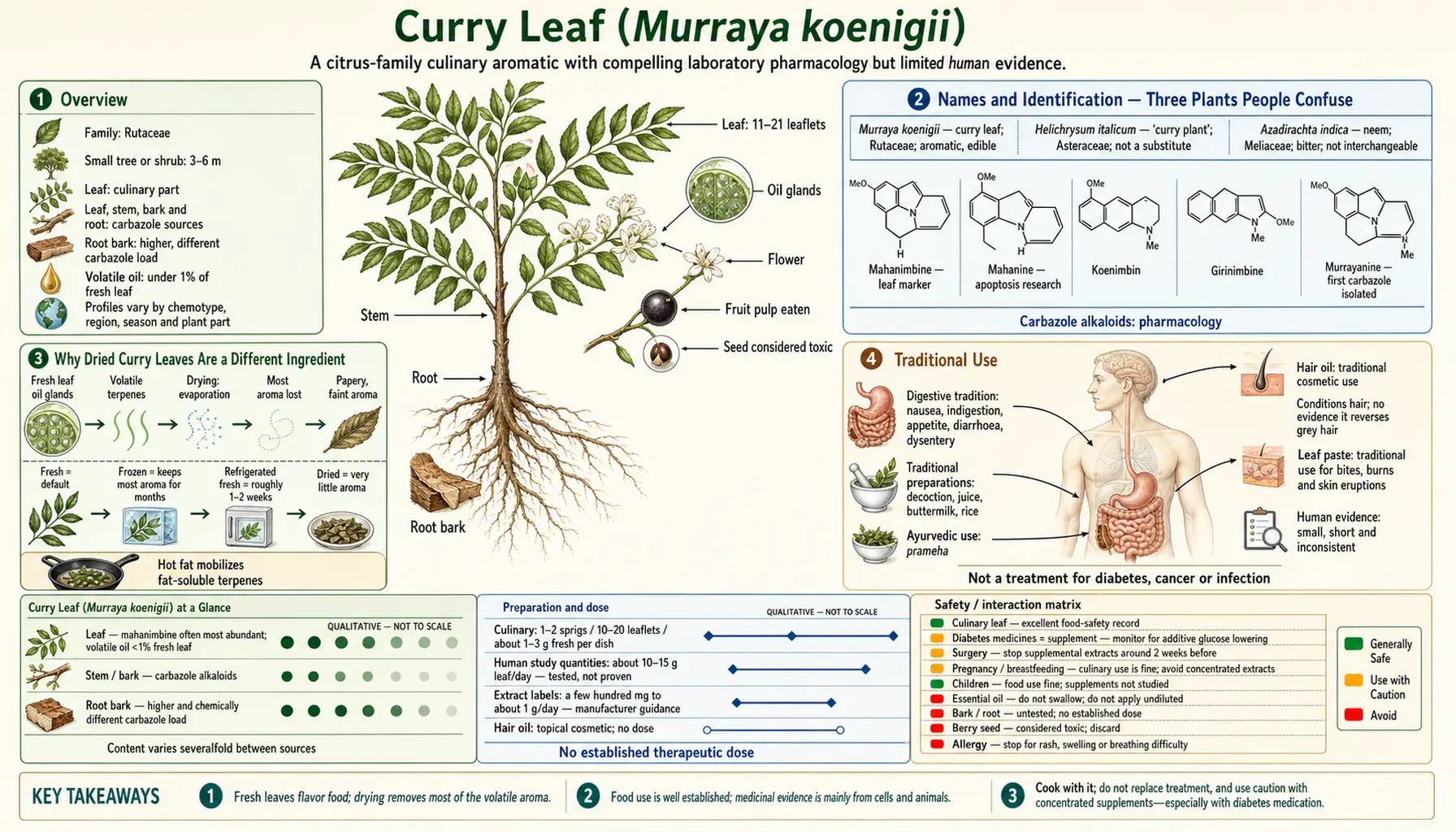
Curry leaf is the glossy, strongly aromatic leaf of Murraya koenigii, a small tree in the citrus family that is grown in dooryards across South India, Sri Lanka and Southeast Asia and dropped into hot oil at the start of a dish. Two things are worth clearing up before anything else: curry leaf has nothing to do with curry powder, which is a British export blend that contains no curry leaf at all, and it is not the ornamental “curry plant” (Helichrysum italicum), a Mediterranean daisy relative that merely smells a little like curry powder. As a food it is superb and has an excellent safety record. As a medicine, the honest position is that almost all of the research is in rodents and cell cultures; the human data is a handful of small, short studies, and the popular claim that curry leaves reverse grey hair has no evidence behind it whatsoever.
Table of Contents
- Overview
- Names and Identification — Three Plants People Confuse
- Why Dried Curry Leaves Are a Different Ingredient
- Traditional Use
- Active Compounds
- Blood Sugar and Metabolic Effects
- Cholesterol, Liver and Antioxidant Research
- Digestive and Antimicrobial Effects
- Carbazole Alkaloids in Cancer Cell Research
- Hair, Grey Hair, and What the Folklore Actually Supports
- The Bark and Root Bark
- Culinary Use
- Forms and Preparations
- Dosage
- Cautions and Contraindications
- Key Research Papers
- Connections
- Featured Videos
Overview
Murraya koenigii (L.) Spreng. is a small tree or large shrub of the family Rutaceae — the citrus family — usually reaching three to six metres. It is native to the Indian subcontinent and Sri Lanka and is now grown throughout Southeast Asia, in East and Southern Africa, in Australia, and in any warm-climate garden belonging to a South Indian household. The tree suckers freely from the roots, which is why a single plant in a courtyard tends to become a small thicket, and why so many families in Tamil Nadu, Kerala, Karnataka and Andhra Pradesh have simply never bought curry leaves in their lives.
The part used in cooking is the leaf, which is compound: each stalk carries roughly eleven to twenty-one small leaflets arranged in pairs along a central rib, and it is normally picked and sold as the whole sprig. Hold a leaflet up to a window and you will see it is peppered with translucent dots. Those are oil glands, and they are the family signature — the same structures that make a lemon peel spray when you bend it. Crush a leaf and what comes off is not the smell of curry powder at all but something citrusy, resinous and faintly like anise, with a bitter green edge underneath.
How it reaches a kitchen matters. In South India and Sri Lanka curry leaves are picked minutes before use, or bought that morning in bundles from a vegetable vendor. In the diaspora, they arrive by air freight and turn up refrigerated in Indian and Southeast Asian grocers, usually in a plastic clamshell or a loose bunch, sometimes still on the stem. In pharmacies and supplement shops the plant arrives in an entirely different guise — a dried leaf powder or a standardised extract capsule sold for blood sugar — and that product has very little in common with the ingredient, either in chemistry or in evidence. This page treats the two separately, because they deserve to be treated separately.
Names and Identification — Three Plants People Confuse
The binomial is Murraya koenigii (L.) Spreng., family Rutaceae. The genus honours the Swedish botanist Johan Andreas Murray; the species epithet honours Johann Gerhard König, an eighteenth-century botanist who collected in South India. Common regional names include:
- Hindi: kadi patta, meetha neem (“sweet neem”)
- Tamil: karuveppilai
- Telugu: karivepaku
- Malayalam: kariveppila
- Kannada: karibevu
- Marathi / Gujarati: kadhilimb / mitho limdo
- Sinhala: karapincha
- Malay / Indonesian: daun kari
- Vietnamese: lá cà ri
- Sanskrit: krishnanimba, girinimba
1. Curry leaf is not curry powder
Curry powder contains no curry leaf. Curry powder is a commercial blend — typically turmeric, coriander seed, cumin, fenugreek, chilli and black pepper, in proportions decided by a manufacturer — that was assembled for the British export market in the eighteenth and nineteenth centuries as a shortcut for cooks who did not have an Indian spice box. It is a product, not a plant, and it is not used as such in most Indian home cooking. Curry leaf, by contrast, is a single fresh leaf from a single tree.
The shared word is an accident of transliteration. The English “curry” descends from the Tamil kari, meaning something closer to a sauced or seasoned dish, and the same root gave the leaf its English name because the leaf goes into that dish. Two very different things ended up with one English label. If you taste them side by side the confusion collapses immediately: curry powder is warm, earthy and turmeric-yellow; curry leaf is bright, citrus-resinous and green.
2. Curry leaf is not the “curry plant”
Garden centres in Europe, the UK, Australia and North America sell a silver-leaved Mediterranean shrub labelled “curry plant”. That is Helichrysum italicum, an Asteraceae — a daisy relative, no more closely related to curry leaf than a sunflower is to a lime. It smells vaguely of curry powder when the sun warms it, which is the entire reason for the name. It is used mainly as an ornamental and as a source of immortelle essential oil, it is used only sparingly in cooking, and it is not a substitute for curry leaf in any dish. Buying it by mistake is one of the most common errors made by people trying to grow curry leaf outside the tropics. Check the Latin name on the label: if it says Helichrysum, it is the wrong plant.
3. Curry leaf is not neem
The Hindi name meetha neem means “sweet neem”, and it causes a third confusion. Actual neem is Azadirachta indica, family Meliaceae — a large tree whose leaf is intensely, memorably bitter and is used medicinally rather than as a seasoning. The two trees have superficially similar compound leaves, which is presumably how the nickname arose, and older herbal texts and market vendors sometimes muddle them. They are not interchangeable. Curry leaf is aromatic and eaten in quantity; neem leaf is bitter, is taken in small medicinal amounts, and carries its own real cautions.
What curry leaf actually is: a citrus relative
Placing Murraya koenigii in Rutaceae is not a taxonomic footnote — it explains the ingredient. Rutaceae is the family of lemon, orange, lime, kaffir lime, wood apple and Sichuan pepper, and its defining feature is the pellucid oil gland: microscopic reservoirs of volatile terpenes sitting in the leaf and rind. That is why crushing a curry leaf smells like crushing a citrus leaf, why the aroma arrives all at once and then fades, and why the leaf behaves in a hot pan the way a strip of lemon zest does rather than the way a dried bay leaf does. It also puts curry leaf in the same broad chemical neighbourhood as the dried citrus peel used in Chinese medicine as chen pi — both are Rutaceae aromatics whose traditional reputation is digestive.
Why Dried Curry Leaves Are a Different Ingredient
This is the most practical point on the page and most sources skip it. The aroma of curry leaf degrades very fast on drying. The compounds that carry the smell are small volatile terpenes held in those oil glands; they evaporate. Air-drying a bunch of curry leaves on a tray over a few days removes the great majority of what made them worth using, and what remains is a papery green leaf with a faint hay-like smell. Commercially dried curry leaves that have then sat in a warehouse and a supermarket shelf for months are, for flavour purposes, close to inert.
The consequences are worth spelling out:
- Fresh is the default. If a recipe says curry leaves, it means fresh ones. Substituting dried at the same count will produce a dish that tastes like the leaves were left out.
- Frozen is a genuinely good substitute. Strip the leaflets or keep whole sprigs, seal them dry in a bag, and freeze. They lose texture and go dark, but they keep most of the aroma for months and can go straight from the freezer into hot oil. This is what most diaspora cooks do.
- Refrigerated fresh leaves keep roughly one to two weeks if they are dry when they go in. Wet leaves rot. Wrap them loosely in a paper towel inside a container rather than sealing damp leaves in plastic.
- It matters for research too. Studies use dried leaf powder, methanolic extracts, hexane extracts, essential oil and fresh leaf more or less interchangeably in the literature, and these are not the same material. Some of the inconsistency between published results is simply this.
Traditional Use
Traditional use is history. It tells you what people believed and did; it is not evidence that the belief was correct. With that said, the record is consistent and old.
Across South India and Sri Lanka the dominant folk use is digestive: curry leaves for nausea, indigestion, loss of appetite, diarrhoea and dysentery, usually as a decoction, a juice, or simply as a heavily leaf-seasoned buttermilk or rice preparation given to someone who is unwell. In Ayurveda the leaf (krishnanimba, girinimba) is classed as bitter and pungent, described as kindling agni — digestive fire — and is used in formulations for prameha, the classical category that overlaps with what is now called diabetes. A separate and very persistent domestic tradition uses curry leaves infused in coconut oil as a hair oil, massaged into the scalp.
Beyond the subcontinent, the leaf travelled with South Indian and Sri Lankan communities into Malaysia, Singapore, Indonesia, Fiji, South Africa and the Caribbean, where it entered local cooking without carrying much of its medicinal apparatus with it. In parts of Southeast Asia it is used simply as an aromatic. Other traditional applications recorded in the ethnobotanical literature include the leaf paste applied to bites, burns and skin eruptions, and the fruit — a small black berry — eaten fresh, though the seed inside it is regarded as toxic and is not eaten.
Active Compounds
Two distinct chemical stories run through this plant: the volatile oil, which is the flavour, and the carbazole alkaloids, which are the pharmacology.
Carbazole alkaloids
Carbazole alkaloids are a class of nitrogen-containing three-ring compounds that are largely characteristic of the genus Murraya and its close relatives in the Rutaceae, and they are the reason this plant has a research literature at all. Dozens have been isolated from the leaf, stem, bark and root. The most studied include:
- Mahanimbine — usually the most abundant carbazole in the leaf, and the compound most often used as the marker in standardised extracts.
- Mahanine — the compound behind most of the cell-culture apoptosis work.
- Koenimbin and koenigicine — named directly for the species.
- Girinimbine — a pyrano-carbazole studied for antimicrobial and cytotoxic effects.
- Murrayanine — historically the first carbazole isolated from the plant, and part of why the genus became chemically interesting.
- Koenoline, murrayacine, bicyclomahanimbicine and many others in smaller amounts.
Essential oil
The volatile fraction typically runs to under one percent of the fresh leaf and is dominated by monoterpenes and sesquiterpenes: α-pinene, β-pinene, sabinene, β-phellandrene, limonene, β-caryophyllene, α-humulene and various oxygenated derivatives. Some populations are strongly β-caryophyllene-dominant, others are pinene-dominant, and this is the fraction that vanishes on drying.
Everything else
The leaf also carries flavonoids, carotenoids including β-carotene, a reasonable amount of calcium and iron by weight, oxalates, and some vitamin C — though it is worth remembering that a serving of curry leaves in a dish is a few grams at most, so its nutritional contribution is real but small.
A caveat that applies to everything below
The alkaloid and essential-oil profiles vary enormously by chemotype, region, season and plant part. Analyses of curry leaf from different parts of India can differ severalfold in mahanimbine content, and the essential-oil composition can differ so much that two samples barely look like the same species on a chromatogram. This is a large part of why published pharmacology results are hard to compare, and it is a strong argument against assuming that a capsule of “curry leaf extract” bears any fixed relationship to the leaves in your kitchen.
Blood Sugar and Metabolic Effects
This is the most-researched claim and the one most often oversold, so it is worth separating the layers carefully.
Cell culture (in vitro). Curry leaf extracts and isolated carbazoles inhibit the digestive enzymes α-amylase and α-glucosidase in the test tube. These are the enzymes that break starch down into absorbable glucose, and they are the same targets as the pharmaceutical drug acarbose. Inhibiting them in a cuvette is a plausible mechanism for blunting the post-meal glucose spike. It is not a demonstration that eating the leaf does that in a person; enzyme-inhibition assays are notoriously generous to plant extracts.
Animal studies. The bulk of the literature is here, and it is genuinely substantial: dozens of studies in streptozotocin-induced diabetic rats and in ob/ob mice have reported reductions in fasting blood glucose, improvements in glucose tolerance, and changes in insulin levels after weeks of curry leaf extract or leaf powder. Yadav and colleagues reported hypoglycaemic and antihyperglycaemic activity of the leaves in diabetic rats in the Journal of Ethnopharmacology in 2002; Xie and colleagues reported reductions in blood cholesterol and glucose in ob/ob mice in 2006. These are consistent enough to be interesting. They are also rodents given doses, on a body-weight basis, far beyond what a person eats in food.
Human studies. This is where the evidence thins out dramatically. There are a small number of published human supplementation studies, most notably an older Indian study by Iyer and Mani in Plant Foods for Human Nutrition that supplemented people with non-insulin-dependent diabetes with curry leaves daily for about a month — a large culinary quantity, on the order of a dozen grams a day — and measured lipid profile, glycated proteins and amino acids. Studies of this kind share the same limitations: they involve tens of participants rather than hundreds, they run for weeks rather than months, several are unblinded or lack a proper placebo arm, and the reported changes are modest and inconsistent between studies. There is no large, well-controlled randomised trial establishing that curry leaf lowers blood glucose in humans, and no clinical guideline anywhere recommends it as a treatment for diabetes.
The honest summary: a plausible mechanism, a strong rodent literature, and human evidence too thin to build a decision on. If you have diabetes, curry leaves are a good thing to cook with and a bad thing to substitute for your medication. See Endocrinology for the broader picture on blood sugar management.
Cholesterol, Liver and Antioxidant Research
Lipids. Several rodent studies report that curry leaf extract lowers total cholesterol, LDL and triglycerides and raises HDL in animals fed high-fat or high-cholesterol diets. The proposed mechanisms are increased faecal excretion of cholesterol and bile acids and modulation of hepatic lipid-handling enzymes. Human data is limited to the same small supplementation studies described above, which report modest lipid changes at best.
Liver. A cluster of animal experiments report protection against chemically induced liver injury — the standard models use carbon tetrachloride, paracetamol overdose or ethanol — with lower serum ALT and AST in animals pre-treated with leaf extract. This is a very common finding for antioxidant-rich plant extracts and should be read as a hypothesis rather than a claim that curry leaf protects a human liver.
Antioxidant activity. Curry leaf performs well in the standard laboratory antioxidant assays (DPPH, FRAP, ABTS), which measure the ability of an extract to neutralise a synthetic radical in a tube. This is worth stating precisely, because it is the single most abused finding in herbal marketing: a high antioxidant assay score is a chemical property of the extract, not a health outcome in a person. Nearly every dark green aromatic leaf scores well. It tells you the plant contains phenolics and flavonoids. It does not tell you what happens after digestion, absorption and metabolism.
Digestive and Antimicrobial Effects
The traditional digestive use is the oldest and, in the ordinary culinary sense, the least controversial. Aromatic bitter leaves that stimulate saliva and gastric secretion are used this way in most cuisines, and curry leaf fits the pattern. Animal work reports gastroprotective and antidiarrhoeal effects for leaf extracts. There is no meaningful human trial evidence, and none is really needed for the culinary claim — a leaf that makes food taste better and is eaten with meals does not require a mechanism.
On the antimicrobial side, isolated carbazole alkaloids and the essential oil inhibit a range of bacteria and fungi in laboratory culture, including some antibiotic-resistant strains. Nagappan and colleagues published one of the more thorough surveys of this in Molecules in 2011. Rahman and Gray reported antimicrobial carbazoles from the plant in Phytochemistry. Adebajo and colleagues reported anti-trichomonal activity for methanolic extract and isolated carbazoles in Phytomedicine. All of this is in vitro. A compound that kills bacteria in a Petri dish at a given concentration has cleared the lowest bar in antimicrobial research; the distance from there to a usable treatment is enormous, and almost nothing crosses it. Curry leaf is not an antibiotic and should never be used as one.
Carbazole Alkaloids in Cancer Cell Research
Mahanine is the compound that put curry leaf into the oncology literature. In cultured human cancer cell lines — leukaemia, prostate, breast, colon — mahanine induces apoptosis, and the mechanistic work points at mitochondrial pathways, caspase activation and effects on Akt signalling. Related carbazoles including girinimbine and mahanimbine show similar cytotoxicity profiles. Ghasemzadeh and colleagues published an evaluation of bioactive compounds and anticancer activity of curry leaf in Evidence-Based Complementary and Alternative Medicine in 2014.
This needs stating flatly: all of it is cell-culture work and a small amount of animal work. There are no human cancer trials of curry leaf or of any curry leaf compound. Substances that kill cancer cells in a dish number in the tens of thousands and include bleach, and the reason isolated compounds are interesting to pharmacologists is as starting points for drug development, not as reasons to eat more of the plant. Nobody should treat curry leaf as a cancer therapy, and no responsible source should imply it.
Hair, Grey Hair, and What the Folklore Actually Supports
Curry leaf infused in warm coconut oil is a genuine and widespread domestic hair treatment across South India, and the tradition is real. The claim that it reverses grey hair is not, and it deserves a direct answer rather than a hedge.
There is no human trial showing that curry leaves restore pigment to grey hair. Not a small one, not a poor one — none. The claim circulates on social media and in aggregated wellness articles that cite each other in a loop, and occasionally cites rodent or in-vitro studies on tyrosinase or melanin that do not test the claim at all.
What is actually known about greying makes the claim implausible on its face. Hair colour comes from melanocytes in the hair follicle bulb that inject pigment into the growing shaft. Greying happens because those melanocyte stem cells are progressively depleted and their function declines — a process driven mainly by age and genetics, with contributions from oxidative stress within the follicle, certain autoimmune and thyroid conditions, and specific nutrient deficiencies such as B12, copper or iron. A follicle that has lost its melanocyte population does not have anything left to stimulate. Nothing applied to the outside of a hair shaft can repigment it, because the shaft is dead keratin.
What a curry-leaf oil massage plausibly does do: the oil conditions the hair and reduces breakage, the massage itself is pleasant and increases scalp blood flow briefly, and the routine is a good one. Those are cosmetic and grooming effects. If your hair looks better after using it, that is not evidence of repigmentation. And if greying appeared unusually early or suddenly, that is a reason to check B12, ferritin and thyroid function — not a reason to buy more leaves.
The Bark and Root Bark
Curry leaf is sometimes listed in herbal catalogues as two separate items — “curry leaf” and “curry tree bark”. They are the same tree. Murraya koenigii bark, stem bark and root bark all appear in the traditional record, used for snake and insect bites, for skin eruptions and itching, and as a bitter tonic and vermifuge, usually as a decoction or a paste applied topically.
Two things follow, and they are important:
- The bark and especially the root bark carry a higher and chemically different carbazole load than the leaf. Several alkaloids reported from the root are found only in trace amounts in the leaf. So the folk uses of the bark are not endorsements of the leaf, and a bark preparation is not a stronger version of a food.
- Bark and root preparations have essentially no safety data. No human dosing studies, no toxicology of the kind that would let anyone recommend an amount, and no quality control on what is sold. The leaf has the reassurance of enormous everyday dietary use behind it; the bark does not. If you see “curry tree bark” sold as a supplement, treat it as an untested herbal medicine rather than an extension of the kitchen ingredient.
Culinary Use
Curry leaf is used almost exclusively fresh, and almost always through hot fat. The canonical technique is the tempering — tadka in Hindi, thalippu in Tamil, oggarane in Kannada — in which oil or ghee is heated, mustard seeds are added and allowed to pop, then a handful of curry leaves is dropped in. They spit violently for a few seconds, go translucent and crisp, and release their oil into the fat, which is then poured over or stirred into the dish. This is a genuinely different result from simmering the leaves, and it is the reason the technique exists: the volatile terpenes are fat-soluble and heat-mobilised.
Dishes where curry leaf is not optional include sambar, rasam, coconut-based Keralan and Sri Lankan curries, upma, poriyal and other South Indian vegetable stir-fries, lemon and coconut rice, dosa and idli accompaniments, chutneys and podis, Chettinad and Kerala fish and chicken preparations, Malaysian and Singaporean Indian-influenced dishes and some Malay curries, and Sri Lankan tempered dishes of nearly every kind.
Unlike a bay leaf, curry leaves fried crisp are usually eaten, and in South India eating them is normal and expected. They are also fried alone as a garnish, blended into chutneys and dry spice powders, and dropped into buttermilk. A few practical notes: add them to hot oil, not to a cold pan; expect them to spatter, especially if damp; and if a recipe calls for a “sprig”, that is the whole stalk with its ten to twenty leaflets, not a single leaflet.
Forms and Preparations
- Fresh leaves — the reference form and the only one that delivers the full aroma. Sold on the stem; refrigerate dry, loosely wrapped; expect one to two weeks.
- Frozen leaves — the best storage answer. Freeze dry and sealed; use straight from frozen into hot oil. Aroma keeps for months, appearance does not.
- Dried leaves — widely sold, and for cooking largely a waste of money. Retains some bitterness, very little aroma. Occasionally used in dry spice blends where its role is minor.
- Leaf powder — the form used in most human supplementation studies. Ranges from freshly dried and potent to old and inert; there is no way to tell from the packet.
- Standardised extract capsules — usually marketed for blood sugar, sometimes standardised to mahanimbine. Standardisation to one marker compound does not guarantee the rest of the profile, and content varies widely between brands. This is the form with the least evidence and the most marketing.
- Curry leaf oil (infused) — leaves warmed in coconut or sesame oil, for hair and scalp. A cosmetic preparation.
- Essential oil (steam-distilled) — an aromatherapy and flavouring material. Not for internal use.
- Fresh juice or decoction — the traditional digestive preparation; leaves crushed with water, sometimes with buttermilk.
- Growing your own — practical in USDA zones 10–11 outdoors and in a pot indoors elsewhere; the tree wants heat and light and sulks below about 10 °C. Check the label reads Murraya koenigii.
Dosage
There is no established therapeutic dose for curry leaf. That is the accurate answer, and any source giving you a confident milligram figure is inventing it.
What can be said:
- Culinary use: a typical South Indian dish uses one or two sprigs — roughly ten to twenty leaflets, perhaps one to three grams fresh. Someone cooking this way daily might eat a few grams a day. This is the amount with centuries of everyday use behind it and no safety concerns.
- Study quantities: the human supplementation work used considerably more — on the order of ten to fifteen grams of leaf per day, which is a large handful and well beyond normal seasoning. That is the amount that has been tested, not an amount that has been shown to work.
- Extract capsules: commercial products commonly suggest something in the range of a few hundred milligrams to a gram or so daily. These figures come from manufacturers, not from dose-finding trials, and there is no evidence base establishing an effective or an upper dose for a curry leaf extract.
- Hair oil: no dose applies; it is topical and cosmetic.
If you want the plant for its putative metabolic effects, the sensible and low-risk approach is to cook with it generously rather than to buy capsules, because the food use is where the safety record is and the capsule is where the uncertainty is.
Cautions and Contraindications
First, the reassurance, because it is the biggest fact here: curry leaf is eaten every day by hundreds of millions of people across South Asia and Southeast Asia and has an excellent food-safety record. In culinary amounts it is not a plant that needs to be approached carefully. Nothing below applies to putting a sprig of leaves in your sambar.
The cautions attach to concentrated extracts, high-dose leaf powder, essential oil and bark preparations, which are a different proposition entirely.
- Diabetes medication — additive glucose lowering. This is the most substantive interaction. If curry leaf extract does lower blood glucose, then taking it alongside metformin, a sulfonylurea (glipizide, glyburide, gliclazide), a GLP-1 agonist or insulin can stack the effects and produce hypoglycaemia — shakiness, sweating, confusion, in severe cases loss of consciousness. Anyone on glucose-lowering medication who starts a curry leaf supplement should monitor more closely for the first few weeks and tell whoever manages their diabetes.
- Surgery. For the same reason, discontinue supplemental extracts around two weeks before scheduled surgery, when blood sugar is being managed deliberately.
- Pregnancy and breastfeeding. Culinary amounts are traditional, ubiquitous and unremarkable — there is no reason to avoid cooking with curry leaves in pregnancy. Concentrated extracts and high-dose powders have no safety data in pregnancy or lactation and should be avoided, which is the default position for any unstudied herbal concentrate.
- Essential oil is not for internal use. Steam-distilled curry leaf oil is a concentrated terpene preparation. Do not swallow it and do not apply it undiluted to skin.
- Bark and root preparations: no meaningful safety data, higher and different alkaloid content, no established dose. Treat as untested.
- The seed of the berry is considered toxic and is traditionally discarded. The fruit pulp is eaten; the seed is not.
- Supplement quality. Carbazole content varies severalfold between sources and is rarely verified. Products may be mislabelled, adulterated, or contain the wrong Murraya species. Prefer manufacturers that publish third-party testing, and treat any product making disease claims as a red flag.
- Allergy. Uncommon, but contact dermatitis and oral reactions to Rutaceae plants are documented. Discontinue on any rash, swelling or breathing difficulty.
- Children. Food use is fine. Supplements are not studied in children and should not be given.
- Do not substitute for treatment. Curry leaf is not a treatment for diabetes, cancer, infection or greying hair, and using it in place of a proven therapy is where real harm happens.
Key Research Papers
Each citation below gives the authors, title, journal and year in plain text. The link opens a PubMed search built from the authors and distinctive title words rather than a fixed record number — a search cannot silently resolve to the wrong paper, which is the failure mode this site takes most seriously.
- Iyer UM, Mani UV. Studies on the effect of curry leaves supplementation on lipid profile, glycated proteins and amino acids in non-insulin-dependent diabetic patients. Plant Foods for Human Nutrition. 1990.
- Yadav S, Vats V, Dhunnoo Y, Grover JK. Hypoglycemic and antihyperglycemic activity of Murraya koenigii leaves in diabetic rats. Journal of Ethnopharmacology. 2002.
- Xie JT, Chang WT, Wang CZ, et al. Curry leaf (Murraya koenigii Spreng.) reduces blood cholesterol and glucose levels in ob/ob mice. American Journal of Chinese Medicine. 2006.
- Nagappan T, Ramasamy P, Wahid ME, Segaran TC, Vairappan CS. Biological activity of carbazole alkaloids and essential oil of Murraya koenigii against antibiotic resistant microbes and cancer cell lines. Molecules. 2011.
- Ghasemzadeh A, Jaafar HZE, Rahmat A, Devarajan T. Evaluation of bioactive compounds, pharmaceutical quality and anticancer activity of curry leaf (Murraya koenigii L.) Evidence-Based Complementary and Alternative Medicine. 2014.
- Rahman MM, Gray AI. A benzoisofuranone derivative and carbazole alkaloids from Murraya koenigii and their antimicrobial activity. Phytochemistry. 2005.
- Adebajo AC, Ayoola OF, Iwalewa EO, et al. Anti-trichomonal, biochemical and toxicological activities of methanolic extract and some carbazole alkaloids isolated from the leaves of Murraya koenigii. Phytomedicine. 2006.
- Mani V, Ramasamy K, Ahmad A, et al. Protective effects of total alkaloidal extract from Murraya koenigii leaves on experimentally induced dementia. Food and Chemical Toxicology. 2012.
- Iyer D, Devi UA. Phyto-pharmacology of Murraya koenigii (L.) Pharmacognosy Reviews. 2008.
- Handral HK, Pandith A, Shruthi SD. A review on Murraya koenigii: multipotential medicinal plant. Asian Journal of Pharmaceutical and Clinical Research. 2012.
Live PubMed Searches
- Murraya koenigii carbazole alkaloids
- Murraya koenigii antidiabetic
- Murraya koenigii clinical trial
- Mahanimbine
- Mahanine apoptosis
- Girinimbine
- Murraya koenigii essential oil composition
- Murraya koenigii hepatoprotective
- Murraya koenigii alpha-glucosidase inhibition
- Hair greying and melanocyte stem cells
Connections
- All Herbs
- Chen Pi (Dried Tangerine Peel) — the other great Rutaceae digestive aromatic, and a useful comparison for how citrus-family volatile oils are used medicinally.
- Neem (Azadirachta indica) — the bitter tree that curry leaf's Hindi nickname meetha neem constantly gets it confused with. Different family, different taste, different uses.
- Endocrinology — diabetes and metabolic conditions, and the context for curry leaf's most-marketed and least-proven claim.
- Conditions on this site that reference this page: Alopecia · Hypothyroidism · Prediabetes