Noni (Morinda citrifolia)
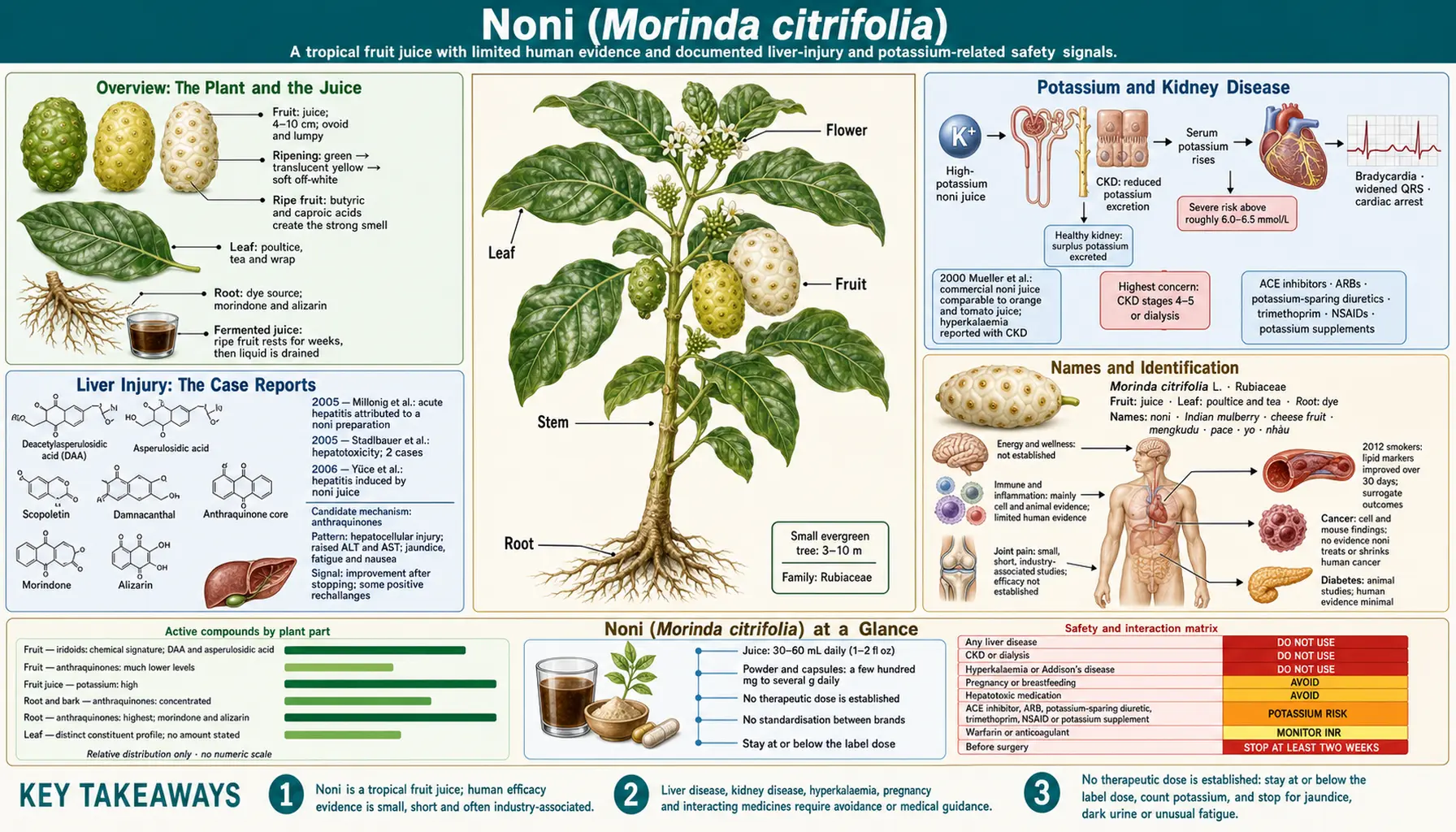
Noni is the fruit of Morinda citrifolia, a small tree of Polynesia, Southeast Asia and northern Australia. Ripe noni smells so strongly of ripe cheese and vomit that its other common name is "cheese fruit" — and it was, for centuries, a Pacific famine food and a Polynesian medicinal plant rather than a daily one. Since the late 1990s it has been sold worldwide as a bottled juice marketed for almost everything.
Two safety issues lead this page. First, there are multiple published case reports of acute hepatitis attributed to noni juice, some in people who went on to be assessed for liver transplantation. The European Food Safety Authority reviewed those reports and did not withdraw noni juice from the market — but the signal is real, it is documented in peer-reviewed journals, and anyone with liver disease or on hepatotoxic medication needs to know about it. Second, noni juice is high in potassium, which is a genuine hazard in chronic kidney disease, where it has caused dangerous hyperkalaemia.
On efficacy: the marketing claims — cancer, diabetes, arthritis, immunity, energy, "everything" — run far ahead of the evidence. The human trial literature is small, mostly short, and largely funded by the industry that sells the product. EFSA's authorisation of noni juice as a novel food in 2003 was a judgement that it is safe enough for most people to drink. It was not a finding that it works.
Table of Contents
- Overview: The Plant and the Juice
- Liver Injury: The Case Reports
- Potassium and Kidney Disease
- Names and Identification
- Traditional Use
- Active Compounds
- The Regulatory Story: What EFSA Actually Said
- The Marketing Claims and the Trial Evidence
- Antioxidant and Smoking-Related Studies
- Immune, Anti-inflammatory and Pain Claims
- Culinary Use
- Forms and Preparations
- Dosage
- Cautions and Contraindications
- Key Research Papers
- Conditions It Is Used For
- Connections
- Featured Videos
Overview: The Plant and the Juice
Morinda citrifolia is a small evergreen tree, 3–10 metres tall, in the family Rubiaceae — the coffee and cinchona family. It is exceptionally tolerant of poor conditions: it grows in salt spray, on raw lava, in coral sand and in the volcanic soils of the Pacific islands, which is precisely why early Polynesian voyagers carried it with them. It is now naturalised throughout the tropics.
The fruit is the part used. It is 4–10 cm, ovoid, lumpy, and ripens from green through translucent yellow to a soft off-white. The mature fruit is famous for its smell — butyric and caproic acids, the same compounds that make aged cheese and rancid butter smell as they do. Traditional Pacific preparation involved fermenting the ripe fruit in a covered container in the sun for weeks, then draining and drinking the liquid. That is essentially what commercial noni juice still is, usually blended with grape or blueberry juice to make it drinkable.
Leaves, bark and root are also used traditionally: the leaves as a poultice and wrap, the root as a source of the red-yellow dyes morindone and alizarin, which were an important trade good in India and Java long before anyone drank the juice.
How it became a global product. Noni juice went from Pacific folk remedy to worldwide supplement in the mid-1990s, driven by multi-level marketing companies. It is one of the clearest examples of a plant whose modern profile was built by a sales network rather than by a research programme — a fact that matters when reading the trial literature, because a large share of it was produced by, or funded by, those same companies.
Liver Injury: The Case Reports
This is the reason for caution, and it is documented in mainstream hepatology and gastroenterology journals rather than in advocacy publications.
What was reported
- 2005, European Journal of Gastroenterology & Hepatology. Millonig, Stadlmann and Vogel described acute hepatitis in a patient attributed to a noni preparation — the index case in the published literature.
- 2005, World Journal of Gastroenterology. Stadlbauer and colleagues in Graz reported hepatotoxicity of noni juice in two further cases, with liver biopsy findings and, in one, evaluation in the context of severe liver injury.
- 2006, Digestion. Yüce and colleagues in Munich reported hepatitis induced by noni juice and asked in their title whether it represented "a rare cause of hepatotoxicity or the tip of the iceberg" — a question that has still not been definitively answered.
Further cases have been reported since, from several European centres. The clinical picture in most is a hepatocellular pattern of injury: markedly raised transaminases (ALT and AST), jaundice, fatigue and nausea, appearing weeks to a few months into regular consumption, and improving after the juice was stopped. In several reported cases, injury recurred when the patient resumed noni — a positive rechallenge, which is one of the stronger pieces of evidence that a substance is genuinely causing a drug-induced liver injury rather than being an innocent bystander.
How strong is the evidence?
We should be honest about both directions here:
- For causation: multiple independent centres; a consistent hepatocellular pattern; improvement on withdrawal; at least some positive rechallenges; and a plausible candidate mechanism in the fruit's anthraquinones, a compound class with known hepatotoxic members.
- Against a simple causal story: the number of reported cases is small set against the very large number of people who have drunk noni juice; several patients were taking other medications or supplements; and commercial noni products are blends whose other ingredients and contaminants are not always characterised. Idiosyncratic drug-induced liver injury is, by definition, rare and unpredictable, which makes it hard to prove and easy to dismiss.
- The industry position is set out explicitly in a 2006 World Journal of Gastroenterology paper by West, Jensen and Westendorf titled "Noni juice is not hepatotoxic", and in a 2009 Journal of Toxicological Sciences paper reporting hepatotoxicity and subchronic toxicity tests that found no liver injury in animals at high doses. These are real data and should be read — alongside the fact that the authors were affiliated with the manufacturer, which is disclosed in the papers and is a legitimate thing for a reader to weigh.
What this means for you
Idiosyncratic liver injury is uncommon but not predictable in advance, so the practical rules are simple:
- Do not drink noni juice if you have existing liver disease — hepatitis B or C, fatty liver disease, cirrhosis, autoimmune hepatitis, or a history of drug-induced liver injury.
- Avoid it if you take medication that stresses the liver — methotrexate, isoniazid, high-dose paracetamol/acetaminophen, amiodarone, some antifungals and statins among many others.
- Stop immediately and get liver function tests if you develop jaundice (yellow eyes or skin), dark urine, pale stools, right-upper-abdominal pain, itching, unusual fatigue or nausea while taking it.
- Tell your doctor you are drinking it. Herbal supplements are a common cause of otherwise unexplained abnormal liver tests, and clinicians frequently do not find out because nobody asks and nobody volunteers.
Potassium and Kidney Disease
This hazard is less discussed than the liver one, is easier to predict, and is in some ways more immediately dangerous.
Noni juice is high in potassium. A 2000 report in the American Journal of Kidney Diseases by Mueller and colleagues, titled "Noni juice (Morinda citrifolia): hidden potential for hyperkalemia?", measured the potassium content of commercial noni juice and found it comparable to high-potassium juices such as orange and tomato juice — and described a patient with chronic kidney disease who developed hyperkalaemia in association with it.
Why this matters. Healthy kidneys excrete surplus potassium without difficulty; dietary potassium is good for most people and is actively encouraged for blood pressure. But in chronic kidney disease, and especially in advanced CKD or dialysis, the kidney cannot dump excess potassium. Serum potassium climbs, and above roughly 6.0–6.5 mmol/L it interferes with cardiac conduction. Severe hyperkalaemia causes bradycardia, widened QRS complexes and can stop the heart. It is one of the few electrolyte problems that kills quickly.
Who is at risk:
- Anyone with chronic kidney disease, at any stage, and particularly stages 4–5 or on dialysis.
- People taking ACE inhibitors (ramipril, lisinopril), ARBs (losartan, candesartan), potassium-sparing diuretics (spironolactone, eplerenone, amiloride), trimethoprim, NSAIDs, or potassium supplements — all of which raise serum potassium.
- People with Addison's disease or other causes of aldosterone deficiency.
- People with poorly controlled diabetes, who can have a type of renal tubular acidosis that impairs potassium excretion.
The practical rule: if you have kidney disease or are on any of the medications above, treat noni juice the way a renal dietitian treats orange juice, tomato juice and banana — as a potassium load that has to be counted. Most renal patients are already given potassium restrictions; a "health juice" is exactly the sort of thing that does not get mentioned in that conversation.
Names and Identification
Binomial: Morinda citrifolia L. Family: Rubiaceae. Parts used: fruit (juice), leaf (poultice, tea), root (dye).
Regional and common names:
- Hawaiian / Tahitian / Polynesian: noni — the name that became global
- English: Indian mulberry, cheese fruit, great morinda, beach mulberry, vomit fruit
- Indonesian / Malay: mengkudu, pace
- Thai: yo (ยอ)
- Vietnamese: nhàu
- Tagalog: apatot, bangkoro
- Hindi: ach, al; the dye is suranji
- Sanskrit: ashyuka
- Chinese: hai ba ji (海巴戟)
- Aboriginal Australian (northern Australia): the fruit is a traditional bush food
Related species that are not the same plant: Morinda officinalis (ba ji tian) is a distinct species used in Traditional Chinese Medicine as a kidney-yang tonic, and its root — not its fruit — is the part used. Do not read TCM material on ba ji tian as if it were about noni juice. Morinda lucida is a West African species used for malaria, again a different plant.
Identification note: ripe noni is soft, translucent-white and unmistakable by smell alone. Fruit sold as dried noni or noni powder is dried before it fully ripens and smells far milder, which is one reason the powder and the juice are experienced so differently.
Traditional Use
Noni is one of the canonical "canoe plants" — species carried deliberately by Polynesian voyagers across the Pacific because they were too useful to leave behind. Its traditional profile is broader than most people assume, and much of it is not medicinal at all.
- Dye. The root yields morindone and other anthraquinone pigments producing reds, purples and yellows. This was noni's most economically significant use for centuries, particularly in India and Java for batik.
- Famine food. In Polynesia, Fiji and parts of Southeast Asia, noni fruit was eaten in times of scarcity. It was not a favoured food — the smell tells you why — but it fruits year-round and reliably.
- Hawaiian traditional medicine (lā‘au lapa‘au). Fruit preparations for wounds, boils, and digestive complaints; leaves warmed and applied over joints and the abdomen.
- Polynesian and Micronesian practice. Fermented juice for general debility; leaf wraps for fever and swelling; unripe fruit for gastrointestinal complaints.
- Southeast Asia. In Indonesia, mengkudu is a Jamu staple for hypertension and diabetes; in Thailand, yo leaves are used in cooking and the fruit medicinally; in Vietnam, nhàu root and fruit are used for joint pain and blood pressure.
- Northern Australia. A traditional Aboriginal bush food and medicine.
Note what is not traditional: the modern marketing frames noni as an ancient panacea drunk daily by healthy Polynesians for wellness. The ethnobotanical record does not support that. It was a dye plant, a famine food and a targeted remedy. Daily juice consumption by well people is a 1990s invention.
Active Compounds
Iridoids — the compound class most characteristic of noni fruit and the one modern analytical work has settled on as its chemical signature. The principal ones are deacetylasperulosidic acid (DAA) and asperulosidic acid, with asperuloside and scandoside also present. Commercial juices are sometimes standardised to DAA content, and iridoid concentration is now the most useful way to compare products. Iridoids show antioxidant and anti-inflammatory activity in laboratory systems.
Scopoletin — a coumarin present in the fruit, and one of the compounds most often invoked in marketing. It has vasodilatory and anti-inflammatory activity in laboratory models and, as a coumarin, is worth flagging in the context of anticoagulant interactions (see Cautions).
Damnacanthal — an anthraquinone from the root and fruit. It inhibits certain tyrosine kinases in cell-based assays and was reported to affect Ras-transformed cells, which is where a large share of the "noni fights cancer" claim originates. That is a cell-culture observation about an isolated compound, not a property of a bottle of juice.
Anthraquinones — morindone, morindin, alizarin, rubiadin and related pigments, concentrated in the root and bark and present at much lower levels in the fruit. This class is important for two opposite reasons: it is the basis of noni's historical value as a dye, and it includes compounds with recognised hepatotoxic and genotoxic potential. Anthraquinone content is the leading candidate mechanism for the reported liver injury, and it is also why EFSA's assessments have paid particular attention to leaf and root material contaminating fruit products.
Polysaccharides — noni fruit contains glucuronic-acid-rich polysaccharides that have shown immunomodulatory activity in animal studies.
Other constituents: ursolic acid, rutin and quercetin glycosides, β-sitosterol, octanoic and hexanoic acids (the smell), vitamin C in modest amounts, and — importantly — potassium, at levels comparable with high-potassium fruit juices.
A 2007 paper in the Journal of Agricultural and Food Chemistry by Potterat and colleagues identified thin-layer chromatography markers and quantified constituents across noni fruit powders and commercial products, and is a good reference point for how much these products vary from one another.
The Regulatory Story: What EFSA Actually Said
This section exists because "EU-approved" appears constantly in noni marketing and is routinely misrepresented.
Noni juice was assessed under the European Union's Novel Food regulation and authorised for sale in 2003. EFSA and its predecessor committees have revisited the product several times since, including specifically in the light of the published hepatitis case reports, and have also assessed noni leaves, noni fruit purée and noni powder in separate opinions. The authorisations have generally been maintained.
What a novel food authorisation means: the applicant demonstrated that the food is safe under the proposed conditions of use. It is a safety threshold for a food, applied to a specific product from a specific applicant at specific intake levels.
What it does not mean:
- It is not a finding that noni juice does anything therapeutic. Health claims in the EU go through an entirely separate and much stricter process, and noni juice does not carry authorised disease-treatment claims.
- It is not a finding that noni is safe for everyone. Safety assessments are made for the general healthy population; they do not clear a product for people with liver disease or kidney failure.
- It does not cover every noni product on sale. Concentrated extracts, capsules, leaf products and blends may fall outside a given authorisation.
The honest summary is that European regulators looked at the hepatitis reports, judged that they did not justify withdrawing a food that many people drink uneventfully, and left it on the market. That is a defensible regulatory decision. It is not a clean bill of health, and the case reports were not retracted.
The Marketing Claims and the Trial Evidence
Noni juice has been marketed for cancer, diabetes, arthritis, hypertension, high cholesterol, immune function, energy, depression, HIV, digestion and skin. The claim list is essentially unbounded, which is itself the clearest signal that it is not evidence-driven — genuinely effective treatments have narrow indications.
What the human literature actually contains:
- Cancer: a small early-phase study of noni in advanced cancer explored dosing and quality-of-life measures. There is no evidence that noni treats or shrinks any cancer in humans. The anticancer story rests on damnacanthal and polysaccharide work in cells and mice. As with any product marketed to people with cancer, the real risk is substitution for effective treatment.
- Diabetes: animal studies report glucose-lowering effects; human trial evidence is minimal and not adequate to support use.
- Arthritis and joint pain: small trials and observational reports, generally industry-associated, have reported symptom improvement. None is large or independent enough to establish efficacy.
- Blood pressure and lipids: see the smoker studies below; results are modest, short-term and industry-funded.
- Energy and general wellness: not measurable in any trial-grade way and not established.
The industry-funding issue is not a rhetorical dismissal. A substantial proportion of published noni research shares authors affiliated with the principal manufacturer — and those authors also wrote the standard 2002 review in Acta Pharmacologica Sinica that is cited throughout the noni literature. Industry funding does not make a study wrong, and these are peer-reviewed papers. But when nearly the entire positive evidence base for a commercial product comes from that product's manufacturer, and independent replication is thin, a reader is entitled to discount accordingly.
Antioxidant and Smoking-Related Studies
The best-documented human work on noni is a small series of studies in heavy smokers, and it is worth describing precisely because it is the strongest human data that exists.
- A 2012 study in The Scientific World Journal by Wang and colleagues reported that noni juice improved serum lipid profiles and other risk markers in cigarette smokers over 30 days.
- A 2013 study in Food Science & Nutrition by the same group reported reductions in lipid-peroxidation-derived DNA adducts in heavy smokers.
How to read these. They are genuine randomised human studies with biochemical endpoints, which puts them well ahead of the cell-culture work that dominates the field. They are also small, short (weeks, not years), conducted in a single specific population, measure surrogate markers rather than clinical outcomes, and were conducted by researchers affiliated with the manufacturer. Improved lipid markers over 30 days in smokers is a long way from "noni prevents heart disease". Nobody has shown that these surrogate changes translate into fewer heart attacks or cancers.
And the obvious point: if you smoke, stopping smoking will do more for these same markers than any juice, by a margin that is not close.
Immune, Anti-inflammatory and Pain Claims
Mechanism: noni polysaccharides show immunomodulatory activity in animal models — effects on macrophage activity and cytokine production. Iridoids including deacetylasperulosidic acid show anti-inflammatory activity in cell and animal systems. Scopoletin has anti-inflammatory and vasodilatory activity in laboratory models.
Human evidence: limited. Small trials have reported improvements in self-reported joint pain and range of motion, and some reduction in inflammatory markers. These are consistently small, short-duration, and rarely independently replicated. Evidence: mostly cell-culture and animal, with a small and industry-associated human layer.
For inflammatory arthritis specifically, this matters: rheumatoid arthritis and related conditions cause irreversible joint destruction if inadequately treated, and disease-modifying drugs prevent that. Noni juice is not an alternative to them.
Culinary Use
Noni fruit is technically edible and is genuinely eaten, but calling it culinary is generous:
- Fruit. Eaten raw in Pacific island cuisine mostly as a famine or subsistence food, often with salt. The smell and the bitter, ammoniacal taste keep it out of everyday cooking almost everywhere it grows.
- Leaves. The genuinely culinary part. In Thailand, bai yo (noni leaves) are used to wrap and steam fish and are added to curries; in Java the young leaves are eaten as a vegetable. They are mild and pleasant, and unlike the fruit are not particularly aromatic.
- Commercial juice. Almost always blended with grape, blueberry or other fruit juices to mask the flavour, and often sweetened. This means a "noni juice" bottle may be a minority noni by volume — check the ingredient list, because it also changes the sugar and potassium content.
Forms and Preparations
- Fermented juice. The traditional and most common commercial form. Ripe fruit is left to ferment for weeks and the liquid drained.
- Pure pressed / pasteurised juice. Less common; stronger tasting.
- Blended juice drinks. The dominant retail product. Read the label for the actual noni percentage and for added sugar.
- Fruit powder and capsules. Dried fruit, milled. Concentration varies widely; potassium is concentrated along with everything else.
- Fruit purée. Assessed separately by EU regulators.
- Leaf tea and leaf extracts. A distinct product from fruit juice, with a different constituent profile and its own separate regulatory assessment.
- Topical oils, creams and seed oil. Used for skin; the seed oil is high in linoleic acid.
- Root preparations. Highest anthraquinone content. Traditionally a dye source. Not appropriate as a supplement.
What to look for on a label: the actual percentage of noni juice; whether it is fruit, leaf or root; iridoid or DAA standardisation if present; added sugars; and a manufacturer that discloses testing. What you will not see, and should mentally add, is the potassium content.
Dosage
No therapeutic dose is established for any indication, because no indication is established.
Commercial products typically suggest 30–60 ml (1–2 fl oz) of juice daily, sometimes split into two doses, often taken before meals. EU novel-food assessments have considered intakes in this general range. Some marketing recommends far higher "loading" intakes in the first weeks; there is no evidence for that practice and it increases both the potassium load and any hepatic exposure.
Powder and capsule doses vary from a few hundred milligrams to several grams daily, with no standardisation between brands and no trial basis for any of them.
Practical framing:
- If you drink it, stay at or below the label dose and treat it as a food, not a medicine.
- Do not take it continuously for months without reason and without occasional liver function tests, particularly if you take other medication.
- Count it as a potassium-containing juice if potassium matters for you.
- Stop at the first sign of jaundice, dark urine or unexplained fatigue.
Cautions and Contraindications
Do not use noni if you have:
- Any liver disease — hepatitis B or C, fatty liver disease, alcohol-related liver disease, cirrhosis, autoimmune hepatitis, or a previous drug-induced liver injury. Published case reports describe acute hepatitis attributed to noni juice, with some patients assessed in the context of severe liver failure.
- Chronic kidney disease, or if you are on dialysis. The potassium load is a real and measurable hazard, and hyperkalaemia has been reported.
- Hyperkalaemia from any cause, including Addison's disease and aldosterone deficiency.
Avoid in pregnancy and breastfeeding. Noni root and fruit have traditional reputations as emmenagogues and abortifacients in several Pacific and Southeast Asian traditions, and there is no adequate human safety data. This is a straightforward avoid.
Drug interactions:
- ACE inhibitors, ARBs, potassium-sparing diuretics (spironolactone, amiloride, eplerenone), trimethoprim, NSAIDs, potassium supplements — all raise serum potassium; noni adds to the load.
- Hepatotoxic medication — methotrexate, isoniazid, amiodarone, high-dose paracetamol/acetaminophen, some antifungals and statins. Do not stack an idiosyncratic hepatotoxin on top of a predictable one.
- Warfarin and other anticoagulants. Noni contains coumarins including scopoletin, and also contains vitamin K in leaf material. Monitor INR if you start or stop it.
- Antihypertensives and antidiabetic drugs — possible additive effects; monitor.
- Immunosuppressants — noni polysaccharides are immunomodulatory in animal models; theoretical interaction in transplant recipients, who are also a group in whom liver and kidney function are closely watched.
Before surgery: stop noni at least two weeks beforehand, as with most supplements, because of the theoretical anticoagulant and blood-pressure effects and the general principle of not confounding perioperative liver tests.
Common minor effects: the taste and smell cause nausea in some people; loose stools are reported; the juice is acidic and can aggravate reflux.
The core message: for a healthy adult with normal liver and kidney function, a modest daily amount of noni juice is, on current evidence, a fairly low-risk thing to drink — and there is very little reason to believe it will do anything for you. For someone with liver or kidney disease, it is genuinely hazardous. That asymmetry, rather than any efficacy question, is what this page is really for.
Key Research Papers
- Millonig G, Stadlmann S, Vogel W. Herbal hepatotoxicity: acute hepatitis caused by a Noni preparation (Morinda citrifolia). European Journal of Gastroenterology & Hepatology. 2005;17(4):445–447.
- Stadlbauer V, Fickert P, Lackner C, et al. Hepatotoxicity of NONI juice: report of two cases. World Journal of Gastroenterology. 2005;11(30):4758–4760.
- Yüce B, Gülberg V, Diebold J, Gerbes AL. Hepatitis induced by Noni juice from Morinda citrifolia: a rare cause of hepatotoxicity or the tip of the iceberg? Digestion. 2006;73(2–3):167–170.
- Mueller BA, Scott MK, Sowinski KM, Prag KA. Noni juice (Morinda citrifolia): hidden potential for hyperkalemia? American Journal of Kidney Diseases. 2000;35(2):310–312. The potassium report.
- West BJ, Jensen CJ, Westendorf J. Noni juice is not hepatotoxic. World Journal of Gastroenterology. 2006;12(22):3616–3619. The manufacturer-affiliated response to the case reports — read alongside items 1–3.
- West BJ, Su CX, Jensen CJ. Hepatotoxicity and subchronic toxicity tests of Morinda citrifolia (noni) fruit. The Journal of Toxicological Sciences. 2009;34(5):581–585. Animal.
- Wang MY, West BJ, Jensen CJ, et al. Morinda citrifolia (Noni): a literature review and recent advances in Noni research. Acta Pharmacologica Sinica. 2002;23(12):1127–1141. The most-cited review; authors are manufacturer-affiliated.
- Wang MY, Peng L, Weidenbacher-Hoper V, et al. Noni juice improves serum lipid profiles and other risk markers in cigarette smokers. The Scientific World Journal. 2012;2012:594657. Human, small, industry-affiliated.
- Wang MY, Peng L, Jensen CJ, et al. Noni juice reduces lipid peroxidation-derived DNA adducts in heavy smokers. Food Science & Nutrition. 2013;1(2):141–149. Human, small, industry-affiliated.
- Potterat O, Felten RV, Dalsgaard PW, Hamburger M. Identification of TLC markers and quantification by HPLC-MS of various constituents in noni fruit powder and commercial noni-derived products. Journal of Agricultural and Food Chemistry. 2007;55(18):7489–7494. Independent analysis of how much commercial products vary.
Live PubMed Searches
- Morinda citrifolia hepatotoxicity
- Noni juice and liver injury
- Noni juice, potassium and hyperkalaemia
- Noni iridoids and deacetylasperulosidic acid
- Morinda citrifolia clinical trials
- Damnacanthal and tyrosine kinase inhibition
- Morinda citrifolia anthraquinones
- Herb-induced liver injury from supplements
- Dietary potassium restriction in chronic kidney disease
- Scopoletin pharmacology
External Resources
- European Food Safety Authority — source for the novel food opinions on noni juice, purée, powder and leaves
- LiverTox — NIH database of drug- and herb-induced liver injury
Conditions Noni Is Used For
Each condition below links to its page. The coloured half of every capsule shows how much human evidence supports this herb for that specific use — traditional use is history, not proof, and is marked as such.
Connections
- All Herbs
- Liver Cirrhosis
- Cirrhosis (Hepatology)
- Nephrology and Hepatology
- Gastroenterology
- Potassium
- Potassium Toxicity
- Toxins
- Conditions on this site that reference this page: Hypothyroidism · Type 2 Diabetes · Iron-Deficiency Anemia · Immunology · Acute Kidney Injury · Alcoholic Hepatitis · Autoimmune Hepatitis · Kidney Disease