Tart Cherry (Prunus cerasus)
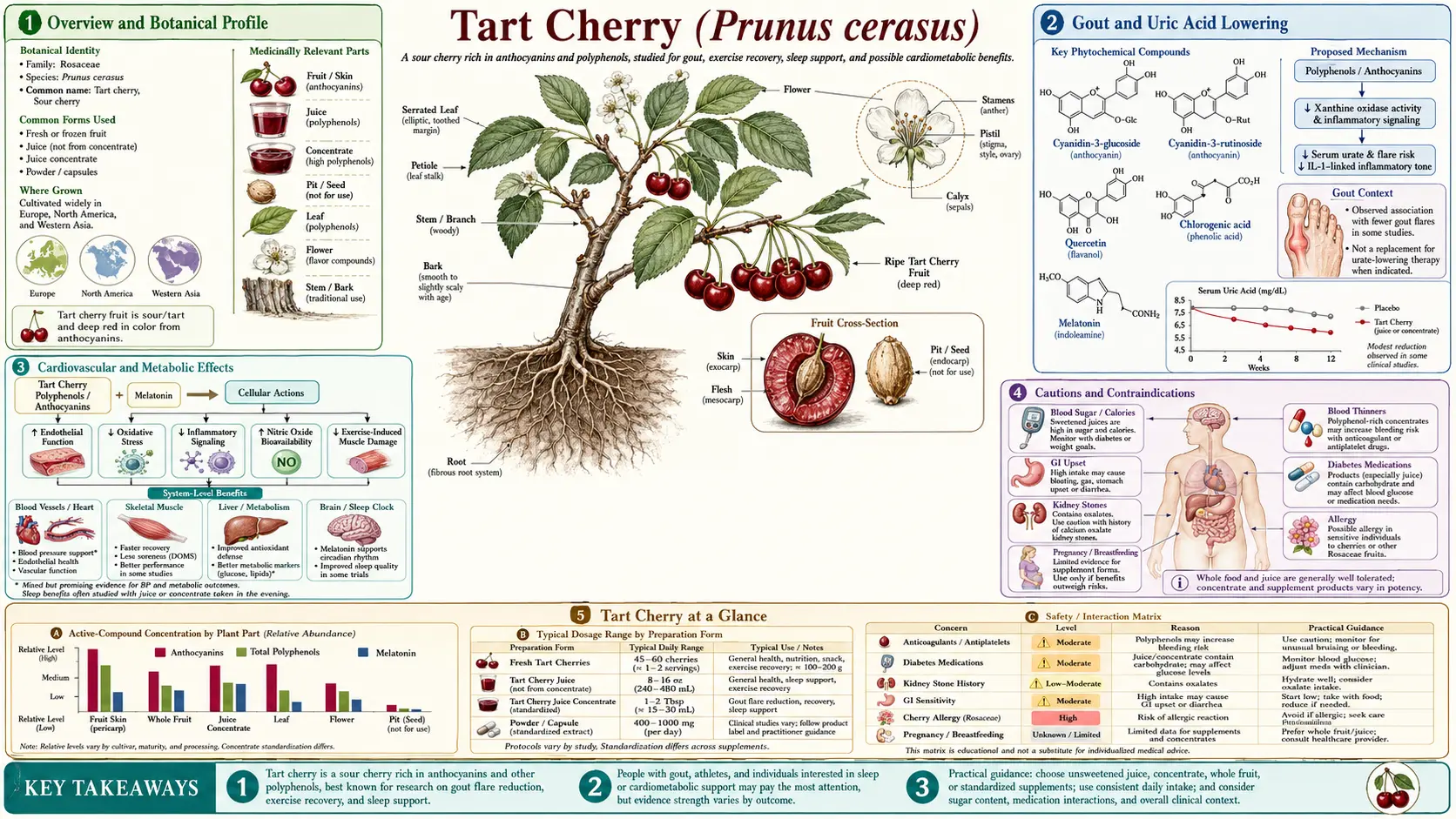
Table of Contents
- Overview and Botanical Profile
- Traditional Use and History
- Active Compounds
- Gout and Uric Acid Lowering
- Exercise Recovery and Muscle Pain
- Sleep and Natural Melatonin
- Inflammation and Joint Pain
- Cardiovascular and Metabolic Effects
- Forms and Preparations
- Recommended Dosage
- Cautions and Contraindications
- Research Papers and References
- Connections
- Featured Videos
Overview and Botanical Profile
Tart cherry (Prunus cerasus), also called sour cherry or Morello cherry, is a deciduous tree native to Europe and Southwest Asia and now widely cultivated in Michigan, Utah, Washington, Poland, and Turkey. It is botanically distinct from the sweet cherry (Prunus avium) and produces smaller, brighter-red fruits with a sharper, more acidic flavor and a substantially higher concentration of polyphenols.
The cultivar most studied in clinical research is the Montmorency tart cherry, an heirloom variety developed in the Montmorency Valley of France and now grown commercially in Michigan, which produces approximately three-quarters of the United States crop. Other research-grade varieties include Balaton (a Hungarian Morello), Schattenmorelle, and Erdi Botermo. Sweet-cherry studies generally cannot be substituted for tart-cherry studies because the anthocyanin and melatonin content differs by an order of magnitude.
The medicinal use of tart cherry centers on its dense concentration of anthocyanins, the deep-red pigments that give the fruit its color and produce most of its anti-inflammatory and antioxidant effects. Tart cherries are also one of the few natural dietary sources of melatonin, the hormone that regulates the human sleep-wake cycle.
Traditional Use and History
Cherries have been gathered and eaten in Europe since prehistoric times, written about by classical authors such as Theophrastus and Pliny the Elder, and used for centuries in folk medicine — most famously the old American "cherries for rheumatism" remedy that prefigured today's research on gout. Modern scientific interest began in the late 1990s with work at Michigan State University on the anti-inflammatory cherry pigments — the fuller story is told in the dedicated History & Traditional Use article.
Active Compounds
The therapeutic activity of tart cherry is attributable to a complex mixture of polyphenols, with anthocyanins as the dominant pharmacologically active class:
- Anthocyanins — primarily cyanidin-3-glucosylrutinoside, cyanidin-3-rutinoside, and cyanidin-3-glucoside. Tart cherries contain roughly five to ten times the anthocyanin content of sweet cherries on a weight basis
- Hydroxycinnamic acids — chlorogenic acid, neochlorogenic acid, p-coumaroylquinic acid; contribute antioxidant capacity
- Flavonols — quercetin, kaempferol, and their glycosides; add to the anti-inflammatory and vasoprotective profile
- Melatonin — tart cherries contain approximately 13 ng of melatonin per gram of fresh fruit, one of the highest naturally occurring dietary concentrations identified
- Procyanidins — oligomeric proanthocyanidins that contribute to the astringent flavor and add vascular and platelet-modulating activity
- Vitamin C, potassium, and fiber — nutritional contributors that complement the polyphenol activity
The ORAC (oxygen radical absorbance capacity) value of dried tart cherries is among the highest reported for common fruits, and standardized tart-cherry juice concentrates report anthocyanin contents in the range of 40-70 mg per 30 mL serving. Pharmacokinetic studies show that cherry anthocyanins are absorbed rapidly, peak in plasma within one to two hours, and are largely cleared by six hours, supporting a divided-dose regimen for sustained effect.
Gout and Uric Acid Lowering
The strongest evidence base for tart cherry concerns the prevention of recurrent gout attacks. The landmark 2012 case-crossover study by Zhang and colleagues, published in Arthritis & Rheumatism, followed 633 gout patients and found that consumption of cherries or cherry extract over a 48-hour period was associated with a 35 percent reduction in the risk of a subsequent gout attack. When cherry intake was combined with allopurinol, the risk reduction reached 75 percent, suggesting an additive effect rather than redundant pharmacology.
Proposed mechanisms include direct inhibition of xanthine oxidase (the enzyme that generates uric acid from purines), increased renal urate excretion mediated by anthocyanin metabolites, and reduction of the NLRP3 inflammasome activation that triggers acute gouty inflammation when monosodium urate crystals deposit in the joint. Tart cherry does not replace urate-lowering therapy in chronic tophaceous gout, but it is a credible adjunct and may reduce attack frequency in patients with intermittent disease.
Several smaller human trials have confirmed modest reductions in serum urate (typically 0.4-0.8 mg/dL) after two to four weeks of daily tart-cherry juice or concentrate. The magnitude is smaller than allopurinol or febuxostat but is achieved without the hypersensitivity and hepatic risks of pharmacological xanthine-oxidase inhibitors. Patients on urate-lowering therapy can generally add tart cherry safely, but should monitor for any interaction with anticoagulants taken concurrently.
Exercise Recovery and Muscle Pain
A second well-developed evidence base concerns tart cherry as a recovery aid after strenuous, eccentric, or endurance exercise. The protocol most often cited is the Howatson-Connolly model: 30 mL of tart cherry juice concentrate (equivalent to about 90 fresh cherries) taken twice daily for five days before an event and continued for two to three days after.
Documented effects in controlled trials include:
- Reduced muscle soreness following marathon and ultramarathon racing
- Faster recovery of isometric strength after eccentric resistance exercise
- Smaller increases in markers of muscle damage (creatine kinase, lactate dehydrogenase) and oxidative stress (protein carbonyls, malondialdehyde)
- Attenuated rise in inflammatory cytokines (IL-6, TNF-alpha) and acute-phase reactants (CRP) after long-distance running
- Reduced post-exercise blood pressure elevation and improved vascular function
The combination of anti-inflammatory anthocyanin activity and antioxidant action against exercise-induced reactive oxygen species appears to be the mechanism. Importantly, the recovery benefit does not blunt the training adaptation in the way that high-dose vitamin C and vitamin E supplementation has been shown to do; the polyphenol load from tart cherry is closer to a dietary intake than to a pharmacological antioxidant bolus.
Sleep and Natural Melatonin
Tart cherries are one of the only dietary sources of measurable melatonin, the pineal hormone that signals biological darkness and helps anchor the circadian sleep-wake rhythm. The 2012 study by Howatson and colleagues showed that adults who drank 30 mL of tart cherry juice concentrate twice daily for seven days had small but statistically significant improvements in total sleep time, sleep efficiency, and reductions in subjective insomnia compared with placebo.
Subsequent trials in older adults with chronic insomnia and in younger adults with delayed-sleep phase have reported similar modest improvements in sleep latency, time awake after sleep onset, and overall sleep quality. Effects are typically smaller than pharmacological melatonin supplementation but are achieved through a dietary pathway, with the additional polyphenol load contributing antioxidant and anti-inflammatory effects that purified melatonin tablets do not provide.
The melatonin content of tart cherry juice is approximately 0.1-0.4 mg per 240 mL serving, well below the typical 0.5-5 mg dose used in melatonin supplementation. The mechanism may therefore involve more than simple melatonin delivery, including modulation of tryptophan metabolism, regulation of the kynurenine pathway, and reduction of the low-grade inflammation that contributes to age-related sleep fragmentation.
Inflammation and Joint Pain
Tart cherry anthocyanins inhibit cyclooxygenase-1 and cyclooxygenase-2 activity in vitro at concentrations achievable through dietary intake, and human trials have reported small reductions in C-reactive protein, IL-6, and TNF-alpha after several weeks of consumption. This anti-inflammatory profile has been investigated as an adjunct for osteoarthritis, fibromyalgia, and chronic non-specific musculoskeletal pain.
Controlled trials in symptomatic knee osteoarthritis have shown modest reductions in pain scores and improvements in physical function over six to twelve weeks of daily tart cherry juice consumption. Effect sizes are smaller than non-steroidal anti-inflammatory drugs but come without the gastric and renal liabilities associated with chronic NSAID use. Patients with severe inflammatory arthritis (rheumatoid arthritis, ankylosing spondylitis) should regard tart cherry as a modest dietary adjunct rather than a substitute for disease-modifying therapy.
Tart cherry has also been studied in fibromyalgia, where the dual anti-inflammatory and sleep-promoting effects appear to address two of the principal symptom domains. Improvements in pain and sleep quality were reported in small trials, though larger studies are needed before firm clinical recommendations can be made.
Cardiovascular and Metabolic Effects
The polyphenol profile of tart cherry overlaps substantially with that of other anthocyanin-rich foods (berries, red wine, hibiscus) and produces a similar cluster of cardiovascular and metabolic effects. Documented findings from controlled trials include:
- Reductions in systolic blood pressure of approximately 5-7 mmHg after four to twelve weeks of daily tart cherry juice in hypertensive adults
- Modest improvements in fasting glucose and HbA1c in adults with insulin resistance and type 2 diabetes
- Reductions in LDL cholesterol and improvements in HDL-to-LDL ratio in dyslipidemic adults
- Improvements in flow-mediated dilation, a measure of endothelial function
- Reductions in oxidized LDL and platelet aggregation markers
The effect sizes are typical of food-based polyphenol interventions and complement, rather than replace, conventional cardiovascular pharmacotherapy. Tart cherry is a reasonable component of an anti-inflammatory dietary pattern in adults with metabolic syndrome, hypertension, or borderline dyslipidemia.
Forms and Preparations
- Fresh tart cherries — seasonal (mid-June through early August in the northern US); 1 cup of fresh tart cherries provides approximately 30-40 mg of anthocyanins
- Frozen tart cherries — year-round availability with essentially full retention of anthocyanin and melatonin content; ideal for smoothies and overnight oats
- Dried tart cherries — concentrated source; check labels and prefer unsweetened or lightly sweetened varieties (many commercial brands add cane sugar or corn syrup)
- Tart cherry juice (single-strength) — an 8-ounce serving from a 100 percent juice product provides approximately 40-50 mg of anthocyanins
- Tart cherry juice concentrate — reduced by simmering 5:1 to 8:1; the form used in most clinical trials; typical research dose is 30 mL twice daily, mixed with water
- Powdered tart cherry extract (capsules) — standardized to anthocyanin content (often 480 mg per capsule, marketed as "CherryPure" or equivalent); convenient for travel
- Freeze-dried whole cherry powder — preserves the full polyphenol matrix and adds fiber; can be stirred into yogurt or oatmeal
Recommended Dosage
- General health and antioxidant maintenance — 1 cup of fresh or frozen tart cherries daily, or 8 oz of single-strength juice, or 1 tablespoon of juice concentrate
- Gout prophylaxis — 1-2 tablespoons of tart cherry juice concentrate twice daily, or 1 cup of fresh or frozen cherries; reassess after 4-8 weeks
- Exercise recovery — 30 mL (approximately 1 oz) of tart cherry juice concentrate twice daily, starting 4-5 days before a hard training session or endurance event and continuing for 2-3 days after
- Sleep support — 8 oz of single-strength juice or 30 mL of concentrate one to two hours before bedtime, taken consistently for at least one to two weeks
- Capsule extract — 480-800 mg of standardized tart cherry extract once or twice daily, depending on indication
Because the active anthocyanins peak in plasma within one to two hours and are largely cleared by six hours, divided dosing produces more sustained tissue exposure than a single large dose. Take tart cherry with or just after a meal to slow gastric emptying and prolong absorption.
Cautions and Contraindications
Tart cherry has an excellent safety profile in dietary amounts. Important considerations include:
- Glycemic load — commercial tart cherry juice contains 25-30 g of natural sugars per 8 oz serving; patients with diabetes or insulin resistance should account for the carbohydrate load and prefer the lower-sugar concentrate or capsule forms
- Gastrointestinal effects — large servings (more than 2 cups of fruit or 16 oz of juice daily) can produce loose stools due to the sorbitol and fiber content; reduce dose if this occurs
- Anticoagulants — the polyphenol load may mildly inhibit platelet aggregation; consult a clinician before adding daily tart cherry juice to warfarin, clopidogrel, or apixaban therapy
- Sleep-promoting medications — the melatonin and polyphenol content may add to the sedative effect of pharmacological melatonin, zolpidem, or trazodone; avoid combining unless directed by a clinician
- Kidney disease — the potassium content of concentrated juices may be significant for patients on a restricted-potassium diet (advanced chronic kidney disease, certain dialysis regimens)
- Surgical procedures — stop tart cherry concentrate 1-2 weeks before elective surgery as a precaution against bleeding risk; resume after the immediate postoperative period
- Pregnancy and breastfeeding — food-form consumption is considered safe; concentrated extracts have insufficient safety data for routine use
Research Papers and References
The following PubMed search links provide curated entry points into the published clinical and mechanistic literature on tart cherry (Prunus cerasus). Each link opens directly in PubMed at the National Library of Medicine.
- Tart cherry and gout / uric acid lowering — PubMed: tart cherry gout uric acid
- Tart cherry and exercise recovery — PubMed: tart cherry exercise recovery
- Tart cherry, melatonin, and sleep — PubMed: tart cherry melatonin sleep
- Anthocyanins and cyclooxygenase inhibition — PubMed: cherry anthocyanin cyclooxygenase
- Tart cherry and osteoarthritis — PubMed: tart cherry osteoarthritis
- Tart cherry and blood pressure — PubMed: tart cherry blood pressure
- Tart cherry, inflammation, and CRP — PubMed: tart cherry inflammation CRP
- Montmorency cherry clinical trials — PubMed: Montmorency cherry clinical
- Tart cherry pharmacokinetics and bioavailability — PubMed: tart cherry pharmacokinetics
- Cherry consumption and cardiovascular risk markers — PubMed: cherry cardiovascular risk anthocyanin
External Authoritative Resources
- NCCIH — Herbs at a Glance
- MedlinePlus — Herbs and Supplements
- PubMed — All research on Prunus cerasus
Connections
- All Herbs
- Tart Cherry Benefits Deep Dive
- Gout
- Uric Acid Test
- Arthritis
- Quercetin
- Turmeric
- Willow Bark
- Anti-Inflammatory Diet
- Blueberries
- Elderberry
- Ginger
- Inflammatory Markers
- Sleep Hygiene
- Insomnia
- Joint Pain
- Fibromyalgia
- Vitamin C
- Cherries — the fresh fruit, with sweet and tart varieties compared.