Kacip Fatimah (Labisia pumila)
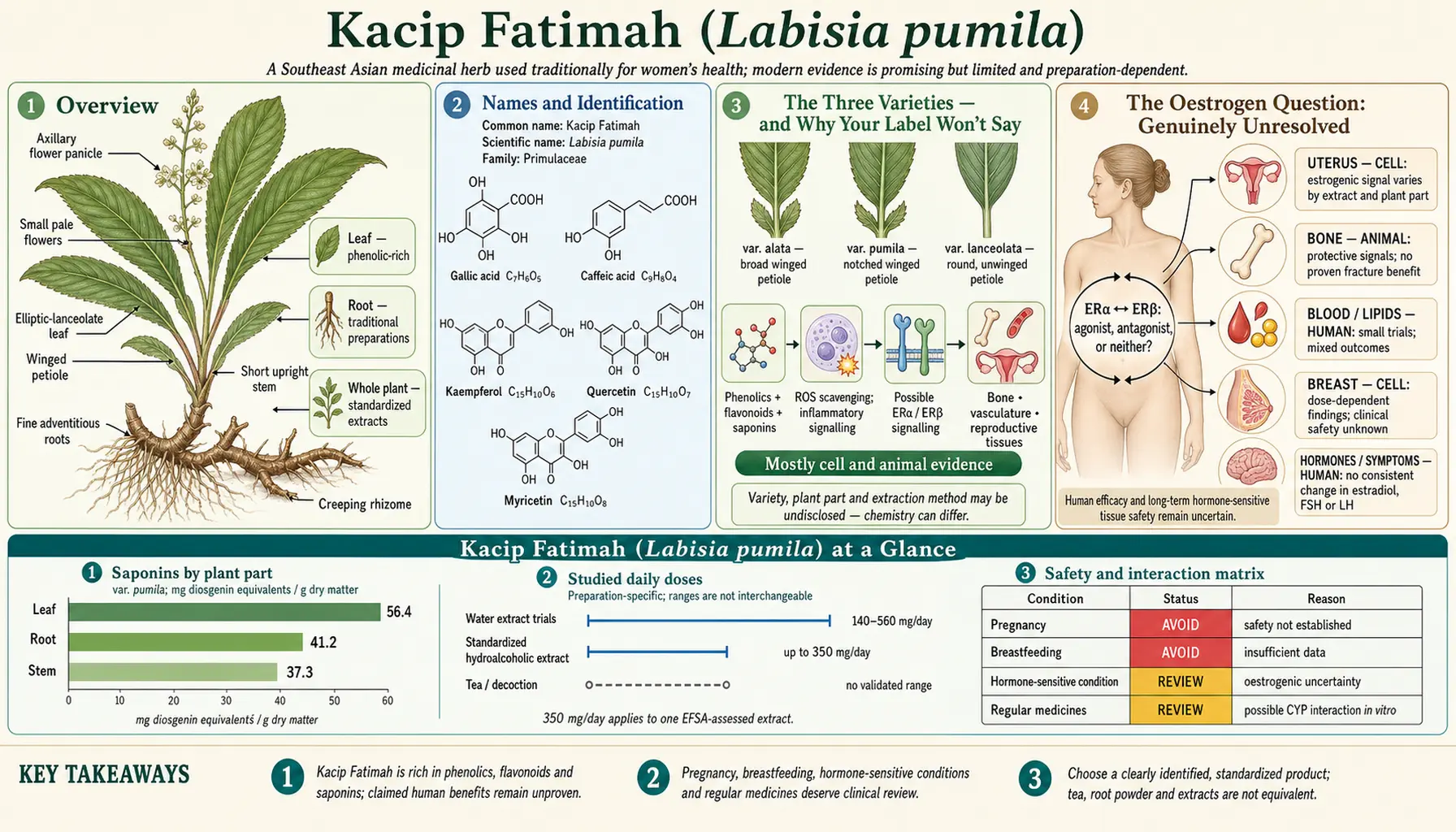
Kacip fatimah is a small, ground-hugging forest herb, Labisia pumila, and it occupies a specific and well-defined place in Malay life: it is the women's herb, the counterpart to tongkat ali. For generations Malay women have taken a decoction of the whole plant in the last weeks of pregnancy to ease delivery, in the weeks after birth to help the uterus contract back down and restore energy, and later in life for painful periods and for the symptoms of menopause. Almost every Malaysian pharmacy stocks it, and almost every Malaysian woman has heard of it.
The evidence behind it is much thinner than its reputation. There is one notable randomised trial of a standardised water extract in pre- and postmenopausal women, one randomised trial of a combination product with tongkat ali, a substantial body of ovariectomised-rat work on bone, and a laboratory literature on oestrogen receptors that points in both directions at once. Whether kacip fatimah behaves as a phytoestrogen, as an anti-oestrogen, or as something more complicated is genuinely unresolved — and until it is, the traditional use in pregnancy and the caution required in hormone-sensitive conditions sit in real, unresolved tension. This page names that tension rather than smoothing it over.
Table of Contents
- Overview
- Names and Identification
- The Three Varieties — and Why Your Label Won't Say
- The Oestrogen Question: Genuinely Unresolved
- Traditional Use
- Active Compounds
- Menopausal Symptoms
- Bone Health After Menopause
- Childbirth, Postpartum Recovery and Menstrual Complaints
- Skin, Collagen and Antioxidant Activity
- Forms and Preparations
- Dosage
- Cautions and Contraindications
- Key Research Papers
- Conditions It Is Used For
- Connections
- Featured Videos
Overview
Labisia pumila is a small perennial herb of the rainforest floor, rarely more than about 40 centimetres tall, with a short creeping woody stem and a rosette of leathery leaves held up towards whatever light filters through the canopy. It grows in the shaded, humid lowland and hill forests of Peninsular Malaysia, Borneo, Sumatra, Java, Thailand and Indochina. It is not showy and it is easy to walk past.
Unlike tongkat ali, where only the taproot is used, kacip fatimah is traditionally used as the whole plant — leaves, stem and roots together — cleaned, dried and boiled. In modern commerce the raw material is usually a dried whole-plant powder or a standardised water extract of it. Wild collection has been heavy enough that cultivation programmes have been established in Malaysia, and the Malaysian government has invested in Labisia pumila as one of its flagship national herbs alongside tongkat ali, misai kucing and hempedu bumi.
The traditional preparation is a decoction: a handful of the dried plant simmered in water for perhaps twenty minutes to an hour, drunk warm, sometimes daily for a defined period around childbirth. The taste is mildly bitter and astringent — nothing like the punishing bitterness of tongkat ali. Today it also reaches consumers as capsules, teabags, ready-to-drink bottled tonics, and in combination formulas aimed at women's health.
Names and Identification
Binomial: Labisia pumila (Blume) Fern.-Vill. Family: Primulaceae. Older papers — including some cited on this page — place it in Myrsinaceae. That is not an error on their part: Myrsinaceae was folded into an expanded Primulaceae by the Angiosperm Phylogeny Group, so both names refer to the same plant and you will see them used interchangeably in the literature.
- Malay: kacip fatimah — a kacip is the small hinged cutter used to split areca (betel) nuts, and the name is usually read as "Fatimah's areca cutter", after the leaf or plant shape.
- Also Malay: selusoh fatimah, from a root meaning to loosen or ease — a direct reference to easing childbirth. Also rumput palis, tadah matahari ("sun-catcher", for the upturned leaf rosette), bunga belangkas hutan and mata pelanduk rimba.
- Indonesian: akar fatimah and regional variants.
- English: no established common name; it is sold as "Kacip Fatimah" or as "Malaysian Ginseng for women", the latter being pure marketing — it is not related to ginseng in any way.
A shared name worth knowing about. A different plant, Anastatica hierochuntica — the resurrection plant or rose of Jericho, known in Malay as rumput fatimah or sanggul fatimah and in Arabic as kaff Maryam — is also used across the Malay world specifically to help labour along, and is sometimes confused with kacip fatimah because of the similar name and the overlapping obstetric use. They are entirely unrelated: Anastatica is a desert mustard from the Middle East and North Africa, not a Malaysian rainforest herb. The distinction matters because Anastatica hierochuntica has attracted specific concern in the obstetric literature over excessive uterine stimulation when taken in labour, and that concern belongs to that plant, not to Labisia pumila. If someone hands you "Fatimah's plant" for use in pregnancy, find out which one it is.
The Three Varieties — and Why Your Label Won't Say
Botanists recognise three varieties of Labisia pumila, and they are not interchangeable:
- Labisia pumila var. alata — the winged variety, named for the flanges running down the leaf stalks. This is the variety used in essentially all the significant research, including the human trials, and the one from which the commercial standardised extracts are made.
- Labisia pumila var. pumila — the type variety, without the winged petiole.
- Labisia pumila var. lanceolata — with narrower, lance-shaped leaves.
Karimi and colleagues analysed leaf, stem and root of the different varieties and found that they differ in their phenolic and flavonoid content and in their antimicrobial activity. That is the crux: these are not cosmetic differences between look-alikes, they are chemically different plants sold under one retail name. When a trial reports a benefit for "Labisia pumila var. alata water extract", that finding does not automatically transfer to a capsule of unspecified whole-plant powder.
And labels rarely specify. A bottle that says only "Kacip Fatimah 500 mg" tells you neither the variety nor the plant part nor the extraction method. If you want the material the research was done on, look for a label that names var. alata and describes a water extract. Very few do.
The Oestrogen Question: Genuinely Unresolved
Everything clinically important about kacip fatimah runs through one question — does it act on oestrogen receptors, and if so, in which direction? The honest answer, as of now, is that the laboratory evidence points both ways and no human study has settled it.
Evidence for oestrogenic activity. Muhamad and colleagues isolated an oestrogenic phytochemical from Labisia pumila and characterised its selectivity between the two oestrogen receptor subtypes, alpha and beta. Separately, much of the rat bone work explicitly frames the plant as phytoestrogenic, and the ovariectomised-rat model it uses is designed to detect oestrogen-like protection of bone — several of those studies found it. If the plant contains molecules that bind oestrogen receptors, oestrogen-like effects in tissues rich in those receptors are the expected consequence.
Evidence pointing the other way. Work in MCF-7 breast cancer cells — a line chosen precisely because its growth is oestrogen-receptor driven — has reported that a var. alata extract induced cell death by inhibiting oestrogen receptor activity. That is an anti-oestrogenic result in the model where oestrogenic and anti-oestrogenic effects are most cleanly distinguished.
How both can be true. These findings are not necessarily contradictory. Many plant compounds are selective oestrogen receptor modulators: they behave as weak oestrogens in one tissue and as blockers in another, depending on which receptor subtype dominates there and which co-regulator proteins are present. Tamoxifen, a prescription drug, does exactly this — it blocks oestrogen in breast tissue while acting like oestrogen in bone and the uterus. A plant extract containing several different active molecules could plausibly show a mixed profile of the same kind. It could also be that different varieties, different extraction solvents and different cell models are simply giving different answers, which is what usually happens in an immature literature.
What this means for you. Not "it's safe because it might be anti-oestrogenic", and not "it works because it might be oestrogenic". It means the direction of the hormonal effect in a living human body is unknown, and that anyone whose health depends on knowing that direction — a woman with oestrogen-receptor-positive breast cancer, a woman on tamoxifen or an aromatase inhibitor, a woman with endometriosis or fibroids, a pregnant woman — should not be the person finding out. That caution is repeated in the Cautions section below because it is the single most important thing on this page.
Traditional Use
Kacip fatimah's traditional role is unusually specific and unusually consistent, which is itself interesting — this is not a general-purpose tonic like tongkat ali, it is a women's medicine with defined indications.
- Before delivery. A decoction taken in the final weeks of pregnancy, traditionally beginning somewhere around the seventh or eighth month, to make labour easier and shorter. The selusoh name encodes this use directly.
- After delivery. Taken through the traditional Malay confinement period — the roughly forty days after birth — to help the uterus contract back to size, reduce bleeding, restore strength, and, in the traditional framing, help the mother's body "dry" and return to its pre-pregnancy state. It is often combined in confinement formulas with other herbs and given alongside the traditional postpartum practices of abdominal binding, herbal baths and warming foods.
- Menstrual complaints. Painful periods, irregular cycles and premenstrual discomfort.
- Menopause. Hot flushes, low energy, low libido and mood changes around the transition.
- General. As a tonic for tiredness, for painful joints and, in some accounts, applied for skin conditions.
The traditional record is a strong signal about where to look. It is not evidence that any of this works, and the pregnancy use in particular is the one place where the length of a tradition should not be read as a safety guarantee — that argument is made in full below.
Active Compounds
- Gallic acid — the dominant simple phenolic in the plant and the compound most often used as the analytical marker for standardising extracts. It is a broadly distributed plant antioxidant, not unique to Labisia, and it should not be assumed to be the constituent responsible for any hormonal effect.
- Flavonoids — including quercetin, rutin, myricetin and kaempferol derivatives. These contribute most of the plant's measured antioxidant capacity in laboratory assays, and some flavonoids have weak oestrogen-receptor affinity, which is one plausible route to the reported phytoestrogenic activity.
- Alkyl resorcinols and benzoquinone derivatives — a more distinctive class for this genus, including compounds described as labisiaquinones. These are among the more interesting constituents chemically and are less well characterised pharmacologically.
- Saponins and triterpenes — present throughout the plant; saponins are the soapy, foaming constituents typical of many traditional decoctions.
- Ascorbic acid, β-carotene, anthocyanins — reported in the leaves, contributing to antioxidant readings.
The identified oestrogen-active constituent reported by Muhamad and colleagues is the closest the literature has come to naming the molecule that matters. It has not yet been developed into a standardisation marker, which is why commercial extracts are standardised to gallic acid — a compound chosen because it is easy to measure, not because it is known to be the active one.
Menopausal Symptoms
Proposed mechanism. If the plant contains weak oestrogen-receptor agonists, they could in principle occupy receptors left under-stimulated after the ovaries stop producing oestradiol, damping the vasomotor instability that produces hot flushes. This is the same mechanism proposed for soy isoflavones and red clover.
Human evidence. Norhayati and colleagues conducted the main human study: a trial of a Labisia pumila var. alata water extract in pre- and postmenopausal women, reporting on both efficacy and safety. This is the study everything else leans on, and readers considering the herb should look it up directly. It is modest in size, and a single trial of that size cannot establish an effect on its own regardless of what it found.
Chinnappan and colleagues ran a randomised, placebo-controlled study of standardised Labisia pumila and Eurycoma longifolia extracts together in peri- and postmenopausal women, measuring hot flushes, quality of life, hormone levels and lipid profile. The design is a real-world one — combination products are what the Malaysian market sells — but it carries an unavoidable limitation: whatever the result, it cannot be attributed to either herb individually.
The honest read. Two small trials, one of them of a combination product, is not enough to call a herb effective for menopausal symptoms. Compare this to black cohosh, which has multiple randomised trials and meta-analyses and is still the subject of legitimate disagreement about whether it beats placebo — and note that hot flushes have one of the highest placebo response rates in all of clinical medicine, frequently 30 percent or more. Any menopause remedy tested without a placebo arm will look like it works. Kacip fatimah may help. It has not been shown to.
Bone Health After Menopause
Proposed mechanism. Bone is continuously torn down by osteoclasts and rebuilt by osteoblasts, and oestrogen restrains the tearing-down. When oestrogen falls at menopause, resorption outruns formation and bone density drops — fastest in the first five to ten years after the last period. A phytoestrogen that partially restrains osteoclast activity would be expected to slow that loss.
Animal evidence — which is where nearly all of it is. The ovariectomised rat is the standard model of postmenopausal bone loss, and several Malaysian groups have used it. Shuid and colleagues reported effects of var. alata on bone markers and bone calcium; Fathilah and colleagues reported changes in the expression of bone-related genes; Mohd Effendy and colleagues examined bone strength across a range of doses and durations, and a companion micro-CT study looked at bone microarchitecture; Nadia and colleagues reviewed the anti-inflammatory, phytoestrogenic and antioxidant strands together. Taken as a body of work it is reasonably consistent, and it is the strongest mechanistic case the herb has for anything.
Human evidence. Thin. What exists sits inside the small menopause trials described above, which measured blood markers and symptoms rather than bone density over time. No human trial has measured bone mineral density by DEXA over a meaningful period, and none has measured fractures — which is the outcome that actually matters, because bone density is a surrogate and people care about not breaking a hip, not about a number.
What to do with that. If you have osteopenia or osteoporosis, the interventions with real fracture-reduction evidence are the ones to build on: adequate vitamin D and calcium, sufficient protein, progressive resistance training and impact loading, balance work to prevent falls, stopping smoking, and — where indicated — prescription therapy. A herb with encouraging rat data belongs, at most, alongside those. It does not replace any of them, and treating it as though it does is how a preventable fracture happens.
Childbirth, Postpartum Recovery and Menstrual Complaints
The traditional claim. That a decoction taken in late pregnancy shortens and eases labour, and that continued through the confinement period it firms the uterus, reduces bleeding and restores strength.
The evidence. There is essentially none in humans for the obstetric use. There is no randomised trial of kacip fatimah in pregnancy or labour, no controlled study of postpartum uterine involution, and no controlled study of postpartum bleeding. What exists is a long and consistent ethnographic record — which tells us the practice is real and widespread, not that it is effective, and certainly not that it is safe.
Why the absence of evidence is more serious here than elsewhere. Every other use on this page can be trialled by an adult who accepts the uncertainty. This one cannot. The proposed benefit — a herb that acts on the pregnant uterus to change how labour proceeds — is, if real, a pharmacological effect on uterine contraction, and pharmacological effects on uterine contraction are exactly what obstetric medicine monitors most carefully, because too much contraction reduces blood flow to the placenta and can harm the baby. A substance potent enough to help would be potent enough to harm. The confusion with Anastatica hierochuntica, which has drawn precisely this concern in the obstetric literature, makes the picture worse rather than better.
For menstrual complaints, outside pregnancy, the picture is less fraught but no better supported: traditional use for dysmenorrhoea and irregular cycles is well documented, controlled evidence is absent.
Skin, Collagen and Antioxidant Activity
Proposed mechanism. Chua and colleagues reviewed the plant with a focus on its bioactive phytochemicals and reported activity promoting skin collagen synthesis — a plausible route being both direct effects on fibroblast collagen production and the antioxidant flavonoids limiting oxidative damage to existing collagen. Falling oestrogen after menopause causes a measurable and fairly rapid loss of skin collagen, so a phytoestrogenic plant is a reasonable place to look.
The evidence level. Cell culture and laboratory assay. There is no human trial of kacip fatimah for skin appearance, elasticity, wrinkles or wound healing. Antioxidant capacity measured in a test tube is one of the least predictive results in all of nutrition science — a great many substances that score well in those assays do nothing measurable in a person, because they are poorly absorbed, rapidly metabolised, or never reach the tissue in question at a meaningful concentration.
This is a hypothesis worth testing. It is not a reason to buy anything.
Forms and Preparations
- Dried whole plant for decoction — the traditional form, sold as a bag of dried, chopped plant material. Simmered in water and drunk warm. Mildly bitter and astringent.
- Standardised water extract capsules — the form used in the human trials, usually standardised to a gallic acid content. If a product names var. alata and a water extraction, it is at least in the same family as the tested material.
- Unstandardised powder capsules — the most common retail form and the least informative. Variety unstated, plant part unstated, extraction unstated.
- Teabags and instant drink sachets — widely sold in Malaysia and Singapore, often sweetened and often blended with other herbs.
- Ready-to-drink tonics and combination formulas — commonly combined with tongkat ali, with other women's herbs, or with vitamins. Combination products make it impossible to attribute either benefit or side effect.
- Confinement packages — sold in Malaysia as complete postpartum kits containing kacip fatimah among several other herbs, alongside binders and oils.
Sourcing note. Southeast Asian herbal products have a documented history of heavy-metal contamination and undeclared pharmaceutical adulteration — the problem is best characterised for tongkat ali but the market and the supply chains are the same. Buy from a manufacturer that will show you a lot-specific certificate of analysis for lead, mercury, arsenic and cadmium, and be sceptical of anonymous online sellers and unlabelled market-stall packets.
Dosage
No therapeutic dose has been established, and there is no official monograph dose. What follows describes what has been used, not what is recommended.
- Standardised water extract: the human trials used doses in the region of a few hundred milligrams per day of a var. alata water extract, taken once daily over a period of months. The exact dose differs between trials and is stated in each paper — check the Norhayati and Chinnappan studies linked below rather than relying on a number quoted second-hand, because supplement marketing frequently attributes a trial dose to a product that is not the trial's extract.
- Traditional decoction: a small handful of the dried whole plant — often described as around 5 to 10 grams — simmered in two to three cups of water down to one, drunk once daily. Traditional dosing is imprecise, and the amount of active material extracted at home is unknown.
- Capsules of unstandardised powder: labels typically suggest 250–500 mg once or twice daily, which is a manufacturer's convention rather than a researched dose.
If you take it for menopausal symptoms, take it for a defined trial period — eight to twelve weeks — and keep a simple written record of hot flush frequency before you start and at the end. Menopausal symptoms fluctuate substantially on their own and the placebo response is large; without a written baseline it is impossible to tell whether anything actually changed. If nothing has, stop.
Cautions and Contraindications
Pregnancy — the central tension. The traditional use is in pregnancy, and this page still says: do not take kacip fatimah in pregnancy without your obstetrician or midwife knowing about it, and preferably not at all. The reasoning is not squeamishness about tradition. It is that the plant has documented oestrogen-receptor activity of unresolved direction, that a herb taken to change how labour proceeds is by definition being taken for an effect on the uterus, that no controlled study has ever measured what it does to uterine activity, fetal wellbeing or blood loss, and that products on the market may not even contain the variety the research used. Traditional use across generations tells you the practice is old. It does not tell you it is safe, because the tradition was never in a position to detect an uncommon harm.
Breastfeeding. Not studied. Avoid, or discuss with a clinician.
Hormone-sensitive conditions — avoid. Oestrogen-receptor-positive breast cancer, a personal history of it, endometrial or ovarian cancer, endometriosis, uterine fibroids. Also avoid if you are taking tamoxifen, an aromatase inhibitor, hormone replacement therapy or oral contraceptives, where a plant with unclear oestrogen-receptor activity could in principle work against or add to the medication and there is no data to say which.
Children and men. Not studied in either. There is no reason for a child to take it.
Drug interactions. No formal human interaction studies exist. Reasonable caution applies to anything hormone-related as above; to anticoagulants, on the general principle that flavonoid-rich extracts can affect platelet function; and to antidiabetic and antihypertensive drugs, where additive effects are theoretically possible. The absence of documented interactions here reflects the absence of studies, not a clean record.
Toxicity data. Animal toxicity work, including a safety assessment of a combined Eurycoma longifolia and Labisia pumila aqueous formulation, has not found significant organ toxicity at ordinary doses, and the human trials reported the extract as well tolerated. This is genuinely reassuring for short-term use in healthy non-pregnant adults. It says nothing about years of use, about pregnancy, or about hormone-sensitive tissue.
Reported side effects. Mild and uncommon in the trials: gastrointestinal upset, and occasional reports of changes in menstrual bleeding pattern. Any new or unusual vaginal bleeding — especially after menopause — is a reason to stop and see a doctor promptly, whether or not you think the herb caused it.
Key Research Papers
- Norhayati MN, George A, Hazlina NH, et al. Efficacy and safety of Labisia pumila var alata water extract among pre- and postmenopausal women. Journal of Medicinal Food. 2014;17(8):929–938.
- Chinnappan SM, George A, Evans M, et al. Efficacy of Labisia pumila and Eurycoma longifolia standardised extracts on hot flushes, quality of life, hormone and lipid profile of peri-menopausal and menopausal women: a randomised, placebo-controlled study. Food and Nutrition Research. 2020;64.
- Muhamad M, Choo CY, Hasuda T, et al. Estrogenic phytochemical from Labisia pumila (Myrsinaceae) with selectivity towards estrogen receptor alpha and beta subtypes. Fitoterapia. 2019;137:104256.
- Karimi E, Jaafar HZ, Ahmad S. Phytochemical analysis and antimicrobial activities of methanolic extracts of leaf, stem and root from different varieties of Labisia pumila Benth. Molecules. 2011;16(6):4438–4450.
- Shuid AN, Ping LL, Muhammad N, et al. The effects of Labisia pumila var. alata on bone markers and bone calcium in a rat model of post-menopausal osteoporosis. Journal of Ethnopharmacology. 2011;133(2):538–542.
- Mohd Effendy N, Abdullah S, Yunoh MF, et al. Time and dose-dependent effects of Labisia pumila on the bone strength of postmenopausal osteoporosis rat model. BMC Complementary and Alternative Medicine. 2015;15:58.
- Fathilah SN, Mohamed N, Muhammad N, et al. Labisia pumila regulates bone-related genes expressions in postmenopausal osteoporosis model. BMC Complementary and Alternative Medicine. 2013;13:217.
- Nadia ME, Nazrun AS, Norazlina M, et al. The anti-inflammatory, phytoestrogenic and antioxidative role of Labisia pumila in prevention of postmenopausal osteoporosis. Advances in Pharmacological Sciences. 2012;2012:706905.
- Chua LS, Lee SY, Abdullah N, et al. Review on Labisia pumila (Kacip Fatimah): bioactive phytochemicals and skin collagen synthesis promoting herb. Fitoterapia. 2012;83(8):1322–1335.
- Zakaria AA, Noor MHM, Ahmad H, et al. A review on therapeutic effects of Labisia pumila on female reproductive diseases. BioMed Research International. 2021;2021:9928199.
- Wang Y, Yan F, Xu DQ, et al. Traditional uses, botany, phytochemistry, pharmacology and applications of Labisia pumila: a comprehensive review. Journal of Ethnopharmacology. 2025;336:118522.
- Teh BP, Ahmad N, Ibnu Rasid EN, et al. Herbal-based formulation containing Eurycoma longifolia and Labisia pumila aqueous extracts: safe for consumption? Pharmaceuticals (Basel). 2021;14(2).
Live PubMed Searches
- Labisia pumila — all literature
- Labisia pumila — clinical trials
- Labisia pumila and the oestrogen receptor
- Labisia pumila — bone and osteoporosis
- Labisia pumila var. alata — phytochemistry
- Kacip Fatimah — by common name
- Anastatica hierochuntica ("rumput Fatimah") in labour — the other plant
- Herbal medicine use in pregnancy — Malaysia
- Phytoestrogens and hot flushes — randomised trials
- Labisia pumila — toxicity and safety
Conditions Kacip Fatimah Is Used For
Each condition below links to its page. The coloured half of every capsule shows how much human evidence supports this herb for that specific use — traditional use is history, not proof, and is marked as such.
Connections
- All Herbs
- Tongkat Ali (Eurycoma longifolia) — the male counterpart in Malay medicine, frequently sold in combination with kacip fatimah and studied by the same research groups.
- Black Cohosh — the most-studied Western herb for menopausal symptoms, and the right benchmark for how much evidence a menopause remedy can actually accumulate.
- Chasteberry — the classic Western herb for premenstrual and cycle complaints, acting through prolactin rather than oestrogen.
- Dong Quai — the Chinese women's herb with a comparable reputation, a comparable evidence gap, and comparable cautions in hormone-sensitive conditions.