Aloe Vera
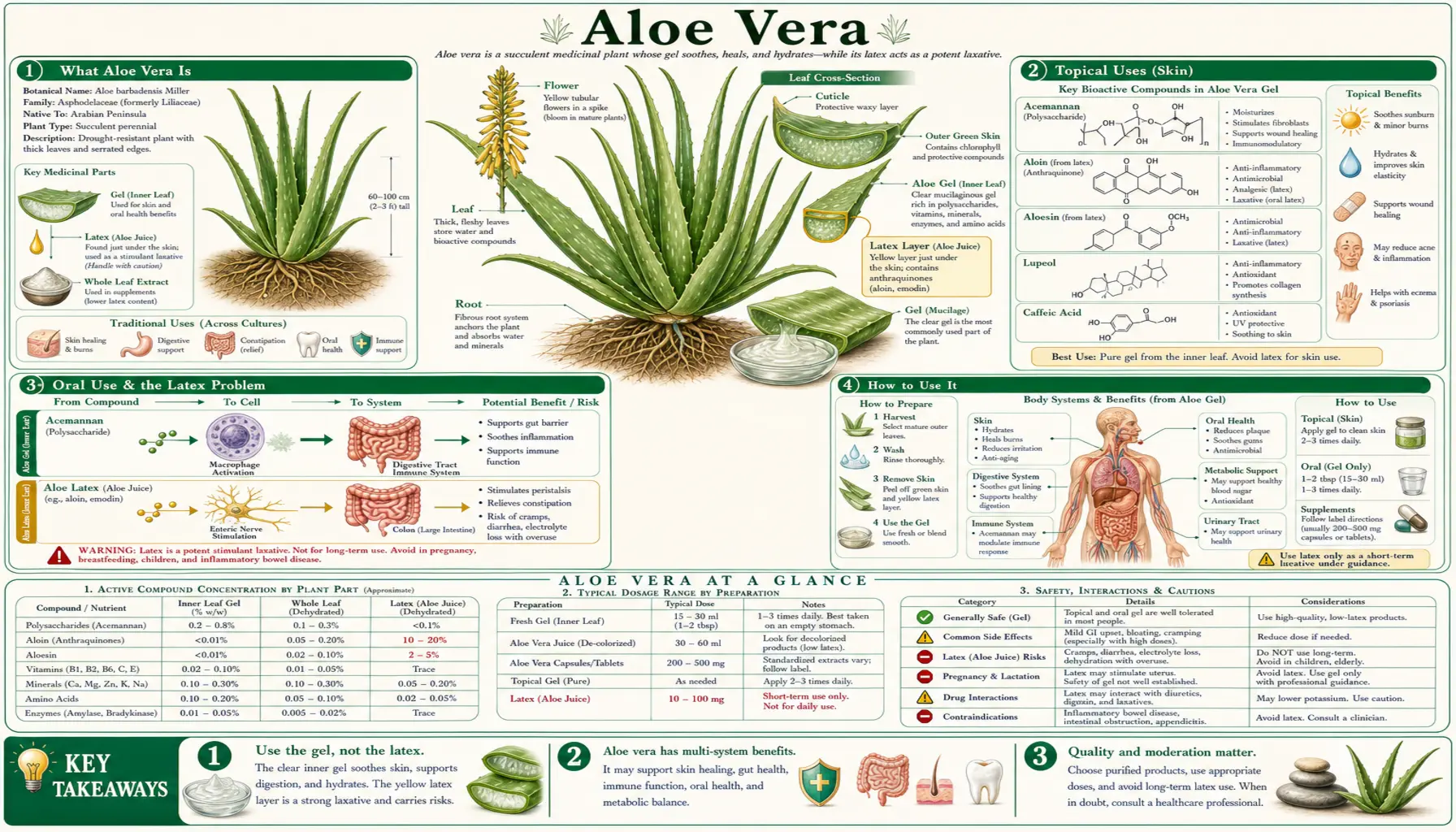
Aloe vera is one of the most familiar plants in the medicine cabinet — the go-to remedy for a kitchen burn or a bad sunburn. As a soothing topical gel for minor skin irritation, it is a reasonable, low-risk choice with modest scientific support. But "aloe" is really two very different substances, and the difference matters enormously for safety. The clear gel inside the leaf is one thing; the bitter yellow latex just under the skin — taken by mouth as a laxative — is another, and it carries real safety concerns, including a cancer signal in animal studies. This article keeps those two apart, because almost everything about aloe's risks and benefits depends on which part you mean and whether you put it on your skin or swallow it.
Table of Contents
- What Aloe Vera Is
- Topical Uses (Skin)
- Oral Use & the Latex Problem
- How to Use It
- Safety & Cautions
- The Bottom Line
- Research Papers
- Connections
- Featured Videos
What Aloe Vera Is
Aloe vera (botanical name Aloe barbadensis Miller) is a succulent plant with thick, spiky leaves that store a jelly-like fluid. Cut a leaf open and you'll find two distinct materials — and telling them apart is the single most important thing to understand about aloe.
- The inner-leaf gel. This is the clear, almost colorless jelly in the center of the leaf. It is mostly water, plus polysaccharides and other compounds. This is what goes into skin lotions, after-sun gels, and "aloe vera gel" drinks. On its own it is generally gentle.
- The latex (also called the sap or "aloe juice" in the old sense). This is a bitter, yellow liquid found in a thin layer just beneath the green leaf skin. It is rich in compounds called anthraquinones — chiefly aloin — which act as powerful stimulant laxatives. The latex is responsible for most of aloe's safety problems when taken by mouth.
"Whole-leaf" products contain both. When a leaf is ground up whole, the gel and the latex end up mixed together, so the product carries the latex's anthraquinones. By contrast, products labeled "inner-leaf," "decolorized," or "purified" are processed (often filtered through activated charcoal) to strip out most of the aloin. The difference is large: one analysis found roughly 100 times more aloin in non-decolorized whole-leaf extract than in decolorized extract. As you'll see, that processing step is central to how risky an oral aloe product is.
Topical Uses (Skin)
Putting aloe gel on the skin is where the plant earns its reputation. The evidence here is modest and somewhat mixed — most studies are small and not high quality — but the uses are plausible, the gel is inexpensive, and the risk is low. That combination makes it a sensible home remedy for minor skin troubles.
Minor burns and sunburn
This is aloe's best-supported use. A systematic review of controlled trials concluded that topical aloe vera may help first- and second-degree burns heal faster, though the authors stressed that the underlying trials were small and of generally poor quality, so the finding should be treated with caution. For a minor kitchen burn or an uncomfortable sunburn, a cool aloe gel is soothing and a reasonable choice.
Wound healing
Aloe is often promoted to speed wound healing, and there's some supportive laboratory and traditional-use rationale. But the honest picture is that the evidence for serious or surgical wounds is weak — some studies have even suggested aloe could slow healing of certain surgical wounds. For everyday scrapes and minor irritation it is generally fine; it is not a substitute for proper medical wound care.
Moisturizing and psoriasis
Aloe gel is widely used as a light, non-greasy moisturizer, and many people find it calming for dry or irritated skin. There is also some evidence that topical aloe preparations can help psoriasis plaques, though results across studies are inconsistent. As with its other skin uses, think of aloe as a gentle soother that may help rather than a proven treatment.
Bottom line for the skin: aloe gel is a reasonable, low-risk topical soother — most useful for minor burns, sunburn, and dry or irritated skin — with realistic, modest expectations.
Oral Use & the Latex Problem
Taking aloe by mouth is a completely different question from rubbing it on your skin, and this is the section to read carefully. The concerns here are real and are backed by regulators and toxicology studies — not internet rumor.
Aloe latex is a stimulant laxative — and the FDA pulled it
The anthraquinones in aloe latex (mainly aloin) are strong stimulant laxatives: they irritate the lining of the gut to force a bowel movement. For decades, aloe was an ingredient in over-the-counter laxatives. That ended in 2002, when the U.S. Food and Drug Administration ruled that aloe (and a related ingredient, cascara sagrada) was not generally recognized as safe and effective for OTC laxative use. The reason is telling: the FDA had asked manufacturers to provide safety data — including studies on cancer risk and genetic damage — and the companies did not supply it. Rather than a clean bill of health, aloe laxatives left the market because their safety was never demonstrated.
A cancer signal in animal studies
The safety questions are not merely theoretical. The U.S. National Toxicology Program ran a two-year study in which rats drank water containing non-decolorized whole-leaf aloe vera extract. The result was "clear evidence of carcinogenic activity": the rats developed tumors of the large intestine (cecum and colon), progressing from tissue overgrowth to adenomas and carcinomas. On the strength of this and similar animal data, the International Agency for Research on Cancer (IARC) classifies whole-leaf extract of aloe vera as "possibly carcinogenic to humans" (Group 2B). There is not enough human data to know the risk in people, but a "clear evidence" animal carcinogenicity finding is a serious flag — and it points specifically at the aloin-containing whole-leaf and latex products, not the purified gel.
Where decolorized gel fits in
The animal cancer signal tracks with the anthraquinone (aloin) content, which is why decolorized / purified inner-leaf gel — with the aloin largely removed — is considered lower risk than whole-leaf or latex products. If someone is going to take aloe by mouth at all, the purified inner-leaf form is the more sensible choice. It is not, however, a free pass: the long-term safety of even oral gel is not fully established.
What oral gel has actually been studied for
Oral aloe gel (not latex) has been tested for metabolic conditions. For blood sugar, a systematic review and meta-analysis found that aloe may modestly improve fasting glucose and HbA1c in people with prediabetes and type 2 diabetes — but the trials were small and varied widely, so the authors called for better-quality studies before recommending it. Some of those same studies also reported small improvements in cholesterol and triglycerides. The overall evidence is limited and mixed: aloe gel is not a proven treatment for diabetes or high cholesterol, and it should never replace prescribed medication.
The bottom line on oral aloe: be cautious. Avoid latex and whole-leaf products, do not use aloe as a routine laxative, and treat any oral aloe — even the gel — as something to discuss with a clinician rather than a casual daily supplement.
How to Use It
On the skin (the low-risk option)
- Fresh gel: Slice open a leaf, scoop out the clear inner gel, and apply a thin layer to intact skin — a sunburn, a minor burn after it has cooled, or a patch of dry skin. Avoid scraping up the yellow layer near the rind.
- Store-bought gel: Choose a quality product where aloe is high on the ingredient list and there's minimal added fragrance or alcohol (which can sting and irritate). Reapply as needed for comfort.
- Use it for minor issues. Deep, large, or infected burns and wounds need medical care, not aloe.
By mouth (only with caution)
- If you use oral aloe at all, choose products clearly labeled "inner-leaf," "decolorized," or "purified" — not "whole-leaf" and not aloe latex.
- Do not use aloe latex as a regular laxative. Stimulant laxatives are not meant for ongoing use, and aloe latex specifically carries the cancer and electrolyte concerns described above. Gentler, better-studied options exist for constipation — ask a pharmacist or clinician.
- Because oral aloe can affect blood sugar and interact with medicines, talk to a clinician or pharmacist before taking it regularly — especially if you take prescription drugs.
Safety & Cautions
Topical gel
Aloe gel on the skin is generally well tolerated. The main issue is an occasional allergic skin reaction (redness, itching, rash). It's worth doing a quick patch test — dab a little on the inner forearm and wait a day — before slathering it over a large area, particularly if you have sensitive skin or known plant allergies.
Oral latex and whole-leaf
This is where the real cautions live:
- Immediate effects: cramping, abdominal pain, and diarrhea. Repeated use can cause loss of electrolytes — especially potassium — and harmless-but-telling dark pigmentation of the colon lining (pseudomelanosis coli).
- Pregnancy and breastfeeding: avoid oral aloe latex. Its strong laxative action could stimulate the uterus, and anthraquinones may pass into breast milk and cause diarrhea in a nursing infant.
- Children: oral aloe latex is not recommended.
- Bowel conditions: avoid oral aloe if you have intestinal problems such as Crohn's disease, ulcerative colitis, a blocked or inflamed bowel, appendicitis, or unexplained abdominal pain.
- The cancer concern from animal studies applies to ingested whole-leaf / non-decolorized aloe, which is another reason to avoid those products by mouth.
Medication interactions (oral aloe)
- Diuretics ("water pills"): combining them with aloe latex can drop potassium dangerously low, because both can deplete potassium.
- Digoxin (a heart medicine): low potassium from aloe latex can make digoxin more dangerous — this combination should be avoided.
- Other oral medications: aloe latex speeds things through the gut and may reduce how well other medicines are absorbed, lowering their effect.
- Diabetes medicines: oral aloe gel may add to their blood-sugar-lowering effect, raising the risk of hypoglycemia (low blood sugar).
- Other stimulant laxatives: stacking them with aloe latex worsens diarrhea and potassium loss.
The Bottom Line
Aloe is two stories in one plant. As a topical gel for minor burns, sunburn, and dry or irritated skin, it is a genuinely useful, low-risk home remedy — modest evidence, easy to use, and gentle, as long as you watch for the occasional skin allergy. Oral aloe is a different story. The latex is a harsh stimulant laxative that the FDA removed from over-the-counter products for lack of safety data, and ingested whole-leaf aloe carries a real cancer signal from animal studies (IARC Group 2B). If you reach for aloe, favor the gel on your skin. If you're considering taking aloe by mouth, be skeptical — avoid latex and whole-leaf products, never use it as a routine laxative, choose purified inner-leaf forms if anything, and check with a clinician first.
Research Papers
- Maenthaisong R, Chaiyakunapruk N, Niruntraporn S, Kongkaew C. The efficacy of aloe vera used for burn wound healing: a systematic review. Burns. 2007;33(6):713–718. doi:10.1016/j.burns.2006.10.384 — Pooled controlled trials suggest topical aloe may shorten healing of first- and second-degree burns, but the trials were small and low-quality, so the conclusion is tentative.
- Surjushe A, Vasani R, Saple DG. Aloe vera: a short review. Indian J Dermatol. 2008;53(4):163–166. doi:10.4103/0019-5154.44785 — A dermatology overview of aloe's skin uses that emphasizes promising traditional applications alongside a real shortage of controlled efficacy data.
- Boudreau MD, Mellick PW, Olson GR, et al. Clear evidence of carcinogenic activity by a whole-leaf extract of Aloe barbadensis Miller (aloe vera) in F344/N rats. Toxicol Sci. 2013;131(1):26–39. doi:10.1093/toxsci/kfs275 — The National Toxicology Program study showing that non-decolorized whole-leaf aloe in drinking water caused large-intestine tumors in rats ("clear evidence of carcinogenic activity").
- Suksomboon N, Poolsup N, Punthanitisarn S. Effect of Aloe vera on glycaemic control in prediabetes and type 2 diabetes: a systematic review and meta-analysis. J Clin Pharm Ther. 2016;41(2):180–188. doi:10.1111/jcpt.12382 — Oral aloe modestly improved fasting glucose and HbA1c in prediabetes and type 2 diabetes, but the evidence base was small and heterogeneous, so better trials are needed.
- Guo X, Mei N. Aloe vera: a review of toxicity and adverse clinical effects. J Environ Sci Health C. 2016;34(2):77–96. doi:10.1080/10590501.2016.1166826 — A safety-focused review documenting the ~100-fold higher aloin in non-decolorized whole-leaf extract, the laxative and electrolyte effects of oral latex, and the colon-tumor findings.