Pandan (Pandanus amaryllifolius)
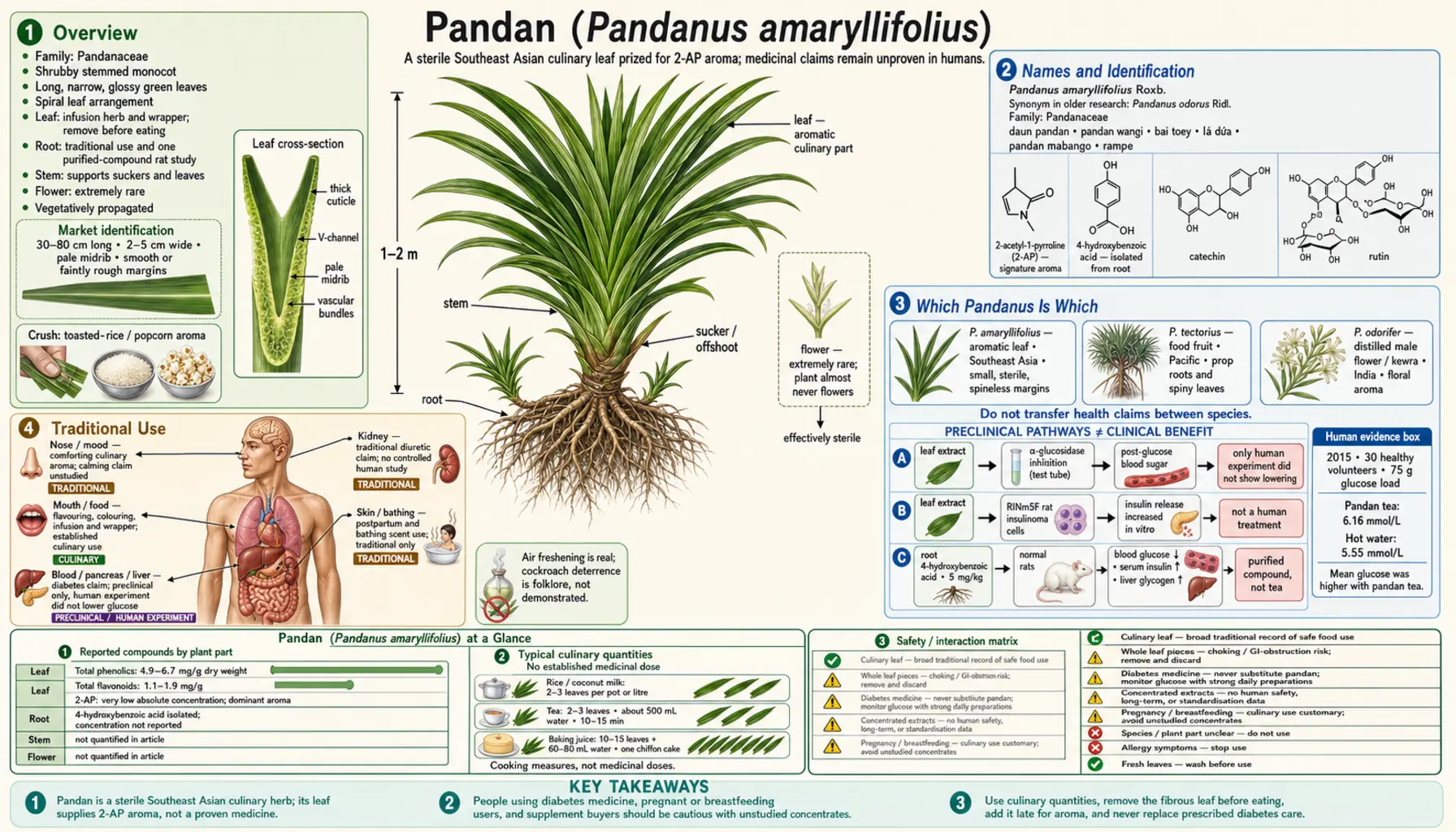
Pandan is a food before it is a medicine. Its long, glossy, strap-shaped leaves are the default sweet aromatic of Southeast Asian kitchens — knotted into a pot of coconut rice, blended into the green of a chiffon cake, wrapped around chicken before it hits the fryer. The reason it smells the way it does is genuinely interesting chemistry: pandan is packed with 2-acetyl-1-pyrroline, the very same molecule that makes basmati and jasmine rice smell like basmati and jasmine rice, but at a far higher concentration.
The medicinal story is much thinner, and this page will say so plainly. Pandan is often marketed for blood sugar. That claim rests on test-tube enzyme assays, rat-cell experiments, and one isolated compound given to normal rats — not on human trials. The single small human experiment that has been published did not show a glucose-lowering effect. Enjoy pandan for what it unambiguously is: one of the great aromatics of world cooking.
One more thing to get straight before anything else. “Pandan” is used loosely for several very different plants in the genus Pandanus. The fragrant culinary leaf on this page is Pandanus amaryllifolius. It is not the Pacific hala fruit (P. tectorius), and it is not the source of Indian kewra water (P. odorifer). Those are separate plants with separate uses, and mixing them up is the most common error in English-language writing about pandan.
Table of Contents
- Overview
- Names and Identification
- Which Pandanus Is Which
- Traditional Use
- Active Compounds
- 2-Acetyl-1-Pyrroline: The Molecule Behind the Aroma
- Blood Sugar: What the Studies Actually Show
- Antioxidant and Antimicrobial Activity
- Diuretic and Other Traditional Claims
- Culinary Use
- Forms and Preparations
- Dosage
- Cautions and Contraindications
- Key Research Papers
- Connections
- Featured Videos
Overview
Pandan is a shrubby, stemmed monocot that grows to roughly one to two metres. Its leaves are long, narrow, bright green and shiny, arranged in a spiral around the stem — which is where the English name screwpine comes from. It is neither a pine nor a relative of the pineapple, despite looking a little like both; the family is Pandanaceae, a group of mostly coastal and wetland tropical plants.
Only the leaf is used. In the Southeast Asian kitchen it functions as an infusion herb and a wrapper rather than as a vegetable. The leaf blade is tough and fibrous, so it is bruised, knotted, blended-and-strained, or tied around food — and then removed. Nobody eats a pandan leaf whole.
Pandanus amaryllifolius is a remarkable plant in one respect that rarely gets mentioned: it is effectively sterile. It almost never flowers, has not been recorded fruiting in cultivation, and has no confirmed wild population. Every pandan plant in every garden in Southeast Asia is propagated vegetatively, from suckers and offshoots pulled off an existing plant. In genetic terms the species is close to a single vast clone, spread by human hands over centuries of gardening. It is one of the very few major culinary herbs of the world that reproduces only because people keep dividing it.
Because it is grown from offshoots, pandan is an easy backyard plant across the tropics: warm, humid, part shade, moist soil. Outside the tropics it is a houseplant that resents cold and dryness. That accessibility explains its ubiquity — in Malaysia, Indonesia, Thailand, Vietnam, the Philippines and Sri Lanka, pandan is more likely to come from the garden or the neighbourhood market than from a supply chain.
Names and Identification
Botanical name: Pandanus amaryllifolius Roxb. — family Pandanaceae. You will also see the synonym Pandanus odorus Ridl. in the older pharmacology literature, which matters when you go looking for research (see the blood-sugar section below).
Local names:
- Malay / Indonesian: daun pandan (literally “pandan leaf”); pandan wangi in Indonesian, “fragrant pandan”
- Thai: bai toey or bai toey hom (ใบเตยหอม) — bai = leaf, hom = fragrant
- Vietnamese: lá dứa (leaf of the “pineapple-like” plant — the name refers to the resemblance, not a relationship)
- Tagalog / Filipino: pandan mabango
- Sinhala (Sri Lanka): rampe
- Khmer: toey; Burmese: commonly transliterated as tayaw
- English: pandan, pandan leaf, fragrant screwpine
How to identify it at the market. Fresh pandan is sold in bundles of long, flat, V-channelled leaves, 30–80 cm long and 2–5 cm wide, deep glossy green on top and slightly paler below, with a pale midrib. The margins are smooth or only faintly rough — unlike most wild Pandanus species, which have distinctly spiny edges and spines along the underside of the midrib. The decisive test is the smell: crush or tear a leaf and you should get an immediate wave of warm, sweet, toasted-rice, popcorn-like aroma. If a leaf looks like pandan but smells of nothing, it is a different screwpine.
Which Pandanus Is Which
This is the single most useful piece of information this page carries. Three plants get called “pandan” or “screwpine” in English, and they are used for completely different things.
- Pandanus amaryllifolius — fragrant pandan. The culinary leaf of Southeast Asia. Small, sterile, spineless-margined, intensely aromatic from 2-acetyl-1-pyrroline. This is the plant this page is about, and the only one of the three whose leaf is the aromatic part.
- Pandanus tectorius — beach screwpine, hala, pandanus fruit. A large coastal tree or shrub with stilt-like prop roots, spiny leaves, and a heavy segmented fruit that looks like a green or orange pineapple crossed with a grenade. In Micronesia, Polynesia, Kiribati and parts of coastal Southeast Asia the fruit is a traditional food — chewed raw in some varieties, cooked or processed into paste in others, since many forms are fibrous and astringent. The leaves are the classic weaving material for mats, baskets and thatch. The leaf is not an aromatic; you cannot substitute it for cooking pandan.
- Pandanus odorifer — kewra, keora, umbrella tree. A South Asian screwpine whose male flowers are steam-distilled to produce kewra water (kewra jal) and kewra attar, an important flavouring in North Indian biryani, sweets such as rasmalai and gulab jamun, and in perfumery. Odisha in eastern India is the traditional centre of production. Kewra smells nothing like cooking pandan — it is floral, honeyed and rose-like, driven mainly by 2-phenylethyl methyl ether rather than 2-acetyl-1-pyrroline. If a recipe calls for kewra water, pandan leaf is not a substitute, and vice versa. This species also appears under the names P. fascicularis and, confusingly, P. odoratissimus.
A practical rule: leaf aromatic and Southeast Asian → P. amaryllifolius. Fruit food and Pacific → P. tectorius. Distilled flower water and Indian → P. odorifer. Health claims made for one species should never be transferred to another, and a good deal of loose writing online does exactly that.
Traditional Use
Pandan's traditional role is overwhelmingly culinary and household — it is a flavouring, a colouring and a scent long before it is a remedy. Where it does appear in traditional medicine, the uses are modest and domestic rather than formal.
- Malay and Indonesian jamu practice: pandan leaf decoction as a mild refreshing drink, sometimes taken for restlessness or as a general tonic; combined with other aromatics in postpartum and bathing preparations for its scent.
- Thai household medicine: bai toey water taken as a cooling drink; the root of the plant has a separate small tradition as a diuretic and for “heat” conditions and diabetes.
- Vietnamese thuốc nam: lá dứa infusions as a pleasant everyday tea, occasionally in mixed formulas for “cooling.”
- Sri Lanka and southern India: rampe as a kitchen aromatic; screwpine species more broadly appear in Ayurvedic and Siddha texts, but usually the flowering species used for kewra rather than the culinary leaf.
- Household use: bundles of pandan leaf placed in cupboards, cars and rice bins as an air freshener and, by folk reputation, a cockroach deterrent. The freshening is real. The insect claim is folklore and has not been demonstrated.
Traditional use tells you what people did. It does not tell you whether it worked. Pandan has an unusually clean traditional record — it is used casually, in food quantities, by hundreds of millions of people, which is reassuring about safety but says nothing about efficacy.
Active Compounds
Pandan leaf is mostly water and fibre. Its chemistry is dominated by a handful of volatile aroma compounds present in tiny amounts, plus a modest set of ordinary plant phenolics.
- 2-Acetyl-1-pyrroline (2-AP) — the signature aroma compound, discussed in detail in the next section. It is present at very low absolute concentration but has an extraordinarily low odour threshold, so it dominates the smell.
- Other volatiles — the leaf essential oil is a minor fraction and its composition varies with variety and extraction method; reported constituents include aliphatic aldehydes, esters and terpenoids. A Chinese analysis of the leaf essential oil catalogued its components in detail (Chen and Ge, 2014).
- Pandanus alkaloids — a family of pyrrolidine alkaloids peculiar to the genus, including pandamarilactones and pandanamine. These are chemically interesting and are the subject of synthetic-chemistry papers, but their pharmacology in humans is essentially unstudied.
- Flavonoids and phenolic acids — a 2013 Malaysian analysis quantified catechin, epicatechin, naringin, rutin and kaempferol, plus gallic, cinnamic and ferulic acids. Total phenolic content ranged from about 4.9 to 6.7 mg per gram of dry weight and total flavonoids from about 1.1 to 1.9 mg/g, varying by growing location (Ghasemzadeh and Jaafar, 2013).
- Chlorophyll and carotenoids — the source of the natural green colour that pandan lends to cakes and jellies.
Put those phenolic numbers in context. Around 5–7 mg of total phenolics per gram of dried leaf is a low-to-middling figure for a green plant; green tea, clove and rosemary are an order of magnitude higher. Pandan is not a concentrated source of antioxidants, and describing it as a “superfood” on the strength of these numbers would be misleading. It is a flavouring.
2-Acetyl-1-Pyrroline: The Molecule Behind the Aroma
If you have ever wondered why pandan smells simultaneously of hot rice, fresh bread crust and popcorn, the answer is a single small nitrogen-containing ring compound: 2-acetyl-1-pyrroline, usually abbreviated 2-AP.
2-AP was identified in 1982 by Ron Buttery and colleagues as the principal compound responsible for the aroma of basmati and other scented rices. Because the molecule is chemically unstable and present at vanishingly low concentrations, it eluded chemists for decades — a 2017 review in the Journal of the Science of Food and Agriculture traced the thirty-three years of work that followed its discovery and noted that it has since been found in a remarkably wide range of plants, animals, fungi, bacteria and processed foods (Wakte and colleagues, 2017).
Why the same molecule in rice and pandan? In fragrant rice, 2-AP accumulates because of a loss-of-function change in the gene for betaine aldehyde dehydrogenase 2 (BADH2). When that enzyme is disabled, its substrate builds up and is converted onward to 2-AP. Almost all the world's famous aromatic rices — basmati, jasmine, and many local landraces — carry a version of this same mutation. Pandan makes 2-AP constitutively, in the leaf, without needing any such defect, and it makes a great deal more of it.
How much more? Reported values vary widely with leaf age, cultivar and analytical method, but pandan leaf typically contains 2-AP at roughly an order of magnitude or more above the level found in fragrant rice grain. That is the practical reason a couple of knotted leaves can perfume an entire pot of rice: you are adding a concentrated natural source of exactly the compound the rice would ideally have made for itself. In parts of Southeast Asia, cooks have long added pandan to ordinary rice for precisely that reason, long before anyone knew why it worked.
2-AP's other party trick is its odour threshold, which sits in the parts-per-billion range — among the lowest of any common food aroma compound. Human noses are exquisitely tuned to it. This is also why it turns up as the smell of freshly baked bread crust and of popcorn, where it forms during the Maillard reaction between proline and sugar breakdown products rather than being made by a living plant.
The instability of 2-AP has direct kitchen consequences. It degrades with heat, oxygen and time. Fresh and frozen pandan leaves smell far stronger than dried ones, and long boiling drives off much of the aroma. Most commercial pandan “essence” and bright-green paste contains added colouring and synthetic flavour rather than a true leaf extract, which is why the flavour is often flatter and sweeter than the real thing.
Interest in 2-AP now extends well beyond flavour. A 2024 study in Current Biology reported that 2-AP in fragrant rice is linked to nitrogen assimilation and to reduced methane emissions from paddy fields — an unexpected agronomic role for a compound most people know only as a smell (Chen and colleagues, 2024).
Blood Sugar: What the Studies Actually Show
Pandan tea is widely sold and shared online as a natural blood-sugar remedy. Here is the entire evidence base, described honestly.
The rat and test-tube work. In 1998, a Thai group at Mahidol University used hypoglycaemia-guided fractionation to isolate 4-hydroxybenzoic acid from the root of Pandanus odorus Ridl. (a name generally treated as a synonym of P. amaryllifolius). Given orally at 5 mg/kg to normal rats, the isolated compound lowered blood glucose and raised serum insulin and liver glycogen (Peungvicha and colleagues, 1998). Three things to notice: the part used was the root, not the leaf; the agent was a purified single compound, not a tea; and the animals were healthy, not diabetic.
The human experiment. A 2015 study in Pharmacognosy Magazine gave 30 healthy volunteers either pandan-leaf tea or hot water fifteen minutes after a standard 75 g oral glucose load. The paper's own reported result was that mean blood glucose was higher in the pandan group (6.16 mmol/L) than in the hot-water control group (5.55 mmol/L), a difference the authors describe as statistically significant. The study's positive findings came from its laboratory arms: the leaf extracts inhibited the enzyme α-glucosidase and increased insulin release from RINm5F rat insulinoma cells in a dose-dependent way (Chiabchalard and Nooron, 2015).
So the mechanism is plausible — α-glucosidase inhibition is a real drug target, the same one acarbose acts on — but the only human data published did not show pandan tea lowering glucose after a sugar load. A 2024 review in Fitoterapia that catalogued more than 100 compounds identified in the plant likewise describes the hypoglycaemic evidence as coming from pharmacological (that is, preclinical) studies (Wang and colleagues, 2024).
What this means for you. There is no randomised controlled trial of pandan in people with diabetes or prediabetes. There is no established dose, no known duration of effect, and no data on interaction with diabetes medication. Pandan tea is a pleasant, safe-tasting drink. It is not a treatment for diabetes, and it should not displace metformin, insulin, dietary change or a clinician's monitoring. If you like it, drink it — and keep checking your numbers the way you already do.
Antioxidant and Antimicrobial Activity
Pandan's antioxidant credentials are real but small, and the most useful demonstration of them is a food-science one rather than a clinical one.
A Malaysian study published in Food Chemistry in 2008 tested pandan leaf extracts as stabilisers in accelerated oxidation and repeated deep-frying trials — that is, as a natural alternative to synthetic antioxidants such as BHA in cooking oil. The extracts slowed oil degradation (Nor and colleagues, 2008). That is an interesting result for food manufacturing. It says nothing about what happens to oxidative stress inside a human body.
The 2013 phenolic profiling study also ran a standard cell-viability screen against the MCF-7 breast cancer cell line and reported inhibition rates of 67–78% depending on growing location (Ghasemzadeh and Jaafar, 2013). Cell-line screens like this are a first-pass filter; a very large fraction of plant extracts show activity in them, and only a tiny fraction of those ever translate into anything useful. This is preliminary laboratory data and should not be read as evidence that pandan does anything to cancer.
Antimicrobial activity has been reported for leaf extracts and essential oil in laboratory assays, and is summarised in the 2024 Fitoterapia review. Again: petri dishes, not patients.
Honest summary: pandan contains ordinary plant antioxidants at ordinary-to-low concentrations, and behaves like a mild natural antioxidant in food systems. There is no human trial evidence that eating or drinking pandan changes any measured health outcome.
Diuretic and Other Traditional Claims
Beyond blood sugar, pandan carries a scatter of traditional claims — diuretic, mild sedative or “calming,” anti-inflammatory, good for fever, good for skin. The pattern for all of them is the same: a plausible traditional use, occasional supporting rodent or in-vitro work in the review literature, and no human trials at all.
The diuretic claim is the most persistent. It is consistent with pandan's use as a light, palatable tea — drinking more fluid produces more urine, which may be a large part of the traditional observation. No controlled human study of pandan's effect on urine output or renal handling of sodium has been published, so there is nothing to quantify.
The “calming” claim is likewise unstudied. Aroma itself has real, measurable effects on mood and arousal, and a smell that a person associates with home cooking and childhood will reliably feel comforting. That is a genuine effect and worth nothing more or less than what it is.
We would rather leave this section short and honest than pad it. Where a herb has almost no human data, the responsible thing is to say so.
Culinary Use
This is where pandan earns its place. It is one of a small handful of ingredients — alongside coconut, palm sugar and glutinous rice — that define the sweet side of Southeast Asian cooking, and it works on the savoury side too.
The classic dishes
- Pandan chiffon cake (Singapore, Malaysia, Indonesia) — the icon. A tall, extremely light, pale-green sponge leavened with whipped egg white and flavoured with pandan extract and coconut milk. Bakeries in Singapore sell them by the thousand. The best versions use real pandan juice, which gives a softer, greyer green than the fluorescent shade of bottled paste.
- Kaya (also srikaya) — a slow-cooked jam of coconut milk, eggs and sugar, scented and coloured with pandan. Spread thickly on charcoal-toasted white bread with a slab of cold butter, it becomes kaya toast, the breakfast of Singapore and Malaysia's kopitiam coffee shops.
- Nasi lemak (Malaysia, Singapore, Brunei) — rice cooked in coconut milk with a knotted pandan leaf in the pot, served with sambal, fried anchovies, peanuts, cucumber and egg. The pandan is not optional; without it the rice tastes flat.
- Gai ho bai toey (ไก่ห่อใบเตย, Thailand) — chicken marinated in soy, oyster sauce, sesame and coriander root, wrapped in a pandan leaf and deep-fried. The leaf is a wrapper and a steam-basket: it perfumes the meat and keeps it juicy, then gets unwrapped and discarded at the table.
- Chè (Vietnam) — the vast family of sweet soups, puddings and drinks. Lá dứa flavours and colours many of them, along with bánh da lợn, the steamed layer cake that alternates pandan-green and mung-bean-yellow strata.
- Kuih (Malay and Nyonya sweets) — an entire genre. Kuih seri muka (glutinous rice base with a pandan custard top), kuih lapis (steamed layer cake), ondeh-ondeh (pandan-scented glutinous rice balls with a molten palm-sugar centre, rolled in grated coconut), putu ayu, talam.
- Savoury uses — a knotted leaf dropped into curries, rendang, coconut soups, congee and braises across Malaysia, Indonesia, Thailand and Sri Lanka. In Sri Lankan cooking, rampe goes into rice and into curry bases alongside curry leaf and lemongrass.
- Drinks — pandan-infused iced tea and barley water, pandan-scented syrups, pandan latte, and increasingly pandan in Western pastry and ice cream.
How cooks actually use it
- Knotted whole. Two or three leaves are tied into a loose knot and dropped into the pot. The knot stops the leaves unravelling and tangling, and makes them easy to fish out at the end. Bruise the leaf first — a quick twist or a whack with the back of a knife — to break cells and release aroma.
- Blended and strained (“pandan juice”). Chop the leaves, blend with a little water, then squeeze through muslin. This is the extract used for cakes and custards. Traditional cooks often let the juice stand overnight in the fridge so the concentrated green sediment settles out and can be used alone for maximum colour and flavour.
- As a wrapper. Used whole around chicken, fish or sticky rice parcels; the leaf is a flavouring vessel, not part of the meal.
- Add late for aroma. Because 2-AP is volatile and heat-sensitive, long simmering blows off much of the fragrance. For maximum scent, add pandan toward the end of cooking, or infuse off the heat with the lid on.
- Freeze, don't dry. Fresh leaves keep about a week wrapped in the refrigerator and freeze extremely well for months. Dried pandan retains only a shadow of the aroma.
Forms and Preparations
- Fresh leaves — sold in bundles in Asian groceries, usually refrigerated. The best form by a wide margin. Look for firm, deep-green, unblemished leaves and check that they smell strongly when scratched.
- Frozen leaves — widely available and a genuinely good substitute; freezing preserves the aroma far better than drying. Use straight from frozen.
- Dried leaves and pandan tea bags — convenient, much weaker, and often smell more of hay than of pandan. Fine for a tea, disappointing in baking.
- Pandan extract, essence or paste — read the label. Many products are largely water, sugar, propylene glycol, synthetic flavour and green dyes (often tartrazine and brilliant blue). A minority are genuine concentrated leaf extract. If the green is nuclear, it is dye.
- Pandan powder — freeze-dried or spray-dried leaf; quality is highly variable.
- Capsules and “pandan extract” supplements — marketed mainly for blood sugar. There is no standardised marker compound, no established dose, and no human trial supporting them. We would not recommend spending money here.
- Live plants — sold as rooted offshoots. If you can grow it, do; a single plant supplies a household.
Dosage
There is no established medicinal dose of pandan. No human trial has identified an effective quantity for any health outcome, so any number you see on a supplement label is invented rather than derived.
What can be described are ordinary culinary quantities, which have centuries of everyday use behind them:
- In rice or coconut milk: 2–3 leaves, bruised and knotted, per pot of rice or per litre of liquid.
- As a tea: 2–3 fresh leaves, chopped, steeped in about 500 mL of just-off-the-boil water for 10–15 minutes, covered.
- For pandan juice in baking: roughly 10–15 leaves blended with 60–80 mL water and strained yields the concentrated extract for one chiffon cake.
These are cooking measures, not doses. Treat pandan the way you treat bay leaf or vanilla — as a flavouring used in the amounts that taste right.
Cautions and Contraindications
Pandan leaf used in food has a long, broad record of safe use across Southeast Asia by very large numbers of people, including children and pregnant women, over many generations. That is genuine reassurance about the culinary form. It does not extend to concentrated extracts or supplements, which have no human safety data at all.
- Do not eat the leaf itself. It is tough and fibrous. Pandan is an infusion herb and a wrapper — remove and discard it. Swallowing pieces of leaf is a choking and gastrointestinal-obstruction risk, particularly for small children.
- Diabetes medication. This is the one interaction worth taking seriously, precisely because pandan is marketed for blood sugar. The human evidence does not support a glucose-lowering effect, so the practical risk is the opposite of the usual one: substituting pandan tea for prescribed medication. Do not do that. If you are on insulin or a sulfonylurea and start drinking strong pandan preparations daily, monitor your glucose as you would with any new routine, and tell your prescriber.
- Concentrated extracts and supplements. No toxicology studies in humans, no data on long-term use, no standardisation. The Pandanus alkaloids in particular have not been characterised toxicologically. Food amounts are one thing; a concentrated capsule is a different exposure entirely, and nobody has studied it.
- Pregnancy and breastfeeding. Culinary use is customary and unremarkable throughout the region. Concentrated extracts and supplements have not been studied and should be avoided on the general principle that unstudied concentrates do not belong in pregnancy.
- Species confusion. Health claims and safety data do not transfer between Pandanus species. Some Pandanus fruits are astringent and require processing before eating; kewra water is a distilled product from a different plant and a different part. If a product simply says “screwpine” or “pandanus extract” without naming the species and plant part, you do not know what you have bought.
- Allergy. Reports are rare, but any plant can sensitise. Stop if you get itching, rash or mouth tingling.
- Contamination. Fresh pandan is often grown domestically or semi-wild and may carry soil or agricultural residue. Wash the leaves before use.
Key Research Papers
- Wakte K, Zanan R, Hinge V, Khandagale K, Nadaf A, Henry R. Thirty-three years of 2-acetyl-1-pyrroline, a principal basmati aroma compound in scented rice (Oryza sativa L.): a status review. Journal of the Science of Food and Agriculture. 2017;97(2):384–395.
- Wang W, Ren Z, Zheng S, Wu H, Li P, Peng W, Su W, Wang Y. Botany, phytochemistry, pharmacology, and applications of Pandanus amaryllifolius Roxb.: a review. Fitoterapia. 2024;177:106144.
- Chiabchalard A, Nooron N. Antihyperglycemic effects of Pandanus amaryllifolius Roxb. leaf extract. Pharmacognosy Magazine. 2015;11(41):117–122.
- Peungvicha P, Temsiririrkkul R, Prasain JK, Tezuka Y, Kadota S, Thirawarapan SS, Watanabe H. 4-Hydroxybenzoic acid: a hypoglycemic constituent of aqueous extract of Pandanus odorus root. Journal of Ethnopharmacology. 1998;62(1):79–84.
- Ghasemzadeh A, Jaafar HZE. Profiling of phenolic compounds and their antioxidant and anticancer activities in pandan (Pandanus amaryllifolius Roxb.) extracts from different locations of Malaysia. BMC Complementary and Alternative Medicine. 2013;13:341.
- Nor FM, Mohamed S, Idris NA, Ismail R. Antioxidative properties of Pandanus amaryllifolius leaf extracts in accelerated oxidation and deep frying studies. Food Chemistry. 2008;110(2):319–327.
- Chen XK, Ge FH. Chemical components from essential oil of Pandanus amaryllifolius leaves. Zhong Yao Cai. 2014;37(4):616–620.
- Chen Y, Hua X, Li S, Zhao J, Yu H, Wang D, Yang J, Liu L. Aromatic compound 2-acetyl-1-pyrroline coordinates nitrogen assimilation and methane mitigation in fragrant rice. Current Biology. 2024;34(15):3429–3438.e4.
Live PubMed Searches
- Pandanus amaryllifolius — all research
- 2-acetyl-1-pyrroline
- 2-acetyl-1-pyrroline, rice aroma and the BADH2 gene
- Pandanus amaryllifolius and diabetes
- Pandanus alkaloids and pandamarilactones
- Pandanus amaryllifolius antioxidant activity
- Pandanus odorifer and kewra water
- Pandanus tectorius (Pacific screwpine)
- α-glucosidase inhibition by plant extracts and postprandial glucose
Connections
- All Herbs
- Lemongrass — the other pillar of the Southeast Asian aromatic pot, and pandan's usual companion in coconut-milk cooking.
- Makrut Lime — the citrus leaf that partners pandan and lemongrass in Thai and Malay dishes.
- Thai Basil — the anise-scented basil of the same kitchens.
- Galangal — the rhizome that completes the Thai and Indonesian aromatic base.
- Ginger — the most-studied culinary rhizome, and a useful comparison for what real human trial evidence looks like.
- Turmeric — another kitchen staple whose supplement claims outrun its human data.
- Coriander Seeds — a warm aromatic used alongside pandan in Malay and Thai spice pastes.
- Cinnamon — the other sweet-spice blood-sugar claim, with a similarly modest evidence base.
- Type 2 Diabetes — what actually works for blood-sugar control, and why herbal teas are not a substitute.
- Rutin — one of the flavonoids identified in pandan leaf.
- Antioxidants — how to read total-phenolic numbers without overinterpreting them.