Silk Cotton Tree (Bombax ceiba)
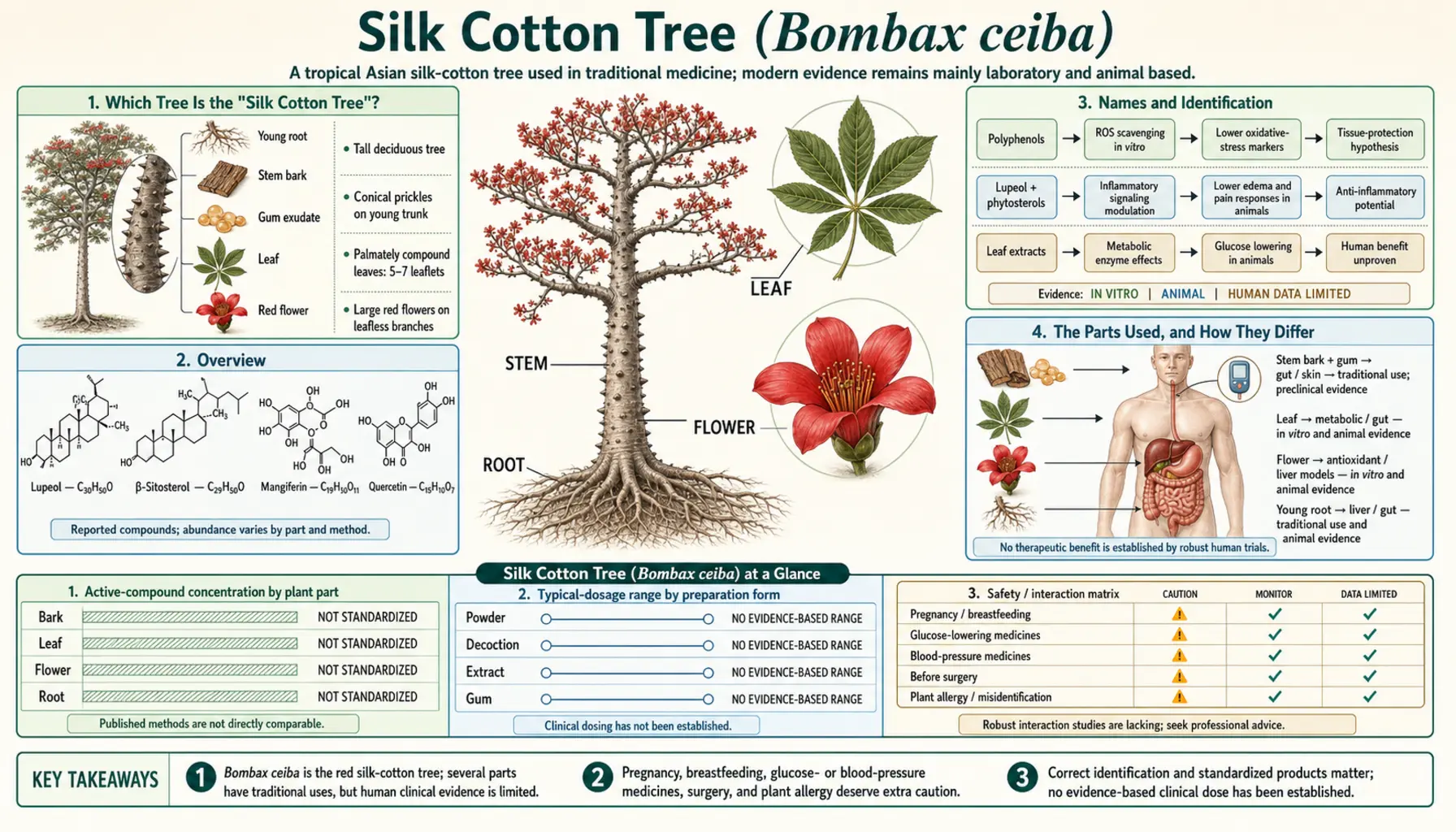
The red silk cotton tree, Bombax ceiba, is one of the most recognisable trees in tropical Asia: a tall, buttressed giant that drops every leaf in late winter and then covers its bare grey branches in enormous scarlet flowers, so that the whole tree looks lit from within before a single leaf returns. Four different parts of it — the flower, the gum, the root and the young fruit — are used in different traditions for completely different purposes, which is unusual and worth untangling carefully.
The evidence position has to be stated up front: there is no human clinical evidence for any medicinal use of Bombax ceiba. Everything in the research literature is test-tube chemistry or rodent screening — antioxidant assays, blood-pressure and blood-sugar effects in anaesthetised animals, liver-protection models in rats. Not one of those findings has been tested in a controlled human trial. The flower is a genuine food in several cuisines and the gum is a genuine classical Ayurvedic material, and both of those statements are true independently of whether the plant treats anything.
A name warning also belongs at the top: "silk cotton tree" is applied to at least two unrelated genera, and the confusion is constant in both markets and literature. Which tree is which is the first section below.
Table of Contents
- Which Tree Is the "Silk Cotton Tree"?
- Overview
- Names and Identification
- The Parts Used, and How They Differ
- Traditional Use
- Active Compounds
- Antioxidant Research
- Blood Pressure and Blood Sugar: the Shamimin Work
- Liver Protection Studies
- Astringency, Diarrhoea and Bleeding
- The Semal Musli Aphrodisiac Claim
- Culinary Use
- Forms and Preparations
- Dosage
- Cautions and Contraindications
- Key Research Papers
- Connections
- Featured Videos
Which Tree Is the "Silk Cotton Tree"?
Two large tropical trees are routinely called the silk cotton tree in English, and they are not the same plant.
- Bombax ceiba L. — the red silk cotton tree. This page's subject. Native to tropical Asia, from India and southern China through mainland Southeast Asia and into northern Australia. Flowers are large and deep red or red-orange, appearing on bare branches in the dry season. Known as semal or simal in Hindi, mu mian in Chinese, hoa gạo in Vietnamese.
- Ceiba pentandra (L.) Gaertn. — kapok. A different genus. Native to the American tropics and West Africa, now planted throughout Asia. Flowers are small, creamy white or pinkish, not showy. This is the commercial kapok tree, whose floss stuffed generations of life jackets, mattresses and pillows because it is light and buoyant.
Both are in the mallow family (Malvaceae, in the group formerly given its own family, Bombacaceae), both have stout buttressed trunks, and both produce pods full of silky white floss around the seeds — which is why both ended up with the same English name. But their flowers, their origins and their traditional medicinal uses are different.
Why it matters to a reader here:
- Herbal products labelled "silk cotton" or "kapok" may contain either species. If you are looking for the Ayurvedic materials mochras or semal musli, you specifically want Bombax ceiba.
- The research literature is filed under the binomials. Searching "silk cotton tree" pulls up both trees plus a few others; searching Bombax ceiba gets you this one.
- Vietnamese usage is a live trap. Cây gòn in southern Vietnam usually means kapok, Ceiba pentandra; Bombax ceiba is more precisely cây gạo, hoa gạo or mộc miên. Both names circulate loosely for both trees.
A third confusion is worth naming: Cochlospermum religiosum is sometimes called the yellow silk cotton tree, and Bombax buonopozense is the West African red-flowered relative. Neither is Bombax ceiba.
Overview
Bombax ceiba is a fast-growing deciduous tree that reaches 20 to 40 metres, with a straight, pale grey trunk that young trees arm with hard conical prickles, and heavy horizontal branches arranged in tiers. Mature trees develop large plank buttresses at the base. The leaves are palmate — five to seven leaflets radiating from one point like fingers — and they drop completely in the dry season.
The flowering is the event. Between roughly February and April across South and Southeast Asia, the leafless tree produces cup-shaped flowers up to 12 cm across, thick and fleshy, in deep red to orange-red, held upright on bare branches. They are full of nectar and draw crowds of birds — mynas, bulbuls, parakeets, sunbirds. Fallen flowers carpet the ground beneath, which is how most people collect them: not by climbing, but by picking them up. After flowering, the tree sets woody capsules that split open to release seeds embedded in white floss, which blows through the air in drifts in early summer.
The tree is planted along roads and in villages across India, Bangladesh, Myanmar, Thailand, Laos, Cambodia, Vietnam and southern China, and it is culturally loaded — the city flower of Guangzhou, a fixture of northern Vietnamese village landscapes and poetry, a sacred tree in parts of India. Its route to use is domestic: fallen flowers gathered and dried on a mat, gum collected from a cut in the bark, roots dug from young saplings.
Names and Identification
Botanical name: Bombax ceiba L.
Synonyms in older literature: Bombax malabaricum DC., Salmalia malabarica (DC.) Schott & Endl. — both appear in Ayurvedic and colonial-era pharmacopoeias.
Family: Malvaceae (subfamily Bombacoideae; formerly placed in Bombacaceae).
Regional names:
- English: red silk cotton, red cotton tree, Malabar silk cotton, Indian kapok tree
- Hindi: semal, simal, semar; the gum is mochras (also spelled mocharas, moch ras)
- Sanskrit: shalmali; the gum is mocharasa
- Bengali: shimul
- Vietnamese: hoa gạo, cây gạo, mộc miên; also called gòn, though that name more often refers to kapok in the south
- Chinese: mu mian (木棉, "wood cotton"); the dried flower used in herbal drinks is mu mian hua
- Thai: ngiu, ngiu daeng ("red ngiu")
- Malay / Indonesian: kekabu, kabu-kabu (names also applied to kapok)
- Burmese: let-pan
Field identification: a big grey-trunked tree, leafless, with prickles on younger bark, tiered branches, and huge red flowers held upright on bare twigs in the dry season. If the flowers are small and white, you are looking at kapok, not this tree.
The Parts Used, and How They Differ
This is the section that saves the most confusion. Four parts of Bombax ceiba are used, and they are used for quite different things by quite different traditions. Treating them as one "herb" produces nonsense.
- The flower. Collected fallen or picked, used fresh as a vegetable and dried for herbal drinks. In Chinese practice, dried mu mian hua is a standard component of the Cantonese five-flower cooling tea and is used for damp-heat diarrhoea and dysentery. In India and Vietnam the flower is cooked. This is the most food-like part and the one most people will actually encounter.
- The gum or exudate — mochras. A reddish-brown resinous gum that oozes from cuts in the bark and hardens into irregular tears. This is the classical Ayurvedic material: a grahi (astringent, binding) drug used for diarrhoea, dysentery, and abnormal bleeding, particularly heavy menstrual bleeding. Mochras is the part with the deepest formal place in a traditional medical system.
- The root — semal musli. The fleshy taproot of a one- or two-year-old sapling, dried and powdered. Used in Ayurveda as a nourishing tonic and, more prominently in the modern market, sold with an aphrodisiac claim. It is also a documented adulterant of the much more expensive safed musli (Chlorophytum borivilianum), which is a different plant entirely.
- The young fruit and seed. Immature pods are cooked as a vegetable in parts of India. The seeds yield an oil; the floss around them is the "silk cotton" — too short and smooth to spin into thread, so it is used as stuffing.
- Bark and thorns get minor traditional use as well: bark decoctions as astringents, and thorn paste ground with milk applied to the face for pimples in Ayurvedic domestic practice.
None of these traditional distinctions has been validated by clinical research. But when reading a claim about Bombax ceiba, the first question worth asking is which part, because a study on root extract says nothing about the flower you might drink in a tea.
Traditional Use
Traditional use records history and practice. It does not establish that anything works.
Ayurveda. Shalmali appears in the classical Indian materia medica, with the gum mocharasa as the principal drug. Its assigned properties are astringent and binding: it is used for diarrhoea and dysentery, for excessive menstrual bleeding and other bleeding disorders, and as an ingredient in tonic formulations. The root, as semal musli, is classed among the vajikarana (virilising, reproductive-tonic) drugs.
Traditional Chinese and Cantonese folk practice. Dried mu mian hua flowers are used to clear "damp heat" — the traditional category that covers summer diarrhoea and dysentery — and appear in the everyday cooling teas drunk in Guangdong, Hong Kong and southern Vietnam during hot, humid months. This is closer to a daily beverage than a medicine.
Vietnam. Cây gạo is culturally central in the north, where its March flowering marks the season. Folk use of the bark and flower for digestive upset and for washing skin complaints is recorded in traditional thuốc nam practice.
Thailand, Myanmar and Laos. Dried flowers and stamens are used in cooling drinks and in northern Thai cooking; the tree also has minor uses in local traditional medicine for fever and diarrhoea.
Active Compounds
The chemistry of Bombax ceiba is reasonably well described — a good deal better described than its clinical effects. The named compounds most often reported are:
- Shamimin — a flavonol C-glycoside isolated from the leaves and named in Pakistani work in the late 1990s. It is the single compound most directly tied to a specific pharmacological claim in this plant: blood-pressure and blood-glucose lowering in anaesthetised animals.
- Lupeol — a pentacyclic triterpene found in the root bark and elsewhere in the plant. Lupeol is widespread across the plant kingdom (it is also in mango, fig and aloe) and has been studied extensively for anti-inflammatory and anticancer signalling in cell culture, with essentially no human data anywhere.
- Mangiferin — a xanthone C-glycoside, best known from mango leaves and bark. It is an antioxidant with a broad preclinical literature of its own, and its presence explains part of the antioxidant activity measured in Bombax extracts.
- Bombasin — a compound reported from the root bark of Bombax ceiba in phytochemical work, along with related derivatives. It is not well characterised pharmacologically and should not be presented as an active principle.
Alongside these: naphthoquinones and naphthol derivatives in the root and bark; flavonoids such as quercetin and kaempferol glycosides in the flowers; tannins, which are the plausible explanation for the astringency of the gum and bark; β-sitosterol and other plant sterols; and, in the seeds, a fixed oil containing the usual mix of palmitic, oleic and linoleic acids plus small amounts of cyclopropenoid fatty acids typical of the mallow family.
The tannin content is the most straightforward chemistry-to-tradition link on this page. Tannins bind and precipitate proteins; that is what "astringent" describes at the molecular level, and it is why a tannin-rich gum feels drying in the mouth and has been used traditionally to check discharge and bleeding. Whether that translates into a clinically meaningful effect on diarrhoea or menorrhagia is unknown, because nobody has run the trial.
Antioxidant Research
Mechanism. Flavonoids, xanthones such as mangiferin, and tannins all donate electrons readily and can neutralise free radicals in a test tube. Extracts of Bombax ceiba flower, bark and root reliably score well in the standard chemical antioxidant assays — DPPH radical scavenging, FRAP, ABTS — and in lipid-peroxidation models.
What level of evidence. Test tube and cell culture only. Several independent groups have published these results for different parts of the plant.
What it means. Less than it sounds like. A high DPPH score means a compound reacts with a purple dye in a cuvette. It does not mean the compound is absorbed, reaches any tissue at a relevant concentration, or changes anything in a person. Antioxidant assay results are the single most over-interpreted number in herbal research. Green tea, red wine and blueberries all score highly; so do many compounds that do nothing useful in the body. Treat these findings as chemistry, not as a health claim.
Blood Pressure and Blood Sugar: the Shamimin Work
This is the most specific pharmacological finding attached to Bombax ceiba, and it is worth describing precisely because it is often repeated as though it were a clinical result.
The finding. A flavonol C-glycoside named shamimin was isolated from Bombax ceiba leaves and reported to lower blood pressure and blood glucose in animals, with a toxicity assessment included in the same work. It was published in Planta Medica in 1999 by a group in Pakistan.
Mechanism. Not established. Flavonoid glycosides can influence vascular tone through nitric-oxide-mediated pathways and can affect glucose handling through several routes, but for shamimin specifically the mechanism was not worked out.
Level of evidence. Animal. Anaesthetised-animal blood-pressure measurement is a screening method, not a model of treating human hypertension. A compound that drops blood pressure acutely in an anaesthetised rat may do nothing, or something harmful, when swallowed daily by a person.
What has happened since. On human trials: nothing — shamimin itself has been cited widely in reviews for over two decades without ever progressing to a human study. But "very little has happened" undersells the wider preclinical picture once other parts of the plant are counted: leaf extract was tested against glucose, lipids and diabetic nephropathy markers in high-fat-diet and streptozotocin rat models in 2017, and separate flower-derived antidiabetic work followed in 2022 and root-derived enzyme-inhibition work in 2023. None of it is human evidence, and none of it changes the practical guidance below. It is a steadier trickle of preclinical interest, spread across parts, than "an isolated result that never advanced" suggests — see the part-by-part breakdown on the Benefits pages for the full picture.
Practical reading: do not take Bombax ceiba for high blood pressure or diabetes. There is no dose, no product standard, and no human data. If you already take blood-pressure or blood-glucose medication, this animal signal is a reason for caution about combining, not a reason to try it.
Liver Protection Studies
Mechanism proposed. Antioxidant compounds can reduce the oxidative injury that follows a chemical insult to liver cells. This is the standard hypothesis behind almost every "hepatoprotective plant" study.
Evidence level: rodent. Extracts of Bombax ceiba have been tested in the classical rat models of chemically induced liver injury — carbon tetrachloride, paracetamol overdose, and the tuberculosis drugs isoniazid and rifampicin — with reports of reduced serum ALT and AST and improved liver histology compared with untreated injured animals.
The important caveat. These models are extremely easy to show an effect in. Hundreds of plant extracts — probably most polyphenol-rich extracts ever tested — produce a positive result in carbon tetrachloride rat models. Very few have gone on to demonstrate anything in human liver disease. The one plant with meaningful human data in this space is milk thistle, and even there the trial results are mixed. A positive rat hepatoprotection study is a starting point, not a finding you should act on.
Do not use Bombax ceiba as a "liver support" while taking isoniazid, rifampicin or paracetamol on the strength of these studies. Drug-induced liver injury is monitored with blood tests and managed by stopping or changing the drug.
Astringency, Diarrhoea and Bleeding
The oldest and most consistent traditional use of this tree — mochras gum for diarrhoea, dysentery and excessive bleeding — rests on astringency.
Mechanism. Tannins cross-link proteins. Applied to a mucous membrane they precipitate surface proteins into a thin, tightened layer, which reduces secretion and can reduce oozing from small vessels. This is real, well-understood chemistry, and it is the same mechanism behind traditional astringents worldwide — oak bark, witch hazel, unripe fruit, strong black tea.
Level of evidence in this plant: traditional only. There is no clinical trial of mochras for diarrhoea, for dysentery, or for heavy menstrual bleeding. Extracts have been screened for antimicrobial activity in the laboratory with modest results, which is a different claim from treating an infection. Two more specific results have since been published: a 2025 rat study found the gum itself reduced gastric acidity and ulcer index in an induced-ulcer model, and a 2024 study found a Shalmali (Bombax ceiba) extract of unspecified plant part altered bleeding-related gene expression in human endometrial cells comparably to tranexamic acid. Neither is a clinical trial, and the second does not even confirm the gum was the material tested — both are covered in full, with their real limits, on the gum Benefits page.
Where the honest warning goes. Diarrhoea and abnormal bleeding are symptoms that need a cause identified, not just a binding agent applied.
- Acute infectious diarrhoea kills through dehydration. The intervention that saves lives is oral rehydration solution — salt, sugar and clean water — and it works regardless of the cause. Nothing on this page substitutes for it. Bloody diarrhoea, high fever, or diarrhoea in a small child or an older adult needs medical assessment.
- Heavy menstrual bleeding has treatable causes — fibroids, adenomyosis, polyps, thyroid disease, bleeding disorders, and, importantly, iron deficiency both as a cause of fatigue and a consequence of blood loss. Using a traditional astringent instead of getting a diagnosis means a treatable condition goes untreated and iron stores keep falling.
The Semal Musli Aphrodisiac Claim
Semal musli — the dried root of a young Bombax ceiba — is sold with an aphrodisiac and male-vitality claim, and appears in commercial "power" formulations across the Indian supplement market. Three things should be said about it.
- There is no clinical evidence. No human trial supports an aphrodisiac, fertility or testosterone effect for Bombax ceiba root. The claim rests on its classical vajikarana classification, which is a category in a traditional system, not a trial result.
- It is a known adulterant. Safed musli (Chlorophytum borivilianum) is an expensive Ayurvedic root with the same category of claim, and semal musli — cheap, similar-looking when dried and powdered — is documented as a substitute and adulterant in that trade. If you buy safed musli, you may be getting Bombax ceiba root. Neither has good human evidence, but paying for one and receiving the other tells you what kind of supply chain you are in.
- Erectile dysfunction is a medical signal, not just a bedroom problem. New erectile dysfunction is frequently the first visible sign of vascular disease and can precede a cardiac event by years; it is also caused by diabetes, low testosterone, medication side effects and depression. Treating it with an unverified root powder means skipping a check-up that could catch something serious early.
Culinary Use
Unlike most plants in this section of the library, Bombax ceiba is genuinely a food in several places.
- The flowers as a vegetable. The fleshy flowers — often just the calyx, the thick green cup at the base — are cooked as a vegetable in parts of India, where semal flowers are used in seasonal dry curries, and in parts of Vietnam and mainland Southeast Asia, where the flowers are used in soups and stir-fries. They are mildly mucilaginous and faintly bitter, and are usually blanched before cooking.
- Dried flowers in cooling drinks. In southern China, Hong Kong and southern Vietnam, dried mu mian hua is one of the flowers in the everyday five-flower herbal tea drunk in humid weather, usually simmered with rock sugar. This is the most common way anyone consumes the plant.
- Dried stamens. In northern Thai and Shan cooking, the dried flower stamens are used in curries and noodle dishes such as khanom chin nam ngiao, where they add colour and a faint sourness.
- Young pods. Immature fruits are cooked as a vegetable in some regions.
- Seed oil. Extracted locally; used mainly for lighting, soap and industrial purposes rather than as a cooking oil, in part because mallow-family seed oils contain cyclopropenoid fatty acids that are undesirable in food unless the oil is refined.
Culinary quantities are the safest way this plant is used, and they carry the long, informal safety record that comes with a food eaten seasonally by large populations.
Forms and Preparations
- Dried flowers. Sold loose in Chinese and Vietnamese herb shops. Simmered as a tea, alone or in the five-flower blend.
- Fresh flowers. Seasonal, gathered where the tree grows; cooked as a vegetable.
- Mochras gum. Hard reddish tears sold by Ayurvedic suppliers, powdered before use and usually taken with water, milk or honey, or compounded into classical formulations.
- Semal musli root powder. Sold as a single powder and in proprietary blends. See the caution above about adulteration in the safed musli trade.
- Bark decoction. Traditional, not commercially standardised.
- Floss. Not medicinal. Used as pillow and mattress stuffing; relevant here only because the airborne fibre is a respiratory irritant.
What to look for on a label: the binomial Bombax ceiba, the part used, and the country of origin. A product that says only "silk cotton extract" has told you nothing — it may be kapok. There is no standardised marker compound and no accepted extract ratio for this plant, so potency claims on labels are not meaningful.
Dosage
No evidence-based dose exists for any part of Bombax ceiba. No human pharmacokinetic study, no dose-ranging trial, and no efficacy trial has been performed, so there is nothing to base a recommendation on. What follows is descriptive.
- Traditional Ayurvedic use of mochras is generally described in the range of roughly 1–3 grams of the powdered gum per day, taken in divided doses with water, milk or honey. This is traditional practice as recorded in Ayurvedic texts and practitioner literature, not a validated dose, and preparations vary widely in composition.
- Dried flower tea is prepared in beverage quantities — a small handful of dried flowers simmered in water — and is drunk as a drink rather than dosed as a medicine.
- Culinary use of flowers and young pods needs no dosing discussion; eat them as a vegetable.
Because there is no human safety data at supplement doses, the sensible position is: the food uses are fine as food, and the concentrated medicinal preparations should be used only under a qualified Ayurvedic or traditional practitioner who knows the material, and not at all in the situations listed below.
Cautions and Contraindications
The central caution is the absence of data. There are no human safety studies of Bombax ceiba at medicinal doses. Long traditional and dietary use suggests the flower is well tolerated as food, but that does not extend to concentrated root or gum preparations taken daily.
Avoid or use only with medical supervision if you
- are pregnant or breastfeeding — no safety data exist at any dose, and the plant has traditional reproductive-tonic uses that have never been evaluated for fetal safety;
- take blood-pressure medication — animal data suggest a hypotensive effect, so additive lowering is theoretically possible;
- take diabetes medication (insulin, sulfonylureas, metformin) — same reasoning for blood glucose; if you use it anyway, monitor more closely;
- have chronic liver or kidney disease, where any unstandardised botanical is a poor risk;
- are giving it to a child — there is no paediatric data of any kind.
Specific hazards worth knowing
- The floss is a respiratory irritant. Airborne silk-cotton and kapok fibre causes cough, wheeze and eye irritation, and occupational exposure in kapok processing has been associated with respiratory symptoms. People with asthma should stay away from the drifting floss in seed season and from old kapok-stuffed bedding.
- Product identity is unreliable. Kapok substituted for Bombax ceiba, and Bombax root substituted for safed musli, are both documented. Buy from suppliers who name the species.
- Surgery. Given the animal blood-pressure and blood-glucose signals and the absence of human data, stop any Bombax ceiba preparation at least two weeks before planned surgery.
- Heavy-metal and contamination risk. This applies to all unregulated traditional preparations sourced from open markets, particularly multi-ingredient Ayurvedic formulations, which have a documented history of lead, mercury and arsenic contamination.
- Do not use it to self-treat a diagnosis. Diarrhoea, abnormal bleeding, liver problems, high blood pressure and diabetes all need proper assessment. The tree is beautiful and its flowers are good food; that is a fair description of what it reliably offers.
Key Research Papers
The literature on Bombax ceiba is small, almost entirely preclinical, and much of it sits in regional journals that are not indexed in PubMed. The links below open a PubMed search rather than a fixed record number, so they cannot resolve to the wrong paper and will also surface newer work.
- Saleem R, Ahmad M, Hussain SA, et al. Hypotensive, hypoglycaemic and toxicological studies on the flavonol C-glycoside shamimin from Bombax ceiba. Planta Medica. 1999;65(4). The single most-cited pharmacological result for this plant — and an animal study.
- Reviews of the pharmacognosy, ethnobotany and phytopharmacology of Bombax ceiba, which collect the scattered constituent and screening literature in one place. Search the review literature.
- Hepatoprotective screening of Bombax ceiba extracts in rat models of chemically induced liver injury, including isoniazid/rifampicin and carbon tetrachloride models. Search the hepatoprotection studies.
- Phytochemical isolation work describing lupeol, mangiferin, naphthoquinones and related constituents from the root bark and other parts. Search the constituent literature.
- Antioxidant and free-radical-scavenging evaluations of flower, bark and root extracts. Search the antioxidant assays.
- Work on Ceiba pentandra (kapok), included here so the two "silk cotton trees" can be told apart in the literature. Search the kapok literature.
Live PubMed Searches
- Bombax ceiba — everything indexed
- Bombax malabaricum — the older synonym
- Bombax ceiba clinical trials
- Mangiferin pharmacology
- Lupeol anti-inflammatory research
- Safed musli adulteration
- Kapok fibre and respiratory symptoms
- Heavy-metal contamination of Ayurvedic products
Connections
- All Herbs
- Marshmallow Root — another Malvaceae plant used as a soothing, mucilage-rich traditional remedy; the closest relative on this site by both family and function.
- Hibiscus — the mallow-family flower with the best human evidence behind it, including randomised trials on blood pressure; a useful comparison for what a real clinical dataset looks like.
- Slippery Elm — a demulcent bark used traditionally for diarrhoea and gut irritation, with the same "long use, thin evidence" profile.