Makrut Lime (Citrus hystrix)
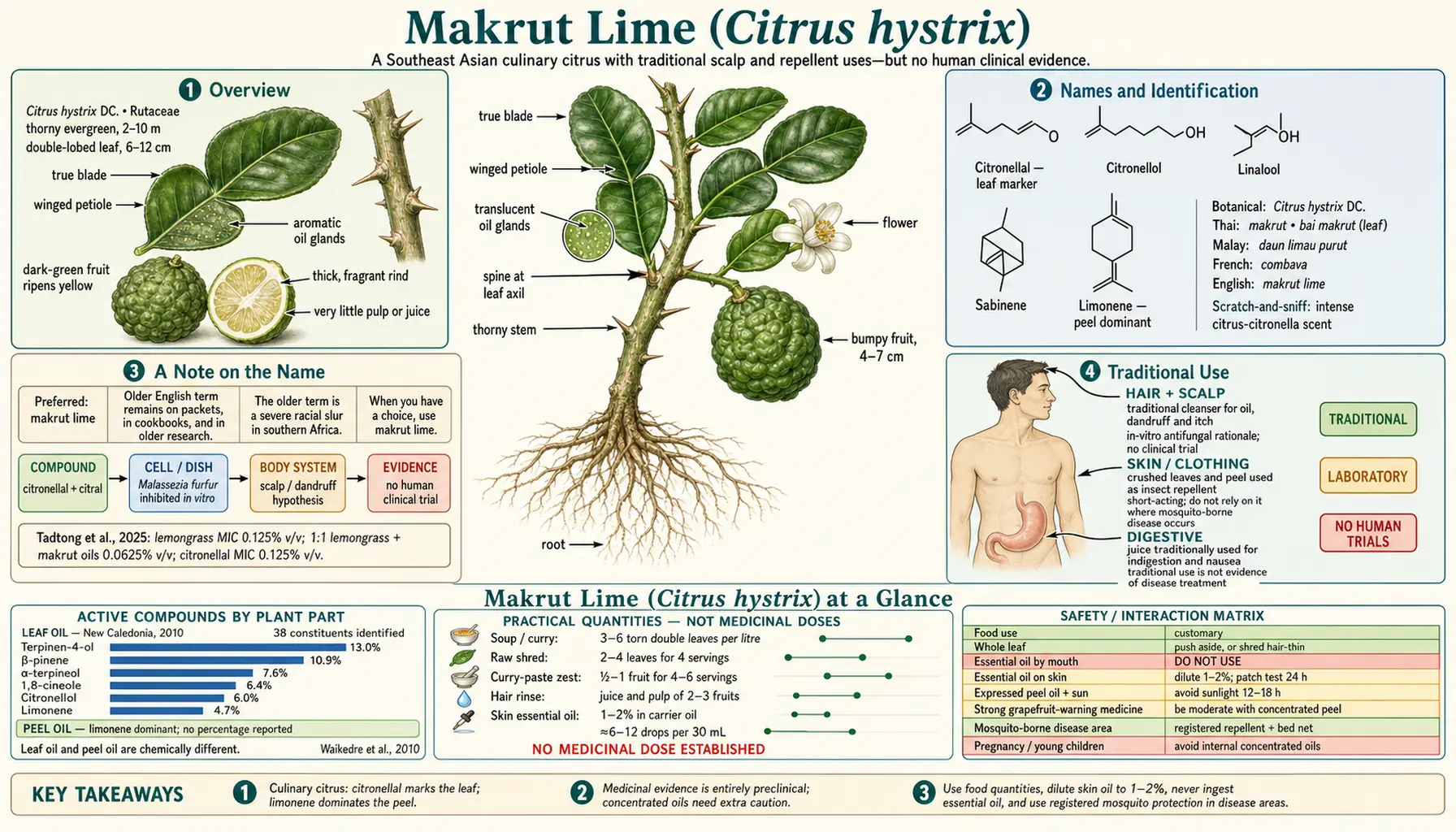
Makrut lime is one of the most recognisable plants in the world's kitchens and one of the least useful ones in a medicine cabinet. Its leaf has an unmistakable double-lobed, hourglass silhouette; its fruit is a small, dark, deeply wrinkled sphere with almost no juice inside. Tear a leaf and the smell is instant and enormous — sharp, green, floral citrus, driven by an aldehyde called citronellal. That leaf is what makes a bowl of tom yum smell like tom yum.
The medicinal evidence, by contrast, is entirely preclinical. Essential oils from the leaf and peel have been tested against fungi, bacteria and cancer cell lines in laboratories, and the results are mixed and modest. There are no human clinical trials. The genuinely defensible non-food uses are the traditional ones — as a hair and scalp wash, and as an insect repellent, where citronellal really does repel mosquitoes, just not for very long.
This page uses both makrut lime and the older English name kaffir lime, for reasons explained in the naming section below.
Table of Contents
- Overview
- Names and Identification
- A Note on the Name
- Traditional Use
- Active Compounds
- Antimicrobial and Antifungal Activity
- Insect Repellency: What Citronellal Can and Cannot Do
- Hair and Scalp Use
- Cell-Culture Studies and Aroma Research
- Culinary Use
- Forms and Preparations
- Dosage
- Cautions and Contraindications
- Key Research Papers
- Connections
- Featured Videos
Overview
Citrus hystrix DC. is a thorny evergreen shrub or small tree in the rue family, Rutaceae — the same family as every other citrus, plus rue itself and curry leaf. It grows to roughly two to ten metres, is armed with sharp spines at the leaf axils, and is native to tropical Southeast Asia, where it has been cultivated in home gardens for centuries.
The famous leaf. What looks like two leaves joined end to end is botanically one leaf. The lower lobe is a greatly expanded, leaf-like winged petiole (leaf stalk) and the upper lobe is the true blade. Many citrus species have a slightly winged petiole; makrut takes it to an extreme, producing the figure-eight shape that no other kitchen herb has. Both lobes are aromatic. The leaf is thick, leathery and glossy, dotted with translucent oil glands you can see against the light and burst by scratching a fingernail across the surface.
The fruit. Small, round to slightly pear-shaped, 4–7 cm across, dark green ripening to yellow, with a rind so bumpy and furrowed it looks diseased — the species epithet hystrix means “hedgehog.” The rind is thick and hugely fragrant. Inside there is very little pulp and only a small amount of juice, which is intensely sour with a resinous bitterness. This is a fruit grown for its skin and its leaves, not for its juice.
In Southeast Asia makrut reaches the kitchen the way herbs did everywhere before supermarkets: from the tree in the yard, from a neighbour, from a market stall selling small bundles of leaves. Outside the region it arrives as frozen leaves (excellent), dried leaves (poor) and occasionally fresh fruit.
Names and Identification
Botanical name: Citrus hystrix DC., family Rutaceae.
- Thai: makrut (มะกรูด) for the fruit and tree; bai makrut (ใบมะกรูด) for the leaf; phiu makrut for the zest
- Vietnamese: lá chanh Thái (“Thai lime leaf”) or chanh thái. Note that plain lá chanh usually means ordinary lime leaf, which is a different and much milder thing
- Malay: daun limau purut (leaf), limau purut (fruit)
- Indonesian: daun jeruk purut, jeruk purut
- Khmer: krauch soeuch; Lao: mak khi hout; Filipino: kabuyaw, kolobot
- French / Réunion / Mauritius: combava — the standard name in French-language cooking
- English: makrut lime, Thai lime, wild lime, and the older kaffir lime
Identifying it. Nothing else in the produce aisle looks like a makrut leaf: two glossy dark-green lobes joined at the waist, the whole thing 6–12 cm long. Ordinary lime and lemon leaves are single, thinner and far less aromatic. The decisive test is the scratch-and-sniff: a real makrut leaf releases a burst of intense citrus-citronella scent that fills a room. If it smells faintly grassy, it is a lime leaf or an old, dried-out makrut leaf.
A Note on the Name
For most of the twentieth century this plant was called kaffir lime in English. That name is now widely avoided. Kaffir is a severe racial slur against Black people in southern Africa — in South Africa it is treated in law as hate speech — and cooks, food writers, publishers and suppliers have increasingly moved to makrut lime, the Thai name, or occasionally Thai lime. The etymology of how the word came to be attached to a Southeast Asian citrus is disputed and probably unrecoverable; the reason for the change does not depend on it.
You will still meet the old name. It is printed on packets of frozen leaves, indexed in cookbooks published for decades, and used in a great many recipes and older research papers. That is why this page carries both names and why the site keeps the old term searchable: so that a reader holding a bag labelled “kaffir lime leaves” can find the right page. When you have a choice, makrut lime is the better word.
Traditional Use
Makrut's traditional roles cluster around three things: flavouring food, washing hair, and keeping insects away. These are household practices rather than a formal pharmacopoeia, and the plant does not have a major place in any classical medical system.
- Hair and scalp washing. Across Thailand, Malaysia and Indonesia the halved fruit or its juice has long been rubbed into the hair and scalp as a cleanser — to cut oil, to treat dandruff and itch, and to leave hair fragrant and shiny. This is the single most widespread traditional use, and it persists commercially: makrut is a common ingredient in Thai and Malaysian shampoos today.
- Insect repellent. Crushed leaves and peel rubbed on skin or clothing, and leaves burned or hung in the house, to drive off mosquitoes and other insects.
- Thai traditional medicine. The juice for indigestion and nausea; the peel in warming tonics; the leaves in the herbal compress balls (luk pra kob) used in Thai massage, and in herbal steam baths.
- Jamu and Malay practice. Jeruk purut in beauty preparations, scalp treatments and post-partum baths.
- Household cleaning. The acidic, oil-rich fruit as a degreaser and deodoriser for hands, cutting boards and cookware — the same logic that makes lemon a cleaning agent.
Traditional use is history and ethnography. It records what people did and found worth repeating; it is not evidence that the plant treats a disease.
Active Compounds
Almost everything interesting about makrut lime is in its essential oils, and the leaf oil and the peel oil are chemically quite different from each other.
Leaf oil — citronellal country
The characteristic compound of makrut leaf oil is citronellal, a lemon-scented monoterpene aldehyde. A 2022 survey of leaf essential oils from twenty citrus accessions in the University of California, Riverside citrus collection found that compositional clusters mapped onto taxonomic groups, and identified citronellal as the characteristic compound of the C. hystrix clade — distinct from the linalyl acetate of bitter orange leaf, the sabinene of sweet orange leaf and the methyl N-methyl anthranilate of mandarin leaf (Clery and colleagues, 2022). Alongside citronellal, makrut leaf oil typically carries citronellol, linalool, sabinene, β-pinene, isopulegol, nerol, terpinen-4-ol, α-terpineol and 1,8-cineole.
An honest complication. Composition varies a great deal with growing region and chemotype. A 2010 analysis of C. hystrix leaf oil collected in New Caledonia identified 38 constituents and found the oil dominated not by citronellal but by terpinen-4-ol (13.0%), β-pinene (10.9%), α-terpineol (7.6%), 1,8-cineole (6.4%) and citronellol (6.0%), with limonene at only 4.7% (Waikedre and colleagues, 2010). Anyone reading “makrut leaf oil is 60–80% citronellal” online should understand that the figure describes typical Southeast Asian material, not a fixed property of the species.
Peel oil — limonene country
The rind oil, like most citrus peel oils, is dominated by limonene, with β-pinene, sabinene, terpinene and a citronellal contribution that distinguishes it from lemon or orange peel. Limonene is what makes the zest smell bright and clean rather than green and floral, and it is why makrut zest and makrut leaf are not interchangeable in a recipe.
Non-volatile constituents
Like other citrus, makrut peel and leaf contain flavonoids of the flavanone and flavone families — the group that includes hesperidin, naringin and rutin — along with phenolic acids and, in the peel, coumarins. Citrus peels as a class contain furanocoumarins, the compounds responsible for the grapefruit–drug interaction, but the furanocoumarin content of makrut peel specifically has not been well quantified, and the amounts used in cooking are small. The practical implications are covered in the cautions section.
Antimicrobial and Antifungal Activity
This is the best-developed strand of makrut research, and it is entirely laboratory work.
Against dandruff yeast. A 2025 Thai study tested essential oils from makrut lime leaves and peel, plus lemongrass, lime, dill and shatavari, against Malassezia furfur — the yeast associated with dandruff and seborrhoeic dermatitis. Lemongrass oil was the strongest single agent (minimum inhibitory concentration 0.125% v/v). A 1:1 combination of lemongrass and makrut lime oils was synergistic, halving the MIC to 0.0625% v/v. The activity tracked citral and citronellal, with citronellal's own MIC at 0.125% v/v (Tadtong and colleagues, 2025).
That is a genuinely interesting result, because it lines up with the traditional scalp wash and with the way Thai shampoos combine makrut and lemongrass. But it is a checkerboard assay in a dish. Nobody has run a randomised trial of a makrut shampoo against ketoconazole or zinc pyrithione in people with dandruff, and until someone does, this is a hypothesis.
Against bacteria — a negative result worth reporting. The 2010 New Caledonian study tested both C. hystrix and C. macroptera leaf oils against five bacterial and five fungal strains. Both oils were inactive against every bacterium tested. The only notable activity came from the C. macroptera oil against the skin fungus Trichophyton mentagrophytes (MIC 12.5 µg/mL) — a different species from the one on this page (Waikedre and colleagues, 2010).
Put those two studies together and the honest picture is: makrut leaf and peel oils have some activity against certain fungi, particularly in combination with lemongrass, and little or none against bacteria. That is a narrow claim, and it is the one the data support.
Insect Repellency: What Citronellal Can and Cannot Do
The traditional use of crushed makrut leaves as a mosquito repellent has a real chemical basis. Citronellal is a genuine insect repellent; it belongs to the same chemical family as the constituents of citronella oil, which is the best-known plant-derived repellent in the world and an active ingredient registered for that purpose in many countries.
The important caveat is duration. A Thai laboratory study screened 38 plant essential oils for repellency against Aedes aegypti using human volunteers, applying 0.1 mL of oil per 30 cm² of forearm. At 10% or 50% dilution, none of the 38 oils prevented mosquito bites for as long as two hours. Only the undiluted oils of citronella, patchouli, clove and makaen (Zanthoxylum limonella) gave two hours of complete repellency, with clove oil the longest at two to four hours against three mosquito species (Trongtokit and colleagues, 2005).
That study did not single out makrut lime, and its findings generalise to the whole category rather than to this plant specifically. But the lesson applies directly: plant essential-oil repellents are short-acting. They evaporate. DEET at 20–30% or picaridin at 20% will typically give five to twelve hours of protection; a citronellal-type botanical gives one to two, and only when applied heavily.
Rubbing a crushed makrut leaf on your arms on a verandah in the evening is a reasonable thing to do and probably helps a little for a short while. It is not adequate protection in a region with malaria, dengue, chikungunya or Japanese encephalitis. In those settings, use a registered repellent and a bed net.
Hair and Scalp Use
The scalp wash is makrut's strongest traditional claim, and the one where the laboratory data and the ethnography actually point the same way.
The classic Thai and Malay preparation is simple: halve two or three fresh fruits, squeeze and rub the juice and pulp into wet hair and scalp, massage, leave a few minutes, rinse. Sometimes the fruit is grilled or steamed first to soften it and release more juice. The result reported by users is a scalp that feels clean and de-greased, less itch, and a strong pleasant scent that lingers.
What plausibly explains that. Three things, none of them mysterious. The juice is acidic, which cuts through sebum and smooths the hair cuticle much as a vinegar rinse does. The peel and juice carry limonene and other terpenes, which are effective solvents for oil — the same reason citrus oil is used in degreasers. And the citronellal- and citral-rich oils have measurable activity against Malassezia, the yeast implicated in dandruff, as the 2025 synergy study showed.
What has not been shown. There is no clinical trial of makrut lime for dandruff, seborrhoeic dermatitis, hair loss or hair growth. Claims that it “stops hair fall” or “regrows hair” have no supporting evidence of any kind. If you have persistent dandruff, an antifungal shampoo containing ketoconazole, ciclopirox, selenium sulfide or zinc pyrithione is the treatment with trials behind it.
Used as a hair rinse, makrut is a pleasant, cheap, low-risk traditional cosmetic. That is a fair description and it is enough.
Cell-Culture Studies and Aroma Research
A 2006 Thai study screened essential oils from a set of Thai medicinal plants for antiproliferative activity against the KB oral carcinoma and P388 murine leukaemia cell lines (Manosroi and colleagues, 2006). Screens of this kind are a routine first filter; a large proportion of plant essential oils show some activity in them because concentrated terpenes are broadly cytotoxic to cells in a dish. Nothing about such a result predicts an effect on a tumour in a person, and none of these oils has progressed to a clinical trial. Treat this as chemistry, not oncology.
On the aroma side, there is a small research literature on citrus fragrance and mood — for example a single-blind randomised crossover study of yuzu (Citrus junos) fragrance and premenstrual emotional symptoms and autonomic activity (Matsumoto and colleagues, 2016). We include it as context and label it plainly: that study is about a different species. No comparable human study of makrut lime aroma has been published. Whatever effect a familiar, well-loved smell has on how you feel is real, but it is not species-specific pharmacology.
Culinary Use
Makrut is a foundation ingredient, not a garnish. In Thai cooking it belongs to the small group — with lemongrass, galangal, coriander root, chilli and shrimp paste — that defines the flavour of the cuisine, and it works differently in leaf form and zest form.
The leaf
- Tom yum (Thailand) — the hot-and-sour soup. Whole torn makrut leaves go into the pot with lemongrass and galangal at the start; they perfume the broth and are pushed to the side of the bowl rather than eaten.
- Tom kha gai — the coconut-galangal chicken soup. Same treatment, softened by coconut milk.
- Green curry (gaeng khiao wan), red curry, panang — leaves are added toward the end of simmering, and often a few very fine shreds are scattered over the finished dish so you get the raw aroma as well as the cooked one.
- Yam and larb salads — hair-thin shreds of raw leaf, cut across the grain with the tough centre rib removed, folded through minced-meat salads.
- Tod mun pla (Thai fish cakes) — finely sliced leaf worked into the paste; this is where the flavour is unmistakable.
- Rendang, sambal, soto, ayam goreng (Malaysia, Indonesia) — daun jeruk purut is a standard aromatic in slow-cooked meat, chilli pastes and fried chicken marinades.
- Cambodian and Lao soups and pastes — used in kroeung, the pounded aromatic base of Khmer cooking.
- Vietnam — lá chanh shredded over boiled or roast chicken is a classic northern touch, though the leaf used is often ordinary lime rather than makrut; lá chanh Thái specifies the makrut leaf.
- Réunion and Mauritius — combava leaf and zest in creole rougails and curries, a legacy of Southeast Asian plant movement across the Indian Ocean.
The zest
The rind is the citrus element in Thai curry pastes. Green, red and panang pastes traditionally include finely chopped or pounded makrut zest along with lemongrass, galangal, coriander root, garlic, shallot, chilli, white pepper and shrimp paste. Grate only the coloured outer layer — the white pith beneath is bitter. A little goes a long way: the zest is far more concentrated than lemon or lime zest and can dominate a dish.
The juice
Here is the part most Western recipes get wrong. Makrut juice is barely used in cooking. There is very little of it, it is harshly sour with a resinous bitterness, and Thai cooks reach for ordinary lime (Citrus aurantifolia, Thai manao) whenever a dish needs sourness. If a recipe calls for “kaffir lime juice,” it almost certainly means ordinary lime juice plus makrut leaf or zest for aroma. The juice's real traditional home is the bathroom, not the kitchen.
Handling notes
- Tear, don't chop, for infusing. Tearing the leaf ruptures the oil glands. Drop whole torn leaves into soups and curries and remove them at the end; they are leathery and unpleasant to chew.
- Shred finely for eating. Stack the lobes, remove the tough centre rib, roll tightly and slice as thinly as you possibly can, across the grain. Thick shreds are chewy.
- Counting leaves. Recipes are inconsistent about whether the double leaf is “one leaf” or two. Most Thai recipes mean the whole double structure. When in doubt, start with less — the aroma is powerful.
- Freeze them. Makrut leaves freeze superbly in a sealed bag for a year or more and can be used straight from frozen. Dried leaves lose most of their aroma and are a poor substitute.
- No good substitute exists. Lime zest plus lemon thyme or a strip of lemongrass gets you in the neighbourhood, but nothing reproduces citronellal.
Forms and Preparations
- Fresh leaves — best. Keep in a sealed bag in the refrigerator for two to three weeks.
- Frozen leaves — almost as good and the standard export form. Widely sold in Asian groceries.
- Dried leaves — weak and papery. Usable in long-simmered dishes, disappointing everywhere else.
- Fresh fruit — sold seasonally; freezes whole. Grate the zest frozen.
- Frozen or dried zest — acceptable for curry paste.
- Leaf and peel essential oils — sold for aromatherapy and cosmetic formulation. Note that leaf and peel oils are chemically different products; check which one you are buying.
- Shampoos and hair rinses — a large category in Thailand and Malaysia. Some contain real extract; many are fragranced with synthetic citronellal.
- Live trees — grown in pots in temperate climates; needs warmth, sun and protection from frost. Home growers get a steady leaf supply from a single plant.
- Supplements — makrut lime capsules and extracts exist. There is no human evidence supporting any of them and no standardised preparation. We would not recommend them.
Dosage
No medicinal dose of makrut lime has been established for any condition. No human trial has tested it, so there is no number to report. Anything printed on a supplement label is a marketing figure.
Practical culinary and topical quantities:
- In soup or curry: 3–6 torn double leaves per litre of liquid.
- Shredded raw over a salad or in fish cakes: 2–4 leaves, very finely sliced, for four servings.
- Zest in curry paste: the zest of half to one fruit for a paste serving four to six.
- Hair rinse: the juice and pulp of 2–3 fruits, or a few tablespoons of juice diluted in a mug of water, massaged in and rinsed out.
- Essential oil on skin: dilute to no more than 1–2% in a carrier oil — roughly 6–12 drops per 30 mL. Never apply undiluted.
Cautions and Contraindications
Makrut lime as food is about as safe as an ingredient gets: it has been eaten daily across Southeast Asia for centuries, in tiny quantities, usually as an aromatic that is removed before eating. The cautions all attach to concentrated forms.
- Do not swallow whole leaves. They are leathery and fibrous. In soups and curries the leaf is an infusion herb — push it aside. If you want to eat it, shred it hair-thin and remove the centre rib.
- Essential oil is not for internal use. Concentrated citrus and citronellal-rich oils can irritate or damage the gastrointestinal tract and there is no established oral dose. Do not drink it or put it in capsules.
- Skin sensitisation. Citronellal, citronellol, citral, linalool and limonene are all recognised fragrance allergens; several are among the substances the European Union requires to be declared on cosmetic labels because of contact-allergy risk. Oxidised (old, air-exposed) citrus oils are considerably more sensitising than fresh ones. Dilute properly, patch test on the inner forearm for 24 hours before wider use, and store oils sealed, cool and dark.
- Photosensitivity from citrus peel oils. Cold-pressed (expressed) citrus peel oils can contain furanocoumarins that cause phototoxic burns on sun-exposed skin — a well-documented problem for bergamot and lime peel oils. Steam-distilled oils are generally free of them. This has not been specifically quantified for makrut peel oil, so treat any expressed makrut peel oil the way you would treat expressed lime oil: keep it off skin that will see sunlight for the next 12–18 hours.
- Furanocoumarins and medication. Citrus peels as a group contain compounds that inhibit intestinal CYP3A4 — the mechanism behind the grapefruit-juice interaction that raises blood levels of statins, some calcium-channel blockers, certain immunosuppressants and others. Makrut peel has not been specifically measured. The amount of zest in a bowl of curry is very small and there is no reported case of an interaction. If you take a drug carrying a strong grapefruit warning, that is a reason to be moderate with concentrated peel preparations, not a reason to avoid a curry.
- Do not rely on it as a mosquito repellent in any area with mosquito-borne disease. See the repellency section above.
- Pregnancy and breastfeeding. Culinary use is customary and unremarkable throughout Southeast Asia. Essential oils and concentrated extracts have not been studied in pregnancy and should be avoided internally; topical use should be well diluted or skipped.
- Children. Food use is fine. Keep essential oils away from infants and young children — concentrated monoterpene oils, particularly those containing 1,8-cineole, should never be applied near the face of a small child.
- The tree has serious thorns. A mundane but real hazard if you grow one.
Key Research Papers
- Clery RA, Armendi A, Franco V, Furrer S, Genereux JC, Kahn TL, Koshiro K. Chemical diversity of citrus leaf essential oils. Chemistry & Biodiversity. 2022;19(3):e202100963.
- Waikedre J, Dugay A, Barrachina I, Herrenknecht C, Cabalion P, Fournet A. Chemical composition and antimicrobial activity of the essential oils from New Caledonian Citrus macroptera and Citrus hystrix. Chemistry & Biodiversity. 2010;7(4):871–877.
- Tadtong S, Chantavacharakorn R, Khayankan S, Akachaipaibul P, Eiamart W, Samee W. Synergistic antifungal properties, chemical composition, and frontier molecular orbital analysis of essential oils from lemongrass, kaffir lime, lime, dill, and shatavari against Malassezia furfur. International Journal of Molecular Sciences. 2025;26(12):5601.
- Trongtokit Y, Rongsriyam Y, Komalamisra N, Apiwathnasorn C. Comparative repellency of 38 essential oils against mosquito bites. Phytotherapy Research. 2005;19(4):303–309.
- Manosroi J, Dhumtanom P, Manosroi A. Anti-proliferative activity of essential oil extracted from Thai medicinal plants on KB and P388 cell lines. Cancer Letters. 2006;235(1):114–120.
- Matsumoto T, Kimura T, Hayashi T. Aromatic effects of a Japanese citrus fruit — yuzu (Citrus junos Sieb. ex Tanaka) — on psychoemotional states and autonomic nervous system activity during the menstrual cycle: a single-blind randomized controlled crossover study. BioPsychoSocial Medicine. 2016;10:11. (A different citrus species, included as context for citrus-aroma research.)
Live PubMed Searches
- Citrus hystrix — all research
- Citrus hystrix essential oil
- Citronellal
- Citronella oil, mosquito repellency and duration of protection
- Malassezia furfur, dandruff and essential oils
- Citrus peel furanocoumarins and CYP3A4
- Limonene, linalool and fragrance contact allergy
- Phototoxicity of expressed citrus peel oils
- DEET and picaridin repellent efficacy comparisons
Connections
- All Herbs
- Lemongrass — makrut's constant partner in Thai soups, and the oil it acts synergistically with against dandruff yeast.
- Pandan — the sweet aromatic of the same kitchens, and the other Southeast Asian leaf used by infusion.
- Thai Basil — the anise-scented basil finished into the curries makrut leaf starts.
- Chen Pi — aged tangerine peel, the East Asian tradition of using citrus rind as a medicine rather than a flavouring.
- Galangal — the third member of the tom yum aromatic trio.
- Ginger — the rhizome galangal is often confused with.
- Coriander Seeds — a core component of the curry pastes makrut zest goes into.
- Tea Tree — another essential oil with real antifungal data in dishes and thin clinical evidence.
- Clove — the oil that outperformed all 37 others in the 2005 repellency study.
- Hesperidin — the citrus flavanone family found across the genus.
- Rutin — another flavonoid common in citrus leaf and peel.
- Conditions on this site that reference this page: Gingivitis · Halitosis (Chronic Bad Breath) · Periodontitis (Gum Disease) · Contact Dermatitis · Seborrheic Dermatitis · Functional Dyspepsia