Cat’s Whiskers / Java Tea (Orthosiphon aristatus)
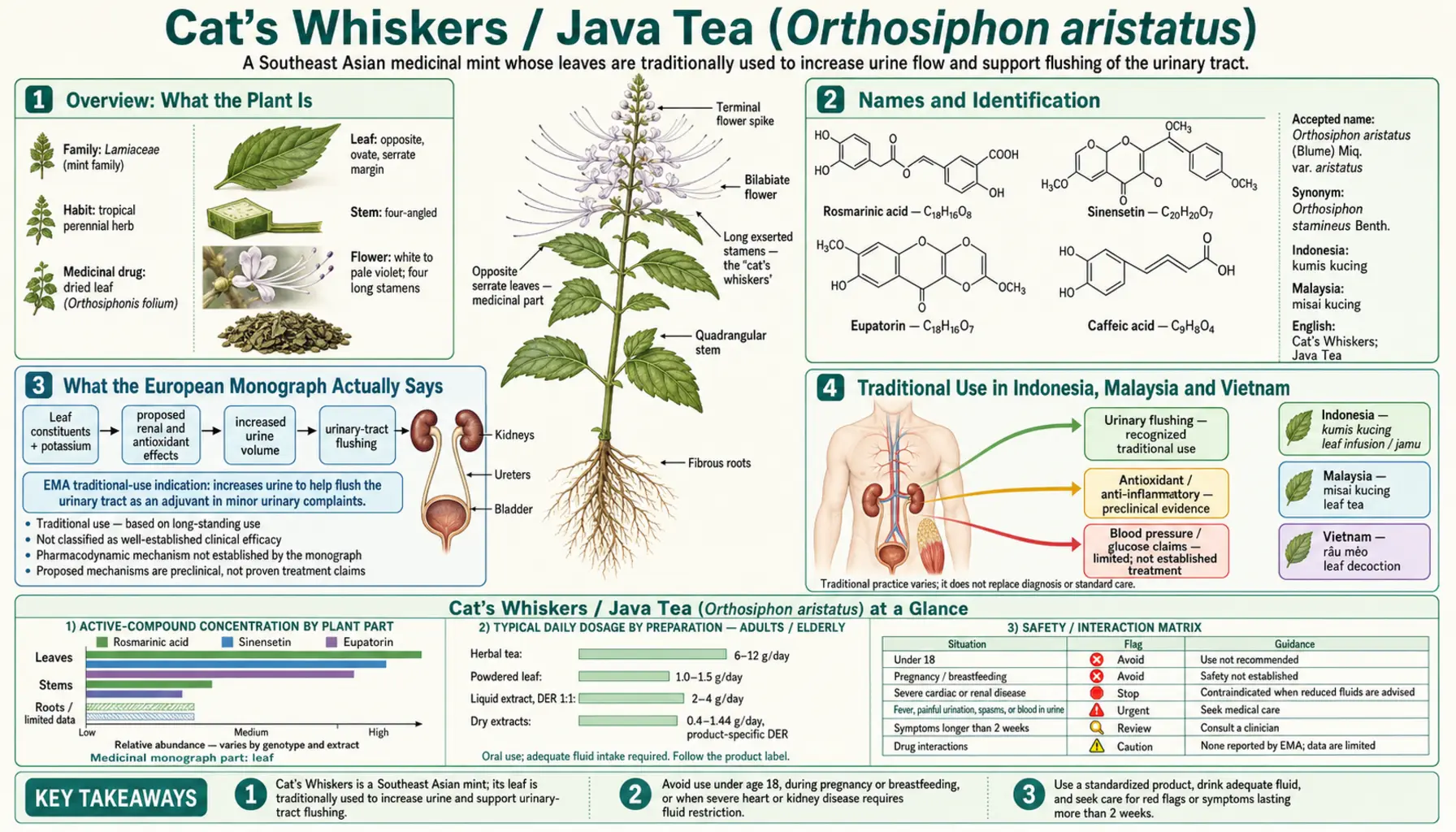
Cat’s whiskers (Orthosiphon aristatus) is a mint-family shrub from Southeast Asia whose flowers throw out long, pale stamens that curve forward like a cat’s whiskers — which is exactly what its Indonesian, Malay, Vietnamese and Thai names all say. In Java, Sumatra, peninsular Malaysia and northern Vietnam the dried leaf has been drunk as a tea for kidney stones, gout and difficult urination for as long as anyone has written it down. It is unusual among Southeast Asian folk herbs in one specific way: the European Medicines Agency has published a formal herbal monograph on the leaf.
That regulatory standing is the most misunderstood thing about this plant, so it is worth stating plainly at the top. The EMA monograph registers Java tea leaf as a traditional herbal medicinal product — a category that requires documented use, not demonstrated efficacy. The monograph’s “well-established use” column, the one reserved for herbs with real clinical evidence behind them, is completely empty. A European licence for cat’s whiskers means that it has been sold and used for at least thirty years without obvious harm. It does not mean a trial showed it works. The rest of this page explains what is actually known, what is merely traditional, and the handful of situations — heart failure, kidney failure, other diuretics — in which drinking a diuretic tea is a genuinely bad idea.
Table of Contents
- Overview: What the Plant Is
- Names and Identification
- What the European Monograph Actually Says
- Traditional Use in Indonesia, Malaysia and Vietnam
- Active Compounds
- Flushing the Urinary Tract: The Diuretic Question
- Kidney Stones
- Blood Pressure and Metabolic Effects
- Uric Acid, Gout and the Hyperuricaemia Research
- Is It a Drink or a Medicine?
- Forms and Preparations
- Dosage
- Cautions and Contraindications
- Key Research Papers
- Connections
- Featured Videos
Overview: What the Plant Is
Orthosiphon aristatus is a soft-stemmed perennial shrub in the mint family (Lamiaceae), growing roughly waist-high, with square stems, opposite toothed leaves, and spikes of white or pale-lilac flowers. The flowers are the giveaway. Four stamens and a style shoot two to three centimetres straight out past the petals, thin and pale and slightly curved. Once you have seen it you will never mistake it for anything else.
The plant is native to the region running from southern China through Indochina and the Malay Peninsula into Indonesia, the Philippines and northern Australia. It likes hot, humid, well-watered ground and grows readily at low elevation. It is cultivated commercially in Indonesia and Java in particular — hence “Java tea” — and also in Vietnam and, on a smaller scale, in Malaysia, where the crop is often grown for the supplement export market.
The part used is the leaf, sometimes with the tender flowering tops attached. It is harvested before or during flowering, dried in shade, and either brewed as a tea or extracted for capsules and tinctures. The European Pharmacopoeia recognises the drug as Orthosiphonis folium and sets a minimum content for a marker flavone called sinensetin.
How it reaches people varies enormously by country. In Indonesian and Malaysian markets it is a cheap loose herb sold by the bag, often as part of a jamu preparation. In Vietnam it is sold dried in pharmacies as râu mèo and brewed as a daily drink. In Germany, France, Poland and several other EU countries it is a licensed pharmacy product with a package leaflet, an approved indication and a defined dose. Same leaf, three completely different regulatory realities.
Names and Identification
The botany here has been messy for a century, and if you are buying the herb or reading the literature the synonymy matters.
- Accepted name: Orthosiphon aristatus (Blume) Miq. var. aristatus. This is the name the EMA monograph uses.
- Orthosiphon stamineus Benth. — a synonym, and still by far the most common name in the pharmacology literature. If you search PubMed you will find more papers under stamineus than under aristatus. They are the same plant.
- Orthosiphon spicatus, Orthosiphon grandiflorus and Clerodendranthus spicatus — older or regional names that appear in Thai, Chinese and Japanese sources. O. grandiflorus in particular is the name used in the Thai kidney-stone trial discussed below.
Local names, and what they mean:
- Kumis kucing (Indonesian and Malay) — literally “cat’s moustache.” Also misai kucing in Malaysia, the same image. This is the name you will see on Malaysian supplement labels.
- Râu mèo (Vietnamese) — “cat whiskers,” again the same image. Different language family, identical metaphor, because the stamens really do look like that.
- Yaa nuat maeo (Thai, หญ้าหนวดแมว) — “cat’s-whisker grass.”
- Java tea (English and much of Europe), Katzenbart or Orthosiphonblätter (German), thé de Java (French), kattensnor (Dutch).
A name that is shared with other plants. “Cat’s whiskers” in English is also used for Cleome gynandra, an entirely unrelated African and Asian leaf vegetable in the Cleomaceae, and occasionally for Tacca species (bat flower). Neither is Orthosiphon, and neither is used for urinary complaints. If a product simply says “cat’s whiskers” with no Latin name on the label, that label is not good enough. Look for Orthosiphon aristatus or Orthosiphon stamineus printed somewhere on the package.
What the European Monograph Actually Says
This section is the reason the page exists, because “approved by the European Medicines Agency” is a phrase that gets used to sell a great deal of cat’s whiskers, and what it means is much narrower than it sounds.
The EMA’s Committee on Herbal Medicinal Products (HMPC) adopted a European Union herbal monograph on Orthosiphon aristatus leaf, revision 1, on 22 September 2021 (reference EMA/HMPC/486551/2020). EU herbal monographs have two parallel columns:
- Well-established use. Reserved for herbal preparations with at least ten years of use in the EU and recognised efficacy and acceptable safety demonstrated by scientific literature — that is, actual clinical data.
- Traditional use. Requires that the preparation has been in medicinal use for at least 30 years, of which at least 15 within the EU or EEA, and that it is plausible and safe for the stated indication. No efficacy trial is required at all.
For cat’s whiskers, the entire “well-established use” column is blank. Every entry in the monograph — the indication, the doses, the contraindications — sits in the traditional-use column. The HMPC did not find the clinical evidence sufficient to support a well-established-use entry, and said so by leaving the column empty.
The approved indication reads, word for word:
“Traditional herbal medicinal product used to increase the amount of urine to achieve flushing of the urinary tract as an adjuvant in minor urinary tract complaints. The product is a traditional herbal medicinal product for use in the specified indication exclusively based upon long-standing use.”
Read that carefully. It is an indication for flushing, not for treating an infection. It is an adjuvant, not a treatment. It applies to minor complaints. And it explicitly labels itself as resting on long-standing use rather than evidence. That last sentence is legally required to appear on the package of every traditional-use registration in Europe, precisely so that the shelf does not imply more than the file supports.
The monograph also carries these instructions, all of which are practical and worth following even if you buy the herb loose in a market:
- Adequate fluid intake is required during treatment — the whole point is to increase urine volume, and you cannot do that while dehydrated.
- Adults and elderly only. Use under 18 is not recommended because there are no adequate data.
- If symptoms persist beyond two weeks, see a clinician.
- Contraindicated where reduced fluid intake is advised — the monograph names severe cardiac or renal disease specifically.
- Fever, painful urination, spasms or blood in the urine mean stop and see a doctor. Those are signs of something a flushing tea does not treat.
- Not recommended in pregnancy or breastfeeding, for lack of data.
- Genotoxicity, reproductive toxicity and carcinogenicity testing have not been performed. The monograph states this outright.
So the honest summary is this: Europe has looked at cat’s whiskers, concluded it is plausible and apparently safe as a mild diuretic tea for minor urinary complaints in adults, written down a sensible dose, and declined to say it works. That is a genuinely useful piece of information — more useful than most herbs get — but it is not a claim of efficacy and should never be quoted as one.
Traditional Use in Indonesia, Malaysia and Vietnam
Across insular and mainland Southeast Asia the traditional indication is remarkably consistent, which is unusual and mildly interesting: almost everywhere the plant grows, people use it for the same thing.
Indonesia. Kumis kucing is a standard component of jamu, the Javanese herbal tradition. It is used for difficulty passing urine, for “stones” (both kidney and bladder), for swelling, for gout, and as a general “cleansing” drink. It appears in commercial jamu blends alongside Sonchus leaf and Strobilanthes (keji beling), other traditional Indonesian stone remedies.
Malaysia. Misai kucing occupies the same niche and has additionally become a small export crop; Malaysian research institutions have put substantial effort into standardising extracts of it, which is why an unusually large share of the modern pharmacology literature comes from Malaysian universities.
Vietnam. Râu mèo is part of thuốc nam, the southern (indigenous Vietnamese) branch of traditional medicine as distinct from imported Chinese formulas. It is brewed as a plain daily tea for urinary complaints, oedema, gout, and stones, often in combination with Plantago seed or maize silk.
Thailand. Yaa nuat maeo is listed in Thai traditional practice for urinary stones and difficult urination, and is one of the few Thai folk herbs that has been through a formal, if small, clinical study for that purpose.
Two things are worth saying about this consistency. First, it is genuine convergent tradition rather than a single text copied around, because the plant is native across the whole range and the names arose independently in unrelated languages. Second, consistency of tradition is not evidence of effect. A great many cultures independently used bloodletting. Convergence tells you a plant is available and that people noticed something — in this case, almost certainly, that drinking a lot of tea makes you urinate more — not that the plant is doing something specific.
Active Compounds
The EMA assessment report gives approximate figures for the dried leaf, and they are worth reading side by side because the proportions are surprising.
- Potassium — about 3% of the dried leaf. This is the single most abundant characteristic constituent, and it is a mineral, not a phytochemical. Cat’s whiskers leaf is, chemically, a potassium-rich plant. Keep this in mind for the cautions section.
- Sinensetin — roughly 0.1–0.19%. A polymethoxylated flavone (a flavone with five methoxy groups instead of free hydroxyls). Sinensetin is the standard analytical marker for the herb; the European Pharmacopoeia sets a minimum of 0.05%. Its role as a marker does not mean it is the active principle — it means it is easy to measure and reasonably specific to the plant.
- Eupatorin and 3′-hydroxy-5,6,7,4′-tetramethoxyflavone — two more polymethoxyflavones that travel with sinensetin and are usually studied alongside it.
- Rosmarinic acid — 0.1–0.5%, plus related caffeic acid depsides (mono- and dicaffeoyltartaric acid, lithospermic acid). Rosmarinic acid is the mint family’s signature antioxidant polyphenol and turns up in rosemary, lemon balm, perilla and most of the culinary Lamiaceae.
- Orthosiphols A–E — about 0.2%, together with staminane- and isopimarane-type diterpenes. These are structurally distinctive to the genus and are the compounds most often invoked in anti-inflammatory work.
- Essential oil — 0.02–0.06%, mostly sesquiterpenes. Small, and not thought to matter much.
- Triterpenes, β-sitosterol, inositol and chromenes round out the profile.
One point about the polymethoxyflavones deserves emphasis because it cuts both ways. Replacing hydroxyl groups with methoxy groups makes a flavone much more fat-soluble and much more resistant to the rapid glucuronidation that destroys most dietary flavonoids in the gut wall. That is a real pharmacokinetic advantage on paper. But those same methoxylated flavones are the class most likely to interact with cytochrome P450 drug-metabolising enzymes — though the comparison usually drawn here needs care: the grapefruit-juice interaction is attributed principally to furanocoumarins such as bergamottin, not to the methoxylated flavones grapefruit also contains, which were investigated early and are not considered the main driver. No clinically documented interaction has been reported for Java tea, and the EMA monograph lists interactions as “none reported,” but “none reported” for a herb no one has formally studied for interactions is a weaker statement than it looks.
A 2024 Chinese mass-spectrometry study mapped the constituents and their metabolites in the plant using high-resolution imaging techniques, and a Polish–German group has shown that gut bacteria substantially transform the extract before absorption — meaning the compounds circulating in your blood after a cup of Java tea are not necessarily the compounds listed on the certificate of analysis.
Flushing the Urinary Tract: The Diuretic Question
The mechanism, as proposed. Java tea is classed as an aquaretic rather than a true diuretic. The distinction matters. A loop diuretic such as furosemide blocks a specific sodium transporter in the kidney and drags water out with the sodium, which is why it depletes potassium and can drop blood pressure hard. An aquaretic increases urine volume with comparatively less electrolyte loss. Java tea’s effect has been attributed variously to its potassium load, to the flavones acting on renal blood flow, and — unglamorously but honestly — to the fact that the recommended preparation involves drinking several cups of hot water a day.
What the animal data show (animal). The EMA assessment report reviews several rat diuresis experiments and the results are not impressive. In one, rats given 700 mg/kg of a 50% ethanolic extract showed urine volume 1.3-fold above control, while furosemide gave a 2.5-fold increase; a 70% ethanolic extract produced no increase in urine volume at all. Sodium excretion did rise across the treated animals — in the 50% ethanol group above furosemide — and uric acid excretion improved. So there is a signal, it is dose- and extract-dependent, and it is far weaker than a real diuretic drug.
What the human data show (human). Very little directly. There is no good randomised trial of Java tea alone as a diuretic in people. The clearest human-relevant work is a small Italian pilot study in which extracts of goldenrod, orthosiphon, birch and cranberry reduced microbial colonisation and biofilm formation on indwelling urinary catheters — a laboratory and ultrastructural study on catheter material, not a clinical outcome trial, and using a four-herb combination.
The plain-language version: cat’s whiskers probably does make you urinate somewhat more, mostly because it is a hot drink with a lot of potassium in it and a mild renal effect on top. “Flushing the urinary tract” is a reasonable description of what it does. It is not an antibiotic, it does not sterilise urine, and it will not treat an infection.
Kidney Stones
Stones are the traditional indication that has actually been studied in people, and the study is worth describing in detail because it is the strongest human data this herb has.
The Thai trial (human). Premgamone and colleagues at Khon Kaen University followed 48 rural stone-formers, identified by ultrasound, for up to 18 months. Half drank two cups a day of Orthosiphon grandiflorus tea (each teabag containing 2.5 g of dried herb); the other half took 5–10 g of sodium potassium citrate daily in divided doses. Sodium potassium citrate is a real, conventional stone-prevention drug. Stone size was tracked by repeat ultrasound.
The rate of stone size reduction per year was 28.6 ± 16.0% in the herb group and 33.8 ± 23.6% in the citrate group — not significantly different. About 90% of initial symptoms (back pain, headache, joint pain) improved in both groups. Fatigue and appetite loss were reported by 26.3% of the citrate group.
How much weight should this carry? Some, but read the limitations honestly. Forty-eight people is small. There was no placebo or no-treatment arm, so we cannot tell how much of that 28% annual shrinkage would have happened anyway — small stones do pass and dissolve spontaneously, and both groups were being encouraged to drink more fluid. A trial showing “no significant difference” between two arms of 24 people is statistically almost guaranteed regardless of what the treatments do. And the species tested was O. grandiflorus, which most authorities treat as the same plant but which is not universally accepted as such.
What the trial does support is a modest, sensible claim: drinking Java tea twice daily was not obviously worse than a standard citrate regimen in a small Thai cohort, and it was better tolerated. That is a reasonable basis for a traditional-use registration and an unreasonable basis for telling someone to skip urology.
Laboratory work (cell-free). A Malaysian group tested standardised O. stamineus water extract as a chemolytic (stone-dissolving) agent on stone material in vitro and reported measurable dissolution. That is a test-tube result on isolated stone fragments; it says nothing about what happens to a stone sitting in a kidney with a body around it.
If you have stones, the interventions with real evidence behind them are unglamorous: drink enough water to produce more than 2.5 litres of urine a day, reduce sodium, keep dietary calcium normal (not low), and get the stone analysed so treatment can be matched to its type. Java tea is at best a pleasant way to hit the fluid target.
Blood Pressure and Metabolic Effects
Mechanism (cell and animal). A 2025 Malaysian study examined three of the plant’s polymethoxyflavones — eupatorin, sinensetin and 3′-hydroxy-5,6,7,4′-tetramethoxyflavone — on isolated rat aortic rings and then in live hypertensive rats, and reported synergistic vasodilation and a blood-pressure-lowering effect. Vasodilation in an aortic ring bath is a clean, informative experiment about a compound; it is several steps removed from a person.
Human trials (human, but combination products). Two Italian randomised trials from Bologna are the best human cardiovascular data, and both used combination supplements:
- Cicero and colleagues (2012) randomised hypertensive, dyslipidaemic patients already on calcium-channel blockers or ACE inhibitors to a nutraceutical containing Orthosiphon stamineus leaf extract, and reported effects on blood pressure and metabolic syndrome components.
- The CONDOR study (2023) randomised 60 people with high-normal blood pressure or stage 1 hypertension, after four weeks of a low-fat low-sodium Mediterranean diet, to eight weeks of a supplement containing magnesium, standardised orthosiphon, hawthorn and hibiscus, or placebo. Systolic pressure fell 3.4 ± 0.9 mmHg versus placebo at eight weeks; diastolic fell 3.8 ± 0.7 mmHg; aortic pressure fell 5.2 ± 1.0 mmHg; hs-CRP dropped slightly.
Be careful how you read those numbers. A 3–4 mmHg systolic reduction is real and, at population scale, not trivial — but it is roughly what you get from losing a few kilograms or cutting a gram of sodium a day, and it is a fraction of what a single antihypertensive drug does. More importantly, the product contained magnesium, hawthorn and hibiscus as well. Hibiscus alone has repeatedly lowered blood pressure in trials. There is no way to attribute the CONDOR result to orthosiphon. Anyone citing CONDOR as evidence that Java tea lowers blood pressure is citing it wrongly.
Cancer-related fatigue (human). One genuinely single-herb human trial exists. A 2024 multicentre phase II study randomised 110 patients with stage II–IV solid tumours undergoing chemotherapy to a standardised rosmarinic-acid-rich O. stamineus extract (marketed as Nuvastatic, 1000 mg three times daily) or placebo for nine weeks, and reported significantly reduced fatigue scores on the Brief Fatigue Inventory in the extract group. This is a properly randomised, double-blind, placebo-controlled trial of the herb by itself, which makes it the highest-quality piece of evidence cat’s whiskers has. It is also phase II, industry-linked, in a subjective outcome, and unreplicated — which is to say, promising and provisional. It is not a reason to take Java tea for fatigue generally.
Uric Acid, Gout and the Hyperuricaemia Research
Gout is one of the traditional indications in every country where the plant is used, and there is a plausible thread connecting it to the diuretic story: the rat work reviewed by the EMA found improved uric acid elimination alongside increased urine output.
More recently, a Chinese group used combined microbiome and metabolomics analysis to probe how Orthosiphon aristatus affects hyperuricaemic nephropathy in an animal model, reporting changes in gut bacterial populations and in purine-related metabolites. This is mechanistic animal work of the modern kind: sophisticated, hypothesis-generating, and entirely preclinical.
There is no human trial of cat’s whiskers for gout. None. The traditional use is old and widespread; the clinical evidence is absent. Gout is a condition where this matters, because untreated hyperuricaemia damages joints and kidneys permanently, and allopurinol and febuxostat are cheap, effective, well-studied drugs. Using Java tea instead of urate-lowering therapy would be a genuinely bad trade. Using it alongside — as a fluid-forward habit during a flare — is harmless in most people, and there is a real argument that simply drinking more fluid helps.
Is It a Drink or a Medicine?
Cat’s whiskers is not a culinary herb. Nobody cooks with it, and it is not part of the Vietnamese fresh-herb plate or the Indonesian spice cabinet. It occupies a category that Southeast Asia has and Western kitchens largely do not: a plant drunk as a routine, mildly medicinal daily tea, in the same way that many households drink pandan water or roselle.
The taste is grassy, slightly bitter, faintly astringent, and unremarkable — closer to a green hay infusion than to anything mint-like, despite the family. It is often blended with lemongrass, pandan or maize silk to make it more pleasant. It contains no caffeine.
The practical consequence of this framing is that the herb tends to be consumed in large volumes over long periods, casually, without the mental brakes people apply to something labelled “medicine.” That is exactly the pattern in which the cautions below matter most.
Forms and Preparations
- Loose dried leaf / teabags. The traditional and by far the most common form. A cup made from 2–3 g of comminuted herb steeped in 150 ml of boiling water is the exact preparation the EMA monograph describes. Cheap, and the only form for which the traditional-use evidence really exists.
- Powdered herb in capsules. Convenient, and dosed at 500–750 mg per capsule in licensed European products.
- Dry extracts. The monograph lists several, each with its own drug-to-extract ratio (DER) and solvent: a water extract at DER 5–7:1, ethanol extracts at DER 5–7:1, 7–8:1 and 8–12:1. The DER is the number that matters on a label. A 10:1 extract means ten parts of dried leaf produced one part of extract, so 200 mg of it corresponds to about 2 g of herb. An extract without a stated DER and solvent cannot be dosed rationally.
- Liquid extract at DER 1:1 in 25% ethanol, dosed by the gram.
- Standardised commercial extracts sold for the supplement market, often standardised to sinensetin or to rosmarinic acid. Standardisation to a marker is a quality-control tool, not proof of activity.
What to look for on a label: the Latin binomial (Orthosiphon aristatus or stamineus), the plant part (leaf — not aerial parts, not root), the DER and extraction solvent if it is an extract, and a batch number. European traditional-herbal-registration products carry a THR or equivalent number and a leaflet; those are the most reliably identified material you can buy.
Dosage
Unusually for a Southeast Asian folk herb, real regulator-approved numbers exist. These are the EMA traditional-use doses, for adults and elderly only:
- Herbal tea: 2–3 g of comminuted leaf in 150 ml of boiling water. Total daily dose 6–12 g — in practice two to four cups a day.
- Powdered herb: 500–750 mg per dose; 1000–1500 mg daily.
- Liquid extract (DER 1:1, 25% ethanol): 2 g per dose; 2–4 g daily.
- Dry water extract (DER 5–7:1): 360 mg per dose; 1080–1440 mg daily.
- Dry extract (DER 8–12:1, 60% ethanol): 200–400 mg per dose; 600–1200 mg daily.
- Dry extract (DER 7–8:1, 70% ethanol): 280 mg per dose; 840 mg daily.
- Dry extract (DER 5–7:1, 30% ethanol): 200 mg per dose; 400 mg daily.
Duration: the monograph says that if symptoms persist longer than two weeks, a doctor or qualified practitioner should be consulted. There is no established safety data for continuous long-term use.
Fluid: the monograph explicitly states that adequate fluid intake is required for the preparation to work as intended. Taking a concentrated capsule while drinking very little water gives you the potassium and the flavones without the flushing, which is the wrong half of the deal.
Under 18: not recommended, for lack of data. This is a formal regulatory position, not a general caution.
Cautions and Contraindications
Cat’s whiskers has a good safety record across centuries of daily use in Southeast Asia and decades of licensed sale in Europe. The EMA monograph lists undesirable effects as “none known” and no overdose cases have been reported. But the specific risks it does carry follow directly from what it is — a potassium-rich diuretic tea — and they cluster in a few identifiable groups.
Heart failure and kidney failure
The monograph’s formal contraindication is: conditions where a reduced fluid intake is recommended, e.g. severe cardiac or renal disease. If your cardiologist or nephrologist has told you to restrict fluids, a herb whose entire purpose is to increase urine output while you drink more water is directly against that advice. This is the clearest contraindication on the page.
The potassium problem
At roughly 3% potassium by dry weight, cat’s whiskers leaf is a concentrated potassium source. Twelve grams of dried herb — the top of the daily range — contains on the order of 350 mg of potassium, though how much of that transfers into a water infusion depends on the brew. For most people this is trivial and even mildly beneficial. For three groups it is not:
- Chronic kidney disease. Failing kidneys cannot excrete a potassium load. Hyperkalaemia is dangerous and can be fatal through cardiac arrhythmia, and it is frequently silent until it is severe. If you have CKD of any stage, do not take this herb without your nephrologist’s agreement.
- Anyone on potassium-sparing diuretics (spironolactone, eplerenone, amiloride, triamterene), ACE inhibitors (lisinopril, ramipril), ARBs (losartan, valsartan), or potassium supplements. All of these raise serum potassium. Adding a high-potassium herbal tea on top is a stacking risk.
- Anyone already told to follow a low-potassium diet. If bananas and oranges are restricted, a potassium-dense herbal concentrate is not exempt.
Other diuretics
Combining Java tea with furosemide, hydrochlorothiazide, chlortalidone, indapamide or any prescription diuretic risks additive fluid loss, dehydration and electrolyte disturbance — particularly in older adults, in whom dehydration presents as confusion, falls and acute kidney injury rather than as thirst. The EMA lists no reported interactions, but that reflects an absence of study, not a demonstration of safety.
Lithium
Any agent that alters renal fluid and sodium handling can change lithium clearance, and lithium has a narrow therapeutic window. This is a theoretical interaction rather than a documented one for this herb specifically, but it is the standard and correct caution for all diuretic herbs and it should be respected.
Pregnancy and breastfeeding
Not established, and not recommended. No reproductive or developmental toxicity testing has been done. There are no fertility data. This is a firm “no data” rather than a demonstrated harm, but with a diuretic in pregnancy the sensible default is avoidance.
Children and adolescents
Not recommended under 18, per the monograph, due to lack of adequate data.
Red flags that mean stop and get seen
The monograph names these specifically: fever, painful urination (dysuria), spasms, or blood in the urine. Any of those during use means stop the herb and see a clinician. They point to infection, obstruction or a stone in motion — conditions that need diagnosis and, often, antibiotics. A pyelonephritis treated with herbal tea can end in sepsis or permanent kidney scarring. This is the single most important practical caution on the page.
Two weeks, then reassess
Persistent urinary symptoms are a reason for investigation, not for a longer course of tea. Recurrent urinary infection, ongoing urgency, or unexplained flank pain all deserve a proper workup.
Key Research Papers
Every citation below has been checked against the PubMed record. Where a claim rests on a regulatory document rather than a journal paper, the primary document is linked directly.
- Committee on Herbal Medicinal Products (HMPC). European Union herbal monograph on Orthosiphon aristatus (Blume) Miq. var. aristatus, folium — Final, Revision 1. European Medicines Agency, reference EMA/HMPC/486551/2020, adopted 22 September 2021. The source for the approved indication, posology and contraindications quoted on this page. The accompanying assessment report and reference list are published alongside it.
- Premgamone A, Sriboonlue P, Disatapornjaroen W, Maskasem S, Sinsupan N, Apinives C. A long-term study on the efficacy of a herbal plant, Orthosiphon grandiflorus, and sodium potassium citrate in renal calculi treatment. Southeast Asian Journal of Tropical Medicine and Public Health. 2001;32(3):654–660.
- Ng ML, Majid AMSA, Yee SM, Natesan V, Basheer MKA, Gnanasekaran A, et al. A phase II randomized, double-blind, placebo-controlled study of Nuvastatic (C50SEW505OESA), a standardized rosmarinic acid-rich polymolecular botanical extract formulation to reduce cancer-related fatigue in patients with solid tumors. Supportive Care in Cancer. 2024;32(6):331.
- Fogacci F, Degli Esposti D, Di Micoli A, Fiorini G, Veronesi M, Borghi C, Cicero AFG. Effect of dietary supplementation with Diuripres on blood pressure, vascular health, and metabolic parameters in individuals with high-normal blood pressure or stage I hypertension: the CONDOR randomized clinical study. Phytotherapy Research. 2023;37(10):4851–4861.
- Cicero AF, De Sando V, Izzo R, Vasta A, Trimarco A, Borghi C. Effect of a combined nutraceutical containing Orthosiphon stamineus on blood pressure and metabolic syndrome components in hypertensive dyslipidaemic patients: a randomized clinical trial. Complementary Therapies in Clinical Practice. 2012;18(3):190–194.
- Cai T, Caola I, Tessarolo F, Piccoli F, D’Elia C, Caciagli P, et al. Solidago, orthosiphon, birch and cranberry extracts can decrease microbial colonization and biofilm development in indwelling urinary catheter: a microbiologic and ultrastructural pilot study. World Journal of Urology. 2014;32(4):1007–1014.
- Ambursa MB, Rahman MNG, Sulaiman SA. An in vitro study of Orthosiphon stamineus (Misai Kucing) standardized water extract as a chemolytic agent in urolithiasis. Journal of Pharmacy and Bioallied Sciences. 2021;13(4):373–379.
- Yam MF, Tew WY, Tan CS, Zhang Y, Chan LW, Ahmad Z, et al. Mechanistic insights into the synergistic vasodilatory actions of eupatorin, sinensetin, and 3′-hydroxy-5,6,7,4′-tetramethoxyflavone in ex vivo aortic ring model and their antihypertensive efficacy in in vivo rat model. Hypertension Research. 2025;48(11):2897–2910.
- Quan H, Ouyang J, Fu X, Lin D, Chen X. Elucidating the therapeutic mechanism of Orthosiphon aristatus in hyperuricemic nephropathy: an integrated microbiome–metabolomics approach. Journal of Ethnopharmacology. 2026;359:121115.
- Ouyang J, Lin D, Chen X, Wang J, Sun L, Zhang H, et al. Analysis of the chemical constituents and their metabolites in Orthosiphon stamineus Benth. via UHPLC-Q Exactive Orbitrap-HRMS and AFADESI-MSI techniques. PLoS One. 2024;19(6):e0304852.
- Popowski D, Zentek J, Piwowarski JP, Granica S, Vahjen W, Kruk A, et al. Gut microbiota of pigs metabolizes extracts of Filipendula ulmaria and Orthosiphon aristatus — herbal remedies used in urinary tract disorders. Planta Medica. 2022;88(3–04):254–261.
- Shafaei A, Halim NHA, Zakaria N, Ismail Z. Analysis of free amino acids in different extracts of Orthosiphon stamineus leaves by high-performance liquid chromatography combined with solid-phase extraction. Pharmacognosy Magazine. 2017;13(Suppl 3):S385–S391.
Live PubMed Searches
These links run a fresh search each time you click, so they stay current as new work appears. They cannot resolve to the wrong paper.
- Orthosiphon aristatus — all published work
- Orthosiphon stamineus (the older synonym, more papers)
- Orthosiphon and diuretic effect
- Orthosiphon and urolithiasis (kidney stones)
- Sinensetin pharmacology
- Misai kucing (the Malaysian research literature)
- Orthosiphon and blood pressure
- Orthosiphon and hyperuricaemia / gout
- Java tea and kidney
- Eupatorin and Orthosiphon
Connections
- All Herbs
- Chanca Piedra — the South American “stone breaker,” the closest parallel to Java tea in a different hemisphere, with a similarly thin evidence base.
- Uva Ursi — the classic European urinary herb, with a firm safety ceiling on duration.
- Horsetail — another traditional aquaretic with its own EMA traditional-use monograph.
- Dandelion — a high-potassium diuretic leaf, with the same potassium cautions as this page.
- Kidney Stones — what actually prevents stone recurrence, and how stones are typed and treated.
- Urinary Tract Infections — why a flushing tea is not a treatment for infection.
- Kidney Disease — the group for whom the potassium content of this herb is a real hazard.
- Gout — the traditional indication with no human evidence, and the proven treatments that exist instead.
- Potassium — why a 3%-potassium leaf matters in kidney disease and on ACE inhibitors.
- Heart Failure — the other condition the EMA monograph names as a contraindication.
- Conditions on this site that reference this page: Acute Kidney Injury · Benign Prostatic Hyperplasia · Interstitial Cystitis / Bladder Pain Syndrome · Overactive Bladder