Peanuts - Beneficial Foods
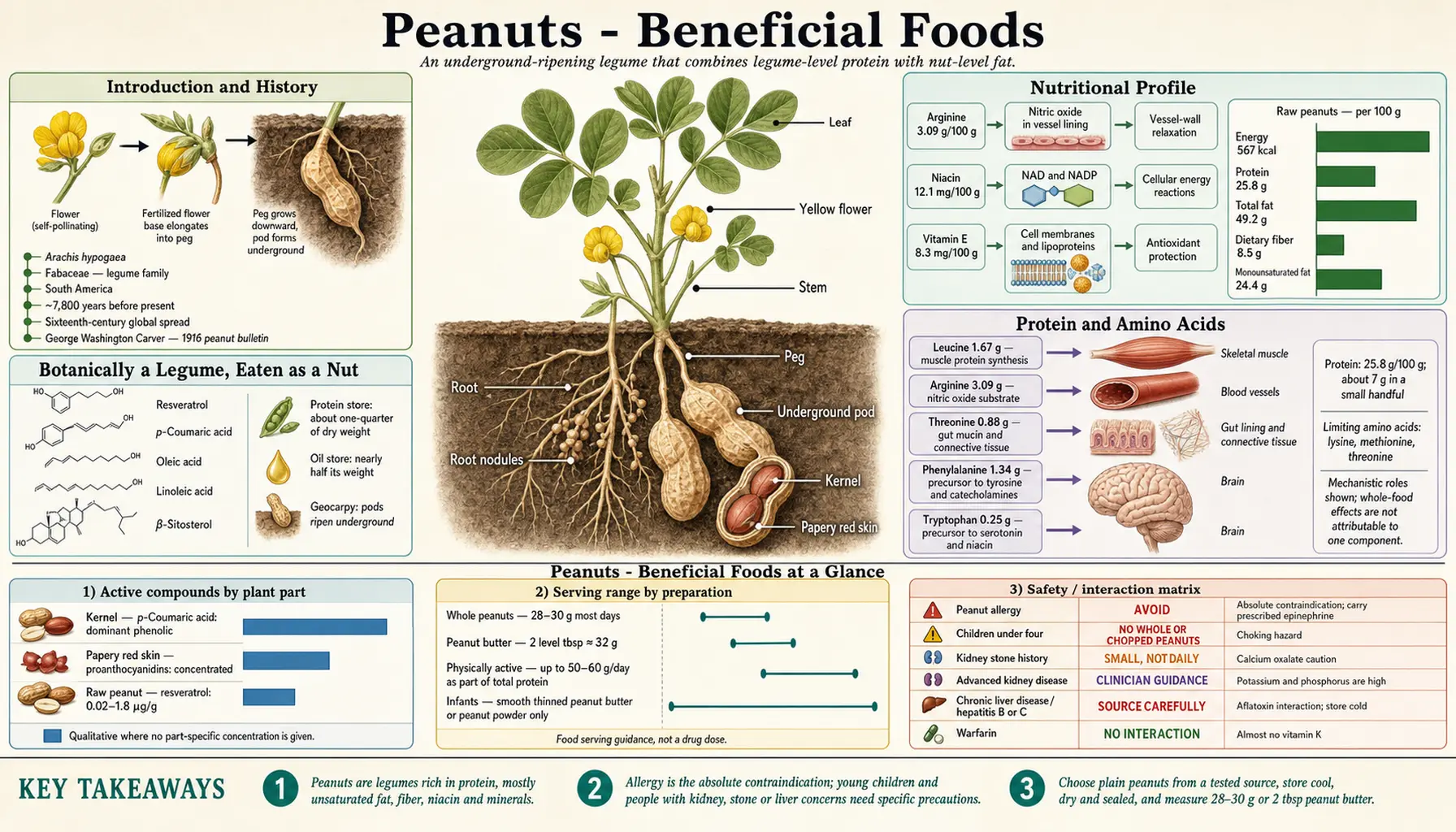
Table of Contents
- Introduction and History
- Botanically a Legume, Eaten as a Nut
- Nutritional Profile
- Protein and Amino Acids
- Monounsaturated Fat and the Omega-6 Question
- Niacin, Vitamin E and the Minerals
- Resveratrol and Other Plant Compounds
- Heart, Blood Sugar and Long-Term Studies
- Peanuts, Appetite and Body Weight
- The Aflatoxin Issue, Handled Practically
- Peanut Allergy
- How to Buy, Store and Prepare
- How Much to Eat
- Who Should Be Careful
- Connections
- References & Research
- Featured Videos
Introduction and History
The peanut, Arachis hypogaea, is the most widely eaten "nut" on the planet, and it is not a nut at all. It is a legume — a close relative of beans, lentils and peas — that grows its pods underground and happens to taste, roast and behave like a tree nut. Roughly fifty million tonnes are harvested every year, more than all true tree nuts combined, and in much of Africa, South Asia and Southeast Asia it is a staple source of protein and cooking fat rather than a snack.
Its home is South America. Genetic work traces cultivated peanuts to a single ancient hybridisation between two wild species, Arachis duranensis and Arachis ipaensis, whose ranges overlap in the valleys of southern Bolivia and northwestern Argentina. Excavations in the Ñanchoc Valley of northern Peru recovered peanut remains in domestic contexts dated to roughly 7,800 years before the present — some of the oldest evidence anywhere for a cultivated food crop in the Americas. People have been growing and eating peanuts, in other words, for something on the order of eight thousand years.
The peanut left South America with Portuguese and Spanish ships in the sixteenth century. It reached West Africa first, where it fit so naturally into existing groundnut cuisine that Europeans later assumed it was native there, then China and India by the same routes. It arrived in North America largely through the transatlantic slave trade — the regional names goober and pinder come from the Bantu words nguba and mpinda. For most of the eighteenth and nineteenth centuries it was a subsistence and livestock crop in the American South, considered food for the poor.
Two things changed that. The first was industrial grinding: several inventors independently produced peanut paste in the late nineteenth century, and by the 1900s peanut butter was on shop shelves. The second was agronomy. George Washington Carver spent decades promoting the peanut as a rotation crop for soil that cotton had stripped bare, publishing a 1916 bulletin on growing peanuts and over a hundred ways to prepare them. He did not invent peanut butter, a claim that still follows him, but he did more than anyone to make the peanut a Southern cash crop.
Today China, India, Nigeria, the United States and Sudan lead world production. In American and European kitchens the peanut is mostly a snack and a sandwich spread. In Indonesian, Thai, Vietnamese, West African, Chinese and Indian cooking it is a sauce base, a stew thickener, a frying oil and a garnish — used the way an ingredient is used, not the way a snack is.
Botanically a Legume, Eaten as a Nut
This distinction is not pedantry. It explains most of what makes peanuts nutritionally unusual, and it explains one of the things that makes them risky.
Peanuts belong to Fabaceae, the legume family. Like lentils, chickpeas and beans, the peanut plant hosts nitrogen-fixing bacteria in root nodules and pulls its own nitrogen from the air — exactly why Carver recommended it for exhausted cotton land. And like other legumes, the seed is built around a large protein store: about a quarter of its dry weight, roughly twice the protein fraction of most tree nuts.
What the peanut does differently is fat. Where lentils and beans store energy as starch, the peanut stores it as oil — nearly half its weight. That combination, legume-level protein plus nut-level fat, exists in very few foods. It is why peanuts sit in the nut aisle rather than the dried-bean aisle, and why they satisfy hunger the way they do.
The other oddity is how the pod forms, a habit botanists call geocarpy. Peanut flowers are ordinary yellow pea flowers that appear above ground and pollinate themselves. After fertilisation the base of the flower elongates into a stalk called a peg, which bends downward, drives into the soil, and only then does the ovary at its tip swell into the familiar wrinkled pod. The peanut therefore ripens buried in warm, damp earth, in direct contact with soil fungi. Hold onto that fact — it is the whole origin of the aflatoxin problem discussed below.
One practical consequence of the legume identity: peanut allergy and tree-nut allergy are separate conditions with separate proteins behind them. Many people allergic to peanuts tolerate almonds and walnuts perfectly well, and vice versa. Plenty of people are allergic to both, but that is co-occurrence, not cross-reaction — only testing and a clinician's judgement can sort out which applies.
Nutritional Profile
The figures below are for raw peanuts, all types, per 100 grams, from the USDA food composition database. One hundred grams is a large amount — about three and a half ounces, or roughly a hundred kernels. A realistic single serving is 28–30 grams, so for a normal handful divide everything by about three and a half.
Macronutrients per 100 g
| Component | Amount | Notes |
|---|---|---|
| Energy | 567 kcal | Dense; a 28 g handful is about 160 kcal |
| Water | 6.5 g | Very low, which is why they keep |
| Protein | 25.8 g | Unusually high for a nut-type food |
| Total fat | 49.2 g | Mostly unsaturated |
| Monounsaturated | 24.4 g | Chiefly oleic acid, as in olive oil |
| Polyunsaturated | 15.6 g | Almost entirely linoleic acid (omega-6) |
| Saturated | 6.3 g | Mainly palmitic acid |
| Total carbohydrate | 16.1 g | Low for a legume |
| Dietary fiber | 8.5 g | About 30% of a day's fiber target |
| Sugars | 4.7 g | Naturally present, mostly sucrose |
| Cholesterol | 0 mg | Plant food |
Vitamins per 100 g
| Vitamin | Amount | Share of adult daily value |
|---|---|---|
| Niacin (B3) | 12.1 mg | ~75% |
| Folate | 240 mcg | ~60% |
| Vitamin E (alpha-tocopherol) | 8.3 mg | ~55% |
| Thiamine (B1) | 0.64 mg | ~53% |
| Pantothenic acid (B5) | 1.77 mg | ~35% |
| Vitamin B6 | 0.35 mg | ~20% |
| Choline | 52.5 mg | ~10% |
| Riboflavin (B2) | 0.14 mg | ~10% |
Minerals per 100 g
| Mineral | Amount | Share of adult daily value |
|---|---|---|
| Manganese | 1.93 mg | ~84% |
| Copper | 1.14 mg | ~127% |
| Magnesium | 168 mg | ~40% |
| Phosphorus | 376 mg | ~30% |
| Zinc | 3.27 mg | ~30% |
| Iron | 4.58 mg | ~25% |
| Potassium | 705 mg | ~15% |
| Selenium | 7.2 mcg | ~13% |
| Calcium | 92 mg | ~7% |
| Sodium | 18 mg | Trace — salted peanuts are a different story |
Two entries deserve a second look. Copper at more than a full day's requirement per 100 grams makes peanuts one of the better plant sources of a mineral most people track poorly. And manganese at 84% is high enough that peanut-heavy diets contribute meaningfully to manganese intake, which matters both as a benefit and, in the rare case of impaired liver clearance, as something to watch.
What peanuts do not supply: vitamin C, vitamin A, vitamin B12 and vitamin K are all essentially absent. Peanuts are a protein, fat, B-vitamin and mineral food, not a source of the antioxidant vitamins.
Protein and Amino Acids
At roughly 26 grams per 100 grams, or about 7 grams in a small handful, peanuts carry more protein than any commonly eaten tree nut. That protein is not complete in the strict sense — the limiting amino acids are lysine, methionine and threonine — but "incomplete" is a misleading word in practice. Anyone eating peanuts alongside grains, dairy, eggs, meat or fish over a day is covered, because the shortfalls in one food are the surpluses in another. Peanut protein complements grain protein almost perfectly: oats, wheat and rice are low in lysine and adequate in methionine, and peanuts are the reverse.
Notable amino acids per 100 g
| Amino acid | Amount | Why it matters |
|---|---|---|
| Arginine | 3.09 g | Nitric oxide substrate; peanuts are among the richest common sources |
| Leucine | 1.67 g | Principal trigger for muscle protein synthesis |
| Phenylalanine | 1.34 g | Precursor to tyrosine and the catecholamines |
| Valine + isoleucine | 1.08 g + 0.91 g | Branched-chain amino acids |
| Lysine | 0.93 g | The limiting amino acid — pair with grains |
| Threonine | 0.88 g | Gut mucin and connective tissue |
| Tryptophan | 0.25 g | Precursor to serotonin and, via kynurenine, to niacin |
| Methionine | 0.32 g | Modest; the other limiting amino acid |
The arginine figure is the standout. Peanuts are one of the densest dietary sources of arginine, which the body converts to nitric oxide in the lining of blood vessels. Nitric oxide relaxes the vessel wall, and impaired production is one of the earliest measurable features of arterial disease. That is a plausible piece of the mechanism behind the cardiovascular findings below, though nobody has shown that peanut arginine specifically is doing the work — the whole food does more than any one component of it.
The tryptophan content pairs neatly with the niacin content: the body can make niacin from tryptophan at roughly a sixty-to-one conversion, so peanuts deliver the vitamin and a precursor to it in the same bite.
Monounsaturated Fat and the Omega-6 Question
Half the weight of a peanut is oil, and the largest single fatty acid in it is oleic acid — the same monounsaturated fat that dominates olive oil and avocado. About 24 of the 49 grams of fat per 100 grams is monounsaturated. High-oleic cultivars, now widely grown, push that fraction higher still and keep better on the shelf, because oleic acid is far less prone to oxidation than the polyunsaturated fats. Saturated fat is modest at about 6 grams, mostly palmitic acid, and peanuts contain no cholesterol and no trans fat in their natural state.
Now the honest complication. About 15.6 grams per 100 grams is polyunsaturated fat, nearly all of it linoleic acid, an omega-6. Peanuts contain effectively no omega-3 at all. Linoleic acid is an essential nutrient and there is nothing wrong with it; the concern is proportion. Diets built on industrial seed oils already deliver linoleic acid far in excess of anything humans historically ate, and the omega-6 to omega-3 ratio of a typical Western diet runs ten to twenty to one against a probable ancestral ratio nearer four to one. Peanuts eaten as a handful contribute a few grams and do not meaningfully move that needle. Peanut oil used as the primary cooking fat, day in and day out, does.
The sensible reading: enjoy peanuts as a whole food and get your fat balance elsewhere. Keep salmon, sardines and other omega-3 sources in the week, use olive oil as the default kitchen fat, and treat peanut oil as an occasional high-heat option rather than a staple. Refined peanut oil has a high smoke point near 230 °C, which is why it is favoured for frying, but repeated heating of any polyunsaturated-containing oil generates oxidation products you do not want. Fresh oil, used once.
Peanuts also carry roughly 220 milligrams of phytosterols per 100 grams, chiefly beta-sitosterol — plant sterols structurally similar to cholesterol that compete with it for absorption in the gut. A real, if small, contribution to the lipid effects seen in feeding studies.
Niacin, Vitamin E and the Minerals
Peanuts are a genuinely good micronutrient food, which is easy to forget about something sold in a bar-snack bowl.
Niacin (vitamin B3). At 12 milligrams per 100 grams, peanuts are one of the richest plant sources of niacin in the food supply, comparable to poultry and fish. Niacin becomes NAD and NADP, the coenzymes that carry electrons in essentially every energy-producing reaction in the body. Severe deficiency causes pellagra — the dermatitis, diarrhoea and dementia that devastated the maize-dependent American South. One of the historical ironies of the peanut is that it grew in exactly those fields and would have prevented the disease had it been eaten rather than sold. Unlike nicotinic acid at gram doses, niacin from food does not cause flushing.
Vitamin E. Around 8 milligrams of alpha-tocopherol per 100 grams. Vitamin E is the primary fat-soluble antioxidant of cell membranes and lipoproteins, and it is in peanuts for the plant's own reasons — it protects the seed's oil from going rancid. Any food storing a lot of unsaturated oil tends to arrive packaged with the vitamin E needed to defend it, a good argument for getting it from oily seeds rather than capsules.
Copper. More than a day's requirement in 100 grams. Copper is required by cytochrome c oxidase in the electron transport chain, superoxide dismutase in antioxidant defence, lysyl oxidase in collagen cross-linking, and ceruloplasmin in iron mobilisation. It is quietly one of the more under-consumed minerals, and peanuts are among the easiest plant foods for fixing that.
Manganese at about 84% of a day's intake per 100 grams is a cofactor for mitochondrial superoxide dismutase and for enzymes in bone formation. Magnesium at 168 milligrams per 100 grams is roughly 40% of a day's need, about 48 milligrams in a handful; it participates in more than three hundred enzymatic reactions, including every step that uses ATP, and low intake is common.
Folate at 240 micrograms per 100 grams is high for a nut-type food and consistent with the peanut's legume ancestry — legume seeds are among the densest sources. Zinc, phosphorus and iron are all present in useful amounts, with the caveat that phytic acid binds some fraction of the zinc and iron and reduces absorption — discussed under cautions below.
Resveratrol and Other Plant Compounds
Peanuts are one of the few foods besides grapes that contain resveratrol, the stilbene compound the plant manufactures as a chemical defence when it is attacked by fungus or physically injured. Because the peanut pod develops underground surrounded by soil fungi, the plant has good reason to make it.
Here is the honest accounting, because resveratrol has been oversold everywhere it appears. Measured resveratrol in raw peanuts ranges from roughly 0.02 to 1.8 micrograms per gram, with peanut butter in a similar range and boiled peanuts markedly higher — boiling in the shell raises measurable free resveratrol several-fold. A 28-gram serving therefore supplies somewhere between a fraction of a microgram and about 50 micrograms. The doses used in the resveratrol trials that generated the headlines were hundreds of milligrams — ten thousand times more. Peanuts are a real dietary source in the sense that the compound is genuinely there and genuinely absorbed. They are not a resveratrol therapy, and nobody should eat them for that reason.
The compounds present in quantities that might actually matter are the phenolic acids and flavonoids:
- p-Coumaric acid is the dominant phenolic in the kernel. Roasting increases its free, extractable form, which is why roasted peanuts test somewhat higher in total antioxidant capacity than raw — an unusual case where cooking raises rather than lowers a measured phytochemical.
- Proanthocyanidins are concentrated in the papery red skin. Peanut skins are one of the richest sources of these condensed tannins in the food supply, a good argument for eating skin-on peanuts rather than blanched ones when the source is trustworthy.
- Small amounts of several isoflavone-type compounds, which boiling increases, plus the phytosterols noted above.
The general point holds here as for every whole food on this site: the measurable benefits in population studies attach to eating the food, not to any single molecule extracted from it. Peanuts are worth eating for their protein, their fat quality, their fiber, their niacin and their minerals. The resveratrol is a footnote.
Heart, Blood Sugar and Long-Term Studies
Peanuts have been studied more thoroughly than most whole foods, partly because they are cheap enough to feed to trial participants for months.
Long-term mortality cohorts
The most informative work is a set of large prospective cohorts. A 2015 analysis pooled the Southern Community Cohort Study — which deliberately enrolled a low-income, largely African American population in the American South — with the Shanghai Women's and Shanghai Men's Health Studies, more than 200,000 people across three very different populations. Higher peanut consumption was associated with lower total mortality in all of them, reductions of 17–21% comparing highest intake to lowest, strongest for cardiovascular death. What makes this valuable is precisely that it was not done in affluent, health-conscious Western professionals, the population most nut research had used. The finding held where peanuts are eaten because they are cheap, not because they are fashionable.
A separate analysis of two large US cohorts followed up to thirty years found nut consumption seven or more times per week associated with about a 20% lower risk of death from any cause, peanuts and tree nuts similar. Later pooled work on cardiovascular endpoints found two or more peanut servings per week associated with roughly 13% lower cardiovascular risk.
These are observational studies and the usual caveat applies in full: people who eat peanuts regularly may differ in a dozen ways from those who do not. What gives the findings weight is the consistency of direction across populations sharing almost nothing else, plus feeding trials showing plausible mechanism.
Controlled feeding trials
Feeding studies in healthy adults show that adding peanuts improves the standard lipid measures — typically lowering total and LDL cholesterol and triglycerides without lowering HDL — even when added on top of the usual diet rather than substituted for something else. In one such trial, eight weeks of added peanuts reduced triglycerides substantially and lowered calculated cardiovascular risk, and participants did not gain the weight the added calories predicted. The candidate mechanisms are all plausible and probably all partly true: oleic acid replacing saturated fat in circulating lipids, phytosterols blocking cholesterol absorption, magnesium and potassium supporting vascular tone, arginine feeding nitric oxide production, and fiber binding bile acids.
Blood sugar
Peanuts have a very low glycemic index, around 13–14, because there is so little available carbohydrate and so much fat and protein slowing gastric emptying, and adding them to a carbohydrate meal measurably flattens that meal's glucose rise. A large prospective study of women found nuts five or more times a week associated with about a 27% lower risk of type 2 diabetes, and peanut butter five or more times a week with about a 21% lower risk, after adjustment for body mass index and other risk factors. See type 2 diabetes and insulin resistance.
The practical qualifier: all of this describes plain peanuts and plain peanut butter. Honey-roasted peanuts, chocolate-coated peanuts and peanut butter with added sugar and hydrogenated oil are different foods, and no cohort study has shown a benefit for them.
Peanuts, Appetite and Body Weight
The obvious objection is arithmetic: 567 calories per 100 grams, half of it fat. On paper a daily handful should add up to steady weight gain. In practice, trials that add peanuts to people's diets consistently find less weight gain than the calorie count predicts, and cohort studies find nut eaters at slightly lower body weight rather than higher. Three things appear to be going on.
Not all the fat is absorbed. Peanut fat is locked inside intact plant cell walls. Chewing ruptures some cells but not all, and the survivors pass into the stool with their oil still inside. Balance studies measuring what actually comes out the other end find meaningful faecal fat losses in people eating whole peanuts, the effect largest for whole nuts and smallest for peanut butter, where grinding has already done the cell rupture for you. Usable energy from whole peanuts is therefore lower than the label figure — but the shortfall is single-digit to low-double-digit percentages, not half.
They are unusually satiating. Protein and fat together are the most filling macronutrient combination there is, and peanuts deliver both plus 8.5 grams of fiber per 100 grams. Studies feeding peanuts as a mid-morning or afternoon snack find people spontaneously eat less at the next meal, offsetting much of what was added. Some trials also measure a modest rise in resting energy expenditure, though less consistently.
The honest summary: peanuts are calorie-dense but behave better than their calorie density suggests, and they are far easier to overeat as salted snacks in front of a screen than as a measured handful with a meal. Portion still matters. A jar of peanut butter eaten by the spoon over a week is 3,000 calories, and no amount of unabsorbed cell-wall fat changes that.
The Aflatoxin Issue, Handled Practically
This deserves a clear-eyed section rather than either dismissal or alarm.
What the problem actually is
Peanuts ripen underground in warm, moist soil. Two soil moulds, Aspergillus flavus and Aspergillus parasiticus, colonise damaged or drought-stressed kernels and produce aflatoxins, of which aflatoxin B1 is the most potent. B1 is classified by the International Agency for Research on Cancer as a Group 1 human carcinogen — the evidence in humans is considered sufficient. It is activated in the liver to an epoxide that binds DNA and produces a characteristic mutation in the p53 tumour suppressor gene, and chronic dietary exposure causes hepatocellular carcinoma. Risk assessments attribute a substantial share of the global liver cancer burden to aflatoxin, concentrated overwhelmingly in regions where maize and groundnuts are staples, storage is warm and humid, and there is no regulatory testing. The effect is strongly synergistic with chronic hepatitis B — the two multiply risk rather than add it.
Aflatoxin is also heat-stable. Ordinary roasting reduces it somewhat but does not destroy it. You cannot cook the problem away.
What this means in a regulated market
Considerably less than the paragraph above implies, and the difference is entirely about testing and sorting. Aflatoxin was identified in the 1960s and the peanut trade in high-income countries has been built around controlling it ever since. The United States sets an action level of 20 parts per billion for total aflatoxins in food; the European Union is stricter for peanuts intended to be eaten directly, at 2 parts per billion for aflatoxin B1 and 4 for total. Commercial lots are sampled, tested, electronically colour-sorted to remove discoloured and shrivelled kernels, and blanched — and because contamination concentrates in visibly damaged nuts, physical sorting removes most of it. Surveys of retail peanut butter in regulated markets routinely find aflatoxin either undetectable or in the low single-digit parts per billion.
The practical rules
- Buy from a source with real testing. Major brands and established retailers in countries with enforced limits test their lots because they are legally exposed if they do not. This single decision does most of the work.
- Be wary of open bins and unbranded bulk peanuts, particularly in hot, humid climates and particularly loose in-shell peanuts of unknown age and origin. This is where the risk actually lives.
- Look at the kernels and throw out the bad ones. Discard anything shrivelled, discoloured, mouldy, dusty-looking or grey-green. Aflatoxin does not distribute evenly — a few contaminated nuts can carry a whole batch's load.
- Trust bitterness. A peanut that tastes bitter, musty, sour or "off" should be spat out and the rest of the batch discarded. Rancidity and mould are the two things that taste bad here, and neither is worth swallowing.
- Store cool, dry and sealed, and buy smaller quantities more often. Mould needs moisture and warmth; long home storage in a warm kitchen is precisely what lets low-level contamination grow into a real one. Details under storing, below.
- Do not save the suspicious ones "for cooking." Heat does not help.
Two groups should be more careful than the general population: anyone with chronic liver disease or chronic hepatitis B or C, because of the multiplicative interaction, and small children, whose exposure per kilogram of body weight is higher for the same portion. For those groups, sourcing matters more — not peanut avoidance. See also mould and mycotoxins, a problem that extends well beyond peanuts to maize, dried figs, tree nuts, spices and improperly stored grain.
Peanut Allergy
Peanut allergy is not a caution to be tucked into a list at the bottom of a page. It is the leading cause of fatal food-induced anaphylaxis in Western countries, it affects on the order of 1–2% of children in the United States, the United Kingdom and Australia, and it is mostly lifelong — only about a fifth of children outgrow it, in contrast to milk and egg allergy where most do.
What is happening
The immune system produces IgE antibodies against specific peanut storage proteins — best characterised are Ara h 1, Ara h 2, Ara h 3 and Ara h 6. Sensitisation to the 2S albumins Ara h 2 and Ara h 6 is the most predictive of genuine clinical reactivity, which is why component-resolved blood testing is useful: it distinguishes the person who will react from the one who merely has detectable antibodies. These proteins are unusually resistant to heat and to digestive enzymes, part of why peanut reactions are severe — the allergen survives roasting and survives the stomach.
Reactions range from mouth itching and hives to vomiting, wheezing, throat swelling and full anaphylaxis with circulatory collapse. Trace exposures can be enough. There is no dose below which reaction is impossible for every allergic person.
If you or your child is allergic
This page cannot substitute for allergy care, and nothing here should be read as encouragement to test tolerance at home. The essentials, for the record: carry prescribed epinephrine auto-injectors and know how to use them, read every label including "may contain" warnings, treat unfamiliar Asian and African cuisines with particular care because peanut is often a hidden base ingredient, and have a written anaphylaxis action plan for schools and carers. Epinephrine is the treatment for anaphylaxis; antihistamines are not, and reaching for one instead of the injector has cost lives. See food allergy and allergies for detail.
A genuinely important reversal on prevention
For roughly fifteen years, guidance in several countries advised delaying peanut introduction in infants thought to be at high risk. Peanut allergy rates rose sharply over the same period. A landmark randomised trial published in 2015 tested the opposite strategy directly: infants aged 4 to 11 months with severe eczema, egg allergy or both were assigned either to consume peanut protein regularly or to avoid it entirely until age five. Among infants not already sensitised, peanut allergy at five years was 13.7% in the avoidance group and 1.9% in the consumption group — an 86% relative reduction. Among those with mild pre-existing sensitisation the reduction was still large. A second trial introducing several allergenic foods early in breastfed infants reached the same conclusion for peanut.
National guidance changed as a result. Expert panel addendum guidelines published in 2017 recommend introducing peanut-containing foods early — around 4 to 6 months for infants with severe eczema or egg allergy, after specialist evaluation, and around 6 months for other infants alongside other solids. The advice runs opposite to what many parents were told a decade ago, and it is one of the clearest examples in modern nutrition of a plausible-sounding precaution that made the problem worse.
Two safety points that must not get lost. First, high-risk infants should be evaluated before peanut is introduced at home — that is how the trial was run and what the guidelines say. Second, whole and chopped peanuts are a serious choking hazard for children under four and must never be given. Early introduction is done with smooth peanut butter thinned with warm water, breast milk or formula, or with peanut flour or powder stirred into other food.
For established allergy, licensed oral immunotherapy now exists. A randomised trial published in 2018 showed a standardised, gradually escalating peanut protein product let a majority of treated children tolerate a substantially higher challenge dose than before, and a product based on it was approved by the FDA in 2020. It reduces the severity of accidental exposure; it is not a cure, it carries its own risk of reactions, and it is done under medical supervision only.
Peanut oil
Highly refined peanut oil has the protein removed during processing, and a double-blind crossover challenge study found peanut-allergic subjects did not react to it, whereas some did react to cold-pressed, unrefined oil which retains protein. That is why refined peanut oil is generally not required to be declared as an allergen. Gourmet, cold-pressed, aromatic and "roasted" peanut oils are a different matter and should be avoided by allergic individuals, and anyone with a history of anaphylaxis should discuss oil with their allergist rather than relying on a general statement.
How to Buy, Store and Prepare
Buying
In-shell raw peanuts keep the longest and cost the least. Choose shells that are unbroken, uniformly pale tan, and free of dark spots, holes or dampness. A pod that rattles loudly when shaken usually holds shrunken kernels — a sign of drought stress or poor curing, and drought-stressed kernels are the ones most likely to carry mould.
Shelled raw peanuts are the most useful form for cooking, since you control the roasting and the salt. Skin-on ("redskin") peanuts retain the proanthocyanidin-rich skin; blanched peanuts have had it removed. Prefer skin-on from a source you trust.
Roasted peanuts should smell sweet and toasty, never sharp, paint-like or musty. Buy from shops with turnover — roasted peanuts go rancid faster than raw ones because roasting exposes the oil.
Peanut butter. Read the ingredient list and expect peanuts, possibly salt, and nothing else. Skip anything containing hydrogenated or partially hydrogenated oil, palm oil added as a stabiliser, added sugar or corn syrup. Natural peanut butter separates because there is nothing in it to stop the oil rising, which is the point; stir it once and store the jar upside down between uses.
Green (raw, undried) peanuts appear seasonally in the American South and across Asia and are the correct starting material for boiled peanuts. They are perishable — refrigerate and use within a few days.
Storing
- In-shell, cool and dry: several months.
- Shelled raw, airtight in the refrigerator: up to about six months.
- Shelled raw, frozen: up to about a year, with no meaningful quality loss. Freezing is the best answer for bulk purchases.
- Roasted: a few weeks at room temperature in a sealed jar; longer refrigerated.
- Peanut butter: a couple of months in the cupboard once opened, longer refrigerated. In a hot kitchen, refrigerate.
The two enemies are oxygen plus warmth, which cause rancidity, and moisture plus warmth, which causes mould. Airtight containers in a cool place address both. Never decant peanuts into a container that is not completely dry.
Preparing
Home roasting gives the best flavour and total control over salt and fat. Spread raw shelled peanuts in a single layer and dry-roast at about 175 °C (350 °F) for 15 to 20 minutes, shaking the pan once or twice, until the skins darken and loosen and the kitchen smells of peanuts. They keep cooking from residual heat, so pull them slightly early, and cool completely before storing or they steam themselves soft. No oil is needed — peanuts fry in their own fat.
Boiled peanuts are green peanuts simmered in the shell in salted water for two to four hours until soft, producing something closer to a bean than a nut — a Southern US and Southeast Asian preparation far older than roasting in the peanut's home range. Boiling raises the measurable levels of several of the phenolic compounds discussed above.
Grinding your own butter takes about five minutes in a food processor with roasted peanuts and a pinch of salt. It passes through a crumbly stage and then suddenly turns glossy and smooth as the cell walls give up their oil. Nothing else need be added.
Savoury uses are where peanuts earn their keep as an ingredient rather than a snack:
- Peanut sauce — ground roasted peanuts with garlic, chili, lime juice, a little honey and coconut milk, over grilled chicken or vegetables.
- West African groundnut stew — peanut butter melted into a tomato, onion, ginger and chili base with chicken or sweet potatoes.
- Crushed roasted peanuts as a finishing texture on stir-fried greens, noodles, cabbage slaws and rice dishes.
- A spoon of plain peanut butter stirred into hot oats, which fixes the one weakness of a bowl of oats by adding fat and protein.
- Peanut butter with apple slices or carrot sticks — the fat slows the sugar and makes a snack that holds.
The one preparation worth avoiding is deep-frying in reused oil; the one product worth avoiding is anything where "peanut" appears next to "candy coating."
How Much to Eat
A standard serving is 28 to 30 grams — about 28 to 30 kernels, a small closed handful, roughly 160 calories, 7 grams of protein, 2.4 grams of fiber and 48 milligrams of magnesium. Two level tablespoons of peanut butter is about 32 grams and comes to a similar place.
The intakes associated with lower mortality and lower cardiovascular risk in the cohort studies are not large. Most of the benefit appears at five or more servings per week, or as little as two servings per week in the cardiovascular analyses. In practical terms: a handful most days, or a couple of tablespoons of peanut butter. There is no evidence that eating five handfuls a day does five times as much good, and there is every reason to think the calories eventually catch up.
| Situation | Reasonable amount |
|---|---|
| General health, no restrictions | 28–30 g most days; 2 tbsp peanut butter is equivalent |
| Managing body weight | One measured handful, eaten with or before a meal rather than grazed from a bowl |
| Physically active or building muscle | Up to 50–60 g a day is reasonable as part of total protein intake |
| Kidney stone history (calcium oxalate) | Small portions, not daily; see cautions |
| Advanced kidney disease | Only on a renal dietitian's advice — potassium and phosphorus are high |
| Infants (allergy prevention) | Smooth thinned peanut butter or peanut powder only, per current guidance, after evaluation if high risk. Never whole peanuts under age 4 |
| Diagnosed peanut allergy | None. Strict avoidance plus carried epinephrine |
Salt is the variable most worth watching. Plain peanuts contain 18 milligrams of sodium per 100 grams; heavily salted roasted peanuts can carry several hundred. If blood pressure is a concern, buy unsalted and salt them yourself, which invariably means less salt.
Who Should Be Careful
Anyone with peanut allergy. Strict avoidance. See the allergy section above. This is the one absolute contraindication on this page.
Children under four. Whole and chopped peanuts are a choking hazard of exactly the wrong size and shape. Smooth peanut butter thinned to a spreadable or stirrable consistency, or peanut powder, only.
People with a history of calcium oxalate kidney stones. Peanuts are moderately high in oxalate, in the region of 140 to 190 milligrams per 100 grams. For most people this is irrelevant; for a recurrent oxalate stone former it is worth knowing, and the standard mitigation applies — eat oxalate-containing foods with a calcium source in the same meal so the oxalate binds in the gut rather than the kidney, and keep fluid intake high. Peanut butter deserves the same attention as spinach and beets here.
People with advanced chronic kidney disease or on dialysis. Peanuts carry 705 milligrams of potassium and 376 milligrams of phosphorus per 100 grams, both restricted in advanced kidney disease. Portion guidance should come from a renal dietitian, not a general page like this one.
Phytic acid and mineral absorption. Like all legumes and seeds, peanuts contain phytic acid, which binds zinc, iron, calcium and magnesium in the intestine and reduces absorption. For anyone eating a varied diet this is a non-issue, and phytate has genuine antioxidant benefits of its own. It matters when peanuts and other high-phytate staples make up the bulk of the diet and iron or zinc status is already marginal. Roasting reduces phytate somewhat; soaking and boiling more. Vitamin C at the same meal improves non-haem iron absorption, so a squeeze of citrus alongside is a cheap fix.
Lectins. Peanuts contain peanut agglutinin. Roasting and boiling substantially reduce lectin activity, and there is no good evidence that peanut lectins cause harm at normal culinary intakes. Raw peanuts in quantity are worth avoiding, mostly for digestibility and taste rather than toxicity.
People with chronic liver disease or chronic hepatitis B or C. Two separate reasons, neither meaning peanuts are inherently harmful: the aflatoxin–hepatitis interaction multiplies liver cancer risk, so source carefully and store cold (see the aflatoxin section); and manganese is cleared through the bile, that clearance is impaired in advanced liver disease, and peanuts are one of the highest-manganese foods.
Reflux and irritable bowel. The high fat content slows gastric emptying, which some people with reflux find aggravating, and the fiber can trouble sensitive guts in larger portions. Peanuts are low in FODMAPs at a standard 28-gram serving but not at 100 grams.
What is not a real interaction. Peanuts contain almost no vitamin K, so they do not interfere with warfarin. They are low in purines and are not a gout risk. And despite persistent internet claims, plain peanuts are not high in tyramine and are not a problem for people on MAO inhibitors — that concern belongs to aged, cured and fermented foods.
As always on this site: this is general food information, not medical advice. Anyone with an established allergy, kidney disease, liver disease or a stone history should take portion decisions to their own clinician.
Connections
- All Food
- Almonds — the tree-nut comparison, lower protein, higher vitamin E
- Walnuts — the one common nut with real omega-3
- Lentils — the peanut's starchy legume cousin
- Olive Oil — the better default kitchen fat
- Resveratrol — what peanuts actually contribute, honestly measured
- Vitamin B3 (Niacin) — peanuts are among the richest plant sources
- Copper — over a day's requirement per 100 g
- Arginine — the nitric oxide precursor peanuts are loaded with
- Mould & Mycotoxins — the aflatoxin question in full context
- Food Allergy — diagnosis, labelling and management
- Anaphylaxis — recognition and epinephrine
References & Research
- Dillehay TD, Rossen J, Andres TC, Williams DE. Preceramic adoption of peanut, squash, and cotton in northern Peru. Science, 2007. Search PubMed
- Sanders TH, McMichael RW Jr, Hendrix KW. Occurrence of resveratrol in edible peanuts. Journal of Agricultural and Food Chemistry, 2000. Search PubMed
- Luu HN, Blot WJ, Xiang YB, Cai H, Hargreaves MK, Li H, Yang G, Signorello L, Gao YT, Zheng W, Shu XO. Prospective evaluation of the association of nut/peanut consumption with total and cause-specific mortality. JAMA Internal Medicine, 2015. Search PubMed
- Jiang R, Manson JE, Stampfer MJ, Liu S, Willett WC, Hu FB. Nut and peanut butter consumption and risk of type 2 diabetes in women. JAMA, 2002. Search PubMed
- Alper CM, Mattes RD. Peanut consumption improves indices of cardiovascular disease risk in healthy adults. Journal of the American College of Nutrition, 2003. Search PubMed
- Traoret CJ, Lokko P, Cruz ACRF, Oliveira CG, Costa NMB, Bressan J, Alfenas RCG, Mattes RD. Peanut digestion and energy balance. International Journal of Obesity, 2008. Search PubMed
- Kensler TW, Roebuck BD, Wogan GN, Groopman JD. Aflatoxin: a 50-year odyssey of mechanistic and translational toxicology. Toxicological Sciences, 2011. Search PubMed
- Liu Y, Wu F. Global burden of aflatoxin-induced hepatocellular carcinoma: a risk assessment. Environmental Health Perspectives, 2010. Search PubMed
- Du Toit G, Roberts G, Sayre PH, Bahnson HT, Radulovic S, Santos AF, Brough HA, Phippard D, Basting M, Feeney M, Turcanu V, Sever ML, Gomez Lorenzo M, Plaut M, Lack G. Randomized trial of peanut consumption in infants at risk for peanut allergy. New England Journal of Medicine, 2015. Search PubMed
- Togias A, Cooper SF, Acebal ML, et al. Addendum guidelines for the prevention of peanut allergy in the United States: report of the National Institute of Allergy and Infectious Diseases-sponsored expert panel. Journal of Allergy and Clinical Immunology, 2017. Search PubMed
- Hourihane JO, Bedwani SJ, Dean TP, Warner JO. Randomised, double blind, crossover challenge study of allergenicity of peanut oils in subjects allergic to peanuts. BMJ, 1997. Search PubMed