Allergies
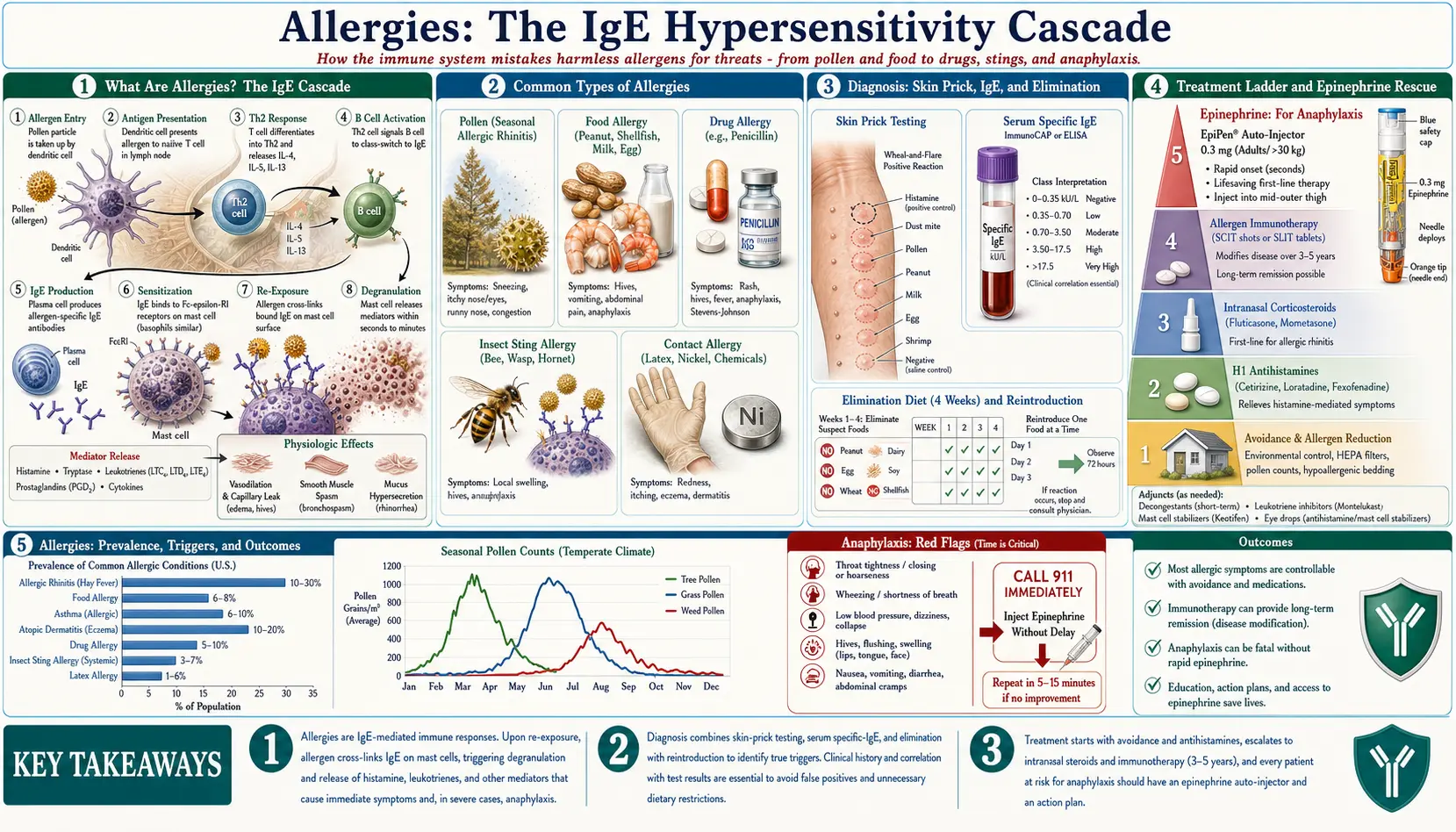
Table of Contents
- What are Allergies?
- Common Types of Allergies
- Common Symptoms of Allergies
- Causes and Risk Factors
- Diagnosis
- Treatment Options
- Prevention and Management Strategies
- Complications of Allergies
- Research Papers
- Connections
- References & Research
- Featured Videos
What are Allergies?
Allergies occur when the immune system reacts to a foreign substance, such as pollen, pet dander, certain foods, or medication, as if it were a threat. These substances, known as allergens, trigger the immune response, which can cause various symptoms ranging from mild to severe.
Common Types of Allergies
1. Seasonal Allergies (Hay Fever)
- Caused by: Pollen from trees, grasses, and weeds.
- Symptoms: Sneezing, runny or stuffy nose, itchy eyes, and sore throat.
2. Food Allergies
- Common triggers: Peanuts, tree nuts, shellfish, milk, eggs, wheat, soy, and fish.
- Symptoms: Hives, swelling, stomach pain, vomiting, and in severe cases, anaphylaxis.
3. Drug Allergies
- Caused by: Reactions to medications such as penicillin, aspirin, or other antibiotics.
- Symptoms: Rash, itching, swelling, and breathing difficulties.
4. Insect Sting Allergies
- Caused by: Stings from bees, wasps, hornets, or fire ants.
- Symptoms: Redness, swelling at the sting site, and in severe cases, anaphylaxis.
5. Skin Allergies
- Includes: Eczema, contact dermatitis, and hives.
- Caused by: Contact with allergens such as latex, certain metals, or cosmetics.
Common Symptoms of Allergies
- Runny or stuffy nose
- Itchy or watery eyes
- Sneezing
- Hives or skin rash
- Swelling: Often in the face, lips, or tongue.
- Shortness of breath or wheezing
- Stomach cramps, nausea, or diarrhea
- Anaphylaxis: A severe, life-threatening reaction that requires immediate medical attention.
Causes and Risk Factors
- Genetic predisposition: Allergies often run in families.
- Environmental exposure: Repeated exposure to allergens can trigger an immune response.
- Asthma and other conditions: People with asthma or other allergic conditions are more likely to develop allergies.
Diagnosis
- Medical history and symptom assessment
- Skin prick test: A small amount of allergen is applied to the skin to check for a reaction.
- Blood tests: To measure levels of allergen-specific antibodies (IgE).
- Elimination diet: To identify food allergies by removing potential triggers and reintroducing them one by one.
Treatment Options
- Medications:
- Antihistamines: To relieve sneezing, itching, and runny nose.
- Decongestants: To reduce nasal congestion.
- Corticosteroids: Nasal sprays or creams to reduce inflammation.
- Epinephrine auto-injectors: For emergency treatment of anaphylaxis.
- Immunotherapy:
- Allergy shots: Gradually introduce small doses of allergens to build tolerance.
- Sublingual tablets: Taken under the tongue to reduce allergic reactions over time.
- Avoidance:
- Identify and avoid triggers: Minimize exposure to known allergens.
Prevention and Management Strategies
- Keep windows closed: To prevent pollen from entering the home during allergy seasons.
- Use air purifiers: To filter allergens from indoor air.
- Shower and change clothes after spending time outdoors to remove pollen and other allergens.
- Maintain a clean environment: Regularly wash bedding, vacuum with a HEPA filter, and reduce dust and mold.
- Carry an epinephrine auto-injector: For those with severe allergies at risk for anaphylaxis.
Complications of Allergies
- Anaphylaxis: A severe, life-threatening allergic reaction.
- Asthma: Allergies can trigger or worsen asthma symptoms.
- Chronic sinusitis: Persistent inflammation of the nasal passages.
- Skin infections: Resulting from scratching due to allergic skin reactions.
References & Research
Historical Background
The concept of allergy was first introduced by Clemens von Pirquet in 1906, who coined the term to describe altered immune reactivity. Charles Richet discovered anaphylaxis in 1902, for which he received the Nobel Prize in 1913. The role of immunoglobulin E (IgE) in allergic responses was independently discovered by Kimishige Ishizaka and Gunnar Johansson in 1966-1967, establishing the modern immunological basis of allergic disease.
Key Research Papers
- Pawankar R, et al. Allergic diseases and asthma: a global public health concern and a call to action. World Allergy Organization Journal. 2014;7(1):12.
- Galli SJ, Tsai M. IgE and mast cells in allergic disease. Nature Medicine. 2012;18(5):693-704.
- Bousquet J, et al. Allergic Rhinitis and its Impact on Asthma (ARIA) 2008 update. Allergy. 2008;63(Suppl 86):8-160.
- Sicherer SH, Sampson HA. Food allergy: epidemiology, pathogenesis, diagnosis, and treatment. Journal of Allergy and Clinical Immunology. 2014;133(2):291-307.
- Du Toit G, et al. Randomized trial of peanut consumption in infants at risk for peanut allergy (LEAP study). New England Journal of Medicine. 2015;372(9):803-813.
- Sampson HA, et al. Food allergy: a practice parameter update. Journal of Allergy and Clinical Immunology. 2014;134(5):1016-1025.
- Durham SR, et al. Long-term clinical efficacy of grass-pollen immunotherapy. New England Journal of Medicine. 1999;341(7):468-475.
- Holgate ST. The epidemic of allergy and asthma. Nature. 1999;402(6760 Suppl):B2-B4.
- Platts-Mills TAE. The allergy epidemics: 1870-2010. Journal of Allergy and Clinical Immunology. 2015;136(1):3-13.
- Lieberman P, et al. The diagnosis and management of anaphylaxis practice parameter: 2010 update. Journal of Allergy and Clinical Immunology. 2010;126(3):477-480.
- Muraro A, et al. EAACI food allergy and anaphylaxis guidelines: diagnosis and management of food allergy. Allergy. 2014;69(8):1008-1025.
Research Papers
Explore current literature on allergies via PubMed topic searches. These links open live PubMed searches for the listed keywords — results update as new studies are indexed.
- Clinical trials on allergic rhinitis — PubMed search
- Clinical trials on food allergy — PubMed search
- Clinical trials on anaphylaxis — PubMed search
- Clinical trials on allergen immunotherapy — PubMed search
- Clinical trials on atopic dermatitis allergy — PubMed search
- Clinical trials on omalizumab allergy — PubMed search
- Clinical trials on IgE-mediated hypersensitivity — PubMed search
Connections
- Pain & Allergy
- Asthma: What Happens in an Attack — interactive animation
- Histamine, Mast Cells & Allergy — interactive animation
- Asthma
- Eczema
- Mast Cell Activation Syndrome
- Alpha-Gal Syndrome
- Food Intolerance
- Sinusitis
- Celiac Disease
- Hives and Flushing
- Chronic Cough
- Elimination Diet
- Shortness of Breath
- Yellow 5 Tartrazine
- Food Additives
- Chronic Pain
- Inflammatory Bowel Disease
- Hashimoto's Thyroiditis
- Quercetin
- Milk
- Common Cold
- Ear Infections