Resveratrol: The Sirtuin-Activating Longevity Antioxidant
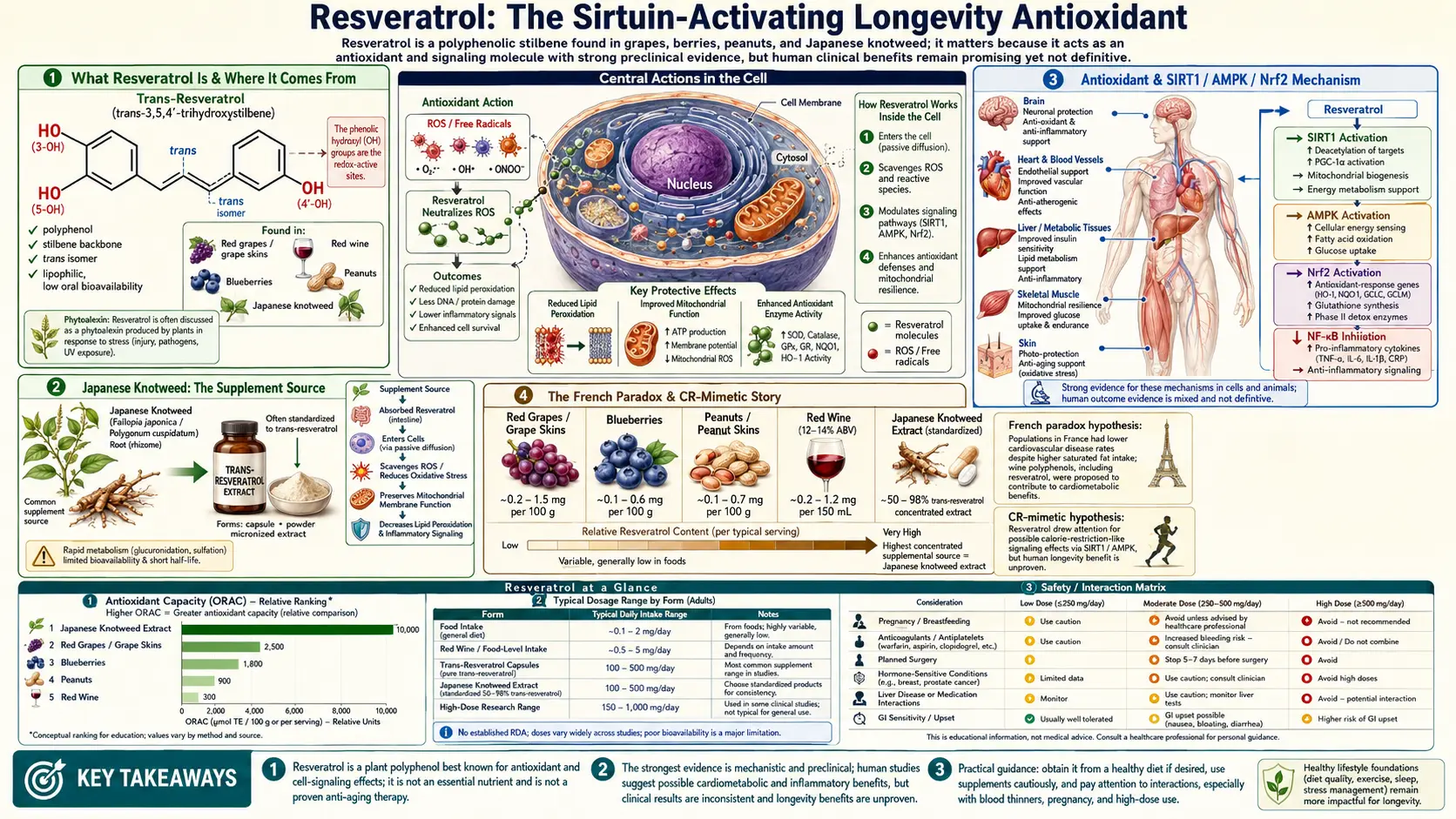
Resveratrol (3,5,4′-trihydroxystilbene) is a stilbene polyphenol that plants produce as a defensive phytoalexin under stress. It became famous as the molecule behind the "French paradox" and as the first reported small-molecule activator of SIRT1, the sirtuin enzyme linked to caloric-restriction biology and longevity. In the body it acts as a direct antioxidant and, more importantly, as a hormetic signaling molecule that switches on SIRT1, AMPK, and the Nrf2 antioxidant-defense pathway. Most dietary resveratrol comes from red wine, grapes, and berries in milligram amounts; nearly all supplements are extracted from Japanese knotweed (Polygonum cuspidatum). The longevity story is genuinely promising but contested — animal data are strong, human trials are mixed, and the field carries the baggage of the Sinclair-lab controversies.
Table of Contents
- What Resveratrol Is & Where It Comes From
- Japanese Knotweed: The Supplement Source
- Antioxidant & SIRT1 / AMPK / Nrf2 Mechanism
- The French Paradox & CR-Mimetic Story
- The Sinclair Controversy & Mixed Human Trials
- Pairing With NAD+ / NMN
- Cardiometabolic Benefits
- Longevity & Sirtuin Biology
- Neuroprotection & Brain Health
- Anti-Inflammatory & Antioxidant Defense
- The Bioavailability Problem
- Forms & Dosing
- Safety & Interactions
- Key Research Papers
- Connections
- Featured Videos
What Resveratrol Is & Where It Comes From
Resveratrol is a stilbenoid — a polyphenol built on a stilbene backbone of two phenol rings joined by a two-carbon ethylene bridge. Its formal chemical name is 3,5,4′-trihydroxy-trans-stilbene, and those three hydroxyl groups are the chemically reactive sites that let it donate hydrogen atoms to neutralize free radicals. It exists as two geometric isomers, trans-resveratrol and cis-resveratrol; the trans form is the biologically active, more stable one and the form used in essentially all research and supplements.
Plants do not make resveratrol for our benefit. It is a phytoalexin — a defensive compound synthesized in response to injury, ultraviolet radiation, and fungal attack (notably Botrytis cinerea, the grey mould of grapes). The enzyme stilbene synthase builds it from malonyl-CoA and a coumaroyl-CoA unit, the same precursor pool that feeds flavonoid synthesis. This stress-response origin is conceptually important: resveratrol is a molecule that signals "the environment is hostile," and much of its biology in animals appears to be an echo of that hormetic, stress-adaptation signaling.
Dietary sources, in rough order of concentration:
- Red wine — the most famous source, with roughly 0.2–2 mg per glass depending on grape variety, region, and fermentation time on the skins. Pinot Noir grown in cool, damp climates tends to be richest because the grapes face more fungal pressure.
- Red and purple grapes — concentrated in the skin and seeds; white wine has far less because it is fermented without the skins.
- Berries — blueberries, bilberries, cranberries, and especially the skins of dark berries.
- Peanuts and pistachios — modest amounts, higher in the red papery skin of peanuts.
- Dark chocolate / cocoa — trace amounts.
- Japanese knotweed (Polygonum cuspidatum) — by far the richest natural source, which is why it, not grapes, is the raw material for supplements (see next section).
The practical problem with diet is dose. The amounts that produce striking effects in animal studies correspond, when scaled by body weight, to hundreds of milligrams or even grams per day in humans — the equivalent of dozens to hundreds of liters of red wine. Diet alone cannot deliver "longevity-study" doses, which is the entire reason the supplement industry exists for this molecule.
Japanese Knotweed: The Supplement Source
Almost every resveratrol capsule sold — whether labeled "from red wine," "grape-derived," or just "resveratrol" — is in fact extracted from the roots of Japanese knotweed (Polygonum cuspidatum, also classified as Reynoutria japonica or Fallopia japonica). Knotweed root is the most concentrated known botanical source of resveratrol, containing it largely as the glycoside polydatin (resveratrol-3-β-glucoside, also called piceid), which is hydrolyzed to free resveratrol during extraction or in the gut.
The economics are simple: extracting resveratrol from grapes or wine would be prohibitively expensive given how little is present, whereas knotweed root can yield standardized extracts of 50%, 98%, or even >99% trans-resveratrol. When a label says "98% trans-resveratrol from Polygonum cuspidatum," that is the honest, standard product.
Japanese knotweed is itself a notable plant beyond resveratrol. In East Asian herbal traditions the root (Hu Zhang) has long been used for cardiovascular and inflammatory complaints, and in the West it is well known to herbalists for a different reason — it also contains emodin and other anthraquinones and is a prominent botanical in some chronic-infection protocols. (See the dedicated Japanese Knotweed herb page for the full traditional and clinical picture.) For the purpose of this article, the key point is that the "antioxidant supplement" and the "invasive weed your neighbor is fighting in the backyard" are the same species, and the resveratrol in your capsule almost certainly began as a knotweed rhizome.
Antioxidant & SIRT1 / AMPK / Nrf2 Mechanism
Resveratrol works through two overlapping mechanisms: a direct chemical antioxidant action and an indirect signaling action that is almost certainly the more biologically important of the two.
Direct antioxidant action
The three hydroxyl groups on the stilbene scaffold can donate hydrogen atoms to quench reactive oxygen and nitrogen species, including superoxide, hydroxyl radicals, and peroxynitrite. Resveratrol also chelates redox-active transition metals such as copper and iron, reducing Fenton-type radical generation. These actions are real but, given the very low blood concentrations achieved after oral dosing, are unlikely to account for most of resveratrol's effects in living animals.
Indirect (signaling) antioxidant action — the important pathways
The dominant model is that resveratrol acts as a hormetic signaling molecule that switches on the cell's own stress-defense and energy-sensing machinery:
- SIRT1 (sirtuin 1) — resveratrol was the first reported small-molecule activator of SIRT1, an NAD+-dependent deacetylase that is the molecular hub of caloric-restriction biology. Active SIRT1 deacetylates and modifies key regulators — PGC-1α (mitochondrial biogenesis), FOXO transcription factors (stress resistance and autophagy), NF-κB (inflammation), and p53 (cell survival). Whether resveratrol activates SIRT1 directly or indirectly is one of the central scientific controversies, addressed below.
- AMPK (AMP-activated protein kinase) — the cell's master fuel gauge, switched on when energy runs low. Resveratrol activates AMPK (in part via SIRT1, in part by mildly inhibiting mitochondrial ATP synthase and raising the AMP:ATP ratio). Active AMPK promotes glucose uptake, fatty-acid oxidation, mitochondrial biogenesis, and autophagy while suppressing mTOR-driven anabolic growth — much the same metabolic state induced by exercise and fasting.
- Nrf2 (nuclear factor erythroid 2–related factor 2) — the master switch for the antioxidant-response element (ARE). Resveratrol promotes Nrf2 translocation to the nucleus, upregulating the body's endogenous antioxidant enzymes: glutathione synthesis, superoxide dismutase, catalase, glutathione peroxidase, heme oxygenase-1, and NQO1. This indirect boosting of the cell's own defenses is more durable and biologically powerful than the molecule's direct radical-scavenging.
The unifying theme: resveratrol behaves as a caloric-restriction / exercise mimetic at the signaling level, nudging SIRT1–AMPK–PGC-1α toward mitochondrial biogenesis and toward Nrf2-driven antioxidant defense, while damping NF-κB inflammation. This is the mechanistic bridge to its proposed cardiometabolic, longevity, and neuroprotective benefits.
The French Paradox & CR-Mimetic Story
Resveratrol owes its fame to two stories that became tangled together in the public imagination.
The French paradox
In the 1980s and 1990s, epidemiologists noted that the French population had relatively low rates of coronary heart disease despite a diet rich in saturated fat — the so-called "French paradox," popularized after a 1992 Lancet commentary by Renaud and de Lorgeril. Habitual moderate red-wine consumption was proposed as a partial explanation, and resveratrol, a distinctive polyphenol in red wine, became the headline candidate molecule. It is important to be honest here: the French paradox is at least as plausibly explained by the overall Mediterranean dietary pattern, the ethanol itself (modest alcohol raises HDL and has antiplatelet effects), and confounding lifestyle factors. The amount of resveratrol in even heavy wine drinking is far too small to plausibly drive the effect on its own. Red wine is best thought of as how resveratrol entered public consciousness, not as proof that resveratrol explains the paradox.
The caloric-restriction-mimetic story
The second and scientifically deeper story began in 2003, when a Nature paper from the Sinclair and Guarente circle reported that resveratrol activated SIRT1 and extended replicative lifespan in budding yeast. This was followed by reports that resveratrol extended lifespan in worms, fruit flies, and short-lived fish, and — most influentially — a 2006 Nature paper (Baur et al.) showing that resveratrol improved health and survival of mice fed a high-calorie diet, shifting their physiology toward that of lean, healthy animals. The framing was electrifying: resveratrol appeared to be a caloric-restriction mimetic, a pill that reproduced some of the benefits of eating less without eating less.
Two crucial caveats kept this from being the slam dunk it was reported as. First, in normal-diet, non-obese mice, resveratrol improved various health markers but did not reliably extend maximum lifespan — the dramatic survival benefit was specific to mice made obese by overfeeding. Second, the doses used were high relative to what humans achieve from supplements, let alone from wine. So the accurate summary is: resveratrol convincingly improves healthspan markers in stressed/obese animal models and behaves like a partial CR-mimetic, but the leap to "resveratrol extends human lifespan" was never actually demonstrated.
The Sinclair Controversy & Mixed Human Trials
No honest discussion of resveratrol can skip the controversy, because it shaped both the science and the supplement market.
The Sinclair / Sirtris episode
David Sinclair of Harvard was the most prominent public champion of resveratrol-as-longevity-molecule. In 2004 he co-founded Sirtris Pharmaceuticals to develop sirtuin-activating compounds; GlaxoSmithKline acquired it in 2008 for about $720 million. The scientific foundation then came under attack on two fronts. First, the central assay used to show that resveratrol "directly activates SIRT1" was found to depend on a fluorescent (Fluor-de-Lys) tag on the test peptide — remove the artificial fluorophore and the direct-activation effect largely disappeared, suggesting much of resveratrol's SIRT1 effect in cells is indirect (e.g., via AMPK and raised NAD+/cellular energy stress) rather than a clean direct activation. Pfizer and Amgen scientists published failures to reproduce key direct-activation findings. GSK eventually shut down the Sirtris site in 2013.
Separately, in 2012 the University of Connecticut found that resveratrol researcher Dipak Das had fabricated data across more than a hundred figures, leading to multiple retractions. Das's work was distinct from Sinclair's, but the two became conflated in public coverage, and the combined effect was to cast a long shadow of skepticism over the entire field.
The fair conclusion is nuanced: resveratrol almost certainly does modulate SIRT1 signaling, but probably indirectly (through AMPK activation and cellular-energy effects) rather than by docking onto and switching on the enzyme the way the original simple model claimed. The longevity benefits are real in some animal models but were over-sold, and the direct-activator narrative was overstated.
Mixed human trials
Human clinical results are genuinely mixed — this is the most important thing for a reader to understand:
- Positive signals: Several randomized trials in people with type 2 diabetes, metabolic syndrome, or obesity report modest improvements in fasting glucose, insulin sensitivity, blood pressure, and markers of inflammation. Some trials show improved flow-mediated dilation (endothelial function), and small studies suggest improved cerebral blood flow.
- Null and disappointing signals: A widely cited 2014 study (Semba et al., JAMA Internal Medicine) measured urinary resveratrol metabolites in an older Italian cohort and found no association between dietary resveratrol intake and inflammation, cancer, cardiovascular disease, or mortality. A notable 2017 trial in healthy, physically active older men found resveratrol actually blunted some of the cardiovascular and mitochondrial benefits of exercise training — an important reminder that a hormetic, antioxidant-signaling molecule can interfere with the body's own beneficial stress responses.
- Heterogeneity: trials differ enormously in dose (75 mg to 5 g/day), formulation, duration, and population. Meta-analyses tend to find small benefits on glycemic and blood-pressure endpoints that are statistically significant but of uncertain clinical importance.
Bottom line for the reader: resveratrol is a biologically active, plausibly useful metabolic-support compound with a strong mechanistic rationale and real (if modest) cardiometabolic signals in humans. It is not a proven longevity drug, the "direct SIRT1 activator" story is largely retired, and in already-healthy, exercising people it may offer little — or even slightly interfere with exercise adaptation.
Pairing With NAD+ / NMN
The most common modern use of resveratrol in longevity protocols is as a partner to NAD+ precursors such as NMN (nicotinamide mononucleotide) and NR (nicotinamide riboside). The logic comes straight from the biochemistry: sirtuins are NAD+-dependent enzymes — every deacetylation reaction SIRT1 performs consumes a molecule of NAD+. So even if resveratrol pushes SIRT1 toward activity, that activity is capped by how much NAD+ is available as fuel. NAD+ levels fall substantially with age, which is the rationale for supplementing precursors.
The proposed synergy:
- NMN / NR raise the NAD+ pool — restoring the substrate that sirtuins burn.
- Resveratrol nudges SIRT1 activity (and activates AMPK, which itself helps maintain NAD+).
- Together, in theory, you both fill the tank (NAD+) and press the accelerator (SIRT1 signaling).
This pairing is the backbone of the well-known Sinclair-style personal regimen and of many commercial "longevity stacks." A practical wrinkle often cited: resveratrol is fat-soluble and poorly absorbed, so it is frequently taken with a fat source (some take it with full-fat yogurt or olive oil) and in the morning, on the rationale that sirtuin/AMPK activity tracks the active, fasted part of the circadian cycle. It is important to be candid that the human evidence for the combination extending lifespan is essentially absent — the rationale is mechanistic and animal-derived. The NAD+ & NMN page covers the precursor side of this story in depth, including the clinical-trial state of NMN/NR themselves.
Other molecules commonly stacked in the same longevity context include spermidine (autophagy induction), quercetin (senolytic and a fellow polyphenol), fisetin, and metformin — all aimed at overlapping nutrient-sensing and stress-response pathways (mTOR, AMPK, sirtuins, autophagy).
Cardiometabolic Benefits
Cardiovascular and metabolic endpoints are where resveratrol's human evidence is strongest, even if still modest.
- Endothelial function & blood pressure — resveratrol upregulates endothelial nitric oxide synthase (eNOS) and protects nitric oxide from oxidative destruction, improving flow-mediated dilation. Meta-analyses show a small reduction in systolic blood pressure, most pronounced at higher doses (≥150 mg/day) and in people with diabetes or hypertension.
- Glycemic control & insulin sensitivity — via AMPK activation and improved mitochondrial function in muscle, several trials in type 2 diabetes report lower fasting glucose, improved HOMA-IR, and modest HbA1c reductions. The effect is inconsistent and clearest in people with established dysglycemia rather than healthy volunteers.
- Lipids & LDL oxidation — as a lipid-phase antioxidant, resveratrol reduces oxidation of LDL particles, an early step in atherosclerosis. Effects on the lipid panel itself (LDL-C, HDL-C, triglycerides) are small and variable.
- Anti-platelet / anti-thrombotic — resveratrol mildly inhibits platelet aggregation, part of the original "red-wine cardioprotection" hypothesis (this is also the basis of a bleeding-interaction caution — see Safety).
For someone tracking cardiovascular risk through markers like ApoB or a coronary calcium score, resveratrol is best understood as a modest adjunct to the foundational interventions (lipid management, blood-pressure control, exercise), not a substitute for them.
Longevity & Sirtuin Biology
The longevity case rests almost entirely on the SIRT1–AMPK–PGC-1α signaling axis described above. In model organisms, activating this axis — whether by caloric restriction, exercise, or putative mimetics — shifts cells toward mitochondrial biogenesis, enhanced stress resistance, improved DNA-repair and genome-stability signaling, autophagy, and reduced chronic inflammation ("inflammaging"). Resveratrol engages enough of this machinery to extend lifespan in yeast, worms, flies, and obese mice, and to improve a long list of healthspan markers across rodent disease models.
What does not follow is a demonstrated human lifespan effect. As discussed, lifespan extension in mammals has been reliable only under metabolic stress (obesity/high-fat diet), the direct-SIRT1-activation mechanism is now seen as largely indirect, and long-term human mortality data are absent. The reasonable position is that resveratrol is one of several candidate "geroprotectors" that plausibly support the biology of healthy aging, used most rationally as part of a broader strategy (real caloric moderation, exercise, sleep, the NAD+ precursors and other agents above) rather than as a stand-alone fountain of youth. See Longevity Protocols for how it fits into integrated regimens.
Neuroprotection & Brain Health
Resveratrol crosses the blood–brain barrier (modestly) and has been studied for cognitive aging and neurodegeneration. The mechanistic rationale is attractive: SIRT1 activation in neurons supports synaptic plasticity and mitochondrial function; Nrf2 induction protects against oxidative neuronal damage; NF-κB suppression reduces neuroinflammation; and resveratrol has been reported to reduce amyloid-beta accumulation and promote its clearance in cell and animal models of Alzheimer's disease.
Human data are early and mixed but include some encouraging signals. Placebo-controlled trials in healthy adults (Kennedy et al., 2010; Wong et al.) reported that a single resveratrol dose increased cerebral blood flow during cognitive tasks. In post-menopausal women, longer trials (e.g., the RESHAW study from the University of Newcastle, Australia) reported improvements in cerebrovascular responsiveness and some cognitive domains over 12–24 months. A phase 2 trial in mild-to-moderate Alzheimer's disease (Turner et al., 2015, Neurology) using high-dose resveratrol (up to 1 g twice daily) found it was safe, penetrated the CNS, and altered cerebrospinal-fluid biomarkers, though it did not produce clear clinical benefit and was associated with some brain-volume changes that require cautious interpretation.
Net: promising mechanistic and biomarker data, plausible support for cerebrovascular and cognitive aging, but not established as a treatment for any neurodegenerative disease. Relevant cross-references include methylene blue and the broader oxidative stress picture.
Anti-Inflammatory & Antioxidant Defense
Many of resveratrol's downstream effects converge on lowering chronic, low-grade inflammation. By inhibiting NF-κB activation, resveratrol reduces transcription of pro-inflammatory cytokines (TNF-α, IL-1β, IL-6) and inflammatory enzymes (COX-2, iNOS). Through SIRT1 it deacetylates the NF-κB p65 subunit, reinforcing the same anti-inflammatory direction. Through Nrf2 it raises endogenous antioxidant capacity (glutathione, SOD, catalase, heme oxygenase-1), which both quenches reactive oxygen species and limits the oxidative triggers of inflammation.
Clinically, trials in metabolic syndrome, type 2 diabetes, non-alcoholic fatty liver disease, and ulcerative colitis have reported reductions in circulating inflammatory markers such as hs-CRP, TNF-α, and IL-6, with the most consistent effects in people who start with elevated inflammation. This anti-inflammatory profile is the connective tissue linking resveratrol's cardiometabolic, neuroprotective, and longevity stories: chronic inflammation is a shared driver across all of them, and dampening it via the Nrf2 / NF-κB / sirtuin network is resveratrol's most consistent biological signature.
The Bioavailability Problem
The single biggest obstacle to resveratrol's clinical usefulness is its poor oral bioavailability. Resveratrol is well absorbed across the gut wall — roughly 70% of an oral dose is taken up — but it is then so rapidly and extensively conjugated by the intestine and liver into glucuronide and sulfate metabolites that the concentration of free, unmodified resveratrol reaching the bloodstream is extremely low, often less than 1% of the dose. Its plasma half-life as free resveratrol is only on the order of a few hours.
This creates a genuine scientific puzzle, sometimes called the "resveratrol paradox": blood levels of the active free molecule after realistic oral doses are far below the concentrations needed to produce most of the effects seen in cell culture. Several explanations are proposed and probably all contribute:
- Active metabolites and reconversion — the glucuronide/sulfate conjugates may serve as a circulating reservoir that is cleaved back to free resveratrol inside specific tissues, and some conjugates may be bioactive themselves.
- Gut and first-pass tissue exposure — intestinal and hepatic tissues see high local concentrations before conjugation, which may matter for gut and liver effects.
- Microbiome metabolism — gut bacteria convert resveratrol into metabolites such as dihydroresveratrol that may have their own activity.
Strategies used to improve delivery include micronized resveratrol (smaller particle size for faster dissolution), liposomal and other lipid-based formulations, and co-administration with piperine (the black-pepper alkaloid), which inhibits glucuronidation and has been shown to substantially raise resveratrol's plasma exposure. Taking resveratrol with dietary fat also improves absorption of this lipophilic molecule. None of these fully solves the rapid-metabolism problem, and the practical implication is that supplement doses must be far higher than dietary amounts, and that comparing "milligrams on the label" between brands is meaningless without considering formulation.
Forms & Dosing
Forms.
- Standardized trans-resveratrol from Japanese knotweed — the workhorse product, typically standardized to 50% or 98–99% trans-resveratrol. Choose products that specify trans-resveratrol content (not just "resveratrol") and that protect the powder from light and air, since trans-resveratrol degrades to the less-active cis form on UV exposure.
- Micronized resveratrol — reduced particle size for improved dissolution and absorption; the form used in several clinical trials.
- Liposomal / lipid-formulated resveratrol — phospholipid encapsulation to improve uptake; useful given the bioavailability problem.
- Resveratrol + piperine combinations — black-pepper extract added to slow conjugation and raise plasma levels.
- Whole-food / red-wine-extract blends — lower-potency products marketed on the "polyphenol synergy" rationale; deliver far less resveratrol per dose.
- Pterostilbene — a closely related dimethylated stilbene found in blueberries; more lipophilic and more bioavailable than resveratrol, sometimes used as an alternative or companion. It is a distinct molecule but engages overlapping SIRT1/AMPK biology.
Dosing. There is no established RDA — resveratrol is a non-essential phytochemical, not a vitamin. Common supplemental ranges:
- General antioxidant / longevity support — 150–500 mg/day of trans-resveratrol, usually once daily in the morning, taken with a fat-containing meal.
- Cardiometabolic / glycemic studies — most positive trials used roughly 150–500 mg/day; some used up to 1,000 mg/day.
- High-dose research protocols (e.g., Alzheimer's trial) — up to 1 g twice daily; only under medical supervision, as GI side effects rise sharply at these doses.
- Sinclair-style longevity stack — commonly cited as on the order of 500 mg to ~1 g in the morning with a fat source, paired with an NAD+ precursor. (This is a personal regimen, not a clinically validated dose.)
Practical tips: take in the morning with fat; pair with NMN/NR if the goal is sirtuin support; store away from light and heat; and recognize that more is not necessarily better — doses above ~1 g/day mainly add GI side effects, and in already-healthy, athletic people the optimal dose may be low or none.
Safety & Interactions
Resveratrol has a good overall safety record at typical supplemental doses, with human trials up to 1–5 g/day for limited periods generally reporting tolerability. Important considerations:
- Bleeding / blood-thinning — resveratrol inhibits platelet aggregation and has mild anticoagulant-like effects. Use caution and consult a clinician before combining it with warfarin, direct oral anticoagulants (apixaban, rivaroxaban, dabigatran, edoxaban), antiplatelet drugs (aspirin, clopidogrel), or other blood-thinning supplements (fish oil, high-dose vitamin E, ginkgo, garlic, quercetin). Discontinue before surgery as advised by your surgeon.
- Estrogenic / phytoestrogen activity — resveratrol is a phytoestrogen with mixed agonist/antagonist activity at estrogen receptors. The clinical significance is uncertain and context-dependent, but caution is warranted in people with hormone-sensitive conditions (breast, uterine, or ovarian cancer; endometriosis; uterine fibroids). Discuss with an oncologist or gynecologist before use in these settings.
- Drug-metabolism (CYP) interactions — resveratrol inhibits several cytochrome P450 enzymes (notably CYP3A4, CYP2C9, CYP2D6) and can raise blood levels of drugs cleared by these pathways. This is especially relevant for narrow-therapeutic-index drugs (some anticoagulants, immunosuppressants, certain statins and calcium-channel blockers). Review your medication list with a pharmacist.
- May blunt some exercise adaptations — as noted, at least one well-conducted trial found high-dose resveratrol reduced the cardiovascular and mitochondrial training response in healthy older men, consistent with the general principle that antioxidant signaling can interfere with the beneficial oxidative stress of exercise. Active, healthy individuals should weigh this.
- GI side effects — nausea, abdominal discomfort, and loose stools become common above ~1 g/day; take with food and consider dividing the dose or lowering it.
- Pregnancy and breastfeeding — given the phytoestrogen activity and limited safety data, supplemental resveratrol is best avoided during pregnancy and lactation.
- Quality variability — potency and the trans:cis ratio vary widely between brands, and oxidized or light-degraded product loses activity. Prefer third-party-tested products that specify trans-resveratrol content.
Key Research Papers
The citations below are real, peer-reviewed papers central to resveratrol biology and its clinical evaluation. Author names, titles, and journals are plain text; the year/volume/pages link resolves the article via DOI or PubMed.
- Howitz KT, Bitterman KJ, Cohen HY, et al. Small molecule activators of sirtuins extend Saccharomyces cerevisiae lifespan. Nature. 2003;425(6954):191–196.
- Baur JA, Pearson KJ, Price NL, et al. Resveratrol improves health and survival of mice on a high-calorie diet. Nature. 2006;444(7117):337–342.
- Lagouge M, Argmann C, Gerhart-Hines Z, et al. Resveratrol improves mitochondrial function and protects against metabolic disease by activating SIRT1 and PGC-1α. Cell. 2006;127(6):1109–1122.
- Pacholec M, Bleasdale JE, Chrunyk B, et al. SRT1720, SRT2183, SRT1460, and resveratrol are not direct activators of SIRT1. Journal of Biological Chemistry. 2010;285(11):8340–8351.
- Park SJ, Ahmad F, Philp A, et al. Resveratrol ameliorates aging-related metabolic phenotypes by inhibiting cAMP phosphodiesterases. Cell. 2012;148(3):421–433.
- Timmers S, Konings E, Bilet L, et al. Calorie restriction-like effects of 30 days of resveratrol supplementation on energy metabolism and metabolic profile in obese humans. Cell Metabolism. 2011;14(5):612–622.
- Semba RD, Ferrucci L, Bartali B, et al. Resveratrol levels and all-cause mortality in older community-dwelling adults. JAMA Internal Medicine. 2014;174(7):1077–1084.
- Gliemann L, Schmidt JF, Olesen J, et al. Resveratrol blunts the positive effects of exercise training on cardiovascular health in aged men. The Journal of Physiology. 2013;591(20):5047–5059.
- Turner RS, Thomas RG, Craft S, et al. A randomized, double-blind, placebo-controlled trial of resveratrol for Alzheimer disease. Neurology. 2015;85(16):1383–1391.
- Kennedy DO, Wightman EL, Reay JL, et al. Effects of resveratrol on cerebral blood flow variables and cognitive performance in humans. The American Journal of Clinical Nutrition. 2010;91(6):1590–1597.
- Walle T, Hsieh F, DeLegge MH, et al. High absorption but very low bioavailability of oral resveratrol in humans. Drug Metabolism and Disposition. 2004;32(12):1377–1382.
- Johnson JJ, Nihal M, Siddiqui IA, et al. Enhancing the bioavailability of resveratrol by combining it with piperine. Molecular Nutrition & Food Research. 2011;55(8):1169–1176.
Live PubMed Searches
- Resveratrol & SIRT1 / sirtuins
- Resveratrol & AMPK
- Resveratrol & Nrf2 antioxidant defense
- Resveratrol bioavailability
- Resveratrol & type 2 diabetes / glucose
- Resveratrol & blood pressure / endothelium
- Resveratrol & cognition / Alzheimer's
- Resveratrol & lifespan / longevity
- Resveratrol with NMN / NAD+
- Polygonum cuspidatum, polydatin & resveratrol
External Authoritative Resources
- Linus Pauling Institute — Resveratrol Micronutrient Information Center
- NCCIH — Herbs and Supplements at a Glance
- MedlinePlus — Resveratrol
- PubMed — All research on resveratrol
Connections
- All Antioxidants
- NAD+ & NMN
- Quercetin
- Spermidine
- Fisetin
- CoQ10 / Ubiquinol
- Alpha Lipoic Acid
- NAC (Glutathione Precursor)
- Methylene Blue
- Curcumin
- Grape Seed Extract
- Pycnogenol
- Japanese Knotweed (Source Herb)
- Longevity Protocols
- Oxidative Stress
- Cardiovascular Disease
- Type 2 Diabetes
- Metabolic Syndrome
- Alzheimer's Disease
- Green Tea
- Blueberries
- Dark Chocolate
- Apolipoprotein B
- Coronary Calcium Score
- Hemoglobin A1C