Vitamin E — Benefits Deep Dive
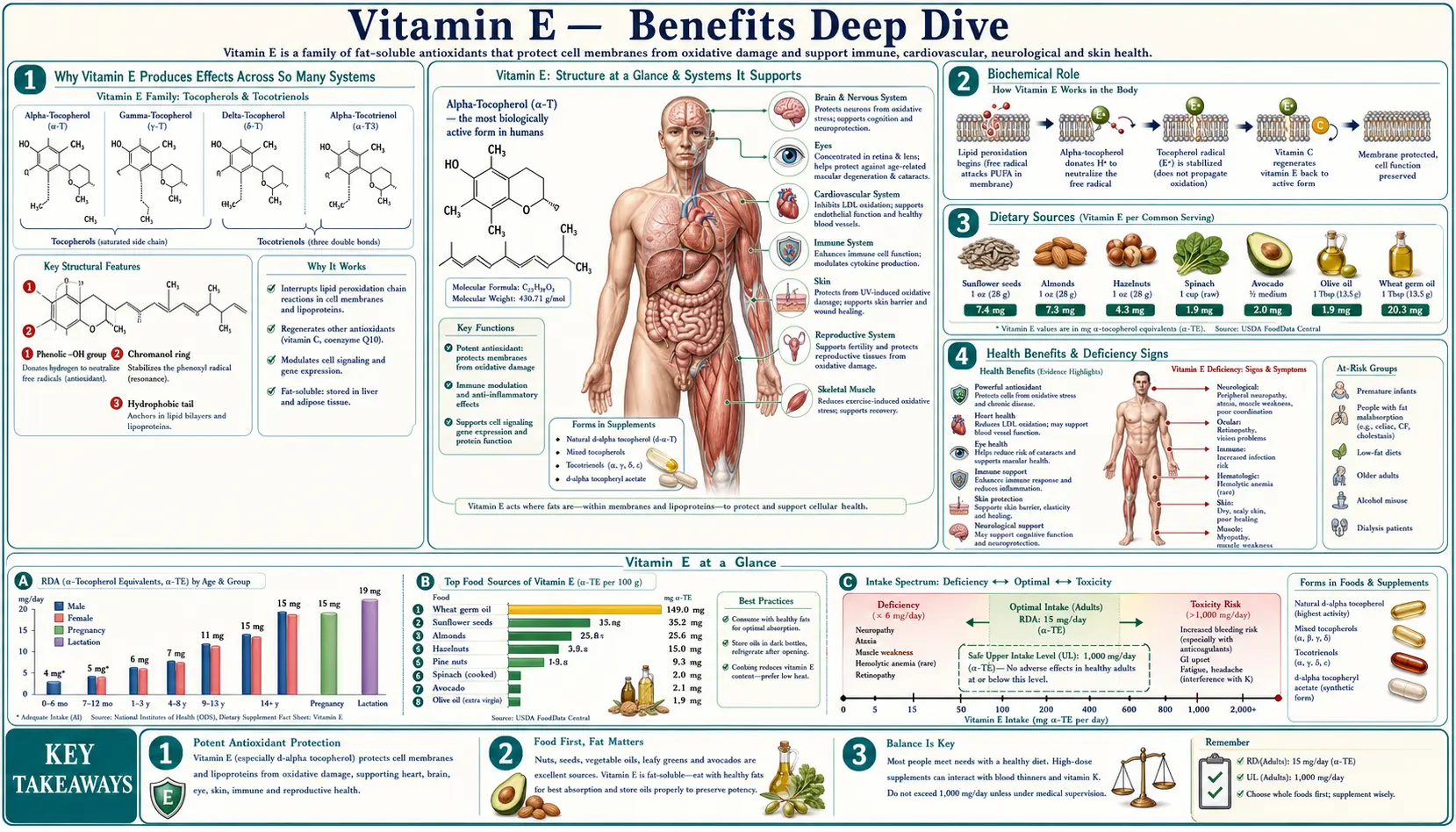
Vitamin E is not one molecule but a family of eight — four tocopherols and four tocotrienols — that together protect every cell membrane in the body from lipid peroxidation, modulate inflammation, regulate immune function, and (in the case of the underappreciated tocotrienols) inhibit cholesterol synthesis and provide neuroprotection at concentrations where alpha-tocopherol does nothing. Each benefit page below explores one specific therapeutic application in clinical-trial depth.
Deep-Dive Articles
Heart Health & Cardiovascular Protection
The most intensively studied (and most contested) Vitamin E indication. LDL oxidation prevention, endothelial function, anti-platelet effects through PKC inhibition. The mixed-results clinical-trial era (ATBC, CHAOS, GISSI, HOPE, HOPE-TOO, Women's Health Study, Physicians' Health Study II, SPACE) explained. Why alpha-tocopherol monotherapy disappoints while gamma-tocopherol and tocotrienols may be the active fraction. The HOPE-TOO heart-failure signal. Practical mixed-tocopherol cardiovascular protocol.
Immune Function & Infection Resistance
The most reproducibly positive Vitamin E indication. Simin Meydani's Tufts work on T-cell proliferation, IL-2 production, and DTH responses in the elderly. The 200 mg/day sweet spot — why more is not better. PGE2 reduction as the central mechanism of immunosenescence reversal. NK cell activity. Upper respiratory tract infection protection in nursing home residents (2004 JAMA trial). Vaccine response enhancement.
Skin Health & Photoprotection
UV photoprotection mechanisms (free-radical scavenging, sunburn-cell reduction, DNA-damage protection). Photoaging prevention through MMP inhibition. Wound healing across all phases. The mixed scar-modulation evidence (Baumann 1999 contact-dermatitis data vs benefits in some studies). The CE Ferulic formulation (Vitamin C + Vitamin E + ferulic acid, the most-studied topical antioxidant combination). Eczema and inflammatory skin conditions. Topical vs oral protocols.
Tocotrienols — The Other Vitamin E Family
Why the four tocotrienols (palm, annatto, rice bran sources) are 40-60× more potent than tocopherols for specific indications — lipid peroxidation in membranes, cholesterol synthesis inhibition (HMG-CoA reductase, the statin enzyme), neuroprotection against glutamate excitotoxicity, anti-cancer apoptosis induction. The Magosso 2013 NAFLD trial. Why alpha-tocopherol monotherapy actively depletes tocotrienols. Mixed-tocopherol/tocotrienol formulations versus alpha-tocopherol monotherapy.
Table of Contents
- Deep-Dive Articles
- Why Vitamin E Produces Effects Across So Many Systems
- Research Papers: Heart & Cardiovascular
- Research Papers: Immune Function
- Research Papers: Skin Health
- Research Papers: Tocotrienols
- Research Papers: Cross-Cutting (Forms, Safety, Mechanism)
- External Authoritative Resources
- Connections
- Featured Videos
Why Vitamin E Produces Effects Across So Many Systems
Vitamin E is not a single nutrient but a family of eight related molecules (four tocopherols + four tocotrienols), and the family operates through four distinct categories of mechanism that together account for the unusually wide therapeutic footprint:
- Universal lipid-phase antioxidant — embedded in every cell membrane in the body, intercepting lipid peroxyl radicals before they can propagate chain reactions of polyunsaturated fatty acid destruction. This single mechanism touches cardiovascular biology (LDL protection), immune function (T-cell membrane preservation), skin photoprotection (UV-induced lipid peroxidation), and neuroprotection (DHA-rich neuronal membranes).
- Non-antioxidant signaling effects — alpha-tocopherol directly inhibits protein kinase C (independent of antioxidant activity), reducing smooth muscle cell proliferation, platelet aggregation, and monocyte adhesion. These cell-signaling effects explain Vitamin E's cardiovascular and anti-inflammatory profile beyond simple oxidant quenching.
- Form-specific specialty mechanisms — gamma-tocopherol uniquely scavenges reactive nitrogen species and inhibits COX-2/5-LOX. Delta- and gamma-tocotrienols inhibit HMG-CoA reductase (cholesterol synthesis). Alpha-tocotrienol blocks 12-lipoxygenase for neuroprotection against glutamate excitotoxicity. These specialty effects exist for the non-alpha-tocopherol forms and are the reason tocotrienol supplementation matters separately from generic "Vitamin E."
- Network antioxidant role — Vitamin E participates in the larger antioxidant network alongside Vitamin C (which regenerates oxidized Vitamin E), glutathione, selenium-dependent glutathione peroxidase (which reduces the lipid hydroperoxides produced by Vitamin E's chain-breaking), and CoQ10. This network role means Vitamin E status interacts with the status of every other antioxidant nutrient.
The clinical implication: the historical "high-dose alpha-tocopherol monotherapy" approach (HOPE, SELECT, and similar large trials) tested only one of these mechanisms (universal antioxidant) using only one of the eight forms. The disappointing results are not evidence that Vitamin E doesn't matter — they are evidence that the supplementation strategy was wrong. Mixed-tocopherol + tocotrienol formulations at moderate doses, paired with adequate Vitamin C, selenium, and dietary intake from nuts and seeds, more accurately recreates the conditions under which Vitamin E demonstrably benefits human biology.
Research Papers: Heart & Cardiovascular
- CHAOS trial (Stephens 1996, Lancet) — PubMed: CHAOS trial
- HOPE trial (Yusuf 2000, NEJM) — PubMed: HOPE trial
- HOPE-TOO extension (Lonn 2005, JAMA) — PubMed: HOPE-TOO
- GISSI-Prevenzione (1999, Lancet) — PubMed: GISSI-Prevenzione
- Women's Health Study (Lee 2005, JAMA) — PubMed: WHS Vitamin E
- Physicians' Health Study II (Sesso 2008, JAMA) — PubMed: PHS II
- SPACE trial in renal disease (Boaz 2000) — PubMed: SPACE renal
- ATBC subgroup (Rapola 1997) — PubMed: ATBC subgroup
- Gamma-tocopherol and metabolic syndrome (Devaraj 2007) — PubMed: Devaraj gamma-tocopherol
- Gamma-tocopherol COX inhibition (Jiang 2001, PNAS) — PubMed: gamma-tocopherol COX
Research Papers: Immune Function
- Meydani elderly DTH trial (Meydani 1997, JAMA) — PubMed: Meydani 1997
- Vitamin E + nursing home respiratory infections (Meydani 2004) — PubMed: nursing home URI
- Cell-mediated immunity in elderly (Meydani 1990, AJCN) — PubMed: Meydani 1990
- Vitamin E and influenza in aged mice (Han 2000) — PubMed: Han influenza mice
- Nutrition and aging immunity review (Pae, Meydani, Wu 2012) — PubMed: nutrition aging review
- Cytokine gene polymorphism (Belisle 2008) — PubMed: Belisle polymorphism
- Vitamin E inflammation review (Lewis 2019, IUBMB) — PubMed: Lewis 2019
- Graat 2002 multivitamin respiratory trial — PubMed: Graat 2002
- Vitamin E and influenza lung viral titers (Hayek 1997) — PubMed: Hayek influenza
- Cyclooxygenase mechanism (Beharka 2002) — PubMed: Beharka COX
Research Papers: Skin Health
- UV photoprotection by Vitamins C + E (Lin 2003, JAAD) — PubMed: Lin 2003
- CE Ferulic formulation (Lin 2005, JID) — PubMed: CE Ferulic
- Topical + oral UV protection in mice (Burke 2000) — PubMed: Burke mice
- Topical Vitamin E scar trial (Baumann & Spencer 1999) — PubMed: Baumann scars
- Vitamin E in human skin review (Thiele 2005) — PubMed: Thiele review
- Combined C + E sunburn protection (Eberlein-König 1998) — PubMed: combined sunburn
- Vitamin E and atopic dermatitis (Tsoureli-Nikita 2002) — PubMed: atopic dermatitis
- Vitamin E in dermatology review (Keen & Hassan 2016) — PubMed: Keen review
- Membrane antioxidant chemistry (Yamamoto & Niki 1988) — PubMed: Yamamoto-Niki
- UVB protection mouse model (Trevithick 1992) — PubMed: Trevithick UVB
Research Papers: Tocotrienols
- Tocotrienol membrane potency (Serbinova 1991) — PubMed: Serbinova 40x potency
- Alpha-tocotrienol neuroprotection (Sen 2000, JBC) — PubMed: Sen neuroprotection
- Palm tocotrienol cholesterol (Qureshi 1996) — PubMed: Qureshi palmvitee
- Tocotrienol + lovastatin synergy (Qureshi 2002) — PubMed: tocotrienol + statin
- NAFLD trial (Magosso 2013) — PubMed: Magosso NAFLD
- Carotid stenosis trial (Tomeo 1995) — PubMed: Tomeo carotid
- 12-Lipoxygenase mechanism (Khanna 2005, JBC) — PubMed: Khanna 12-LOX
- Breast cancer cell gene expression (Nesaretnam 2010) — PubMed: Nesaretnam breast
- Pancreatic cancer Phase I (Springett 2015) — PubMed: Springett pancreatic
- Tocotrienol nervous system review (Sen 2007) — PubMed: Sen review
- Hair growth pilot (Beoy 2010) — PubMed: Beoy hair
- Tocotrienol 21st-century review (Aggarwal 2010) — PubMed: Aggarwal review
Research Papers: Cross-Cutting (Forms, Safety, Mechanism)
- Alpha-tocopherol transfer protein (alpha-TTP) biology — PubMed: alpha-TTP
- RRR vs all-rac stereoisomer bioactivity — PubMed: RRR vs all-rac
- CYP4F2 omega-hydroxylation pathway — PubMed: CYP4F2 catabolism
- Gamma-CEHC and natriuresis — PubMed: gamma-CEHC natriuresis
- Vitamin E and warfarin interaction — PubMed: warfarin interaction
- Vitamin E and Vitamin K interaction — PubMed: Vitamin K interaction
- Ataxia with Vitamin E deficiency (AVED) — PubMed: AVED
- Long-term safety meta-analyses — PubMed: long-term safety
- Hemorrhagic stroke risk meta-analysis — PubMed: hemorrhagic stroke
- SELECT prostate cancer signal — PubMed: SELECT prostate
External Authoritative Resources
- Linus Pauling Institute — Vitamin E Micronutrient Information Center — the single most authoritative scientific summary of Vitamin E biology and clinical evidence, regularly updated
- NIH Office of Dietary Supplements — Vitamin E Fact Sheet (Health Professional version)
- NCCIH — Vitamins and Minerals
- MedlinePlus — Vitamin E (consumer)
- PubMed — All research on Vitamin E (~110,000 papers as of 2026)
- PubMed — All research on tocotrienols (~3,000 papers as of 2026)
Connections
- All Vitamins
- Vitamin E (Main Page)
- Vitamin E for Heart Health
- Vitamin E for Immune Function
- Vitamin E for Skin Health
- Tocotrienols — The Other Vitamin E Family
- Vitamin C
- Vitamin A
- Vitamin D3
- Vitamin K
- Selenium
- Zinc
- Magnesium
- Oxidative Stress
- Cardiovascular Disease
- Atherosclerosis
- NAFLD / NASH
- Cancer
- Almonds
- Walnuts
- Olive Oil