Vitamin E: History and Discovery
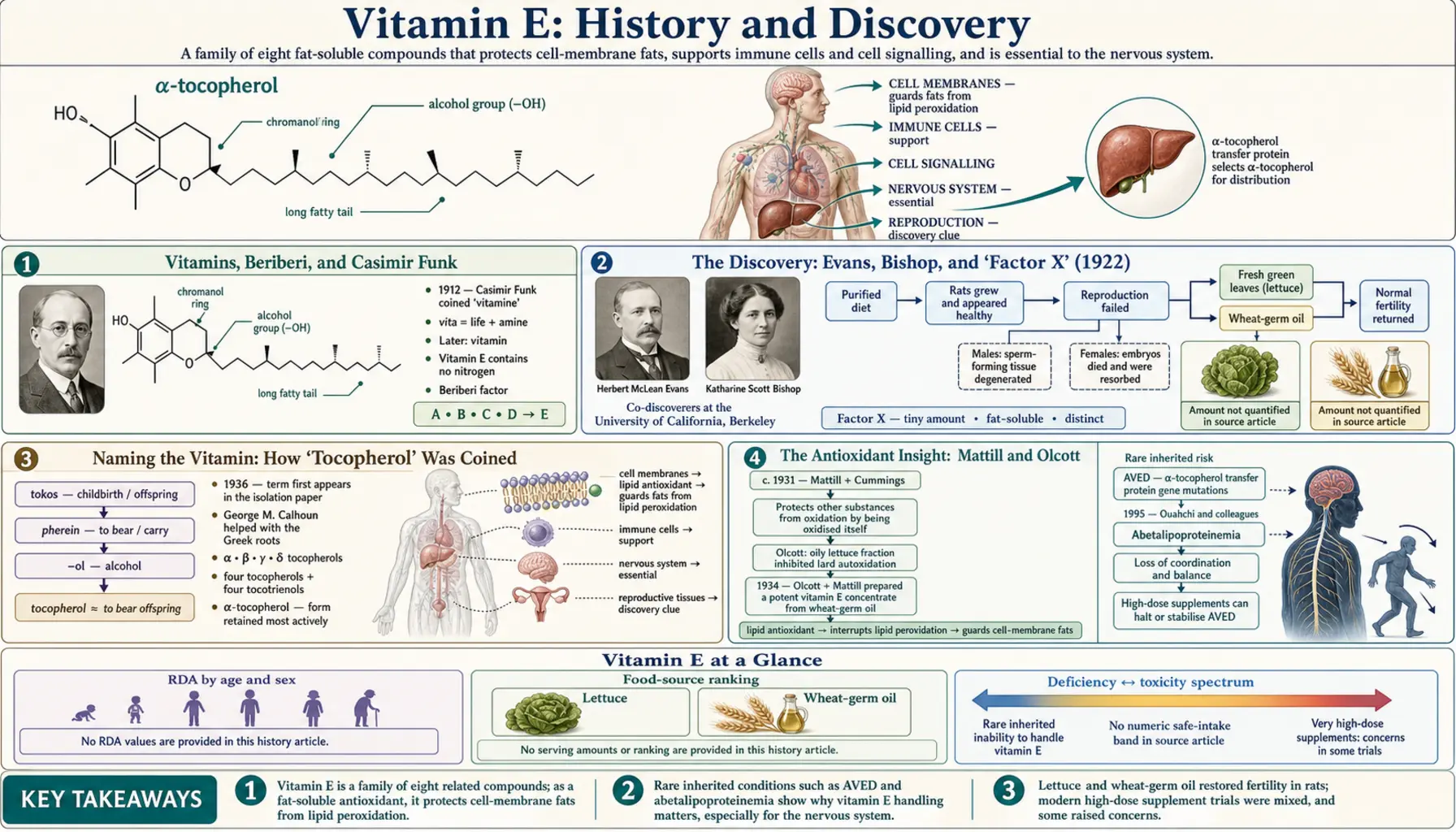
Vitamin E began not as a cure for any human illness but as a puzzle about rats that could not have babies. In 1922, at the University of California, Berkeley, the embryologist Herbert McLean Evans and his research associate Katharine Scott Bishop showed that rats fed an otherwise complete purified diet became infertile — and that something in lettuce and wheat-germ oil restored their fertility. They called it "factor X." That single observation opened a thirty-year detective story: a Greek professor helped name the molecule "tocopherol," chemists at Iowa learned it was an antioxidant, a Berkeley team isolated it pure from wheat-germ oil in 1936, and in 1938 two laboratories — one in New Jersey, one in Switzerland — worked out its structure and built it from scratch. This article tells that story carefully: who did what, when, and where the credit is shared or disputed. Where a date or a claim is firmly documented we say so; where sources disagree, we say that too.
Table of Contents
- Vitamins, Beriberi, and Casimir Funk
- The Discovery: Evans, Bishop, and "Factor X" (1922)
- Naming the Vitamin: How "Tocopherol" Was Coined
- The Antioxidant Insight: Mattill and Olcott
- Isolation in Pure Form: Wheat-Germ Oil (1936)
- Structure and Synthesis: Fernholz and Karrer (1938)
- The Nobel Connection — and a Common Misunderstanding
- Proving It Matters in Humans: From AVED to the Trials
- The Legacy of the Discovery
- Research Papers and References
- Connections
- Featured Videos
Vitamins, Beriberi, and Casimir Funk
Vitamin E was discovered during one of the most exciting periods in the history of nutrition. In the years around 1900, scientists were realising that some diseases were caused not by germs or poisons but by the absence of something in food. The classic examples were the deficiency diseases: scurvy (later traced to vitamin C), beriberi (vitamin B1), pellagra (vitamin B3, niacin), and rickets (vitamin D). Each had been a mystery for centuries; each turned out to be a missing nutrient.
In 1912, the Polish-born biochemist Casimir Funk, working in London, proposed that these protective food factors belonged to a single chemical class and coined the word "vitamine" — from the Latin vita ("life") plus "amine," because he believed the compounds were amines (nitrogen-containing). The "e" was later dropped to give the modern word vitamin once it became clear that not all of these substances are amines — vitamin E itself, for example, contains no nitrogen at all. Funk did not discover vitamin E; he was working chiefly on the beriberi factor. But his idea and his word gave the field its name, and it is the reason the fat-soluble factor Evans and Bishop found a decade later was eventually slotted into the alphabet as "vitamin E" — the letter simply marking that it was identified after vitamins A, B, C, and D.
This is the backdrop to understand: by the early 1920s, scientists already expected that purified diets might be missing tiny, powerful factors essential for health. What no one yet suspected was that one of those factors would announce itself not through a wasting disease, but through the failure of reproduction.
The Discovery: Evans, Bishop, and "Factor X" (1922)
The discovery of vitamin E is firmly documented and firmly dated. In 1922, at the University of California, Berkeley, the anatomist and embryologist Herbert McLean Evans (1882–1971) and his research associate Katharine Scott Bishop (1889–1976) published a short paper in the journal Science with a deliberately careful title: "On the Existence of a Hitherto Unrecognized Dietary Factor Essential for Reproduction." That paper is the birth certificate of vitamin E.
The finding came from a simple but telling experiment. Evans and Bishop raised rats on a purified diet that contained all the nutrients then known to be necessary — protein, carbohydrate, fat (as lard), minerals, and the recognised vitamins. The rats grew and appeared healthy, but they could not successfully reproduce. The males' sperm-forming tissue degenerated; the females conceived but the pregnancies failed, the embryos dying and being resorbed. When the researchers added fresh green leaves (lettuce) or wheat-germ oil to the same diet, normal fertility returned. Something in those foods — present in tiny amounts, soluble in fat, and quite distinct from the vitamins already known — was essential for reproduction. They referred to it as "factor X."
It is worth pausing on the partnership. Katharine Scott Bishop was a physician (an M.D.) whose work was central to this discovery, at a time when women were rare in laboratory science and rarely given full credit. The historical record consistently names her alongside Evans as co-discoverer of the dietary factor that became vitamin E, and this page does the same. The work also unfolded in a competitive field: other laboratories, notably that of Barnett Sure at the University of Arkansas, were independently studying the same reproductive factor in the early 1920s. Sure is generally credited with proposing the name "vitamin E" in 1924 (with Evans using the term the following year, in 1925) — the letter simply marking that it was the fifth fat- or food-factor to be recognised after A, B, C, and D. The core priority for the discovery, however — the 1922 demonstration that a distinct, fat-soluble dietary factor was essential for reproduction — belongs to Evans and Bishop.
Naming the Vitamin: How "Tocopherol" Was Coined
For its first years the new factor went by the plain label "vitamin E." The familiar chemical name tocopherol came later and has a charming origin that is well documented. The name was coined in 1936 — the same year the pure compound was isolated (see below) — when Herbert Evans and his co-workers Oliver H. Emerson and Gladys Anderson Emerson proposed the names "alpha-tocopherol" and "beta-tocopherol" for the active substances they had extracted from wheat-germ oil. Evans, not being a classicist himself, turned for help to a colleague at Berkeley, George M. Calhoun, a professor of Greek, who is credited with assisting in building the word from Greek roots. (Popular accounts sometimes place the naming in the early 1920s, around the time of the 1922 discovery, but the term "tocopherol" first appears in the 1936 isolation paper.)
The result captures exactly what the vitamin first appeared to do. Tocopherol joins three parts:
- tokos (τόκος) — Greek for "childbirth" or "offspring";
- pherein (φέρειν) — Greek for "to bear" or "to carry"; and
- the suffix -ol, the standard chemical ending signalling that the molecule is an alcohol.
Put together, the name means roughly "to carry a pregnancy" or "to bear offspring" — a direct nod to the rat-fertility experiments that revealed it. The -ol ending also encodes a real chemical fact: vitamin E is, structurally, an alcohol. As more members of the family were found, they were distinguished by Greek letters — alpha-, beta-, gamma-, and delta-tocopherol — with the related tocotrienols named later still. Alpha-tocopherol, the form the body retains most actively, became the reference compound and the one most people mean when they say "vitamin E."
The Antioxidant Insight: Mattill and Olcott
One of the most important chapters in vitamin E's story is often left out of the headline: the discovery of what it actually does at the chemical level. Today vitamin E is described above all as the body's chief fat-soluble antioxidant — but that understanding did not come from Evans and Bishop. It came chiefly from the laboratory of Henry A. Mattill (1883–1953), an American biochemist who worked at the universities of Rochester and later Iowa.
The key steps fall in the early 1930s. Around 1931, Mattill and a colleague (Cummings) recognised that vitamin E could protect other substances from oxidation by being oxidised itself — the essential idea of an antioxidant. In the same period, the chemist Herbert S. Olcott, working with Mattill, observed that an oily fraction from lettuce inhibited the spoiling (autoxidation) of lard, and by 1934 Olcott and Mattill had prepared a potent vitamin E concentrate from wheat-germ oil and studied its chemistry. From this body of work grew the now-central idea that vitamin E's biological job is to act as a lipid antioxidant — guarding the fats in cell membranes from the chain-reaction damage called lipid peroxidation.
This matters for an honest history because it separates two different achievements. Evans and Bishop discovered that the factor existed and was essential; Mattill and Olcott began to explain how it works. Both are part of the real story, and the antioxidant insight — though it took decades more to confirm in living tissue — is arguably the discovery that made vitamin E matter far beyond fertility, connecting it to ageing, heart disease, and cell protection.
Isolation in Pure Form: Wheat-Germ Oil (1936)
Discovering that a vitamin exists is one thing; holding it in your hand as a pure substance is another. For more than a decade after 1922, vitamin E was known only by its effects, hidden inside oily mixtures. The decisive step came back at Berkeley in 1936, when Herbert M. Evans, together with Oliver H. Emerson and Gladys Anderson Emerson, succeeded in isolating alpha-tocopherol in pure, crystalline form from wheat-germ oil. Their report — "The isolation from wheat germ oil of an alcohol, α-tocopherol, having the properties of vitamin E" — appeared in the Journal of Biological Chemistry.
The achievement is often associated in particular with Gladys Anderson Emerson (1903–1984), a meticulous biochemist who went on to a distinguished career in nutrition science; the painstaking purification that finally pinned down the active substance is frequently credited to her hands. (Note that some reference works date this isolation to 1935 and the published paper to 1936; the 1936 Journal of Biological Chemistry publication is the firm, citable landmark, and this page uses that date.)
With a pure compound in hand, vitamin E was no longer a mysterious "factor." Chemists could now weigh it, analyse it, and ask the next questions: what is its exact molecular structure, and can it be built artificially? Those questions were answered, dramatically fast, just two years later.
Structure and Synthesis: Fernholz and Karrer (1938)
The year 1938 was vitamin E's chemical coming-of-age, and it involved two separate accomplishments by two different people — a point worth keeping straight, because they are sometimes blurred together.
First, the structure. Working out how the atoms of alpha-tocopherol are arranged was accomplished by Erhard Fernholz, a chemist then at the Merck research laboratories in the United States. By breaking the molecule into fragments and analysing the pieces, Fernholz deduced the molecular structure of alpha-tocopherol in 1938 — identifying its characteristic ring (a chromanol) joined to a long fatty "tail."
Second, the synthesis. In the same year, the Swiss chemist Paul Karrer (1889–1971) and his team at the University of Zurich achieved the first laboratory synthesis of alpha-tocopherol — building the vitamin from simpler chemicals rather than extracting it from plants. This was a milestone with practical consequences: a vitamin that can be synthesised can be manufactured, studied at scale, and eventually sold as a supplement. (The synthetic product is a mixture of mirror-image forms, "all-rac" or dl-alpha-tocopherol, which is why natural and synthetic vitamin E differ in potency — but that is a later refinement of the same 1938 breakthrough.)
So the chemistry of the discovery has a clear division of labour: Evans, O. H. Emerson, and G. A. Emerson isolated it (1936); Fernholz determined its structure (1938); and Karrer first synthesised it (1938). Holding those credits apart is part of telling the history accurately.
The Nobel Connection — and a Common Misunderstanding
It is sometimes implied that vitamin E was "Nobel Prize–winning" work. The honest picture is more nuanced, and it is worth getting right.
Paul Karrer, who first synthesised alpha-tocopherol in 1938, was indeed a Nobel laureate: he shared the 1937 Nobel Prize in Chemistry (with the British chemist Walter Norman Haworth). But the official citation tells the real story. Karrer's prize was awarded, in the Nobel Foundation's words, "for his investigations on carotenoids, flavins and vitamins A and B2" — that is, for his earlier work on other vitamins and pigments. The prize came in 1937, the year before his vitamin E synthesis, and the citation does not mention vitamin E or tocopherol at all. So while a future (and recent past) Nobel laureate did the first vitamin E synthesis, it is inaccurate to say the Nobel Prize was given for vitamin E. It was not.
Neither Herbert Evans nor Katharine Scott Bishop received a Nobel Prize for discovering vitamin E, and no Nobel Prize has been awarded specifically for the discovery or chemistry of vitamin E. Recognising this keeps the record clean: vitamin E's history is rich with distinguished, well-credited scientists, but the popular "Nobel-winning vitamin" shorthand applies only loosely — through Karrer's prize for unrelated work — and should not be repeated as if the prize honoured tocopherol itself.
Proving It Matters in Humans: From AVED to the Trials
A striking feature of vitamin E's history is how long it took to show that the vitamin matters for people, not just laboratory rats. Unlike scurvy or beriberi, there was no dramatic human deficiency disease to point to. For decades, sceptics asked whether humans ever actually lacked it.
The clearest proof came from rare patients. In some inherited conditions the body cannot handle vitamin E normally — for example in abetalipoproteinemia, and most pointedly in a disorder now called ataxia with vitamin E deficiency (AVED). In 1995, a team led by K. Ouahchi and colleagues, reporting in Nature Genetics, traced AVED to mutations in the gene for the alpha-tocopherol transfer protein (the liver protein that selects alpha-tocopherol for distribution around the body). People with this mutation develop a progressive neurological disease — loss of coordination and balance — purely from being unable to use vitamin E, and high-dose supplements can halt or stabilise it. This was decisive: it proved beyond doubt that vitamin E is essential for the human nervous system.
From the 1990s onward, vitamin E also entered the era of large clinical trials, as researchers tested the antioxidant idea by giving supplements to thousands of people to see whether they prevented heart disease and cancer. The results were famously mixed — some trials showed no benefit, and a few raised concerns at very high doses — which forced a more careful, modern understanding of vitamin E as a multifunctional nutrient rather than a cure-all. That clinical chapter is told in detail on the main Vitamin E page and the Vitamin E Benefits articles; here it simply closes the discovery arc, from infertile rats in 1922 to human genetics and global trials at the century's end.
The Legacy of the Discovery
The discovery of vitamin E is a model of how nutritional science actually advances — not in a single flash, but as a relay race run over decades by many hands. A fertility puzzle in rats (Evans and Bishop, 1922) led to a Greek-rooted name (Evans with Calhoun's help), then to the chemical insight that the factor is an antioxidant (Mattill and Olcott, early 1930s), then to its isolation in pure form (Evans and the Emersons, 1936), and finally to its structure and synthesis (Fernholz and Karrer, 1938). Each runner carried the baton a stage further.
What began as the "anti-sterility factor" is now understood to be far more than that: a family of eight related compounds (four tocopherols and four tocotrienols) that protect the fats in every cell membrane, support immune cells, and participate in cell signalling. The reproductive role that named it turned out to be just the first visible effect of a much broader job. And the cautious, sometimes disappointing results of modern trials are themselves part of the legacy — a reminder that confirming what a nutrient does in real human lives is as hard, and as important, as discovering it in the first place.
For the full account of vitamin E's forms, mechanisms, food sources, dosing, and the modern clinical evidence, see the main Vitamin E page and its companion Benefits articles. This page has told only one story: how an unrecognised factor in lettuce and wheat germ became one of the most studied vitamins in the world.
Research Papers and References
The references below document the milestones described above. Author names, titles, and journals are given as plain text; only the stable DOI, PMID, or archive link is hyperlinked, and each opens in a new tab. The two Science and Journal of Biological Chemistry entries are the original discovery and isolation papers; the others are peer-reviewed historical reviews and the genetics paper that confirmed vitamin E's role in human health.
- Evans HM, Bishop KS. On the existence of a hitherto unrecognized dietary factor essential for reproduction. Science. 1922;56(1458):650-651. — doi:10.1126/science.56.1458.650
- Evans HM, Emerson OH, Emerson GA. The isolation from wheat germ oil of an alcohol, α-tocopherol, having the properties of vitamin E. Journal of Biological Chemistry. 1936;113:319-332. (Reprinted as a Nutrition Classic in Nutrition Reviews. 1974;32(3):80-82.) — PMID: 4593257
- Wolf G. The discovery of the antioxidant function of vitamin E: the contribution of Henry A. Mattill. Journal of Nutrition. 2005;135(3):363-366. — doi:10.1093/jn/135.3.363 (PMID: 15735064)
- Ouahchi K, Arita M, Kayden H, Hentati F, Ben Hamida M, Sokol R, Arai H, Inoue K, Mandel JL, Koenig M. Ataxia with isolated vitamin E deficiency is caused by mutations in the α-tocopherol transfer protein. Nature Genetics. 1995;9(2):141-145. — doi:10.1038/ng0295-141
- The Nobel Prize in Chemistry 1937 — Paul Karrer, awarded "for his investigations on carotenoids, flavins and vitamins A and B2." — NobelPrize.org: Paul Karrer, Chemistry 1937
- Vitamin E discovery and history — PubMed: vitamin E / tocopherol history and discovery
- Tocopherol isolation and chemistry — PubMed: alpha-tocopherol isolation, structure, and synthesis
External Authoritative Resources
- NIH Office of Dietary Supplements — Vitamin E
- NCCIH — Antioxidants
- PubMed — All research on vitamin E / tocopherol