Olive Leaf — Benefits Deep Dive
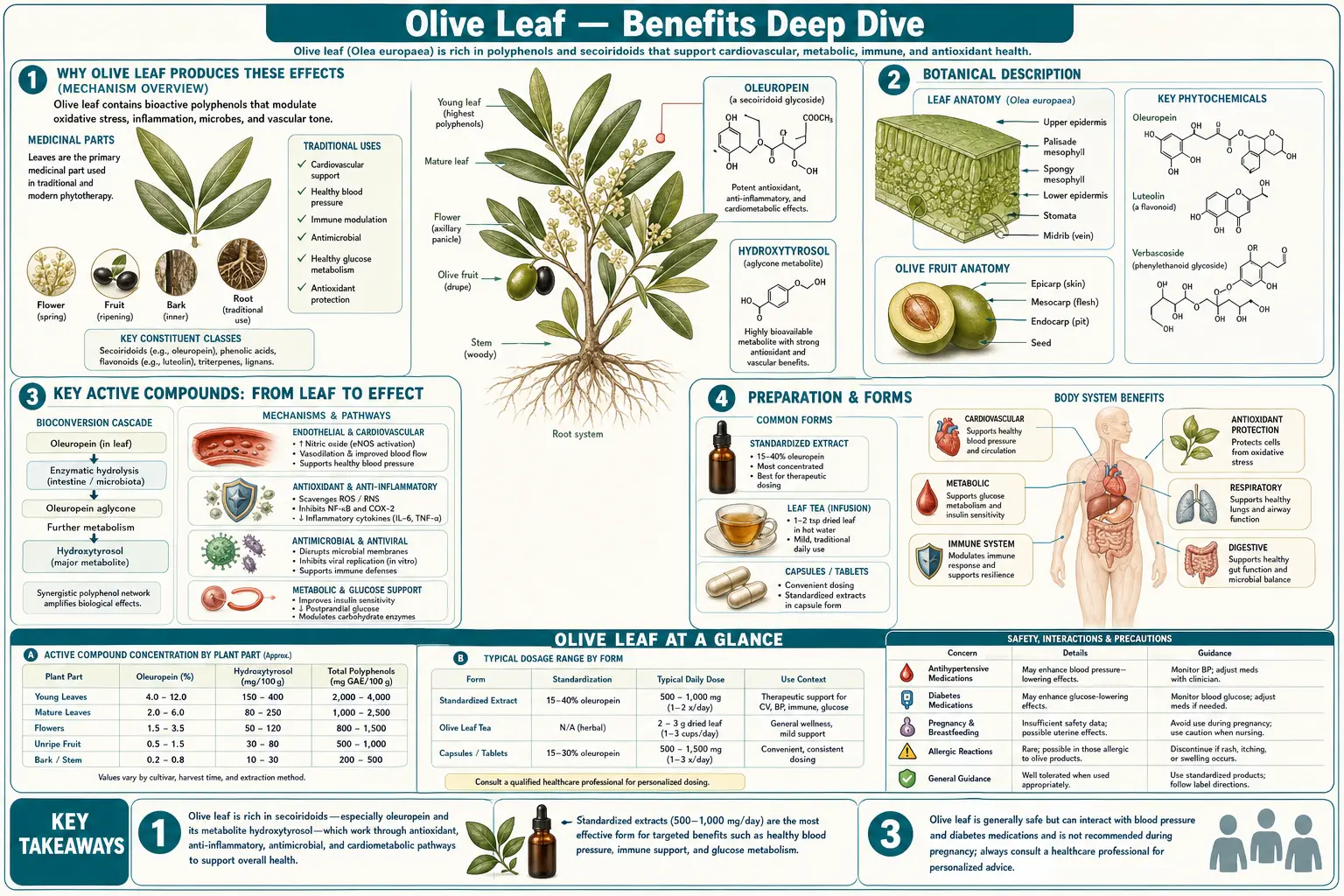
Olive leaf (Olea europaea leaf) is the higher-polyphenol cousin of the celebrated olive fruit. Fresh olive leaves contain 6-9% oleuropein by dry weight — orders of magnitude more than the fruit oil itself — making standardized olive leaf extract (OLE) the most concentrated dietary delivery vehicle for oleuropein and its bioactive hydrolysis product hydroxytyrosol. These two phenolics, central to the Mediterranean cardiometabolic story, drive four mechanistically distinct but overlapping clinical effects: ACE inhibition and endothelial nitric oxide upregulation for blood pressure, broad-spectrum antimicrobial activity via elenolic acid for traditional fever and antiviral indications, two-electron radical scavenging plus Nrf2 activation for cellular antioxidant defense, and AMPK activation plus beta-cell preservation for insulin sensitivity. Pharmaceutical-comparable clinical evidence exists in the cardiovascular domain (Susalit 2011 matched OLE 500 mg twice daily to captopril) and in the prediabetes domain (Wainstein 2012 demonstrated significant HOMA-IR reduction). Standardized OLE at 500-1,000 mg/day, standardized to 18-20% oleuropein, is the clinical-trial-validated dose across all four indications below.
Deep-Dive Articles
Cardiovascular & Blood Pressure
The pivotal Susalit 2011 trial showed OLE 500 mg twice daily matched captopril 12.5-25 mg twice daily on systolic and diastolic BP reduction in stage-1 hypertension, while additionally lowering triglycerides. Lockyer 2017 confirmed the BP and lipid effects in prehypertensive adults. Mechanism: oleuropein and hydroxytyrosol upregulate endothelial nitric oxide, inhibit angiotensin-converting enzyme, reduce LDL oxidation, and contribute the polyphenol portion of the Mediterranean diet's well-documented cardiovascular benefit.
Antimicrobial & Antiviral
The Markin 2003 Mycoses review documents broad-spectrum in vitro activity against MRSA, E. coli, H. pylori, Candida species, herpes simplex viruses, influenza, and several protozoa. Traditional Mediterranean use for fevers, wound infections, and urinary tract complaints maps onto the mechanism of elenolic acid (released from oleuropein hydrolysis) directly disrupting microbial membranes and inhibiting viral envelope-receptor docking. Practical role in recurrent UTI prophylaxis, HSV flare reduction, and early acute upper respiratory illness.
Antioxidant & Anti-Aging
Oleuropein and hydroxytyrosol rank among the most potent dietary antioxidants, with hydroxytyrosol's catechol structure providing three to four times the per-mole radical-quenching capacity of Vitamin E. Mitochondrial-membrane-targeted protection (reduced cytochrome c release, preserved cardiolipin), Nrf2 pathway activation upregulating endogenous phase II antioxidant enzymes, and direct comparison to the lower polyphenol content of extra-virgin olive oil itself. Mechanistic alignment with established aging pathways (mitochondrial function, telomere biology, skin photoaging).
Blood Sugar & Insulin Sensitivity
Wainstein 2012 randomized 79 insulin-resistant prediabetic adults to OLE 500 mg twice daily or placebo for 14 weeks; the OLE arm showed ~15% HOMA-IR reduction and improved beta-cell responsiveness. Oleuropein acts as a glucose-dependent insulin secretagogue (gentler than sulfonylureas) plus a peripheral insulin sensitizer via AMPK activation in skeletal muscle and hepatocytes. Stacking strategy with metformin, GLP-1 contribution, and the gut-microbiome mechanism. Practical role in prediabetes and metabolic syndrome.
Table of Contents
- Deep-Dive Articles
- Why Olive Leaf Produces These Effects (Mechanism Overview)
- Research Papers
- External Authoritative Resources
- Connections
- Featured Videos
Why Olive Leaf Produces These Effects (Mechanism Overview)
Most herbal therapeutics owe their activity to a single principal mechanism or to a small group of related actions. Olive leaf is unusual because two phenolic constituents — oleuropein and its hydrolysis product hydroxytyrosol — produce four mechanistically distinct effects that together cover the four deep-dive topics above. The unifying chemistry is that olive leaf is the most concentrated dietary delivery vehicle for these two polyphenols, and each phenolic carries multiple bioactivities.
- ACE inhibition and endothelial nitric oxide upregulation (blood pressure) — oleuropein has measurable in vitro inhibition of angiotensin-converting enzyme, the same target as pharmaceutical ACE inhibitors. Independently, both oleuropein and hydroxytyrosol upregulate endothelial NO synthase (eNOS) and increase NO bioavailability, producing direct vasodilation. The combination of weak ACE inhibition plus NO-mediated vasodilation produces blood pressure reductions comparable to a starting-dose pharmaceutical ACE inhibitor in stage-1 hypertension — the basis for the Susalit 2011 head-to-head trial results detailed in the Cardiovascular deep-dive.
- Direct antimicrobial activity via elenolic acid (antimicrobial and antiviral) — when ingested, oleuropein is partially hydrolyzed by gastric and intestinal enzymes, releasing elenolic acid (an antimicrobial monoterpene secoiridoid) in addition to hydroxytyrosol. Elenolic acid disrupts bacterial and viral membrane integrity, inhibits microbial protein synthesis, and blocks viral envelope-receptor docking. This produces the broad-spectrum in vitro activity against gram-positive and gram-negative bacteria, herpes viruses, influenza, candida species, and several protozoa documented in the Markin 2003 review — see the Antimicrobial deep-dive.
- Two-electron radical scavenging plus Nrf2 activation (antioxidant) — hydroxytyrosol's ortho-dihydroxyphenyl (catechol) structure allows it to donate two hydrogens to neutralize free radicals while forming a stable, non-reactive ortho-quinone product. This is structurally why hydroxytyrosol outperforms Vitamin E and Vitamin C in standard ORAC, FRAP, and DPPH radical-quenching assays. Beyond direct quenching, hydroxytyrosol activates the Nrf2/Keap1 pathway, inducing transcription of the phase II endogenous antioxidant battery (NQO1, HO-1, glutathione peroxidase, thioredoxin). The combined direct-plus-hormetic mechanism produces durable cellular antioxidant capacity and is the foundation for the mitochondrial protection and aging-marker benefits described in the Antioxidant deep-dive.
- AMPK activation and beta-cell preservation (insulin sensitization) — oleuropein and hydroxytyrosol activate AMP-activated protein kinase (AMPK) in skeletal muscle and hepatocytes, increasing glucose uptake and inhibiting hepatic gluconeogenesis — the same mechanism as metformin. Additionally, oleuropein potentiates glucose-stimulated insulin secretion from pancreatic beta cells in a glucose-dependent manner (unlike sulfonylureas, which override the glucose dependency and produce hypoglycemia risk). The dual effect on insulin sensitivity and insulin secretion explains the HOMA-IR improvement observed in the Wainstein 2012 prediabetic trial, detailed in the Blood Sugar deep-dive.
The therapeutic appeal of OLE is that all four mechanisms are produced by a single well-tolerated supplement at a single dose range (500 mg twice daily, standardized to 18-20% oleuropein), making it a reasonable single agent for patients in the common clinical situation of having multiple components of metabolic syndrome at once — mild hypertension plus prediabetes plus borderline lipids, often in a Mediterranean-aligned dietary context where additional OLE-derived polyphenol load augments dietary olive oil's effects.
The complication is that the same multi-mechanism profile creates multiple potential drug interactions (with antihypertensives, with insulin and sulfonylureas, with anticoagulants), so patients on prescription medications need physician supervision when adding OLE. See the dosing and cautions sections within each deep-dive page for specifics.
Research Papers
- Susalit E et al. (2011). Olive (Olea europaea) leaf extract effective in patients with stage-1 hypertension: comparison with Captopril. Phytomedicine 18(4):251-258. The pivotal head-to-head trial demonstrating OLE blood-pressure equivalence to a first-line pharmaceutical ACE inhibitor. — PubMed
- Wainstein J et al. (2012). Olive leaf extract as a hypoglycemic agent in both human diabetic subjects and in rats. Journal of Medicinal Food 15(7):605-610. The pivotal trial demonstrating OLE improvement in HOMA-IR insulin sensitivity in prediabetic adults. — PubMed
- Markin D, Duek L, Berdicevsky I (2003). In vitro antimicrobial activity of olive leaves. Mycoses 46(3-4):132-136. The most-cited modern review of OLE broad-spectrum antimicrobial activity. — PubMed
- Lockyer S et al. (2017). Impact of phenolic-rich olive leaf extract on blood pressure, plasma lipids and inflammatory markers: a randomised controlled trial. European Journal of Nutrition 56(4):1421-1432. Confirms OLE blood pressure and lipid effects in a placebo-controlled crossover trial. — PubMed
- Bulotta S et al. (2014). Beneficial effects of the olive oil phenolic components oleuropein and hydroxytyrosol: focus on protection against cardiovascular and metabolic diseases. Journal of Translational Medicine. A comprehensive review of the oleuropein and hydroxytyrosol mechanistic literature across cardiovascular and metabolic indications. — PubMed
External Authoritative Resources
- LiverTox — Olive Leaf and Oleuropein Hepatotoxicity Review (NIH-NIDDK)
- EFSA Scientific Opinion — Olive Polyphenols and LDL Oxidation Health Claim (2011)
- MedlinePlus — Olive Leaf
- PubMed — All research on olive leaf extract and oleuropein (~3,000+ papers)
- WHO — Cardiovascular Diseases Fact Sheet (context for OLE's hypertension indication)
Connections
- All Herbs
- Olive Leaf (Main Page)
- OLE for Cardiovascular & BP
- OLE for Antimicrobial & Antiviral
- OLE for Antioxidant & Anti-Aging
- OLE for Blood Sugar
- Olive Oil
- Hypertension
- Cardiology
- Type 2 Diabetes
- Endocrinology
- Continuous Glucose Monitor
- Urinary Tract Infections
- Staphylococcus Aureus
- Escherichia Coli
- Influenza
- Garlic
- Oregano
- Rosemary
- Lysine (HSV Synergy)
- Resveratrol
- Curcumin
- Vitamin C
- Vitamin E
- Celery Juice for Blood Pressure
- Immune Boosting