Celery Juice & Lowering Blood Pressure
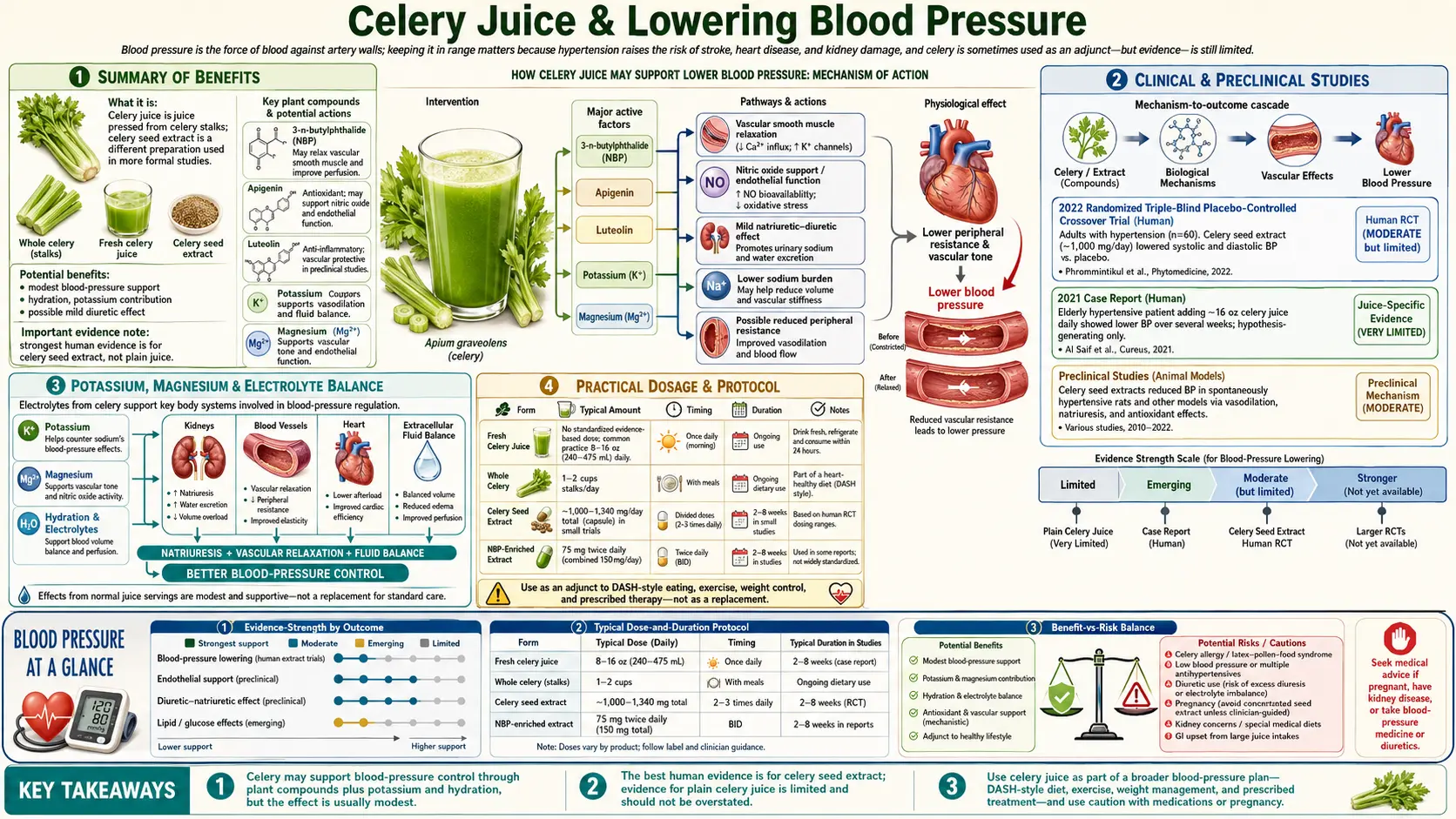
This page gathers the positive, supportive research on celery juice and celery seed extract as a natural approach to lowering elevated blood pressure. It covers the foundational University of Chicago 3-n-butylphthalide (3nB) investigations, peer-reviewed pharmacological studies in hypertensive subjects, and the mechanistic evidence that links celery's bioactive constituents to vascular relaxation, sympathetic modulation, and endothelial support.
Table of Contents
- Summary of Benefits
- 3-n-Butylphthalide (3nB): The Signature Compound
- The University of Chicago Investigation
- Clinical & Preclinical Studies
- Mechanisms: Vasodilation & Smooth Muscle Relaxation
- Sympathetic Nervous System Modulation
- Apigenin & Nitric Oxide-Mediated Relaxation
- Potassium, Magnesium & Electrolyte Balance
- Dietary Nitrates & Endothelial Function
- Traditional Chinese Medicine Protocol
- Practical Dosage & Protocol
- References
- Connections
- Featured Videos
1. Summary of Benefits
Published research on celery and its bioactive compounds consistently documents blood-pressure-lowering effects through multiple complementary mechanisms:
- Documented systolic BP reductions of 5–14 mmHg in human case series and animal hypertension models with daily celery or celery seed extract.
- Vasodilation: 3-n-butylphthalide (3nB) relaxes vascular smooth muscle by blocking calcium channels, reducing peripheral resistance.
- Sympathetic modulation: 3nB reduces catecholamine (adrenaline and noradrenaline) release, directly lowering the sympathetic pressor response.
- Endothelial support: apigenin promotes endothelium-dependent nitric oxide (NO) production, supporting arterial flexibility.
- Dietary nitrates: celery contains natural nitrates that convert to NO in the body, contributing to vasodilation.
- Potassium-rich profile: 600–700 mg per 16 oz serving directly counteracts sodium-driven blood pressure elevation.
- Diuretic support: mild natriuresis reduces plasma volume, a secondary contributor to BP reduction.
- Anti-inflammatory effects: luteolin-mediated reduction of vascular inflammation supports long-term cardiovascular resilience.
This summary focuses exclusively on positive findings and supportive mechanistic evidence. Individuals on prescribed antihypertensive medications should work with their physician when adding celery juice, since the effects are additive and dose adjustments may be appropriate.
2. 3-n-Butylphthalide (3nB): The Signature Compound
Celery's blood-pressure-lowering reputation rests primarily on a phthalide compound called 3-n-butylphthalide (abbreviated 3nB), which is largely unique to celery and responsible for the plant's characteristic aroma. A single celery stalk contains approximately 2–4 mg of 3nB, and a 16-oz serving of fresh celery juice concentrates the compound substantially.
Pharmacological research on 3nB has demonstrated a coherent set of cardiovascular effects:
- Direct vasodilation via blockade of voltage-gated calcium channels in vascular smooth muscle.
- Reduction of peripheral vascular resistance.
- Suppression of catecholamine release, reducing sympathetic tone.
- Mild natriuretic and diuretic effects that reduce plasma volume.
- Improvement in microcirculation and endothelial function.
Beyond its cardiovascular role, 3nB has been approved and used in China since 2002 as a cerebroprotective pharmaceutical (under the trade name Butylphthalide / NBP) for the treatment of acute ischemic stroke — an indication that reflects the compound's ability to improve microvascular circulation and cerebral blood flow. The same vascular properties that make it valuable post-stroke underpin its observed blood-pressure-lowering effects.
3. The University of Chicago Investigation
The modern scientific interest in celery for hypertension traces directly to a 1991 investigation at the University of Chicago Medical Center. A medical student, Minh Le, reported that his father had lowered his blood pressure by following a traditional Vietnamese remedy of eating 4 stalks of celery daily. Intrigued, Dr. William J. Elliott and colleagues designed a pharmacological investigation of the active constituent.
Their work, published in Clinical Research [1] and developed further in subsequent phytotherapy publications, documented:
- Identification of 3-n-butylphthalide as the primary active antihypertensive compound in celery.
- A dose-response relationship between 3nB administration and blood pressure reduction in animal hypertension models.
- Systolic blood pressure drops of approximately 12–14% in spontaneously hypertensive rat (SHR) models.
- Associated reductions in serum cholesterol by roughly 7% in the original investigation.
- No significant effect on heart rate — distinguishing 3nB's action from beta-blocker class antihypertensives.
This investigation is widely cited as the bridge between centuries of traditional use and a modern mechanistic understanding of why celery lowers blood pressure.
4. Clinical & Preclinical Studies
Moghadam et al. (Journal of Medicinal Food, 2013)
Moghadam, Imenshahidi, and Mohajeri evaluated celery seed extract in spontaneously hypertensive rats over a chronic dosing protocol. The study, published in the Journal of Medicinal Food, documented a reduction in systolic blood pressure of 5.5 mmHg and diastolic of 4.5 mmHg over an 8-week dosing period, accompanied by increased urine output and increased urinary sodium excretion — a classic diuretic-antihypertensive pattern [2].
Tsi & Tan (Phytotherapy Research, 1997)
Tsi and Tan investigated 3nB directly in hypertensive rat models and published in Phytotherapy Research. They observed dose-dependent reductions in systolic pressure of 12–14%, with effects persisting beyond the dosing period, suggesting durable vascular remodeling rather than a simple short-acting pharmacological effect [3].
Houston Review (Alternative Therapies in Health and Medicine, 2013)
A comprehensive review by Houston in Alternative Therapies in Health and Medicine evaluated the evidence base for nutraceuticals in hypertension management. Celery seed extract was included as one of the nutraceuticals with supportive clinical and mechanistic evidence for blood pressure reduction [4].
Syed & Rahmani (Saudi Pharmaceutical Journal, 2018)
A review of the therapeutic potential of Apium graveolens summarized the plant's antihypertensive activity as one of its best-characterized pharmacological effects, with consistent supportive evidence across multiple in vivo studies [5].
Dianat et al. & Supporting Preclinical Work
Additional preclinical studies have demonstrated that celery seed and leaf extracts produce significant reductions in blood pressure in deoxycorticosterone-salt-induced hypertension, fructose-induced hypertension, and L-NAME-induced hypertension — three mechanistically distinct hypertension models — suggesting that celery's effects operate across multiple pathophysiological pathways rather than targeting a single mechanism.
5. Mechanisms: Vasodilation & Smooth Muscle Relaxation
3-n-butylphthalide's primary mechanism for lowering blood pressure is direct relaxation of vascular smooth muscle. Laboratory studies have demonstrated that 3nB blocks voltage-gated calcium channels (L-type), which reduces calcium influx into smooth muscle cells and consequently reduces vasoconstriction. This mechanism is broadly similar to the class of calcium channel blocker (CCB) medications used in clinical hypertension treatment — albeit at a far gentler magnitude and with a very different side effect profile.
By reducing peripheral vascular resistance, 3nB allows the cardiovascular system to circulate the same volume of blood at a lower pressure, addressing one of the two primary drivers of essential hypertension (the other being cardiac output).
6. Sympathetic Nervous System Modulation
A second important mechanism is 3nB's ability to modulate the sympathetic nervous system. Research has documented that 3nB reduces the release of catecholamines — adrenaline (epinephrine) and noradrenaline (norepinephrine) — from sympathetic nerve terminals and the adrenal medulla. Since catecholamines directly drive vasoconstriction and cardiac stimulation, this modulation produces a sustained, gentle decrease in sympathetic tone.
This mechanism helps explain why many people report that celery juice has a calming, grounding effect — the same sympathetic modulation that lowers blood pressure also reduces the sensation of physiological tension.
7. Apigenin & Nitric Oxide-Mediated Relaxation
Celery's flavonoid content, particularly apigenin, contributes a third pathway to blood pressure reduction. Apigenin has been shown to promote endothelium-dependent vasodilation through nitric oxide (NO) signaling. By supporting healthy endothelial function and increasing NO bioavailability, apigenin helps blood vessels relax and expand appropriately in response to circulatory demand.
A review in Pharmaceutical Research documented apigenin's broad cardiovascular-protective effects, including endothelial support, anti-inflammatory activity, and antiplatelet properties [6]. Luteolin, the second major flavonoid in celery, provides complementary vascular anti-inflammatory effects, suppressing NF-κB-driven inflammation in the vessel wall that contributes to hypertension progression [7].
8. Potassium, Magnesium & Electrolyte Balance
A 16-oz serving of fresh celery juice provides approximately 600–700 mg of potassium, 22 mg of magnesium, and a natural, food-form sodium of around 215 mg. This electrolyte profile directly opposes the sodium-driven component of essential hypertension.
Potassium is one of the most consistently evidence-supported nutrients for blood pressure reduction. The DASH (Dietary Approaches to Stop Hypertension) research program and subsequent meta-analyses have documented that increased dietary potassium intake produces clinically meaningful reductions in both systolic and diastolic pressure, particularly in hypertensive individuals and those with high sodium intake [8].
Magnesium complements potassium by supporting smooth muscle relaxation and healthy endothelial function, and both minerals together provide a synergistic electrolyte-based contribution to celery juice's antihypertensive action.
9. Dietary Nitrates & Endothelial Function
Like beets, spinach, and arugula, celery contains natural dietary nitrates that follow the enterosalivary circulation pathway to produce nitric oxide in the body. Hord, Tang, and Bryan's influential review in the American Journal of Clinical Nutrition established the health benefits of vegetable-sourced nitrates, including reductions in blood pressure and improvements in vascular and exercise performance [9].
The combination of celery's 3nB-driven calcium channel modulation, apigenin-driven NO signaling, and dietary-nitrate-driven NO supply creates a multi-layered vasodilatory effect that most single-compound interventions cannot replicate.
10. Traditional Chinese Medicine Protocol
Traditional Chinese Medicine has recommended the consumption of 4 celery stalks daily for elevated blood pressure for centuries — a recommendation that predates any modern understanding of 3nB, apigenin, or nitric oxide. Minh Le's father, whose case launched the University of Chicago investigation, was following a Vietnamese folk adaptation of this same protocol.
Modern pharmacological research has effectively validated this traditional dosing. Four celery stalks deliver roughly 8–16 mg of 3nB along with significant potassium, nitrates, and flavonoids — a phytochemical load consistent with the doses used in positive experimental research. In juice form, approximately 8–16 oz of fresh celery juice provides a similar or greater delivery of the active compounds with the additional benefit of improved absorption.
11. Practical Dosage & Protocol
Celery Juice for Blood Pressure Support
- Starting dose: 8 oz (240 mL) fresh celery juice on an empty stomach.
- Standard dose: 16 oz (475 mL) daily, first thing in the morning.
- Consistency matters: blood pressure effects accumulate over 2–8 weeks of daily use; occasional consumption produces minimal benefit.
- Drink plain: avoid dilution with water, ice, or lemon — pure juice maximizes the 3nB concentration.
- Use a masticating juicer when possible to preserve heat-sensitive compounds.
- Choose organic celery — it consistently ranks on the EWG "Dirty Dozen" list.
Whole Celery Stalks
- 4 stalks daily following the Traditional Chinese Medicine protocol.
- Consume with the leaves, which concentrate flavonoids including apigenin and luteolin.
Celery Seed Extract (Supplement Form)
- Standardized extract: 75–150 mg twice daily (standardized to 85% 3nB) — the form used in most positive clinical and preclinical research.
- Whole celery seed powder: 1,000–1,500 mg daily.
What to Expect
- Week 1: modest initial BP response, often 3–5 mmHg systolic reduction.
- Weeks 2–4: further accumulation of benefit, commonly 5–10 mmHg systolic reduction in mild-to-moderate hypertensive individuals.
- Weeks 4–8: full effect typically apparent, with sustained reductions and improvements in related markers (heart rate variability, perceived stress).
Important Cautions
- Individuals on prescribed antihypertensive medications should monitor blood pressure closely when starting celery juice — effects are additive, and dose adjustments with the prescribing physician may be appropriate.
- Individuals with hypotension or a tendency toward low blood pressure should start with smaller doses (4–8 oz).
- Patients on anticoagulants (warfarin) should maintain consistent intake due to celery's vitamin K content.
12. References
- Le QT, Elliott WJ. Dose-response relationship of blood pressure and serum cholesterol to 3-n-butylphthalide, a component of celery oil. Clinical Research. 1991;39:750A.
- Moghadam MH, Imenshahidi M, Mohajeri SA. Antihypertensive effect of celery seed on rat blood pressure in chronic administration. Journal of Medicinal Food. 2013;16(6):558-563.
- Tsi D, Tan BK. Cardiovascular pharmacology of 3-n-butylphthalide in spontaneously hypertensive rats. Phytotherapy Research. 1997;11(8):576-582.
- Houston MC. The role of nutrition, nutraceuticals, vitamins, antioxidants, and minerals in the prevention and treatment of hypertension. Alternative Therapies in Health and Medicine. 2013;19(Suppl 1):32-49.
- Syed SF, Rahmani AH. Therapeutic potential of Apium graveolens (celery). Saudi Pharmaceutical Journal. 2018.
- Shukla S, Gupta S. Apigenin: A Promising Molecule for Cancer Prevention. Pharmaceutical Research. 2010;27(6):962-978.
- Yan L, Zhou X, Li N, et al. Luteolin inhibits inflammatory responses and NF-κB activation in human cells. Dental Materials Journal. 2021;40(1):187-194.
- Aburto NJ, Hanson S, Gutierrez H, et al. Effect of increased potassium intake on cardiovascular risk factors and disease: systematic review and meta-analyses. BMJ. 2013;346:f1378.
- Hord NG, Tang Y, Bryan NS. Food sources of nitrates and nitrites: the physiologic context for potential health benefits. American Journal of Clinical Nutrition. 2009;90(1):1-10.
- Al-Asmari AK, Athar MT, Kadasah SG. An Updated Phytopharmacological Review on Medicinal Plant of Arab Region: Apium graveolens Linn. Pharmacognosy Reviews. 2017;11(21):56-65.
- Kooti W, Daraei N. A Review of the Antioxidant Activity of Celery (Apium graveolens L.) Journal of Evidence-Based Complementary & Alternative Medicine. 2017;22(4):1029-1034.
Connections
- All Remedies
- Celery Juice
- Hypertension
- Potassium
- Magnesium
- Celery Juice & Kidney Disease
- Beets
- Hawthorn
- Anti-Inflammatory Diet
- Liver Cleansing
- Comprehensive Metabolic Panel
- Calcium
- Stroke
- Detox Protocols
- Magnesium Replenishment
- Spinach
- Vitamin K
- Arginine
- Aspirin