Olive Leaf: History and Traditional Use
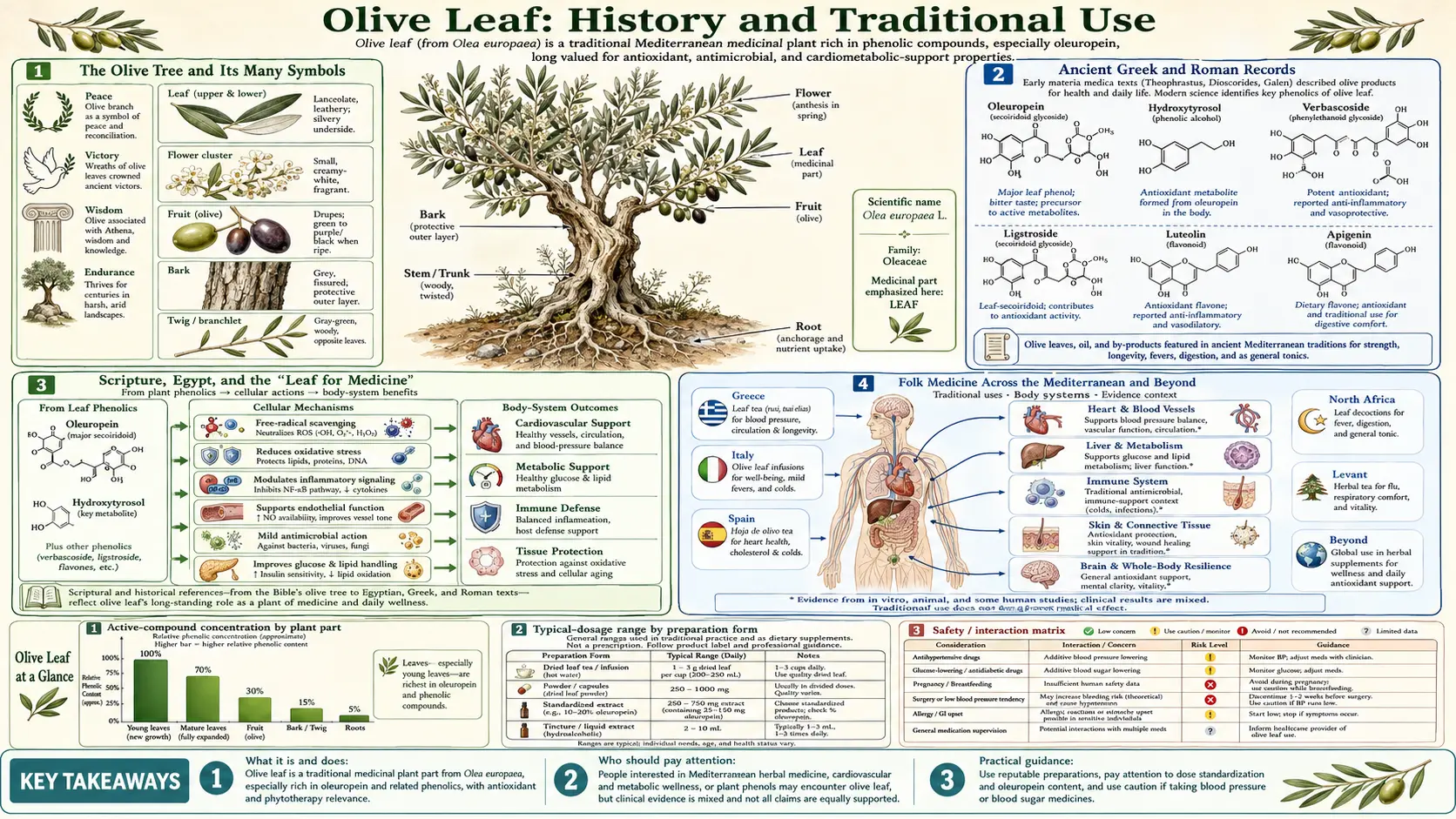
The olive tree, Olea europaea, has been cultivated around the Mediterranean for thousands of years, and for almost as long its silvery leaves — not only its famous fruit and oil — have been gathered, brewed, and applied as a folk medicine. This is the story of how a humble, bitter leaf travelled from the writings of ancient Greek physicians, through scripture and Mediterranean kitchens, to a Victorian fever remedy and finally to the modern laboratory bench. Where the record is firm we say so; where a claim rests on tradition or belief rather than documented fact, we mark it plainly as such.
Table of Contents
- The Olive Tree and Its Many Symbols
- Ancient Greek and Roman Records
- Scripture, Egypt, and the “Leaf for Medicine”
- Folk Medicine Across the Mediterranean and Beyond
- The 1854 Fever Remedy and the Quinine Comparison
- From Bitter Leaf to Named Compound: Oleuropein
- The Blood-Pressure Discovery and the Modern Revival
- From Tradition to Modern Research
- References
- Connections
- Featured Videos
The Olive Tree and Its Many Symbols
To understand the history of olive leaf you first have to understand the place the olive tree held in the world that used it. The cultivated olive, Olea europaea, has been a defining plant of Mediterranean civilization for thousands of years, valued above almost all others for its fruit, its oil, and its hardy, long-lived wood. A single olive tree can live for centuries, surviving drought and poor soil, and groves were handed down across generations — so the tree became a symbol of permanence, prosperity, and life itself long before anyone wrote down a recipe for its leaves.
In ancient Greece the olive was woven into myth and civic life. Tradition held that the goddess Athena gave the olive tree to the city of Athens, and the olive branch became an enduring emblem of peace, victory, and divine favour; victorious athletes at the ancient Olympic Games were crowned with wreaths cut from a sacred olive. These are cultural and mythological traditions rather than medical claims, but they matter to the leaf's history: a plant this revered, this present in daily ritual, was a plant whose every part people noticed, gathered, and tried. The same evergreen leaves that crowned champions were close at hand whenever someone fell ill.
It is worth being clear about a distinction that runs through this whole story. For most of recorded history the prestige of the olive belonged to its oil and its fruit; the leaf was the cheap, abundant, bitter part — a folk remedy and a household standby rather than a luxury good. That humble status is exactly why the leaf's medicinal record is patchier and more anecdotal than its symbolic record. Much of what follows is traditional and folk knowledge, passed along by use rather than carefully documented, and it deserves to be read in that spirit.
Ancient Greek and Roman Records
The written medicinal record of the olive begins in the classical Mediterranean. The Greek physician and pharmacologist Dioscorides, who compiled his great herbal De Materia Medica in the first century CE, is generally credited as the earliest author to set down preparations made from the olive in a systematic pharmacopoeia — a work that would shape European and Islamic medicine for the next sixteen centuries. The roughly contemporary Roman encyclopaedist Pliny the Elder likewise catalogued the olive among the useful plants of his Natural History. These are named here as historical primary sources rather than as modern citations, and honesty requires a caution: much of the classical praise attaches specifically to olive oil and to the fruit. The Hippocratic Corpus, for example, is often cited for containing dozens of medicinal uses of olive oil, and Dioscorides recommends oil for complaints such as toothache. Claims that specific ancient physicians prescribed the leaf for a precise list of conditions are frequently repeated in popular writing but are harder to pin to the original texts, so we report the classical inheritance broadly rather than putting modern words in ancient mouths.
What the classical and later traditions do consistently associate with the olive is a cluster of uses that recurs again and again: cooling or “regulating” fevers, soothing and cleansing the skin, calming inflammation of the mouth and throat, and dressing wounds and sores. The astringent, slightly bitter character of a leaf decoction fits these uses well, and the same indications reappear in the medieval Islamic and European medical traditions that inherited and expanded the Greek and Roman texts. The thread is real even where the precise classical wording is uncertain: across the ancient Mediterranean, the olive in its various forms was understood as a cooling, cleansing, fever-easing plant.
Readers will sometimes see the great Persian physician Ibn Sina (Avicenna) and his Canon of Medicine cited for olive-leaf remedies. Avicenna certainly wrote at length on the olive, and Islamic medicine made extensive use of the tree; but, as with the Greek sources, the strongest documented attributions concern olive oil and the fruit rather than a clearly specified leaf preparation. We therefore name these traditions as part of the olive's broad medical heritage without over-claiming the detail.
Scripture, Egypt, and the “Leaf for Medicine”
The olive is among the most frequently mentioned plants in the Bible, where it stands for blessing, anointing, peace, and renewal. The best-known image is the olive leaf the dove brings back to Noah after the Flood, the sign that the waters had receded and life could begin again. One verse in particular is often quoted in connection with the leaf's healing reputation: in the King James rendering of Ezekiel 47:12, describing trees growing by the waters flowing from the temple, “the fruit thereof shall be for meat, and the leaf thereof for medicine.” That passage is a vision of trees in general rather than a prescription for olive specifically, and it should be read as scriptural symbolism, not as a clinical instruction — but it is genuinely part of why the olive leaf carries such an old aura of healing in Western culture.
A second, frequently repeated claim concerns ancient Egypt. Olive branches have been recovered from Egyptian tombs, and it is widely said that the olive was used in the embalming or mummification of royalty and held as a symbol of heavenly power. The presence of olive in funerary contexts is real; the further idea that olive leaf was prized specifically as a preservative because the Egyptians recognised its decay-fighting (antimicrobial) properties is best treated as tradition and later interpretation rather than established fact. It is a satisfying story — an ancient people sensing what chemistry would later confirm — and it may even contain truth, but the documented evidence is for olive's funerary and symbolic use, not for a knowing antimicrobial application. We include it here, clearly labelled, because it is part of how people tell the olive's history, while being careful not to present folklore as proven.
Folk Medicine Across the Mediterranean and Beyond
Away from the famous texts, the most reliably documented chapter of olive-leaf history is the living folk medicine of the lands where the tree grows. Modern ethnobotanical reviews — surveys that record how ordinary people in different regions actually use a plant — show a remarkably consistent picture, and they are firmer ground than romantic claims about named ancient physicians. The comprehensive review of Olea europaea by Hashmi and colleagues (2015) gathers traditional uses reported from across the Mediterranean and well beyond it.
Two uses stand out for how often they recur across separate cultures. The first is high blood pressure: a hot-water infusion of olive leaves has been a traditional remedy for hypertension in Greece, and folk traditions in Morocco, Algeria, and Brazil likewise record olive-leaf preparations used to lower blood pressure or to act as a diuretic. The second is diabetes (high blood sugar): olive leaf has been used traditionally for diabetes in Morocco, Algeria, and Palestine, among other places. It is striking — and historically important — that these two folk indications are precisely the two areas where modern clinical research on olive leaf has since concentrated and found the most support. The tradition pointed, in effect, at the right targets.
Beyond blood pressure and blood sugar, the recorded folk uses form a broad, sensible cluster: fevers; infections of the respiratory and urinary tracts; diarrhoea and other digestive complaints; inflammation, rheumatism, and haemorrhoids; and skin conditions. Tunisian folk medicine, for instance, has used olive-leaf preparations for inflammation of the gums, for earache and middle-ear trouble (otitis), and against bacterial infection, while an East African tradition used a bark infusion of the tree against tapeworm. None of these folk uses is a modern endorsement, and some have little or no clinical testing behind them; they are presented as the documented historical practice of real communities. But taken together they explain why olive leaf earned its long-standing reputation as an all-purpose tonic for resisting illness — a reputation built, leaf by leaf, in kitchens and sickrooms rather than in libraries.
The 1854 Fever Remedy and the Quinine Comparison
The olive leaf enters the modern medical literature through a small but well-documented episode in Victorian Britain. In 1854 the Pharmaceutical Journal — a respected professional publication still in print today — carried an account by the British pharmacologist Daniel Hanbury describing the use of a decoction of olive leaves to treat fevers, including the intermittent fevers then lumped together with malaria. Hanbury reproduced a simple, now often-quoted recipe attributed to a correspondent: boil a handful of leaves in water down to about half its volume, then give the patient a wineglassful every few hours until the fever breaks. The correspondent reportedly judged the remedy, for fever, “more effective than quinine.”
This deserves careful framing, because fever remedies are exactly where overstatement does real harm. Hanbury was reporting and passing along a folk practice, not running a controlled trial, and the loose nineteenth-century use of the word “malaria” covered many fevers that were not the mosquito-borne parasitic disease we now mean by it. Olive leaf is not a treatment for malaria, which today requires specific antimalarial drugs; anyone with a possible malarial illness needs prompt medical care. What the 1854 report genuinely documents is that, by the mid-nineteenth century, olive leaf's old reputation as a fever-cooling remedy had crossed from Mediterranean folk practice into the formal pharmacy literature of northern Europe. Hanbury, curious about why it might work, also speculated that the leaf contained a specific bitter active principle — an intuition that would not be chemically confirmed for another half-century.
From Bitter Leaf to Named Compound: Oleuropein
The shift from folklore to chemistry began in the early twentieth century, and here the historical record becomes precise. In 1908 the French chemists Bourquelot and Vintilesco isolated the olive leaf's characteristic bitter substance and gave it the name oleuropein. They described it as an intensely bitter, non-crystalline compound, readily soluble in alcohol and fairly soluble in water — the very bitterness, in other words, that herbalists had always tasted in an olive-leaf brew now had a name and could be studied as a single chemical entity. This is the kind of genuinely documented scientific milestone, with named researchers and a firm date, that the rest of this herb's pre-modern history mostly lacks.
Identifying a compound is not the same as understanding it. Oleuropein's detailed chemical structure was not worked out until 1960, when Panizzi and co-workers determined that it is a secoiridoid — an ester linking elenolic acid to a dihydroxyphenyl-ethanol (the building block of the antioxidant now called hydroxytyrosol) through a sugar. That structure matters because it explains a great deal of olive leaf's behaviour: when oleuropein breaks down, it yields hydroxytyrosol and elenolic-acid derivatives, the smaller molecules to which much of the leaf's antioxidant and antimicrobial activity is now attributed. The first careful laboratory study explicitly framed around the antimicrobial action of the purified compounds — oleuropein and hydroxytyrosol tested against bacteria and fungi — came decades later, with work such as Bisignano and colleagues (1999) and Markin and colleagues (2003), which helped move olive leaf's ancient “anti-infective” reputation onto a measurable footing.
The Blood-Pressure Discovery and the Modern Revival
The single observation that did most to revive scientific interest in olive leaf concerned blood pressure — and it lined up almost eerily with the old Mediterranean folk use. Around 1962, Italian researchers reported that oleuropein lowered blood pressure when given to laboratory animals. For a compound drawn from a leaf that Greek villagers had long brewed as a tea for hypertension, this was a striking convergence of folklore and pharmacology, and it opened a line of investigation that continues today into how olive-leaf polyphenols relax blood vessels and support the lining of the arteries.
That thread runs straight into the modern clinical era. In a randomised, double-blind trial published in Phytomedicine in 2011, Susalit and colleagues compared a standardised olive-leaf extract against the established blood-pressure drug captopril in adults with stage-1 hypertension; over the study period the olive-leaf extract produced reductions in blood pressure broadly comparable to the medication, and was also associated with a fall in triglyceride levels. Results from a single trial are not the last word, and olive leaf is not a replacement for prescribed treatment of a serious condition like high blood pressure — but the study is a fair marker of how far the leaf had travelled: from a bitter folk tea, to a named bitter compound in 1908, to a hypotensive effect in animals around 1962, to a controlled human comparison with a pharmaceutical drug. Alongside blood pressure, the same modern revival has revisited olive leaf's traditional uses for blood sugar, for antioxidant protection, and as an anti-infective, the themes explored in this site's Olive Leaf Benefits articles.
From Tradition to Modern Research
The history of olive leaf is unusual among herbal histories for how cleanly its oldest reputations map onto its best modern evidence. For centuries, Mediterranean folk medicine reached for olive-leaf tea chiefly for two things: to bring down a fever and to steady high blood pressure, with a wider supporting role against infections, inflammation, and high blood sugar. Modern research, starting from the 1908 isolation of oleuropein and the early-1960s discovery of its blood-pressure effect, has put the firmest footing under exactly those two traditional uses — cardiovascular and metabolic — while laboratory work on oleuropein and hydroxytyrosol has given the leaf's old “anti-infective” standing a measurable, if still preliminary, basis.
It is fair, then, to say that tradition asked good questions and research is steadily answering them — provided we keep the honest cautions in view. The romantic anecdotes that decorate olive leaf's story (the knowing Egyptian embalmers, the precise ancient prescriptions, the Victorian “cure” for malaria) are better treated as folklore or as loosely documented tradition than as fact, and olive leaf today is a gentle supportive supplement, not a cure for any disease and never a substitute for proper medical care. With that framing, the detailed chemistry, mechanisms, dosing, and clinical evidence are taken up in the companion articles: Cardiovascular and Blood Pressure, Blood Sugar, Antimicrobial and Antiviral, and Antioxidant and Anti-Aging.
The line that runs from a dove's olive branch, through a bitter cup of leaf-tea in a Greek kitchen and a recipe printed in an 1854 pharmacy journal, to a randomised trial against a modern drug, is the real history of this plant: not a single inventor or a miraculous secret, but a slow, collective, cross-cultural noticing of a useful leaf — now, at last, being explained.
References
The list below combines key peer-reviewed sources on the traditional use and pharmacology of olive leaf with curated PubMed topic-search links. Historical primary texts (Dioscorides' De Materia Medica, Pliny's Natural History, the Hippocratic Corpus, Avicenna's Canon of Medicine, the 1854 Pharmaceutical Journal report by Daniel Hanbury, and the Bible) are named in the article as historical sources rather than as modern citations. Each external link opens in a new tab.
- Hashmi MA, Khan A, Hanif M, Farooq U, Perveen S. Traditional Uses, Phytochemistry, and Pharmacology of Olea europaea (Olive). Evidence-Based Complementary and Alternative Medicine. 2015;2015:541591. — doi:10.1155/2015/541591
- Susalit E, Agus N, Effendi I, et al. Olive (Olea europaea) leaf extract effective in patients with stage-1 hypertension: comparison with Captopril. Phytomedicine. 2011;18(4):251-258. — doi:10.1016/j.phymed.2010.08.016 · PMID 21036583
- Bisignano G, Tomaino A, Lo Cascio R, Crisafi G, Uccella N, Saija A. On the in-vitro antimicrobial activity of oleuropein and hydroxytyrosol. Journal of Pharmacy and Pharmacology. 1999;51(8):971-974. — doi:10.1211/0022357991773258 · PMID 10504039
- Markin D, Duek L, Berdicevsky I. In vitro antimicrobial activity of olive leaves. Mycoses. 2003;46(3-4):132-136. — doi:10.1046/j.1439-0507.2003.00859.x Search PubMed
- Olea europaea leaf — ethnobotany and traditional use PubMed: Olea europaea leaf ethnobotany traditional use
- Oleuropein — history, chemistry, and pharmacology PubMed: oleuropein olive leaf pharmacology review
External Authoritative Resources
- NCCIH — Herbs at a Glance
- MedlinePlus — Herbs and Supplements
- PubMed — All research on Olea europaea leaf