Malaria — The Plasmodium Parasite
Symptoms & Diagnosis
The fever paroxysms, the warning signs of severe disease, and how malaria is confirmed.
Read the deep dive →Severe & Cerebral Malaria
Cerebral malaria, severe anemia, and organ failure — the medical emergency.
Read the deep dive →Malaria in Pregnancy & Children
Why these groups bear most of the severe disease and death.
Read the deep dive →Diagnosis: Blood Smear & RDT
Microscopy, rapid antigen tests, and PCR.
Read the deep dive →Treatment & Prevention
How malaria is treated and the three pillars of prevention.
Read the deep dive →Antimalarial Drugs & ACT
Artemisinin-combination therapy, IV artesunate, and radical cure.
Read the deep dive →Prevention: Nets, Prophylaxis & Vaccines
Bed nets, traveler prophylaxis, and the RTS,S and R21 vaccines.
Read the deep dive →Drug Resistance
Why chloroquine failed and the threat of artemisinin partial resistance.
Read the deep dive →Malaria is one of the oldest and deadliest diseases known to humanity — a life-threatening illness caused by single-celled Plasmodium parasites and spread by the bite of an infected mosquito. Despite enormous progress, the World Health Organization still estimates roughly a quarter of a billion cases and several hundred thousand deaths every year, the overwhelming majority of them young children in sub-Saharan Africa. Yet malaria is both preventable and treatable. This page explains what causes malaria, how the parasite cycles between mosquito, human blood, and the liver, why the fever comes in waves, how the infection is diagnosed and treated, and how bed nets, prophylactic drugs, and the new malaria vaccines are turning the tide against it.
Table of Contents
1. What Is Malaria?
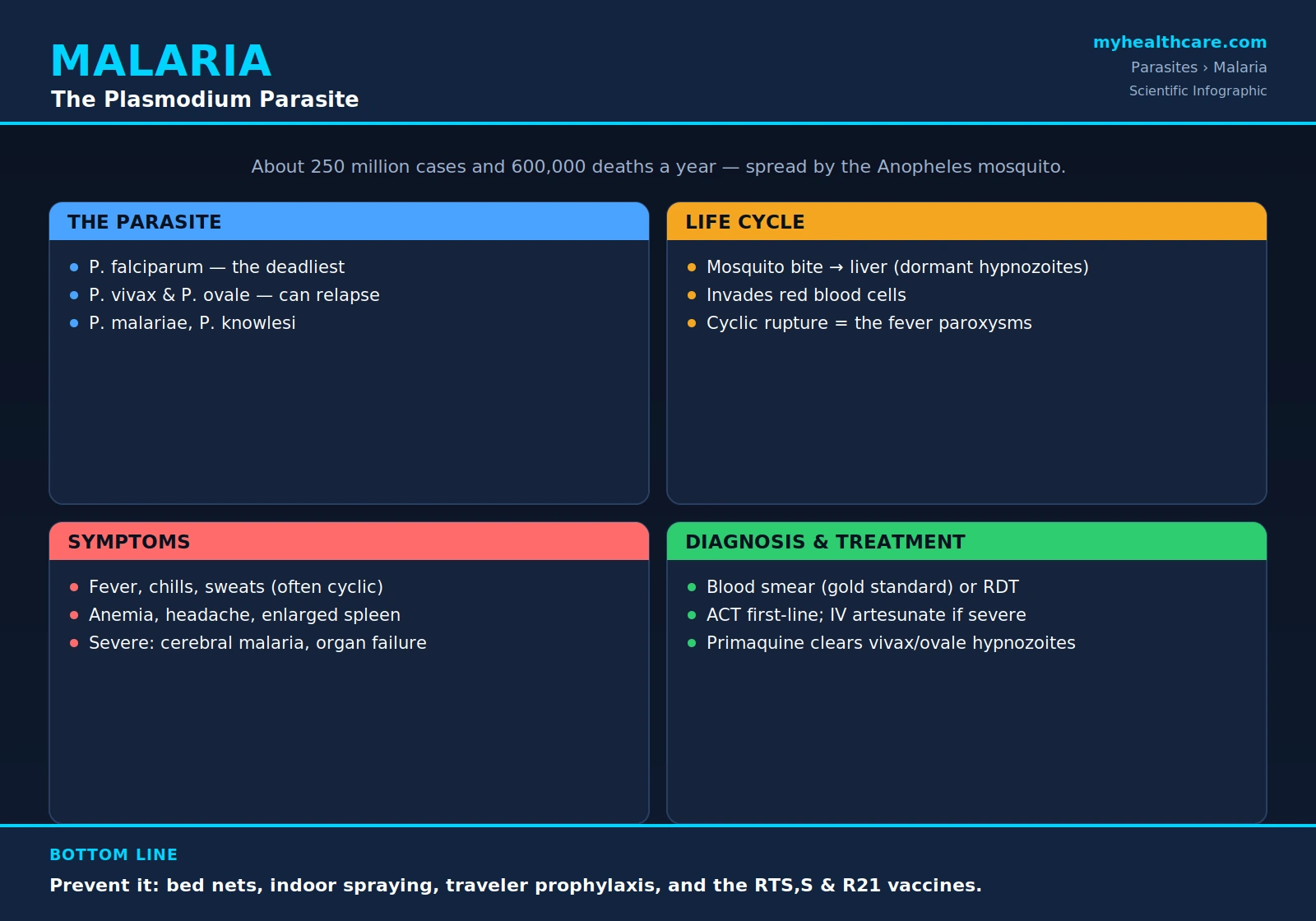
Malaria is a life-threatening disease caused by protozoan parasites of the genus Plasmodium. These are not bacteria or viruses but single-celled animals (protozoa) that live inside a host. Five species are known to cause malaria in people:
- Plasmodium falciparum — the deadliest by far, responsible for the great majority of severe disease and deaths, and the dominant species in sub-Saharan Africa.
- Plasmodium vivax — the most geographically widespread, common in Asia and Latin America, and notable for its ability to relapse months after the first illness.
- Plasmodium ovale — similar to P. vivax in its capacity to relapse; found mainly in West Africa.
- Plasmodium malariae — a milder, chronic infection that can smolder for years.
- Plasmodium knowlesi — a zoonotic species normally infecting macaque monkeys in Southeast Asia, but increasingly recognized as a cause of human malaria that can become severe.
The scale of the disease remains staggering. The World Health Organization estimates roughly 250 million cases and around 600,000 deaths each year. Most of those deaths are in young children under the age of five in sub-Saharan Africa, where P. falciparum predominates and access to prompt diagnosis and treatment is hardest. Pregnant women are another high-risk group. Crucially, malaria is both preventable and curable: the tragedy of its death toll lies largely in delayed diagnosis, lack of access to effective drugs, and gaps in prevention — not in any inability of medicine to treat it.
2. Life Cycle
Malaria has one of the most intricate life cycles in all of human medicine, shuttling between a mosquito and a person and passing through several distinct forms along the way. Understanding it explains nearly everything about how the disease behaves — why fevers come in waves, why some species relapse, and why certain drugs work only at certain stages.
The bite and the liver stage. Infection begins when an infected female Anopheles mosquito takes a blood meal and injects parasites in a form called sporozoites. Within minutes these travel through the bloodstream to the liver, where they invade liver cells and multiply silently. This liver stage causes no symptoms and typically lasts a week or two.
Dormant forms and relapse. In P. vivax and P. ovale infections, some liver-stage parasites do not multiply immediately. Instead they become hypnozoites — dormant forms that can lie quiet in the liver for weeks, months, or even longer before reactivating to cause a fresh bout of illness. This is why these two species are said to relapse, and why their treatment must include a drug that clears the liver, not just the blood.
The blood stage. When liver-stage parasites mature, they burst out and invade red blood cells. Inside each red cell the parasite feeds and multiplies, then ruptures the cell to release a new generation that immediately invades fresh red cells. This destructive cycle repeats over and over, and it is responsible for the symptoms of malaria.
Why the fever comes in waves. In a single person the blood-stage parasites tend to become synchronized, so that great numbers of red cells rupture at roughly the same time. Each synchronized rupture releases parasites and cell debris that trigger an immune reaction — producing the classic fever paroxysm of shaking chills, burning fever, and drenching sweats. Because the cycle length differs by species, the paroxysms can recur every other day (tertian pattern, as in P. vivax, P. ovale, and P. falciparum) or every third day (quartan pattern, as in P. malariae).
Back to the mosquito. A few blood-stage parasites develop into sexual forms called gametocytes. When another mosquito bites the infected person and ingests these, the parasite reproduces sexually inside the insect and eventually produces new sporozoites — ready to be passed to the next human bite, completing the cycle.
3. How It Spreads
By far the most important route of malaria transmission is the bite of an infected female Anopheles mosquito. Only females bite (they need a blood meal to develop their eggs), and only certain Anopheles species are efficient vectors. These mosquitoes typically bite between dusk and dawn, which is why nighttime protection matters so much.
Malaria is not spread by casual person-to-person contact — you cannot catch it by touching, sharing food with, or being near someone who has it. However, because the parasite circulates in the blood, a small number of cases arise through blood-to-blood routes:
- Congenital malaria — passed from an infected mother to her baby around the time of birth.
- Transfusion malaria — through transfused blood or, rarely, organ transplantation.
- Shared needles — among people who inject drugs.
The geographic risk follows the mosquito. Transmission is concentrated in tropical and subtropical regions — sub-Saharan Africa above all, but also parts of South and Southeast Asia, the Pacific, Latin America, and the Middle East — where warmth and standing water let Anopheles thrive. Travelers who visit endemic areas without taking preventive measures are at real risk, and because symptoms can be delayed, illness sometimes appears only after returning home. Any fever in a traveler returning from a malarial region should be treated as a possible medical emergency until malaria is ruled out.
4. Symptoms
The early symptoms of malaria are often nonspecific and flu-like, which is one reason the disease can be missed. Because of this, malaria should always be suspected in anyone with a fever who lives in or has recently traveled to an endemic area. Symptoms typically begin 10 days to a few weeks after the infecting bite, but with some species — and in people taking partially effective prophylaxis — they may not appear until weeks or even months later.
Uncomplicated malaria commonly causes:
- Fever, chills, and sweats — sometimes in the rhythmic tertian (every other day) or quartan (every third day) cycles described above.
- Headache and muscle and joint aches.
- Fatigue, malaise, and weakness.
- Nausea, vomiting, and abdominal discomfort.
- Anemia, from the destruction of red blood cells, and an enlarged spleen (splenomegaly).
Severe falciparum malaria is a medical emergency. P. falciparum can progress within hours from an ordinary-looking fever to organ failure and death, especially in young children, pregnant women, and people without prior immunity. Warning features include:
- Cerebral malaria — confusion, seizures, and coma, caused by infected red cells obstructing the small vessels of the brain.
- Severe anemia from massive red-cell destruction.
- Respiratory distress, including a dangerous build-up of fluid in the lungs.
- Acute kidney failure (sometimes with dark urine, historically called "blackwater fever").
- Hypoglycemia (dangerously low blood sugar).
- Abnormal bleeding, very high parasite loads, jaundice, shock, and death.
The lesson is that malaria can deteriorate fast. Prompt recognition and treatment of P. falciparum — before these complications develop — is what separates a routine recovery from a fatal outcome.
5. Diagnosis
Because malaria can mimic many other febrile illnesses, the diagnosis must be confirmed in the laboratory rather than guessed from symptoms alone. Prompt diagnosis is critical: every hour of delay in severe falciparum infection can cost a life.
- Blood smear microscopy — the gold standard. A drop of the patient's blood is spread on a slide, stained (classically with Giemsa stain), and examined under the microscope. Both a thick smear (which concentrates the blood to detect even low numbers of parasites) and a thin smear (which preserves the parasites' shape) are made. Microscopy can identify the species and quantify the parasitemia — the percentage of red cells infected — which guides how severe the case is and whether intravenous treatment is needed.
- Rapid diagnostic tests (RDTs). These dipstick-style tests detect Plasmodium antigens in a finger-prick blood sample and give an answer in minutes, without a microscope or electricity. They have transformed malaria diagnosis in remote and resource-limited settings, though they are less able to quantify the parasite load and some are less sensitive for non-falciparum species.
- Polymerase chain reaction (PCR). Molecular tests detect parasite DNA with very high sensitivity and can precisely distinguish the species, including mixed infections. PCR is mainly used in reference laboratories, for research, and in cases where microscopy and RDTs are inconclusive.
In practice, a returning traveler or a person in an endemic area with an unexplained fever should have a blood smear (or RDT) performed urgently, and if the first test is negative but suspicion remains high, the testing is repeated over the following days.
6. Treatment
Malaria is curable, and the right treatment depends on the infecting species, the severity of illness, where the infection was acquired (because drug resistance varies by region), and the patient's circumstances such as pregnancy. The following reflects widely reported practice; actual treatment must be specialist- and guideline-guided, and the details below are presented for understanding, not self-treatment.
- Artemisinin-based combination therapy (ACT) is the first-line treatment for uncomplicated P. falciparum malaria in most of the world. Pairing a fast-acting artemisinin derivative with a longer-lasting partner drug clears the parasite quickly while protecting against resistance.
- Chloroquine remains effective and is still used in the limited regions where the parasite has stayed sensitive to it, and for some non-falciparum infections.
- Clearing the dormant liver stage of P. vivax and P. ovale requires an additional drug — primaquine or tafenoquine — to kill the hypnozoites and prevent relapse. These drugs can trigger dangerous red-cell breakdown in people with glucose-6-phosphate dehydrogenase (G6PD) deficiency, so patients should be screened for G6PD deficiency before they are given.
- Severe malaria is treated as an emergency with intravenous artesunate, the most effective drug for the sickest patients, alongside intensive supportive care for the failing organs.
Drug resistance is a defining and worsening challenge. P. falciparum long ago developed widespread resistance to chloroquine, which is why ACT became the standard. More ominously, partial resistance to artemisinin — the cornerstone of modern treatment — first emerged in Southeast Asia and has since been detected in parts of Africa, raising the prospect that today's best drugs could lose their power. Protecting the effectiveness of existing drugs, and developing new ones, is therefore a central goal of malaria control.
7. Prevention
Most of the dramatic reductions in malaria over the past two decades came from prevention, not treatment. The core strategies aim to stop the mosquito from biting, kill the mosquito, protect travelers with drugs, and now — for the first time — vaccinate children against the parasite itself.
- Insecticide-treated bed nets (ITNs). Sleeping under a net treated with long-lasting insecticide is one of the most effective and cost-efficient malaria interventions ever deployed, because Anopheles mosquitoes bite mainly at night. ITNs both physically block bites and kill mosquitoes that land on them.
- Indoor residual spraying (IRS). Coating the inside walls of homes with a residual insecticide kills mosquitoes that rest there after feeding, reducing transmission across a community.
- Mosquito-bite avoidance. Repellents, covering exposed skin, and reducing standing water where mosquitoes breed all lower the chance of being bitten.
- Chemoprophylaxis for travelers. People traveling to endemic areas can take preventive antimalarial medication before, during, and after the trip; the choice of drug depends on the destination's resistance patterns.
- Malaria vaccines. A landmark advance: the RTS,S/AS01 (brand name Mosquirix) vaccine and the newer R21/Matrix-M vaccine are now recommended for children living in areas with significant malaria transmission. These vaccines reduce malaria cases and deaths in young children and are being rolled out across endemic regions as a powerful new layer of protection alongside nets and drugs.
No single tool is enough on its own. The strength of modern malaria control lies in combining these measures — nets and spraying to suppress the mosquito, prompt diagnosis and effective drugs to cure the infected, and vaccines to protect the most vulnerable children.
Key Research Papers
Peer-reviewed reviews and landmark trials on malaria — covering the biology of Plasmodium, the clinical disease, the emergence of drug resistance, the treatment of severe malaria, and the malaria vaccines. Journal names appear as plain text; the year/volume/pages link opens the full citation via DOI.
- White NJ, Pukrittayakamee S, Hien TT, Faiz MA, Mokuolu OA, Dondorp AM. Malaria. The Lancet. 2014;383(9918):723–735. — doi:10.1016/S0140-6736(13)60024-0
- Phillips MA, Burrows JN, Manyando C, van Huijsduijnen RH, Van Voorhis WC, Wells TNC. Malaria. The Lancet. 2018;391(10130):1608–1621. — doi:10.1038/nrdp.2017.50
- Gardner MJ, Hall N, Fung E, et al. Genome Sequence of the Human Malaria Parasite Plasmodium falciparum. Nature. 2002;419(6906):498–511. — doi:10.1038/nature01097
- Dondorp AM, Nosten F, Yi P, et al. Artemisinin Resistance in Plasmodium falciparum Malaria. New England Journal of Medicine. 2009;361(5):455–467. — doi:10.1056/NEJMoa0808859
- Dondorp AM, Fanello CI, Hendriksen ICE, et al. Artesunate versus Quinine in the Treatment of Severe Falciparum Malaria in African Children (AQUAMAT): An Open-Label, Randomised Trial. The Lancet. 2010;376(9753):1647–1657. — doi:10.1016/S0140-6736(10)61924-1
- The RTS,S Clinical Trials Partnership. First Results of Phase 3 Trial of RTS,S/AS01 Malaria Vaccine in African Children. New England Journal of Medicine. 2011;365(20):1863–1875. — doi:10.1056/NEJMoa1102287
- The RTS,S Clinical Trials Partnership. Efficacy and Safety of RTS,S/AS01 Malaria Vaccine With or Without a Booster Dose in Infants and Children in Africa: Final Results of a Phase 3, Individually Randomised, Controlled Trial. The Lancet. 2015;386(9988):31–45. — doi:10.1016/S0140-6736(15)60721-8
- Datoo MS, Dicko A, Tinto H, et al. Safety and Efficacy of Malaria Vaccine Candidate R21/Matrix-M in African Children: A Multicentre, Double-Blind, Randomised, Phase 3 Trial. The Lancet. 2024;403(10426):533–544. — doi:10.1016/S0140-6736(23)02511-4
- Chandramohan D, Zongo I, Sagara I, et al. Seasonal Malaria Vaccination with or without Seasonal Malaria Chemoprevention. New England Journal of Medicine. 2021;385(11):1005–1017. — doi:10.1056/NEJMoa2026330
PubMed Topic Searches
Each link opens a live PubMed query so results stay current as new papers are indexed.
- PubMed: Plasmodium falciparum malaria review
- PubMed: Plasmodium vivax hypnozoite relapse
- PubMed: Severe falciparum malaria artesunate
- PubMed: Cerebral malaria pathogenesis
- PubMed: Artemisinin resistance Plasmodium falciparum
- PubMed: RTS,S / R21 malaria vaccine
- PubMed: Insecticide-treated bed nets malaria
- PubMed: Plasmodium knowlesi human malaria
Connections
- All Parasites
- Tu Youyou — the discoverer of artemisinin, the backbone of modern malaria treatment
- Acanthamoeba
- Giardia
- Toxoplasma
- Entamoeba
- Cryptosporidium
- Ascaris (Roundworm)
- Pinworm
- Hookworm
- Tapeworm
- Schistosoma
- Infectious Disease
- Hematology
- Anemia
- Sickle Cell Disease
- All Conditions
- Malaria — the infectious-disease summary of the same illness.
- Paul Hermann Müller — DDT, the failed eradication programme, and why resistance ended it