Pinworm — The Cause of Enterobiasis
Symptoms & Diagnosis
The hallmark nighttime itch, who gets it, and the simple "tape test."
Read the deep dive →Anal Itching & Sleep Disturbance
The hallmark nighttime perianal itch — and the restless sleep and irritability it causes.
Read the deep dive →Pinworm in Children & Households
Why it sweeps through families, schools, and daycares — and why the whole home is treated.
Read the deep dive →Complications & Unusual Sites
Usually harmless — but the rare problems, from vulvovaginitis to the appendix.
Read the deep dive →Treatment & Prevention
Easy to cure — the drugs, the repeat dose, and beating reinfection.
Read the deep dive →Pyrantel & Albendazole Treatment
The simple over-the-counter and prescription cures — and why a second dose two weeks later matters.
Read the deep dive →Hygiene & Preventing Reinfection
Handwashing, short nails, morning showers, and hot-washing bedding to break the cycle.
Read the deep dive →Recurrent Pinworm & the Whole Household
When pinworm keeps coming back — treating everyone at once and outlasting the eggs.
Read the deep dive →The pinworm (Enterobius vermicularis) is a tiny, white, thread-like roundworm that lives in the human intestine. It is the most common worm infection in the United States and in other temperate countries, and it is especially familiar to families with school-age children. Worldwide, it infects hundreds of millions of people. Despite how widespread — and how unsettling — it can be, pinworm is fundamentally a nuisance infection, not a dangerous one: its main consequence is itching and disturbed sleep, it is easy to diagnose, and it responds reliably to inexpensive medication. This page explains what pinworms are, the clever night-time life cycle that lets them spread so easily, why whole households tend to be affected, how the infection is found with a simple "tape test," and how it is treated and prevented.
Table of Contents
1. What Is Pinworm?
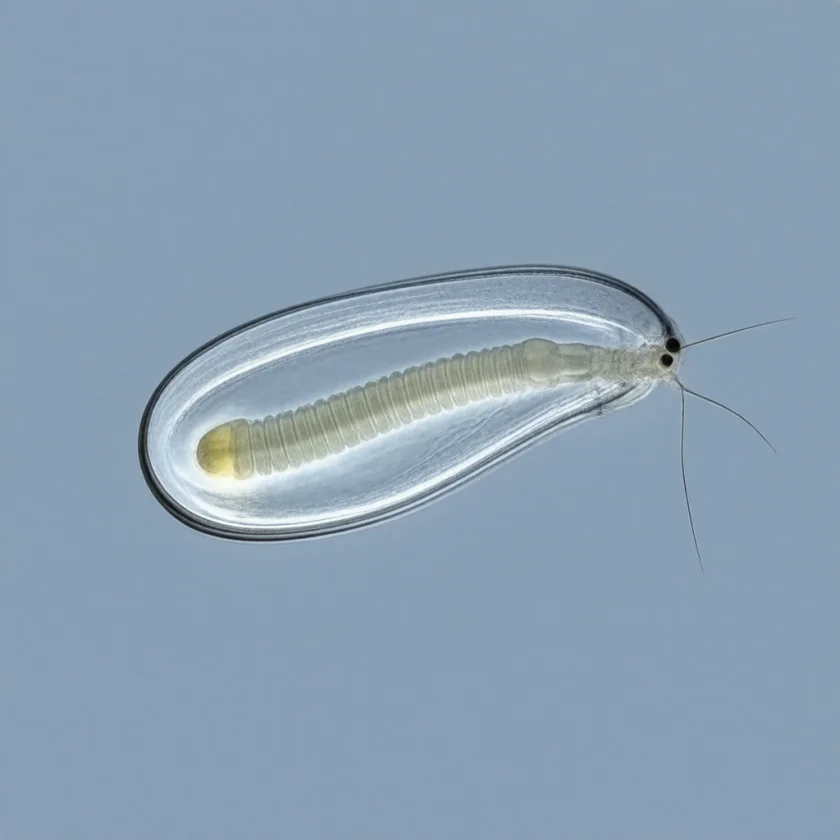
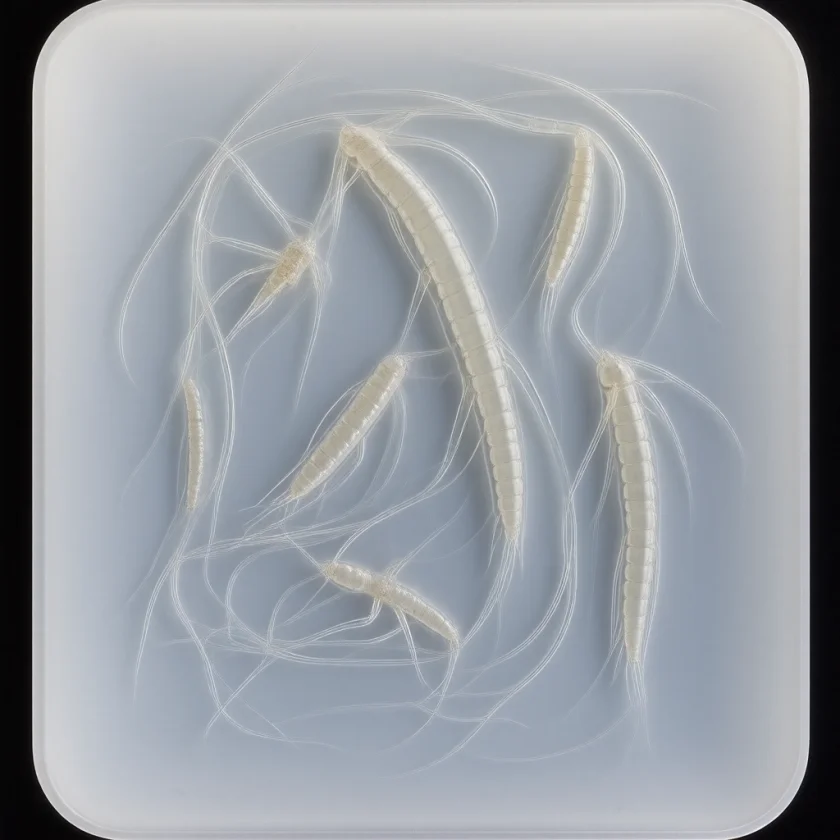
The pinworm, Enterobius vermicularis, is a small parasitic roundworm — a member of the group of worms called nematodes. The adult worms are tiny and white, and look like short pieces of thread or fine cotton. An adult female is only about a third of an inch long (roughly 8–13 millimeters), and the males are smaller still, which is why the worms are sometimes called "threadworms" or "seatworms." They live in the lower part of the small intestine and the large intestine, where they feed and mate.
Pinworm infection — the condition doctors call enterobiasis (or oxyuriasis) — is extraordinarily common. It is the most frequent worm infection in the United States and across other temperate regions of the world, and globally it affects hundreds of millions of people. Humans are the only natural host: you cannot catch pinworms from a dog, a cat, or any other animal, and your pets cannot catch them from you. The infection turns up in every kind of household and is not a sign of poor hygiene or a dirty home — it simply spreads very efficiently from person to person, particularly among children.
It is worth stating plainly, because the idea of a worm living inside the body is alarming: pinworm is a nuisance, not a threat. It does not invade tissues or organs, it does not cause serious illness in the vast majority of people, and complications are rare. Its real cost is the maddening itch it causes and the broken sleep that follows.
2. Life Cycle
The pinworm's life cycle is the key to understanding everything else about the infection — why it itches at night, why it spreads so easily, and why a single dose of medicine is not enough. It is a tidy, self-perpetuating loop that runs almost entirely between the human gut, the skin around the anus, and the hands.
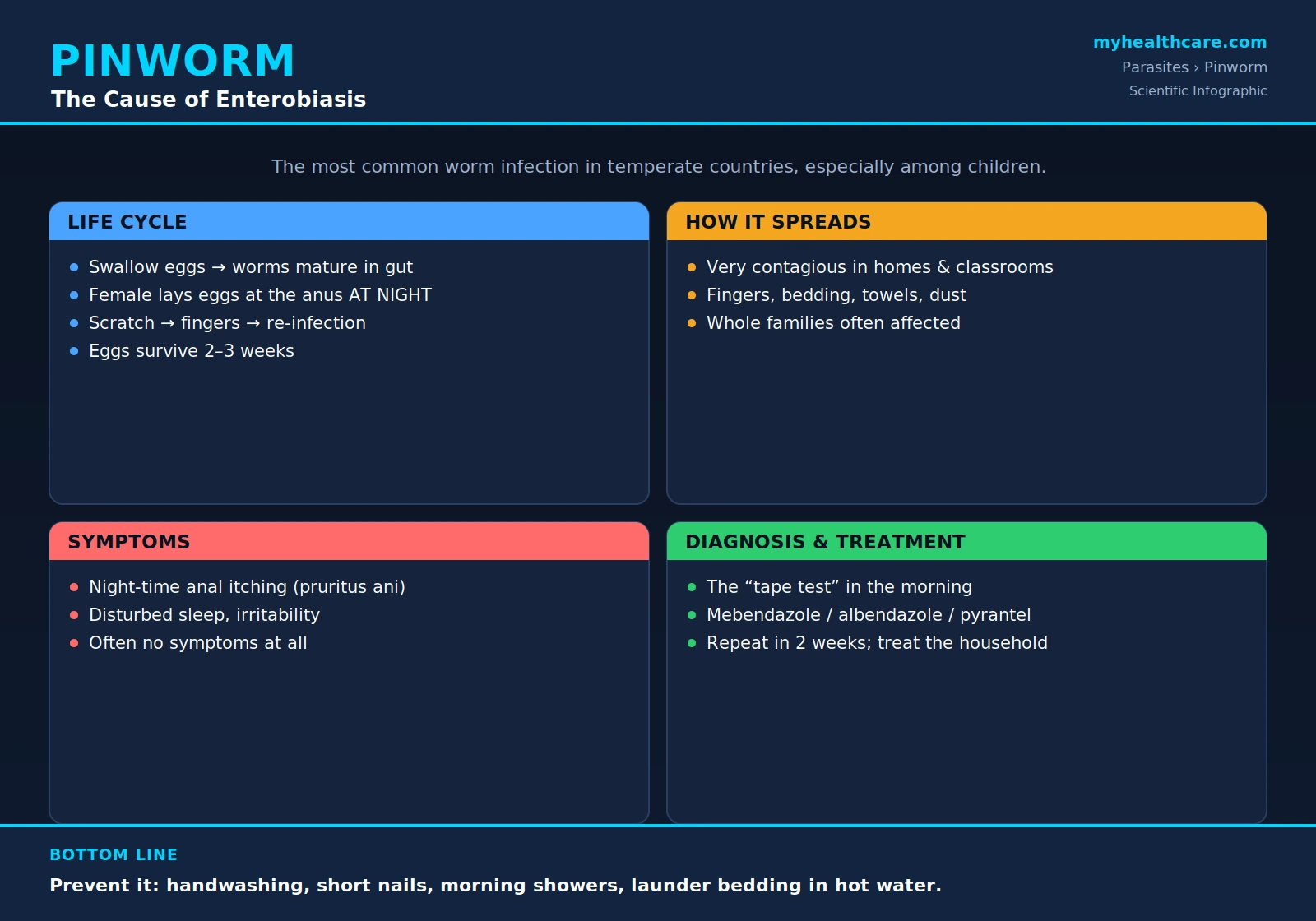
Infection begins when a person swallows microscopic pinworm eggs. The eggs hatch in the small intestine, and the young worms move down toward the large intestine, maturing into adults over the course of a few weeks. There the males and females mate. The males then die, but the egg-laden females have one more remarkable thing to do.
At night, while the host is asleep and relaxed, the pregnant female worm migrates down the intestine and out through the anus onto the surrounding skin. There, in the folds of skin around the anus (and, in girls, sometimes nearby), she deposits thousands of tiny, sticky eggs — and then usually dies. The eggs are coated in a substance that both makes them cling to skin and provokes intense itching.
This is where the loop closes. Crucially, the eggs become infective within just a few hours of being laid. When the sleeping or waking person scratches the itchy area, eggs are transferred onto the fingers and under the fingernails. From there they reach the mouth — completing a fresh round of self-infection — and they are also spread onto bedding, nightclothes, towels, toys, and household surfaces. Off the body, pinworm eggs are hardy: they can survive for two to three weeks in the environment, lying in wait to be picked up by the same person or by someone else. Because the worms keep this cycle running, an untreated infection can persist for a long time, refreshed night after night.
3. How It Spreads
Pinworm spreads by what is called the fecal–oral route — that is, eggs that originate around the anus end up being swallowed. It is highly contagious, and within the close quarters of a household or a classroom it moves with ease. This is why pinworm is so often a whole-family or whole-classroom problem rather than an isolated case: by the time one child is diagnosed, others nearby have frequently already picked up the eggs.
The eggs travel by several everyday routes:
- Contaminated fingers. Scratching the itchy perianal skin loads the fingers and the spaces beneath the fingernails with eggs, which are then carried to the mouth or onto whatever the person touches.
- Bedding, nightclothes, and towels. Eggs shed during the night collect in sheets, pajamas, and underwear and transfer to the next person who handles them.
- Toys and shared surfaces. Eggs deposited on toys, tables, door handles, and other surfaces survive for weeks and pass to anyone who touches them and then touches their face.
- Dust and air. Lightweight eggs can become airborne in household dust — for example, when bedding is shaken out — and may then be inhaled or swallowed.
Because so many of these routes operate at once, person-to-person spread is the rule. This pattern of easy household transmission is the single most important reason that treatment is usually aimed not at one individual but at everyone living under the same roof at the same time (see Treatment).
4. Symptoms
The hallmark symptom of pinworm — and often the only one — is intense itching around the anus, especially at night. Doctors call this pruritus ani. The timing is no accident: it coincides with the nightly migration of the female worms out onto the skin to lay their sticky, irritating eggs. The itching can be severe enough to wake a child repeatedly, and the resulting loss of sleep often shows up indirectly as restlessness, irritability, and difficulty concentrating during the day. In some children the disturbed nights are the first thing a parent notices, before anyone suspects worms at all.
Other features can include:
- Vaginal or vulvar irritation in girls. Because the perianal area is close to the genitals, wandering worms can cause itching, redness, and irritation there as well.
- Disturbed sleep and daytime tiredness, as a direct consequence of the night-time itching.
- Visible worms. Sometimes the small white, thread-like worms can be seen moving on the skin around the anus at night, or noticed in the stool.
Just as important is what usually does not happen. Many infections cause no symptoms at all and are discovered only by chance. And although there are uncommon reports of pinworms turning up in places such as the appendix or, in girls, the female genital tract, serious complications are rare. For the great majority of people, pinworm remains an itchy nuisance and nothing more.
5. Diagnosis
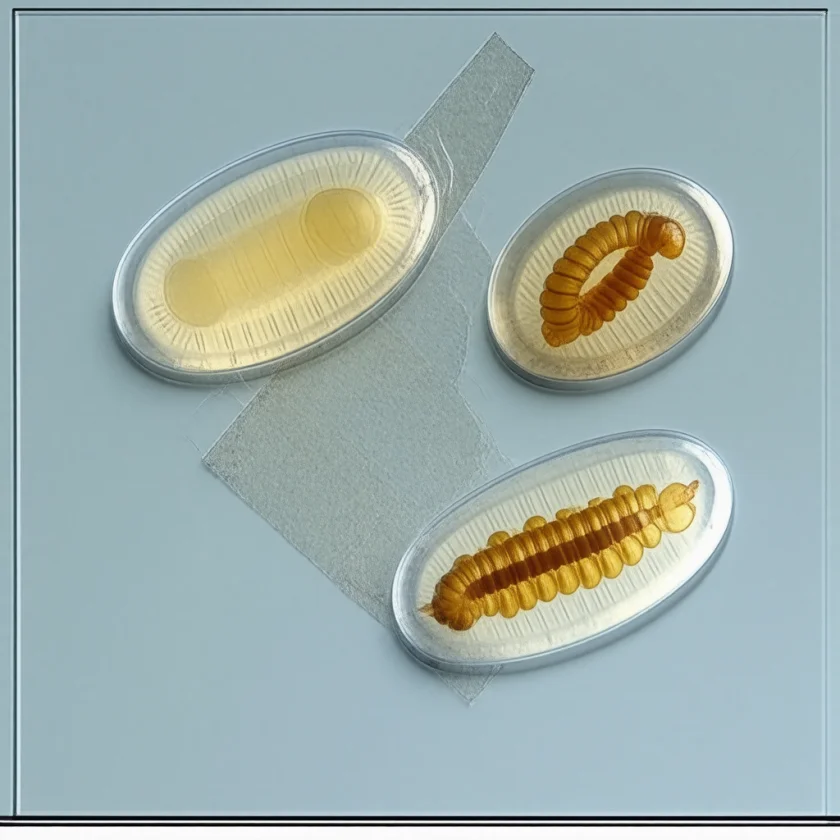
Pinworm is one of the easier parasitic infections to confirm, but it calls for the right test done at the right time. The standard method is the "tape test" (also called the cellophane-tape or sticky-tape test). A piece of clear cellophane tape is pressed, sticky side down, against the skin around the anus first thing in the morning — before the person bathes or uses the toilet. The tape is then pressed onto a glass slide and examined under a microscope. Because the female worms lay their eggs on the perianal skin overnight, the early-morning timing is what makes the test work: it catches the eggs before they are washed or wiped away.
The tape test is usually repeated on several consecutive mornings if the first one is negative, because the worms do not lay eggs every single night and a single sample can miss an infection that is really there. Under the microscope the eggs have a characteristic shape, and sometimes the small worms themselves are seen directly — either captured on the tape or spotted on the skin or in the stool.
One practical point trips up many families and even clinicians: a routine stool sample — the test used for most other intestinal parasites — usually misses pinworm. That is because pinworm eggs are deposited on the skin outside the body rather than passed in the feces, so they are typically absent from a standard stool examination. When pinworm is suspected, the perianal tape test — not a stool test — is the tool for the job.
6. Treatment
Pinworm responds reliably to inexpensive anti-worm medication, and treatment is straightforward. The medicines most commonly reported for it are mebendazole, albendazole, and pyrantel pamoate (pyrantel is the active ingredient in several over-the-counter worm treatments). Each is typically given as a single dose.
The single most important feature of treatment follows directly from the worm's life cycle: the dose is repeated after about two weeks. A first dose kills the worms that are present at the time but does not destroy eggs, and any eggs that survive in the gut or are swallowed again will hatch into a new generation of worms over the following days. Giving a second dose roughly two weeks later catches those newly hatched worms before they can mature and lay eggs of their own, breaking the cycle of re-infection.
Because pinworm spreads so easily within a home, treatment is usually not limited to the person with symptoms. The entire household is generally treated at the same time, on the same schedule, so that no untreated carrier remains to keep the infection circulating. Treatment is normally paired with practical hygiene measures — washing bedding, nightclothes, and underwear (ideally in hot water), trimming fingernails, and the handwashing steps described under Prevention — to clear away eggs already shed into the environment.
This information is presented as reported in the medical literature and public-health guidance; the choice of medicine, the exact dosing, and whether to treat an entire household should be directed by a clinician, particularly for very young children, pregnant women, and anyone with other health conditions.
7. Prevention
Because pinworm is spread by eggs traveling from the perianal skin to the hands, the mouth, and shared surfaces, prevention is built around simple habits that interrupt that journey. None of them is complicated, but used together — especially during and just after treating an infection — they sharply reduce both the chance of catching pinworm and the chance of passing it on or re-infecting oneself.
- Frequent, thorough handwashing with soap and water, especially after using the toilet, after changing diapers, and before preparing or eating food. This is the most important single measure.
- Keep fingernails short, so that fewer eggs can lodge beneath them.
- Discourage scratching the anal area and nail-biting, both of which move eggs onto the fingers and into the mouth.
- Shower in the morning. A morning shower washes away eggs laid on the skin overnight and is more effective than a bath, which can leave eggs floating in the water.
- Launder bedding, underwear, nightclothes, and towels regularly in hot water, and avoid shaking these items out (which can scatter eggs into the air and dust). Changing underwear daily helps as well.
For a sense of how pinworm fits among the wider family of parasitic infections — from single-celled protozoa to the larger worms — see the Parasites overview.
Key Research Papers
Peer-reviewed reviews and reports on Enterobius vermicularis — covering its biology, epidemiology, diagnosis, treatment, and the uncommon complications that have been described. Journal names appear as plain text; the year/volume/pages link opens the full citation via DOI.
- Leung AKC, Lam JM, Barankin B, Wong AHC, Leong KF. Pinworm (Enterobius vermicularis) Infestation: An Updated Review. Current Pediatric Reviews. 2025;21(4):333–347. — doi:10.2174/0115733963283507240115112552
- Wendt S, Trawinski H, Schubert S, Rodloff AC, Mössner J, Lübbert C. The Diagnosis and Treatment of Pinworm Infection. Deutsches Ärzteblatt International. 2019;116(13):213–219. — doi:10.3238/arztebl.2019.0213
- Lashaki EK, Mizani A, Hosseini SA, et al. Global Prevalence of Enterobiasis in Young Children Over the Past 20 Years: A Systematic Review and Meta-Analysis. Osong Public Health and Research Perspectives. 2023;14(6):441–450. — doi:10.24171/j.phrp.2023.0204
- Gunaratna GP, Dempsey S, Ho C, Britton PN. Diagnosis of Enterobius vermicularis Infestations. Journal of Paediatrics and Child Health. 2020;56(12):1994. — doi:10.1111/jpc.15188
- Fantinatti M, Da-Cruz AM. Enterobius vermicularis in Brazil: An Integrative Review. Revista da Sociedade Brasileira de Medicina Tropical. 2023;56:e0073-2023. — doi:10.1590/0037-8682-0073-2023
- Sousa J, Hawkins R, Shenoy A, Petroze R, Mustafa M, et al. Enterobius vermicularis-Associated Appendicitis: A 22-Year Case Series and Comprehensive Review of the Literature. Journal of Pediatric Surgery. 2022;57(8):1494–1498. — doi:10.1016/j.jpedsurg.2021.09.038
- Taghipour A, Olfatifar M, Javanmard E, Norouzi M, Mirjalali H, et al. The Neglected Role of Enterobius vermicularis in Appendicitis: A Systematic Review and Meta-Analysis. PLOS ONE. 2020;15(4):e0232143. — doi:10.1371/journal.pone.0232143
- Sosin M, Kent JR, Chahine AA. Enterobius vermicularis Appendiceal Colic. Journal of Laparoendoscopic & Advanced Surgical Techniques. 2019;29(5). — doi:10.1089/lap.2018.0693
- Hechenbleikner EM, McQuade JA. Parasitic Colitis. Clinics in Colon and Rectal Surgery. 2015;28(2):79–86. — doi:10.1055/s-0035-1547335
- Schiefke I, Schmäschke R, Ott R, Schiefke F, Mössner J. Indigenous (Autochthonous) Helminthiases, Including Enterobiasis. Der Internist. 2006;47(8):793–800. — Search PubMed
PubMed Topic Searches
Each link opens a live PubMed query so results stay current as new papers are indexed.
- PubMed: Enterobius vermicularis review
- PubMed: Enterobiasis epidemiology children
- PubMed: Pinworm diagnosis tape test
- PubMed: Enterobius treatment mebendazole
- PubMed: Enterobiasis transmission and complications
- PubMed: Enterobius vermicularis appendicitis
- PubMed: Pinworm pruritus ani
- PubMed: Enterobius albendazole pyrantel
Connections
- All Parasites
- Acanthamoeba
- Giardia
- Malaria
- Toxoplasma
- Entamoeba
- Cryptosporidium
- Ascaris (Roundworm)
- Hookworm
- Tapeworm
- Schistosoma
- Infectious Disease
- Gastroenterology
- All Conditions
- Herbs covered on this site that discuss this condition: Black Walnut · Elecampane · Wormwood
- Mimosa Pudica