Severe and Cerebral Malaria
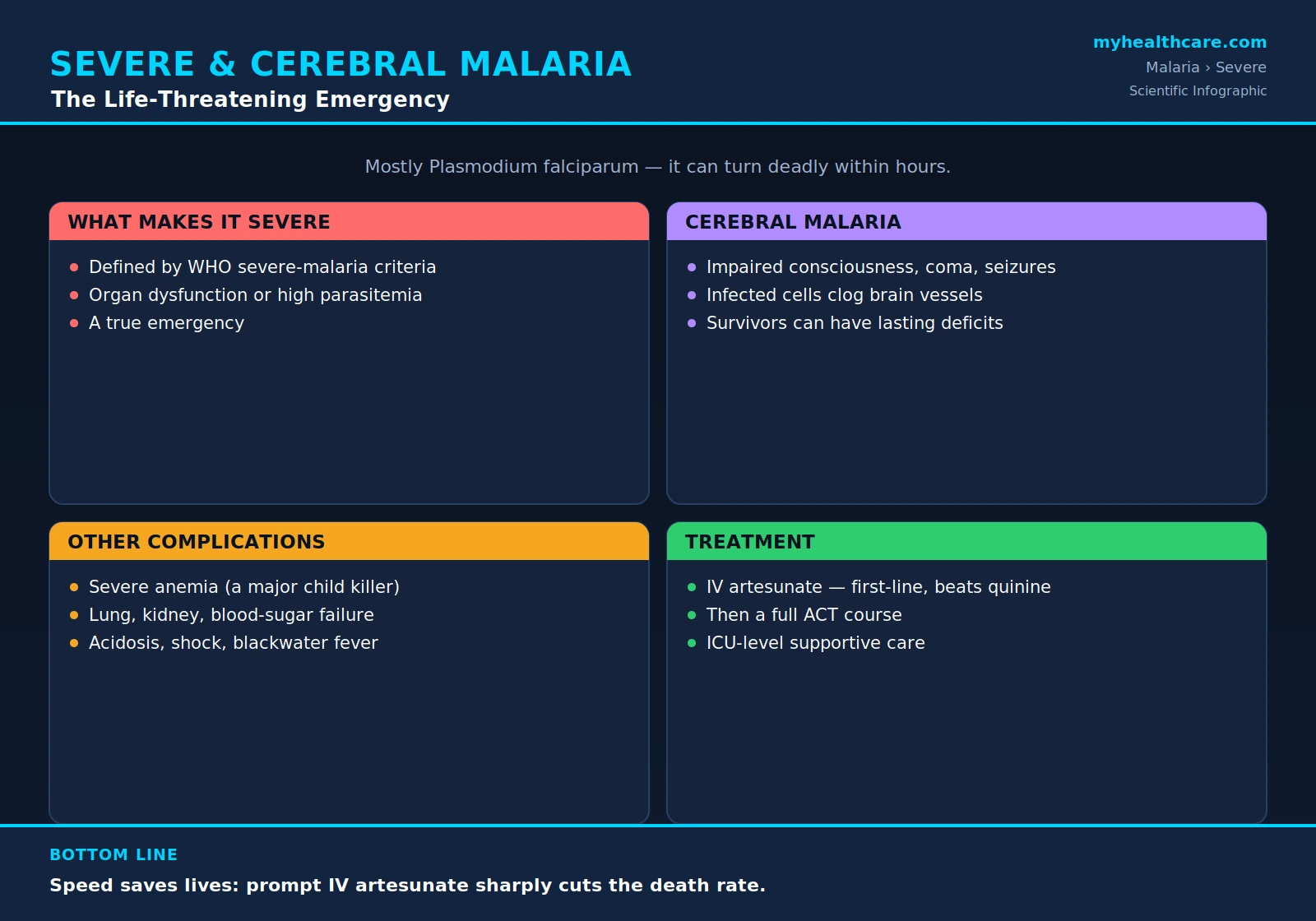
Most malaria infections, caught early and treated promptly, run an uncomplicated course. But malaria can also turn deadly — sometimes within hours. Severe malaria is a medical emergency in which the parasite overwhelms the body's defenses and begins to shut down vital organs. Its most feared form, cerebral malaria, attacks the brain, causing coma, seizures, and, in survivors — especially children — lasting neurological harm. Almost all severe and cerebral malaria is caused by one species, Plasmodium falciparum, and almost all of it is treatable if recognized in time. This page explains what makes malaria "severe," how it injures the brain and other organs, why it progresses so fast, and how modern emergency treatment with intravenous artesunate has transformed survival.
Table of Contents
- What Makes Malaria "Severe"
- Cerebral Malaria
- Severe Anemia
- Other Organ Complications
- Why It Progresses So Fast
- Treatment of Severe Malaria
- Prognosis
- Key Research Papers
- Featured Videos
1. What Makes Malaria "Severe"
"Severe malaria" is not just a bad case of ordinary malaria — it is a distinct, life-threatening syndrome defined by specific clinical and laboratory findings. The World Health Organization (WHO) classifies malaria as severe when infection with Plasmodium is accompanied by one or more signs of organ dysfunction or by a very high parasite burden, in the absence of another identified cause. The defining features include:
- Impaired consciousness or coma (cerebral malaria).
- Severe anemia from massive destruction of red blood cells.
- Acute kidney injury — the kidneys failing to clear waste.
- Acute respiratory distress and fluid in the lungs (pulmonary edema).
- Repeated or prolonged seizures.
- Circulatory collapse (shock) and abnormal bleeding.
- Low blood sugar (hypoglycemia) and metabolic acidosis (dangerously acidic blood).
- Jaundice and hyperparasitemia — a large proportion of red cells infected.
The overwhelming majority of severe malaria is caused by Plasmodium falciparum, the most dangerous of the human malaria parasites. (Plasmodium knowlesi, and occasionally Plasmodium vivax, can also cause severe disease, but falciparum dominates the global toll.) Severe malaria is a true emergency. Without rapid, effective treatment its mortality is very high, and even with the best care a meaningful proportion of patients die. Recognizing it quickly — and starting intravenous antimalarial therapy without delay — is the single most important determinant of survival.
2. Cerebral Malaria
Cerebral malaria is the most dreaded complication of falciparum infection. It is defined, in essence, by malaria plus unrousable coma — a depressed level of consciousness that cannot be explained by other causes such as low blood sugar or seizures alone. Patients may slip from confusion and drowsiness into deep coma over hours, and many, particularly children, suffer seizures along the way.
What is happening inside the brain is a process called sequestration. As P. falciparum matures inside a red blood cell, it studs the cell's surface with sticky proteins that make the infected cell adhere to the lining of small blood vessels. In the brain, vast numbers of these parasitized red cells become trapped in the microvessels — the tiniest capillaries. This packing of the small vessels obstructs blood flow, starves brain tissue of oxygen, and triggers inflammation and leakage across the blood-brain barrier. The result is the swelling, impaired perfusion, and dysfunction that produce coma and seizures. Studies that counted parasites in brain tissue after death confirmed that true cerebral malaria is marked by this dense sequestration in the brain's small vessels, distinguishing it from coma due to other causes.
A characteristic and clinically useful sign is malarial retinopathy. When a doctor examines the back of the eye in cerebral malaria, the retina — which shares the same kind of small vessels as the brain — often shows distinctive changes: patchy whitening, vessel discoloration, and small hemorrhages. Because the retina offers a direct window onto the brain's microvasculature, these findings help confirm that a comatose patient's illness is genuinely cerebral malaria rather than another disease that happens to coexist with parasites in the blood.
Cerebral malaria is often survivable with prompt treatment, but it can leave a lasting mark. Among survivors — especially children — a substantial fraction are left with neurological and cognitive deficits: epilepsy, weakness or coordination problems, behavioral changes, language difficulties, and impaired attention, memory, and learning. These long-term consequences make cerebral malaria not only a leading cause of death in young children in endemic regions but also an important cause of acquired disability.
3. Severe Anemia
Malaria is, at its core, a disease of the red blood cells — the parasite invades them, multiplies inside them, and bursts them open to spread. In severe infection this red-cell destruction becomes catastrophic. Severe malarial anemia arises from several forces acting together:
- Direct destruction of infected red cells as the parasites complete their cycle and rupture the cells.
- Removal of uninfected red cells by the spleen, which clears damaged and antibody-coated cells along with the parasitized ones, so that far more cells are lost than are actually infected.
- Suppressed production of new red cells in the bone marrow during the infection.
The consequence is a profound drop in hemoglobin, the oxygen-carrying pigment of the blood. Severe anemia is one of the major killers in malaria, particularly among young children in high-transmission areas of sub-Saharan Africa, where repeated infections compound the problem. A child can become pale, breathless, and dangerously weak, and may need an urgent blood transfusion alongside antimalarial drugs to survive. Because the anemia can deepen rapidly, it is one of the WHO's defining criteria for severe malaria and a key reason that prompt treatment matters so much.
4. Other Organ Complications
Beyond the brain and the blood, severe malaria can injure nearly every organ system. Several complications may occur together, and any one of them can be fatal:
- Acute respiratory distress and pulmonary edema. The lungs can fill with fluid, making breathing labored and oxygen levels dangerously low. This can develop or worsen even after antimalarial treatment has begun, and it carries a high mortality.
- Acute kidney injury. The kidneys may abruptly fail to filter the blood, causing waste products to accumulate; some patients require dialysis. Kidney failure is a particularly important complication in adults with severe malaria.
- "Blackwater fever." Massive breakdown of red cells (hemolysis) can release so much hemoglobin into the blood that it spills into the urine, turning it dark red, brown, or near-black — a striking sign that often accompanies kidney injury.
- Jaundice. Yellowing of the skin and eyes from the breakdown of red cells and from liver involvement.
- Hypoglycemia. Dangerously low blood sugar, which is common in young children and in pregnant women, and can also be worsened by quinine treatment; it is easily missed because its symptoms overlap with those of the malaria itself.
- Metabolic acidosis. The blood becomes too acidic, largely from obstructed blood flow and the build-up of lactic acid in poorly perfused tissues. Acidosis, often signaled by deep, rapid breathing, is one of the strongest predictors of death in severe malaria.
- Shock ("algid malaria"). A state of circulatory collapse with low blood pressure and cold, clammy skin, sometimes complicated by a coexisting bacterial bloodstream infection.
- Abnormal bleeding and clotting (DIC). In some patients the clotting system is thrown into disarray, with spontaneous bleeding from the gums, nose, or gut.
The presence of any of these complications marks the infection as severe and signals the need for hospital-level, often intensive-care, management.
5. Why It Progresses So Fast
One feature sets P. falciparum apart from the other human malaria parasites and explains why severe malaria can escalate so alarmingly: it multiplies rapidly and to very high densities. Falciparum can invade red cells of all ages and reach parasite burdens far higher than other species, so the number of parasites in the blood can climb steeply with each 48-hour cycle. Combined with the sequestration that clogs small vessels in the brain, kidneys, and other organs, this means that organ damage can accumulate quickly once disease becomes severe.
The practical lesson is stark: in severe malaria, hours matter. A patient who looks moderately ill in the morning can be comatose by evening. Delay in starting effective treatment is one of the strongest predictors of death. For this reason, anyone with malaria who shows a warning sign — drowsiness or confusion, repeated vomiting, inability to drink or eat, dark urine, difficulty breathing, or unusual weakness — should be treated as a potential emergency and brought to medical care immediately, without waiting to see whether they improve on their own.
6. Treatment of Severe Malaria
Severe malaria is a true emergency, and its treatment differs fundamentally from that of uncomplicated malaria. The cornerstone is intravenous (IV) artesunate — a fast-acting drug from the artemisinin family given directly into a vein so it reaches a high concentration in the blood immediately.
Two landmark randomized trials established IV artesunate as superior to intravenous quinine, the older standard. The SEAQUAMAT trial in Asian adults found that artesunate cut deaths substantially compared with quinine, and the larger AQUAMAT trial in African children confirmed a major reduction in mortality. On the strength of this evidence, the WHO recommends IV artesunate as the first-line treatment for severe malaria worldwide, for adults and children alike, including in pregnancy. Artesunate also tends to be safer to administer than quinine, which can itself cause low blood sugar and dangerous heart-rhythm effects.
Treatment follows a clear sequence:
- Parenteral artesunate is given for at least 24 hours, and continued until the patient can reliably take medicines by mouth.
- Once the patient improves and can swallow, a full course of an oral artemisinin-based combination therapy (ACT) is given to completely clear the infection and prevent relapse. A single drug given briefly is never sufficient. (See the dedicated Antimalarial Drugs and ACT page for how these regimens work.)
Just as important as the antimalarial drug is supportive care, ideally in a high-dependency or intensive-care setting. This may include blood transfusion for severe anemia, careful fluid management, treatment of seizures, correction of low blood sugar and acid-base disturbances, oxygen or mechanical ventilation for respiratory failure, dialysis for kidney failure, and antibiotics when a coexisting bacterial infection is suspected. Notably, some treatments that seem intuitive are not helpful and can be harmful: corticosteroids and aggressive fluid boluses, for example, have not improved outcomes in cerebral malaria and may worsen them. Expert, protocol-driven supportive care, paired with prompt IV artesunate, gives the patient the best chance of survival.
7. Prognosis
Untreated, severe malaria is very often fatal — and cerebral malaria, left untreated, is essentially uniformly so. The arrival of effective therapy has changed this picture dramatically. With prompt intravenous artesunate and good supportive care, the majority of patients survive, and the switch from quinine to artesunate alone has saved many thousands of lives, especially among African children.
Even so, the outlook depends heavily on how quickly treatment begins and on which complications are present. Coma, severe acidosis, kidney failure, and very high parasite counts all worsen the odds. And survival is not always a complete recovery: cerebral malaria can leave lasting sequelae, particularly in children, including epilepsy, motor and coordination problems, and difficulties with attention, memory, behavior, and learning. These neurological after-effects underscore why the disease must be prevented where possible and treated as an emergency where it occurs. The most effective strategy remains not getting severe in the first place — through bite prevention, prophylaxis where appropriate, vaccines, and, above all, early treatment of ordinary malaria before it has a chance to progress. (See Prevention, Nets, Prophylaxis, and Vaccines.)
Key Research Papers
Peer-reviewed trials, reviews, and pathology studies on severe and cerebral malaria — covering the WHO disease definition, the mechanisms of brain and organ injury, the diagnostic value of malarial retinopathy, and the trials that made intravenous artesunate first-line therapy. Journal names appear as plain text; the year/volume/pages link opens the full citation via DOI.
- Dondorp A, Nosten F, Stepniewska K, Day N, White N (SEAQUAMAT group). Artesunate versus Quinine for Treatment of Severe Falciparum Malaria: A Randomised Trial. The Lancet. 2005;366(9487):717–725.
- Dondorp AM, Fanello CI, Hendriksen ICE, et al. (AQUAMAT group). Artesunate versus Quinine in the Treatment of Severe Falciparum Malaria in African Children (AQUAMAT): An Open-Label, Randomised Trial. The Lancet. 2010;376(9753):1647–1657.
- World Health Organization. Severe Malaria. Tropical Medicine & International Health. 2014;19(Suppl 1):7–131.
- White NJ, Pukrittayakamee S, Hien TT, Faiz MA, Mokuolu OA, Dondorp AM. Malaria. The Lancet. 2014;383(9918):723–735.
- Idro R, Jenkins NE, Newton CRJC. Pathogenesis, Clinical Features, and Neurological Outcome of Cerebral Malaria. The Lancet Neurology. 2005;4(12):827–840.
- Taylor TE, Fu WJ, Carr RA, et al. Differentiating the Pathologies of Cerebral Malaria by Postmortem Parasite Counts. Nature Medicine. 2004;10(2):143–145.
- Beare NAV, Taylor TE, Harding SP, Lewallen S, Molyneux ME. Malarial Retinopathy: A Newly Established Diagnostic Sign in Severe Malaria. The American Journal of Tropical Medicine and Hygiene. 2006;75(5):790–797.
- Trampuz A, Jereb M, Muzlovic I, Prabhu RM. Clinical Review: Severe Malaria. Critical Care. 2003;7(4):315–323.
- Sinclair D, Donegan S, Isba R, Lalloo DG. Artesunate versus Quinine for Treating Severe Malaria. Cochrane Database of Systematic Reviews. 2012;(6):CD005967.
- Bartoloni A, Zammarchi L. Clinical Aspects of Uncomplicated and Severe Malaria. Mediterranean Journal of Hematology and Infectious Diseases. 2012;4(1):e2012026.
Live PubMed Searches
Each link opens a live PubMed query so results stay current as new papers are indexed.
- Severe falciparum malaria
- Cerebral malaria pathogenesis
- Intravenous artesunate severe malaria
- Cerebral malaria neurological sequelae children
- Severe malarial anaemia
- Malarial retinopathy
- Blackwater fever malaria
- Malaria acute kidney injury
Connections
- All Parasites
- Malaria Overview
- Symptoms & Diagnosis
- Malaria in Pregnancy & Children
- Diagnosis: Blood Smear & RDT
- Treatment & Prevention
- Antimalarial Drugs & ACT
- Prevention, Nets & Vaccines
- Drug Resistance
- Hematology
- Neurology
- Meningitis
- Sepsis
- All Conditions
- Malaria — the overall disease from which these life-threatening complications arise.