Malaria Treatment and Prevention
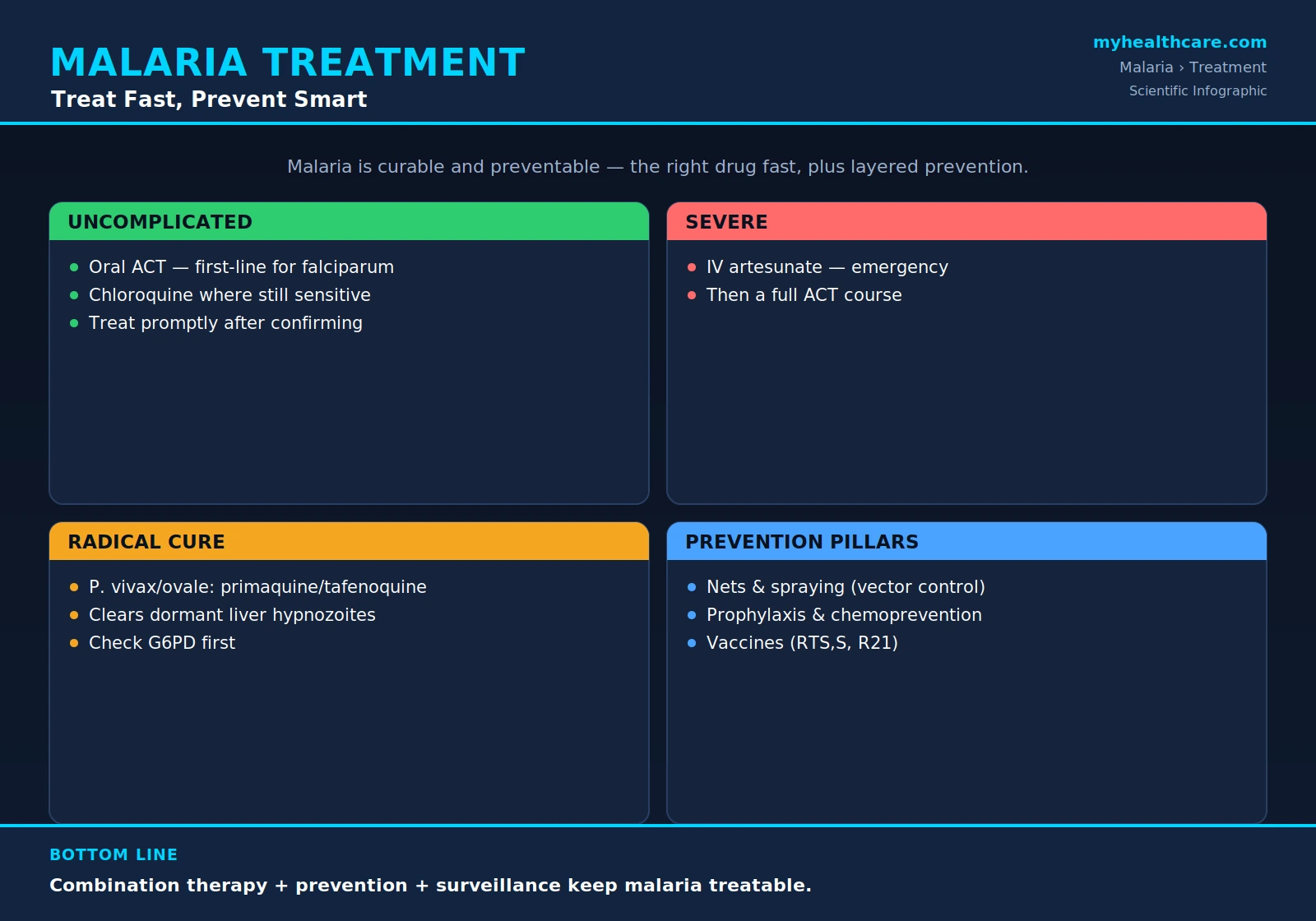
Malaria is treatable and largely preventable. The parasites that cause it — single-celled Plasmodium organisms carried by night-biting Anopheles mosquitoes — can be killed by modern medicines, and the bites that deliver them can be blocked by nets, sprays, preventive drugs, and now vaccines. The story of malaria over the past two decades has been one of enormous progress: deaths fell sharply as artemisinin-based medicines and insecticide-treated nets reached the people who needed them. Yet malaria still kills hundreds of thousands of people a year, most of them young children in sub-Saharan Africa, and the parasite keeps evolving ways to resist our best drugs. This page explains how malaria is treated — from a few pills for an uncomplicated case to an intensive-care emergency for a severe one — and how it is prevented, so that the disease is stopped before it ever starts.
Antimalarial Drugs & ACT
How malaria is treated — artemisinin-combination therapy, IV artesunate, and radical cure.
Read the deep dive →Prevention: Nets, Prophylaxis & Vaccines
Bed nets, traveler prophylaxis, seasonal chemoprevention, and the RTS,S and R21 vaccines.
Read the deep dive →Drug Resistance
Why chloroquine failed, artemisinin partial resistance, and what keeps treatment working.
Read the deep dive →Table of Contents
1. The Principles of Treatment
Good malaria care rests on a simple idea: confirm the diagnosis, then treat fast. Malaria is one of the few infections that can kill a healthy person within a day or two, so once it is found there is no time to lose — but it is also frequently confused with flu, typhoid, and many other fevers, so guessing is dangerous in both directions. Treating someone who does not have malaria wastes medicine and leaves the real illness unaddressed; failing to treat someone who does have it can be fatal. For this reason the World Health Organization recommends that, wherever possible, malaria be confirmed by a laboratory test — either a microscope examination of a blood smear or a finger-prick rapid diagnostic test (RDT) — before treatment begins. The dedicated Diagnosis page explains how these tests work.
Once malaria is confirmed, the right treatment depends on four questions:
- Which species? The five human malaria parasites behave differently. Plasmodium falciparum causes the most dangerous disease and the most deaths. P. vivax and P. ovale are usually milder but can hide dormant in the liver and relapse months later. P. malariae and the monkey-derived P. knowlesi round out the picture.
- How severe? A person who is awake, alert, and able to swallow has uncomplicated malaria and can be treated with pills. A person with confusion, seizures, breathing trouble, kidney failure, severe anemia, or very high parasite counts has severe malaria — a medical emergency that needs injected medicine and intensive care.
- Where was it acquired? Drug resistance is not the same everywhere, so the choice of medicine depends on the region a person caught malaria in. This is why doctors always ask a feverish traveler exactly where they have been.
- Is the patient pregnant? Pregnancy changes both the danger (malaria is far more dangerous for mother and baby) and the choice of drugs, because some antimalarials are not safe in early pregnancy. The Pregnancy & Children page covers these special situations.
These four questions — species, severity, place, and pregnancy — shape every treatment decision that follows.
2. Treating Uncomplicated Malaria
Most malaria is uncomplicated and can be cured at home with a short course of tablets. For P. falciparum, the standard of care worldwide is artemisinin-based combination therapy, almost always abbreviated ACT. An ACT pairs a fast-acting artemisinin derivative — such as artemether, artesunate, or dihydroartemisinin — with a longer-lasting partner drug like lumefantrine, piperaquine, amodiaquine, or mefloquine. The artemisinin component clears the bulk of the parasites within hours, dramatically reducing the chance of progressing to severe disease, while the partner drug lingers in the blood to mop up the survivors and prevent relapse. A typical course, such as artemether-lumefantrine, is taken over three days. The Antimalarial Drugs & ACT page describes each of these medicines in detail.
The reason two drugs are always combined, rather than giving artemisinin alone, is to protect both from resistance — an idea explored in the resistance section below. It is also why patients are urged to finish the full course even after they feel better: stopping early leaves the toughest parasites alive and is exactly how resistance spreads.
Not all malaria needs an ACT. Chloroquine, the old workhorse drug, still works in some parts of the world and against the non-falciparum species where they remain sensitive — for example, much P. vivax still responds to chloroquine, though resistant strains exist and are spreading in some regions. Where P. vivax remains chloroquine-sensitive, chloroquine clears the blood-stage infection; where it is resistant, an ACT is used instead. Whatever the species, the blood-stage cure is only half the job for relapsing malaria — see the radical-cure section.
3. Treating Severe Malaria
Severe malaria is a medical emergency. When the parasite count climbs and infected red blood cells begin to clog the small vessels of the brain, kidneys, and other organs, a person can deteriorate from feeling ill to organ failure and coma within hours. Warning signs include impaired consciousness or seizures (cerebral malaria), difficulty breathing, very low blood sugar, severe anemia, dark or scanty urine signalling kidney injury, abnormal bleeding, and shock. Any of these means the patient needs to be in a hospital, ideally with intensive-care support.
The cornerstone of treatment is intravenous artesunate. Large randomized trials — in Asian adults and then in African children — showed that IV artesunate saves substantially more lives than the older drug quinine, which it has now replaced as the global first choice. Artesunate is given by injection until the patient is stable enough to take pills, after which they are switched to a full three-day course of an oral ACT to finish clearing the infection and prevent relapse. Just as important is the supportive care that surrounds the antimalarial: correcting low blood sugar and fluid balance, transfusing blood for severe anemia, controlling seizures, supporting failing kidneys with dialysis when needed, and managing breathing. In well-resourced settings this combination has turned a once almost-uniformly-fatal condition into one most people survive.
4. Radical Cure for Relapsing Malaria
Two species — P. vivax and P. ovale — have a hidden trick that the others lack. When they first infect a person, some of the parasites slip into the liver and turn into hypnozoites: dormant, sleeping forms that the standard blood-stage drugs cannot touch. The patient is treated, the blood clears, and they feel well — only for the hypnozoites to reawaken weeks or months later and trigger a fresh attack of malaria, sometimes more than once. Curing the blood is therefore not enough; to be truly free of these species, the dormant liver forms must be killed too. This second step is called radical cure.
Radical cure uses one of two drugs from the same chemical family (the 8-aminoquinolines): primaquine, taken daily for one or two weeks, or tafenoquine, a longer-acting cousin that can be given as a single dose. Both clear the liver hypnozoites and prevent relapse — but both carry one critical safety catch. In people who inherit a common enzyme deficiency called G6PD deficiency (glucose-6-phosphate dehydrogenase deficiency), these drugs can trigger a sudden, dangerous breakdown of red blood cells (hemolysis). For this reason patients should be tested for G6PD deficiency before receiving primaquine or tafenoquine. Because the test is not available everywhere, lack of safe access to G6PD testing remains one of the biggest obstacles to eliminating P. vivax malaria.
5. The Three Pillars of Prevention
The best malaria is the one that never happens. Modern malaria prevention rests on three complementary pillars, and the great gains of recent decades came from deploying them together.
Pillar one — vector control. Because malaria can only spread through the bite of an Anopheles mosquito, stopping the mosquito stops the disease. The two backbone tools are insecticide-treated bed nets, which protect sleepers during the night-time hours when these mosquitoes bite, and indoor residual spraying, in which the inside walls of homes are coated with a long-lasting insecticide that kills mosquitoes when they land. The mass distribution of treated nets across Africa is widely credited as the single largest driver of the fall in malaria deaths since 2000.
Pillar two — chemoprevention and prophylaxis. Drugs can also be used to prevent malaria, not just treat it. Travelers to malarial regions take prophylaxis — medicines such as atovaquone-proguanil, doxycycline, or mefloquine, taken before, during, and after the trip. For people who live where malaria is constant, the WHO recommends targeted chemoprevention for those most at risk: seasonal malaria chemoprevention for young children during the high-transmission rainy months, and preventive treatment for pregnant women and infants. The Prevention & Vaccines page details each of these strategies.
Pillar three — vaccines. For the first time in history, malaria can be vaccinated against. Two vaccines aimed at P. falciparum in young children — RTS,S/AS01 (brand name Mosquirix) and the newer R21/Matrix-M — have been recommended by the WHO and are being rolled out across Africa. They do not give complete protection and are not a substitute for nets and drugs, but added on top of those tools they meaningfully reduce malaria illness and death in children, and R21 in particular has shown high efficacy in seasonal settings.
6. The Resistance Problem
Malaria treatment is locked in a long arms race with the parasite. Time and again, a drug that once cured malaria reliably has lost its power as resistant Plasmodium strains emerged and spread. Chloroquine, which was cheap, safe, and astonishingly effective in the mid-twentieth century, is the cautionary tale: falciparum resistance arose, spread across continents, and rendered the drug largely useless against the deadliest malaria. The same fate later overtook the next-line drug, sulfadoxine-pyrimethamine.
This history is precisely why malaria is now treated with combinations rather than single drugs. When a parasite faces two medicines at once that work in different ways and clear from the body at different rates, it must develop resistance to both simultaneously to survive — a far taller order. Combination therapy is, in effect, a deliberate strategy to slow the evolution of resistance and keep our medicines working longer.
The current concern is artemisinin partial resistance, in which the parasite is cleared more slowly than it should be. First detected in the Greater Mekong region of Southeast Asia and now confirmed in parts of East Africa, it threatens the very drugs at the heart of modern treatment. Partial resistance does not yet mean ACTs fail outright — the partner drug usually still finishes the job — but it is an early warning that must be taken seriously. The Drug Resistance page tells this story in full and explains what is being done to stay ahead of it.
7. Access and Global Programs
A medicine only saves lives if it reaches the person who needs it, in time and at a price they can afford. Malaria kills overwhelmingly in low-income settings, so the global response has been built as much around access as around science. The World Health Organization's global malaria strategy sets ambitious targets for reducing cases and deaths and for moving more countries toward elimination — the point at which local transmission is stopped entirely. Dozens of countries have already eliminated malaria, and several more are on the verge.
Reaching that goal depends on getting tools to the front line. International financing — through bodies such as the Global Fund and national programs like the U.S. President's Malaria Initiative — pays for free or heavily subsidized ACTs, rapid diagnostic tests, and insecticide-treated nets distributed through public health systems and community health workers. This is why a child in a remote village can be tested with a finger-prick RDT and treated with a quality-assured ACT at no cost. The unfinished business is formidable: stagnating funding, spreading drug and insecticide resistance, conflict, and climate change all threaten the gains. But the trajectory of the last quarter-century — deaths roughly halved, several countries declared malaria-free — shows that elimination, country by country, is a realistic goal rather than a dream.
Key Research Papers
Peer-reviewed reviews and landmark trials underpinning the treatment and prevention of malaria — covering artemisinin-based combination therapy, intravenous artesunate for severe disease, radical cure of relapsing malaria, and the RTS,S and R21 vaccines. Journal names appear as plain text; the year/volume/pages link opens the full citation via DOI.
- Poespoprodjo JR, Douglas NM, Ansong D, et al. Malaria. The Lancet. 2023;402(10419):2328–2345. — doi:10.1016/S0140-6736(23)01249-7
- White NJ, Pukrittayakamee S, Hien TT, Faiz MA, Mokuolu OA, Dondorp AM. Malaria. The Lancet. 2014;383(9918):723–735. — doi:10.1016/S0140-6736(13)60024-0
- Dondorp AM, Fanello CI, Hendriksen ICE, et al. Artesunate versus Quinine in the Treatment of Severe Falciparum Malaria in African Children (AQUAMAT): An Open-Label, Randomised Trial. The Lancet. 2010;376(9753):1647–1657. — doi:10.1016/S0140-6736(10)61924-1
- Dondorp A, Nosten F, Stepniewska K, Day N, White N (South East Asian Quinine Artesunate Malaria Trial group). Artesunate versus Quinine for Treatment of Severe Falciparum Malaria: A Randomised Trial. The Lancet. 2005;366(9487):717–725. — doi:10.1016/S0140-6736(05)67176-0
- Karunajeewa HA, Mueller I, Senn M, et al. A Trial of Combination Antimalarial Therapies in Children from Papua New Guinea. New England Journal of Medicine. 2008;359(24):2545–2557. — doi:10.1056/NEJMoa0804915
- Lacerda MVG, Llanos-Cuentas A, Krudsood S, et al. Single-Dose Tafenoquine to Prevent Relapse of Plasmodium vivax Malaria. New England Journal of Medicine. 2019;380(3):215–228. — doi:10.1056/NEJMoa1710775
- Dondorp AM, Nosten F, Yi P, et al. Artemisinin Resistance in Plasmodium falciparum Malaria. New England Journal of Medicine. 2009;361(5):455–467. — doi:10.1056/NEJMoa0808859
- RTS,S Clinical Trials Partnership. Seven-Year Efficacy and Immunogenicity of RTS,S/AS01 Malaria Vaccine among Young African Children. New England Journal of Medicine. 2016;374(26):2519–2529. — doi:10.1056/NEJMoa1515257
- Chandramohan D, Zongo I, Sagara I, et al. Seasonal Malaria Vaccination with or without Seasonal Malaria Chemoprevention. New England Journal of Medicine. 2021;385(11):1005–1017. — doi:10.1056/NEJMoa2026330
- Datoo MS, Natama MH, Somé A, et al. Efficacy of a Low-Dose Candidate Malaria Vaccine, R21 in Adjuvant Matrix-M, with Seasonal Administration to Children in Burkina Faso: A Randomised Controlled Trial. The Lancet. 2021;397(10287):1809–1818. — doi:10.1016/S0140-6736(21)00943-0
PubMed Topic Searches
Each link opens a live PubMed query so results stay current as new papers are indexed.
- PubMed: Artemisinin combination therapy treatment
- PubMed: Intravenous artesunate severe malaria
- PubMed: Primaquine tafenoquine radical cure
- PubMed: Insecticide-treated nets prevention
- PubMed: RTS,S and R21 malaria vaccine
- PubMed: Artemisinin resistance falciparum
- PubMed: Seasonal malaria chemoprevention
- PubMed: Malaria elimination global strategy
Connections
- All Parasites
- Malaria Symptoms & Diagnosis
- Severe & Cerebral Malaria
- Malaria in Pregnancy & Children
- Diagnosis: Blood Smear & RDT
- Antimalarial Drugs & ACT
- Prevention: Nets, Prophylaxis & Vaccines
- Malaria Drug Resistance
- Malaria Overview
- Malaria (Infectious Disease)
- Infectious Disease
- Sepsis
- Hematology
- All Conditions