Malaria in Pregnancy and Children
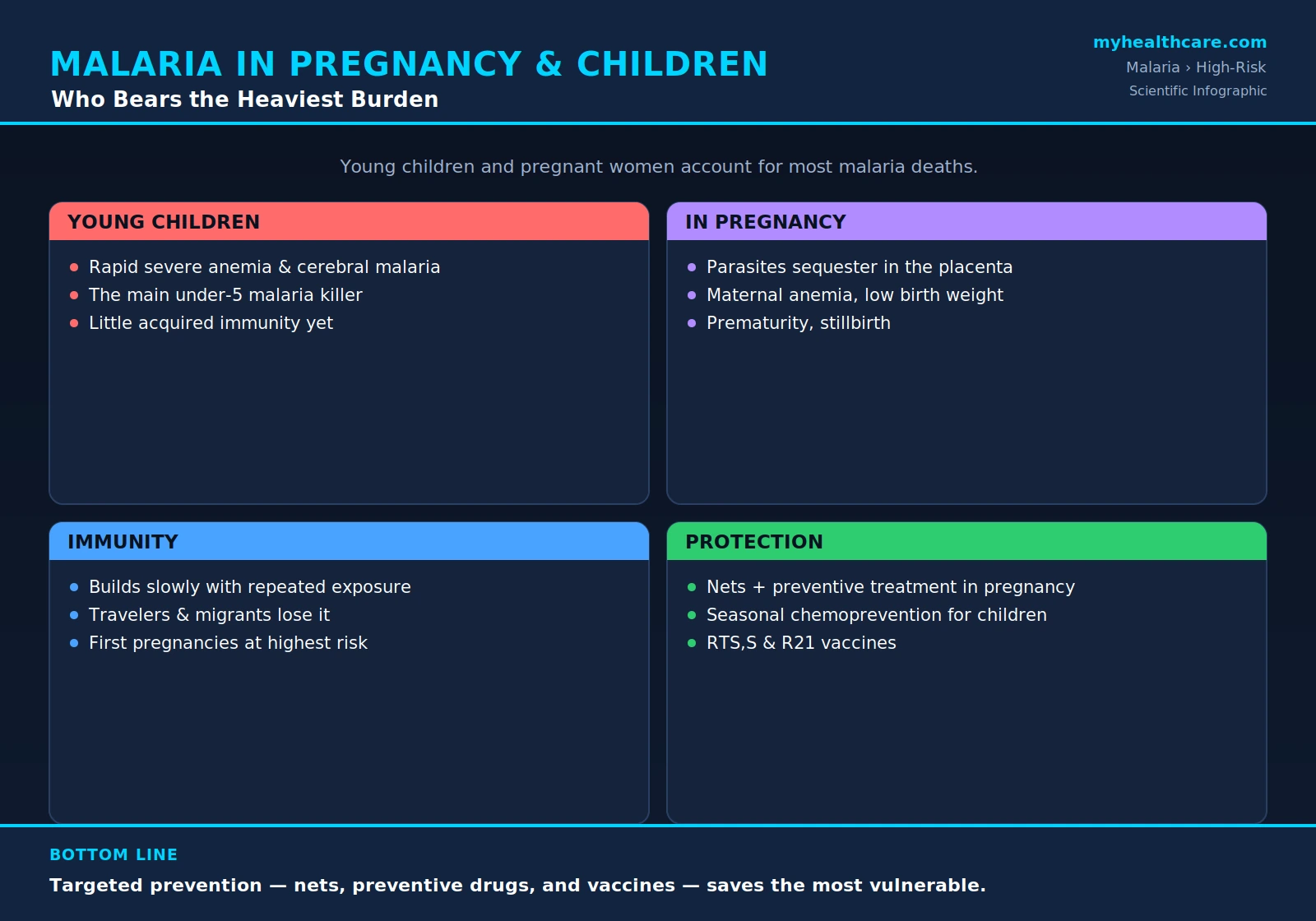
Malaria does not strike everyone equally. Across the world's malaria-endemic regions, two groups carry the heaviest share of the suffering and death: young children and pregnant women. Together they account for the large majority of the disease's deaths. The reasons are partly biological and partly a matter of immunity — protection against malaria is something the body learns slowly, over years of repeated exposure, so those who have not yet built it (the very young) or whose defenses are altered (pregnant women) are the most vulnerable. This page explains why these two groups bear the burden, how the disease behaves differently in each, and what proven tools — treated bed nets, preventive medicines, and the new malaria vaccines — can protect them.
Table of Contents
- Why These Groups Bear the Burden
- Malaria in Young Children
- Acquired Immunity and Why It Fades
- Malaria in Pregnancy
- Protecting Pregnant Women
- Protecting Children
- Treatment Considerations
- Key Research Papers
- Featured Videos
1. Why These Groups Bear the Burden
Malaria's toll is not spread evenly across a population. In the parts of sub-Saharan Africa where transmission is intense, the overwhelming majority of malaria deaths occur in children under five years of age, while pregnant women form the second major high-risk group. Understanding why comes down to a single, central idea: immunity to malaria is acquired, not inborn, and it is acquired slowly.
A person living in a high-transmission area is bitten by infected mosquitoes again and again, year after year. With each infection the immune system learns a little more about the parasite. Over time — typically many years — this builds a state of partial immunity (sometimes called premunition or semi-immunity). It does not prevent infection outright, but it blunts the severity, so that older children and adults in endemic areas often carry the parasite with mild or even no symptoms. Crucially, this protection has to be earned through repeated exposure, and it builds with age.
The consequence is stark. Young children have not lived long enough to acquire this protection. They meet the parasite with an immune system that has never seen it before, and so they are the most likely to progress to severe, life-threatening disease. Pregnant women are vulnerable for a different and specific reason — explained in the section on malaria in pregnancy below — in which the parasite exploits the placenta, a brand-new organ the immune system has no prior experience defending. In both cases, the unifying thread is a gap in immunity that the parasite is quick to exploit.
2. Malaria in Young Children
For a young child in an endemic area, malaria can turn from a mild fever into a medical emergency within hours. Because children under five lack the partial immunity that protects older people, the parasite is able to multiply rapidly and to drive the body toward the most dangerous complications. Malaria is among the leading causes of death in young children in Africa, and the great majority of the world's malaria deaths in this age group occur there.
The early signs are deceptively ordinary and nonspecific, which is part of what makes childhood malaria so dangerous. A child may simply have:
- Fever, often coming in waves, sometimes with shaking chills and sweats.
- Poor feeding or refusal to eat or drink, and vomiting.
- Fussiness, drowsiness, or unusual lethargy.
- Cough or fast breathing, which can be mistaken for a chest infection.
None of these points unmistakably to malaria, and a young child cannot describe how they feel — so the illness is easily underestimated in its first hours. Yet in a non-immune child the disease can progress with frightening speed toward two complications that account for most childhood malaria deaths:
- Severe malarial anemia. The parasite destroys red blood cells, and the body's production of new ones is suppressed. In a small child this can collapse the blood's oxygen-carrying capacity within a day or two, leaving the child pale, breathless, and dangerously weak. This is one of the most common ways malaria kills the very young.
- Cerebral malaria. When parasitized red cells clog the small blood vessels of the brain, a child can slip into seizures, abnormal posturing, and coma. Cerebral malaria carries a high risk of death, and survivors may be left with lasting neurological problems. This complication is covered in depth on the Severe & Cerebral Malaria page.
Other dangerous turns include low blood sugar (hypoglycemia), respiratory distress from acidosis, and repeated convulsions. Because the window between "just a fever" and a life-threatening crisis can be so short, the guiding rule in endemic regions is simple and urgent: a feverish young child should be tested and treated promptly, never watched and waited upon. See Diagnosis for how a rapid test or blood smear confirms the infection in minutes.
3. Acquired Immunity and Why It Fades
The partial immunity that protects long-term residents of endemic areas is one of the most important — and most often misunderstood — features of malaria. It is worth being clear about what it is and what it is not.
It is real, but partial. Years of repeated infection teach the immune system to control the parasite, reducing the chance that any given infection becomes severe. This is why, in a high-transmission setting, malaria deaths are concentrated in the youngest children: by the time a person reaches older childhood or adulthood, they have usually acquired enough protection to survive infections that would endanger a non-immune person.
It is not permanent, and it is not protective for everyone. Because this immunity depends on continued, ongoing exposure to keep it "topped up," it begins to fade when exposure stops. Two groups are caught out by this:
- Travelers and visitors from non-endemic countries have no acquired immunity at all. An adult tourist, businessperson, or aid worker visiting an endemic region is, immunologically, in the same defenseless position as a local infant — which is why travelers can develop severe malaria from a single infection and why preventive measures for them are so important.
- People who grew up in an endemic area but then move away — for example, to live in another country — gradually lose their semi-immunity. A particularly tragic pattern is the returning traveler who visits family in their country of origin, assumes they are still protected as they were in childhood, takes no precautions, and falls seriously ill. Immunity that is not continually reinforced does not last.
The practical lesson is that immunity should never be relied upon as a substitute for protection. Even people who once lived in an endemic region need bed nets, preventive medicine, and prompt testing when they travel back — a point developed further on the Prevention & Vaccines page.
4. Malaria in Pregnancy
Pregnancy creates a unique and dangerous vulnerability to malaria, even in women who had built up solid partial immunity before they conceived. The key lies in a single new organ: the placenta.
Plasmodium falciparum — the deadliest malaria parasite — has a special trick. The infected red blood cells display sticky surface proteins that allow them to bind to receptors in the placenta and accumulate there, a process called sequestration. The result is placental malaria: a heavy load of parasites concentrated in the placenta, sometimes producing few parasites in the bloodstream and so escaping detection by a standard blood test even as it does serious harm. Because the placenta is a new organ that the woman's immune system has not encountered before, her hard-won general immunity offers little defense at this particular site.
Placental malaria damages both mother and baby:
- For the mother: severe maternal anemia, which can be life-threatening at delivery, and a higher risk of severe malaria overall.
- For the baby: the inflamed, parasite-laden placenta cannot nourish the fetus properly, leading to low birth weight (a leading contributor to infant death), premature birth, growth restriction inside the womb, miscarriage, and stillbirth.
A critical pattern is that first pregnancies carry the highest risk. A woman pregnant for the first time has never mounted an immune response to the placental form of the parasite, so first-time mothers and (to a lesser degree) those in their second pregnancy suffer the most severe effects. With subsequent pregnancies, a specific protective immunity to placental malaria gradually develops, and the risk declines — though it never disappears entirely.
While P. falciparum is the chief threat through this placental mechanism, P. vivax malaria is also harmful in pregnancy, contributing to maternal anemia and low birth weight, and it should not be dismissed as a mild infection in this setting. For the wider population picture of who suffers and dies from malaria, see the Symptoms & Diagnosis hub.
5. Protecting Pregnant Women
Because malaria in pregnancy is both common and dangerous in endemic areas, public-health programs deploy a combination of proven, low-cost tools aimed specifically at expectant mothers. The cornerstone measures are:
- Insecticide-treated nets (ITNs). Sleeping under a treated net every night is one of the simplest and most effective protections. Pregnant women are encouraged to use ITNs throughout pregnancy to reduce the number of infective mosquito bites.
- Intermittent preventive treatment in pregnancy (IPTp). In areas of moderate-to-high transmission, the World Health Organization recommends giving pregnant women full treatment courses of an antimalarial medicine — sulfadoxine-pyrimethamine (SP) — at scheduled antenatal visits, regardless of whether they currently feel ill. The goal is to clear and suppress the silent placental infections that a blood test might miss. IPTp-SP reduces maternal anemia, placental malaria, and low birth weight. Its benefit, however, depends on the local level of SP drug resistance, which is one reason malaria-control programs monitor resistance so closely.
- Prompt diagnosis and treatment of any malaria illness during pregnancy, using regimens chosen to be safe for the stage of pregnancy (see Treatment Considerations).
These measures work best together and are delivered through routine antenatal care, which makes reliable access to antenatal services itself a powerful tool against malaria in pregnancy. A fuller account of nets, preventive drug strategies, and vaccines appears on the Prevention & Vaccines page.
6. Protecting Children
Protecting children draws on the same prevention toolkit, sharpened by tools designed for the young and by the recent arrival of effective malaria vaccines. The main strategies are:
- Insecticide-treated nets. As for pregnant women, a treated bed net over a child's sleeping space is a frontline defense, blocking the night-biting mosquitoes that transmit malaria.
- Seasonal malaria chemoprevention (SMC). In regions where malaria transmission is concentrated into a few rainy months — much of Africa's Sahel — children are given monthly courses of preventive antimalarial medicine during the high-transmission season. SMC sharply reduces malaria cases and deaths in young children and is one of the most cost-effective childhood interventions available.
- Prompt diagnosis and treatment. Because childhood malaria can escalate so quickly, ensuring that a feverish child is tested and treated without delay — ideally within 24 hours — saves lives. Community health workers equipped with rapid tests and effective drugs are central to this.
- The malaria vaccines. Two vaccines — RTS,S/AS01 and R21/Matrix-M — are now recommended by the World Health Organization for children living in areas of malaria transmission. Delivered as a multi-dose series in early childhood, they meaningfully reduce malaria illness, severe malaria, and death, and they are being rolled out across endemic countries. They do not replace nets, chemoprevention, or prompt treatment — they add a powerful new layer on top of them. Details of both vaccines are on the Prevention & Vaccines page.
Combined — nets, seasonal chemoprevention, fast treatment, and now vaccination — these measures have driven large reductions in childhood malaria where they are well delivered, and they represent the clearest path to protecting the group that suffers most.
7. Treatment Considerations
For both children and pregnant women, the single most important treatment principle is the same as for anyone with malaria: prompt, effective treatment saves lives. Delay is the enemy. But within that shared urgency, both groups require special care in the choice of medicine.
In children, antimalarial drugs are highly effective, but doses must be carefully matched to body weight, and a young child with severe malaria — one who is drowsy, convulsing, unable to drink, or deeply anemic — needs emergency hospital care with injectable treatment, not oral tablets alone. Recognizing the danger signs early and getting the child to a facility quickly is often the difference between recovery and death.
In pregnancy, treatment is more nuanced because some antimalarial drugs are avoided in early pregnancy (the first trimester), when the developing baby is most sensitive, while others are considered appropriate. The safest and most effective choice depends on the trimester, the species of parasite, the severity of the illness, and local drug-resistance patterns. For this reason, treatment of malaria in pregnancy must be directed by a clinician — it is not a situation for self-medication or guesswork. The key point for patients is to seek care immediately and to make sure the treating clinician knows the pregnancy and its stage.
The specific medicines used — including the artemisinin-based combination therapies (ACTs) that are the modern standard for uncomplicated malaria, and injectable artesunate for severe disease — are described in detail on the Antimalarial Drugs & ACT page. The broader treatment and prevention picture is gathered on the Treatment & Prevention hub.
Key Research Papers
Peer-reviewed studies and reviews on the burden of malaria in pregnancy and childhood, on the protective strategies (IPTp, seasonal chemoprevention, vaccines), and on the treatment of severe pediatric disease. Journal names appear as plain text; the year/volume/pages link opens the full citation via DOI.
- Desai M, ter Kuile FO, Nosten F, et al. Epidemiology and Burden of Malaria in Pregnancy. The Lancet Infectious Diseases. 2007;7(2):93–104.
- Rogerson SJ, Desai M, Mayor A, et al. Burden, Pathology, and Costs of Malaria in Pregnancy: New Developments for an Old Problem. The Lancet Infectious Diseases. 2018;18(4):e107–e118.
- Steketee RW, Nahlen BL, Parise ME, Menendez C. The Burden of Malaria in Pregnancy in Malaria-Endemic Areas. The American Journal of Tropical Medicine and Hygiene. 2001;64(1 Suppl):28–35.
- ter Kuile FO, van Eijk AM, Filler SJ. Effect of Sulfadoxine-Pyrimethamine Resistance on the Efficacy of Intermittent Preventive Therapy for Malaria Control During Pregnancy. JAMA. 2007;297(23):2603–2616.
- Marsh K, Forster D, Waruiru C, et al. Indicators of Life-Threatening Malaria in African Children. The New England Journal of Medicine. 1995;332(21):1399–1404.
- Dondorp AM, Fanello CI, Hendriksen ICE, et al. Artesunate Versus Quinine in the Treatment of Severe Falciparum Malaria in African Children (AQUAMAT): An Open-Label, Randomised Trial. The Lancet. 2010;376(9753):1647–1657.
- White NJ, Pukrittayakamee S, Hien TT, et al. Malaria. The Lancet. 2014;383(9918):723–735.
- RTS,S Clinical Trials Partnership. Efficacy and Safety of RTS,S/AS01 Malaria Vaccine With or Without a Booster Dose in Infants and Children in Africa: Final Results of a Phase 3, Individually Randomised, Controlled Trial. The Lancet. 2015;386(9988):31–45.
- Chandramohan D, Zongo I, Sagara I, et al. Seasonal Malaria Vaccination With or Without Seasonal Malaria Chemoprevention. The New England Journal of Medicine. 2021;385(11):1005–1017.
- Datoo MS, Natama MH, Somé A, et al. Efficacy of a Low-Dose Candidate Malaria Vaccine, R21 in Adjuvant Matrix-M, With Seasonal Administration to Children in Burkina Faso: A Randomised Controlled Trial. The Lancet. 2021;397(10287):1809–1818.
Live PubMed Searches
Each link opens a live PubMed query so results stay current as new papers are indexed.
- Malaria in pregnancy
- Placental malaria falciparum
- Severe malaria in children
- Intermittent preventive treatment (IPTp)
- Seasonal malaria chemoprevention (SMC)
- RTS,S and R21 malaria vaccines
- Malaria acquired immunity
- Malaria, low birth weight & anemia
Connections
- All Parasites
- Malaria Overview
- Malaria Symptoms & Diagnosis
- Severe & Cerebral Malaria
- Diagnosis: Blood Smear & RDT
- Malaria Treatment & Prevention
- Antimalarial Drugs & ACT
- Prevention: Nets, Prophylaxis & Vaccines
- Malaria Drug Resistance
- Reproductive Medicine
- Hematology
- Anemia
- Neurology
- All Conditions
- Malaria — the main disease page covering the parasite, transmission, and global burden behind these maternal and childhood risks.