Malaria
What is Malaria?
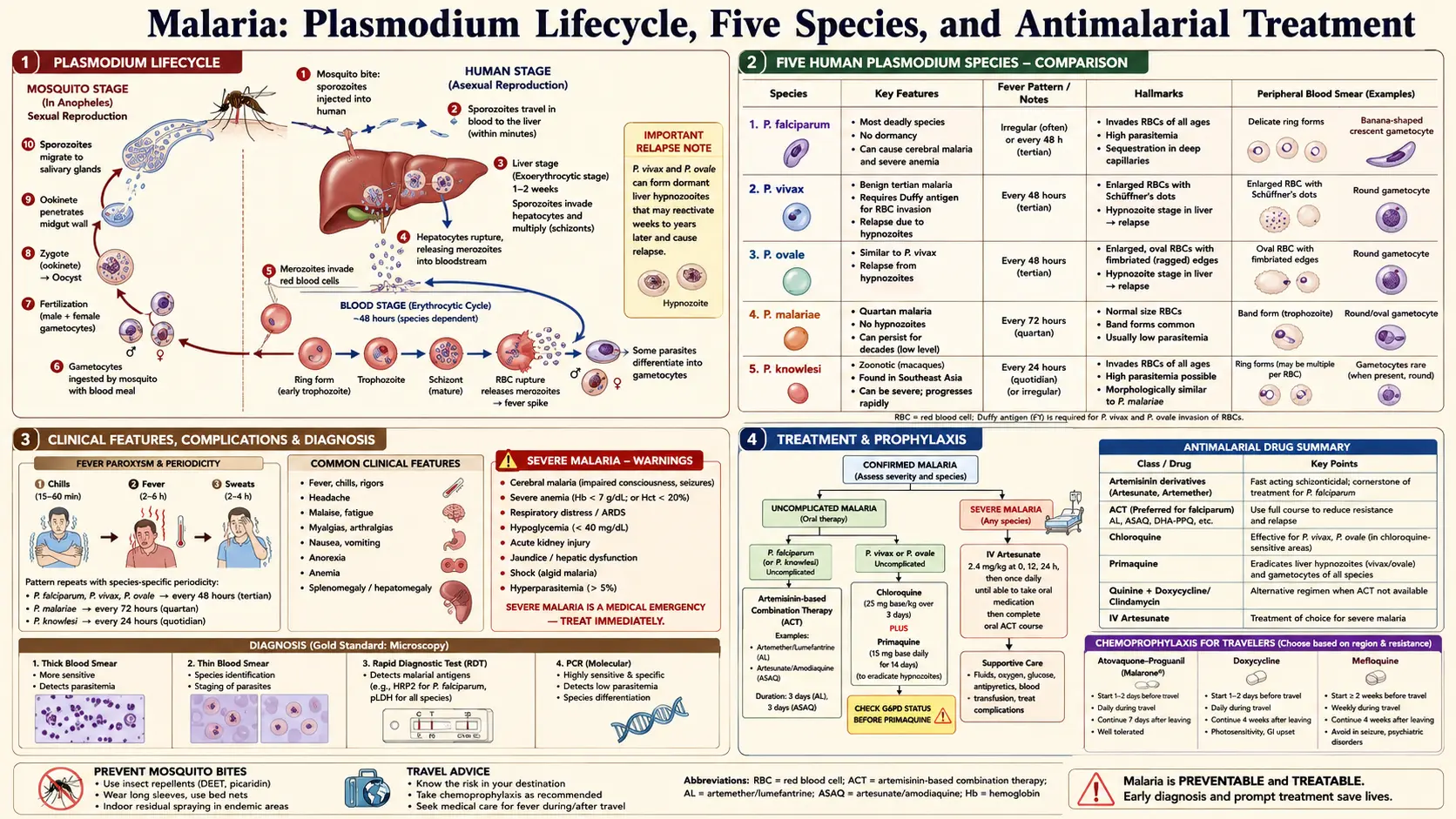
Malaria is a life-threatening disease caused by parasites that are transmitted to humans through the bites of infected female Anopheles mosquitoes. It is most prevalent in tropical and subtropical regions.
Causes of Malaria
- Parasites: Malaria is caused by Plasmodium parasites, with the most severe cases attributed to Plasmodium falciparum and Plasmodium vivax.
- Transmission: Through the bite of an infected mosquito. Less commonly, it can be transmitted through blood transfusion, organ transplant, or shared needles, and from mother to child during pregnancy.
Symptoms of Malaria
Symptoms typically appear 10–15 days after the mosquito bite and include:
- Fever and chills
- Headache
- Muscle and joint pain
- Fatigue
- Nausea and vomiting
- Diarrhea
- Abdominal pain
- Sweating
Severe Malaria
- Complications: May lead to severe anemia, respiratory distress, and organ failure.
- Cerebral malaria: A serious condition where the parasite affects the brain, causing seizures and potential coma.
Diagnosis
- Microscopic examination: Blood smears are examined to detect the presence of Plasmodium parasites.
- Rapid diagnostic tests (RDTs): Detects antigens associated with the malaria parasite.
- Molecular tests: PCR tests for accurate diagnosis in more complex cases.
Treatment Options
- Antimalarial drugs:
- Artemisinin-based combination therapies (ACTs): The most effective treatment for P. falciparum malaria.
- Chloroquine: Used for treating non-resistant P. vivax and P. ovale malaria.
- Primaquine: Administered to prevent relapse in P. vivax and P. ovale cases.
- Supportive care: For severe cases, hospitalization may be required to manage complications like anemia and organ failure.
Prevention Strategies
- Insecticide-treated bed nets (ITNs): Help prevent mosquito bites during sleep.
- Indoor residual spraying (IRS): Spraying insecticides on walls to kill mosquitoes.
- Antimalarial prophylaxis: Preventive medications for travelers to high-risk areas.
- Eliminate standing water: Reducing mosquito breeding sites by removing or covering stagnant water.
- Wear protective clothing: Long sleeves and pants when outdoors.
Risk Factors
- Geographic location: Living in or traveling to tropical and subtropical regions, especially sub-Saharan Africa, increases risk.
- Pregnancy: Pregnant women are at higher risk of severe malaria and complications.
- Children: Young children are more susceptible to severe outcomes.
- Weak immune system: People with compromised immune systems are more vulnerable.
Complications of Malaria
- Severe anemia: Due to the destruction of red blood cells.
- Organ failure: Can affect the kidneys, liver, or spleen.
- Cerebral malaria: Leads to brain damage, seizures, or coma.
- Death: Without prompt treatment, malaria can be fatal, especially P. falciparum infection.
References & Research
Historical Background
The malaria parasite was first identified in 1880 by French military physician Charles Louis Alphonse Laveran while stationed in Algeria, for which he received the Nobel Prize in 1907. In 1897, Sir Ronald Ross demonstrated that mosquitoes transmit malaria, earning the 1902 Nobel Prize. The development of chloroquine in the 1930s-1940s and artemisinin-based therapies derived from traditional Chinese medicine by Tu Youyou (2015 Nobel Prize) represent landmark therapeutic advances.
Key Research Papers
- White NJ, Pukrittayakamee S, Hien TT, et al. Malaria. The Lancet. 2014;383(9918):723-735.
- Greenwood BM, Bojang K, Whitty CJM, Targett GAT. Malaria. The Lancet. 2005;365(9469):1487-1498.
- Dondorp AM, Nosten F, Yi P, et al. Artemisinin resistance in Plasmodium falciparum malaria. New England Journal of Medicine. 2009;361(5):455-467.
- Murray CJL, Rosenfeld LC, Lim SS, et al. Global malaria mortality between 1980 and 2010: a systematic analysis. The Lancet. 2012;379(9814):413-431.
- Ashley EA, Dhorda M, Fairhurst RM, et al. Spread of artemisinin resistance in Plasmodium falciparum malaria. New England Journal of Medicine. 2014;371(5):411-423.
- Dondorp AM, Fanello CI, Hendriksen IC, et al. Artesunate versus quinine in the treatment of severe falciparum malaria in African children (AQUAMAT): an open-label, randomised trial. The Lancet. 2010;376(9753):1647-1657.
- Bhatt S, Weiss DJ, Cameron E, et al. The effect of malaria control on Plasmodium falciparum in Africa between 2000 and 2015. Nature. 2015;526(7572):207-211.
- Miller LH, Ackerman HC, Su XZ, Wellems TE. Malaria biology and disease pathogenesis: insights for new treatments. Nature Medicine. 2013;19(2):156-167.
- Cowman AF, Healer J, Marapana D, Marsh K. Malaria: biology and disease. Cell. 2016;167(3):610-624.
- Tu Y. Artemisinin -- a gift from Traditional Chinese Medicine to the world (Nobel Lecture). Angewandte Chemie International Edition. 2016;55(35):10210-10226.
Research Papers
The following PubMed topic searches retrieve current peer-reviewed literature on Malaria. Each link opens a live PubMed query so you always see the most recent publications.
- Malaria review
- Plasmodium falciparum pathogenesis
- Artemisinin combination therapy malaria
- Malaria vaccine RTS,S efficacy
- R21 malaria vaccine
- Insecticide-treated bed nets malaria
- Artemisinin resistance Plasmodium
- Severe cerebral malaria
- Chloroquine resistance malaria
- WHO malaria global report
- Malaria pregnancy intermittent preventive
- Artemisia annua malaria
Connections
- Infectious Disease
- Anemia
- Garlic
- Neem
- Immune Boosting
- Turmeric
- Iron
- Vitamin A
- Parasites
- Headache
- Fatigue
- Nausea and Vomiting
- Abdominal Pain
- Joint Pain
- Tick-Borne Co-Infections
- Sepsis
- Meningitis
- Methylene Blue
- Hydroxychloroquine and Antimalarials
- Artemisia annua (Sweet Wormwood)
- Malaria in Pregnancy and Children
- Severe and Cerebral Malaria
- Diagnosing Malaria: Blood Smear, RDT, and PCR — how microscopy, rapid antigen tests, and PCR confirm infection.
- Malaria Symptoms and Diagnosis — fever paroxysms, warning signs, and who is most at risk.
- Malaria: The Plasmodium Parasite — parasite life cycle, transmission, treatment, and prevention.
- Antimalarial Drug Resistance — how chloroquine fell, why artemisinin is faltering, and what protects the drugs we still have.
- Malaria Prevention: Nets, Prophylaxis, and Vaccines — insecticide-treated nets, indoor spraying, traveler prophylaxis, and the RTS,S and R21 vaccines.
- Antimalarial Drugs and Artemisinin Combination Therapy — how ACT, intravenous artesunate, and the older antimalarials work.
- G6PD Deficiency — partial malaria resistance; primaquine and tafenoquine trigger hemolysis.