Antimalarial Drugs and Artemisinin Combination Therapy
Malaria is caused by single-celled Plasmodium parasites carried by mosquitoes, and for most of human history it had no reliable cure. Today it is highly treatable when caught early, thanks to a small but powerful set of antimalarial drugs. The cornerstone of modern treatment is artemisinin-based combination therapy (ACT) — a pairing of a fast-acting compound derived from the sweet wormwood plant with a slower, longer-lasting partner drug. This page explains how antimalarials work, what ACT is and why it became the global standard, how the most dangerous cases are treated with intravenous artesunate, the older drugs that still have a role, the special problem of relapsing malaria, and why the constant threat of drug resistance shapes which medicines doctors reach for.
Table of Contents
- How Antimalarials Work
- Artemisinin-Based Combination Therapy (ACT)
- Intravenous Artesunate for Severe Malaria
- Chloroquine and Older Drugs
- Radical Cure of Relapsing Malaria
- Treatment in Special Groups
- Why Resistance Shapes the Drug Menu
- Key Research Papers
- Featured Videos
1. How Antimalarials Work
To understand antimalarial drugs, it helps to know that the malaria parasite passes through several stages inside the human body. After an infected mosquito bites, parasites first travel to the liver, where they multiply silently for several days without causing symptoms. They then burst out into the bloodstream and begin invading red blood cells. It is this repeating cycle of invading, multiplying inside, and rupturing red blood cells — the blood stage — that produces the fevers, chills, and other illness of malaria.
Most antimalarial drugs work by killing the parasite during this blood stage. By attacking the forms that are actively damaging red blood cells, they stop the cycle that makes a person sick and clear the infection that can be passed back to mosquitoes. A subset of drugs also acts against the parasite's liver stages, which matters both for prevention and for fully curing the types of malaria that can hide dormant in the liver.
A central principle of malaria treatment is to combine drugs that attack the parasite in different ways. When a single drug is used alone, any rare parasite that happens to survive can multiply and pass on its resistance, so the drug gradually loses its power. Pairing two medicines with different targets means a parasite would have to resist both at once — a far less likely event. This logic of using more than one drug together is the backbone of the modern treatment strategy described in the rest of this page, and it is why nearly every recommended regimen for falciparum malaria is a combination rather than a lone tablet.
2. Artemisinin-Based Combination Therapy (ACT)
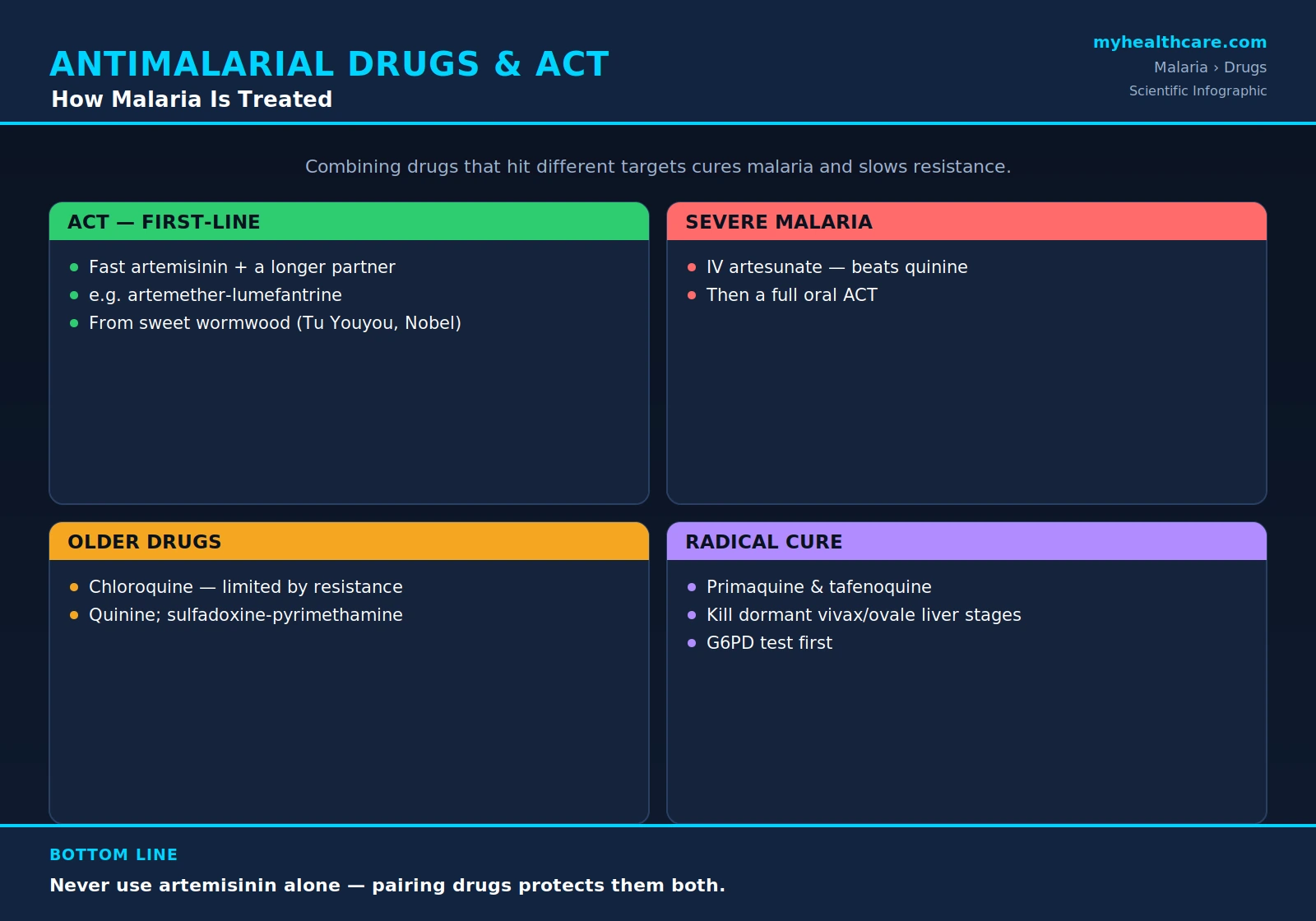
Artemisinin-based combination therapy, almost always shortened to ACT, is the recommended first-line treatment for uncomplicated Plasmodium falciparum malaria — the most common and most dangerous species — throughout the world. An ACT pairs two drugs with complementary strengths:
- A fast-acting artemisinin derivative (such as artesunate, artemether, or dihydroartemisinin) that rapidly kills the large majority of blood-stage parasites within the first day or two, quickly relieving symptoms and reducing the parasite load.
- A longer-acting partner drug that lingers in the body for days to weeks and mops up the remaining parasites, preventing the infection from rebounding after the short-lived artemisinin component has cleared.
Several fixed combinations are used around the world depending on local resistance patterns and supply, including artemether-lumefantrine, artesunate-amodiaquine, dihydroartemisinin-piperaquine, artesunate-mefloquine, and artesunate-sulfadoxine-pyrimethamine. A standard ACT course is taken by mouth, typically over three days, and is highly effective against sensitive parasites.
The artemisinin component has a remarkable origin. It is extracted from sweet wormwood (Artemisia annua, known in Chinese as qinghao), a plant used in traditional Chinese medicine for fevers. In the 1970s the Chinese scientist Tu Youyou isolated the active compound, artemisinin, from this plant — work for which she shared the 2015 Nobel Prize in Physiology or Medicine. The discovery transformed malaria treatment worldwide and is one of the clearest modern examples of a plant remedy yielding a precisely understood, life-saving drug.
3. Intravenous Artesunate for Severe Malaria
When malaria becomes severe — with complications such as impaired consciousness, seizures, breathing difficulty, kidney failure, severe anemia, or very high parasite levels — it is a medical emergency that requires treatment given directly into a vein rather than by mouth. For decades the standard was intravenous quinine, but large clinical trials changed practice.
The landmark SEAQUAMAT trial in Asian adults and the later AQUAMAT trial in African children both showed that intravenous artesunate substantially reduces the risk of death compared with quinine. As a result, intravenous (or intramuscular) artesunate is now the first-line treatment for severe malaria of any species in patients of all ages. It acts quickly, is generally better tolerated than quinine, and avoids some of quinine's dangerous side effects, such as profound drops in blood sugar.
Injectable treatment is continued until the patient is stable and able to swallow, after which they must complete a full course of an oral ACT. This follow-on oral course is essential: the injectable artesunate brings the crisis under control, but the longer-acting partner drug in the ACT is needed to fully clear the parasite and prevent relapse. The recognition, monitoring, and supportive care of these critically ill patients is covered on the Severe and Cerebral Malaria page.
4. Chloroquine and Older Drugs
Before artemisinin, a different family of drugs carried the global fight against malaria, and several still have a place today where parasites remain sensitive to them.
- Chloroquine was for decades the inexpensive, widely used mainstay of malaria treatment and prevention. Its usefulness against P. falciparum has been badly eroded by the spread of resistance, which emerged in the mid-20th century and now affects most of the world. However, chloroquine still has a role: it remains effective in the few regions where falciparum parasites are still sensitive, and it is used against some non-falciparum species — notably chloroquine-sensitive P. vivax — to clear the blood-stage infection (paired with a separate drug to address the dormant liver forms; see the section below).
- Quinine, derived from the bark of the cinchona tree, is one of the oldest antimalarials. Once central to treating severe disease, it has largely been replaced by artesunate, but it is still used in certain circumstances, often combined with an antibiotic such as doxycycline or clindamycin.
- Sulfadoxine-pyrimethamine (SP) is an antifolate combination. Although resistance has limited its use as a stand-alone treatment, it retains an important role in prevention — for example in protecting pregnant women and young children in high-transmission areas — and as a partner drug within some ACT regimens.
These older agents illustrate a recurring theme in malaria: a drug that was once a frontline cure can be pushed aside by resistance, yet still remain valuable in specific places, against specific species, or for specific purposes such as prevention.
5. Radical Cure of Relapsing Malaria
Two species of malaria parasite, Plasmodium vivax and Plasmodium ovale, have a special trick: they can leave behind dormant forms in the liver, called hypnozoites, which lie inactive for weeks, months, or even years before reawakening and triggering a fresh bout of illness. These reawakenings are called relapses. Standard blood-stage drugs such as chloroquine or an ACT clear the active infection but do nothing to the sleeping liver forms, so a person can be treated, recover, and then become sick again from the same original infection.
Eliminating these dormant liver forms is called radical cure, and it requires a drug that reaches the liver stage. Two medicines do this:
- Primaquine, given as a course over about two weeks alongside the blood-stage treatment.
- Tafenoquine, a longer-acting relative that can be given as a single dose, simplifying the regimen.
Both drugs share a critical safety caveat: in people with an inherited enzyme deficiency called G6PD deficiency (glucose-6-phosphate dehydrogenase deficiency), they can trigger dangerous breakdown of red blood cells, known as hemolysis. For this reason, patients should be tested for G6PD deficiency before receiving primaquine or tafenoquine, and dosing must be adjusted or the drug avoided when the test is abnormal. Radical cure is therefore a careful, clinician-directed step rather than something to undertake on one's own.
6. Treatment in Special Groups
Some groups of patients need special care in choosing antimalarial drugs, because certain medicines are restricted or have not been fully studied in them. Treatment in these situations should always be directed by a clinician or specialist, and any doses discussed here are presented as reported in the medical literature, not as personal instructions.
- Pregnant women. Malaria in pregnancy is especially dangerous for both mother and baby, so prompt treatment is essential, but drug choice is constrained. Some antimalarials are avoided at particular stages of pregnancy, and certain drugs used for radical cure or prevention are not given because of risks to the fetus. Recommended regimens differ by trimester, which is why expert guidance is important.
- Infants and young children. Children carry the heaviest burden of severe and fatal malaria. They are treated with the same broad strategy — ACT for uncomplicated disease, intravenous artesunate for severe disease — but with weight-based dosing and child-friendly formulations, and with some drugs restricted in the very young or the very small.
- People with G6PD deficiency. As noted above, this inherited condition shapes whether the relapse-preventing drugs primaquine and tafenoquine can be used, and testing is recommended before they are given.
The particular dangers malaria poses to mothers and children, and the protective measures used for them, are explored further on the Malaria in Pregnancy and Children page.
7. Why Resistance Shapes the Drug Menu
The history of malaria treatment is, in many ways, a history of races against resistance. Time and again, a drug has been introduced, proved wonderfully effective, and then gradually lost its power as parasites evolved to survive it — chloroquine being the classic example. This is why today's strategy leans so heavily on combinations: pairing drugs makes it much harder for the parasite to develop resistance to both at once, protecting the usefulness of each.
The stakes are high because the artemisinins are now the most important antimalarials in the world, and partial resistance to artemisinin has already emerged, first detected in Southeast Asia and since reported in other regions. Safeguarding these drugs — by always using them in combination, by ensuring patients take complete courses, by avoiding poor-quality or counterfeit medicines, and by monitoring how well treatments are working — is a central public-health priority. The choice of which ACT or other regimen to use in a given country is guided by ongoing surveillance of local resistance, which is why the recommended drug menu varies from place to place and changes over time.
The science of how resistance arises, how it is tracked, and what it means for the future of malaria control is covered in depth on the Drug Resistance page.
Key Research Papers
Peer-reviewed trials and reviews underpinning modern antimalarial treatment — from the trials that made artesunate first-line for severe malaria, to the rationale for combination therapy, the discovery of artemisinin, and the emergence of drug resistance. Journal names appear as plain text; the year/volume/pages link opens the full citation via DOI.
- Dondorp A, Nosten F, Stepniewska K, Day N, White N; South East Asian Quinine Artesunate Malaria Trial (SEAQUAMAT) group. Artesunate versus quinine for treatment of severe falciparum malaria: a randomised trial. The Lancet. 2005;366(9487):717–725.
- Dondorp AM, Fanello CI, Hendriksen ICE, et al. (AQUAMAT group). Artesunate versus quinine in the treatment of severe falciparum malaria in African children (AQUAMAT): an open-label, randomised trial. The Lancet. 2010;376(9753):1647–1657.
- Eastman RT, Fidock DA. Artemisinin-based combination therapies: a vital tool in efforts to eliminate malaria. Nature Reviews Microbiology. 2009;7(12):864–874.
- White NJ, Pukrittayakamee S, Hien TT, Faiz MA, Mokuolu OA, Dondorp AM. Malaria. The Lancet. 2014;383(9918):723–735.
- Tu Y. The discovery of artemisinin (qinghaosu) and gifts from Chinese medicine. Nature Medicine. 2011;17(10):1217–1220.
- Dondorp AM, Nosten F, Yi P, et al. Artemisinin resistance in Plasmodium falciparum malaria. New England Journal of Medicine. 2009;361(5):455–467.
- Wellems TE, Plowe CV. Chloroquine-resistant malaria. The Journal of Infectious Diseases. 2001;184(6):770–776.
- Llanos-Cuentas A, Lacerda MVG, Hien TT, et al. Single-dose tafenoquine to prevent relapse of Plasmodium vivax malaria. New England Journal of Medicine. 2019;380(3):215–228.
- Eziefula AC, Bousema T, Yeung S, et al. Single dose primaquine for clearance of Plasmodium falciparum gametocytes in children with uncomplicated malaria in Uganda: a randomised, controlled, double-blind, dose-ranging trial. The Lancet Infectious Diseases. 2014;14(2):130–139.
- RTS,S Clinical Trials Partnership. Efficacy and safety of RTS,S/AS01 malaria vaccine with or without a booster dose in infants and children in Africa: final results of a phase 3, individually randomised, controlled trial. The Lancet. 2015;386(9988):31–45.
Live PubMed Searches
Each link opens a live PubMed query so results stay current as new papers are indexed.
- Artemisinin combination therapy falciparum
- Intravenous artesunate severe malaria
- Chloroquine resistance Plasmodium falciparum
- Primaquine tafenoquine vivax radical cure
- G6PD deficiency primaquine hemolysis
- Artemisinin resistance Southeast Asia
- Malaria treatment in pregnancy
- Dihydroartemisinin-piperaquine uncomplicated malaria
Connections
- All Parasites
- Malaria Overview
- Symptoms & Diagnosis
- Severe & Cerebral Malaria
- Malaria in Pregnancy & Children
- Diagnosis: Blood Smear & RDT
- Treatment & Prevention
- Prevention, Nets, Prophylaxis & Vaccines
- Drug Resistance
- Anemia
- Complete Blood Count
- Sepsis
- Hematology
- Malaria — the general infectious-disease overview of the illness these drugs treat.
- All Conditions