Giardia — The Cause of Giardiasis
Symptoms & Diagnosis
The spectrum from silent carriage to chronic illness, and how giardiasis is diagnosed.
Read the deep dive →Acute & Chronic Diarrhea
Foul, greasy diarrhea, bloating, gas, and "sulfur burps" — and how it can drag on for weeks.
Read the deep dive →Malabsorption & Weight Loss
When the gut can't absorb fat and nutrients — steatorrhea, lactose intolerance, and faltering growth.
Read the deep dive →Post-Infectious & Long-Term Effects
The lasting aftermath — post-giardiasis IBS, fatigue, and new food intolerances.
Read the deep dive →Treatment & Prevention
The drugs that clear it, safe water, and what to do when it won't go away.
Read the deep dive →Metronidazole & Tinidazole Treatment
The antiparasitic drugs that clear Giardia — the alternatives, and the safer options in pregnancy.
Read the deep dive →Prevention: Water & Hygiene
"Beaver fever," backcountry water, filters and boiling, and stopping spread in daycares.
Read the deep dive →Refractory Giardiasis & Drug Resistance
When the first drug fails — combination therapy and treatment-resistant infections.
Read the deep dive →Giardia is a microscopic, single-celled parasite that lives in the small intestine and is one of the most common intestinal parasites in the world. The illness it causes — giardiasis — is the most common parasitic cause of waterborne diarrhea, a fact reflected in its folk name, "beaver fever." A single mouthful of contaminated stream water, an unwashed hand at a daycare, or a meal prepared by someone shedding the parasite can be enough to start an infection. This page explains what Giardia is, how it survives and spreads, what it does to the gut, how the diagnosis is confirmed, and how giardiasis is treated and prevented.
Interactive Visualization Cyclospora: From Contaminated Field to Relapsing Illness — watch why washing cannot save the salad Follow the parasite from irrigation water to your gut: rinse the leaves and watch it survive, chill the field so it never ripens, then treat it with the drug that works — and the one that has no target on it. Launch →Table of Contents
1. What Is Giardia?
Giardia duodenalis — also known as Giardia lamblia and Giardia intestinalis, three names for the same organism — is a flagellated, single-celled protozoan that colonizes the upper small intestine of humans and many animals. It is not a bacterium or a virus but a protozoan, a tiny animal-like microbe complete with its own internal machinery for movement. Despite its simplicity, it is one of the most frequently identified intestinal parasites on the planet, infecting people in every region from remote villages to wealthy cities.
Giardia holds a particular distinction: it is the most common parasitic cause of waterborne diarrhea. Because hikers, campers, and backpackers have long acquired it from seemingly pristine mountain streams — water that wild animals such as beavers help to contaminate — the infection earned the nickname "beaver fever." The illness it produces, giardiasis, ranges from a brief, self-limited bout of diarrhea to a stubborn, weeks-long disorder of bloating, greasy stools, and weight loss.
What makes Giardia so successful is a combination of an extremely low infectious dose, a tough environmental survival stage, and the ability to spread by several routes at once. The sections that follow trace how the parasite cycles between its two forms, how it travels from one person to the next, and why it can be so difficult to shake.
2. Life Cycle
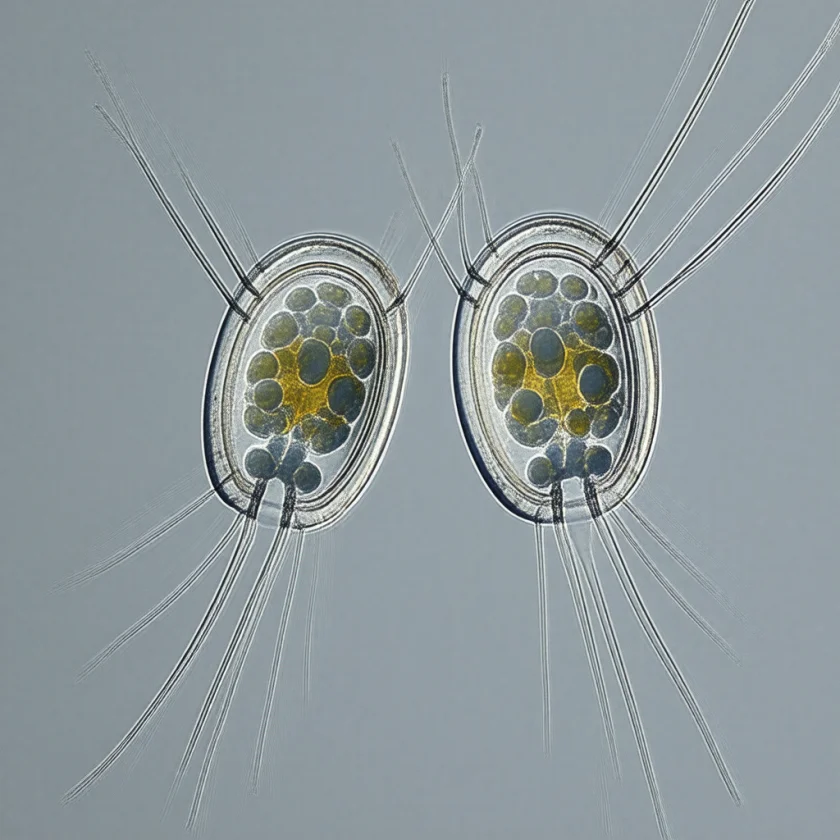
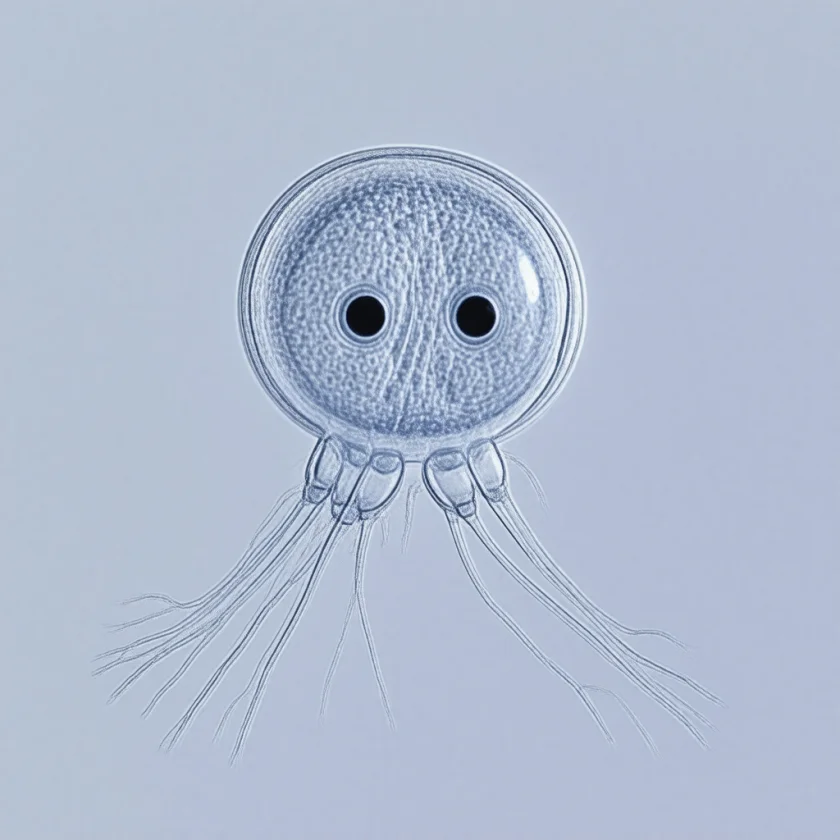
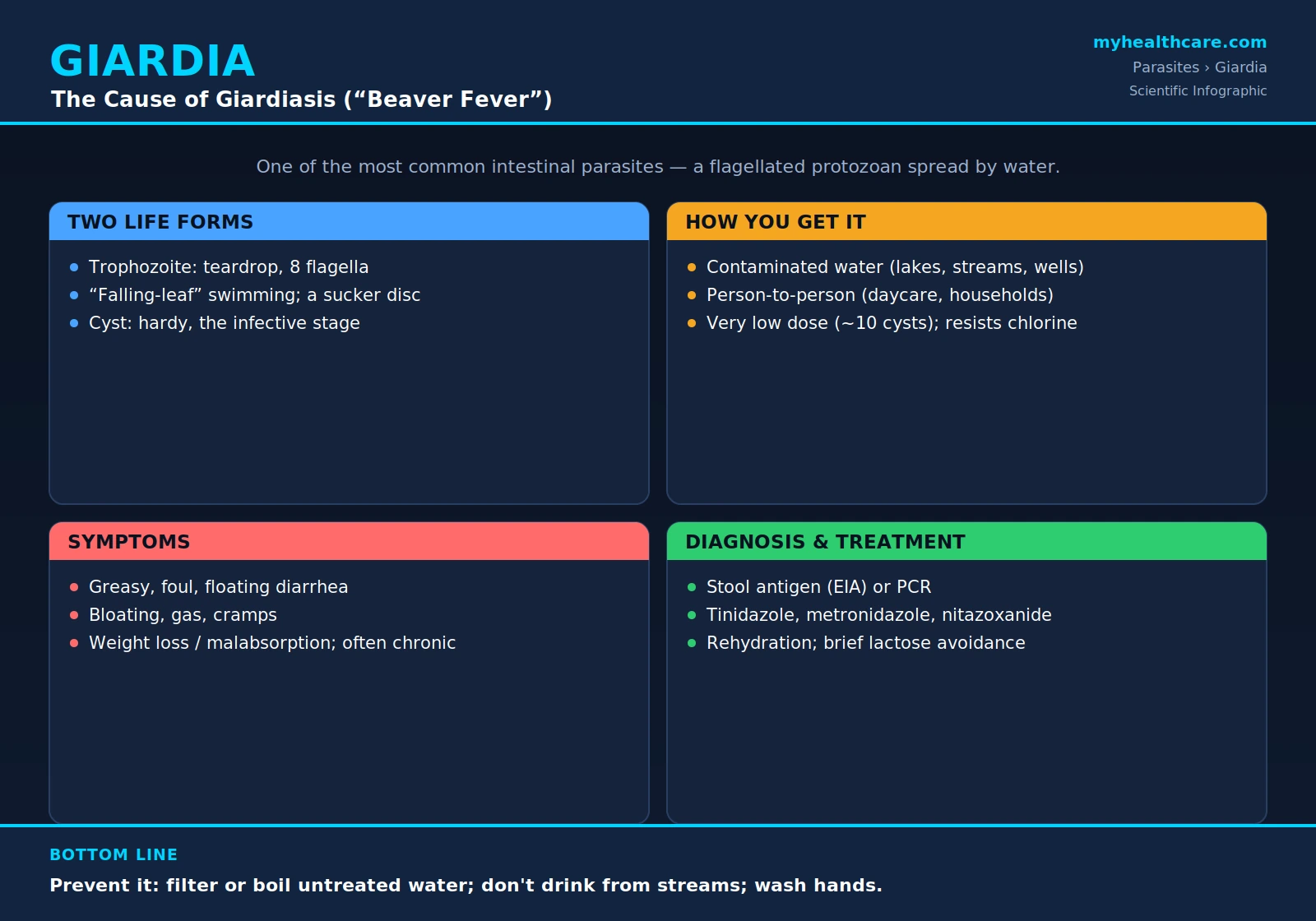
Giardia exists in two very different forms, and understanding both is the key to understanding the whole disease. The first is the trophozoite, the active, feeding, dividing form that lives in the small intestine. It is a striking microscopic object: teardrop- or pear-shaped, bearing eight whip-like flagella that propel it with a characteristic gentle, tumbling "falling-leaf" motion. On its underside sits a large ventral adhesive disc — a sucker-like structure the trophozoite uses to grip the lining of the small intestine and hold its position against the constant downward flow of the gut.
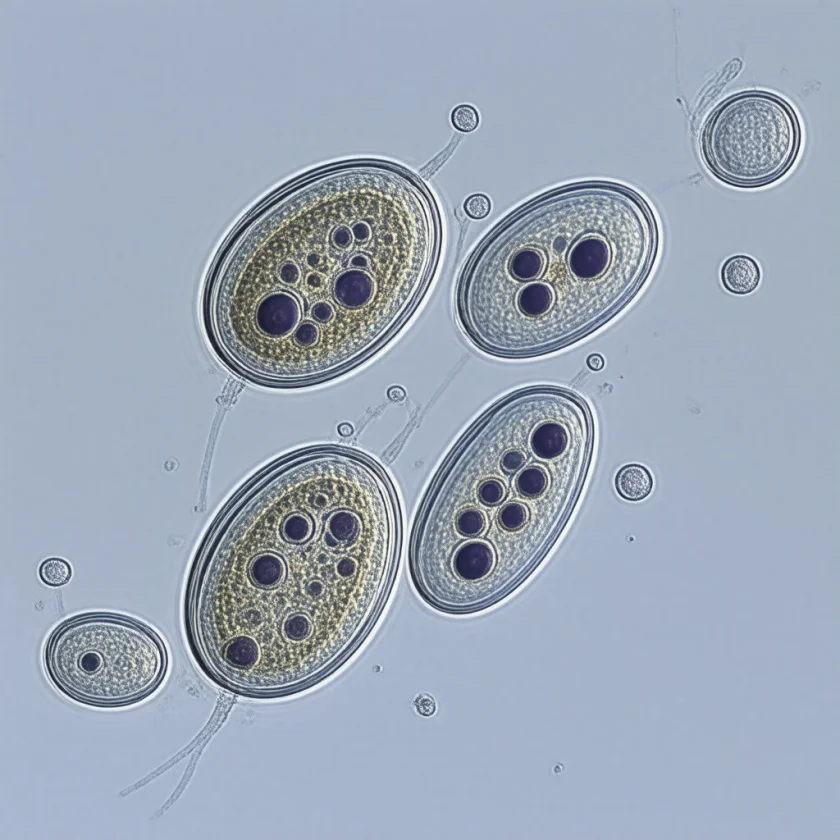
The second form is the cyst, the dormant, hardy, infective stage. As trophozoites are carried toward the large intestine, many transform into oval, thick-walled cysts containing four nuclei. This protective wall is what allows Giardia to survive outside the body — in cold water, on surfaces, and in the environment — for weeks. The cyst, not the fragile trophozoite, is the form that passes the infection from one host to the next.
The cycle is fecal-oral and self-renewing. A person swallows cysts in contaminated water or food. Once the cysts reach the small intestine, the change in environment triggers excystation, and each cyst releases trophozoites. These trophozoites attach to the intestinal wall, feed, and multiply by simple division, sometimes coating large stretches of the gut lining. As they move downstream, they encyst again, and the newly formed cysts are shed in the stool — ready to be swallowed by the next host and begin the cycle anew. Because cysts are passed in enormous numbers, even a single infected person can seed a great deal of contamination.
3. How It Spreads
Giardiasis spreads by the fecal-oral route: cysts passed in one person's or animal's stool are swallowed by another. What makes Giardia especially transmissible is its very low infectious dose — ingesting as few as roughly ten cysts can be enough to cause infection. Because each infected host can shed millions of cysts, this small threshold means contamination spreads easily.
The classic route is water. Cysts contaminate drinking and recreational water alike — lakes, streams, rivers, springs, and improperly treated wells. Crucially, the cyst wall makes Giardia resistant to the routine levels of chlorine used to disinfect drinking water and swimming pools, and the cysts survive well in cold water. This is why filtration or boiling, rather than chlorination alone, is the reliable defense, and why even clear-looking mountain streams can transmit the parasite.
Beyond water, Giardia spreads readily from person to person wherever hand-to-mouth contact and fecal contamination meet — most notoriously in daycare centers, among household members of an infected person, and in other settings involving close contact or diaper changing. It is also acquired through contaminated food handled by an infected person and is a frequent cause of traveler's diarrhea in regions with unsafe water. Because so many of those infected have mild or no symptoms, the parasite often circulates silently before an outbreak is recognized.
4. Symptoms
Symptoms of giardiasis typically begin one to three weeks after exposure — an incubation period long enough that many people no longer connect the illness to the stream they drank from or the trip they took. The most recognizable feature is diarrhea that is greasy, foul-smelling, and often floats, a clue to the malabsorption of fat that the infection causes. Alongside the diarrhea, people commonly report:
- Bloating and a sense of abdominal fullness.
- Excessive gas (flatulence), sometimes with sulfurous, "rotten-egg" belching.
- Abdominal cramps and discomfort.
- Nausea and reduced appetite.
- Fatigue.
- Weight loss driven by malabsorption — including a temporary lactose intolerance that can make dairy products worsen symptoms for weeks after the parasite is gone.
The picture is highly variable. Many infected people have no symptoms at all and clear the parasite on their own while unknowingly shedding cysts. Others suffer an acute illness that resolves in a week or two. A subset, however, go on to chronic or relapsing giardiasis, with symptoms that wax and wane over months and progressive weight loss. Notably, even after the infection itself is cured, a fraction of patients develop post-infectious irritable bowel syndrome and lingering fatigue — a long-term aftermath documented in large studies following waterborne outbreaks.
5. Diagnosis
Because the symptoms of giardiasis overlap with many other causes of diarrhea, the diagnosis rests on testing the stool for the parasite rather than on symptoms alone. Several complementary methods are used, and clinicians often combine them.
Stool antigen tests, usually performed as an enzyme immunoassay (EIA), detect specific Giardia proteins in a stool sample. They are sensitive, give a clear positive-or-negative answer, and have become a common first-line test in many laboratories.
The traditional method is stool ova-and-parasite (O&P) microscopy, in which a trained technician examines the stool under a microscope for Giardia cysts and trophozoites. Because the parasite is shed intermittently — heavily on some days and barely at all on others — a single negative sample does not rule out infection, and several specimens collected on different days may be needed to find it.
Increasingly, laboratories use multiplex molecular (PCR) panels that detect Giardia DNA along with the DNA of many other gastrointestinal pathogens from a single stool sample. These molecular panels are highly sensitive and can identify several causes of diarrhea at once, which is useful when the clinical picture is unclear or when more than one pathogen may be present.
6. Treatment
Giardiasis is treatable, and several effective oral medications are available. The choice among them depends on the patient, local practice, and individual factors, so treatment should be directed by a clinician; the regimens below describe what is typically reported rather than a prescription.
Tinidazole is widely used and is often given as a single dose, which makes it convenient and helps people complete the full course. Metronidazole, taken over several days, is another long-established option. Nitazoxanide, available as a suspension and tablets, is also commonly used and is a frequent choice for children. In pregnancy, where the usual drugs may be avoided especially in the first trimester, paromomycin — a poorly absorbed agent that acts within the gut — is one of the options that has been used.
Alongside antiparasitic medication, supportive care matters. Keeping up with fluids prevents the dehydration that diarrhea can cause, and because Giardia can leave behind a temporary lactose intolerance, briefly avoiding milk and other dairy products often eases symptoms during recovery. Most people respond well to a first course of treatment; when symptoms persist, a clinician may re-test, consider re-infection or a resistant strain, and select an alternative drug or a longer course.
7. Prevention
Because Giardia spreads through swallowed cysts, prevention focuses on keeping those cysts out of the mouth — through clean water, clean hands, and care around infected people. The cyst's resistance to chlorine makes water treatment the centerpiece.
For untreated water from streams, lakes, springs, or questionable wells, the dependable safeguards are to boil it — a rolling boil for about one minute is sufficient — or to filter it with a filter rated to remove Giardia cysts. The simplest rule for hikers and travelers is the most effective: do not drink untreated water directly from streams or lakes, however clear it appears.
Good hand hygiene is the other pillar. Washing hands thoroughly with soap and water — especially after using the toilet, after changing diapers, and before preparing or eating food — interrupts person-to-person spread. In recreational water, avoid swallowing pool, lake, or river water while swimming. And because giardiasis spreads easily within families and other close-contact groups, treating infected household members helps stop the parasite from circulating and re-infecting people who have just recovered.
Key Research Papers
Peer-reviewed reviews and clinical studies on Giardia and giardiasis — covering the parasite's biology, its zoonotic spread, how the infection is diagnosed and treated, and the long-term consequences documented after large waterborne outbreaks. Journal names appear as plain text; the year/volume/pages link opens the full citation via DOI.
- Adam RD. Biology of Giardia lamblia. Clinical Microbiology Reviews. 2001;14(3):447–475. — doi:10.1128/CMR.14.3.447-475.2001
- Feng Y, Xiao L. Zoonotic Potential and Molecular Epidemiology of Giardia Species and Giardiasis. Clinical Microbiology Reviews. 2011;24(1):110–140. — doi:10.1128/CMR.00033-10
- Thompson RCA. The Zoonotic Significance and Molecular Epidemiology of Giardia and Giardiasis. Veterinary Parasitology. 2004;126(1–2):15–35. — doi:10.1016/j.vetpar.2004.09.008
- Schuurman T, Lankamp P, van Belkum A, Kooistra-Smid M, van Zwet A. Comparison of Microscopy, Real-Time PCR and a Rapid Immunoassay for the Detection of Giardia lamblia in Human Stool Specimens. Clinical Microbiology and Infection. 2007;13(12):1186–1191. — doi:10.1111/j.1469-0691.2007.01836.x
- Gardner TB, Hill DR. Treatment of Giardiasis. Clinical Microbiology Reviews. 2001;14(1):114–128. — doi:10.1128/CMR.14.1.114-128.2001
- Tejman-Yarden N, Eckmann L. New Approaches to the Treatment of Giardiasis. Current Opinion in Infectious Diseases. 2011;24(5):451–456. — doi:10.1097/QCO.0b013e32834ad401
- Wensaas KA, Langeland N, Hanevik K, Mørch K, Eide GE, Rortveit G. Irritable Bowel Syndrome and Chronic Fatigue 3 Years After Acute Giardiasis: Historic Cohort Study. Gut. 2012;61(2):214–219. — doi:10.1136/gutjnl-2011-300220
- Hanevik K, Wensaas KA, Rortveit G, Eide GE, Mørch K, Langeland N. Irritable Bowel Syndrome and Chronic Fatigue 6 Years After Giardia Infection: A Controlled Prospective Cohort Study. Clinical Infectious Diseases. 2014;59(10):1394–1400. — doi:10.1093/cid/ciu629
- Litleskare S, Rortveit G, Eide GE, Hanevik K, Langeland N, Wensaas KA. Prevalence of Irritable Bowel Syndrome and Chronic Fatigue 10 Years After Giardia Infection. Clinical Gastroenterology and Hepatology. 2018;16(7):1064–1072.e4. — doi:10.1016/j.cgh.2018.01.022
- Grazioli B, Matera G, Laratta C, et al. Giardia lamblia Infection in Patients with Irritable Bowel Syndrome and Dyspepsia: A Prospective Study. World Journal of Gastroenterology. 2006;12(12):1941–1944. — doi:10.3748/wjg.v12.i12.1941
PubMed Topic Searches
Each link opens a live PubMed query so results stay current as new papers are indexed.
- PubMed: Giardia duodenalis giardiasis
- PubMed: Giardia waterborne outbreak
- PubMed: Giardia stool antigen and PCR diagnosis
- PubMed: Giardiasis drug treatment
- PubMed: Giardia post-infectious IBS
- PubMed: Giardia cyst chlorine resistance
- PubMed: Giardia assemblage zoonotic transmission
- PubMed: Giardia malabsorption and lactose intolerance
Connections
- All Parasites
- Cyclospora: From Contaminated Field to Relapsing Illness — interactive animation
- Acanthamoeba
- Malaria
- Toxoplasma
- Entamoeba
- Cryptosporidium
- Ascaris
- Pinworm
- Hookworm
- Tapeworm
- Schistosoma
- Infectious Disease
- Chronic Diarrhea
- Gastroenterology
- All Conditions
- Herbs covered on this site that discuss this condition: Bael (Aegle marmelos) · Black Walnut · Elecampane · Wormwood