Malaria Prevention: Nets, Prophylaxis, and Vaccines
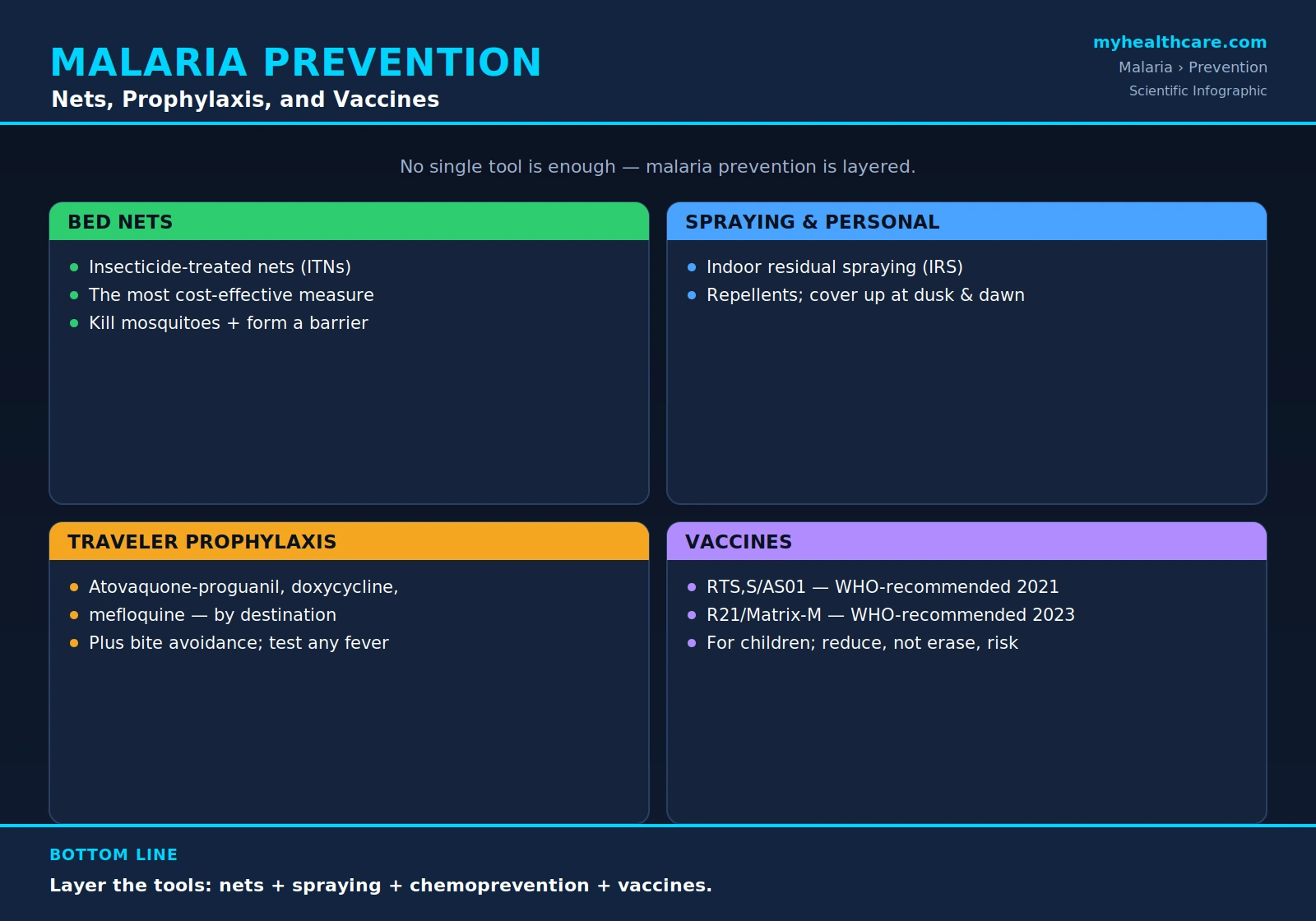
Malaria kills hundreds of thousands of people every year, the great majority of them young children in sub-Saharan Africa — yet much of that toll is preventable. Over the past two decades a layered toolkit has driven malaria deaths down sharply: insecticide-treated bed nets, indoor spraying, preventive medicines for the most vulnerable, and, most recently, the first vaccines ever licensed against a human parasite. No single tool is a magic bullet. The power lies in combining them. This page explains how each method works, who it is for, where its limits lie, and how the pieces fit together into a strategy that protects whole communities and individual travelers alike.
Table of Contents
- A Layered Strategy
- Insecticide-Treated Nets (ITNs & LLINs)
- Indoor Residual Spraying (IRS)
- Personal Protection
- Chemoprophylaxis for Travelers
- Chemoprevention in Endemic Areas
- Malaria Vaccines
- Key Research Papers
- Featured Videos
1. A Layered Strategy
There is no single intervention that stops malaria on its own. The mosquito that carries the parasite, the parasite itself, and the human host each offer different points of attack, and an effective program presses on several at once. The World Health Organization frames prevention as a layered defense: vector control (stopping the mosquito), chemoprevention and prophylaxis (stopping the parasite in people at risk), and now vaccination (priming the immune system). Each layer has gaps that the others help to cover.
This layering matters because every tool has a weak point. Bed nets fail if a mosquito bites in the early evening before bedtime, or if it has become resistant to the insecticide. Preventive drugs are never perfectly protective and cannot be taken indefinitely. Even the best malaria vaccine reduces risk rather than eliminating it. Stacking complementary measures closes those gaps: a child who sleeps under a net, lives in a sprayed house, and is vaccinated is far better protected than one relying on any one method alone. Modeling and field data both show that the steep fall in malaria across Africa between 2000 and 2015 came overwhelmingly from this combined push — with insecticide-treated nets contributing the largest single share.
2. Insecticide-Treated Nets (ITNs & LLINs)
Sleeping under an insecticide-treated net is the single most effective and cost-effective malaria-prevention measure available, and it is the foundation of vector control in endemic countries. The principal malaria mosquitoes — Anopheles species — bite mainly at night, when people are asleep, which is exactly when a net does its work.
A treated net protects in two ways at once. First, it is a physical barrier: the mesh keeps mosquitoes away from the sleeping person. Second, and just as important, the fabric is impregnated with a long-lasting insecticide (historically a pyrethroid) that kills or repels mosquitoes that land on it. Because the insecticide kills the mosquito, a net protects not only the person sleeping beneath it but also — when enough households use them — reduces the local mosquito population, extending some protection to neighbors who have no net. This "community effect" is one reason mass net distribution is so powerful.
Modern nets are long-lasting insecticidal nets (LLINs), in which the insecticide is woven or bound into the fibers so it survives repeated washing and lasts roughly three years before needing replacement. Pooled evidence from randomized trials shows that, compared with no nets, ITNs substantially cut both malaria episodes and child deaths — one of the best-documented findings in all of public health.
The chief threat to nets is insecticide resistance. Decades of pyrethroid use have selected for mosquitoes that survive contact with treated fabric, blunting the killing effect even though the physical barrier remains. In response, newer "dual-active-ingredient" nets combine a pyrethroid with a second compound (such as a pyrrole or a synergist) to overcome resistance, and these are being rolled out where resistance is widespread. Even a partly resistant mosquito population, however, is held in check far better with nets than without them.
3. Indoor Residual Spraying (IRS)
Indoor residual spraying is the other pillar of vector control. Trained teams spray a long-acting insecticide onto the inside walls and ceilings of houses. Many Anopheles mosquitoes rest on an indoor surface after taking a blood meal; when they land on a sprayed wall, they absorb a lethal dose. A single round of spraying can keep killing mosquitoes for several months, covering a full transmission season.
Like bed nets, IRS works at the level of the whole community rather than the individual. Because it culls the mosquitoes that enter and rest in homes across a village, it lowers the chance of transmission for everyone in the sprayed area — including people who happen not to be home when a mosquito strikes. IRS is especially valuable for rapidly knocking down transmission during epidemics or in high-burden zones, and it can be paired with nets, though programs take care to choose insecticide classes that complement, rather than duplicate, those used on nets so that resistance is not driven by both tools at once.
The trade-offs are practical: IRS demands skilled teams, repeated visits, household cooperation (furniture must be moved and walls left unpainted), and a reliable insecticide supply. Where it can be sustained, it is a potent partner to nets in the layered strategy.
4. Personal Protection
Beyond community-wide vector control, individuals can lower their own risk of being bitten — an especially important consideration for travelers and for the hours when nets offer no cover. The malaria mosquito tends to feed from dusk through dawn, so personal protection focuses on those hours.
- Insect repellents applied to exposed skin — products containing DEET, picaridin, or oil of lemon eucalyptus (PMD) are the best studied — reduce bites for several hours per application.
- Covering the skin with long sleeves and long trousers, particularly in the evening and at night, leaves mosquitoes less to bite. Treating clothing with permethrin adds further protection.
- Physical barriers in the home — window and door screens, and air conditioning where available — keep mosquitoes out of living and sleeping spaces.
- Sleeping under a net remains the cornerstone of personal protection even for short-term visitors.
The evidence for repellents alone in reducing clinical malaria is more modest than that for nets, and personal measures are best understood as a supplement to — not a replacement for — nets, spraying, and (for travelers) preventive medication.
5. Chemoprophylaxis for Travelers
People traveling from malaria-free regions into endemic areas have little or no acquired immunity, so even a single infection can become severe. For them, the standard of care is chemoprophylaxis — taking an antimalarial drug before, during, and for a period after the trip to prevent infection from taking hold. The right drug depends chiefly on the drug-resistance pattern of the destination, as well as the traveler's health, pregnancy status, and tolerance of side effects.
The commonly used regimens include:
- Atovaquone-proguanil (often sold as Malarone) — taken daily, started 1–2 days before entering the malaria area and continued for 7 days after leaving. Generally well tolerated; a popular choice for shorter trips.
- Doxycycline — an inexpensive daily antibiotic that doubles as malaria prophylaxis, begun 1–2 days before travel and continued for 4 weeks after return. Can cause sun sensitivity and stomach upset.
- Mefloquine — taken weekly, started 1–2 weeks before travel and continued for 4 weeks afterward. Convenient weekly dosing, but not suitable for everyone because of possible neuropsychiatric side effects.
Two points are essential. First, no prophylactic drug is 100 percent protective, so travelers must still avoid bites with repellents, covered skin, and nets. Second, the post-travel doses matter: the drugs act on the parasite in the blood, and stopping too soon can allow an infection acquired in the last days of the trip to emerge. Because malaria can appear weeks after return, any fever in a returned traveler must be treated as a medical emergency and tested for malaria promptly, regardless of whether prophylaxis was taken. For the drugs used to treat established infection, see Antimalarial Drugs & ACT.
6. Chemoprevention in Endemic Areas
In places where malaria is constantly present, the most vulnerable groups can be given preventive antimalarial medicine on a planned schedule — not because they are sick, but to keep them from becoming infected during the riskiest periods. These strategies, collectively called chemoprevention, are aimed at the people malaria harms most: young children and pregnant women.
- Seasonal malaria chemoprevention (SMC) gives young children a full course of antimalarial drugs at monthly intervals during the high-transmission rainy season. In the African Sahel, where transmission is sharply seasonal, SMC has prevented a large share of childhood malaria cases and is now delivered to tens of millions of children each year.
- Intermittent preventive treatment in pregnancy (IPTp) provides pregnant women with treatment doses of an antimalarial at scheduled antenatal visits. Malaria in pregnancy endangers both mother and baby — causing maternal anemia, low birth weight, and stillbirth — and IPTp meaningfully reduces these harms.
- Perennial malaria chemoprevention in infants (IPTi/PMC) pairs antimalarial doses with routine infant immunization visits in areas of year-round transmission, protecting babies through their most vulnerable first year.
Chemoprevention is not the same as treatment. It is given on a calendar, to people who may be perfectly well, precisely to stop infection before it starts. Combined with nets and, increasingly, vaccination, it is one of the most cost-effective ways to shield the youngest and most fragile from severe disease and death.
7. Malaria Vaccines
For most of the twentieth century, a malaria vaccine was considered nearly impossible: the parasite is a complex organism with many life stages, not a single virus or bacterium, and it has evolved to evade the human immune system. That barrier has finally been broken. Two vaccines are now recommended by the World Health Organization, marking the first time any vaccine against a human parasite has reached widespread use.
RTS,S/AS01 (brand name Mosquirix) was the first. After decades of development and a large phase 3 trial across seven African countries, it became the first malaria vaccine ever recommended, with WHO endorsing it in 2021 for children living in areas of moderate-to-high transmission. RTS,S targets the parasite at the sporozoite stage — the form injected by a mosquito bite — trying to stop the infection before it reaches the liver. Given as a series of doses with a later booster, it modestly but meaningfully reduces clinical malaria, severe malaria, and hospitalizations in young children. Its protection wanes over time, which is why the booster dose matters and why it is layered on top of nets and other measures rather than replacing them.
R21/Matrix-M is the second. Built on a similar sporozoite-targeting principle but with a different adjuvant (Matrix-M) and design, it demonstrated high efficacy in phase 2b and phase 3 trials and was recommended by WHO in 2023. R21 can be manufactured at very large scale and lower cost, which is critical for meeting the enormous demand across Africa. In seasonal-transmission settings, dosing it just before the malaria season produced especially strong protection.
Both vaccines share the same honest caveat: they reduce the risk of malaria, they do not eliminate it. A vaccinated child can still catch malaria, so vaccination is added to — never substituted for — bed nets, indoor spraying, prompt diagnosis, and effective treatment. Used together, these tools are now driving malaria deaths down further, and the arrival of two licensed vaccines has transformed what the layered strategy can achieve.
Key Research Papers
Peer-reviewed systematic reviews and landmark trials underpinning each layer of malaria prevention — from insecticide-treated nets and indoor spraying to preventive medicines and the two WHO-recommended vaccines. Journal names appear as plain text; the year/volume/pages link opens the full citation via DOI.
- Pryce J, Richardson M, Lengeler C. Insecticide-Treated Nets for Preventing Malaria. Cochrane Database of Systematic Reviews. 2018;(11):CD000363.
- Pluess B, Tanser FC, Lengeler C, Sharp BL. Indoor Residual Spraying for Preventing Malaria. Cochrane Database of Systematic Reviews. 2010;(4):CD006657.
- Maia MF, Kliner M, Richardson M, Lengeler C, Moore SJ. Mosquito Repellents for Malaria Prevention. Cochrane Database of Systematic Reviews. 2018;(2):CD011595.
- Radeva-Petrova D, Kayentao K, ter Kuile FO, Sinclair D, Garner P. Drugs for Preventing Malaria in Pregnant Women in Endemic Areas. Cochrane Database of Systematic Reviews. 2014;(10):CD000169.
- Wilson AL; IPTc Taskforce. A Systematic Review and Meta-Analysis of the Efficacy and Safety of Intermittent Preventive Treatment of Malaria in Children (IPTc). PLoS ONE. 2011;6(2):e16976.
- RTS,S Clinical Trials Partnership. Efficacy and Safety of RTS,S/AS01 Malaria Vaccine with or without a Booster Dose in Infants and Children in Africa: Final Results of a Phase 3, Individually Randomised, Controlled Trial. The Lancet. 2015;386(9988):31–45.
- Datoo MS, Dicko A, Tinto H, et al. Safety and Efficacy of Malaria Vaccine Candidate R21/Matrix-M in African Children: A Multicentre, Double-Blind, Randomised, Phase 3 Trial. The Lancet. 2024;403(10426):533–544.
- Datoo MS, Natama MH, Somé A, et al. Efficacy of a Low-Dose Candidate Malaria Vaccine, R21 in Adjuvant Matrix-M, with Seasonal Administration to Children in Burkina Faso: A Randomised Controlled Trial. The Lancet. 2021;397(10287):1809–1818.
- Bhatt S, Weiss DJ, Cameron E, et al. The Effect of Malaria Control on Plasmodium falciparum in Africa between 2000 and 2015. Nature. 2015;526(7572):207–211.
- White NJ, Pukrittayakamee S, Hien TT, Faiz MA, Mokuolu OA, Dondorp AM. Malaria. The Lancet. 2014;383(9918):723–735.
Live PubMed Searches
Each link opens a live PubMed query so results stay current as new papers are indexed.
- Insecticide-treated nets malaria prevention
- Indoor residual spraying malaria
- Malaria chemoprophylaxis travelers
- Seasonal malaria chemoprevention children
- Intermittent preventive treatment in pregnancy
- RTS,S malaria vaccine
- R21/Matrix-M malaria vaccine
- Pyrethroid insecticide resistance Anopheles
Connections
- All Parasites
- Malaria Overview
- Symptoms & Diagnosis
- Severe & Cerebral Malaria
- Malaria in Pregnancy & Children
- Diagnosis: Blood Smear & RDT
- Malaria Treatment & Prevention
- Antimalarial Drugs & ACT
- Drug Resistance
- Malaria — the disease these nets, preventive drugs, and vaccines are designed to stop.
- Toxoplasma
- Sepsis
- Hematology
- Infectious Disease
- All Conditions
- Paul Hermann Müller — indoor spraying versus nets — what the Cochrane evidence actually shows