Malaria Symptoms and Diagnosis
Malaria is one of the most common and serious infectious diseases in the world, caused by single-celled Plasmodium parasites that are spread to people through the bite of an infected female Anopheles mosquito. Its early symptoms are deceptively ordinary — fever, headache, chills, and aching muscles that can easily be mistaken for influenza or a viral infection. That very ordinariness is what makes malaria dangerous: an uncomplicated case can deteriorate into a life-threatening illness within hours, especially in young children, pregnant women, and travelers who have never been exposed before. This page explains how malaria typically presents, the warning signs that signal severe disease, who is most at risk, how the infection is confirmed in the laboratory, and — most importantly — when a fever must be treated as a medical emergency.
Severe & Cerebral Malaria
The life-threatening complications — cerebral malaria, severe anemia, and organ failure.
Read the deep dive →Malaria in Pregnancy & Children
Why pregnant women and young children bear most of the severe disease and death.
Read the deep dive →Diagnosis: Blood Smear & RDT
How malaria is confirmed — microscopy, rapid antigen tests, and PCR.
Read the deep dive →Table of Contents
1. The Classic Presentation
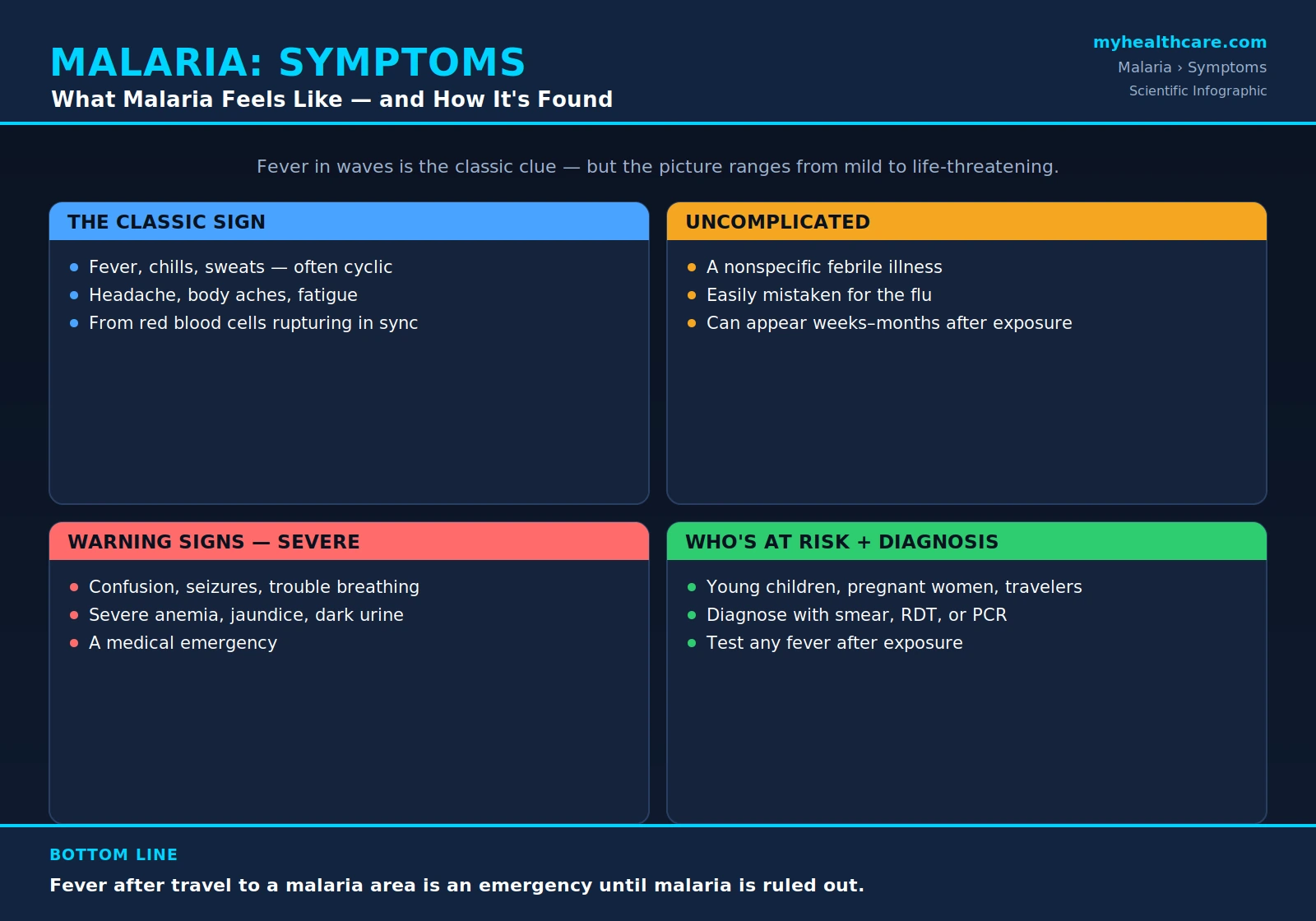
The textbook image of malaria is the fever paroxysm — a dramatic, recurring cycle that unfolds in three stages. It begins with the cold stage: a sudden, shaking chill so intense the person may shiver under blankets despite a rising temperature. This is followed by the hot stage, in which the fever spikes high — often above 40°C (104°F) — with flushed skin, a pounding headache, and sometimes confusion. Finally comes the sweating stage: the fever breaks, drenching sweats pour out, the temperature falls, and the exhausted person feels briefly better before the cycle begins again.
The reason for this rhythm lies inside the red blood cells. After the parasite invades a red cell, it multiplies and then bursts the cell open to release a new wave of parasites — and this synchronized rupture of millions of infected red cells is what triggers the chill-fever-sweat paroxysm. Because each Plasmodium species completes this red-cell cycle on its own schedule, the fevers recur at characteristic intervals: roughly every 48 hours for P. vivax and P. ovale (a pattern historically called "tertian"), and every 72 hours for P. malariae ("quartan"). P. falciparum, the most dangerous species, often does not synchronize neatly and may instead produce a continuous or irregular fever.
Alongside the fever, the classic illness brings a cluster of flu-like complaints: headache, generalized muscle aches (myalgia), profound fatigue and weakness, nausea, vomiting, poor appetite, and sometimes diarrhea or abdominal pain. An enlarged spleen and mild jaundice may develop as the body destroys infected and damaged red cells. It is worth emphasizing, however, that the neat textbook paroxysm is often absent in real life — particularly early in the illness and in P. falciparum infection — so the lack of a perfectly cyclic fever should never be taken as evidence against malaria.
2. Uncomplicated Malaria
Most people with malaria first present with what clinicians call uncomplicated malaria — a febrile illness with parasites in the blood but without signs of organ failure or other severe features. The hallmark of this stage is how thoroughly nonspecific it is. Fever, chills, headache, body aches, fatigue, and nausea describe a great many infections, and malaria in its early hours looks indistinguishable from the flu, a viral illness, or any number of common febrile conditions. There is no symptom that, on its own, reliably says "malaria." The single most useful clue is not a symptom at all but the patient's exposure history: time spent in a region where malaria is transmitted.
A critical and frequently misunderstood point is timing. After an infective mosquito bite, the parasites first spend about a week maturing silently in the liver before they spill into the bloodstream and cause illness. The incubation period — the gap between the bite and the first symptoms — is typically 7 to 30 days, but it can be much longer. P. falciparum usually declares itself fastest, within about two weeks. P. vivax and P. ovale, by contrast, can hide for far longer because they form dormant liver stages called hypnozoites that may reactivate weeks to many months after the original bite, producing a delayed first illness or a later relapse. This means a fever can be malaria even if a person left the endemic area months earlier — and antimalarial drugs taken for prevention can blunt or delay symptoms, stretching the incubation period further still. Because uncomplicated malaria is so easily mistaken for something trivial, and because P. falciparum can progress to severe disease within a day, anyone with fever and a relevant travel or residence history needs prompt testing rather than watchful waiting.
3. Warning Signs of Severe Disease
The most important skill in recognizing malaria is knowing when an ordinary-looking febrile illness has crossed into severe malaria — a true medical emergency, almost always caused by P. falciparum, in which the parasite damages vital organs. Severe disease can develop with frightening speed, sometimes within hours of the first symptoms. The following warning signs mean a person needs emergency medical care without delay:
- Impaired consciousness — drowsiness, confusion, difficulty staying awake, delirium, or coma. Any change in mental state is an alarm.
- Repeated or prolonged seizures (convulsions), particularly in a child.
- Trouble breathing — rapid, labored, or deep breathing, which can signal fluid in the lungs or severe acidosis.
- Severe anemia — extreme pallor, weakness, and breathlessness as infected red cells are destroyed in large numbers.
- Jaundice (yellowing of the eyes or skin) and dark, tea-colored urine, reflecting the breakdown of red cells and strain on the liver and kidneys.
- Inability to keep fluids down — persistent vomiting, or being too weak to eat, drink, or sit up — leading to dehydration.
- Abnormal bleeding, very low blood pressure (shock), or markedly reduced urine output.
- Profound weakness — a child or adult who can no longer stand or sit unsupported.
The brain complication, known as cerebral malaria, is among the most feared forms of severe disease and carries a high risk of death and lasting neurological harm. Low blood sugar (hypoglycemia), kidney failure, and a falling blood pressure can accompany it. For a detailed look at these complications — how they arise, how they are managed, and why they are so dangerous — see the dedicated Severe & Cerebral Malaria page.
4. Who Is Most at Risk
Malaria does not strike everyone equally. The risk of falling severely ill depends heavily on whether a person has built up partial protection through repeated past infections — a phenomenon called acquired immunity. In areas of intense, year-round transmission, people are bitten and infected over and over from infancy, and survivors gradually develop a degree of immunity that limits the severity of later infections (though it never fully prevents infection). This is why the burden of severe and fatal malaria falls so unevenly on those who lack that protection:
- Young children, especially those under five, who have not yet acquired immunity. Children bear the greatest share of severe malaria and malaria deaths worldwide, and can decline from fever to coma alarmingly fast.
- Pregnant women, in whom pregnancy temporarily weakens malaria-specific immunity. The parasite can accumulate in the placenta, threatening both mother and baby with severe anemia, low birth weight, prematurity, and stillbirth.
- Travelers, migrants, and other non-immune people visiting an endemic region from a malaria-free area. Lacking any acquired immunity, they are at high risk of severe disease if infected — and clinicians far from the tropics may not consider malaria quickly enough.
- People with HIV/AIDS and others with weakened immune systems, who tend to suffer more frequent and more severe episodes.
This protective immunity is also a double-edged caution: it fades when a person leaves an endemic area for a few years, so returning residents visiting family abroad can lose their old protection and become as vulnerable as any first-time traveler. The special dangers faced by mothers and children are covered in depth on the Malaria in Pregnancy & Children page.
5. How Malaria Is Diagnosed
Because malaria's symptoms are nonspecific, the diagnosis cannot be made on the clinical picture alone — it must be confirmed by a laboratory test that demonstrates the parasite. The guiding principle is simple and life-saving: test anyone who has a fever and a plausible exposure to malaria, and treat a confirmed case promptly. Three main tools are used:
- Microscopy of a blood smear remains the gold standard. A drop of the patient's blood is spread on a glass slide, stained, and examined under a microscope. A skilled microscopist can confirm the diagnosis, identify the Plasmodium species, and measure the parasite density (how heavily the blood is infected) — information that guides treatment and signals severity. Because parasite numbers rise and fall in cycles, a single negative smear does not rule out malaria; if suspicion remains, the smear is repeated every 12 to 24 hours over two to three days.
- Rapid diagnostic tests (RDTs) are simple, dipstick-style cards that detect Plasmodium proteins (antigens) in a finger-prick of blood and give a result in about 15–20 minutes. They require no microscope or electricity, which has transformed malaria diagnosis in remote and resource-limited settings. RDTs are fast and easy but cannot quantify parasite density, and some can stay positive for a period after successful treatment.
- Polymerase chain reaction (PCR) and other molecular methods detect parasite DNA with very high sensitivity. PCR can find very low-level infections that microscopy and RDTs miss, and can precisely identify and distinguish species. It is mainly used in reference laboratories, research, and complex or mixed-species cases rather than for routine bedside diagnosis.
For travelers returning to non-endemic countries, the same rule holds with extra force: clinicians should keep malaria firmly in mind for any fever after travel and obtain testing urgently, since a missed P. falciparum infection can turn fatal. The practical details of each method — how smears are prepared and read, how RDTs work, and where PCR fits — are explained on the Diagnosis: Blood Smear & RDT page.
6. When to Seek Care
The single most important message about malaria symptoms is this: a fever after travel to or residence in a malaria-endemic area is a medical emergency until malaria has been excluded by testing. This is true even if the symptoms seem mild, even if they appeared weeks or months after leaving the area, and even if preventive medication was taken. Malaria is curable when caught early, but P. falciparum in particular can progress from an ordinary fever to severe, organ-threatening disease within a day — so the safe response to a possible exposure is to seek care and get tested promptly, not to wait and see.
Treat it as an immediate emergency — call for urgent help or go straight to a hospital — if a person with a current or recent malaria risk develops any of the warning signs of severe disease: confusion or reduced consciousness, seizures, difficulty breathing, severe weakness or inability to stand, repeated vomiting, dark urine, jaundice, or abnormal bleeding. Children and pregnant women warrant an especially low threshold for seeking care, because they can deteriorate quickly. When seeking medical attention, always tell the clinician about any travel in the past year, including the specific countries and dates — this single piece of history is often what prompts the test that makes the diagnosis. Prompt recognition, prompt testing, and prompt treatment are what turn a potentially fatal infection into a curable one.
Key Research Papers
Peer-reviewed reviews and studies on the clinical features, immunology, and laboratory diagnosis of malaria. Journal names appear as plain text; the year/volume/pages link opens the full citation via DOI.
- White NJ, Pukrittayakamee S, Hien TT, Faiz MA, Mokuolu OA, Dondorp AM. Malaria. The Lancet. 2014;383(9918):723–735. — doi:10.1016/S0140-6736(13)60024-0
- Ashley EA, Pyae Phyo A, Woodrow CJ. Malaria. The Lancet. 2018;391(10130):1608–1621. — doi:10.1016/S0140-6736(18)30324-6
- Doolan DL, Dobaño C, Baird JK. Acquired Immunity to Malaria. Clinical Microbiology Reviews. 2009;22(1):13–36. — doi:10.1128/CMR.00025-08
- Wongsrichanalai C, Barcus MJ, Muth S, Sutamihardja A, Wernsdorfer WH. A Review of Malaria Diagnostic Tools: Microscopy and Rapid Diagnostic Test (RDT). American Journal of Tropical Medicine and Hygiene. 2007;77(6 Suppl):119–127. — doi:10.4269/ajtmh.2007.77.119
- Rogerson SJ, Desai M, Mayor A, Sicuri E, Taylor SM, van Eijk AM. Burden, Pathology, and Costs of Malaria in Pregnancy: New Developments for an Old Problem. The Lancet Infectious Diseases. 2018;18(4):e107–e118. — doi:10.1016/S1473-3099(18)30066-5
- Rahimi BA, Thakkinstian A, White NJ, Sirivichayakul C, Dondorp AM, Chokejindachai W. Severe Vivax Malaria: A Systematic Review and Meta-Analysis of Clinical Studies Since 1900. Malaria Journal. 2014;13:481. — doi:10.1186/1475-2875-13-481
- White NJ. Determinants of Relapse Periodicity in Plasmodium vivax Malaria. Malaria Journal. 2011;10:297. — doi:10.1186/1475-2875-10-297
- Achan J, Talisuna AO, Erhart A, Yeka A, Tibenderana JK, Baliraine FN, et al. Quinine, an Old Anti-Malarial Drug in a Modern World: Role in the Treatment of Malaria. Malaria Journal. 2011;10:144. — doi:10.1186/1475-2875-10-144
- Noor AM, Kinyoki DK, Mundia CW, Kabaria CW, Mu’awia W, Snow RW. The Changing Risk of Plasmodium falciparum Malaria Infection in Africa: 2000–10. The Lancet. 2014;383(9930):1739–1747. — doi:10.1016/S0140-6736(13)62566-0
PubMed Topic Searches
Each link opens a live PubMed query so results stay current as new papers are indexed.
- PubMed: Malaria clinical features and symptoms
- PubMed: Uncomplicated falciparum malaria presentation
- PubMed: Severe malaria warning signs and criteria
- PubMed: Plasmodium vivax relapse and hypnozoites
- PubMed: Malaria rapid diagnostic test and microscopy
- PubMed: Malaria PCR and molecular diagnosis
- PubMed: Imported malaria in returning travelers
- PubMed: Malaria, children, pregnancy, and acquired immunity
Connections
- All Parasites
- Malaria Overview
- Severe & Cerebral Malaria
- Malaria in Pregnancy & Children
- Diagnosis: Blood Smear & RDT
- Treatment & Prevention
- Antimalarial Drugs & ACT
- Prevention, Nets & Vaccines
- Drug Resistance
- Hematology
- Infectious Disease
- Sepsis
- Meningitis
- All Conditions
- Malaria — the main overview of the disease and its treatment.