Diagnosing Malaria: Blood Smear, RDT, and PCR
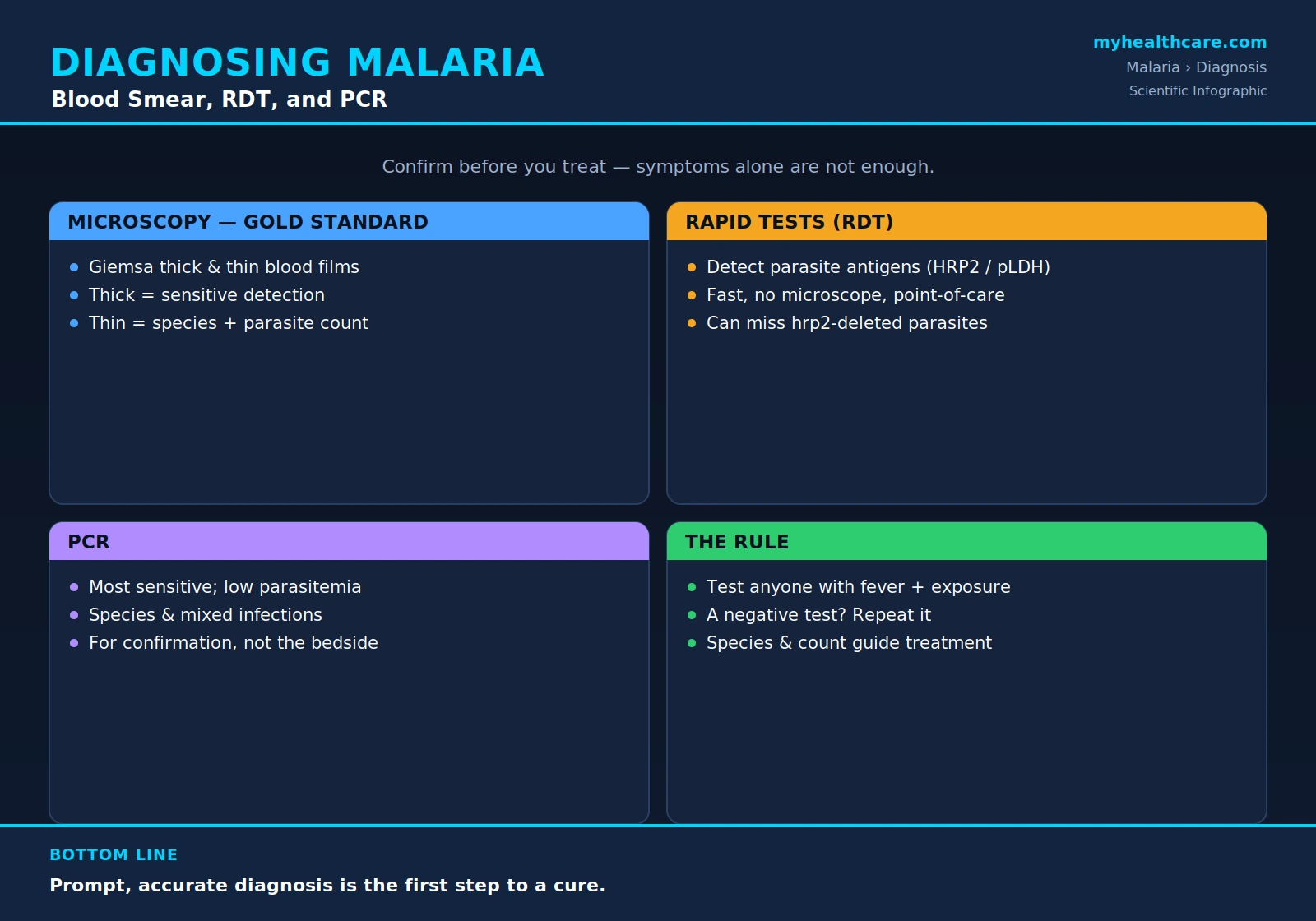
Malaria is curable when it is caught and treated promptly — but it can also kill within a day or two if it is missed, especially when caused by Plasmodium falciparum. The trouble is that malaria's early symptoms (fever, chills, headache, muscle aches, fatigue) look like the flu, a urinary infection, dengue, typhoid, or a dozen other common illnesses. There is no way to be certain from symptoms alone. For this reason the World Health Organization recommends that every suspected case of malaria be confirmed in the laboratory before antimalarial treatment is given. This page explains the three tests that confirm malaria — the blood smear examined under a microscope, the rapid diagnostic test (RDT), and the polymerase chain reaction (PCR) — what each one can and cannot do, and how clinicians put them together to reach the right diagnosis.
Table of Contents
- Why Fast, Accurate Diagnosis Matters
- Microscopy — The Gold Standard
- Rapid Diagnostic Tests (RDTs)
- Molecular Tests (PCR)
- Putting It Together
- Special Situations
- Key Research Papers
- Featured Videos
1. Why Fast, Accurate Diagnosis Matters
Malaria sits in an unusual and dangerous middle ground: it is highly treatable, yet it can become lethal faster than almost any other infection a traveler or a child in an endemic region is likely to face. Uncomplicated malaria, treated early with the right drugs, resolves in the vast majority of cases. The same infection left unrecognized for a few extra days can progress to severe disease — coma, kidney failure, severe anemia, breathing difficulty — and death. The window between "easily cured" and "critically ill" can be remarkably short, particularly with P. falciparum.
The central problem is that the symptoms of malaria are nonspecific. Fever, chills, sweats, headache, body aches, nausea, and fatigue accompany countless infections. Studies in endemic areas have shown repeatedly that diagnosing malaria on clinical grounds alone — treating anyone with a fever as if they have malaria — is unreliable: it both misses true cases and, just as importantly, leads to many people being treated for malaria when they actually have something else. That over-treatment wastes scarce drugs, fuels drug resistance, and — most dangerously — leaves the real cause of the fever untreated.
The solution is parasitological confirmation: actually demonstrating the parasite (or its proteins or its DNA) before starting treatment. The World Health Organization recommends that prompt diagnosis by microscopy or a rapid diagnostic test be available for, and applied to, all patients with suspected malaria. The practical rule that follows is simple and worth remembering: test before you treat. The only common exception is a critically ill patient in whom treatment cannot safely wait for results — and even then, testing is done in parallel, not skipped.
2. Microscopy — The Gold Standard
Examining a stained drop of the patient's blood under a light microscope has been the reference standard for diagnosing malaria for more than a century, and it remains so today. The blood is collected (usually by a fingerprick or from a venous sample), spread on a glass slide, and stained — classically with Giemsa stain, which colors the parasites so they stand out against the red blood cells. Two kinds of film are prepared, and they do different jobs.
- The thick film is a small, concentrated pool of blood. Because many layers of cells are examined at once, it is the more sensitive of the two — it is what you use to detect whether parasites are present at all, even when there are very few of them. In the thick film the red cells are lysed (broken open) during staining, leaving the parasites visible against a cleared background.
- The thin film is a single layer of blood, like a conventional blood smear, with the red cells left intact. It is less sensitive for simply finding parasites, but it preserves the shape of the infected cells and the parasites inside them. This is what allows the microscopist to identify the species of Plasmodium — falciparum, vivax, ovale, malariae, or knowlesi — and to count the parasitemia, the proportion of red cells that are infected.
Knowing the species and the parasitemia is not academic. The species determines which drugs are appropriate (for example, whether a course of medication is needed to clear dormant liver forms of P. vivax and P. ovale). The parasitemia — especially a high one — is one of the warning signs of severe malaria and helps decide whether a patient needs hospital admission and intravenous treatment, and it provides a number that can be tracked over the following days to confirm the treatment is working.
Microscopy is inexpensive, requires only modest equipment, can detect all species, and gives a quantitative result. Its great limitation is that it is operator-dependent: it requires a well-made slide, good stain, a working microscope, and above all a trained, experienced microscopist. At low parasite densities, or where skill and quality control are lacking, sensitivity and species identification suffer, and field studies have documented that the quality of routine microscopy is often well below that of an expert reference laboratory. One more practical point: a single negative film does not rule malaria out. Parasites cycle through the bloodstream, and densities fluctuate. If the clinical suspicion remains, the standard practice is to repeat the blood films — typically every 12 to 24 hours over a 48- to 72-hour period — before malaria is considered excluded.
3. Rapid Diagnostic Tests (RDTs)
A malaria rapid diagnostic test is a small lateral-flow device — conceptually similar to a home pregnancy or COVID test. A drop of blood and a buffer are applied, and within roughly 15 to 20 minutes one or more colored lines appear that indicate whether malaria parasite proteins (antigens) are present. RDTs require no microscope, no electricity, and minimal training, which is exactly why they have transformed malaria diagnosis at the point of care — in remote clinics, by community health workers, and anywhere a skilled microscopist is not available.
RDTs work by detecting parasite antigens in the blood. The main targets are:
- HRP2 (histidine-rich protein 2), which is produced specifically by P. falciparum — the species responsible for most severe and fatal malaria. HRP2-based tests are sensitive for falciparum.
- pLDH (parasite lactate dehydrogenase) and aldolase, enzymes produced by malaria parasites more broadly. These allow detection of the non-falciparum species (such as P. vivax) and are often combined with an HRP2 line on the same device so a single test can flag "falciparum" versus "non-falciparum or mixed."
For all their convenience, RDTs have real limitations that clinicians must keep in mind:
- They are generally not quantitative. A standard RDT tells you the antigen is present, not how high the parasitemia is — so it cannot, on its own, gauge the severity that a parasite count provides.
- HRP2 can persist after cure. The HRP2 antigen lingers in the blood for days to weeks after the parasites have been killed by treatment. An HRP2 RDT can therefore stay positive even though the infection has cleared, which makes it unsuitable for judging whether treatment has worked or for diagnosing a new fever in someone treated recently.
- Gene deletions cause false negatives. Some P. falciparum parasites have lost the pfhrp2 and pfhrp3 genes and so produce no HRP2 protein. An HRP2-only RDT will read negative in these infections even when the patient genuinely has falciparum malaria. These deletions were first reported in the Amazon and have since been documented in parts of Africa and elsewhere, prompting the WHO to monitor their spread and, in affected areas, to recommend tests that do not rely on HRP2 alone. A negative RDT in a sick patient with strong clinical suspicion should never be the end of the story.
- At very low parasite densities RDTs may also be less sensitive than expert microscopy or molecular testing.
The takeaway is that RDTs are an enormous public-health advance and the right first test in many settings, but a negative RDT does not exclude malaria, and a positive HRP2 line in a recently treated patient does not necessarily mean active infection. Where the result and the clinical picture disagree, microscopy or PCR is used to settle the question.
4. Molecular Tests (PCR)
Polymerase chain reaction (PCR) and related nucleic-acid amplification methods detect the parasite's DNA rather than its proteins. By copying tiny amounts of Plasmodium genetic material until there is enough to detect, PCR is the most sensitive tool available — it can pick up infections with parasite densities far below the threshold that microscopy or an RDT can see.
That extreme sensitivity makes PCR especially valuable in a handful of situations:
- Very low parasitemia — for example, asymptomatic carriers or early infections — that a smear or RDT may miss.
- Identifying the exact species, including distinguishing closely related species and the zoonotic P. knowlesi, which can be mistaken for P. malariae on a smear.
- Detecting mixed infections with more than one species, which are easy to overlook by microscopy.
- Resolving equivocal cases — when microscopy and RDT disagree, or when results are ambiguous — and confirming difficult diagnoses.
PCR is also a workhorse of research and reference laboratories: it underpins surveillance for drug-resistance markers and for the pfhrp2/3 gene deletions that defeat HRP2 RDTs. Its limitations are practical rather than scientific: it requires specialized equipment, reagents, and trained staff, it is more expensive, and the result is generally not available quickly enough to guide the first dose of treatment at the bedside. For these reasons PCR is not a routine point-of-care test. In day-to-day clinical care, microscopy and RDTs do the front-line work; PCR is reserved for confirmation, for the hard cases, and for research and public-health surveillance.
5. Putting It Together
In practice, the three tests complement one another, and a few principles tie them into a coherent approach.
Test anyone with fever and a malaria exposure. The single most important step is to think of malaria in the first place. Anyone with a fever (or a recent history of fever) who lives in, or has traveled to, a malaria-endemic area should be tested. In returning travelers in particular, malaria must be actively considered and ruled out — a delayed diagnosis in someone with no immunity can be rapidly fatal.
A negative test does not always exclude malaria. This bears repeating because it is where diagnoses go wrong. A single negative smear, or a negative RDT, can occur in genuine malaria — because parasite density is low, because of pfhrp2/3 gene deletions (for HRP2 RDTs), or simply because of timing. When suspicion remains, the answer is to repeat the testing — serial blood films over 48 to 72 hours, a different test method, or molecular confirmation — rather than to abandon the diagnosis on one negative result.
Species and parasitemia guide treatment. Confirming malaria is only the first question; the next is which kind and how much. The Plasmodium species determines the drug regimen, and the parasitemia, together with clinical signs, separates uncomplicated from severe disease and helps decide between oral outpatient therapy and intravenous hospital care. These results feed directly into the treatment decisions discussed on the Treatment & Prevention hub and the Antimalarial Drugs & ACT page. Where parasites survive treatment, the question shifts to drug resistance, which laboratory monitoring also helps detect.
6. Special Situations
Several groups warrant a particularly low threshold to test and to re-test, because in them malaria is both more likely to be dangerous and more likely to be missed.
- Suspected severe malaria. In a critically ill patient — with impaired consciousness, seizures, jaundice, dark urine, breathing difficulty, or signs of shock — diagnosis must be immediate and treatment must not be delayed. Testing (microscopy to establish species and parasitemia, plus an RDT for speed) is done without delay, and treatment is started promptly while results are obtained. See Severe and Cerebral Malaria for the warning signs.
- Pregnant women. Malaria in pregnancy can be serious for both mother and baby, and a substantial share of infections can be present in the placenta with few or even no parasites detectable in a peripheral blood smear. A negative film in a pregnant woman with malaria exposure and unexplained illness should not be taken as reassurance; repeat testing and clinical vigilance are essential. See Malaria in Pregnancy and Children.
- Returning travelers. People who acquire malaria abroad and fall ill after coming home are a classic source of missed, and sometimes fatal, diagnoses — partly because clinicians outside endemic areas may not think of malaria, and partly because non-immune adults can deteriorate quickly. Any fever in a recent traveler from an endemic region should trigger malaria testing, and a single negative result should prompt repeat testing rather than reassurance.
- Children in endemic areas. Young children bear much of the world's severe malaria burden and can progress rapidly. Prompt confirmatory testing — rather than presumptive treatment of every fever — ensures that those with malaria are treated correctly and those without are evaluated for the real cause.
Across all of these, the unifying message is the one that runs through this whole page: confirm the diagnosis, and where doubt remains, test again.
Key Research Papers
Peer-reviewed reviews and primary studies on the laboratory diagnosis of malaria — microscopy, rapid diagnostic tests, HRP2 gene deletions, and molecular methods. Journal names appear as plain text; the year/volume/pages link opens the full citation via DOI.
- Wongsrichanalai C, Barcus MJ, Muth S, Sutamihardja A, Wernsdorfer WH. A Review of Malaria Diagnostic Tools: Microscopy and Rapid Diagnostic Test (RDT). American Journal of Tropical Medicine and Hygiene. 2007;77(6 Suppl):119–127.
- Tangpukdee N, Duangdee C, Wilairatana P, Krudsood S. Malaria Diagnosis: A Brief Review. Korean Journal of Parasitology. 2009;47(2):93–102.
- Bell D, Wongsrichanalai C, Barnwell JW. Ensuring Quality and Access for Malaria Diagnosis: How Can It Be Achieved? Nature Reviews Microbiology. 2006;4(Suppl 9):S7–S20.
- Moody A. Rapid Diagnostic Tests for Malaria Parasites. Clinical Microbiology Reviews. 2002;15(1):66–78.
- Murray CK, Gasser RA, Magill AJ, Miller RS. Update on Rapid Diagnostic Testing for Malaria. Clinical Microbiology Reviews. 2008;21(1):97–110.
- Mouatcho JC, Goldring JPD. Malaria Rapid Diagnostic Tests: Challenges and Prospects. Journal of Medical Microbiology. 2013;62(10):1491–1505.
- Gamboa D, Ho MF, Bendezu J, et al. A Large Proportion of P. falciparum Isolates in the Amazon Region of Peru Lack pfhrp2 and pfhrp3: Implications for Malaria Rapid Diagnostic Tests. PLoS ONE. 2010;5(1):e8091.
- Cheng Q, Gatton ML, Barnwell J, et al. Plasmodium falciparum Parasites Lacking Histidine-Rich Protein 2 and 3: A Review and Recommendations for Accurate Reporting. Malaria Journal. 2014;13:283.
- Snounou G, Viriyakosol S, Zhu XP, et al. Identification of the Four Human Malaria Parasite Species in Field Samples by the Polymerase Chain Reaction and Detection of a High Prevalence of Mixed Infections. Molecular and Biochemical Parasitology. 1993;58(2):283–292.
- Ochola LB, Vounatsou P, Smith T, Mabaso MLH, Newton CRJC. The Reliability of Diagnostic Techniques in the Diagnosis and Management of Malaria in the Absence of a Gold Standard. Lancet Infectious Diseases. 2006;6(9):582–588.
Live PubMed Searches
Each link opens a live PubMed query so results stay current as new papers are indexed.
- Malaria diagnosis: microscopy and RDT
- Giemsa thick and thin blood film malaria
- Malaria rapid diagnostic test HRP2
- pfhrp2/pfhrp3 gene deletion false negative
- Malaria PCR species identification
- Imported malaria in returning travelers
- Placental malaria in pregnancy: diagnosis
- Parasitemia and severe malaria prognosis
Connections
- All Parasites
- Malaria Overview
- Malaria Symptoms & Diagnosis
- Severe and Cerebral Malaria
- Malaria in Pregnancy and Children
- Malaria Treatment & Prevention
- Antimalarial Drugs & ACT
- Prevention: Nets, Prophylaxis & Vaccines
- Drug Resistance
- Hematology
- Lab Tests
- Sepsis
- Infectious Disease
- All Conditions
- Malaria — the disease these smear, RDT, and PCR tests confirm.