Antimalarial Drug Resistance
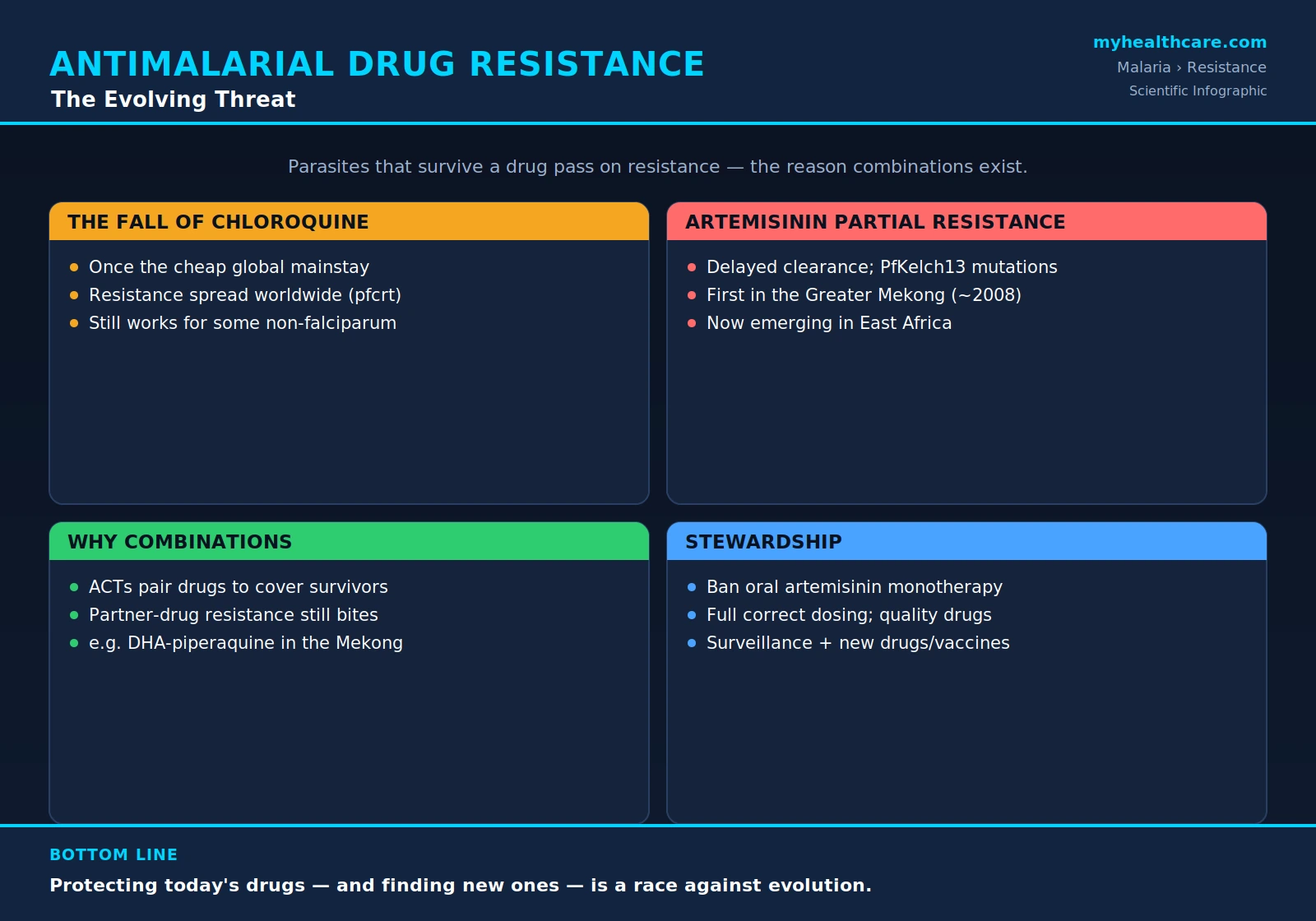
Drug resistance is the central plot of the modern malaria story. Time and again, a cheap and effective medicine has rolled out across the world, driven deaths down — and then slowly stopped working, as the malaria parasite evolved to survive it. Chloroquine, the wonder drug of the mid-twentieth century, and the antifolates that followed it both lost much of their power this way. Today the worry has shifted to artemisinin, the backbone of the combination therapies that now anchor treatment worldwide. This page explains why resistance keeps happening, traces the drugs that have already fallen, examines the threat to artemisinin and its partner drugs, and describes how surveillance, careful drug stewardship, and new tools aim to protect the medicines we still have.
Table of Contents
- Why Resistance Happens
- The Fall of Chloroquine
- Antifolate Resistance
- Artemisinin Partial Resistance
- Why Combination Therapy Matters
- Surveillance and Stewardship
- Insecticide Resistance Too
- The Path Forward
- Key Research Papers
- Featured Videos
1. Why Resistance Happens
Drug resistance is evolution in fast-forward. A single person with malaria can carry billions of parasites, and those parasites are not all identical — random mutations make some of them slightly better than others at surviving a given drug. When a medicine is taken, it kills the susceptible parasites first. If the drug fully clears the infection, the story ends there. But if even a few parasites survive — because they happen to tolerate the drug — those survivors are the ones that go on to multiply and, through a feeding mosquito, spread to the next person. With each round of incomplete killing, the tolerant strains make up a larger share of the population, until the drug no longer works at all.
Several human factors pour fuel on this fire by giving parasites a survival foothold:
- Under-dosing. Too low a dose, a course stopped early once symptoms ease, or poor absorption all expose parasites to a sub-lethal amount of drug — enough to kill the weak but not the tolerant, which is precisely the condition that selects for resistance.
- Monotherapy. Relying on a single drug means a parasite needs to defeat only one obstacle. If it can survive that one drug, nothing else is there to finish it off.
- Counterfeit and substandard drugs. Fake medicines with little or no active ingredient, or genuine drugs that have degraded in heat, deliver a weak, resistance-promoting dose while the patient believes they are properly treated.
- Drugs with a long tail. A medicine that lingers in the blood at low levels for weeks leaves a long window in which newly acquired parasites meet only a faint, sub-curative concentration — another setting that favors the resistant.
The lesson that runs through all of malaria's resistance history is simple: partial killing breeds resistance. Anything that lets some parasites survive a drug — weak doses, single drugs, bad-quality medicines — speeds the day that the drug stops working.
2. The Fall of Chloroquine
For a generation, chloroquine was the closest thing malaria had to a perfect drug. It was cheap, safe enough to give to children and pregnant women, taken by mouth, and remarkably effective. From the 1940s onward it became the global mainstay of malaria treatment and helped drive enormous reductions in illness and death.
Then it began to fail. Resistance in Plasmodium falciparum — the deadliest of the malaria parasites — emerged independently in two places in the late 1950s and 1960s: Southeast Asia (around the Thai–Cambodian border) and South America. From these foci it spread relentlessly, reaching Africa by the late 1970s and 1980s, where the consequences were catastrophic; the loss of chloroquine is associated with a rise in malaria deaths across the continent during those decades.
The molecular culprit was eventually pinned down. Resistance is driven chiefly by mutations in a gene called pfcrt, which encodes a transporter protein in the parasite's digestive vacuole — the compartment where chloroquine normally accumulates and does its damage. Mutant versions of the transporter pump chloroquine back out, so the drug can no longer reach a lethal concentration inside the parasite. A second gene, pfmdr1, modulates the degree of resistance.
Chloroquine is not entirely finished. It still works against some non-falciparum species in some regions — notably much (though no longer all) P. vivax malaria, where chloroquine-resistant strains have since appeared in parts of Asia and Oceania. But against falciparum across most of the world, the old wonder drug is gone, a sobering reminder of how completely resistance can dismantle even the best treatment.
3. Antifolate Resistance
As chloroquine failed, the world reached for replacements. One of the most widely used was sulfadoxine-pyrimethamine (SP), a fixed combination of two antifolate drugs. Antifolates work by blocking the parasite's ability to make folate, a building block it needs to copy its DNA and reproduce. The two components attack two different steps of the same pathway.
SP had the advantage of a single-dose cure, but its useful life was short. Resistance arose through the stepwise accumulation of point mutations in two parasite genes: dhfr (the target of pyrimethamine) and dhps (the target of sulfadoxine). As more of these mutations piled up, the drugs bound their targets less and less effectively, and treatment failure climbed. In high-transmission regions, clinically useful SP for treating falciparum malaria was lost within years of its introduction in some areas.
Today SP is little used as a stand-alone cure for falciparum malaria, but it has not vanished. Because of its safety in pregnancy and its long action, it remains a workhorse of preventive programs — intermittent preventive treatment in pregnancy and seasonal malaria chemoprevention in children — in areas where resistance still allows it to provide useful protection. The antifolate story underscores another theme: a drug can lose its role as a curative treatment while still serving a narrower preventive purpose.
4. Artemisinin Partial Resistance
The most worrying chapter in malaria's resistance saga is unfolding now, and it concerns artemisinin — the fast-acting, derived-from-sweet-wormwood drug that forms the core of the combination therapies on which the world now depends. Artemisinins clear parasites from the blood faster than any other antimalarial, which is exactly why their faltering is so alarming.
The first clear signal came from western Cambodia, in the Greater Mekong subregion, around 2008–2009. Patients there were taking longer than expected to clear parasites from their blood after artemisinin treatment — the drug still worked, but more slowly. In 2014 researchers identified the molecular marker behind this delayed parasite clearance: mutations in the parasite gene PfKelch13 (often written K13). Different K13 mutations have since been mapped across malaria-endemic regions and tied to the slow-clearance phenotype.
Two features of this resistance deserve emphasis. First, it is partial, not complete. Artemisinin has not stopped killing the parasite; it simply does so more slowly, leaving a larger burden of surviving parasites for the partner drug to mop up — which puts that partner drug under heavy strain (see the next section). Second, and most ominously, K13-mediated artemisinin partial resistance is no longer confined to Southeast Asia. It has now independently emerged in East Africa — documented in Rwanda, Uganda, and elsewhere — arising from local mutations rather than spreading from Asia. Because Africa carries the overwhelming majority of the world's malaria burden, the appearance of artemisinin partial resistance there is one of the gravest threats facing malaria control today.
5. Why Combination Therapy Matters
The single most important defense against resistance is built into the way the drugs are now given. Artemisinin-based combination therapies (ACTs) deliberately pair a fast-acting artemisinin with a longer-acting partner drug (such as lumefantrine, piperaquine, amodiaquine, or mefloquine). The logic is a numbers game: for a parasite to survive, it would have to be simultaneously resistant to both drugs at once — a far rarer event than becoming resistant to either one alone. A parasite that tolerates the artemisinin is killed by the partner; a parasite that tolerates the partner is killed by the artemisinin. Pairing drugs this way also protects each one, because neither is ever left to face the parasite by itself.
But combination therapy is not foolproof. If a parasite is already partially resistant to the artemisinin, more parasites survive into the period when only the partner drug remains — and that heavier load gives partner-drug resistance more chances to take hold. When both the artemisinin and the partner are compromised, ACTs can fail outright. The clearest example comes from the Greater Mekong region, where dihydroartemisinin-piperaquine failure rates climbed as resistance to both the artemisinin component and to piperaquine spread together, forcing some countries to change their first-line treatment.
This is why protecting the partner drugs is now as important as protecting the artemisinins themselves — and why surveillance watches not just for slow clearance but for the partner-drug resistance markers that turn a stumble into an outright treatment failure.
6. Surveillance and Stewardship
Because resistance is detected, in the end, by drugs failing in real patients, the world has built a system to catch trouble early and to slow its spread. The main tools are:
- Therapeutic-efficacy studies. The gold-standard method: treat a group of patients with the recommended drug and follow them closely to measure how many are truly cured and how fast their parasites clear. A rising failure rate is the definitive signal that a drug is losing its grip, and triggers a review of national treatment policy. The World Health Organization recommends switching a first-line drug once treatment failure crosses about 10 percent.
- Molecular markers. Watching for known resistance genes — K13 for artemisinin, pfcrt and pfmdr1 for older drugs, dhfr and dhps for antifolates — lets scientists track resistance across whole regions from a small blood sample, often before failures become obvious in clinics.
- Banning oral artemisinin monotherapies. Taking an artemisinin alone, without a partner drug, is one of the surest ways to breed resistance to the world's best medicine. A sustained global effort has worked to remove single-ingredient oral artemisinin products from markets and replace them with proper combinations.
- Ensuring full, correct dosing and quality drugs. Cracking down on counterfeit and substandard medicines, and helping patients complete the full course at the right dose, denies parasites the sub-lethal exposure that selects for resistance in the first place.
Together, these measures form a discipline often called drug stewardship: using the medicines carefully, watching them constantly, and acting fast when they begin to fail, so that each drug lasts as long as possible.
7. Insecticide Resistance Too
Resistance is not only a problem for the drugs that treat people — it is also a growing problem for the tools that stop people from being infected in the first place. The mosquitoes that transmit malaria are themselves evolving, and across much of Africa the main Anopheles vectors have become resistant to the insecticides used in insecticide-treated bed nets and indoor residual spraying.
The mechanisms parallel those in the parasite: mutations that change the insecticide's target so it no longer binds, and beefed-up detoxification enzymes that break the chemical down before it can kill. Resistance to pyrethroids — the class long used to treat bed nets — is now widespread, threatening to blunt the single most effective malaria-prevention tool of the past two decades.
The response mirrors drug stewardship: monitoring mosquito populations for resistance, rotating between different insecticide classes, and deploying newer net technologies — such as nets that combine a pyrethroid with a second compound that restores killing power against resistant mosquitoes. Insecticide resistance is, in short, a parallel threat to malaria control, and the fight against it runs alongside the fight to protect the drugs.
8. The Path Forward
Malaria's history teaches that no single drug stays effective forever, so the strategy now is to stay several steps ahead of the parasite. The path forward rests on a few pillars:
- New drugs and combinations. A pipeline of antimalarial compounds with entirely new mechanisms is in development, along with new partner drugs and even triple combination therapies that pair an artemisinin with two partner drugs, so that resistance to any one of the three still leaves two working medicines.
- Vaccines. The first malaria vaccines — RTS,S/AS01 and the more recently introduced R21/Matrix-M — do not depend on the drugs at all. By preventing infections, vaccines reduce the number of parasites exposed to medicines, easing the selective pressure that drives resistance.
- Multiple first-line therapies. Rather than relying on one ACT everywhere, deploying several different first-line combinations in the same area spreads the pressure across drugs, so no single medicine bears the full weight of every infection.
- Protecting the drugs we have. Ultimately, the cheapest and fastest defense is good stewardship of the existing arsenal — quality-assured medicines, full correct dosing, no monotherapy, and vigilant surveillance — to keep today's drugs working for as long as possible while tomorrow's are developed.
The contest between medicine and parasite is not one that is ever finally "won"; it is managed. The goal is to keep effective treatment available to everyone who needs it, in every region, for as long as possible — and to have the next tool ready before the current one fails.
Key Research Papers
Peer-reviewed studies tracing the rise of antimalarial drug resistance — from the molecular basis of chloroquine resistance to the first detection and ongoing spread of artemisinin partial resistance, partner-drug failure, and insecticide resistance in the mosquito vector. Journal names appear as plain text; the year/volume/pages link opens the full citation via DOI.
- Dondorp AM, Nosten F, Yi P, et al. Artemisinin Resistance in Plasmodium falciparum Malaria. New England Journal of Medicine. 2009;361(5):455–467.
- Ariey F, Witkowski B, Amaratunga C, et al. A Molecular Marker of Artemisinin-Resistant Plasmodium falciparum Malaria. Nature. 2014;505(7481):50–55.
- Ashley EA, Dhorda M, Fairhurst RM, et al. Spread of Artemisinin Resistance in Plasmodium falciparum Malaria. New England Journal of Medicine. 2014;371(5):411–423.
- Ménard D, Khim N, Beghain J, et al. A Worldwide Map of Plasmodium falciparum K13-Propeller Polymorphisms. New England Journal of Medicine. 2016;374(25):2453–2464.
- Uwimana A, Legrand E, Stokes BH, et al. Emergence and Clonal Expansion of in vitro Artemisinin-Resistant Plasmodium falciparum kelch13 R561H Mutant Parasites in Rwanda. Nature Medicine. 2020;26(10):1602–1608.
- Balikagala B, Fukuda N, Ikeda M, et al. Evidence of Artemisinin-Resistant Malaria in Africa. New England Journal of Medicine. 2021;385(13):1163–1171.
- Imwong M, Suwannasin K, Kunasol C, et al. The Spread of Artemisinin-Resistant Plasmodium falciparum in the Greater Mekong Subregion: A Molecular Epidemiology Observational Study. The Lancet Infectious Diseases. 2017;17(5):491–497.
- van der Pluijm RW, Imwong M, Chau NH, et al. Determinants of Dihydroartemisinin-Piperaquine Treatment Failure in Plasmodium falciparum Malaria in Cambodia, Thailand, and Vietnam: A Prospective Clinical, Pharmacological, and Genetic Study. The Lancet Infectious Diseases. 2019;19(9):952–961.
- Fidock DA, Nomura T, Talley AK, et al. Mutations in the P. falciparum Digestive Vacuole Transmembrane Protein PfCRT and Evidence for Their Role in Chloroquine Resistance. Molecular Cell. 2000;6(4):861–871.
- Wellems TE, Plowe CV. Chloroquine-Resistant Malaria. Journal of Infectious Diseases. 2001;184(6):770–776.
- Ranson H, Lissenden N. Insecticide Resistance in African Anopheles Mosquitoes: A Worsening Situation that Needs Urgent Action to Maintain Malaria Control. Trends in Parasitology. 2016;32(3):187–196.
Live PubMed Searches
Each link opens a live PubMed query so results stay current as new papers are indexed.
- Artemisinin resistance in falciparum malaria
- PfKelch13 (K13) resistance marker
- Chloroquine resistance and pfcrt
- Antifolate (SP) resistance: dhfr/dhps
- Artemisinin partial resistance in Africa
- Dihydroartemisinin-piperaquine failure
- Insecticide resistance in Anopheles
- Triple artemisinin combination therapy
Connections
- All Parasites
- Malaria Overview
- Malaria Symptoms & Diagnosis
- Severe & Cerebral Malaria
- Malaria in Pregnancy & Children
- Diagnosis: Blood Smear & RDT
- Malaria Treatment & Prevention
- Antimalarial Drugs & ACT
- Prevention: Nets, Prophylaxis & Vaccines
- Toxoplasma
- Schistosoma
- Anemia
- Malaria — the general disease overview behind the drugs whose resistance is tracked here.
- Infectious Disease
- All Conditions