Tapeworm — Taeniasis and Cysticercosis
Symptoms Overview
All tapeworm species — intestinal disease, neurocysticercosis, hydatid disease, and B12-depleting fish tapeworm.
Read the deep dive →Intestinal Tapeworm Symptoms
T. saginata, T. solium, Diphyllobothrium, and Hymenolepis nana — from proglottid segments to megaloblastic anemia.
Read the deep dive →Neurocysticercosis — Brain Cysts
50 million infected globally. Seizures, hydrocephalus, meningitis — leading cause of adult epilepsy in the developing world.
Read the deep dive →Diagnosis — Imaging & Serology
MRI, CT, EITB Western blot, stool microscopy, and WHO classification for hydatid disease.
Read the deep dive →Treatments Overview
Praziquantel, niclosamide, albendazole — and the complexities of stage-dependent NCC management.
Read the deep dive →Praziquantel & Albendazole
Single-dose praziquantel for most tapeworms, B12 replacement for fish tapeworm, long-course albendazole for Echinococcus.
Read the deep dive →Neurocysticercosis Treatment
Stage-dependent therapy: when NOT to treat calcified cysts, albendazole + dexamethasone for viable cysts, surgery for ventricular NCC.
Read the deep dive →Prevention & Food Safety
Cook pork to 63°C, freeze × 10 days, WASH programs, pig vaccination CYSVAX, dog deworming for Echinococcus.
Read the deep dive →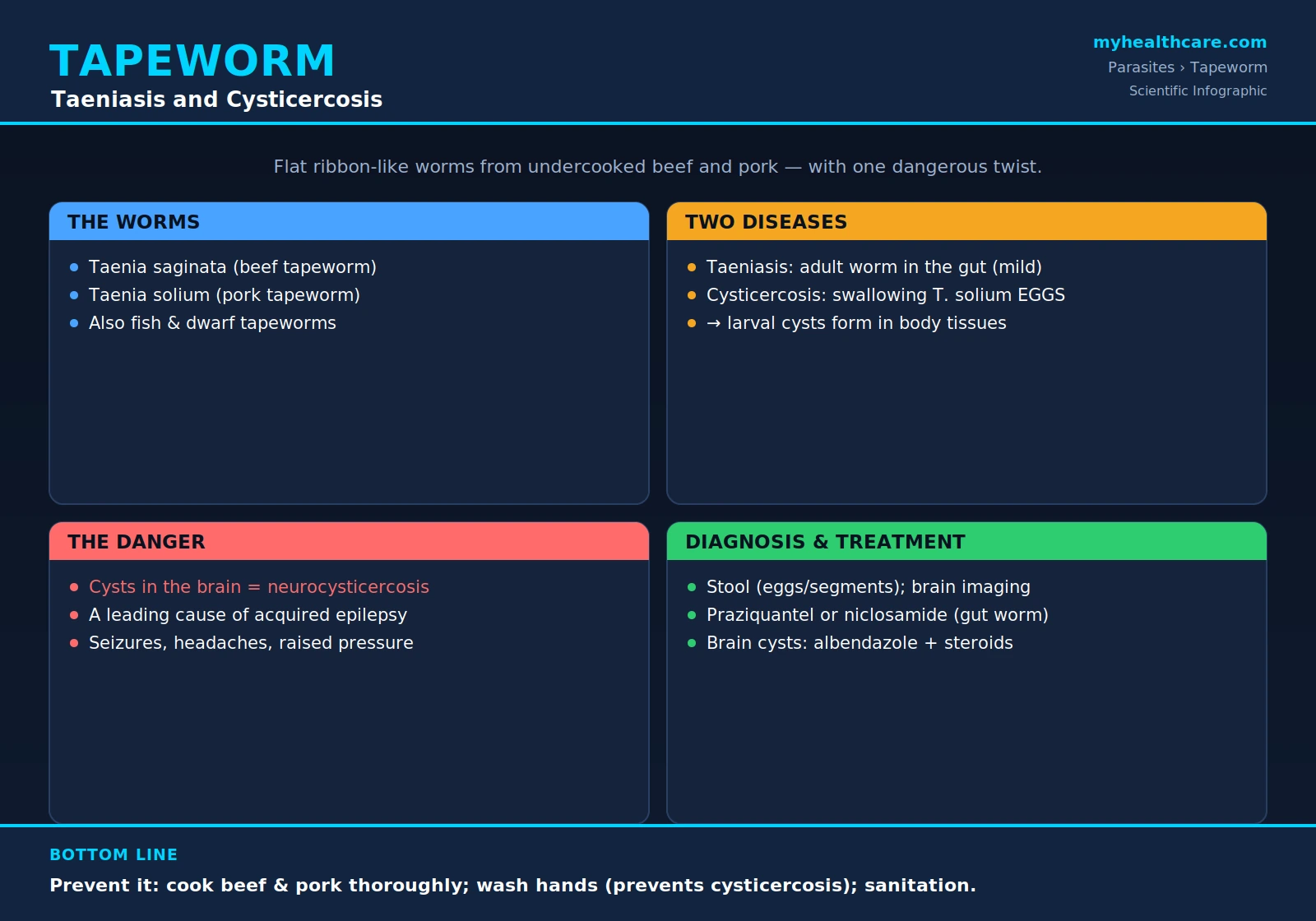
Tapeworms are flat, ribbon-like parasitic worms that can live in the human intestine, sometimes for years, often causing surprisingly few symptoms. Yet behind that mild reputation hides one of the most serious of all parasitic diseases. The pork tapeworm, Taenia solium, has a second and far more dangerous form — one in which its larvae invade the body's own tissues, including the brain. This page explains the two human species that matter most, the unusual two-track life cycle that makes the pork tapeworm so dangerous, how these infections spread, the symptoms they cause, and how doctors diagnose, treat, and prevent them. The information here describes how these conditions are reported in the medical literature; it is educational and is not a substitute for evaluation and care by a qualified clinician.
Table of Contents
1. What Is a Tapeworm?
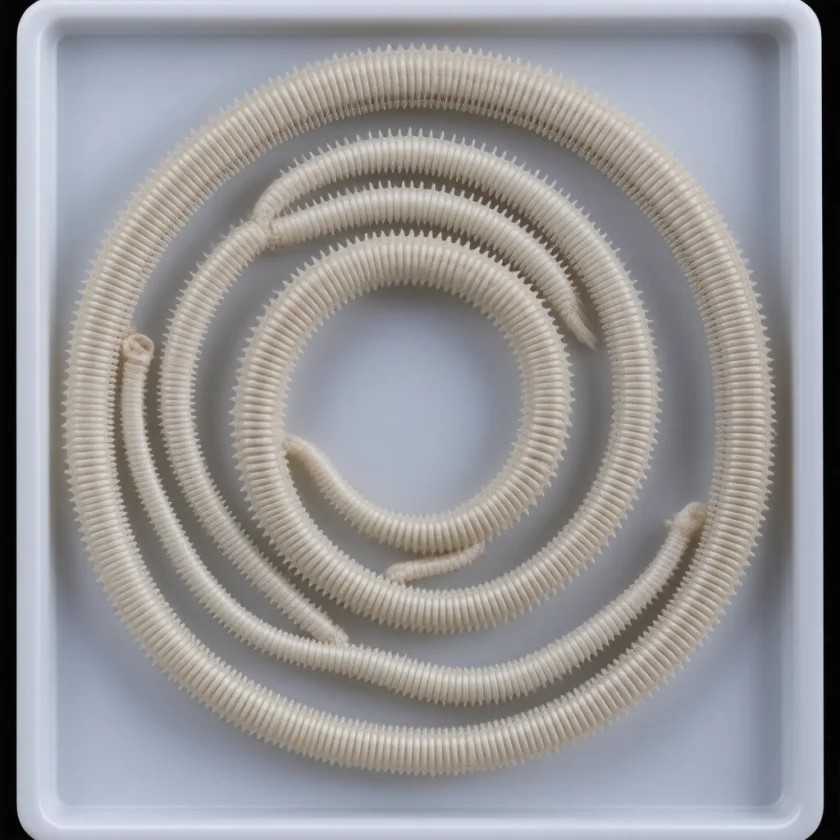
Tapeworms are a group of parasitic flatworms known scientifically as cestodes. They are flat and segmented — shaped like a long, pale ribbon — and they live by anchoring themselves to the lining of a host's intestine and absorbing nutrients directly through their body surface. They have no mouth and no gut of their own; the host's digested food is their food. An adult worm is built from a head (the scolex) that grips the intestinal wall, a neck that produces new segments, and a long chain of repeating segments called proglottids, each of which matures and fills with eggs.
Several species of tapeworm infect humans. The two most important are the beef tapeworm (Taenia saginata), acquired from infected beef, and the pork tapeworm (Taenia solium), acquired from infected pork. Two other species are also seen in people: the fish tapeworm (Diphyllobothrium species, sometimes called the broad tapeworm), caught from raw or undercooked freshwater fish, and the dwarf tapeworm (Hymenolepis nana), the most common tapeworm worldwide and the one most often found in children.
Having an adult tapeworm living in the intestine is called taeniasis, and it is usually a mild condition. The crucial point — the one that makes tapeworms more than a curiosity — is that the pork tapeworm, Taenia solium, has a second and far more dangerous form. When its larvae lodge in the body's tissues rather than its adult form living in the gut, the result is a disease called cysticercosis, described in detail in the sections that follow. Understanding the difference between these two forms is the key to understanding why tapeworms matter.
2. Life Cycle
The tapeworm has a two-host life cycle, and following it step by step is the easiest way to understand why Taenia solium is so dangerous. There are two quite different ways the cycle can play out in a human, and the difference is everything.
The ordinary path — you become the home of the adult worm. A person eats undercooked beef or pork that contains larval cysts called cysticerci — tiny fluid-filled bladders, each holding a single immature worm, embedded in the animal's muscle. Stomach and intestinal juices dissolve the cyst, the young worm attaches to the intestinal wall, and over the following months it grows. An adult tapeworm can reach several meters in length and may live in the intestine for months to years. As it matures it releases egg-filled segments — the proglottids — which pass out of the body in the stool, carrying thousands of eggs into the environment. Those eggs are then eaten by cattle or pigs, hatch into larvae, and travel to the animal's muscle to form new cysticerci, completing the cycle. In this path the human carries the adult worm, and the illness is the relatively mild taeniasis.
The dangerous twist — you become the home of the larvae. Here is the part that sets the pork tapeworm apart. If a person swallows the eggs of Taenia solium — not larval cysts in pork, but the microscopic eggs shed in human stool — the body responds the way a pig's body would. The eggs hatch in the intestine, and the released larvae burrow through the intestinal wall, enter the bloodstream, and spread throughout the body, settling in tissues such as muscle, the eye, and especially the brain, where each forms a cyst. This condition is called cysticercosis. The decisive fact to grasp is this: cysticercosis comes from swallowing the eggs, which are passed in human feces — it does not come from eating pork. A person can even develop cysticercosis from eggs produced by a tapeworm in their own intestine, or, more commonly, from eggs spread by another person carrying the worm.
3. How It Spreads
Because the adult worm and the tissue-invading larvae enter the body by completely different routes, it is worth separating the two clearly.
How the adult tapeworm spreads (taeniasis). A person acquires the intestinal worm by eating raw or undercooked beef or pork that contains live larval cysts. Beef carries Taenia saginata; pork carries Taenia solium. The fish tapeworm is acquired the same general way, from raw or undercooked freshwater fish. In every case it is the larval cyst hidden in the meat that starts the infection — thorough cooking destroys it.
How cysticercosis spreads. Cysticercosis is acquired by swallowing Taenia solium eggs by the fecal-oral route — that is, ingesting microscopic eggs that originated in human stool. This typically happens through food, water, or hands contaminated with the feces of a person who is carrying an adult pork tapeworm, often within the same household. A tapeworm carrier who does not wash their hands carefully can contaminate food they prepare and pass eggs to family members, who then develop cysticercosis even if they themselves have never harbored an adult worm. This is why good hygiene around a known tapeworm carrier matters so much: careful handwashing and prompt treatment of the carrier protect the people around them from the far more serious tissue disease. Improving sanitation and access to clean water reduces transmission at the community level.
4. Symptoms
The symptoms depend entirely on which form of the infection a person has, and the two could hardly be more different.
Intestinal taeniasis (the adult worm). Most people with an adult tapeworm in the intestine have few or no symptoms at all. When symptoms do occur, they are usually mild: vague abdominal discomfort, mild nausea, a change in appetite, or loss of a little weight. Often the first thing a person notices is the appearance of moving segments (proglottids) in the stool or on underclothing — small, flat, whitish pieces that may wriggle. While unsettling, this intestinal form is generally not dangerous.
Cysticercosis (the larvae in tissue). Here the picture is defined by where the cysts lodge. Cysts in muscle or under the skin may cause small lumps but often go unnoticed; cysts in the eye can threaten vision. By far the most consequential form is neurocysticercosis — cysts in the brain or the surrounding tissues. Depending on their number and location, brain cysts can cause seizures, headaches, raised pressure inside the skull (with headache, vomiting, and visual disturbance), and a range of other neurological problems. The single most important fact about this disease is its public-health weight: neurocysticercosis is one of the leading causes of acquired epilepsy worldwide, and it is a major cause of seizures in many regions where the pork tapeworm is common. A mild intestinal worm and a seizure-causing brain infection are, remarkably, two faces of the same parasite.
5. Diagnosis
As with the symptoms, the way the two forms are diagnosed is quite distinct.
Diagnosing the intestinal worm. Taeniasis is identified by examining the stool for tapeworm eggs or for the egg-bearing segments (proglottids). Because eggs are shed irregularly, more than one sample may be needed. Examining the structure of a passed proglottid, and in some settings using molecular tests, can help tell Taenia saginata from Taenia solium — a distinction that matters, because only the pork tapeworm carries the risk of cysticercosis.
Diagnosing neurocysticercosis. Brain disease cannot be found by looking at the stool; it requires looking at the brain. The cornerstone is neuroimaging — a CT or MRI scan that can reveal the cysts themselves, the inflammation around them, or the calcified lesions left behind after old cysts have died and hardened. Imaging is supported by blood antibody tests that detect the body's immune response to the parasite. Because the appearance on a scan can resemble other conditions, the diagnosis is generally made by combining the imaging findings, the blood tests, the clinical picture, and the person's exposure history, often using published diagnostic criteria; difficult cases are best evaluated by specialists.
6. Treatment
The two forms also call for very different treatment, and the gap in complexity between them is wide. The descriptions below reflect how treatment is reported in the medical literature; actual therapy must be chosen and supervised by a clinician.
Clearing the intestinal tapeworm. Treating the adult worm is generally straightforward. A single antiparasitic medicine — most often praziquantel, or alternatively niclosamide — is usually enough to kill the worm, which is then passed from the body. This treats the taeniasis and, just as importantly, stops the carrier from shedding eggs that could cause cysticercosis in others.
Managing neurocysticercosis. Treatment of brain cysticercosis is far more complex and is managed by specialists, because killing cysts in the brain can provoke a burst of inflammation that is itself dangerous. Care is highly individualized — and, crucially, not every cyst is treated; the decision depends on how many cysts there are, where they sit, whether they are alive or already calcified, and the patient's symptoms. When antiparasitic drugs are used, they are typically albendazole, sometimes combined with praziquantel, and they are given together with corticosteroids to control the inflammation that follows cyst death and with anti-seizure medicines to manage seizures. Some patients also need procedures to relieve raised pressure inside the skull. This is specialist territory; the takeaway for a general reader is that brain cysticercosis is treatable but demands careful, expert, case-by-case management rather than a one-size-fits-all cure.
7. Prevention
Both the mild and the severe forms of tapeworm disease are largely preventable, and most of the measures are practical and within reach.
- Cook beef and pork thoroughly. Heating meat all the way through kills the larval cysts that cause the intestinal worm. Where adequate freezing is available, it can also kill cysts in meat. This is the single most effective step against taeniasis.
- Wash hands and produce. Careful handwashing — especially after using the toilet and before preparing or eating food — and washing fruits and vegetables prevent the swallowing of eggs. Good hand hygiene specifically prevents cysticercosis, because that disease comes from ingesting eggs passed in human stool.
- Improve sanitation and clean water. Proper disposal of human waste and access to safe water break the cycle by keeping eggs out of food and drink and away from pigs.
- Promptly treat tapeworm carriers. Finding and treating people who harbor an adult pork tapeworm removes the source of the eggs and protects everyone around them — one of the most powerful community-level interventions.
- Inspect and regulate meat. Meat inspection and proper husbandry of pigs and cattle catch infected animals before the meat reaches the table.
Together these measures interrupt the parasite's life cycle at several points at once, which is why regions that combine meat inspection, sanitation, and treatment of carriers see far less disease.
Key Research Papers
Peer-reviewed reviews, diagnostic criteria, treatment guidelines, and epidemiological studies on tapeworm infection in humans — covering Taenia solium and Taenia saginata, the broad fish tapeworm, taeniasis, cysticercosis, and especially neurocysticercosis. Journal names appear as plain text; the year/volume/pages link opens the full citation via DOI.
- Garcia HH, Gonzalez AE, Evans CAW, Gilman RH. Taenia solium Cysticercosis. The Lancet. 2003;362(9383):547–556. — doi:10.1016/S0140-6736(03)14117-7
- Garcia HH, Nash TE, Del Brutto OH. Clinical Symptoms, Diagnosis, and Treatment of Neurocysticercosis. The Lancet Neurology. 2014;13(12):1202–1215. — doi:10.1016/S1474-4422(14)70094-8
- Del Brutto OH, Nash TE, White AC Jr, et al. Revised Diagnostic Criteria for Neurocysticercosis. Journal of the Neurological Sciences. 2017;372:202–210. — doi:10.1016/j.jns.2016.11.045
- White AC Jr, Coyle CM, Rajshekhar V, et al. Diagnosis and Treatment of Neurocysticercosis: 2017 Clinical Practice Guidelines by the IDSA and the ASTMH. Clinical Infectious Diseases. 2018;66(8):e49–e75. — doi:10.1093/cid/cix1084
- Nash TE, Garcia HH. Diagnosis and Treatment of Neurocysticercosis. Nature Reviews Neurology. 2011;7(10):584–594. — doi:10.1038/nrneurol.2011.135
- Carpio A. Neurocysticercosis: An Update. The Lancet Infectious Diseases. 2002;2(12):751–762. — doi:10.1016/S1473-3099(02)00454-1
- Ndimubanzi PC, Carabin H, Budke CM, et al. A Systematic Review of the Frequency of Neurocysticercosis with a Focus on People with Epilepsy. PLoS Neglected Tropical Diseases. 2010;4(11):e870. — doi:10.1371/journal.pntd.0000870
- Gripper LB, Welburn SC. Neurocysticercosis Infection and Disease — A Review. Acta Tropica. 2017;166:218–224. — doi:10.1016/j.actatropica.2016.11.015
- Coyle CM, Mahanty S, Zunt JR, et al. Neurocysticercosis: Neglected but Not Forgotten. PLoS Neglected Tropical Diseases. 2012;6(5):e1500. — doi:10.1371/journal.pntd.0001500
- Scholz T, Garcia HH, Kuchta R, Wicht B. Update on the Human Broad Tapeworm (Genus Diphyllobothrium), Including Clinical Relevance. Clinical Microbiology Reviews. 2009;22(1):146–160. — doi:10.1128/CMR.00033-08
PubMed Topic Searches
Each link opens a live PubMed query so results stay current as new papers are indexed.
- PubMed: Taenia solium taeniasis
- PubMed: Neurocysticercosis and epilepsy
- PubMed: Cysticercosis treatment with albendazole
- PubMed: Taenia saginata beef tapeworm
- PubMed: Diphyllobothrium fish tapeworm
- PubMed: Neurocysticercosis diagnosis and imaging
- PubMed: Taeniasis and cysticercosis prevention
- PubMed: Hymenolepis nana dwarf tapeworm